Nuclear power is dead. Here’s why it’s pretending that it’s not
|
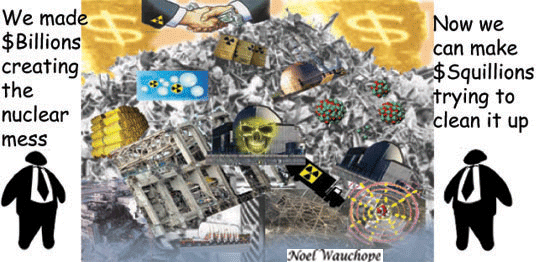
US Nuclear Site Cleanup Underfunded By Up To $70 Billion, Clean Technica, December 1st, 2020 by Michael Barnard …………………..Nuclear power is going to be the gift that keeps on returning fiscal dividends for a century.
That’s why Brookfield bought the bankrupt Toshiba Westinghouse division, for the long-term, guaranteed decommissioning revenue. SNC Lavalin bought Canada’s CANDU for the same reason, although I’m sure they are at the trough on the Canadian SMR idiocy too. This isn’t exactly a secret. Nuclear projects always go over budget and over schedule, and there is exactly zero reason to believe decommissioning estimates provided by the industry. So why have jurisdictions been building more nuclear plants, whether at the egregious but at least honest costs of Hinkley, or the massively underestimated but increasingly obvious costs of the Virgil C. Summer and Vogtle sites? Three reasons. The first is the magic of net present value. That calculates the value of future dollars today given inflation. Just as a thousand bucks bought a lot more in 1990 than it does today, in 2050 it will buy a lot less than it does today. That means that liabilities that will be incurred decades in the future approach zero cost in today’s cost benefit analysis. Can you say generational inequity? The second is ideology. When really blatantly obvious economic sense gets thrown out the window, you start looking around for irrationality or graft. A lot of conservatives really hate onshore wind because it spoils the views from their manses (UK) or ranches (US) or country estates (Oz). They also think of wind and solar as inadequate hippy shit. They think nuclear is the answer. These are opinions that they formed in the 1970s or perhaps the 1980s, but conservatives have a stronger tendency to not let empirical reality change their mind. So Hinkley, Vogtle, and Summer are a triumph of ideology over reality. The third is graft. When we start talking about $10 billion or more to build a plant, billions in subsidies, and another billion to take the thing apart, a lot of people start rubbing their hands together and figuring out who they have to bribe now to get a big payoff later. The entire regulatory structure in the two states that had nuclear plants in construction until recently when one was finally put out of the state’s fiscal misery were both structured so that no matter how much the utility spent, it was guaranteed a set profit. If they built a $15 billion nuclear plant, they made a lot of profit off of the rate payers. If they built $2 billion worth of wind and solar instead, they made a lot less money off of the rate payers. It’s dumb as a box of hammers, but it’s part of the reason a lot of utilities love nuclear, and coal-generation carbon capture schemes to boot. They are licenses to print money. Outside of China, where they have trained resources who can build nuclear plants who would be mediocre at building wind and solar (which they are building a lot more of) and nuclear plants will displace coal plants, it doesn’t make a lot of sense to build new nuclear. The looming decommissioning debacle is just the icing on the cake. Wind and solar have proven themselves to be vastly cheaper, completely reliable on grids, and easy to integrate in very large amounts. Their decommissioning costs are trivial. That’s yet another reason why nuclear is dead, but pretending it’s not. https://cleantechnica.com/2020/12/01/us-nuclear-site-cleanup-underfunded-by-up-to-70-billion/ |
“……….
|
UK’s projected high electricity costs for Hinkley nuclear project – a warning for Egypt
for electricity generated by the El Dabaa plant that Russia’s state-owned
Rosatom is building in Egypt.
predicted that prices per megawatt hour – how much it costs to produce one
megawatt of energy for one hour – from El Dabaa would be at least four
times more than from renewable power sources. Renewable energy prices have
fallen significantly since 2016, while nuclear power has become more
expensive.
from the Hinkley Point C nuclear power station that EDF is building for
decades after the plant is completed. While construction does not follow
the Build-Own-Operate model, EDF negotiated a 35-year power purchase price
linked to inflation with the British government in 2016 to extract as much
profit as possible. The British government’s Public Accounts Committee
conservatively estimated that this deal will cost consumers an additional
$40 billion (about R615 billion) over the 35 years of the contract compared
with alternative energy sources such as solar and wind.https://allafrica.com/stories/202012010852.html
£132billion and counting – Britain’s nuclear decommissioning mess could take 120 years

UK taxpayers foot huge bill for the incompetence of The Nuclear Decommissioning Authority (NDA)
 UK’s nuclear sites costing taxpayers ‘astronomical sums’, say MPs
Public accounts committee says ignorance, incompetence and weak oversight to blame, Guardian, Damian Carrington Environment editor @dpcarrington Fri 27 Nov 2020 The Nuclear Decommissioning Authority (NDA) has a perpetual lack of knowledge about the state and location of waste on the 17 sites it is responsible for making safe, a powerful committee of MPs has found.
This results from decades of poor record keeping and weak government oversight, the MPs said. Combined with a “sorry saga” of incompetence and failure, this has left taxpayers footing the bill for “astronomical sums”, they said.
The NDA acknowledges that it still does not have full understanding of the condition of its sites, including 10 closed Magnox stations from Dungeness in Kent to Hunterston in Ayrshire, the MPs report said.
The NDA’s most recent estimate is that it will cost current and future generations of UK taxpayers £132bn to decommission the civil nuclear sites, with the work not being completed for another 120 years.
Since 2017, the NDA’s upper estimate of the cost of the 12-15-year programme just to get the sites to the ”‘care and maintenance” stage of the decommissioning process has increased by £3.1bn to £8.7bn. “Our past experience suggests these costs may increase further,” said the MPs’ report.
The lack of knowledge of the sites was a significant factor in the failure of a 2014 contract the NDA signed with a private sector company to decommission the Magnox sites. The government was forced to take back the contract in 2018 and the botched tender has now cost taxpayers £140m, the MPs found.
Sir Geoffrey Clifton-Brown, deputy chair of the public accounts committee (PAC), said: “Although progress has been made since our [2018] report, incredibly, the NDA still doesn’t know even where we’re currently at, in terms of the state and safety of the UK’s disused nuclear sites. Without that, and after the Magnox contracting disaster, it is hard to have confidence in future plans or estimates.” ……….
The UK has eight operating nuclear power plants, with all but one due to retire in the next decade. Only one new plant is being built, at Hinkley Point in Somerset, and it is years behind schedule and billions over budget.
Despite recent speculation over another new plant being given the go-ahead at Sizewell in Suffolk, Boris Johnson failed to announce this in his green industrial revolution plan last week. The government’s new national infrastructure strategy, published on Wednesday, said: “The government is pursuing large-scale nuclear projects, subject to clear value for money for both consumers and taxpayers.”
In 2015, the government stripped another private consortium of a £9bn contract to clean up the nuclear waste site at Sellafield. The company had been heavily criticised for its executives’ expense claims which included a £714 bill for a “cat in a taxi”. https://www.theguardian.com/environment/2020/nov/27/uks-nuclear-sites-costing-taxpayers-astronomical-sums-say-mps#_=_
British MP’s continue to botch in the ever more costly saga of Britain’s “old” nukes and “new” nukes
Times 27th Nov 2020, The NDA doesn’t really know because, as it told MPs, it “still does not have full understanding of the condition of the 17 sites”. It’s a point it proved with the meltdown of the £3.8 billion Magnox clean-up contract wrongly awarded to the Cavendish Fluor Partnership in 2014. That fiasco saw a High Court judge rule that the losing bidder, Energy Solutions and its partner, Bechtel, should have won the 14-year contract to bring the plants to a state of “care and maintenance”. The upshot? The government terminated the contract at a cost to the taxpayer of £142 million.
And now it’s back in the hands of the NDA, which is telling MPs that even that bit of work will now cost up to £8.7 billion and take another “12 to 15 years”. As the committee notes: “Past experience with the NDA suggests even these estimates will soon be out of date and costs may increase further”.
Isn’t that the story of everything to do with nuclear? True, you’d expect new-build plants to be better managed than Magnox and less
tricky to decommission than the Sellafield complex. The NDA also rejects the committee’s “suggestions that we may not understand the safety of our sites”. And the taxpayer-fleecing cost of the electricity coming from the £22.5 billion Hinkley Point C is meant to cover the clean-up bill.
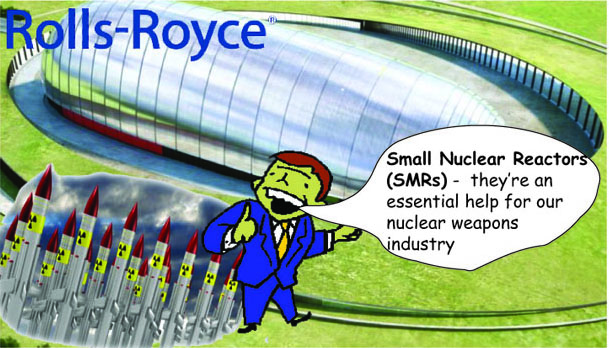 Yet before Boris presses the go button on more nukes, including Rolls-Royce’s modular type, shouldn’t there be a debate about the waste? The government’s big idea is to bribe some local authority into housing a nice toxic dump, prettily dressed up as a “geological disposal facility”. Copeland in Cumbria is the closest to volunteering. But a deal is a long way off and the plan’s been vetoed before by Cumbria county council.
https://www.thetimes.co.uk/edition/business/nuclear-clean-up-bill-needs-scrutiny-h7c3xcz27
Depressing news for the nuclear lobby in Western Europe
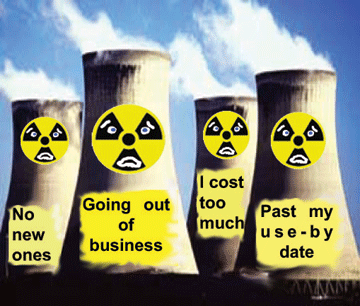 Western Europe cools on plans for nuclear power https://climatenewsnetwork.net/western-europe-cools-on-plans-for-nuclear-power/, November 25th, 2020, by Paul Brown As more reactors face closure, governments in Europe may prefer renewable energy to replace nuclear power.
LONDON, 25 November, 2020 – News that two more reactors in the United Kingdom are to shut down on safety grounds earlier than planned has capped a depressing month for nuclear power in Europe.
The news came after weeks of unfounded speculation, based on “leaks”, that the British government was about to take a stake in a giant new French-designed nuclear power station planned at Sizewell in Suffolk on the east coast of England as part of a “Green New Deal.” Taxpayers’ backing would have enabled the heavily-indebted French company EDF to finance the project.
In the event Boris Johnson, the prime minister, in his 10-point “green” plan for the UK, boosted a far more speculative alternative scheme from a Rolls-Royce consortium which was helping to pay for research and development into a full-blown proposal to construct 16 small modular reactors (SMRs).
He failed to mention the Sizewell scheme at all, and instead of singing the praises of nuclear power extolled the virtues of offshore wind power, in which the UK is currently the world leader.
Johnson hopes that offshore wind will produce enough electricity to power every home in Britain, leaving little room for a nuclear industry. He has referred to the UK as “becoming the Saudi Arabia of wind power.”
Meanwhile across the English Channel in Belgium the Electrabel company – the Belgian subsidiary of French utility Engie – has cancelled any further planned investment in its seven-strong nuclear reactor fleet because of the government’s intention to phase out nuclear power by 2025.
“The cause of this damage [at Hunterston] is not fully understood, and it is entirely possible that this form of age-related damage may be much more extensive”
Plans will only be re-instated if a Belgian government review fails to find enough alternative electricity supply to replace the reactors’ output. The seven Belgian reactors currently produce half the country’s electricity supply.
These reversals come seven years after British governments promised a nuclear renaissance by encouraging French, Japanese, American and finally Chinese companies to build ten nuclear power stations in the UK. Only one station has been begun, a £22 billion (US$29 bn) joint venture between EDF and Chinese backers.
The French, with a 70% stake and the Chinese with 30%, began work on the twin reactors, to be known as Hinkley Point C, in Somerset in the West of England more than two years ago. The station was due to be completed in 2025, but is behind schedule and has cost overruns.
The two partners wanted to replicate these reactors at the planned Suffolk plant, Sizewell C, but EDF has not found the necessary capital to finance it, hoping that the London government would either take a stake or impose a nuclear tax on British consumers to help pay for it.
The idea was for Hinkley Point C and Sizewell C to replace the 14 smaller reactors that EDF owns in Britain, thus keeping the nuclear industry’s 20% share of the UK’s electricity production. Johnson appears to have dashed these hopes. At best Hinkley Point C will produce 7% of the nation’s needs.
Meanwhile there is a question mark over the future of EDF’s remaining reactor fleet in Britain. Two of the 14, also at the Sizewell site, are French-designed pressurised water reactors opened in 1991, and have plenty of life left in them, but the other 12 are all older British-designed advanced gas-cooled reactors (AGRs) that use graphite blocks to control nuclear reactions.
Premature closure
A serious safety flaw has emerged in this design, involving hundreds of cracks in the graphite, causing doubts over whether the reactors could be turned off quickly in an emergency.
After a long stand-off with the UK’s nuclear safety watchdog, the Office for Nuclear Regulation, EDF decided earlier this year to prematurely close two of the worst affected reactors – both in a station known as Hunterston B in Scotland. Now, for the same reason, two further reactors at Hinkley Point B in Somerset will also close. All four reactors will be defuelled in 2022.
Currently six of these 12 AGR reactors are turned off – out of service for maintenance or safety checks. Two of them, at Dungeness B on the south-east coast of England, have been undergoing repairs since 2018 – this time because of corrosion of vital pipework – although cracks in the graphite blocks are also a safety issue here too.
While EDF remains upbeat about its prospects in developing nuclear power and is keeping its remaining ageing AGR reactors going until they can be replaced, it is hard to see where the company will get the money to build a new generation of reactors or attract government subsidies to do so.
The UK’s decision to back the British company Rolls-Royce to develop SMRs means it is unlikely the government has the money or the political inclination to back the French as well.
Rolls-Royce has been badly hit by the Covid-19 pandemic because a large part of its business relies on the struggling aviation business, while it needs support because it makes mini-reactors to power British nuclear submarines. The proposed SMR research programme will allow nuclear-trained personnel to switch between military and civilian programmes.
Long out of office
The Rolls-Royce SMRs are a long shot from the commercial point of view, since they  are unproven and likely to be wildly expensive compared with renewable energy. However, they have the political advantage of being British, and their development lies so far into the future that the current government will be out of office before anyone knows whether they actually work or are economic.
As far as the current crop of reactors is concerned, it is clear that at least those with graphite cores are nearing the end of their lives. Nuclear power has some way to go before it can expect a renaissance in the UK.
Paul Dorfman is a research fellow at University College London. He told the Climate News Network: “It is  apparent that the graphite cores of Hunterston B, Hinkley B, and possibly all UK AGR reactors have developed and continue to develop significant structural damage to graphite bricks, including keyway cracks in the fuelled section of the reactor.
“It is also clear that the cause of this damage is not fully understood, and it is entirely possible that this form of age-related damage may be much more extensive.
“Given that weight loss in graphite blocks and subsequent graphite cracking occurs in all UK AGRs, what’s happening with Hunterston B has significant implications for the entire UK AGR fleet.
Dr Dorfman concluded: “Given the parlous finances of EDF, who are already struggling with their own reactor up-grade bills in France, it is entirely likely that UK nuclear generation will be reduced to just Sizewell B, with electricity generation relying almost entirely on renewables by the time Hinkley C comes online, very late and over-cost as usual.” – Climate News Network
European Commission approves Romania’s purchase of nuclear reactors
 EU blesses Romania’s $8bn US nuclear deal https://www.globalconstructionreview.com/news/eu-blesses-romanias-8bn-us-nuclear-deal/ 25 November 2020 | By GCR Staff EU blesses Romania’s $8bn US nuclear deal https://www.globalconstructionreview.com/news/eu-blesses-romanias-8bn-us-nuclear-deal/ 25 November 2020 | By GCR Staff
The European Commission has approved an agreement between the governments of the US and Romania to add two reactors to the Cernavoda nuclear power plant, ending longstanding plans to enlist Chinese aid in the project.Ludovic Orban, the prime minister of Romania, announced the endorsement on Friday. “We are delighted that we received this agreement from the Directorate of Energy, which will allow us to sign the agreement in the final form,” he said. Romania and the US signed an intergovernmental agreement in October for an $8bn programme of works to refurbish reactor 1 and build reactors 3 and 4 at the Black Sea plant (see further reading). The two also agreed a memorandum of understanding whereby America’s Export-Import Bank would provide $7bn of loans for the development of nuclear and related projects. In 2013 Romania and China signed two agreements that assigned China General Nuclear (CGN) a leading role in building and financing the reactors. This was followed by a deal in May 2019 between Romania’s state nuclear company Nuclearelectrica and CGN to build two 700MW reactors. Romania changed course at the start of this year as the Trump administration intensified its criticisms of China. The project will be coordinated by Aecom and will involve a consortium of companies from the US, Romania, Canada, and France to install two Canadian Candu 6 reactors. Romania and France have signed a declaration of intent on civil nuclear cooperation, and Orano, a state-owned French engineer, has also agreed to work with Nuclearelectrica on the project. |
|
UK government losing enthusiasm for new nuclear power stations, as grim financial realities set in
|
The government’s latest thinking on how to replace its aging fleet of nuclear plants marks a dramatic shift from 2013, when David Cameron agreed to funding for new reactors at the Hinkley Point site with support from China. Since then, relations with China have deteriorated, electricity demand slumped and renewables such as wind and solar farms became much cheaper than new atomic plants……
|
|
Standard nuclear designs are still too costly, and safety features are only a third of nuclear costs.
Ars Technica 21st Nov 2020, Should any discussion of nuclear power go on for long enough, it becomes inevitable that someone will rant that the only reason they’ve become unaffordable is a proliferation of safety regulations. The argument is rarely (if ever) fleshed out—no specific regulation is ever identified as problematic, and there seems to be no consideration given to the fact that we might have learned something at, say, Fukushima that might merit addressing through regulations.
But there’s now a paper out that provides some empirical evidence that safety changes have contributed to the cost of building new nuclear reactors. But the study also makes clear that they’re only one of a number of factors, accounting for only a third of the soaring
costs. The study also finds that, contrary to what those in the industry seem to expect, focusing on standardized designs doesn’t really help matters, as costs continued to grow as more of a given reactor design was built.
Ohio likely to require nuclear reactor audit before renewing bailout
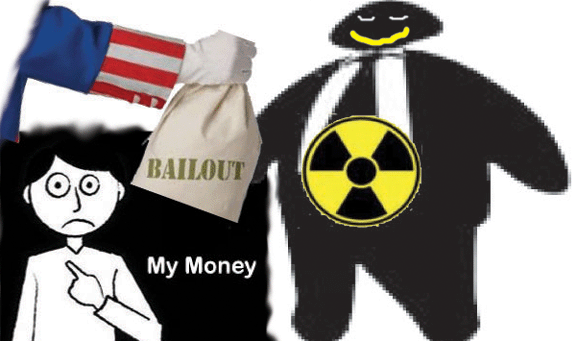 Ohio likely to require nuclear reactor audit before renewing bailout -analysts https://uk.reuters.com/article/instant-article/idUKL1N2I61D0 Banking and Financial News Scott DiSavino, NEW YORK, Nov 20 (Reuters) – Ohio’s legislature will likely require the owner of two nuclear power reactors to prove they need financial assistance to remain in service following a bribery scandal related to passage of the state’s 2019 nuclear bailout, analysts said on Friday.FirstEnergy Corp lobbied state officials to provide more than $1 billion to fund the continued operation of its Davis-Besse and Perry reactors. Ohio likely to require nuclear reactor audit before renewing bailout -analysts https://uk.reuters.com/article/instant-article/idUKL1N2I61D0 Banking and Financial News Scott DiSavino, NEW YORK, Nov 20 (Reuters) – Ohio’s legislature will likely require the owner of two nuclear power reactors to prove they need financial assistance to remain in service following a bribery scandal related to passage of the state’s 2019 nuclear bailout, analysts said on Friday.FirstEnergy Corp lobbied state officials to provide more than $1 billion to fund the continued operation of its Davis-Besse and Perry reactors.
The Ohio reactors are now owned by Energy Harbor, which emerged from the bankruptcy of FirstEnergy’s FirstEnergy Solutions unit in February. The reactors likely still need financial help to keep operating. FirstEnergy was not alone in seeking state funding for its reactors. Nuclear plants in Illinois, New York, New Jersey and Connecticut also received subsidies in recent years. n Ohio, however, the U.S. Federal Bureau of Investigation (FBI) arrested Larry Householder, Speaker of the Ohio House of Representatives, in July, alleging bribery related to the passage of the state’s nuclear subsidy law, known as House Bill 6 (HB6). In an effort to undue damage done by the scandal, Ohio politicians have proposed new legislation that could remove or reduce the nuclear subsidies in HB6. “Ultimately, the subsidies may be reduced following the audit but we are skeptical they’ll go to zero when all is said and done,” said Josh Price, senior analyst at Height Capital Markets. FirstEnergy shares fell over 3% on Friday to their lowest since September. Earlier this week, the FBI also raided a home owned by Sam Randazzo, chairman of the Public Utilities Commission of Ohio (PUCO). Randazzo resigned on Friday, according to the state governor’s office. Officials at the PUCO had no comment. Energy Harbor was not immediately available for comment. FirstEnergy said its “Board will continue to take decisive action to address this matter,” noting it is in the “best interest” of Ohio and the nation to maintain clean and reliable nuclear power. Reporting by Scott DiSavino Editing by Marguerita Choy |
UK government’s plans for Sizewell and Wylfa nuclear stations are wavering, with doubts about costs
 Carbon Brief 18th Nov 2020, Media reaction: Boris Johnson’s ‘10-point’ net-zero plan for climatechange. In the lead up to the plan, expectations were running high for a major announcement on nuclear power, after weeks of stories about a “green light” for the Sizewell C plant and Rolls-Royce planning to build up to 16 mini-nuclear plants. In an article published at the start of November, the i newspaper said “Johnson…is expected to commit to building a new nuclear power station at Sizewell in Suffolk”. Carbon Brief 18th Nov 2020, Media reaction: Boris Johnson’s ‘10-point’ net-zero plan for climatechange. In the lead up to the plan, expectations were running high for a major announcement on nuclear power, after weeks of stories about a “green light” for the Sizewell C plant and Rolls-Royce planning to build up to 16 mini-nuclear plants. In an article published at the start of November, the i newspaper said “Johnson…is expected to commit to building a new nuclear power station at Sizewell in Suffolk”.**************
The Daily Mail’s Ruth Sunderland said new nuclear will “have to be” part of the UK’s energy mix and suggested that Johnson was posed to give approval to the new Sizewell facility, despite opposition “by protesters who say it threatens ecology and wildlife”. The reality was less specific. The plan included a fund of £525m “to help develop large and smaller-scale nuclear plants, and research and develop new advanced modular reactors”, but did not mention a specific project.
**************
A government consultation last year concluded that the UK “will…require” new nuclear power to meet its
net-zero emissions target. An analysis by environment correspondent Fiona Harvey in the Guardian noted that with proposals for new nuclear in the UK from Sizewell to Wylfa wavering “if the government wishes to expand nuclear power, it will have to prove that it can be economical”.https://www.carbonbrief.org/media-reaction-boris-johnsons-10-point-net-zero-plan-for-climate-change |
Britain’s enthusiasm for nuclear power stations is waning.
Bloomberg 20th Nov 2020, Britain’s ambition to renew its aging fleet of nuclear power plants is losing momentum after the government offered few new details on how it will support additional projects. Prime Minister Boris Johnson’s
administration set aside 500 million pounds ($661 million) for small modular reactor projects but was silent on support for traditional
large-scale plants.
The issue gained urgency on Thursday as Electricite de France SA’s announced the closure of its Hinkley Point B reactors two
years early. The government’s latest thinking on how to replace its aging fleet of nuclear plants marks a dramatic shift from 2013, when David Cameron agreed to funding for new reactors at the Hinkley Point site with support from China. Since then, relations with China have deteriorated, electricity demand slumped and renewables such as wind and solar farms became much cheaper than new atomic plants.
https://www.bnnbloomberg.ca/nuclear-power-pushed-to-back-burner-in-u-k-s-green-energy-plan-1.1525271
Bankrupt AREVA, resuscitated as ‘Framatome’, joins the the Sizewell C nuclear build Consortium
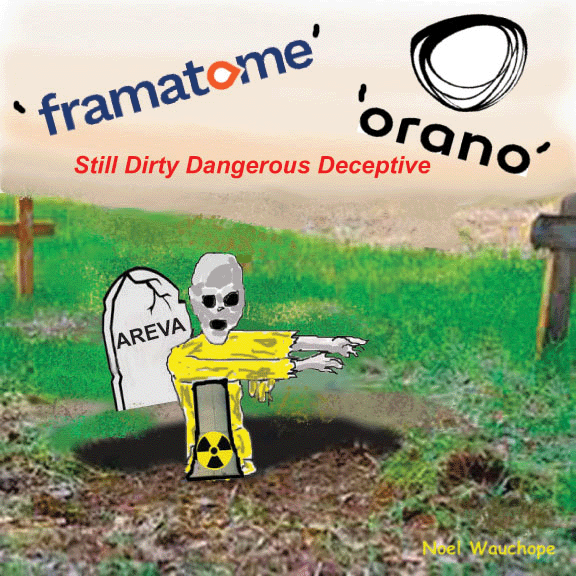
companies and organisations from across the UK working to design, supply
and construct the proposed nuclear power station in Suffolk, England.
Consortium, we are engaging new partnerships with British companies and
suppliers to support lifetime management of the country’s existing
nuclear facilities and new build projects,” said Marc Duret, managing
director of Framatome in the UK.
https://www.neimagazine.com/news/newsframatome-joins-sizewell-c-consortium-8368345
Russia and the United States Nuclear Industry
Trump’s Impact on Nuclear Proliferation, Treating Foreign Policy as a Business, Just Security, by Tamsin Shaw, November 18, 2020 “…………….Russia and the United States Nuclear Industry
It’s only relatively recently that the public and private U.S. institutions have begun to examine seriously the intricate financial network that lies behind and links Russian nuclear business dealings in the United States. Public perception of these dealings has been dominated by the false Uranium One conspiracy theory. This distraction has diverted attention from the extent to which Russia has established a strong foothold in the US nuclear industry in a way that suggests an aspiration to vertical control.
The grain of truth in the Uranium One story is that in 2010 Canadian company Uranium One, which was responsible for mining 20% of the currently licensed uranium in the United States, made an agreement with JSC Atomredmetzoloto, or ARMZ, the mining arm of Rosatom, giving them a controlling stake (51%). In 2013 Rosatom acquired full ownership. Uranium One continues to mine approximately 10% of that licensed in-situ uranium.
The United States also relies, both for civilian utilities and defense purposes, on nuclear fuel supplied by Russian subsidiary of Rosatom called Techsnabexport (TENEX). No U.S. uranium enrichment facilities are currently in operation. The U.S. company, Centrus has a new centrifuge design but it will likely be over a decade before it goes into action.
Nor does the United States currently have a company that builds commercial nuclear reactors. The only U.S. company now aiming to construct them is Bill Gates’s TerraPower, which is working on what will likely be the next generation of reactors, small modular reactors (SMRs), but again these won’t be commercially viable for a decade. Commercial nuclear reactors were previously designed and built by US company Westinghouse. But on March 24, 2017, Westinghouse declared Chapter 11 bankruptcy. The sale of that company naturally has serious national security implications. But the story of the sale and of the role that the Trump administration played in it raises many questions.
Trump’s friend and adviser, Tom Barrack, seized on the opportunity presented by the Westinghouse bankruptcy to put together a new version of the Marshall Plan for the Middle East, producing his own document setting out the details. In his March 2017 white paper, Barrack refers to the plan interchangeably as the “Trump Marshall Plan” and the “Trump Plan.” The July 2019 House Oversight and Reform Committee report details the ambitious deal Barrack tried to put together to purchase Westinghouse. Barrack had permission from the highest levels at the White House for a US-led consortium involving Colony Capital, IP3, and financial firms Blackstone and Apollo. Barrack assured Blackstone CEO Steve Schwartzman,
Our GCC [Gulf Cooperation Council] allies in Saudi Arabia and the UAE have committed to invest in the Westinghouse acquisition and are willing to concurrently lock in Westinghouse as the primary partner on the 30+ reactors expected to be constructed in their countries in the coming decade.
IP3 officials were very optimistic. President Trump and Jared Kushner had met with MBS on March 14, and IP3 boasted that this meeting prepared the way for a “partnership to acquire Westinghouse between IP3 and Saudi Arabia.” They eagerly arranged meetings with officials in the administration to promote the plan, including then-CIA Director Mike Pompeo, Director of the National Economic Council Gary Cohn, and top National Security Council (NSC) Staff officials. They also briefed Jared Kushner.
But in January, 2018 it was announced that Canadian company, Brookfield Business Partners, a subsidiary of investing giant Brookfield Asset Management, would purchase Westinghouse. And Westinghouse promptly and unilaterally decided to sever ties with IP3. ProPublica discovered that Kushner was the one who prevented the IP3-led deal from happening, reporting that Kushner “wanted to table the nuclear question in favor of simpler alliance-building measures with the Saudis, centered on Trump’s visit in May, according to a person familiar with the discussions.”
The Westinghouse sale went through on August 1, 2018. Three days later it was announced that Brookfield Properties, another subsidiary of Brookfield Asset Management that had just purchased Westinghouse, would buy Jared Kushner out of his catastrophic real estate deal involving 666 Fifth Avenue.
Who Owns Westinghouse?
The Westinghouse purchase was naturally considered an extremely sensitive deal, deserving scrutiny by the Committee on Foreign Investment in the United States (CFIUS), which at the time included Steve Mnuchin, Rex Tillerson, Jeff Sessions, Wilbur Ross and Dan Coats. The committee approved the transaction but with a Nuclear Regulatory Committee (NRC) Requirements Notice forbidding transfer of their licenses and insisting on compliance with all applicable statutory and regulatory requirements. But the NRC filing submitted to CFIUS is fairly thin. It tells us that Westinghouse would be “ultimately controlled” by Brookfield Asset Management, but little about the money behind the deal. According to their 2018 20-F annual report, BBU acquired 44% of the company, while having a 100% voting interest, having put in $405m of equity totaling $920m, with the balance coming from “institutional partners.” The rest of the purchase price was funded with approximately $3b of long-term debt financing. The sources of the equity and financing aren’t disclosed.
Immediately prior to the Westinghouse sale, prominent foreign policy experts Thomas Duesterberg and William Schneider wrote an article expressing serious concerns about the opacity………….https://www.justsecurity.org/73422/trumps-impact-on-nuclear-proliferation/
£525 million pledged to build UK small nuclear reactors, no funding package yet revealed for £20 billion Sizewell plant
Times 18th Nov 2020. A total of £525 million has been pledged “to help develop large and
smaller-scale nuclear plants, and research and develop new advanced modular
reactors”. However, there is no word as yet on a funding package to
support the proposed £20 billion new nuclear plant at Sizewell in Suffolk.
1 This Month



26 September – International Day for the Total Elimination of Nuclear Weapons


PLEASE OPPOSE HR 8255 AND S.3639 – bills would accelerate satellite deployment, with no environmental review or safeguards – https://ncstd5li.quorum.us/campaign/169331/
To see nuclear-related stories in greater depth and intensity – go to https://nuclearinformation.wordpress.com
-
Archives
- September 2026 (257)
- August 2026 (330)
- July 2026 (355)
- June 2026 (287)
- May 2026 (306)
- April 2026 (356)
- March 2026 (251)
- February 2026 (267)
- January 2026 (308)
- December 2025 (358)
- November 2025 (359)
- October 2025 (375)
-
Categories
- 1
- 1 NUCLEAR ISSUES
- business and costs
- climate change
- culture and arts
- ENERGY
- environment
- health
- history
- indigenous issues
- Legal
- marketing of nuclear
- media
- opposition to nuclear
- PERSONAL STORIES
- politics
- politics international
- Religion and ethics
- safety
- secrets,lies and civil liberties
- spinbuster
- technology
- Uranium
- wastes
- weapons and war
- Women
- 2 WORLD
- ACTION
- AFRICA
- Atrocities
- AUSTRALIA
- Christina's notes
- Christina's themes
- culture and arts
- Events
- Fuk 2022
- Fuk 2023
- Fukushima 2017
- Fukushima 2018
- fukushima 2019
- Fukushima 2020
- Fukushima 2021
- general
- global warming
- Humour (God we need it)
- Nuclear
- RARE EARTHS
- Reference
- resources – print
- Resources -audiovicual
- Weekly Newsletter
- World
- World Nuclear
- YouTube
-
RSS
Entries RSS
Comments RSS
 nuclear-news