Unprecedented number of France’s nuclear reactors to go offline, and strikes continue.
From Feb. 6, six French reactors will have started 2021 maintenance, with five more to come this month, an unprecedented 11 reactors starting maintenance before March.
Reactors set for 10-year overhauls in 2021…………
S&P Global Platts Analytics assumes February output to average around 46 GW, a new record low for that month, before recovering above last year’s monthly averages………
wo strikes, an incident at Paluel and a return to milder and at times windy weather affected nuclear output in the second half of January.
Strikes continue
Another 24-hour strike was scheduled to start Feb. 9 at 2000 GMT, EDF said on its transparency website Feb. 4.
EDF workers are protesting against planned restructuring of the French state-owned utility, splitting nuclear and other operations.
Ongoing discussions with the European Commission about the details of the planned reform of the ARENH price mechanism have delayed a first presentation of those plans envisaged in January.
EDF currently has to sell 100 TWh of nuclear generation at Eur42/MWh to domestic suppliers.
The reform aims to lift prices as well as volumes………. https://www.spglobal.com/platts/en/market-insights/latest-news/electric-power/020521-french-nuclear-retreats-from-12-month-high-amid-early-start-to-2021-maintenance
How the nuclear industry will try to avoid decommissioning costs
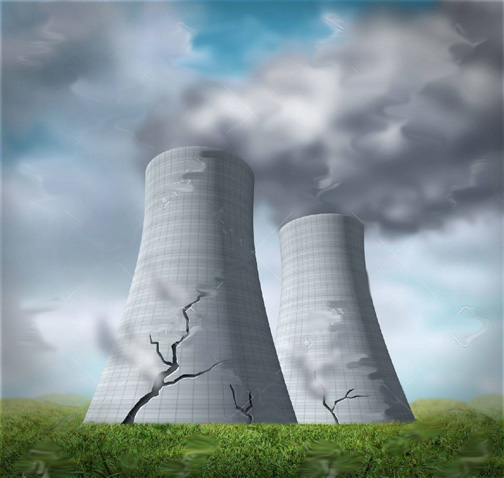
They want to renew reactor licenses. It’s not just for their immediate survival – it’s also to take attention away from the astronomic costs of decommissioning nuclear reactors, and to avoid those cosrs during their lifetime (the lifetime of the companies, not the reactors).
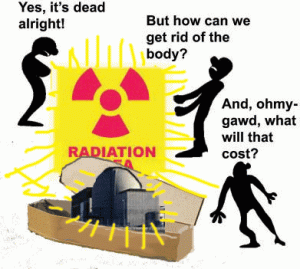
Nuclear has another friend in Biden, but changes at the NRC could mean more scrutiny ahead, Utility Dive . 1 Feb 21, Matthew Bandyk ”’……………Subsequent license renewal
A top priority of the nuclear industry continues to be extending the lifetime of existing nuclear plants, a necessary step to maintain nuclear power’s position as a major source of electricity generation. Many reactors have retired for economic reasons, with several more expected to close in 2021, and the construction of new reactors to replace them remains a herculean task.
Over the past several years the NRC started accepting applications from nuclear plants to remain open for 80 years. The commission is also considering whether it should begin developing a framework for licensing plants to run for up to 100 years, holding the first public meeting on that topic on Jan. 21.
No U.S. nuclear plant had ever been licensed to operate beyond 60 years until Florida Power & Light’s Turkey Point reactors received a second license renewal from the NRC at the end of 2019, allowing operation for 80 years. Exelon’s Peach Bottom plant in Pennsylvania got permission to operate up to 80 years a few months later. These approvals came despite objections from environmental groups that the NRC was failing to do its duty by not requiring these plants to undergo more extensive reviews of the potential environmental and safety risks from 80 years of operation.
The NRC rejected a challenge to the Turkey Point relicensing process filed by the Natural Resources Defense Council and Friends of the Earth. Baran dissented, saying the commission should evaluate the groups’ position that Turkey Point cannot rely on a review of the environmental impacts of relicensing the reactors that was from 2013 and not specific to the site, and that the plant must instead perform a new review.
NRDC and Friends of the Earth have appealed the NRC’s decision on Turkey Point, and that challenge is currently pending before the U.S. Court of Appeals for the D.C. Circuit.
The nuclear watchdog group Beyond Nuclear brought a similar challenge against the Peach Bottom relicensing, and Baran once again dissented when the NRC released its order in November 2020 rejecting the group’s claim, but this time, he was joined by Hanson, who had been appointed to the commission after the Turkey Point decision.
The dissent of Baran and Hanson “conveys that a Democratically-led commission is at least more open to taking the hard looks at these license extensions that [the National Environmental Policy Act] demands,” said Paul Gunter, reactor oversight project director at Beyond Nuclear. A “hard look” would mean performing new environmental assessments of issues related to the aging of a nuclear plant, such as whether components of the plant have been embrittled by exposure to radiation over the course of decades, according to Gunter.
Dominion’s North Anna and Surry reactors in Virginia are next in line to potentially receive 80-year licenses. In addition, last November, NextEra Energy applied for license extensions up to 80 years for both of its reactors at the Point Beach plant in Wisconsin, and Duke Energy has told the NRC it intends to apply for similar extensions for the three reactors at its Oconee plant in South Carolina later this year. …………….. https://www.utilitydive.com/news/nuclear-has-another-friend-in-biden-but-changes-at-the-nrc-could-mean-more/593609/
Britain’s unaffordable nuclear power plans collapse, one by one
 Times 31st Jan 2021, Nuclear winter for Britain as power plants close. Hinkley Point is last man standing as other power stations are scrapped. Hitachi president Hiroaki Nakanishi had a grand dream when
the Japanese giant paid £696 million for the right to build two nuclear power stations in the UK. “Today starts our 100-year commitment to the UK and its vision to achieve a long-term, secure, low- carbon and affordable energy supply,” declared Nakanishi in 2012, as he signed a deal to buy the Horizon nuclear project from Germany’s RWE and Eon.
particularly when they are the first of a new design. Theresa May’s government eventually offered to take a third of the equity in Horizon alongside the Japanese government and Hitachi. Boris Johnson’s administration is exploring a new financial model, the regulated asset base, where investors could earn a return during construction.
that had begged Hitachi to grant the project a reprieve, executive Toshikazu Nishino said that it had not received adequate backing from government.
https://www.thetimes.co.uk/article/nuclear-winter-for-britain-as-power-plants-close-gb8c5dx07
Why nuclear power is a bad way to balance renewable energy
Why nuclear power is a bad way to balance renewable energy https://100percentrenewableuk.org/why-nuclear-power-is-a-bad-way-to-balance-renewable-energy
David Toke, Ian Fairlie and Herbert Eppel from 100percentrenewableuk discuss how nuclear power effectively switches off wind and solar power and how a 100percent renewable energy system is much better for the UK than one involving nuclear power
The Government, backed by a lot of public policy reports paid for by pro-nuclear interests, constantly pushes out the view that nuclear power is ‘essential’ to balancing wind and solar power.
But what they never mention is the massive waste of renewables that occurs in such a scenario.
Under the scenarios planned by the Government nuclear power is paid very high prices to generate power even when there is excess electricity, which pushes renewables to close down.
The Government also refuses to undertake serious investigations of how a system that uses excess renewables to create short and long term storage is a much better way of organising our energy needs rather than wasting more money on building nuclear power statitons.
If you agree the aims of 100percentrenewableuk please join the discussion via our email group.
Half a £billion here, half a £billion there – the costs of Hinkley Point C go up again
 NFLA 28th Jan 2021, Half a billion here, half a billion there – the costs of Hinkley Point C
go up again, just as Hitachi finally gives up on Wylfa B.
The UK & Ireland .Nuclear Free Local Authorities (NFLA) note with little surprise the announcement from EDF Energy that the costs of building the Hinkley Point C has gone up again, now to an eye-watering £23 billion.
It also comes as the Japanese nuclear utility Hitachi formally withdraws its interest from the possible development of the Wylfa B site, criticising the UK Government’s lack of support in its decision.
https://www.nuclearpolicy.info/news/costs-hinkley-point-c-up-again-hitachi-finally-gives-up-wylfa-b/
It is all over for Britain’s £20bn Wylfa nuclear project

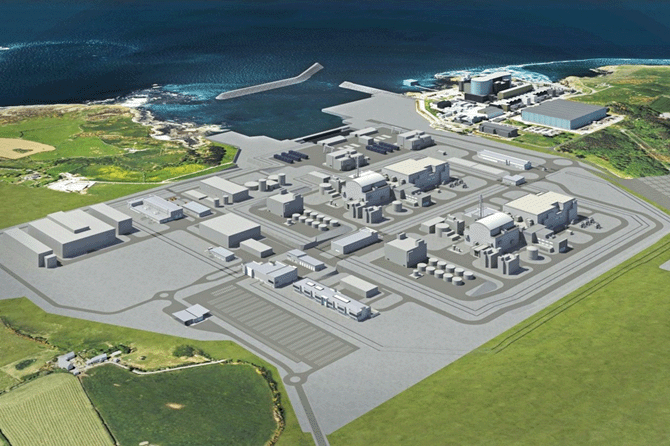 Wylfa: End for £20bn nuclear plant bid as plans ditched, It is all over for the £20bn project to build a new nuclear power plant on Anglesey, after developers dropped their planning bid.
Horizon Nuclear Power has pulled a request to approve reactor designs at Wylfa, blaming UK government funding options as one reason.
Japanese backers Hitachi pulled out of the development last September.
Another firm has since unveiled plans for a smaller hybrid nuclear and wind plant on a separate site at Wylfa.
The Development Consent Order (DCO) process, which is the name given to planning applications for major UK infrastructure projects such as Wylfa, has been under consideration since June 2018.
A decision was due to be made on the plan by the UK’s business and energy secretary at the end of April, following a series of requests by Horizon to extend the process while it held talks with other interested parties.
But Horizon has now written to the Planning Inspectorate and the Department for Business, Energy and Industrial Strategy, confirming the end of the troubled project.
Its letter said negotiations on the future of Wylfa had been “positive and encouraging”.
However, it added: “They have not, unfortunately, led to any definitive proposal that would have allowed the transfer to some new development entity.
“In light of this and in the absence of a new funding policy from HM Government, Hitachi Ltd., has taken the decision to wind-up Horizon as an active development entity by 31 March 2021.
“As a result, we must now, regretfully, withdraw the application.”…… https://www.bbc.com/news/uk-wales-55833186
Ho hum – another delay, another cost rise – for the beleaguered Hinkley nuclear power project
expected to rise again, the energy firm behind the plant revealed. EDF said
significant progress has been made on the site in Somerset but the start of
electricity generation is now expected in June 2026, compared with previous
estimates of an opening date at the end of 2025. The cost for the project
is now estimated at between £22 billion and £23 billion, compared with
projected costs of £21.5 billion and £22.5 billion announced in 2019. The
coronavirus crisis led to a number of changes on the Hinkley site,
including reducing the number of workers to enable social distancing, and
concentrating on the most critical areas of construction.
https://www.somersetlive.co.uk/news/uk-world-news/uks-new-nuclear-power-plant-4932726
Pandemic adds to delays and costs of Hinkley Point C nuclear project
|
Hinkley Point C nuclear power station cost rises by £500m, French group EDF warns pandemic delays will push back estimated start-up date to 2026 Ft.com, 27 Jan 21,
France’s EDF has again revised up the expected cost of Hinkley Point C, the nuclear power station under construction in south-west England, warning that delays arising from the pandemic will add about £500m and push back the station’s estimated start-up date to 2026.
The group, which is financing the construction of the plant along with its junior partner CGN of China, said it expected the project in Somerset to cost up to £23bn compared with a 2019 estimate of a maximum of £22.5bn. EDF quotes costs in 2015 prices in order to maintain consistency for the markets but the real bill is likely to be higher after accounting for inflation. …….https://www.ft.com/content/fbc43de5-d3ae-49fd-9f5f-9e84f1db508d
|
|
EDF collapses on the stock market amid difficult negotiations in Brussels.
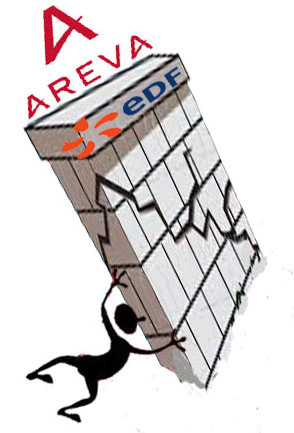 Le Monde 25th Jan 2021, EDF collapses on the stock market amid difficult negotiations in Brussels.
The French group is engaged in a vast reorganization project, contested by the company’s unions. EDF is the largest nuclear operator in Europe and one of the main electricity producers in the world, but a few lines were enough to make its value skid on the stock market on Monday January 25.
In an article published on the BFM Business website on Monday morning, the channel said that negotiations between Paris and Brussels on one of the key points of the French nuclear reform are failing. In a few minutes, the group’s action collapsed and lost up to 18% in the afternoon to close at -15%.
A day of tumbling stopped at the last minute by an intervention from Bercy, who did everything to deny the failure of the negotiations. To understand this dark day for the company, we must return to the very subject of negotiations. For months, France has been pleading with the
European Commission for a reform of the complex system which requires EDF to resell part of its production to its competitors. Set up in 2011, this mechanism called “regulated access to historic nuclear electricity” (Arenh) forces the energy company to resell a quarter of its nuclear
production at a fixed price – this tariff is set at 42 euros per megawatt hour.
Tokyo High Court holds TEPCO responsible for Fukushima nuclear crisis

No wonder that the global nuclear industry is hellbent on nationalising itself – so that the taxpayer is responsible. Nobody will want to invest in private nuclear companies after this.
High court denies government responsibility for Fukushima nuclear crisis, Japan Times, 22 Jan 21, The Tokyo High Court on Thursday ordered the operator of the crippled Fukushima No. 1 nuclear power plant to pay damages to evacuated residents, but it overturned an earlier ruling by Maebashi District Court that had also acknowledged the central government’s responsibility over the 2011 nuclear crisis.
Among around 30 such lawsuits across the country, the decision of the Tokyo High Court was the first high court ruling absolving the state of responsibility, contradicting an earlier decision of the Sendai High Court in September that ordered both the state and Tokyo Electric Power Company Holdings Inc. to pay damages.
The government’s failure to instruct Tepco to take measures against tsunamis “is not found to be significantly unreasonable,” Presiding Judge Akira Adachi said in handing down the ruling.
The lawsuit focused on the reliability of an official long-term quake assessment made in 2002, which has been used in previous rulings to determine the liability of the state and Tepco for their failure to prevent the nuclear disaster.
Adachi noted the assessment had caused a debate since its release, and that the government was unable to predict a huge tsunami.
Implementing measures such as constructing seawalls would not have prevented the tide from entering the nuclear plant, he added.
Thursday’s ruling instead ordered Tepco to pay a total ¥119.72 million to 90 plaintiffs, more than triple the amount awarded in the lower court ruling. ………..https://www.japantimes.co.jp/news/2021/01/21/national/crime-legal/government-denies-fukushima-responsibility/
Local governments in Japan growing more reliant on nuclear taxes
|
Local governments growing more reliant on nuclear taxes, THE ASAHI SHIMBUN, by Hideki Muroya and Takuho Shiraki.January 20, 2021 Local governments are increasingly depending on tax revenues from the nuclear plants they host, a relationship that has deepened over the 10 years since the Fukushima nuclear disaster, an analysis by The Asahi Shimbun shows.That follows the introduction of new tax regimes that ensure a steady flow of nuclear-related tax yields–even when reactors are idle or in the process of being decommissioned. They were brought about largely through increasing existing taxes on nuclear fuels and levying new taxes on spent nuclear fuels kept at the plants.
In fiscal 2011, right after the triple meltdown at the Fukushima No. 1 nuclear power plant, jurisdictions home to nuclear plants and related facilities yielded some 20.1 billion yen ($193.7 million) in taxes. The bulk of that came from taxes on nuclear fuel; many local governments only began collecting spent fuel taxes years after the accident. But then the figure more than doubled to an estimated 46.7 billion yen in fiscal 2020, ending in March, despite the nuclear plants being offline. The Asahi Shimbun studied nuclear-related tax revenues received by host municipalities and the 13 prefectures where those municipalities are located. Local governments can impose taxes on nuclear fuel and spent nuclear fuel at plants and related facilities through approving ordinances to do so. Of all the jurisdictions examined, Aomori Prefecture, where nuclear fuel cycle facilities are concentrated, and Fukui Prefecture, which hosts 15 reactors, the most in Japan, account for more than 60 percent earned through those taxes. The amount for fiscal 2020 is larger than the 40.3 billion yen brought in during fiscal 2010, when the plants were operating. Nuclear fuel taxes were originally based on the value of reactor fuel. As a result, six prefectures housing nuclear plants reported no tax revenues from nuclear fuel taxes in fiscal 2011. Desperate to secure income sources even during plant closures, Fukui Prefecture introduced in autumn 2011 a new fuel-tax system based on reactor output capacity–meaning the reactors can be taxed even when shut down. Other jurisdictions home to nuclear plants followed suit. ….. http://www.asahi.com/ajw/articles/14121969 |
|
|
Another bit of boring nuclear propaganda – from Morocco this time
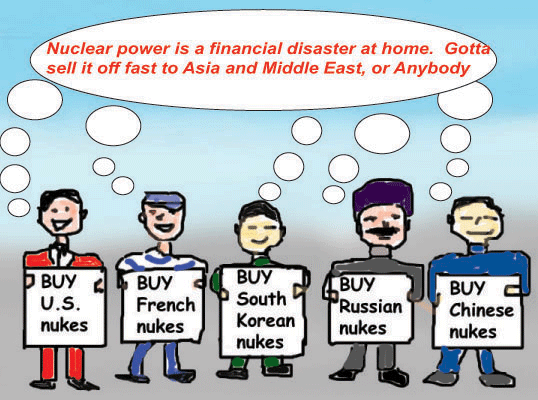
A straight handout from the nuclear lobby? Of course! Not a word about the costs. Not a word

Christina Macpherson’s websites & blogs
about safety, environmental issues. Not a word about the problem of radioactive trash produced. And, of course – no mention that medical radioisotopes can now be made safely and efficiently in non nuclear cyclotrons
Morocco, Hungary Sign Agreement On Nuclear Energy Cooperation. The agreement boosts bilateral cooperation in scientific and academic research. By Sanae Alouazen, Jan 20, 2021 Rabat- Morocco’s National Center for Nuclear Energy, Science and Technology (CNESTEN) and the Hungarian Center for Energy Research signed a cooperation agreement on Tuesday. The agreement aims to strengthen cooperation between the two research centers in the field of nuclear energy……. https://www.moroccoworldnews.com/2021/01/332545/morocco-hungary-sign-agreement-on-nuclear-energy-cooperation/
“They’ll be able to dream up some bogus price” – UK nuclear proponents want financing system

|
UK needs new finance model for nuclear – experts, Montel News , KELLY PAUL, London 18 Jan 2021
The UK must adopt a regulated asset base model (RAB) to kickstart investment in nuclear development, or risk the country missing its target to be net zero by 2050, proponents of the financing mechanism say.
A RAB model for financing could attract pension funds, insurance firms, sovereign wealth funds and infrastructure asset managers to shore up French utility EDF’s funds and carry a new nuclear project through to completion, industry experts told Montel. The UK’s plans to build new nuclear infrastructure in the country have stalled against a backdrop of political reticence to commit, spiralling costs associated with Hinkley Point C, which EDF is building, and the steady retreat of potential investors. …… Under RAB, an economic regulator would grant a licence to a company to charge a regulated price to users in exchange for the provision of infrastructure, in this case a nuclear reactor. …….
The UK government recently confirmed it has entered into negotiations with EDF on the Sizewell C reactor in Suffolk and has pledged to reach an investment decision on at least one nuclear power station by the end of the current parliament. High cost EDF itself signalled that the cost for the Hinkley C reactor would be between GBP 21.5 billion and GBP 22.5 billion, a rise of between GBP 1.9 billion and GBP 2.9 billion as compared with previous estimates. In France, meanwhile, the operator’s Flamanville reactor is running 11 years behind schedule and EDF’s estimated cost of completion has spiralled to EUR 12.4bn, up from its original estimate of EUR 3.3bn.
Blank cheque Detractors of the RAB model have dismissed the mechanism as a “blank cheque” for UK consumers to sign, while others called into question the price competitiveness of new nuclear given the falling cost of renewables. Critics maintain that by guaranteeing a significant source of capital ahead of the expensive construction phase, as RAB does, consumers are essentially being asked to pay for a reactor when they have no way of assessing how costly it will be, or if any of the delays that have marred Hinkley could occur again. At the government’s recent consultation on the RAB model, specific figures relating to financing were not discussed. “They’ll be able to dream up some bogus price,” said Stephen Thomas, emeritus professor of energy policy at the University of Greenwich. https://www.montelnews.com/en/story/uk-needs-new-finance-model-for-nuclear-experts/1187367 |
|
The hidden costs of France’s old, past-their-use-by-date nuclear reactors
Ian Fairlie’s Blog 16th Jan 2021, In early 2019, four French EDF scientists wrote a 22 page report on load following in French nuclear reactors. The English version was first published on April 1 2020 but this has only recently been brought to my attention (ie mid Jan 2021).
This report is instructive and worrying, and requires careful reading. In essence, it discusses how French nuclear engineers have managed to retrofit and configure France’s reactors so that they can follow the diurnal loads increasingly required by France’s electricity needs.
It should be borne in mind that EDF’s 58 nuclear reactors are very old and past their sell-by dates. Most are between 30 and 40 years old with an average age of 33 years in 2018.
Some background is necessary to explain why this report was written. French reactors have been
operating since the 1980s. Since their gross output has usually exceeded French domestic requirements, especially at night, much is exported to France’s neighbours i.e. UK, Belgium, Netherlands, Germany, Italy and Spain.
Large amounts were until recently also sent to large pumped storage schemes in Switzerland at night. These transfers have been at a considerable financial loss to EDF and the French Treasury as the prices for such supplies are understood to be low. In addition, during the day, France imports significant amounts of electricity- mainly from the renewables in Germany.
https://www.ianfairlie.org/news/french-report-nuclear-power-plant-flexibility-at-edf/
Profound questions raised by the employment tribunal case; bullying at Sellafield nuclear site?

 Byline Times 15th Jan 2021, An employment tribunal case that has been running for more than two yearshas started to raise profound questions over management at Europe’s
largest nuclear reprocessing plant, the ability of the employment tribunal
system to defend the rights of whistleblowers, ethical conduct by major law firms, and a conflict of interest at the Equality and Human Rights Commission.
The case of McDermott versus Sellafield, the Nuclear
Decommissioning Authority and former Sellafield HR director Heather Roberts
has been brought under the Public Interest Disclosure Act 1998 – also
known as the Whistleblowers’ Act. Alison McDermott, an HR professional
and diversity specialist, claims that the sudden termination of her
freelance contract in October 2018 by Sellafield was linked to her
protected disclosures containing evidence of systemic bullying, and racist
and sexist incidents at the Sellafield site in Cumbria.
1 This Month



26 September – International Day for the Total Elimination of Nuclear Weapons


PLEASE OPPOSE HR 8255 AND S.3639 – bills would accelerate satellite deployment, with no environmental review or safeguards – https://ncstd5li.quorum.us/campaign/169331/
To see nuclear-related stories in greater depth and intensity – go to https://nuclearinformation.wordpress.com
-
Archives
- September 2026 (257)
- August 2026 (330)
- July 2026 (355)
- June 2026 (287)
- May 2026 (306)
- April 2026 (356)
- March 2026 (251)
- February 2026 (267)
- January 2026 (308)
- December 2025 (358)
- November 2025 (359)
- October 2025 (375)
-
Categories
- 1
- 1 NUCLEAR ISSUES
- business and costs
- climate change
- culture and arts
- ENERGY
- environment
- health
- history
- indigenous issues
- Legal
- marketing of nuclear
- media
- opposition to nuclear
- PERSONAL STORIES
- politics
- politics international
- Religion and ethics
- safety
- secrets,lies and civil liberties
- spinbuster
- technology
- Uranium
- wastes
- weapons and war
- Women
- 2 WORLD
- ACTION
- AFRICA
- Atrocities
- AUSTRALIA
- Christina's notes
- Christina's themes
- culture and arts
- Events
- Fuk 2022
- Fuk 2023
- Fukushima 2017
- Fukushima 2018
- fukushima 2019
- Fukushima 2020
- Fukushima 2021
- general
- global warming
- Humour (God we need it)
- Nuclear
- RARE EARTHS
- Reference
- resources – print
- Resources -audiovicual
- Weekly Newsletter
- World
- World Nuclear
- YouTube
-
RSS
Entries RSS
Comments RSS
 nuclear-news