10 years after Fukushima nuclear disaster, – poor prospects for nuclear revival in Japan
Decade after Fukushima disaster survivor looks back | Tomioka just 10 km from wrecked nuclear plant
gainst almost any conceivable tsunami. Two reactors are ready to start splitting atoms again to heat water into steam and generate power, the operator has told regulators.
All of Fukushima prefecture’s reactors are closed permanently or set to do so. Chubu Electric Power Co. , owner of the Hamaoka plant, declined to make an executive available for comment. It has formally applied to reopen two reactors at the plant and told regulators that new measures such as the wall, mainly completed in 2015, make them safe to operate.
Concern about the marketing of radioactively contaminated scrap metal
 NFLA 4th March 2021, The UK & Ireland Nuclear Free Local Authorities (NFLA) has submitted a
Germany to pay nuclear operators 2.4 bln euros for plant closures
|
Germany to pay nuclear operators 2.4 bln euros for plant closures, https://www.reuters.com/article/germany-nuclear-settlement/germany-to-pay-nuclear-operators-24-bln-euros-for-plant-closures-idUSS8N2IR026 By Reuters Staff, (Reporting by Vera Eckert, Tom Kaeckenhoff and Markus Wacket, editing by Thomas Escritt)
FRANKFURT, March 5 21, (Reuters) – The German government has agreed to pay nuclear operators 2.4 billion euros ($2.86 billion) in compensation for forcing them to shut their nuclear plants early in response to the the Fukushima disaster, ministries said on Friday.The Frankfurter Allgemeine Zeitung daily had reported on Thursday that a sum of 2.4 billion euros will be made available from the general budget, citing government sources. The four affected companies are the German listed utilities RWE, which will get 880 million euros, and E.ON , which will get 42.5 million euros, as well as Swedish state-owned rival Vattenfall, which will get 1.425 billion euros, and mainly publicly-owned German EnBW , which will get 80 million euros. A Constitutional Court ruling in November had found in favour of the companies in their complaint that the government’s previous offer had not gone far enough. The court called for a speedy settlement of the dispute, which was mainly pursued by Vattenfall. The court had already ruled in 2016 that while the nuclear phase-out was legal, the operators needed to be better compensated for lost production. ($1 = 0.8389 euros) |
|
Nuclear Power’s Prospects Cool a Decade After Fukushima Meltdowns
Nuclear Power’s Prospects Cool a Decade After Fukushima Meltdowns
Disaster at the Japanese reactors marked a turning point for an industry that once promised to give the world a nearly unlimited source of energy WSJ, By Peter Landers, March 3, 2021
OMAEZAKI, Japan—At a seaside nuclear-power plant here, a concrete wall stretching a mile along the coast and towering 73 feet above sea level offers protection against almost any conceivable tsunami. Two reactors are ready to start splitting atoms again to heat water into steam and generate power, the operator has told regulators.
Yet despite safety measures set to cost nearly $4 billion, the Hamaoka plant hasn’t produced a single kilowatt since May 2011, and it has no target date to restart. The paint on billboards is fading and an old “no trespassing” sign outside the barbed wire lies on the ground—signs of creeping neglect.
Even a local antinuclear leader, Katsushi Hayashi, said he spent more time these days fighting an unrelated rail line in the mountains, confident that regulators and public opinion wouldn’t let the plant open any time soon. “Fukushima gave us all the proof we need. It’s dangerous,” Mr. Hayashi said.
The triple meltdowns at Japanese nuclear reactors in Fukushima after the March 11, 2011, earthquake and tsunami marked a turning point in an industry that once dreamed of providing the world with nearly unlimited power.
A decade after Fukushima, just nine reactors in Japan are authorized to operate, down from 54 a decade ago, and five of those are currently offline owing to legal and other issues. All of Fukushima prefecture’s reactors are closed permanently or set to do so. Chubu Electric Power Co. , owner of the Hamaoka plant, declined to make an executive available for comment. It has formally applied to reopen two reactors at the plant and told regulators that new measures such as the wall, mainly completed in 2015, make them safe to operate…… (subscribers only) https://www.wsj.com/articles/nuclear-powers-prospects-cool-a-decade-after-fukushima-meltdowns-11614767406
Public Service Enterprise Group trying to force ratepayers to act as guarantors for nuclear power debts
 Obligating ratepayers to act as guarantors…
…. they seek to leverage the subsidies as a means to obligate ratepayers to act as guarantors of the plants’ profitability,
It is noteworthy that PSEG never offered to return any stranded-cost payments to ratepayers and now has the temerity to argue that this $3 billion wealth transfer should not be considered in determining whether the nuclear plants require further subsidization.
Despite the efforts of PSEG and Exelon to ignore precedent and establish their preferred regulatory structure, the fact remains that the BPU and Legislature removed precisely these types of costs and risks from ratepayer responsibility long ago.
|
Ratepayers held up their side of nuclear deal. PSEG must do the same https://www.njspotlight.com/2021/03/nj-board-public-utilities-must-decide-massive-nuclear-subsidies-pseg-drumbeat-no-justification-responsibility-costs-risks/ STEVEN S. GOLDENBERG | MARCH 3, 2021
There is no justification for PSEG’s effort ‘to require ratepayers to assume responsibility for the costs and risks associated with the continued operation’ of its nuclear plants
With the issue regarding the propriety of nuclear subsidies — known as Zero Emission Certificates or ZECs — again before the Board of Public Utilities, the predictable PSEG-inspired public drumbeat supporting its nuclear plants has begun. News outlets, including NJ Spotlight News, have recently featured articles and editorials that tout the benefits the nuclear plants confer on the state, and are intended to gin up support for extending the current $300 million annual ratepayer subsidies. Continue reading
|
Michigan Attorney General wants review of nuclear plant license transfer to Holtec
 an energy company to seek more review before it undertakes a license transfer that could cost Michiganders money and safety.AG Nessel is petitioning the Nuclear Regulatory Commission to look more closely into a case involving a license transfer request for the Palisades Nuclear Plant and Big Rock Point Independent Spent Fuel Storage Installation, which are both currently owned by Entergy Co.
Nessel is requesting a hearing for the transfer of control of the licenses to those facilities from Entergy to Holtec International.
Earlier this month, Entergy and Holtec filed an application asking for the approval of the transfer of control of the licenses. Entergy plans to retire the Palisades Nuclear Plant in 2022.
A trust fund of about $550 million was established with ratepayer funds to decommission the Palisades. Not only does Holtec want to use that fund to decommission the Palisades but also to handle the site restoration and fuel management cost.
Attorney General Nessel filed her petition and request to further review this license transfer application.
In her petition, Nessel said that she supports safe decommissioning, site restoration and fuel management at Palisades, but she’s concerned that Holtec does not have the financial qualifications to complete a risk-intensive project.
The petition demonstrates that Holtec has underestimated the costs for actual decommissioning, thus threatening the health and safety of Michigan residents, according to Michigan AG Dana Nessel. The petition also questions Holtec’s exemption request to use the decommissioning funds for site restoration and nuclear fuel management without providing evidence of other funding sources.
“Protecting the environment, the health and the pocketbooks of Michigan residents are part of my responsibilities as attorney general,” said Nessel in a press release. “My concern is that by seriously underestimating the cost of decommissioning, site restoration and nuclear fuel management, coupled with a lack of appropriate financial assurances, Holtec endangers our environment and health, and potentially leaves our residents to bear the costs of proper clean-up.”
Palisades Nuclear Power Plant is located in Covert Township and the Big Rock Point facility is located in Hayes Township both on the shores of Lake Michigan.
Is it wise for the Biden administration to fund Small Nuclear Reactors?

|
Climate change and ‘advanced nuclear’ solutions, The Hill, BY GREGORY JACZKO, — 02/23/21
Nuclear power is knocking on the government’s door offering solutions. The Biden platform answered by including so-called “advanced nuclear” in its list of climate options. The question now is will they wisely fund any such efforts?
While talk of advanced nuclear reactors is ubiquitous, a precise definition is elusive. Without a clear target in which to aim, government funds will not hit the mark. Advanced nuclear has become the catch-all for the knight-in-shining-armor reactors that promise to address issues that have kept nuclear a marginal electricity player since its inception. But we need more than this open-ended definition. The Biden administration should support projects only if they can compete with renewables and storage on deployment cost and speed, public safety, waste disposal, operational flexibility and global security. There are none today.
The only advanced nuclear technologies close to realization are called small modular reactors. These reactors are smaller than traditional reactors and are self-contained. These features allow companies to manufacture most of the reactor in a factory and ship it to a plant site. This concept evokes images of smart phones rolling out of factories by the billions — each design identical and mass produced. Their small size reduces the amount of radiation that can be released to the environment, greatly reducing — but not eliminating — safety to a plant’s community….
Yet the economic competitiveness of small modular reactors appears weak. Shrinking the size of a traditional reactor and splitting it among many modules increases the cost of the electricity it produces. It is the same reason airlines fly large capacity jets instead of private jets. You maximize the revenue per area of the aircraft hull. Proponents argue mass production will overcome this problem with fleet-wide economies of scale and construction efficiencies. Only wide scale adoption of the technology would deliver those benefits and there is no obvious market to support that today.
Moreover, the nuclear industry always promises better, faster and cheaper yet it fails to deliver. ……
Small modular designs are only promising to be cheaper than traditional reactors. Current estimates show they are more expensive than renewables, like wind and solar, even with storage and without subsidies. Small reactors have a long way to go to be competitive. Dramatic cost decreases for high-volume energy storage, which address the intermittency of some renewables, make the competitive case for any form of nuclear even tougher.
Even if everything else was lined up perfectly, nuclear has little time to catch up. After reentering the Paris Agreement, the U.S. will again strive to achieve drastic reductions in greenhouse gas emissions (GHG) within the next 10 years. Even in the most optimistic scenario, we won’t see even a handful of small modular nuclear reactors in the U.S. until 2029 or 2030, which means a large-scale impact would come far after the climate tipping point.
What about the other factors like proliferation resistance and waste disposal? For those criteria, small modular reactors offer no advantages over their traditional reactor cousins. Even if the cost factors are addressed, proliferation concerns and waste management will be hurdles.
Most importantly, no small modular reactors have been deployed yet in the United States, despite government efforts. In 2011, the Department of Energy (DOE) offered $400 million grants to support two small modular reactor designs. After providing tens of millions, only one design is still under development. That company originally planned to build a 12-module plant at the Idaho National Laboratory.
Predictably, this project is in trouble. Electricity customers have committed to purchase just a small fraction of the power produced annually by that plant, which now is likely to be scaled down, diminishing the economies of scale from mass production. It will not operate until at least 2030, years behind schedule and too late to help deal with the problem forecast in the best climate models. Despite these challenges, the federal government agreed in concept to a $1.4 billion direct subsidy over 10 years for the project. Without this cash infusion, the project will not meet its already disputed targets for price competitiveness. Such largesse is part of the billions Congress and the Trump administration committed to other advanced reactor concepts, none of which are close to deployment. To avoid wasting money on advanced nuclear reactors, the Biden administration must establish clear metrics for advanced nuclear reactors and apply them rigorously. Only ideas that can meet the pressing timetable of climate demands and electricity market realities deserve a serious look. My list is a good place to start. If advanced reactors cannot meet these metrics, they should not receive funding. Proponents of nuclear power will certainly say that living up to my list is an arduous task. Perhaps it is, but the future of our planet hangs in the balance. That is more important than the profits of an industry. Dr. Gregory Jaczko was the chairman of the U.S. Nuclear Regulatory Commission from 2009 to 2012 and currently develops clean energy projects and teaches at Princeton University. https://thehill.com/opinion/energy-environment/539991-climate-change-and-advanced-nuclear-solutions |
|
France slow to leave nuclear power, (cheaper to extend lives of reactors)

France to extend lifetime of old nuclear power plants https://au.finance.yahoo.com/news/france-extend-lifetime-old-nuclear-102331756.html
Thu, 25 February 2021, French safety officials on Thursday gave the green light to extend the lifetime of the country’s oldest nuclear power plants as it seeks to boost the share of renewables in its power mix.
Nuclear energy currently provides nearly 70 percent of French electricity, more than in any other country.
France, hoping to reduce that share to 50 percent by 2035 — a target pushed back from an earlier 2025 date — with the help of renewables, has been holding off from building new reactors.
The number of French reactors, at 56, is second in the world only to the United States which operates 85.
French safety officials on Thursday gave the green light to extend the lifetime of the country’s oldest nuclear power plants as it seeks to boost the share of renewables in its power mix.
Nuclear energy currently provides nearly 70 percent of French electricity, more than in any other country.
France, hoping to reduce that share to 50 percent by 2035 — a target pushed back from an earlier 2025 date — with the help of renewables, has been holding off from building new reactors.
The number of French reactors, at 56, is second in the world only to the United States which operates 85.
The safety of French nuclear plants is checked every decade.
ASN asked state-controlled electricity provider EDF, which manages the country’s nuclear plants, to undertake any necessary work to safeguard their security.
The main target was to “limit the consequences of any accident, especially any serious accident involving the meltdown of a reactor”, ASN’s deputy director-general Julien Collet told AFP.
Another objective was to improve the resistance of the plants to outside shocks including earthquakes, floods, extremely hot weather, or a fire in the reactor.
Anti-nuclear campaigners have long demanded the closure of veteran nuclear power stations, and last year obtained the decommissoning of France’s oldest plant at Fessenheim in the east of the country.
“Active French nuclear power plants were built to operate for 30 or 40 years. Beyond that, nuclear reactors enter an unknown ageing phase,” said NGO Greenpeace, calling for more plants to be closed.
ASN president Bernard Doroszczuk told the Ouest France newspaper that there were still “weak points” in the stations’ security equipment, requiring “vigilance”, but that there had been improvements.
France’s nuclear reactors, grouped in 18 sites, are all second-generation pressurised water reactors.
EDF in 2015 estimated the cost of dismantling all the reactors at 75 billion euros ($92 billion) but a parliamentary report said the real cost would be more.
A third-generation reactor called EPR and under construction since 2007 in Flamanville in northern France was supposed to go online in 2012, but the launch date has been delayed repeatedly and is now fixed for next year.
Flamanville’s cost has run over 10 billion euros, more than three times the initial estimate. Once operational, it will have an estimated life span of 60 years.
City giant Legal and General will not be funding Sizewell nuclear project
 Telegraph 20th Feb 2021, Sizewell C proves to be a turn-off for City giant Legal & General. Legal & General has ruled out helping to fund the new Sizewell C nuclear power plant, dealing a blow to EDF as it seeks backers for the £20bn project.
L&G has not spoken publicly about its plans but in a written response to a pension-holder, one of its investment service consultants said: “I have had it confirmed that Legal & General will not be investing in the Sizewell C nuclear power plant.” L&G declined to comment further. It comes after Aviva Investors expressed concerns about the potential ESG (environmental, social and governance) risks of nuclear power. It said the ESG impact of nuclear was “far from clear at this time.” L&G’s boss Nigel Wilson reportedly described Hinkley in 2016 as a “£25bn waste of money”. https://www.telegraph.co.uk/business/2021/02/20/sizewell-c-proves-aturn-off-city-giant-legal-general/
The merging of the economic and the political power of big nuclear corporations
 Big money, nuclear subsidies, and systemic corruption, Bulletin of the Atomic Scientists, By Cassandra Jeffery, M. V. Ramana | February 12, 2021, ”………… the long-term impact of legislation that favors nuclear energy firms involves the great economic and political power that these large utilities possess. To better understand the basis of the economic power of these corporations, we analyzed financial data from electric utilities listed on the New York Stock Exchange (NYSE) between 1970 and 2019 on the standard Compustat database.
The first trend that is evident is one of increasing market concentration. From the 1970s through to the mid-1990s, there were roughly 80 to 85 companies listed in this sector on the NYSE. By 2000, that number had dropped to 56. The reason was a series of mergers and acquisitions through which large companies absorbed smaller companies. For example, Commonweath Edison became part of Unicom in 1994. Unicom and the Philadelphia Electric Company merged in 2000 to form Exelon. Similar mergers and acquisitions have continued, and by 2019 there were only 36 utility companies operating in the United States.
Measured through their market capitalization values, these 36 corporations are not equal. By and large, the corporations with the largest market cap values are the ones that own nuclear plants. Exelon is a good example, owning 17 of the 94 nuclear units that are operating in the United States as of November 2020. In 2019, Exelon’s average market capitalization was $44.3 billion. But Exelon is by no means the largest utility. Nextera Energy ($118 billion), Dominion ($69 billion), Duke ($67 billion), and American Electric ($47 billion) dominate the industry in terms of market capitalization. All of these five companies had a higher market capitalization in 2019 than the largest utility that did not own nuclear plants: Sempra Energy ($44.1 bn).
Over the last six years, when there have been no mergers or acquisitions among these companies, 11 out of the 14 companies that own nuclear assets have consistently held market capitalization values well above the median (based on 36 companies in all). Two of the remaining three hover near the median value, sometimes higher, sometimes lower. (The one remaining utility, El Paso, was recently bought out by JP Morgan, and will no longer be a publicly traded company.) On the whole, companies with nuclear plants have recorded larger market capitalization values than the median of 22 utilities that don’t own nuclear assets.
The legislative means used to take money away from electricity consumers and bail out economically failing nuclear plants owned by these large corporations helps further their market power, as illustrated by Dominion’s value rising from $49.5 billion in 2018 to $69.4 billion in 2019. While it is well known that wealthy corporations have a lot of political power, it seems from these examples that the converse might also be true: The political power enjoyed by these large corporations is at the root of their economic power. Indeed, as political economists Jonathan Nitzan and Shimshon Bichler have argued at length, the standard economic concept of capital symbolizes “organized power writ large,” challenging the conventional division between politics and economics. The various bills passed in state legislatures offer a political assurance to investors that revenues for these utilities are assured for the foreseeable future, which naturally translates into higher stock prices and market capitalizations.………https://thebulletin.org/2021/02/big-money-nuclear-subsidies-and-systemic-corruption/
Wall Street: the Ultimate War Profiteers

Wall Street: the Ultimate War Profiteers
Wall Street plays the foundational role in the war industry by outright owning war corporations……
Big Finance sits at the top of the war industry by purchasing most shares of war corporations and by owning war corporations. Insatiable demand for profit places immense structural pressure on the Pentagon and Capitol Hill for sky-high U.S. military and intelligence budgets, broad deployment of troops overseas, and the opening up of governmental jobs to corporations. …………
Wars must be created and expanded, and military bases, through which to route goods and services, must be established and entrenched to satisfy investors. Notwithstanding, ending the wars first requires addressing the embedded profit motive, otherwise it is business as usual.
Who Are the Ultimate War Profiteers? A U.S. Air Force Veteran Removes the Veil, Covert Action Magazine By Christian Sorensen February 10, 2021
While war corporations, or so-called “defense contractors,” make billions in profits, Wall Street is the ultimate beneficiary of today’s nonstop wars. The prosaic nature of war profiteering—far from the work of a shadowy cabal—is precisely why the collusion is so destructive and should be outlawed.
The U.S. ruling class deploys the military for three main reasons: (1) to forcibly open up countries to foreign investment, (2) to ensure the free flow of natural resources from the global south into the hands of multinational corporations, and (3) because war is profitable. The third of these reasons, the profitability of war, is often lacking detail in analyses of U.S. imperialism: The financial industry, including investment banks and private equity firms, is an insatiable force seeking profit via military activity.
The war industry is composed of corporations that sell goods and services to the U.S. government and allied capitalist regimes around the world. Investment banks and asset management firms hold most shares of every major public war corporation.
The best-known financial firms holding the stock of war corporations include: Vanguard Group, BlackRock, State Street, JPMorgan Chase, Wells Fargo, and Wellington Management Continue reading
Planning inspectors recommended against Wylfa Newydd project on Anglesey
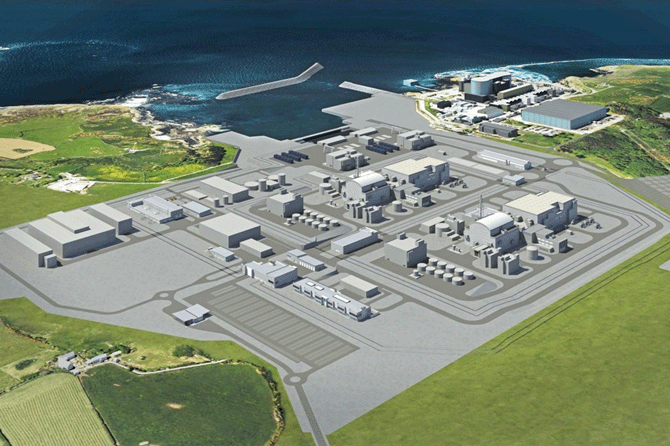
Planning inspectors recommended refusal for new nuclear power plant, Nation Cymru Gareth Williams, local democracy reporter
Plans to build a new nuclear power station were likely to be refused even before the project was shelved by backers.
UK Government appointed planning inspectors had recommended that the Wylfa Newydd project on Anglesey be rejected over a number of concerns from experts.
The application has since been withdrawn after Hitachi, the company behind the project, decided that the power plant was too expensive to build without a funding deal with the UK Government in place.
Energy company Horizon – a subsidiary of Hitatchi – needed an Approval of the Development Consent Order (DCO) to allow the £16bn project to go ahead.
DCOs are needed for any planning application regarded as a major UK infrastructure project and DCO process for Wylfa Newydd had been underway since 2018.
The Planning Inspectorate’s conclusion, which was made public for the first time on Thursday, was intended to be considered as a recommendation – with the final decision down to the UK Government.
But expert planning officers felt that the scheme would fail to meet some of the United Nations’ biological diversity standards.
Inspectors also told UK Government ministers it had concerns over the project’s impact on the local economy, housing stock and the Welsh language…..
The findings of the planning inspectors’ report, which were made public for the first time on Thursday, said there was a lack of scientific evidence put forward by developers to demonstrate that the Arctic and Sandwich tern populations around the Cemlyn Bay area, where the plant was set to be built, would not be disturbed by construction.
There were fears that these birds would subsequently abandon nearby Cemlyn Bay as a result.
It also raised wider concerns over the general impact on Cemlyn Bay, the Cae Gwyn site of special scientific interest and Tre’r Gof……..
It went on to conclude: “Having regard to all the matters referred in this report, the ExA’s conclusion is that, on balance, the matters weighing against the proposed development outweigh the matters weighing in favour of it.
“The ExA therefore finds the case for development is not made and it recommends accordingly.”
‘Pulling the plug’
Before pulling the plug on the DCO application last month, Hitachi confirmed that talks had been taking place with potential new investors. But with no concrete offer forthcoming, Hitachi announced it would wind up its Horizon Nuclear Power subsidiary by March 2021……… https://nation.cymru/news/planning-inspectors-recommended-refusal-for-new-nuclear-power-plant/
Daily Post 5th Feb 2021, The UK’s Planning Inspectorate has released its report into Wylfa Newydd –
showing they had recommended refusal over biodiversity issues.
Nuclear power unaffordable in USA, Russia, India, France, even China, but NO SOLUTION TO WASTES
|
Germany: Nuclear phaseout or renaissance? https://www.dw.com/en/germany-looking-for-final-repository-for-nuclear-waste-global-outlook/a-56449115– 5 Feb 21,
Germany’s nuclear phaseout will be completed by the end of 2022. Safe final repositories for nuclear waste still haven’t been found, but some countries are still building new reactors. Does nuclear have a future? There are currently 413 nuclear reactors in operation in 32 countries around the globe. According to the annual World Nuclear Industry Status Report (WNISR), nuclear power accounted for about 10% of global electricity demand in 2019, the highest share being 17.5% in 1996. Most reactors were built between 1968 and 1986, mainly in Europe, the United States, the former Soviet Union and Japan. The global average age of these reactors is 31 years.
|
|
|





South Africa’s new nuclear power plan would be a costly mistake
|
The National Energy Regulator of South Africa (Nersa), has issued a consultation paper and called for public input, comment and response to a determination by the Minister of Mineral Resources and Energy, in terms of Section 34(1) of the Electricity Regulation Act, 2006, to procure 2,500 MW of new nuclear power in South Africa. The ministerial determination was sent to Nersa for its consideration and concurrence, which is a necessary step before the Department of Mineral Resources and Energy (DMRE) can issue a request for proposals to nuclear vendors following an open, transparent and competitive procurement process. I am opposed to new nuclear power in South Africa, and this is definitely not because I am ideologically against nuclear energy or nuclear technology per se, but for sound, pragmatic reasons and the absence of a valid business case, including, amongst other factors:
This ministerial determination comes at a time when the world of energy and electricity is undergoing rapid change when the prices of renewable and flexible generation technologies are plummeting when new energy storage technologies are emerging, when the future of large-scale, centralised generation is changing and when the demand for electricity over long-distance transmission grids is decidedly uncertain and declining. The Integrated Resource Plan (IRP) 2019 indicates that a nuclear build programme “is a no-regret option in the long term”. I disagree and consider that a nuclear new-build programme is exactly the opposite – very high risk and high-regret option indeed. This is not the time to be making extremely expensive 100-year commitments. So, I urge thinking people to oppose new nuclear power in South Africa – because this is clearly not a national priority, and a new nuclear procurement cannot prevent the current electricity crisis from becoming a catastrophe in the course of the next decade. DM Written comments on the ministerial determination for 2,500 MW of new nuclear power in South Africa should be sent by email to Nersa at irp-procurement.newcap@nersa.org.za. The closing date is for written comments is Friday – 5 February 2021, but generally, Nersa does accept written comments after the closing date too. The dates for public hearings on the ministerial determination will be announced by Nersa shortly. Chris Yelland, energy advisor to OUTA, and managing director at EE Business Intelligence. |
|
Economics’ failure over destruction of nature presents ‘extreme risks’

Economics’ failure over destruction of nature presents ‘extreme risks’
New measures of success needed to avoid catastrophic breakdown, landmark review finds
Guardian 2nd Feb 2021. The world is being put at “extreme risk” by the failure of economics to take account of the rapid depletion of the natural world and needs to find new measures of success to avoid a catastrophic breakdown, a landmark review has concluded.
education were urgently needed, he said.
similar Treasury-sponsored review in 2006 by Nicholas Stern is credited with transforming economic understanding of the climate crisis.
change – provided opportunities for the international community to rethink an approach that has seen a 40% plunge in the stocks of natural capital per head between 1992 and 2014.
1 This Month



26 September – International Day for the Total Elimination of Nuclear Weapons


PLEASE OPPOSE HR 8255 AND S.3639 – bills would accelerate satellite deployment, with no environmental review or safeguards – https://ncstd5li.quorum.us/campaign/169331/
To see nuclear-related stories in greater depth and intensity – go to https://nuclearinformation.wordpress.com
-
Archives
- September 2026 (257)
- August 2026 (330)
- July 2026 (355)
- June 2026 (287)
- May 2026 (306)
- April 2026 (356)
- March 2026 (251)
- February 2026 (267)
- January 2026 (308)
- December 2025 (358)
- November 2025 (359)
- October 2025 (375)
-
Categories
- 1
- 1 NUCLEAR ISSUES
- business and costs
- climate change
- culture and arts
- ENERGY
- environment
- health
- history
- indigenous issues
- Legal
- marketing of nuclear
- media
- opposition to nuclear
- PERSONAL STORIES
- politics
- politics international
- Religion and ethics
- safety
- secrets,lies and civil liberties
- spinbuster
- technology
- Uranium
- wastes
- weapons and war
- Women
- 2 WORLD
- ACTION
- AFRICA
- Atrocities
- AUSTRALIA
- Christina's notes
- Christina's themes
- culture and arts
- Events
- Fuk 2022
- Fuk 2023
- Fukushima 2017
- Fukushima 2018
- fukushima 2019
- Fukushima 2020
- Fukushima 2021
- general
- global warming
- Humour (God we need it)
- Nuclear
- RARE EARTHS
- Reference
- resources – print
- Resources -audiovicual
- Weekly Newsletter
- World
- World Nuclear
- YouTube
-
RSS
Entries RSS
Comments RSS
 nuclear-news