Wall St is growing wary of Southern Co.’s promises to carry out Vogtle nuclear project economically

Wall Street braces for further delays, cost overruns at Vogtle nuke project, S and P Global, Darren Sweeney, 15 Jan 21,
| Wall Street is growing wary of Southern Co.’s promise to meet the regulatory approved in-service dates for the new Alvin W. Vogtle nuclear reactors in Georgia.
Southern subsidiary Georgia Power Co. has announced plans to “adjust key milestones” on the construction of Unit 3 at the nuclear plant expansion in response to an increase in COVID-19 cases. “Since October, the site has seen a significant increase in COVID-19 cases, consistent with the broader regional and national rise in cases,” Georgia Power said in a Jan. 11 news release. “This increase, combined with other productivity challenges, continues to impact construction production and the pace of testing activity completion.”……. Mizuho Securities USA LLC said it anticipates a seven-month delay from the Georgia Public Service Commission’s approved in-service dates for the units and a “$2.0 billion total project cost overrun.” “While the company continues to target a regulatory in-service date of November 2021 for Unit 3, they are running short of time in the calendar,” Mizuho analyst Paul Fremont wrote in a Jan. 13 research report. “For prior nuclear projects, it has taken roughly one year between the start of hot functional testing … to commercial operation of the plant. Based on these standards, Georgia Power’s previous schedule of beginning [hot functional testing] in January 2021 and commercial operation in November 2021 already looked aggressive.” Prior to Georgia Power’s update, Scotia Capital (USA) Inc. analyst Andrew Weisel noted that the Vogtle project “brings one-of-a-kind execution risks” for Southern. ….. “The company does not mention construction cost revisions in its press release, but we believe that the inability to meet production goals will likely result in an increase in the cost estimate to complete the project,” Fremont wrote. The analyst said he anticipates Southern will announce additional construction costs and update the schedule during a February earnings call. The independent Vogtle Monitoring Group said in a June 2020 filing with the Georgia PSC that Georgia Power and Southern Nuclear were “highly unlikely” to meet the regulatory approved in-service dates for Vogtle units 3 and 4………….. https://www.spglobal.com/marketintelligence/en/news-insights/blog/q3-us-solar-and-wind-power-by-the-numbers |
As Britain’s plan for Wyfla nuclear project founders, it’s time to start a green revolution
PAWB 11th Jan 2021, On the last day of troubled 2020, the Westminster Government has deferred a decision on a Development Consent Order for a nuclear power station at Wylfa until the end of April 2021.
This is the fourth time this has happened, and the second time in a row for Duncan Hawthorne, chief executive Horizon, to ask for a deferral.
 On January 10 the Times revealed that Hitachi is winding Horizon up completely by March 31, 2021. This is the logical conclusion of the process that started exactly two years ago when Hitachi suspended Horizon’s operations at Wylfa. Then in September 2020, they announced that they were ditching their plans to build two huge reactors at Wylfa completely.
The attempt to build Wylfa B has been shambolic from the start. It’s high time to abandon the foolish dream that has paralyzed Anglesey’s development since 2006. As we approach the 10th
anniversary of the Fukushima disaster, the latest to be mentioned as ‘saviours’ of the radioactive poisoning project that would threaten the health of everyone on the island and beyond are three US companies.
Here they are: Bechtel Corporation, Westinghouse and Southern Company. Here are
some of the trio’s transgressions: Bechtel – recently fined nearly $58million for financial fraud with another company over a 10-year periodat Hanford Nuclear Reservation, the most radioactively contaminated site in the United States. This followed a fine of $125million for low quality work on the same site in 2016. Much more could be said about Bechtel. Westinghouse and Southern Company – Westinghouse went bankrupt while trying to build Vogtle Power Station in the state of Georgia.
The two AP1000 reactors of the type destined for Wylfa are five years behind Schedule, have doubled in cost to $25billion, and there is no guarantee that thepower station will ever be completed. Another of their projects was the V C Summer nuclear plant in South Carolina. It was abandoned unfinished in 2017, and is still being paid for by taxpayers.
However, with this latest information, it looks very unlikely that these three American companies are prepared to pay through their noses for two white elephant sites at Wylfa and Oldbury.
This is the end of Horizon’s journey. And the end once and for all of the nuclear industry’s plans to destroy an especially beautiful part of northern Ynys Môn. It is high time that politicians on Ynys Môn andGwynedd Councils, the Senedd in Cardiff, and at Westminster to recognise
this fact and to turn their attention towards cleaner, cheaper and more sustainable ways of producing electricity. The renewable technologies are available. This is the time to start a real green revolution.
Nuclear power – a dubious and very costly addition in UK’s energy plan
|
Renew Extra 9th Jan 2021, Dave Elliott: The White Paper on modelling UK electricity supply has some very odd things to say: it seems to see nuclear (and carbon capture) as low cost: ‘low-cost solutions at low carbon intensities can only be achieved with a combination of new nuclear and gas CCUS’.
However, it says that the use of hydrogen makes it more flexible, and it admits that ‘it is
technically possible for higher levels of hydrogen-fired generation to also replace nuclear and gas CCUS’, although it adds that ‘this is dependent on the quantity and cost of hydrogen available for generating electricity’. The White paper promised that a review of all existing energy National Policy Statements (NPSs), and presumably their cost and demand assumptions, would be carried out over the next year.
This is important since the old very dated NPSs (which were all designated by the government in 2011) have been used to justify decisions on energy. For example, the old NPSs were sometimes used to justify nuclear expansion on the basis of then expected growth in demand for electricity, whereas it’s actually fallen a lot.
It may help that the White Paper also noted that BEIS is to further upgrade its energy modelling work, going beyond its Mackay Carbon Calculator, its update of the late Prof. David Mackay’s 2011 modelling system.
There certainly are cost issues to face up to up. As far as it has panned out so far, nuclear would add even more costs (including curtailment costs) and doesn’t seem very suited to balancing variable renewables. CCS/CCSU may be similarly expensive and operationally
constrained. But although renewables have got dramatically cheaper and green hydrogen conversion for balancing may do too, there will still be system integration costs. As I noted in a recent post, they have been put, in an Imperial College London review, at €14 per MWh at up to 35%renewable penetration, right up to £30/MWh at up to 85% penetration, well below typical green generation cost. Some of there costs will fall, as the technology improves, and will be offset by efficiency savings, as energy supply and demand balancing gets better, but they are not zero.
https://renewextraweekly.blogspot.com/2021/01/hydrogen-flexibility-in-energy-white.html |
|
Hitachi pulls plug on Horizon nuclear subsidiary
Hitachi pulls plug on Horizon nuclear offshoot John Collingridge, Sunday January 10 2021, The Sunday Times A project to build a huge nuclear power station in north Wales is to be wound down by the end of March, threatening hopes of its resurrection via a sale.
Japan’s Hitachi has told staff it will shut its Horizon subsidiary, which was to build a £20bn nuclear power plant at Wylfa on Anglesey, by March 31. That could scupper a sale of the site, despite interest from bidders including a US consortium of Bechtel, Southern Company and Westinghouse.
The Wylfa site is seen as one of the…… (subscribers only) https://www.thetimes.co.uk/article/hitachi-pulls-plug-on-horizon-nuclear-offshoot-q0tp0kcpx
Creating jobs and community opportunities -Pickering City Council wants immediate dismantling of nuclear station
Clean Air Alliance (accessed) 8th Jan 2021, Ontario’s new Minister of Finance, Peter Bethlenfalvy, can create 16,000 person-years of employment in Pickering by directing Ontario Power Generation (OPG) to immediately dismantle the Pickering Nuclear Station after its operating licence expires in December 2024.
According to the International Atomic Energy Agency, immediate dismantling is “the
preferred decommissioning strategy” for nuclear plants. In fact, dismantling is the one area of employment growth in the nuclear industry.
Immediate dismantling will permit most of the 600-acre site to be returned to the local community by 2034 for parkland, recreational facilities, dining, entertainment, housing and other employment uses. That is among the reasons why Pickering City Council unanimously supports having the plant dismantled as “expeditiously as possible” after it is shut down.
Unfortunately, OPG wants to delay dismantling until 2054 to put off its
dismantling costs for 30 years despite the fact that it already has more
than $7.5 billion in its decommissioning and dismantling fund.
Decommissioning of Oyster Creek nuclear station – a nasty precedent for closing down of other USA reactors.
|
The decommissioning at Oyster Creek was funded by ratepayers and amounted to almost $1 billion when it was sold, presumably for significantly less than its billion-dollar-fund balance. Authoritative sources had previously estimated the cost to decommission Oyster Creek at over $1.4 billion. The original decommissioning schedule was to occur over a 60-year period, but the new owners are betting they can decommission the plant faster, and for significantly less than their investment, pocketing the difference. The quicker they can do this, the more they earn. Of course, if they find they bit off more than they can chew and look like they are on a pathway to failure, they can pack up their wrenches and backhoes and abandon the project, leaving New Jersey ratepayers to fund whatever actions remain to safely complete decommissioning. Seems like a win-win for both buyer and seller. For the new owner, if the challenges exceed their abilities, they can simply cut and run before depleting their newly acquired billion-dollar decommissioning fund. For the seller, they have unloaded an unpleasant responsibility in a way that’s sadly reminiscent of the actions of a deadbeat dad. Current questions on nuclear subsidiesThe current question before the BPU on subsidies presents a rare opportunity for regulators to exert some leverage considering tangential, but critical, questions on nuclear energy. Are safety practices sufficient to deter today’s technology-savvy terrorists? How reliable are their storage processes for spent fuel and what are the long-term plans for its disposal or relocation? What are the plans for the eventual decommissioning of remaining New Jersey nuclear reactors that combined are almost five times the size of Oyster Creek? Are we comfortable following the path blazed by Oyster Creek with the potential of a pre-emptive sale if the new owners make their way out of Dodge before the sheriff shows up …. |
|
Holtec wants to build new nuclear reactor at site of USA’s oldest, most dangerous nuclear station
 New Jersey nuclear plant proposed at site of old reactor PBS, Jan 5, 2021
LACEY, N.J. (AP) — The company that’s in the process of mothballing one of the nation’s oldest nuclear power plants says it is interested in building a new next-generation nuclear reactor at the same site in New Jersey.
Holtec International last month received $147.5 million — $116 million of which will come from the U.S. Department of Energy — to complete research and development work on a modern nuclear reactor that could be built at the site of the former Oyster Creek Nuclear Generating Station in the Forked River section of Lacey Township, New Jersey.
Holtec owns that facility and oversaw its shutdown in 2018……
company spokesperson Joe Delmar said Holtec is “actively engaged with the Nuclear Regulatory Commission” about the project, but has not yet formally applied to build the reactor…..
Jeff Tittel, director of the New Jersey Sierra Club and a longtime opponent of the Oyster Creek plant, called the proposal “a threat to health and safety.”
“Things are going from bad to worse,” he said. “What was supposed to be the cleanup and ending of the Oyster Creek nuclear plant is now being looked at for another nuclear power plant. The whole point of closing and decommissioning this site was to get rid of the oldest and probably most dangerous nuclear plant. Putting all of that nuclear material in one area that is vulnerable to climate impacts like sea-level rise is a disaster waiting to happen.”……. https://www.pbs.org/newshour/economy/new-nuclear-plant-could-rise-at-site-of-former-one-in-nj
Grand Gulf nuclear plant in Mississippi raises concerns about nuclear power
That means Entergy Corp., which is the plant’s main owner, and the Midcontinent Independent System Operator, which operates the regional grid, often have to rely on other generation to fill the gap — possibly costing more and boosting greenhouse gas emissions if fossil fuel sources are tapped.
“The same rule applies to Grand Gulf as applies to coal, to gas, to any resource that we know we’re paying more for than we’re getting from,” said Logan Atkinson Burke, executive director of the New Orleans-based Alliance for Affordable Energy. “And the question is, who’s profiting from that, and who is being burdened by it?”
Experience at Grand Gulf suggests regulators and plant operators may need to consider new approaches and closer oversight of aging reactors, which face an uncertain future if they become too expensive to repair and maintain, observers say. This could have national implications as the electricity industry tries to transition away from fossil fuels and aims to rely more heavily on carbon emissions-free nuclear power.
The industry says nuclear plants are performing well broadly and companies are making investments to keep them operating. But Grand Gulf shows that a reactor that often goes offline can be expensive and undermine climate goals. An examination of New Orleans, for example, provided a snapshot in the past, estimating that a multiday unplanned outage at Grand Gulf in late 2018 resulted in higher costs of more than $1 million for New Orleans ratepayers, according to data from the city.
Aging and troubled nuclear reactors in competitive markets also occupy shaky ground because cheaper options like renewables have been able to undercut them economically, and there isn’t always a customer base to prop them up. Grand Gulf operates in a regulated territory, so it has protection, said Paul Patterson, a utility analyst with Glenrock Associates LLC. But he added that keeping plants alive isn’t a given.
“If the stars aren’t aligned politically to support these plants, it’s not going to happen,” he said………
Grand Gulf finished last among U.S. reactors at 68.8% capacity…….
At the same time, the Nuclear Regulatory Commission recently questioned the site’s operators about mislabeling of waste tied to the plant. And the Federal Energy Regulatory Commission has been reviewing complaints around Grand Gulf’s financial structure that could lead to a refund for customers……..
Nuclear reactors are designed to act as baseload power plants, which means they aren’t usually turned on and off frequently. It also takes time to take a nuclear plant offline, unless there’s an emergency that automatically trips the reactor for safety reasons.
But downtime at Grand Gulf has plagued the plant for years, as E&E News reported in 2018 (Energywire, Dec. 4, 2018). ……. its performance tanked in 2020, as it was at zero on about 39% of the days. This stemmed largely from the refueling and upgrades Entergy undertook — and issues that followed.
Safety concerns could lead to more time that Grand Gulf is not operating, according to observers. Edwin Lyman of the Union of Concerned Scientists ticked off a list of statistics for Grand Gulf that he said concern him. The reactor is in Column 2 of the NRC’s so-called Action Matrix, meaning its performance has declined. It has a number of “green” or low-level safety issues that may trigger additional inspections and reviews, and it has a “white” finding, which is more severe.
“That’s showing a troubling trend in management and safety control,” said Lyman, nuclear power safety director at UCS…..
Lyman questioned whether there is stringent oversight by federal regulators of basic procedures such as replacing and maintaining equipment, following guidelines and continuing education. Management needs to follow through on overseeing maintenance activities, he said.
“All of these seem to be challenging the safety of the plant,” he said.
The NRC looks for so-called cross-cutting issues, which are something that affects most or all safety cornerstones. This is as broad as having a “safety conscious work environment” and can be as specific as human behavior and identifying and solving problems. But the agency has been under pressure to weaken its oversight, which means such patterns may be missed, Lyman said…….
Colby Cook, a spokesperson for the Louisiana Public Service Commission, said a directive last year authorized LPSC staff to initiate a complaint at FERC regarding Grand Gulf’s operations. He said the complaint hasn’t been filed yet. But it could involve other jurisdictions that have an interest in how the plant performs.
And regulators in various states are watching federal agencies for potential decisions related to Grand Gulf………
Lyman of USC acknowledged bipartisan support in Congress for nuclear power. He said it’s up to the Energy Department to promote nuclear as a climate solution, but said the reactors need to be running safely if that’s the case. This is where the NRC comes in.
“The people who you need to depend on to make sure the plants are running safely are not doing their jobs now,” Lyman said…….
Lyman called for a more detailed grading system at the NRC so the public has a better sense of safety problems. That could lead to public pressure on the staff and management at certain plants, which also are dealing with the COVID-19 pandemic.
“I’m concerned generation with the operating reactor fleet especially when they are under economic pressure, especially now with COVID,” Lyman said……
Burke of the Alliance for Affordable Energy in Louisiana said she has no reason to be confident that Grand Gulf will have a great future performance. When the plant is offline, she said, Entergy and MISO likely depend on gas-fueled generation in the region. Burke also worried that new natural gas-fired units could be proposed to replace Grand Gulf at some point….
Burke said utilities and regulators need to plan with credible data.
“If we’re honest about what this plant is costing us all, then this plant shuts down and we finally get to plan for the future,” she said. https://www.eenews.net/stories/1063721867
Bechtel, Westinghouse and Southern Company’s hopeless case to save shambolic Wylfa nuclear project

 People Against Wylfa B 31st Dec 2020, On the last day of troubled 2020, the Westminster Government has deferred a decision on a Development Consent Order for a nuclear power station at Wylfa until the end of April 2021. This is the fourth time this has happened, and the second time in a row for Duncan Hawthorne, chief executive Horizon, to ask for a deferral.
‘saviours’ of the radioactive poisoning project that would threaten the health of everyone on the island and beyond are three US companies.
was the V C Summer nuclear plant in South Carolina. It was abandoned
unfinished in 2017, and is still being paid for by taxpayers. https://www.stop-wylfa.org/news/
Cover-up! how consumers will be forced to pay for cost-overruns for Sizewell C nuclear construction
 Cover-up! how consumers will be forced to pay for cost-overruns for Sizewell C construction, https://100percentrenewableuk.org/cover-up-how-consumers-will-be-forced-to-pay-for-cost-overruns-for-sizewell-c-construction–by David Toke, 30 Dec 20, In a historic change of policy the Conservatives have announced that consumers, not EDF, will pay for cost overruns in building Sizewell C. The crucial phrase in the Government’s document on the so-called ‘Regulated Asset Base’ (RAB) model is ‘Cost overruns that were not excluded from the RAB would be shared between investors and consumers through suppliers’ (para 47 page 14). Note: ‘consumers’ means electricity consumers who will have to pay twice for Sizewell C; extra on their bills long before any power is generated and for many years after generation begins. Cover-up! how consumers will be forced to pay for cost-overruns for Sizewell C construction, https://100percentrenewableuk.org/cover-up-how-consumers-will-be-forced-to-pay-for-cost-overruns-for-sizewell-c-construction–by David Toke, 30 Dec 20, In a historic change of policy the Conservatives have announced that consumers, not EDF, will pay for cost overruns in building Sizewell C. The crucial phrase in the Government’s document on the so-called ‘Regulated Asset Base’ (RAB) model is ‘Cost overruns that were not excluded from the RAB would be shared between investors and consumers through suppliers’ (para 47 page 14). Note: ‘consumers’ means electricity consumers who will have to pay twice for Sizewell C; extra on their bills long before any power is generated and for many years after generation begins.The RAB document was produced alongside the Government’s new Energy White Paper. This should be compared to the Government position in the 2011 White Paper which stated that ‘new nuclear stations should receive no public support unless similar support is available to other low-carbon technologies’. (page 8) Under the Government’s RAB proposals it is claimed that clear criteria are going to be set for what cost overruns will be payable by the consumer and what by the developer, with the outcomes carefully monitored by a ‘Regulator’. But of course once the construction juggernaut for Sizewell C starts rolling where information, not to mention armies of lawyers and hired consultants of various sorts, will be controlled by EDF, I do not seriously believe that EDF will be stopped from passing on virtually whatever costs it wants to pass on to the consumer. It is not even certain that the ‘Regulator’ will be able to stop costs of building (the still uncompleted) Hinkley C being passed onto the consumer through the books assigned to Sizewell C- that is given that workers are likely to be switched from one operation to the other. In other words, it is a blank cheque for EDF for a power plant that is not only unnecessary but which will actually cause large quantities of renewable energy to be wasted because of nuclear power’s inflexible operation (see our report on this). In effect not just consumers but renewable energy operators will be paying for the cost-overruns of building Sizewell C. Laughingly, in a world where no (at least western) nuclear power plant has been attempted this century without massive construction cost overruns being generated, the RAB document talks about ‘low probability risks such as cost overruns above a certain threshold’ (page 12). In the case of Hinkley C the cost overruns are mounting already. The most charitable explanation for the RAB document is that Treasury officials are allowing themselves to be engaged in an exercise of self-deception in order to launder a policy that if stated plainly would be deemed politically unacceptable. Reading between the lines of the RAB document and the Energy White Paper itself, the only substantial barrier stopping EDF being handed a blank cheque contract is the payment that EDF would receive for electricity generated. The White Paper says ‘We expect the sector to deliver the goal it set for itself in our Nuclear Sector Deal, published in 2018, to reduce the cost of nuclear new build projects by 30 per cent by 2030’ (page 49). So in other words the Treasury wants EDF to accept less than £65 per MWh in 2012 prices. (2012 prices, the year in which Hinkley C’s contract was priced is the funny money basis for electricity contracts these days!). Obviously EDF wants more, but with the RAB mechanism it may not need more. This is because RAB mechanism is a piece of political jelly that will allow any nuclear developer to offer to complete Sizewell C for a low sum when in reality British electricity consumers will pay for what will be called ‘cost overruns’ over and above such a figure. The RAB mechanism is a flexible political device that allows Sizewell C to be built regardless of cost realities. It is an act of public manipulation and mystification worthy of the best traditions of ‘Yes Minister’. But even so these plans are likely to cause mounting opposition when consumers realise they are likely to have to start paying extra on their bills without getting any electricity in return. Then they will have to pay extra again for the power when (evenutally) it does start being generated. Professor Tom Burke, the founding Director of E3G commented: ‘Constructing Sizewell will cost just over £20 billion. If EDF borrow this money it will double the cost to over £40 billion. EDF is negotiating with the government to make consumers pay the construction cost in advance by a levy on everyone’s energy bills. They will then have to pay again for the electricity which will still be more expensive than that from renewables.’ In effect consumers will have to pay twice for the project – first for several years before the plant has generated anything, and then again for up 40 years afterwards.
|
|
|
Ohio a clear example of corporate power and dark money shaping public policy

What happened in Ohio is a clear example of corporate power combined with the growth of “dark money” organizations following the  2010 Citizens United Supreme Court decision to shape public policy decisions. The reasons why FirstEnergy engaged in such activities are not hard to guess. Any entity that invests so heavily in these dark money organizations, media strategies, lobbyists, and political contributions will be expecting a sizeable return on its investments. And indeed, it has been rewarded handsomely. The irony is that an industry that acknowledges that it is not economically competitive is spending massively on lobbying. It is the ratepayers and taxpayers who bear the cost of these twisted priorities.
 A dirty battle for a nuclear bailout in Ohio https://thebulletin.org/2020/04/a-dirty-battle-for-a-nuclear-bailout-in-ohio/# By Shakiba Fadaie, M. V. Ramana,
  April 21, 2020 Last July, Ohio’s governor signed House Bill 6 (HB6) to provide FirstEnergy (now Energy Harbor), a large electric utility, with subsidies of nearly $150 million per year to keep its Perry and Davis-Besse nuclear power plants operating. Ohio is only the fifth US state to offer such subsidies; other states include New York, Illinois, New Jersey, and Connecticut. Although the subsidies are justified by some as necessary for climate mitigation, in the latter four states, electricity generation from natural gas, which results in greenhouse gas emissions, has increased since 2017, when these subsidy programs started kicking in. Moreover, in Ohio, subsidies are also being extended to coal power plants, providing the clearest illustration that what underlies the push for subsidies to nuclear plants is not a result of a real commitment to climate mitigation but a way to use climate concerns to bolster the profits of some energy corporations.
The enormous lobbying effort that won the subsidies used dark money–backed organizations that spent millions of dollars to sway voters and politicians. But it didn’t stop with the bill being signed into law—the lobbying also thwarted the ability of citizens to put the proposal to a democratic vote through a referendum, including by funding television advertisements that falsely claimed that China was “intertwining themselves financially in our energy infrastructure” and threatening “national security,” implying that not going through with the nuclear bailout would somehow lead to Chinese control of Ohio’s power grid. As confronting climate change gets in the way of corporate profits, such dirty battles are sure to emerge more often.
Electricity economics. It has been known since the late 1970s that the cost of constructing nuclear plants in the United States is very high, but the cost gap between nuclear electricity and other alternatives has increased dramatically in the last decade. In its most recent estimate, the Wall Street firm Lazard estimated that a new nuclear plant will generate electricity at an average cost of $155 per megawatt hour, nearly four times the corresponding estimates of around $40 per megawatt hour each for new wind and solar energy plants. The average cost for natural gas plants is $56 per megawatt hour.
The gap will only grow larger. While the costs of nuclear power have been increasing, the costs of wind and solar power have declined by around 70 to 90 percent in the last decade. Even solar projects that offer some amount of storage to meet demand when the sun no longer shines are becoming cheaper. Last year, the city of Los Angeles signed such a contract at $33 per megawatt hour. So new nuclear power plants are simply not competitive in the US electricity market.
But what about already operating nuclear plants, those that don’t have to worry about borrowing money for construction or repaying the money they have already borrowed? Herein lies the real cost problem for electric utilities that own nuclear plants. For each megawatt hour of electricity generated in 2019, the average nuclear power plant in the United States spent $30.42 on fuel, repairs and maintenance, and wages; some spent much more. Those costs are comparable to the overall generation costs (including the cost of construction) of solar and wind power listed above.
Renewable energy plants, of course, cost very little to operate since they don’t need any fuel. Thus, already existing renewable plants will remain far cheaper than nuclear plants. With natural gas plants, the comparison with nuclear plants depends on the cost of natural gas; thanks to fracking, for the last many years, natural gas plants have also lowered their operational costs to way below that of nuclear reactors.
The net result is that nuclear electricity is no longer competitive, and that is a problem for utilities that operate in states where electricity is traded on the market. (Other states, where a state regulator approves electricity projects, allow utilities to pass on the high costs of nuclear power to rate payers.) The number of nuclear plants this trend affects is quite large. In 2018, Bloomberg analysts estimated that “more than one quarter of all nuclear plants don’t make enough money to cover their operating costs.”
Political games. This state of affairs has led electric utilities in various states to try and get taxpayers and ratepayers to pay more to keep up their profits. Ohio’s FirstEnergy started early, in 2014, when it asked Ohio regulators to allow its distribution utilities to enter into agreements to purchase the outputs of its coal and nuclear plants at a set price that significantly exceeded wholesale electricity market prices. Ohio ratepayers would end up paying for electricity from these plants even if the distribution companies could have purchased electricity from other providers at cheaper prices. The proposal was approved in 2016, but the Federal Energy Regulatory Commission blocked the deal because it would have been unfair to consumers.
Since then, FirstEnergy has regularly tried to get subsidies in one form or another—until it succeeded in 2019 with HB6. In summary, that bill forces electricity consumers in Ohio to pay a surcharge on their monthly bills, and the resulting amounts go to subsidizing two nuclear power plants owned by FirstEnergy—Perry and Davis-Besse—and two coal-fired plants owned by Ohio Valley Electricity Corporation. The bill also weakens (and will eventually gut) Ohio’s requirements for a minimum amount of electricity to be provided by renewable sources and reduces its targets for improving energy efficiency.
There has been a recent history of growth of renewables in Ohio, albeit from a pitifully low base. According to the US Energy Information Administration, between 2011 and 2017, Ohio’s wind and solar production grew by factors of 7.6 and 4.3 respectively. The reasons for this growth presumably have to do with the economic factors mentioned earlier. Likewise, energy efficiency programs saved twice as much as was spent on implementing them, and were projected to save $4 billion over 10 years. An increase in renewable energy production combined with energy efficiency improvements was shown to be the most economical way to reduce Ohio’s emissions by over 30 percent between 2012 and 2030 as part of the 2014 proposed Clean Power Plan of the US Environmental Protection Agency.
What do those in favor of the bill say? The arguments being used by pro-nuclear groups can be categorized into two sets of claims: economic and environmental. The environmental argument is that nuclear power is a clean power source and a source of “clean air,” a claim made by, for example, Judd Gregg, former governor and senator from the state of New Hampshire and a member of the advocacy council of Nuclear Matters. The problem with that argument is two-fold. First, it does not explain why the bill would support the continued operation of old coal power plants. Second, it doesn’t fit well with the fact that renewables and energy efficiency are far cheaper sources of clean air, and this bill guts both of those.
The economic argument has to do with the fact that nuclear power plants are a source of employment among those communities living near the facilities. When they are shut down, those jobs would obviously disappear. Naturally, some labor unions, those with many members working in the nuclear industry, supported the bill. The International Brotherhood of Electrical Workers website, for example, proudly announced that its “activists have been hard at work, pressing representatives from both political parties to support this job-saving bill and urging all of their Buckeye State brothers and sisters to do the same,” with a union official going on to offer the tip: “No form letters or petitions, but one-on-one contact with the people that vote for them… It’s the personal touch that works.”
But, as with the environmental argument, the economic argument is dubious. The Perry and Davis-Besse nuclear power plants employ an estimated 700 workers each. Even generous estimates that include “additional jobs … that result from the overall economic boost associated with lower electricity prices and more in-state production” assert that the two plants create a combined 4,270 jobs. While these claims don’t square with the higher electricity costs that drive the need for subsidies, even these figures are just a fraction of the “over 81,000 workers” employed in the energy efficiency sector in the state.
More to the point, the number of jobs at these nuclear plants is very small when viewed in the context of the millions of dollars offered as subsidies to FirstEnergy, which, if invested in other energy resources, would create work for many more people. Per unit of electricity generated, nuclear power creates somewhere between one-half and one-sixth the number of jobs created by solar photovoltaic electricity. Because solar energy costs much less to install or generate, nuclear power employs even fewer on a per dollar basis.
The big fight. None of these arguments is exactly rocket science, and the fact that HB6 amounted to a corporate bailout was clear to many. Coalitions of Ohio companies, the state’s manufacturers’ association, environmental groups, and economists testified against the bill. A consumer group ran targeted radio advertisements pointing out how the bill was intended “to subsidize FirstEnergy’s failing investments.” All to no avail.
FirstEnergy’s lobbying power was overwhelming. Politicians were targeted directly and were offered campaign contributions. FirstEnergy and a political action committee they created contributed millions to political candidates and parties in Ohio. Although the details remain murky, much of the funding is documented by two main sources: state and federal campaign-finance filings and records from bankruptcy proceedings that FirstEnergy had entered into. Among the more egregious examples of this funding was the use of payroll deductions from FirstEnergy’s roughly 15,000 employees to raise and pay nearly a million dollars in political contributions between 2017 and 2019, most of it going to Republicans. The effort also included at least $9.5 million in television advertisements, much of which came from a dark money group. There is evidence, however, that FirstEnergy paid at least $1.9 million to this group.
Although Republicans received the majority of the financial contributions, Democrats were also recipients, and therefore support for (and opposition to) the bill was not strictly along party lines. On the Democratic side, those who supported the bill typically cited “a desire to retain union jobs at the endangered plants.” On the other side of the aisle, those Republicans who opposed it invoked problems with subsidies in general.
The raw political and economic power of the industry was on display even after the bill was passed. Having been defeated within the legislature, grassroots organizations such as Ohioans Against Corporate Bailouts and Ohio Consumers Power Alliance took to the streets and tried to collect signatures on a petition calling for a referendum question about HB6 to be included in the 2020 elections. It was a tough task, since those opposing the bailout had less than two months to gather over a quarter of a million valid signatures.
FirstEnergy tried to stop them with a two-pronged approach. The first was a legal trick. It went to the state’s supreme court and argued that the monthly charges on customers “should be considered tax increases, which cannot be challenged by a referendum.” But the court dismissed the case, saying there was “no ‘justiciable controversy’ for it to decide.” For the main part, though, the response from FirstEnergy and other beneficiaries was more of the same: dark money–backed organizations spending millions to undo the grassroots efforts by urging voters to refuse signing the petition.

Among these organizations was one called Ohioans for Energy Security, which sponsored television advertisements that falsely claimed that China is “intertwining themselves financially in our energy infrastructure,” threatening “national security,” and implying that not going through with the bailout campaign would lead to Chinese control of Ohio’s power grid. The watchdog organization Energy and Policy Institute quickly identified that some of the people featured in the TV advertisement were in fact FirstEnergy employees. In other words, there was reason to suspect that FirstEnergy was behind the advertisement. Ohioans for Energy Security also mailed thousands of letters to state residents with bold lettering behind a Chinese flag imploring, “Don’t give the Chinese government your personal information.” The hyperbolic allegations about China apparently are connected to natural gas-fired power plants in Ohio that were partially financed by a Chinese government-owned bank, although FirstEnergy has itself borrowed money from the same bank.
There were also accusations that the law’s supporters were trying to buy off circulators and take their petitions. Another front group, Protect Ohio Clean Energy Jobs, whose spokesperson was registered as a lobbyist for FirstEnergy Solutions, used “targeted ads on social media” to urge people who had already signed the referendum petition to withdraw their names.
The point of all these actions by FirstEnergy and its front or allied organizations was to dissuade voters from participating—and they succeeded. In October of last year, Ohioans Against Corporate Bailouts announced that it would not file the referendum petition, and HB6 went into effect.
Lessons. What happened in Ohio is a clear example of corporate power combined with the growth of “dark money” organizations following the 2010 Citizens United Supreme Court decision to shape public policy decisions. The reasons why FirstEnergy engaged in such activities are not hard to guess. Any entity that invests so heavily in these dark money organizations, media strategies, lobbyists, and political contributions will be expecting a sizeable return on its investments. And indeed, it has been rewarded handsomely. The irony is that an industry that acknowledges that it is not economically competitive is spending massively on lobbying. It is the ratepayers and taxpayers who bear the cost of these twisted priorities.
Although they have not been so egregious in their strategies and the energy and environmental policy outcomes have not been so detrimental, electricity utilities in New York, Illinois, New Jersey, and Connecticut have also pursued profits at a financial cost to customers. As in the case of Ohio, the concerned electricity utilities all have investments in fossil fueled plants as well, and they have a vested interest in maintaining those plants for as long as possible.
Adding up all the bailouts to utilities with nuclear plants in the five aforementioned states would result in roughly $15 billion going from consumers to these corporations over the next several years. Although such a sum might seem small when compared to the much larger bailouts that have been paid out in the aftermath of the economic crashes in 2008 and 2020, it is nevertheless a large amount of money within the electricity sector. More important, the funds go to maintaining the profits of large energy corporations, often under the guise of climate mitigation, but without delivering the real and rapid reductions of emissions that are urgently needed.
Climate change is a serious concern, and finding ways of rewarding electric utilities for maintaining the status quo is not the way to tackle it. Even worse, by diverting much-needed resources and investment away from renewables and related technologies, these subsidies undermine efforts to decarbonize the electricity sector and further entrench companies that invest in high-risk energy sources, be they nuclear or fossil-fueled.
Nuclear power ridiculously expensive and uncompetitive – the market has spoken
 “nuclear is ridiculously expensive and uncompetitive”. So, nothing really needs to happen for renewable energy investment to grow. The reality is that the market has said “no” to nuclear and “yes” to renewables.
The Reality Is that the Market Has Said “No” to Nuclear and “Yes” to Renewables, RIAC, Paul Dorfman PhD, Honorary Senior Research Associate at the UCL Energy Institute University College London; Chair of the Nuclear Consulting Group; Member of the Irish Govt. Environment Protection Agency Radiation Protection Advisory Committee, and Tatyana Kanunnikova– 27 Dec 20,
“………. As for nuclear energy, can it be used to help mitigate climate change? What are the problems associated with nuclear energy?
 With mounting public concern and policy recognition over the speed and pace of the low carbon energy transition needed to mitigate climate change, nuclear power has been reframed as a response to the threat of global warming. However, at the heart of the question of nuclear power, there are differing views on how to apply foresight, precaution, and responsibility in the context of the poor economics of nuclear, the possibility of accidents, the consequences of those accidents, and indeed whether there exists a place for nuclear at all within the swiftly expanding renewable evolution.
When one considers nuclear, it is absolutely important to consider its life cycle in terms of carbon emissions. A study by Prof Benjamin Sovacool looked at 103 different studies and concluded that the average value for nuclear in terms of life cycle emissions was about 66 grams of carbon dioxide for every kilowatt-hour produced. This compares to about 9 grams per kilowatt-hour for wind and 32 grams per kilowatt-hour for solar. This puts nuclear as the third-highest carbon emitter after coal-fired plants and natural gas.
So, in terms of carbon emissions, nuclear is lower than fossil fuel but produces significantly more carbon dioxide in terms of its life 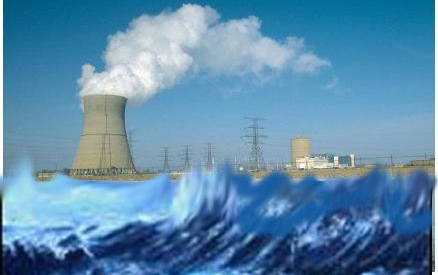 cycle than renewable power. And perhaps more importantly, with ramping predictions for sea level rise and climate disturbance, nuclear will be an important risk, since climate change will impact coastal nuclear plants earlier and harder than is currently expected. Proposed new reactors, together with radioactive waste stores, including spent fuel located on the coasts, will be vulnerable to sea level rise, flooding, and storm surge. These coastal sites will need considerable investment just to protect them against sea level rise, and in the medium term, they will even be subject to abandonment or relocation.
Adapting coastal nuclear power to climate change will entail significantly increased expense for construction, operation, waste storage, and decommissioning. Inland nuclear power plants will do no better. This is because they must be cooled by significant amounts of water and they have to shut down if that cooling water is either too warm or the river flow is reduced. These are two factors that will  absolutely happen with increased climate change. We are seeing this already in France where their reactors stationed by rivers, reliant on river water for cooling, have both diminished river flow and increased water temperatures in the summertime. That implies that there will be a significant inland nuclear station nuclear power shutdown in the future.
The other problem is one of economics, since nuclear is so hugely expensive. Carrying on constructing and prolonging the life of current nuclear plants is enormously costly. New construction is eye-wateringly expensive, which means that if we continue to build nuclear plants, we have much less resource, money, to put into the real solution to climate change, which is renewable power, demand-side management, and storage.
What are the advantages of solar and wind power?
A recent report by Standard and Poor, the key market analyst, found that renewable energy technology global investment has been running at about 350 billion dollars per year for the last few years. But for nuclear, it fell to about 17 billion for last year.
Standard and Poor say that they see “little economic rationale for new nuclear build in the US or Western Europe owing to massive cost escalations and renewables cost-competitiveness, which should lead to a material decline in nuclear generation”. Similarly, Lazard—the world’s leading financial advisory and asset management firm—has just compared the cost of new nuclear, which runs at about $119 to $192 per megawatt-hour, compared to $32 to $42 for utility-scale solar and between $20 and $54 for onshore wind per megawatt-hour. So there is a huge cost difference between nuclear and renewable technologies. Lazard go on to say that the unsubsidized, levelized cost of energy of large-scale wind and solar are at a fraction of the cost of new nuclear or even coal generators, even if the very great cost of nuclear decommissioning and ongoing maintenance is excluded.
Bloomberg New Energy Finance agrees with Lazard’s analysis. The key disadvantage to nuclear power is that it is just too expensive. For renewables, the cost is far lower and continues to fall, which is why what we see is the majority of new nuclear only being constructed with the support of vast state and public subsidy. So, given the reality that funding is limited, we need to make a choice between very expensive nuclear and very inexpensive renewables.
What hinders investments in renewable energy?
In fact, all of the markets are putting all of the money into renewable energy and none of the markets are putting their money into nuclear. There is no market investment in new nuclear. All the investment is going into renewable energy, as I have just discussed. The only problem is, of course, is that if governments via state subsidy put enormous amounts of the low carbon energy budgets into nuclear, they will have less money to invest properly in real low carbon energy technologies such as renewables, storage, and demand-side management.
What initiatives could help promote investments in renewable energy?
I do not think renewable energy needs pushing. The cost of renewables is a fraction of the cost of new nuclear. As Mr. Tanaka, a former director of the International Energy Agency and a former long-standing nuclear advocate, says, “nuclear is ridiculously expensive and uncompetitive”. So, nothing really needs to happen for renewable energy investment to grow. The reality is that the market has said “no” to nuclear and “yes” to renewables……………..
In the journey to manage the decline of fossil fuels, not all low carbon technologies are equal. The reality is that nuclear is far less benign, far more expensive, and far more carbon-intensive than other renewable options. Nuclear will struggle to compete with the technological, economic, and security advantages of the coming renewable evolution. In bidding goodbye to fossil fuels, we should also say goodbye to nuclear. And given the ramping costs and risks that cling to this, essentially late 20th-century technology, it is not before time.
Interviewed by Tatyana Kanunnikova. https://russiancouncil.ru/en/analytics-and-comments/interview/the-reality-is-that-the-market-has-said-no-to-nuclear-and-yes-to-renewables/
Russia marketing small nuclear reactors to the Arctic , (who cares about the toxic wastes?)

Rosatom to build small-scale land-based Arctic nuclear plant by 2028
Rosatom said it has reached an agreement with the government of the Republic of Sakha (Yakutia) setting out parameters for pricing energy that will be produced by the nuclear plant, which is expected to be completed by 2028……….
“I am convinced that a small-scale nuclear power plant will give a qualitative impetus to the development of the Arctic regions of Yakutia, stimulate the development of industry in Ust-Yansky ulus and improve the living standards of local residents,” said in a statement Head of the Sakha Republic Aysen Nikolayev.
The nuclear plant is expected to operate for 60 years but the press release did not specify how Rosatom plans to deal with the nuclear waste produced by it.
Rosatom officials said the small-scale nuclear plant is based on a proven technology that has already been tested in Arctic conditions.
RITM-200 reactors are already being used on the recently commissioned Arktika nuclear-powered icebreaker and six other 22220 design heavy Russian icebreakers that are being built, Rosatom officials said…….
“The implementation of this project strengthens the leading position of Rosatom in the world market of small nuclear power plants.”…….
Rosatom is also actively marketing the technology for export overseas, Likhachev said. https://thebarentsobserver.com/en/nuclear-safety/2020/12/rosatom-build-small-scale-land-based-arctic-nuclear-plant-2028
Marketing nuclear technology to Slovakia
 Mochovce new-build project receives loan boost, WNN, 24 December 2020
Italy’s Enel has announced that its subsidiary Enel Produzione and the Czech company Energetický a Průmyslový Holding (EPH) have agreed to a provide additional loans for the completion of Mochovce 3 and 4 in the Slovak Republic, and altered the terms for EPH to eventually buy out Enel’s stake in Slovenské elektrárne. They and EP Slovakia BV have signed a new agreement that modifies some of the terms and conditions of the 2015 contract concerning the sale of the stake held by Enel Produzione in the Slovak utility…….
Construction on the two Mochovce units was restarted in 2008 and aimed at having both units in operation by 2013, at a total cost of EUR2.8 billion. This was increased at the start of this month to about EUR6.2 billion. Fuel loading at unit 3 is expected by April 2021 and at unit 4 in 2023. ………. https://www.world-nuclear-news.org/Articles/Mochovce-new-build-project-receives-loan-boost
Economic crisis forces North Korea to put new nuclear parade facilities on ice.
Kim Jong Un forced to put new nuclear parade facilities on ice. Satellite images show economic crisis is delaying North Korean leader’s vanity projects, Edward White in Seoul, DECEMBER 24 2020 “…….”…….The delays are the latest indications of the financial crisis unfolding in the secretive state, where the economy has been buffeted by sanctions, pandemic-linked border closures and damage from extreme flooding and typhoons this year. Rapid construction previously observed at Wonsan, as well as a new hospital in Pyongyang and facilities at a training ground for the regime’s theatrical nuclear weapons parades continue to “lose steam”, according to analysis of images published on Wednesday by 38 North, a programme run by the Stimson Center, a US think-tank. ……. https://www.ft.com/content/68dd3c40-5add-4ce7-979c-63cbb945aa58
1 This Month



26 September – International Day for the Total Elimination of Nuclear Weapons


PLEASE OPPOSE HR 8255 AND S.3639 – bills would accelerate satellite deployment, with no environmental review or safeguards – https://ncstd5li.quorum.us/campaign/169331/
To see nuclear-related stories in greater depth and intensity – go to https://nuclearinformation.wordpress.com
-
Archives
- September 2026 (257)
- August 2026 (330)
- July 2026 (355)
- June 2026 (287)
- May 2026 (306)
- April 2026 (356)
- March 2026 (251)
- February 2026 (267)
- January 2026 (308)
- December 2025 (358)
- November 2025 (359)
- October 2025 (375)
-
Categories
- 1
- 1 NUCLEAR ISSUES
- business and costs
- climate change
- culture and arts
- ENERGY
- environment
- health
- history
- indigenous issues
- Legal
- marketing of nuclear
- media
- opposition to nuclear
- PERSONAL STORIES
- politics
- politics international
- Religion and ethics
- safety
- secrets,lies and civil liberties
- spinbuster
- technology
- Uranium
- wastes
- weapons and war
- Women
- 2 WORLD
- ACTION
- AFRICA
- Atrocities
- AUSTRALIA
- Christina's notes
- Christina's themes
- culture and arts
- Events
- Fuk 2022
- Fuk 2023
- Fukushima 2017
- Fukushima 2018
- fukushima 2019
- Fukushima 2020
- Fukushima 2021
- general
- global warming
- Humour (God we need it)
- Nuclear
- RARE EARTHS
- Reference
- resources – print
- Resources -audiovicual
- Weekly Newsletter
- World
- World Nuclear
- YouTube
-
RSS
Entries RSS
Comments RSS
 nuclear-news