Further delay, more costs, for Finland’s nuclear power station, Fennovoima
Helsinki Times 4th May 2021, THE NUCLEAR POWER PROJECT of Fennovoima in Pyhäjoki, North Ostrobothnia,
is set to be delayed further, writes YLE. The Finnish consortium of power
and industrial companies stated last week that its effort to ensure the
design and licencing materials meet the Finnish standards has taken longer
than expected, predicting that a building permit for the plant could be
secured by mid-2022 instead of 2021.
The construction would therefore start
in the summer of 2023 and the plant start commercial operation in 2029. The
timetable is set forth in a supplement attached last week to the building
permit application the consortium filed with the Ministry of Employment and
the Economy in 2015. Fennovoima, the supplement reveals, has also raised
its cost estimate for the project from 6.5–7.0 to 7.0–7.5 billion
euros, citing its own operational and administrative costs.
The dramatic economic failure of America’s nuclear industry

The controversial future of nuclear power in the U.S. National Geographic, 45 May 21, ”……….debates rage over whether nuclear should be a big part of the climate solution [[the nuclear industry’s confidence trick] in the U.S. The majority of American nuclear plants today are approaching the end of their design life, and only one has been built in the last 20 years. Nuclear proponents are now banking on next-generation designs …….
Yet an expansion of nuclear power faces some serious hurdles, and the perennial concerns about safety and long-lived radioactive waste may not be the biggest: Critics also say nuclear reactors are simply too expensive and take too long to build to be of much help with the climate crisis.
Bombs into plowshares
A test reactor at the Idaho National Laboratory, where Finan now works, produced the first electrical power from nuclear energy in 1951. Its success was soon trumpeted in President Dwight Eisenhower’s famous “atoms for peace” speech to the United Nations in 1953. Arjun Makhijani, a nuclear physicist who runs the non-profit Institute for Energy and Environmental Research, points out that the speech was given shortly after a thermonuclear test blast in the Soviet Union, when atomic fears were at a peak.
The United States, still the world’s largest producer by far of nuclear electricity, currently has 94 reactors in 28 states. But after the Three Mile Island accident in 1979, when a reactor partially melted down near Middletown, Pennsylvania, enthusiasm for nuclear energy dimmed.
The average age of American power plants, which are licensed to run for 40 years, is 39; in the last decade, at least five have been retired early, largely because maintenance costs and cheaper sources of power made them too expensive to operate.
The most recent closure came just last week, on April 30, when the second of two reactors was shut down at the Indian Point power plant, on the Hudson River north of New York City. …
Late and over budget
While environmental opposition may have been the primary force hindering nuclear development in the 1980s and 90s, now the biggest challenge may be costs. Few nuclear plants have been built in the U.S. recently because they are very expensive to build here, which makes the price of their energy high.
Jacopo Buongiorno, a professor of nuclear science and engineering at MIT, led a group of scientists who recently completed a two-year study examining the future of nuclear energy in the U.S. and western Europe. They found that “without cost reductions, nuclear energy will not play a significant role” in decarbonizing the power sector.
“In the West, the nuclear industry has substantially lost its ability to build large plants,” Buongiorno says, pointing to Southern Company’s effort to add two new reactors to Plant Vogtle in Waynesboro, Georgia. They have been under construction since 2013, are now billions of dollars over budget—the cost has more than doubled—and years behind schedule. In France, ranked second after the U.S. in nuclear generation, a new reactor in Flamanville is a decade late and more than three times over budget………
Misguided funding for small nuclear reactors

Small Modular Nuclear Reactors Are Mostly Bad Policy, Clean Technica By Michael Barnard 3 May 21,
People asserting that SMRs are the primary or only answer to energy generation either don’t know what they are talking about, are actively dissembling or are intentionally delaying climate action.
Like hydrogen, small modular nuclear reactors have been seeing a resurgence of interest lately. Much of that is driven by governmental policies and investments focusing on the technology. Much of it comes from the nuclear industry. And inevitably, some comes from entrepreneurs attempting to build a technology that they hope will take off in a major way, making them and their investors a lot of money.
Most Of The Attention & Funding Is Misguided At Best, & Actively Hostile To Climate Action At Worst
First, let’s explore briefly the world of small modular nuclear reactors (SMNR) or small and medium reactors (SMR). The most common acronym is SMR, but you’ll see both.
As it says on the box, they are nuclear generation devices, specifically fission nuclear. That means they use radioactively decaying fissile materials, fuels, to heat a liquid which creates steam which drives steam turbines to generate electricity. Technically, they are like a coal generation plant, but with the heat provided by the decay of uranium instead of the burning of long-buried plant matter.
There are a handful of differences between them and traditional nuclear generation reactors. The biggest one is that they are smaller, hence the ‘small’ and ‘medium’ in the names. They range from 0.068 MW to 500 MW in capacity, with the International Atomic Energy Association using small for up to 300 MW and medium for up to 700 MW.
Despite the buzz, this is not new technology. The first nuclear generation plant was a Russian 5 MW device that went live in 1954. Hundreds of small reactors have been built for nuclear powered vessels and as neutron sources. This is well trodden ground. Most of the innovations being touted were considered initially decades ago.
In the seven decades since the first SMR was commissioned, 57 different designs and concepts have been designed, developed and, rarely, built. Most of the ones which are built are doing what nuclear reactors do, getting older without new ones being built to replace them.
The Russian models are far-north icebreaker power plants being considered for land-based deployment in remote northern towns, with the Siberian one at end of life. The Indian ones are 14 small CANDU variants in operation, most decades old now. The Chinese one is coming up to end of its 40-year life span as well.
The Argentinean model has been in construction on and off for over a decade with work stoppages, political grandstanding, and monetary problems. It may never see the light of day.
The Chinese HTR-PM, under construction for the past decade, is the only one with remotely new technology. If commissioned, it is expected to be the first Gen IV reactor in operation.
And to be clear, this isn’t a technology, it’s many technologies. Across the decades, 57 variants of 18 types have been put forward. None of the types can be considered to be dominant.
Claims About SMRs Don’t Withstand Advocates for SMRs typically make some subset of the following claims:
They are saferThey can be manufactured in scaled, centralized manufacturing facilities so they will be cheaperThey can provide clean power for remote facilities or communitiesThey can be deployed onto decommissioned coal generation brownfield sitesThey can be built faster.
Safety concerns aren’t why nuclear is failing in the marketplace, economics are why nuclear is failing in the marketplace…….. . https://cleantechnica.com/2021/05/03/small-modular-nuclear-reactors-are-mostly-bad-policy/
The huge carbon footprint and massive energy use of online activities and of Bitcoin

This is a most timely article. Why is the world not noticing this? Elon Musk and other billionaire Bitcoin fans are also fans of space travel – another energy-gobbling thing. They are fans of nuclear energy. The thing that nuclear energy fans have in common with space travel fans and Bitcoin fans is their religious fervour for endless growth and endless energy use.
Unfortunately our entire culture, the Western consumer culture, has swept the world with a mindless belief in ever more stuff, ever more digital use, with no awareness of the energy used. So we tink that our billions of trivial tweets are up ”in the cloud”, – not even realising that they are in dirty great steel data buildings that use massive amounts of energy just to keep cool, This ever- expanding energy and resource gobbling is going to kill us, – and Bitcoin is just one glaring, sorry example of this.
Truth or fiction: Is mining bitcoin a ticking time bomb for the climate? Rehabilitating Earth By Jennifer Sizeland 2 May 21
While many of us may consider the carbon footprint of buying a physical item like a jumper or a toaster, it is truly mind boggling to think about the environmental impact of time spent online. This may be why the huge carbon footprints of cryptocurrencies like bitcoin are going largely under the radar for many of us, including investors and climate activists.
Yet the real-world cost of bitcoin cannot be underestimated. A University of Cambridge study found that the network burns through 121 terawatt-hours per year, putting it into a category of a top-30 country in terms of electricity usage. In fact, the carbon cost was largely ignored altogether until 2017 when prices surged and the general population started to take more notice. Aside from the significant carbon footprint of bitcoin, it’s important to understand what bitcoin is and why it’s so popular.
Decoding Cryptocurrencies
Bitcoin is created by mining a 64-digit hexadecimal number (known as a ‘hash’) that is less than or equal to the target hash that the miner is looking for. The miner gets paid in crypto tokens for all the currency they make. The act of solving these computational equations on the bitcoin network makes the payment network trustworthy. It proves the worth of the bitcoin and verifies it at the same time so that it can’t be spent twice. Essentially, an online log makes records of the transactions made and once approved, they’re added to a block on the chain, hence the phrase ‘blockchain’.
What makes it all the more confusing is that not only is cryptocurrency fairly new to the general population, but the way it is created is shrouded in secrecy due to its niche status. This makes it much harder for miners to be held accountable for their intensive carbon usage, in a time when every company needs to consider their impact on the planet.
The secrecy is also what excites investors about bitcoin since it isn’t tied to a certain location or institution and it’s completely decentralised – unlike a bank. Investors trust bitcoin as inflation is controlled algorithmically by cutting the reward rate periodically, rendering the rate of new bitcoin supplies as unalterable by design. The issue remains that there is no government or organisation to hold them to account for their carbon footprint. A footprint which is intrinsically tied to its value as the demand for it increases, using more and more energy. With every market jump, the cost to the planet is greater.
The price of one bitcoin is $57,383 at the time of writing, which takes the market cap value above that of Facebook and Tesla. The wider cryptocurrency market that includes dogecoin, ethereum and litecoin has reached an estimated $1.4 trillion and counting.
From a financial perspective, miners want cheap servers to increase their profit margins which is why much of the bitcoin activity is done in China. As the industry is unregulated there is no reason why activity wouldn’t surge in the place where it costs the least to do it. Currently, China does not have a cost-effective renewable energy supply so two thirds of the grid is fuelled by dirty coal power stations.

Another problematic caveat to the bitcoin story is the amount of so-called green companies and investors that are buying into it. Some of them are not disclosing this element of their portfolio due to the immense carbon footprint but those that are publicly traded have no choice. Perhaps one of the most high-profile companies to reap the rewards from bitcoin is Elon Musk’s Tesla, who have made $1 billion in 10 weeks from their investment. It remains to be seen whether these businesses are doing their due diligence regarding the origins of their bitcoin and if it is mined from a sustainable source. While this may give Tesla more money to invest in green infrastructure, it’s hard to say whether this is the more ethical way to do so……….
One important lesson we can take from this is that it demonstrates how the digital world has a very real impact on planet Earth. Whether we’re buying cryptocurrency or simply scrolling the internet, we are impacting the planet in one way or another. https://rehabilitatingearth.com/2021/05/02/truth-or-fiction-is-mining-bitcoin-a-ticking-time-bomb-for-the-climate/
China’s big stake in UK’s new nuclear projects
Times 2nd May 2021 , How Beijing bought up Britain. China has quietly spent £134bn hoovering up
UK assets, from nuclear power to private schools and pizza chains. Research
reveals that almost 200 British companies are either controlled by Chinese
investors or count them as minority shareholders. The value of Chinese
investments totals £134 billion.
Some of the biggest sums have been spent
in the energy sector, notably nuclear power. Chinese state-owned China
General Nuclear (CGN) bought a 33.5 per cent stake in Hinkley Point C power
station in Somerset, the first new nuclear facility to be built in the UK
in more than 20 years.
The main investor is France’s EDF. CGN, which has
been blacklisted in America for allegedly helping to acquire US tech for
military use in China, has also joined with EDF on the proposed nuclear
plant at Sizewell C in Suffolk. CGN will take a 20 per cent stake during
the plant’s development. Plans for a third plant, at Bradwell in Essex,
have China hawks up in arms, because CGN intends to take a majority 66.5
per cent stake during development and will use its own reactor technology.
https://www.thetimes.co.uk/article/how-beijing-bought-up-britain-hqll9tjtx
Delays, increased costs and geopolitical uncertainties throw doubt on construction of nuclear power station in Finland.
Nuclear power plant construction in north Finland faces delay, increased costs and geopolitical uncertainties
Costs for the partly Russian-owned controversial plant will be €1 billion more than previously estimated. Barents Observer, By Thomas Nilsen , April 29, 2021
“Further deterioration of political and commercial relations between the EU, the USA and Russia could lead to more sanctions between the parties. Such deteriorated international affairs and sanctions could influence the project’s schedule and financing, in particular,” Fennovoima writes in its updated construction license application to Finnish authorities on Wednesday.
Work on the site in Pyhäjoki south of Oulu is in full swing despite final permission for the reactor itself at Hanhikivi 1 nuclear power plant is not yet granted.
The original application was delivered in 2015, but as Fennovoima sees “changes in boundary conditions,” an updated application was made. Among other things, the application includes an additional survey on the power plant’s impact on the marine environment and fishery during operation.
Other changes are related to security and preparedness arrangements and design solutions, although, no changes to the key principles of the power plant, Fennovoima underlines…….
Russia’s state-owned nuclear corporation holds a 34% stake in the plant. For Moscow, export of civilian nuclear power reactors is both a commercial revenue and a source of symbolic technology pride.
Last week, government officials in the Czech Republic said they were kicking Rosatom out of the play for bidding at a planned new reactor for the Dukovany nuclear power plant. The move came amid the diplomatic turmoil between Prague and Moscow following a 2014 blast in a weapons storage which Czech intelligence blames Russian military spies for being involved.
Like with the Czech nuclear power plant, also Fennovoima’s Hanhikivi 1 reactor is planned to receive uranium fuel supplies from Russia…….. https://thebarentsobserver.com/en/nuclear-safety/2021/04/construction-nuclear-power-plant-runs-delay-costs-increase-and-geopolitical#.YIp3J6ITqk0.twitter
Whistleblower can’t sue U.S.Dept of Labor, because it has ‘sovereign immunity’
Federal Nuclear Engineer Loses Whistleblower Retaliation Appeal, Bloomberg Law, May 1, 2021,
- Safety reports on nuclear plant allegedly cost him promotions
- Energy Reorganization Act doesn’t allow suit against government
A Nuclear Regulatory Commission engineer who blew the whistle on health and safety risks at a nuclear power plant can’t sue the Department of Labor for alleged retaliation because it’s shielded by sovereign immunity, the Fourth Circuit said Friday.
Michael Peck worked as senior resident inspector at the Diablo Canyon Nuclear Power Plant. After he left the plant, Peck took three actions regarding concerns he had with safety conditions there—he filed a formal “differing professional opinion” with the NRC; sent a letter to the Senate Committee on Environment and Public Works, which oversees the NRC; and provided testimony to the…… (subscribers only) https://news.bloomberglaw.com/us-law-week/federal-nuclear-engineer-loses-whistleblower-retaliation-appeal
Many hurdles to jump before Bradwell nuclear station starts construction. Meanwhile renewables race ahead
| Nuclear Engineering International 29th April 2021. JUST BEFORE THE TURN OF the year, on 18 December, UK energy regulator Ofgem granted an electricity generation licence to Bradwell Power Generation Co Ltd. The company is planning to build a new nuclear station at Bradwell on the UK’s Essex coast, near where one of the country’s first nuclear stations is in a ‘care and maintenance’ decommissioning phase. The licence was welcomed by Bradwell Power Generation chief executive Alan Raymant, who called it, “an important milestone on the journey to completing the Bradwell B project and demonstrates our continued progress”. But what may sound like the culmination of a process is in fact an early step, and Raymant admitted, “The generating licence is one of many licences and permits we will need in order to develop, construct and operate Bradwell B”. Support for the Bradwell project is mixed. The UK government generally acts on the assumption that nuclear will continue to supply around a fifth of electricity supply, as it has over the last two decades. But that is largely because it was thought that replacing this large tranche of zero-carbon power with renewables sources was too ambitious. The scale of the renewables roll-out has put that assumption under pressure in some quarters. The GDA process has been under way since January 2017 and in February 2020 it reached step four, the final step, which ONR describes as “Successful completion of the high-level technical assessment of the design”. ONR estimates that step 4 will be completed by the start of 2022. As part of this process, in January the Environment Agency opened a consultation on its assessment of the design. The EA’s role is to regulate “specific environmental matters at nuclear sites in England by issuing environmental permits to cover site preparation, construction, operation and decommissioning”. EA provides a statement about a design’s acceptability at the end of the GDA. During the GDA, it works by identifying concerns. So-called ‘GDA Issues’ are significant, but resolvable, and must be resolved before construction of the reactor starts and before GDA can be completed. ‘Assessment Findings’ are matters best resolved at the site- specific stage. In a consultation now under way EA has listed six potential GDA Issues and 40 Assessment Findings. The GDA Issues are: While operational experience is used to support safety case documentation, the Environment Agency and ONR have noted that it is not used consistently across the project. The Requesting Party has not addressed a Regulatory Observation about this. The Requesting Party has shown that it has considered the environmental aspects of the station design. However, it still has to demonstrate that it has adequately considered the safety aspects of the design. Where safety aspects are still under review the Requesting Party must ensure that environmental protection is given appropriate consideration. The Requesting Party has proposed using rectangular filters in the heating, ventilation and air conditioning system. It must demonstrate that these are equivalent or better than cylindrical types, which are considered best practice in the UK. ONR/EA have not yet received design requirements for the spent fuel, which define the specifications for an interim store which will be used before the fuel is disposed of in a geological disposal facility. The Requesting Party has yet to confirm its strategy for disposing of the in-core instrument assemblies and that this will not affect disposal of the waste in-core instrument assemblies. The Requesting Party has still to get advice from Radioactive Waste Management Ltd on whether the higher activity waste from the UK HPR1000 will be able to be disposed of in the latter’s planned geological disposal facility. No date for submission of the final application to the Planning Inspectorate have been published by Bradwell Power Generation, but it is likely to be after 2022. https://www.neimagazine.com/features/featurethe-development-clock-is-ticking-on-bradwell-b-8707354/ |
UK’s £41 billion nuclear submarine project beset by delays, safety problems, cost overruns
Times 25th April 2021, HMS Anson trundled out of Devonshire Dock Hall on Tuesday to a ripple of
applause, before its 7,400-tonne bulk slipped into the water for the first time. The launch of the Royal Navy’s fifth Astute submarine was a milestone for the defence giant BAE Systems, which builds the boats at its cavernous factory at Barrow-in-Furness on the Cumbrian coast.
But despite the fanfare, it was also a reminder of the growing risks that haunt this most sensitive corner of the defence industry. HMS Anson, a hunter-killer submarine powered by a nuclear reactor but armed with conventional weapons,
has been almost a decade in the making. It is years late and is still some way off being ready. It may have to undergo years of trials before being accepted into service. Its launch was delayed by problems with HMS Audacious, the fourth Astute.
It sat in the water for almost three years before leaving Barrow last year. Delays to the Astutes illustrate the
challenges facing Britain’s submarine enterprise, the biggest cost to the Ministry of Defence. Crucially, they point to the risks around the successor programme: the construction of four Trident nuclear warhead-armed submarines, Dreadnoughts, which are needed to sustain the UK’s policy of continuous at-sea deterrent.
Those risks range from delays refuelling the ageing Vanguard submarines they will eventually replace, to setbacks and
cost overruns on vital infrastructure projects, to management churn and weak scrutiny. They suggest that without drastic action, the MoD may have to adjust its expectations for the £41 billion project, particularly the assumption that the first boat will be in service in the “early 2030s”.
https://www.thetimes.co.uk/article/are-britains-nuclear-subs-slipping-below-the-waves-3zt7658zq
Extended subsidies for New Jersey’s nuclear stations
New Jersey utility board extends ZEC subsidies for PSEG nuclear plants, S and P Global, Steven Dolley Editor Valarie Jackson 28 Apr 21, The New Jersey Board of Public Utilities voted unanimously April 27 to extend the state’s zero-emission certificate subsidies for PSEG Nuclear’s Hope Creek and Salem plants, payments the company said it must continue to receive if the plants are not to be permanently shut for being unprofitable to operate.
The board’s decision extends, until May 2025, a ZEC subsidy of $10/MWh provided to PSEG for generation from its Hope Creek and Salem-1 and -2 nuclear units in Hancocks Bridge, with a combined capacity of 3.736 GW.
PSEG officials have said, including at a hearing in March on the proposed extension of the ZECs, that the company would permanently shut the units if the subsidies were not extended, because they would be uneconomic to continue to operate.
…….. Opponents of the ZEC program have said that the subsidies are an unnecessary bailout of nuclear power, claiming that economic analyses had not demonstrated that such large subsidies are needed to keep Hope Creek and Salem in operation and renewable generation is a more desirable path for the state.
Jeff Tittel, director of the anti-nuclear New Jersey Sierra Club, said in an April 27 statement, “this is the third year in a row that the BPU rubberstamped these unneeded subsidies,” which “will take money away from offshore wind, solar, and energy efficiency programs in New Jersey. We are concerned that it will prevent this state from moving forward with our 100% renewable goals by 2050.”………… www.spglobal.com/platts/en/market-insights/latest-news/electric-power/042721-new-jersey-utility-board-extends-zec-subsidies-for-pseg-nuclear-plants
Do the New Jersey nuclear power plants really need a handout?
N.J. nuclear plants may get $300M bailout renewed. If they do, you’ll keep footing the bill.
nj.com Apr 26, 2021By Amanda Hoover | NJ Advance Media For NJ.com,
The Board of Public Utilities will decide Tuesday if it will continue to award hundreds of millions in subsidies to PSE&G, the operator of New Jersey’s three nuclear power plants.
And if it does, you’ll see the money come out of your pocket — even if you’re not a PSE&G customer.
The question before the board is whether or not the power company needs the money as nuclear plants become increasingly less profitable. Critics and consumer advocates say the company should take the financial hit itself, but PSE&G insists the plants present a situation so dire it will be forced to shutter them without assistance.
This won’t be new money on your bill, but a continued rate hike. PSE&G first won about $300 million in annual subsidies in a controversial 2019 BPU decision. The subsidies are zero emissions credits, known as ZECs for short. They became available under a law signed by Gov. Phil Murphy in 2018 to promote clean energy.
But things have changed, critics say. The coronavirus shutdowns have put many out of work and hampered local businesses. The extra charge tacked on to each bill means more to consumers.
And electric usage is likely up now as many people work and spend more time at home. With more people struggling financially, the estimated $41 a year per customer takes new significance. There’s already a moratorium on energy shutoffs through the end of June to help those who are struggling.
“These are profitable plants, we didn’t think they deserved this handout from the beginning,” said Stefanie Brand, director of the Rate Counsel, the body that advocates for utility customers. “We now have about a million households in this state that are struggling to pay their bills. Their plants may not be as profitable as PSE&G would like, they’re still — as far as we’re concerned — profitable.”
Because the companies are unregulated, much of the financial information is private. That leaves outsiders guessing how much the energy company really needs a handout. The plants include Salem 1 and 2 reactors owned by PSE&G and Exelon, as well as the Hope Creek Nuclear Generating Station owned solely by PSE&G. All are in Lower Alloways Creek in Salem County……..
Keeping the plants in place until 2050 also assumes they will function past their expected lifespan. That means costly repairs that will continue to threaten their profitability…….
PSE&G has spent millions in lobbying and threatened to shutter the plants or neglect repairs without the subsidies…….. https://www.nj.com/business/2021/04/nj-nuclear-plants-may-get-300m-bailout-renewed-if-they-do-youll-keep-footing-the-bill.html
Subsidies for New Jersey’s nuclear power stations

What ratepayers will pay in subsidies for NJ’s nuclear power plants, nj spotlight, TOM JOHNSON, APRIL 26, 2021 PSEG pushing state regulators to move forward on a yearly subsidy of about $300 million. The state is poised once again to decide whether to subsidize New Jersey’s three remaining nuclear power plants, but unlike two years ago, the question is not so much about whether ratepayers should fund the program, but how much they should pay.
PSEG pushing state regulators to move forward on a yearly subsidy of about $300 million. The state is poised once again to decide whether to subsidize New Jersey’s three remaining nuclear power plants, but unlike two years ago, the question is not so much about whether ratepayers should fund the program, but how much they should pay.
Public Service Enterprise Group, the operator of the three plants in South Jersey, is urging state regulators to approve another yearly subsidy at the same level of roughly $300 million, awarded in April 2019. This time, however, the New Jersey Board of Public Utilities can reduce the level of subsidy, an option not available previously to the annoyance of a couple of BPU commissioners, who nevertheless went along with approving the subsidy anyway………
How other states have dealt with nuclear subsidies
In Illinois, Exelon Generation has threatened to shutter two of its power plants. The governor of Illinois released an analysis earlier this month that recommends $350 million in ratepayer subsidies over five years be approved to keep them open.
Meanwhile in Ohio, nuclear plants were originally awarded ratepayer subsidies of $150 million annually, but they were repealed this spring. That happened after a scandal concerning the speaker of the Ohio House of Representatives and others over bribery allegations involving subsidies intended for FirstEnergy Solutions, a former subsidiary of FirstEnergy, to be approved.
For some critics, all of that raises the question of how long states will have to subsidize these plants.
“This is a habit that won’t go away and only increase over time,’’ said Steven Goldenberg, an attorney for the New Jersey Large Energy Users Coalition, and a participant in the last two zero-emissions credits (ZEC) cases. As the nuclear plants age, the companies will keep asking ratepayers to fund huge capital investments, he said…….
Opponents of the subsidy dispute the company’s claims. The Division of Rate Counsel’s review of PSEG’s applications claims the company overstates its projected costs and underestimates projected revenues……..https://www.njspotlight.com/2021/04/what-ratepayers-will-pay-in-subsidies-for-njs-nuclear-power-plants/
Scots financial firms invested £7bn in nuclear weapons

Scots financial firms invested £7bn in nuclear weapons, Billy Briggs The Ferret, April 25, 2021, Three major Scottish financial institutions — NatWest Group, Lloyds Banking Group and Standard Life Aberdeen — invested a total of £7bn in nuclear weapons over a two year period.
A new report, seen by The Ferret, also reveals two Scots universities held £2.4m of investments in companies that undertake work related to nuclear weapons, while 11 council pension funds together had £275m invested in 20 firms in the sector.
The study is by Don’t Bank on The Bomb Scotland, a network of organisations campaigning for banks, universities, pension funds and public bodies to divest from companies involved in the production of nuclear weapons. It says these organisations together held investments worth £7.2bn in nuclear weapons producers between 2018 and 2020.
Don’t Bank on the Bomb is calling for divestment. It argues that organisations investing in nuclear weapon producers are “supporting activities that contravene commitments made under the Nuclear Non-Proliferation Treaty”……
Medact Scotland, Scottish CND, Pax Christi Scotland and the Edinburgh Peace and Justice Centre are all members of Don’t Bank on the Bomb Scotland.
The umbrella group says there is a heightened global nuclear risk at the moment. It points to tensions between the US, Israel and Iran over the latter’s nuclear programme, and deadly clashes between nuclear-armed nations India and China in the western Himalayas. ……..
International law on nuclear weapons was strengthened in January 2021 by the UN Treaty on the Prohibition of Nuclear Weapons (TPNW), the study says. The treaty prohibits the development, production, testing, possession, transfer, use and threat of use of nuclear weapons.
Don’t Bank on the Bomb’s report says the treaty is important to note for investors because financial assistance may be viewed as unlawful under international law.
The roles of three major financial groups based in Edinburgh are highlighted by the report. It says Natwest Group, formerly RBS, held investments worth £2bn in 15 companies between January 2018 and January 2020. These investments were made primarily in the form of loans and through the underwriting of bond issuances, while shareholdings make up a small proportion of the total.
Natwest has a policy which “only partially restricts investment in nuclear weapons producers”, the report claims. Meetings were held with the bank in 2020 and March 2021 and Don’t Bank On The Bomb said it sent an open letter to it, drawing attention to the “catastrophic humanitarian and environmental consequences of nuclear weapons” and the recent entry into force of the TPNW.
The letter called on the bank to exclude nuclear weapons from investment and was co-signed by over 40 civil society organisations, including trade unions, faith organisations and environmental NGOs.,……
Lloyds Banking Group, which is registered in Edinburgh, is also named. It invested £3.4bn in 10 nuclear weapons producers between January 2018 and January 2020, the report says. These investments were made primarily in the form of loans and through the underwriting of bond issuances. ……….
Standard Life Aberdeen, headquartered in Edinburgh, is also cited. The report says the company offers customers some socially responsible investment funds that exclude nuclear weapons producers but adds that most of its funds do not.
“The company owned or managed shares worth over £1.5bn in 20 of the world’s top 28 nuclear weapons producers between January 2018 and January 2020. Standard Life Aberdeen should stop investing in weapons of mass destruction,” the report says. ……..
Both Glasgow University and Strathclyde University also invest in the nuclear weapons industry. The former held shares worth £1.9m in 16 companies as of 30 September 2020. Strathclyde University owned shares worth £473,633 in two companies – BAE Systems and Thales.
Don’t Bank on The Bomb calls for “student activism” to “persuade” these universities to change their investment strategies. It claimed the University of Edinburgh changed its policy on arms investments in 2016 in response to a five year “responsible investment campaign”, led by students. ……….
The report adds that at least six Scots universities have policies that either explicitly or implicitly restrict investment in nuclear weapons producers. “It is clear that the University of Glasgow and the University of Strathclyde are outliers when it comes to nuclear weapons investments in the Scottish higher education sector,” the study says……….
On council pension funds, the study found that 11 funds collectively held shares worth over £275m in 20 companies that undertake work related to nuclear weapons as at 30 September 2020.
Lothian Pension Fund was the largest investor in nuclear weapons, holding shares worth nearly £126m in five nuclear weapons producers. This includes £102m invested in the world’s largest arms company, Lockheed Martin. Strathclyde Pension Fund came second, holding shares worth £120m in 16 companies.
Don’t Bank On the Bomb Scotland said: “Most Scottish local authority pension funds are reluctant to exclude harmful industries from investment. However, a growing number of Scottish councils are taking a stand against nuclear weapons investments by passing a resolution that calls on their pension fund to divest from nuclear weapons producers……. https://theferret.scot/scots-financial-firms-invested-7bn-nuclear-weapons/
France’s EDF imposes conditions on India, re massive nuclear station planned for Jaitapur. EDF will be “Neither investor in the project nor responsible for construction”.
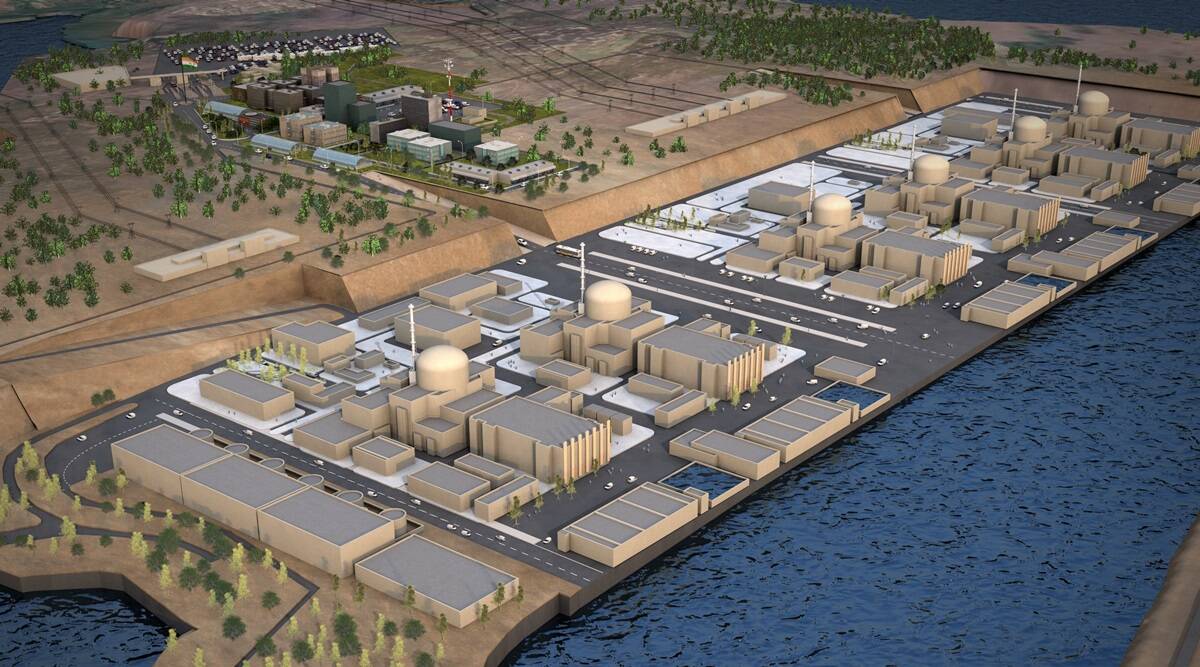
World Nuclear News 23rd April 2021, French company EDF has submitted to Nuclear Power Corporation of India Ltd (NPCIL) its binding techno-commercial offer to build six EPRs at Jaitapur in Maharashtra. The offer is the culmination of work that began with the 2018signature of an agreement between the two companies and paves the way for discussions towards a binding framework agreement.
https://world-nuclear-news.org/Articles/EDF-submits-offer-for-Jaitapur-project
Le Monde 23rd Aprilo 2021, It is believed to be the largest civilian atomic infrastructure in the world, with an installed capacity of 9,600 megawatts. This offer should initially have been submitted at the end of 2018 to the Nuclear Power Corporation of India Limited (NPCIL) group, the future operator of the plant.
But the approach of India’s spring 2019 general elections had made it untimely in the eyes of nationalist Prime Minister Narendra Modi, who is a candidate for his return to power. If the drafting of the document, more than 7,000 pages, finally took much longer than expected, it is also because of the sensitivity of its central subject: the distribution of responsibilities between the French corporation and the public operator. Indian.
In this case, EDF intends to impose its conditions. While the company chaired by Jean-Bernard Lévy originally said that it would build the entire Jaitapur plant, it now proposes to provide only “engineering studies and equipment”,
without being “Neither investor in the project nor responsible for construction”.
Brookfield interested in selling its stake in nuclear company Westinghouse
Brookfield explores sale of stake in nuclear firm Westinghouse -sources, Reuters, 24 Apr 21, Joshua FranklinDavid French, Brookfield Business Partners (BBU_u.TO) is exploring options including the sale of a minority stake in Westinghouse Electric Co that could value the U.S. nuclear power developer and servicer at as much as $10 billion including debt, people familiar with the matter said on Friday.
The sale plans come as the nuclear power sector may benefit from President Joe Biden’s push to tackle climate change. Biden unveiled a target to slash America’s carbon emissions by the end of the decade to 50% of what they were in 2005, and included nuclear power in the potential energy mix to achieve this goal. read more
While critics argue it is more expensive than renewable power sources and poses heightened safety risks, Westinghouse is among the companies seeking to develop smaller nuclear reactors, which are billed as cheaper and easier to deploy.
Brookfield Business Partners has hired investment banks to engage with potential buyers for a minority stake in Westinghouse, the sources said, requesting anonymity as the discussions are private.
The sources cautioned that there is no certainty Brookfield will find a buyer and that an outright sale of the company is also an option. Brookfield Business Partners and Westinghouse declined to comment.
Brookfield Business Partners Chief Executive Cyrus Madon said on a Feb. 5 earnings call that it could “test the market” in relation to Westinghouse.
“We could hang onto it and continue milking these incredible cash flows, but it will all come down to what’s the value we can get versus what we can create by keeping it,” Madon said.
One of the most storied names in the American power industry, Westinghouse was acquired by Brookfield Business Partners, an affiliate of Canadian asset manager Brookfield (BAMa.TO), in 2018 for $4.6 billion, including debt, from Toshiba Corp (6502.T)…… Brookfield Business Partners Chief Executive Cyrus Madon said on a Feb. 5 earnings call that it could “test the market” in relation to Westinghouse.
“We could hang onto it and continue milking these incredible cash flows, but it will all come down to what’s the value we can get versus what we can create by keeping it,” Madon said.
One of the most storied names in the American power industry, Westinghouse was acquired by Brookfield Business Partners, an affiliate of Canadian asset manager Brookfield (BAMa.TO), in 2018 for $4.6 billion, including debt, from Toshiba Corp (6502.T)…….. Brookfield Business Partners Chief Executive Cyrus Madon said on a Feb. 5 earnings call that it could “test the market” in relation to Westinghouse.
“We could hang onto it and continue milking these incredible cash flows, but it will all come down to what’s the value we can get versus what we can create by keeping it,” Madon said.
One of the most storied names in the American power industry, Westinghouse was acquired by Brookfield Business Partners, an affiliate of Canadian asset manager Brookfield (BAMa.TO), in 2018 for $4.6 billion, including debt, from Toshiba Corp (6502.T)……. https://www.reuters.com/business/energy/exclusive-brookfield-explores-sale-stake-nuclear-firm-westinghouse-sources-2021-04-23/
1 This Month



26 September – International Day for the Total Elimination of Nuclear Weapons


PLEASE OPPOSE HR 8255 AND S.3639 – bills would accelerate satellite deployment, with no environmental review or safeguards – https://ncstd5li.quorum.us/campaign/169331/
To see nuclear-related stories in greater depth and intensity – go to https://nuclearinformation.wordpress.com
-
Archives
- September 2026 (257)
- August 2026 (330)
- July 2026 (355)
- June 2026 (287)
- May 2026 (306)
- April 2026 (356)
- March 2026 (251)
- February 2026 (267)
- January 2026 (308)
- December 2025 (358)
- November 2025 (359)
- October 2025 (375)
-
Categories
- 1
- 1 NUCLEAR ISSUES
- business and costs
- climate change
- culture and arts
- ENERGY
- environment
- health
- history
- indigenous issues
- Legal
- marketing of nuclear
- media
- opposition to nuclear
- PERSONAL STORIES
- politics
- politics international
- Religion and ethics
- safety
- secrets,lies and civil liberties
- spinbuster
- technology
- Uranium
- wastes
- weapons and war
- Women
- 2 WORLD
- ACTION
- AFRICA
- Atrocities
- AUSTRALIA
- Christina's notes
- Christina's themes
- culture and arts
- Events
- Fuk 2022
- Fuk 2023
- Fukushima 2017
- Fukushima 2018
- fukushima 2019
- Fukushima 2020
- Fukushima 2021
- general
- global warming
- Humour (God we need it)
- Nuclear
- RARE EARTHS
- Reference
- resources – print
- Resources -audiovicual
- Weekly Newsletter
- World
- World Nuclear
- YouTube
-
RSS
Entries RSS
Comments RSS
 nuclear-news