Washington’s nuclear industry a costly failure for ratepayers. Now they’re about to fail again, with small nuclear reactors

Advanced Nuclear Dreaming in Washington State, CounterPunch, PATRICK MAZZA 19 Apr 21……………..The WPPSS default was part of the first wave of nuclear failures in the U.S. In the wake of the 1979 Three Mile Island accident, approximately 100 proposed nuclear plants were cancelled. Recent years have seen a second round of failures. The Energy Policy Act of 2005 put $25 billion in nuclear subsidies on the table. That jumpstarted all of four nuclear reactors, two each in Georgia and South Carolina. The only way Wall Street would touch the projects was to make ratepayers carry the risk by paying for “work in progress” before the first watt is delivered. South Carolina ratepayers won’t even see that. Cost overruns killed the project there in 2017 after $9 billion was thrown away, setting up a political and court fight over whether ratepayers will continue to be soaked. The last two standing, Georgia’s Vogtle plants, were to have cost $14 billion and come on line in 2016-17. Now costs have doubled to $28 billion and scheduled completion this year and next is considered unlikely.
IS THE SMR A SOLUTION?
SMRs are the nuclear industry’s answer to avoid such failures in the future. Instead of being custom-built and individually licensed, SMRs are intended to cut costs by licensing a single design manufactured at a plant and sent for final assembly to their operating site. Smaller than the 1,000-megawatt-plus plants with which we’re familiar, SMRs are 100 MW or less, and designed with safety features to prevent meltdowns such as experienced at Japan’s Fukushima plant in 2011. Though there are questions about that, as covered below.
X-energy’s proposed plant is 80 MW. The Washington partnership envisions clustering four to make a 320-MW complex, with costs estimated at $2.4 billion. Half is to come from the U.S. Department of Energy’s Advanced Reactor Demonstration Program (ARDP), and half from private investors, apparently leaving ratepayers out of the picture this time.
ARDP in 2020 made two $80 million grants to advanced nuclear reactor developers, one to X-energy, and the other to TerraPower, a venture in which Bill Gates has invested. The latter, slated to be 345 MW, aims at eventual scales as large as today’s plants, so it is not an SMR. The TerraPower liquid-sodium cooled reactor concept has its own set of issues. Liquid-sodium reactors have suffered operating difficulties and fires, and pose potential weapons proliferation hazards. The Raven will look at TerraPower in a future post……..
ROCKY ROAD TO MASS PRODUCTION
“The road to such mass manufacturing will be rocky,” Makhijani and M.V. Ramana write in a recent article, “Why Small Modular Reactors Won’t Help Counter the Climate Crisis.” “Even with optimistic assumptions about how quickly manufacturers could learn to improve production efficiency and lower cost, thousands of SMRs, which will all be higher priced in comparison to large reactors, would have to be manufactured for the price per kilowatt for an SMR to be comparable to that of a large reactor.”
That sets up “a chicken-and-egg economic problem,” they write. “Without the factories, SMRs can never hope to achieve the theoretical cost reductions that are at the heart of the strategy to compensate for the lack of economies of scale. But without the cost reductions, there will not be the large number of orders to stimulate the investments needed to set up the supply chain in the first place.”
That is leaving aside the prospect of a design defect being discovered after many SMRs have been deployed. In the 1990s, multiple Westinghouse-built reactors suffered common steam generator problems, resulting in lawsuits. “If an error in a mass-manufactured reactor were to result in safety problems, the whole lot might have to be recalled, as was the case with the Boeing 737 Max and 787 Dreamliner jetliners,” Makhijani and Ramana write. “But how does one recall a radioactive reactor? What will happen to an electricity system that relies on factory-made identical reactors that need to be recalled?”
The economic hurdles of SMRs posed by its competitors are overwhelming.
“Lazard, a Wall Street financial advisory firm, estimates the cost of utility-scale solar and wind to be about $40 per megawatt-hour,” Makhijani and Ramana write. “The corresponding figure for nuclear is four times as high, about $160 per MWh – a difference that is more than enough to use complementary technologies, such as demand response and storage, to compensate for the intermittency of solar and wind.”
While costs for competitors declines, nuclear costs continue to escalate. Cost for a proposed Idaho project by NuScale, another SMR developer, has doubled from an estimated $3 billion in 2015 to $6.1 billion in 2020 “long before any concrete has been poured,” Makhijani and Ramana note………. https://www.counterpunch.org/2021/04/19/advanced-nuclear-dreaming-in-washington-state/
USA’s Defense Secretary Lloyd Austin – a ”soldier’s soldier” and a useful purchaser for Raytheon’s military merchandise
Austin’s personal history and connection to the military and Raytheon mark him as a fitting Pentagon chief in an era of destructive militarism and creeping fascism in the U.S.
When civilians no longer control the key institutions of government and war industries ensure the perpetuation of endless wars from which they make obscene profits, the political system can no longer be defined as a democracy.

Defense Secretary Lloyd Austin—Former Member of Raytheon Board of Directors—Has Awarded Over $2.36 Billion in Contracts to Raytheon Since His Confirmation in January, Covert Action Magazine By Jeremy Kuzmarov – April 19, 2021 he Pentagon has awarded the defense giant Raytheon Technologies over $2.36 billion in government contracts since Secretary of Defense Lloyd Austin III’s confirmation on January 22nd.
Austin was on Raytheon’s board of directors prior to his confirmation.
Austin at the time had made a commitment to resign from Raytheon’s board and recuse himself from all matters concerning Raytheon for four years and agreed to divest from his financial holdings in the company, amounting to between $500,000 and $1.7 million in stock.
These initiatives, however, have not prevented Austin from using his position to bolster Raytheon’s fortunes. Nor those of other defense contractors on whose board he has sat such as Booz Allen Hamilton, the world’s “most profitable spy organization,” according to Bloomberg News, and Pine Island Capital, a private equity firm that invests in military industry.[1]
At Austin’s nomination hearing, Senator Elizabeth Warren (D-MA) questioned him about his ties to Raytheon—whose headquarters are based in Warren’s home district (Waltham, Massachusetts).
A year earlier, Warren had proposed legal changes to strengthen ethics at the Defense Department by blocking the revolving door between the Pentagon and giant defense contractors like Raytheon, including by prohibiting big defense contractors from hiring former Pentagon officials for four years after they leave government.
Warren paradoxically voted to confirm Austin’s appointment as Defense Secretary—even though he embodies the danger of the revolving door.
Mark Pocan (D-WI), who with Barbara Lee wrote a letter in November 2020 to President-elect Joe Biden requesting that he nominate a Secretary of Defense with no previous ties to weapons manufacturers, stated that “American national security should not be defined by the bottom lines of Boeing, General Dynamics and Raytheon.”
With men like Austin at the helm, however, it is very clearly being defined in this way…………….
Phyllis Bennis of the Institute for Policy Studies, a left-wing think-tank, told The Intercept that since “Raytheon manufactures the bomb components that are used in Yemen, [General Austin] bears a direct responsibility [for war crimes and civilian deaths]. He was making money as a board member of this company that is directly responsible for the death and destruction there.”
William Hartung, the director of the arms and security project for the Center for International Policy, said that “picking Austin was tantamount to making the position of Secretary of Defense the Secretary of Defense contractors.”
Raytheon’s 2021 Pentagon Contracts
Fitting with Hartung’s assessment, Raytheon has benefitted from multi-million-dollar government contracts on a near-daily basis since Austin has taken charge at the Pentagon.
On February 1st, the company secured a whopping $290,704,534 government contract to produce equipment for depot maintenance facilities and services in support of the F-35 Lightning II, which military analyst Pierre Sprey characterized as “overweight and dangerous.”……………….
Promoting More War
Though Austin claims to have recused himself from decisions involving Raytheon, the Pentagon under his direction is providing his old company with huge contracts on a daily basis that is bolstering its profits and stock price.
Austin furthermore has used his new bully pulpit to advocate for yet greater levels of military spending—to the benefit of Raytheon.
On February 25th, for example, on a visit to the U.S.S. Nimitz, Austin emphasized the need for U.S. warships throughout the globe to deter security threats—from China to Iran. A week later on a tour of Southeast Asia with Secretary of State Antony Blinken, Austin warned about China again and the North Korean nuclear threat and pledged that the U.S. would maintain a robust military presence in the Indo-Pacific.
He further cautioned North Korea that the United States, following military exercises with South Korea, was “ready to fight tonight.”
When fighting resumed in Eastern Ukraine in early April, Austin assured Ukraine’s Defense Minister Andrii Taran of the “U.S. commitment to building the capacity of Ukraine’s forces to defend more effectively against [supposed] Russian aggression”–which was demonstrated by a recent $125 million military aid package–and took to Twitter to reaffirm the U.S.’s “unwavering support for Ukraine’s sovereignty, territorial integrity, and Euro-Atlantic aspirations.”
…………A Soldier’s Soldier
Besides his connection to Raytheon, Austin’s appointment as Pentagon chief was controversial because he had not been retired from the military for the requisite seven years and required a legal waiver.
Traditionally, the role of Defense Secretary is supposed to be a civilian position, ensuring the U.S.’s military apparatus is led not by a warfighter, but a policymaker. That requirement is laid out in the National Security Act of 1947 that established the Defense Department.
Heralded as a “soldier’s soldier” who would endure hardships with his troops, the 6’4” tall Austin graduated from West Point in 1975, and led infantry troops in the capture of Baghdad during the 2003 Operation Iraqi Freedom.
After a stint commanding the 10th Mountain Division in Afghanistan, Austin was appointed as chief of staff of the U.S. Central Command at McDill Air Force Base in Tampa, Florida, a high-tech command post where military officers could watch live imagery on plasma screens and order air-strikes through the Pentagon’s secure internet server.
Groomed for high military command by Admiral Mike Mullen, Chairman of the Joint Chiefs of Staff from 2007 to 2011, Austin was appointed as Commanding General of U.S. forces in Iraq in 2010, and Commander of the U.S. Central Command (CENTCOM), which is responsible for all military operations in the Middle East, by President Obama in 2013.
In this latter capacity, Austin drafted a war plan—approved by Obama—that allowed the U.S. military for the first time to directly provide ammunition and weapons to Syrian opposition forces, who included Islamic jihadists.
President Obama also endorsed General Austin’s idea to increase the air campaign on Islamic State of Iraq and the Levant (ISIS) from Incirlik Air Base in Turkey. The result was an increase in civilian deaths. Journalists Anand Gopal and Azmat Khat determined that one in five of the 27,500 coalition air strikes in the 2nd Iraq War resulted in at least one civilian death, more than 31 times the number that was publicly acknowledged
Austin’s personal history and connection to the military and Raytheon mark him as a fitting Pentagon chief in an era of destructive militarism and creeping fascism in the U.S.
When civilians no longer control the key institutions of government and war industries ensure the perpetuation of endless wars from which they make obscene profits, the political system can no longer be defined as a democracy. https://covertactionmagazine.com/2021/04/19/defense-secretary-lloyd-austin-former-member-of-raytheon-board-of-directors-has-awarded-over-2-36-billion-in-contracts-to-raytheon-since-his-confirmation-in-january/
How weapons maker Raytheon determines U.S. foreign policy decisions

Defense Secretary Lloyd Austin—Former Member of Raytheon Board of Directors—Has Awarded Over $2.36 Billion in Contracts to Raytheon Since His Confirmation in January, Covert Action Magazine By Jeremy Kuzmarov – April 19, 2021
”…………… One of the Raytheon company founders, Vannevar Bush, became president of the Massachusetts Institute of Technology (MIT) and chairman of the U.S. Office of Scientific Research and Development (OSRD) during World War II, which initiated the Manhattan Project that led to the development of the atomic bomb.
In 2003, Raytheon put out a press release bragging that half of all air-to-ground precision guided missiles (PGMs) used by coalition forces in Operation Iraqi Freedom were made by Raytheon.
…………….On February 25th, for example, on a visit to the U.S.S. Nimitz, Austin emphasized the need for U.S. warships throughout the globe to deter security threats—from China to Iran. A week later on a tour of Southeast Asia with Secretary of State Antony Blinken, Austin warned about China again and the North Korean nuclear threat and pledged that the U.S. would maintain a robust military presence in the Indo-Pacific.
He further cautioned North Korea that the United States, following military exercises with South Korea, was “ready to fight tonight.”
When fighting resumed in Eastern Ukraine in early April, Austin assured Ukraine’s Defense Minister Andrii Taran of the “U.S. commitment to building the capacity of Ukraine’s forces to defend more effectively against [supposed] Russian aggression”–which was demonstrated by a recent $125 million military aid package–and took to Twitter to reaffirm the U.S.’s “unwavering support for Ukraine’s sovereignty, territorial integrity, and Euro-Atlantic aspirations.”
The latter implied the joining of the European Union (EU) and North Atlantic Treaty Organization (NATO), which would inevitably escalate conflict between the world’s two major nuclear-armed powers (the U.S. and Russia).
On April 13th, Austin announced that the United States would increase its military presence in Germany by about 500 personnel and was scuttling plans introduced by President Donald Trump for a large troop reduction in Europe.
Austin meanwhile in Tel Aviv affirmed the U.S. “ironclad commitment” to Israel, which receives a record $3.8 billion in U.S. military aid each year, and on a visit to Afghanistan stated that the Biden administration wanted to see a “responsible end” to the Afghan war, but that the “level of violence must decrease” for “fruitful diplomacy” to have a chance.
These comments and many others were music to the ears of Raytheon, which gave $506,424 in donations to Biden’s presidential campaign.
…………….Raytheon was also the first major defense contractor to sell weapons to Saudi Arabia, selling the kingdom over 1,000 cluster bombs designed to maximize civilian casualties between 1970 and 1995. The company further hired members of the Saudi Royal Family as consultants, and opened a branch in Riyadh in 2017.
After the Yemen war began in 2015, Raytheon, according to an analysis by The New York Times, booked more than $3 billion in new bomb sales to the Saudis, causing its stock prices to increase from about $108 to more than $180 per share.
In 2019, Raytheon sold an estimated $8 billion in weapons to Saudi Arabia and the United Arab Emirates, which are centrally involved in the war in Yemen.

After an October 2016 Saudi airstrike on a funeral home in Sana’a that killed 140 people and wounded 500 more, human rights workers discovered a bomb shard bearing the identification number of Raytheon.[2] It was one of at least 12 attacks on civilians that human rights groups tied to Raytheon’s ordnance during the first two years of the war.
In order to secure the lucrative Saudi deals, Raytheon took advantage of federal loopholes by sending former State Department officials to lobby their former colleagues, and later benefitted by having their former top lobbyist, Mark Esper, appointed as Defense Secretary in June 2019 in a precursor to General Austin’s hiring.………..
Defense Secretary Lloyd Austin—Former Member of Raytheon Board of Directors—Has Awarded Over $2.36 Billion in Contracts to Raytheon Since His Confirmation in January
Electricity customers pay excessive costs for nuclear power – Egypt, Turkey, UK, France, Russia

Part two | Nuclear energy in Africa, The second in this three-part series looks at how power purchase agreements raise the cost of electricity for consumers and act as major sources of inflationary pressure in economies. New Frame, By: Neil Overy, 1 Dec 2020 Recent deals brokered between host nations and nuclear power companies show how consumers ultimately bear the cost of building nuclear power plants because of power purchase agreements, which favour the vendor and lower their financial risk but often lead to hugely inflated electricity costs for consumers.
No official details have yet been given to indicate what the price will be for electricity generated by the El Dabaa plant that Russia’s state-owned Rosatom is building in Egypt. But in 2016, one Egyptian energy expert predicted that prices per megawatt hour – how much it costs to produce one megawatt of energy for one hour – from El Dabaa would be at least four times more than from renewable power sources. Renewable energy prices have fallen significantly since 2016, while nuclear power has become more expensive.
British consumers will pay excessive amounts for electricity from the Hinkley Point C nuclear power station that EDF is building for decades after the plant is completed. While construction does not follow the Build-Own-Operate model, EDF negotiated a 35-year power purchase price linked to inflation with the British government in 2016 to extract as much profit as possible. The British government’s Public Accounts Committee conservatively estimated that this deal will cost consumers an additional $40 billion (about R615 billion) over the 35 years of the contract compared with alternative energy sources such as solar and wind.
A similar story is playing out in Turkey. Critics have pointed out that the price the government has agreed to pay Rosatom for electricity generated by the Akkuyu plant the Russian vendor is building will cost the country an additional $27 billion over the 15-year period of the power purchase agreement. This is because the price that has been agreed between Rosatom and the Turkish government is significantly above current electricity costs. A 2019 report by the Union of Chambers of Turkish Engineers and Architects notes that electricity purchased from the plant will be at least 275% more expensive than alternatives.
Financial trouble
Despite such deals being signed, the long-term financial viability of state-owned nuclear vendors is questionable. EDF received significant cash injections from the French government and secured favourable loans backed by the British Treasury for Hinkley Point C, but was still forced to sell a third of its stake in the project to the China General Nuclear Power Group in 2016 because it was running out of money.
And EDF remains in serious financial trouble. It is about $52 billion in debt and two major agencies have given it a negative credit rating. The French energy company’s problems stem from delays in the construction of Hinkley Point C, which is said to have cost it at least another $4 billion so far, and at other nuclear power stations it is building. The Flamanville 3 project in France is now four times over budget and 10 years late. In Finland, the Olkiluoto 3 project is also four times over budget and is now only expected to be running in 2022, 13 years after its original start-up date. Further delays at Hinkley Point C and Flamanville 3 are strongly anticipated, which will plunge EDF further into the mire, meaning that more bailouts from the French government are likely.
Rosatom has experienced serious problems financing the Akkuyu nuclear power station. In 2016, it tried to sell a 49% share in the project because it could not raise the necessary capital to complete the plant. After failing to find any buyers, Rosatom was saved, at least in the short term, late last year by a $400 million loan from another Russian state-owned enterprise, Sberbank. Unsurprisingly, the completion of this plant is also delayed. Originally scheduled to be operational by 2019, its completion has already been pushed back twice and it is now predicted to be partially operational by 2023.
That companies like EDF and Rosatom are reliant on the willingness of their respective governments to fund their survival is troubling. The economic consequences of the Covid-19 pandemic perfectly illustrate how susceptible both the global economy and individual economies are to unexpected shocks. Falling electricity sales in France owing to Covid-19 are resulting in intense speculation that EDF will need a significant emergency bailout from the French government sometime in early 2021 or face financial ruin. It is not clear what would happen to the plants it is currently building if EDF were to collapse. They could be abandoned, or taxpayers in host countries could be forced to pay even more for their completion.
These financial difficulties are often the result of problems that emerge during the construction phase of nuclear power stations, which lead to delays. A study completed in 2014 revealed the extent of this problem, saying only 3% of nuclear power stations have been built on schedule. In 2018, researchers from the Centre for Environmental Policy at Imperial College London found that between 1955 and 2016, construction delays increased the cost of nuclear power plants by 18% on average over their original budgets.
Consumers as cash cows
In effect, the public pays twice for these delays. In vendor countries such as France and Russia, taxpayers contribute to the bailouts of state-owned companies like EDF and Rosatom. In recipient countries, such as the United Kingdom, Egypt and Turkey, the public pays through artificially inflated electricity bills.
Rather than reflecting on this double burden, vendors and compliant governments are inventing new ways to squeeze yet more money out of the public. To fund additional nuclear power plants in Britain, the government is now considering a new funding model called Regulatory Asset Base (RAB).
The RAB model basically gives a blank cheque to vendors, allowing them to start charging customers for electricity during the construction phase of a power plant, before the station even produces electricity. In addition, it covers vendors for construction cost overruns of up to 30%, all of which would be paid for by consumers. It is proposed that the British government would cover any construction cost overruns of more than 30%. In effect, this funding model transfers almost all financial risk from investors to consumers, through hugely inflated electricity bills or tax transfers to vendors, or both.
In September, EDF appeared to indicate that it would only bid for the contract to build the proposed $25 billion Sizewell C nuclear plant in Britain if the British government adopted the RAB funding model…………………https://www.newframe.com/part-two-nuclear-energy-in-africa/
Ratepayer advocate calls on New Jersey Supreme Court to reverse decision allowing subsidy to nuclear power
Nuclear subsidy gets new challenge, NJ Spotlight TOM JOHNSON, ENERGY/ENVIRONMENT WRITER | APRIL 14, 2021 | ENERGY & ENVIRONMENT, NJ ratepayer advocate asks Supreme Court to consider decision on $300 million subsidy. Regulators are poised to add more,
New Jersey Rate Counsel Director Stefanie Brand is asking the New Jersey Supreme Court to reverse last month’s appellate court decision upholding the award of hundreds of millions in ratepayer subsidies to the state’s nuclear power plants.
In a notice of a petition for certification, the Division of Rate Counsel argued the lower court erred when it upheld the New Jersey Board of Public Utilities’ decision in 2019 to approve $300 million in new surcharges on customers’ gas and electric bills. Without the subsidies, Public Service Enterprise Group, whose subsidiary operates three nuclear units in South Jersey, has threatened to close the plants because they are no longer profitable.
If the high court decides to review the case, it could result in the justices taking up the case at roughly the same time as the BPU, which is scheduled to decide whether the plants — Hope Creek, Salem I and Salem II — qualify for additional subsidies from ratepayers for another three years. The BPU is expected to rule on those applications on April 27. The first subsidy added about $70 a year to what residential customers pay for electricity……… https://www.njspotlight.com/2021/04/nj-rate-counsel-director-stefanie-brand-seeks-supreme-court-reversal-300-million-nuclear-subsidy-pseg/
New nuclear power may not be feasible in USA – former NRC chair says
Former NRC chair questions economic feasibility of new nuclear in US, Utility Dive Iulia Gheorghiu. 12cApr 21,
Without further aid from Congress and the White House, the prospects for the U.S. nuclear industry will dwindle in the face of cheaper resources that are getting built faster than new nuclear generators, according to a former Chairman of the U.S. Nuclear Regulatory Commission………
Excepting NuScale Power, which has advanced in permitting with the NRC, the near-term potential for other small modular reactor designs to replace physical coal plants is “very low in the near future, like zero,” Allison Macfarlane, …..
The only U.S. reactors currently under construction continue to face delays. Vogtle Unit 3 and Unit 4 are poised to be the first nuclear plants completed in the United States [since 2016]……….
Excepting NuScale Power, which has advanced in permitting with the NRC, the near-term potential for other small modular reactor designs to replace physical coal plants is “very low in the near future, like zero,” Allison Macfarlane, …..
The only U.S. reactors currently under construction continue to face delays. Vogtle Unit 3 and Unit 4 are poised to be the first nuclear plants completed in the United States [since 2016]……….
Georgia Power, one of the owners of the two nuclear reactors at Vogtle Power Plant, recently announced construction remediation work, signaling further delays for the unit that is expected to be operational later this year.
“If we don’t pay attention to this issue, there is no future for nuclear, you will not build anything. It will all be too expensive, it will all take too long,” she said.
She remarked on supply chain issues with larger designs, such as the Westinghouse AP1000 design, a pressurized water reactor power plant that was used in V.C. Summer and Vogtle construction.
“The AP1000 is a good design, but it may be a dead design,” Macfarlane said. https://www.utilitydive.com/news/former-nrc-chair-questions-economic-feasibility-of-new-nuclear-in-us/598188/
Bitcoin: cryptocurrency an extreme energy user. Can it be justified in a climate emergency?

This is a critically important article. As long as multi billionaires like Elon Musk and Bill Gates are accepted as authorities of integrity, on what direction society should take, we are in trouble. Both of these visionary zealots are enthusiastic about nuclear power. Both are enthusiastic about nuclear-powered space rocketry. Elon Musk is all for Bitcoin. I don’t know about Bill Gates’opinion on this. While we acknowledge thsat these entrepreneurs have made beneficial achievements, we really do not need to minlessly follow them. Neither are really scientific experts, and should not in any way be determining society’s policies on climate, or anything else. Neither show any awareness of concern about unlimited growth and unlimited energy use, on a finite planet.
A new “crypto climate accord” wants to clean up Bitcoin. But the calls for government regulation, bans and taxation are growing. The post Can cryptocurrency be justified in a climate catastrophe? appeared first on RenewEconomy.
Can cryptocurrency be justified in a climate catastrophe? — RenewEconomy
Bitcoin mining and cryptocurrency in general are having what could very loosely be sort of described as a ‘coming of age’ moment. It’s loose because advocates of these digital currencies, which obtain ‘trust’ from requiring massive amounts of energy to generate (‘proof of work’), don’t seem to be handling the challenges of dealing with key issues like climate and environment particularly well.
This was explored recently in RenewEconomy, in this post detailing how there are many Bitcoin mining operations running massive server farms that either exist on carbon intensive grids, or even directly use fossil gas on mining sites where that gas would have otherwise been flared.
And last week, we covered a piece of research that predicted Bitcoin’s energy consumption will match that of Australia’s by the year 2024.
“Under the Paris Agreement, China is devoted to cut down 60 per cent of the carbon emission per GDP by 2030 based on that of 2005. However, according to the simulation results of the [blockchain carbon emission] model, we find that the carbon emission pattern of Bitcoin blockchain will become a potential barrier against the emission reduction target of China”, the researchers found. It’s significant, because the fate of China on energy and climate decides, by and large, the fate of the world.
Part of the reason interest has increased in Bitcoin was a significant purchase of it by Tesla. CEO Elon Musk is a well-known fan of cryptocurrency, including Dogecoin, an alternative to the more mainstream Bitcoin. But scrutiny of its extreme energy consumption, alongside a lack of any real sustainability or environment initiatives across the industry of Bitcoin miners, has led to nearly months now of constant criticism (including from this author).
Now, a new initiative is attempting to change that at a surprisingly ambitious and fundamental level. Last week, a range of organisations launched the ‘Crypto Climate Accord’, aiming to decarbonise the entire cryptocurrency industry, including Bitcoin trading house Coinshares.
Among the partners are the Rocky Mountain Institute (RMI), well-regarded among energy experts, and representations from the United Nations Framework Convention on Climate Change (UNFCCC). Energy Web and the Alliance for Innovative Regulation (AIR) are involved too, as are the cryptocurrency companies.
“The Accord intends to achieve this by working collaboratively with the cryptocurrency industry — including all blockchains — to transition to 100% renewable energy by 2025 or sooner. While many organisations are individually taking steps to decarbonise their operations, the Accord recognises that an industry-wide coalition and scalable solutions can quickly multiply impact.”
Total decarbonisation of power by 2025 comes along with full decarbonisation of all business operations by 2040, and with the active removal of historical emissions from the Earth’s atmosphere by 2040. These are both genuinely ambitious goals, and they seem to be closely tied to international climate diplomacy. It is a far cry from the decentralised, regulation-hating, unaccountable world of Bitcoin mining as it exists today.
While this seems like a step in the right direction, it is very likely its advocates will be swimming against the tide. The very philosophy of collective action to take responsibility for the externalities of profit-making business is contrary to the libertarian values of individual freedom. Some participants may not be all that invested. “Coinshares less than two weeks ago was arguing more energy consumption is about the best thing ever. I’m not sure how this is inspired by the Paris Agreement if they’ve clearly never read it or don’t understand it”, wrote Alex De Vries, author of the Digiconomist blog.
Meanwhile, Bitcoin seems only to be getting hungrier for energy, and there doesn’t seem to be much effort to direct that big ship towards clean power sources only. Cheap coal and gas will likely get cheaper, as they both get displaced from grids by renewable energy.
The Centre for Global Development just released a new analysis showing that mining a single Bitcoin is equivalent to the total annual energy usage of 18 Americans, or 2,199 Tanzanians.
They recommend a range of policy options to forcibly clamp down on the problem, including a ban of large mining operations and taxing mining activity. Neither of these will be welcomed by the industry. “The most hopeful case for the environment is that the price of bitcoin falls low enough to push most miners out of business, leaving behind only those with access to cheap renewable energy and the most efficient mining rigs”, they write.
The question is whether voluntary accords or forcible regulation win out in cleaning up Bitcoin. The alternative is very ugly – a major new threat to climate action at a sensitive time indeed.
An American village made dependent on the nuclear industry. Perry schools’ crisis if the nuclear power station shuts down

After Being “Promised Wealth:” What Happens to Perry if the Nuclear Power Plant Shuts Down? Spectrum News, By Micaela Marshall Cleveland, Apr. 08, 2021, PERRY, Ohio — What’s been called the largest corruption and money-laundering scheme in Ohio history has dominated headlines since last summer.
The political back-and-forth surrounding House Bill 6 has led to uncertainty in communities that rely on the two Ohio nuclear power plants caught up in the controversy.
What You Need To Know
The money-laundering scheme surrounding House Bill 6 has been in the headlines for months
House Bill 6 is a bailout for nuclear power plants
The halting of the bailout causes concerns the plants may close
The communities and schools depending on the employment at the plants are worried.
The village of Perry in Lake County is known for two things: The Perry Nuclear Power Plant and Perry Local Schools, and the relationship between the two is vital to the local economy. ……
Less than three miles away [from the schools complex] is the Perry Nuclear Power Plant.
It was commissioned in 1987 and a big promise was made to the people of Perry, in return for the risk of exposure.
“Back in the day, they were promised wealth that would go on through eternity,” Thompson said.
That guarantee held up at first and allowed for the Perry Local Schools District to become home to state-of-the-art facilities.
“We were able to build and have some amenities that were not common,” Thompson said.
The Goodwin Theatre, and a campus fitness center with an Olympic-sized pool are some of those amenities.
“You’re not going to see another district that’s built like this,” he said.
Grants have led to upgrades over the years. …..
The two-story building’s architecture is elaborate. There’s even a clock tower.
“It has absolutely zero use other than aesthetics,” Thompson said.
Many of the features are unique for a school, especially one in rural Ohio.
“You have this outside veranda that is just gorgeous,” he said pointing to the area outside the middle school.
………… “Nothing’s going to replace the revenue that the nuclear power plant has brought this community over the last 30 years,” Thompson said. ………. https://spectrumnews1.com/oh/columbus/news/2021/04/08/-they-were-promised-wealth-that-would-go-on-through-eternity–what-happens-to-perry-if-the-nuclear-power-plant-shuts-down-
France fully nationalises debt-laden EDF nuclear company, – EDF can now focus on renewable energy.
France reportedly to spend $12bn to buy out EDF minority shareholders
NS Energy 7th April 2021
POWERNUCLEARINVESTMENTBy NS Energy Staff Writer 07 Apr 2021
The move is part of the proposed restructuring of the multinational electric utility company
The French government is reportedly anticipating to spend around 10 billion euros ($11.87bn) to buy out minority shareholders in EDF.
The move is part of the proposed restructuring of the multinational electric utility company, in which the current ownership of the French government stands at 83.7%.
Currently under discussion between Paris and the European Commission, the restructuring is expected to result in the formation of a holding company, EDF SA, Reuters reported.
The holding company will be fully state-owned and the proposed restructuring of EDF is codenamed “Project Hercules.”
CGT union executive Sebastien Menesplier was quoted by the news agency as saying: “We are told the state will invest 10 billion euros to buy back the shares held by minority shareholders in order for EDF SA to become 100% state-owned.”
The French government has initiated Project Hercules in order to secure the future of the debt-laden nuclear unit of EDF.
The project was also conceived to enable more attractive part of the business not get impacted by the group’s liabilities.
The proposed restructuring is planned to include nationalisation of the holding company that will incorporate nuclear assets.
As part of the plans, a separate entity, which will be controlled by the holding company, will be created to hold more lucrative businesses.
EDF earlier said that it would be able to double its growth target for renewable energy if the planned restructuring was given go ahead.
The company expected to expand its renewable energy capacity to 100GW by 2030, if Project Hercules is rolled out.
In February, EDF Renewables, along with its partners Enbridge and wpd, started the construction activities at the 448MW Calvados offshore wind farm in France.
Uncertain future for EDF’s Dungeness nuclear power station. It may have to shut down early.
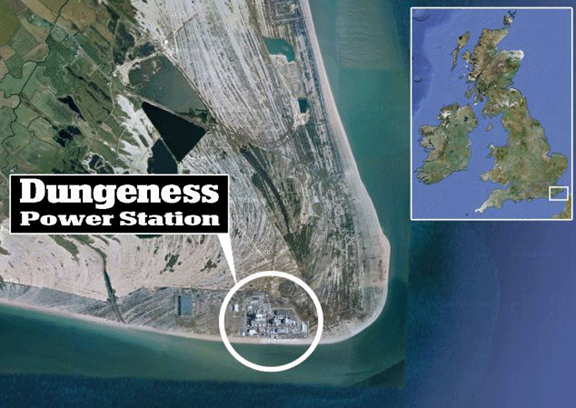
Reuters 8th April 2021, DF Energy, owned by French utility EDF, is exploring a range of scenarios for its Dungeness B nuclear plant in Britain, including bringing forward its decommissioning date of 2028, it said on Thursday. The 1.1 gigawatt Dungeness B plant, in Kent on the south coast of England, has been offline since 2018 as the company has been carrying out inspections and maintenance of pipes carrying steam to the turbine. EDF Energy has also been trying to complete repair work on corrosion identified during inspections of safety back-up systems.
The plant is currently forecast to return to service in August. It was designed in the 1960s and first started generating
electricity in 1983. EDF Energy said it has spent more than 100 million pounds ($138 million) on the plant during its current outage and it has a number of ongoing technical challenges that make its future uncertain.
New defects in France’s Flamanville nuclear project. Doubts that it will start-up on time, – or indeed ever!
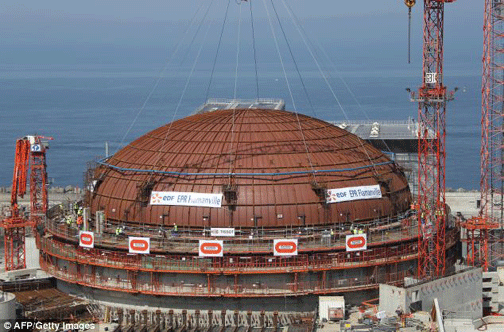
France Info 7th April 2021, Flamanville EPR: “The start-up does not seem possible before 2023” and we can doubt “that it will start one day”, according to negaWatt. “The decision to stop the costs is extremely difficult to take because we are talking about an investment of around 20 billion euros,” said energy expert and spokesperson for the association, Yves Marignac.
La Presse de la Manche 6th April 2021, The Nuclear Safety Authority was notified on March 17, 2021 of the late detection of faults in several pieces of equipment in reactors 1 and 2 at the Flamanville nuclear power plant, in the English Channel.
Japanese government continues Japan’s ”Nuclear Village” generous grants to keep ageing nuclear reactors going.

Lucrative grants offered to keep aging nuclear reactors running, http://www.asahi.com/ajw/articles/14326422
THE ASAHI SHIMBUN
April 7, 2021 The central government is offering billions of yen in new grants to Fukui Prefecture to allow a nuclear plant operator to run its aging reactors beyond their operational life span of 40 years.
Fukui is not the only prefecture in Japan that hosts old reactors, and the grants could create momentum toward the restarts of these units.
“As for an expansion of grants, up to 2.5 billion yen ($22.6 million) will be provided per nuclear plant to a prefecture preparing to respond to the extension of the 40-year life of reactors,” the Ministry of Economy, Trade and Industry said in a document presented to the Fukui prefectural government on April 6.
The ministry’s offer is expected to become a key point of discussions as Fukui Prefecture and the prefectural assembly begin to weigh whether they should approve of the restart of three reactors in question there.
Fukui Governor Tatsuji Sugimoto hailed the central government’s offer, calling it “a step forward.”
He had urged the prefectural assembly to discuss the restart issue in February, but the assembly put off the debate, citing a lack of measures to revitalize the local economy.
Osaka-based Kansai Electric Power Co. is pushing to reactivate the three reactors in Fukui Prefecture–the No. 1 and 2 reactors at the Takahama nuclear plant in Takahama and the No. 3 reactor at the Mihama nuclear plant in Mihama.
The Nuclear Regulation Authority has given its one-time permission to operate those reactors for 20 more years beyond their 40-year life spans.
If the local governments approve the restarts, Fukui Prefecture would receive a combined 5 billion yen under the new grant setup.
The town halls of Takahama and Mihama have already given the greenlight to the restarts. The remaining hurdle is whether the governor and the prefectural assembly will approve them.
The maximum 2.5 billion yen will be made available over a period of five years, according to the industry ministry’s Agency for Natural Resources and Energy.
The offer of the funds came in response to the Fukui prefectural government’s request for additional grants concerning the reactors as a measure to stimulate the local economy.
The prefectural government is expected to discuss how to distribute the grants with Takahama and Mihama.
Other prefectures hosting old reactors operated by companies seeking the 20-year extension will be eligible for the new grants.
The only other facility that has gained the NRA’s permission to operate beyond 40 years is the Tokai No. 2 nuclear plant in Ibaraki Prefecture.
Five other reactors in Japan have been in service for more than 35 years.
The decommissioning process has started for other aging reactors because their operators decided that upgrades and additional safeguard measures required to bring them back online would be too expensive.
(This article was written by Kenji Oda and Takayuki Sato.)
Bitcoin mining to consume more electricity than whole of Australia by 2024 — RenewEconomy

Researchers warn bitcoin mining could undermine efforts to reach global climate targets, with electricity consumption expected to surpass that of Australia. The post Bitcoin mining to consume more electricity than whole of Australia by 2024 appeared first on RenewEconomy.
Bitcoin mining to consume more electricity than whole of Australia by 2024 — RenewEconomy
The amount of electricity consumed by bitcoin mining operations will surge over the next three years, consuming more power than entire countries, including that of Australia, new research has predicted.
In a new research paper published in the journal Nature Communications, researchers from the Chinese Academy of Sciences and Tsinghua University have projected that on current trends, bitcoin mining electricity consumption will more than double from its current levels, peaking in 2024.
At that time, the researchers say, the total electricity consumption of Bitcoin miners will reach as high as 297 terawatt-hours annually if no measures are undertaken to curb energy use or emissions. This will be more than the annual electricity consumption of the whole of Australia, which currently stands at around 265 terawatt-hours per year.
The surge in electricity consumption will see bitcoin rank as the equivalent of the 12th largest electricity consumer amongst all countries, higher than the likes of major European economies, including Italy and Spain.
The researchers say that without stricter regulatory controls, the growing energy demand of Bitcoin and cryptocurrencies more broadly could undermine global sustainability efforts.
Using a simulated carbon emissions model, the research led by researchers Dabo Guan and Shouyang Wang estimates that Bitcoin mining will be responsible for 130 million tonnes of carbon emissions – higher than the emissions of countries like Qatar and the Czech Republic.
The operation of cryptocurrencies like bitcoin requires substantial computational power to process transactions and to maintain a transaction ledger.
Computers dedicated to processing these transactions are awarded in return for their computational power by being issued units of the cryptocurrency.
The offer of potentially lucrative cryptocurrency units in return for computing resources has sparked a surge in investment in dedicated ‘mining’ equipment, which has sent energy consumption surging with it.
This has particularly been the case in China, where access to cheaper supplies of electricity and ready access to the necessary computer equipment has made bitcoin mining a profitable venture.
It is estimated that around 70 per cent of bitcoin miners are located in China.
But the researchers said that the operations are already causing electricity demand throughout China to increase, with bitcoin mining ranking in the top 10 among China’s 182 prefecture-level cities, as well as amongst 42 major industrial sectors in China.
Bitcoin is already responsible for approximately 5.4 per cent of China’s electricity emissions.
The researchers warned that the bitcoin mining operations could undermine China’s efforts to meet its targets under the Paris Agreement.
“The Paris Agreement is a worldwide agreement committed to limit the increase of global average temperature,” the research paper says.
Under the Paris Agreement, China is devoted to cut down 60 per cent of the carbon emission per GDP by 2030 based on that of 2005. However, according to the simulation results of the [blockchain carbon emission] model, we find that the carbon emission pattern of Bitcoin blockchain will become a potential barrier against the emission reduction target of China.”
As Ketan Joshi reported for RenewEconomy, the quest to supply Bitcoin mining operations with cheap sources of power have seen operators turn to fossil fuel generators for their supplies of electricity.
The researchers suggest that an ‘individualised’ approach that encourages miners to shift away from regions predominantly powered by coal and into regions that can act as a source of zero emissions electricity.
he paper warns that the imposition of carbon prices or taxes may only work to shift miners to other countries with lower energy costs, potentially seeing them continue to use supplies of fossil fuel electricity.
The researchers say miners should be moved into regions with higher proportions of renewable energy supplies, such as hydroelectricity, and supporting operations to take advantage of surplus electricity supplies.
While this ‘site regulation’ approach modelled by the researchers showed electricity demand growing even higher, potentially reaching 320 terawatt-hours by 2025, however, emissions will be substantially lower.
“Among all the intended policies, Site Regulation shows the best effectiveness, reducing the peak carbon emission per GDP of the Bitcoin industry to 6 kg per USD. Overall, the carbon emission per GDP of the Bitcoin industry far exceeds the average industrial carbon intensity of China, which indicates that Bitcoin blockchain operation is a highly carbon-intense industry,” the paper says
In a positive move, Polish utilities remove their investment in nuclear power development.

Nuclear Project Divestment Positive for Polish Utilities, Fitch Ratings, Tue 30 Mar, 2021. -London-. The announced divestment of shares in the first nuclear power plant project in Poland to the State Treasury is positive for the credit profiles of divesting utilities, Fitch Ratings says.
For utilities, this step takes away the risk of being involved in high-risk, long-term and very capital-intensive nuclear generation projects, which are beyond the capacity of even a consortium of utilities if not backed by price-support mechanisms or state guarantees to debt. It will also let utilities concentrate on expansion in much less capital-intensive and much shorter time-to-EBITDA wind, solar and gas-fired generation……….
As per Poland’s new energy policy, the first nuclear power block is expected to start generation in 2033….
The government is planning to make nuclear generation a source of baseload electricity……….
the adoption of the country’s new energy policy in February 2021, new nuclear power programme in October 2020 and negotiations with suppliers of nuclear technology. The US’s Westinghouse Electric Company (B/Stable) is leading the race………
However, even after the final decisions with respect to location and construction are taken, the process will be lengthy and technically complex, so delays beyond the planned delivery date of 2033 are a real possibility. Most of the ongoing nuclear generation projects in Europe face multi-year delays. This strengthens our view that the announced withdrawal of PGE, ENEA and Tauron from the nuclear project company is positive for their credit profiles.
Contact:
Artur Galbarczyk
Director
+48 22 338 6291
Fitch Ratings Ireland Limited Sp. z o.o. Branch in Poland
Krolewska 16, 00-103 Warsaw
Arkadiusz Wicik
Senior Director
+48 22 338 6286
Media Relations: Adrian Simpson, London, Tel: +44 20 3530 1010, Email: adrian.simpson@thefitchgroup.com
Additional information is available on www.fitchratings.com https://www.fitchratings.com/research/corporate-finance/nuclear-project-divestment-positive-for-polish-utilities-30-03-2021
Ohio’s Electric Power Association happy to see the end of customer-funded nuclear subsidies
EPSA expresses support for Ohio’s end of customer-funded nuclear subsidies, https://dailyenergyinsider.com/news/29767-epsa-expresses-support-for-ohios-end-of-customer-funded-nuclear-subsidies/?amp Chris Galford, With Gov. Mike DeWine’s approval last week, Ohio House Bill 128 officially put an end to nuclear energy subsidies in the state and amended existing law to better benefit solar resources instead, earning praise from the Electric Power Supply Association (EPSA).
Specifically, H.B. 128 took aim at the provisions of another bill, H.B. 6, from the last General Assembly.
“Today is a long-awaited day for Ohio families and businesses,” Todd Snitchler, head of the EPSA, said. “The nuclear subsidies included in H.B. 6 were unnecessary and unjustified, and only passed due to the alleged unprecedented corruption in the legislative process and referendum effort. The H.B. 6 debacle shows that politically motivated efforts to subsidize favored energy resources at the behest of powerful and well-funded interests invites malfeasance, undermines competition and innovation, and drives up costs for consumers without ensuring better energy solutions for those paying the bill.”
H.B. 6 had, at the time, been widely promoted by FirstEnergy Corp. and FirstEnergy Solutions. It categorized nuclear power alongside other renewable energy sources. It allowed providers to draw credits for each megawatt hour of electricity reported and to draw from a $20 million annual disbursement fund for renewable sources, among other things.
The EPSA staunchly opposed that fact, and even now, Snitchler added that the rest of H.B. 6 should be taken up by the Legislature and resolved. However, the national trade association did call the current moves a win for fair market competition and consumer choice.
H.B. 128 was sponsored by state Reps. Jim Hoops (R-Napoleon) and Dick Stein (R-Norwalk)
1 This Month



26 September – International Day for the Total Elimination of Nuclear Weapons


PLEASE OPPOSE HR 8255 AND S.3639 – bills would accelerate satellite deployment, with no environmental review or safeguards – https://ncstd5li.quorum.us/campaign/169331/
To see nuclear-related stories in greater depth and intensity – go to https://nuclearinformation.wordpress.com
-
Archives
- September 2026 (257)
- August 2026 (330)
- July 2026 (355)
- June 2026 (287)
- May 2026 (306)
- April 2026 (356)
- March 2026 (251)
- February 2026 (267)
- January 2026 (308)
- December 2025 (358)
- November 2025 (359)
- October 2025 (375)
-
Categories
- 1
- 1 NUCLEAR ISSUES
- business and costs
- climate change
- culture and arts
- ENERGY
- environment
- health
- history
- indigenous issues
- Legal
- marketing of nuclear
- media
- opposition to nuclear
- PERSONAL STORIES
- politics
- politics international
- Religion and ethics
- safety
- secrets,lies and civil liberties
- spinbuster
- technology
- Uranium
- wastes
- weapons and war
- Women
- 2 WORLD
- ACTION
- AFRICA
- Atrocities
- AUSTRALIA
- Christina's notes
- Christina's themes
- culture and arts
- Events
- Fuk 2022
- Fuk 2023
- Fukushima 2017
- Fukushima 2018
- fukushima 2019
- Fukushima 2020
- Fukushima 2021
- general
- global warming
- Humour (God we need it)
- Nuclear
- RARE EARTHS
- Reference
- resources – print
- Resources -audiovicual
- Weekly Newsletter
- World
- World Nuclear
- YouTube
-
RSS
Entries RSS
Comments RSS
 nuclear-news