Costs of upgrading USA’s nuclear arsenal has jumped up by $140 billion in just 2 years.

Surprise! Upgrading America’s Nuclear Arsenal Will Be Stupefyingly Expensive
The cost jumped $140 billion in just 2 years. Here’s why. Popular Mechanics, BY KYLE MIZOKAMIMAY 26, 2021
- The Congressional Budget Office (CBO) now says the cost of updating the U.S.’s nuclear weapons is $140 billion more than it estimated just 2 years ago.
- The increase is largely due to inflation and the inclusion of new, expensive projects the CBO didn’t cover 2 years ago.
- The new estimate comes as a proposal in Congress seeks to trim the nuclear budget.
- The nonpartisan Congressional Budget Office’s (CBO) estimate of nuclear weapon expenditures over the next decade has jumped a staggering $140 billion in just 2 years………………………. https://www.popularmechanics.com/military/weapons/a36534316/cost-upgrading-us-nuclear-arsenal-increases/
Anxieties on the impact of pandemic on the Hinkley Point C nuclear power project, -major delays could result

Telegraph 23rd May 2021, EDF has warned that the coronavirus pandemic could cause major delays to its £23bn Hinkley Point C nuclear power plant. Talks are continuing between the French state-owned power business and British officials about potential hold-ups caused by the Covid crisis. Hinkley’s start date has already been pushed back to June 2026 due to a six-month delay caused by the pandemic. It was originally due to come online in 2025 when it was given the go-ahead in 2016. EDF first raised concerns over the possible delays at the start of the pandemic with the Low Carbon Contracts Company (LCCC), the government-owned company that acts as counterparty on clean energy subsidy contracts. Under its subsidy contract, Hinkley Point C is guaranteed £92.50 per MwH for 35 years. The Somerset site – eing built by EDF and its Chinese partner CGN – will become the UK’s first nuclear power plant in decades. However, the length of this 35-year term will be cut if Hinkley is not generating by May 2029 – reducing the guaranteed income for EDF. It can be cancelled altogether if the plant is not operational by October 2033. EDF said it has not applied to the LCCC for a specific extension to those deadlines, but that on principle it may be entitled to an extension because Covid is a “force majeure” event – an unforeseen event that affects a company’s ability to deliver on its contract. It stressed that the June 2026 schedule for Hinkley Point C to start generating, which was announced in January, remains unchanged and the project is making good progress. “We anticipate that it may take some time to establish the true impact of Covid-19 on complex construction projects such as Hinkley Point, as it is still unknown when Covid-19 restrictions will cease.” https://www.telegraph.co.uk/business/2021/05/23/edf-warns-delays-hinkley-due-pandemic/ |
Senator Bernie Sanders unveils Bill to force Pentagon to pass audit, citing “fraud” and “waste”
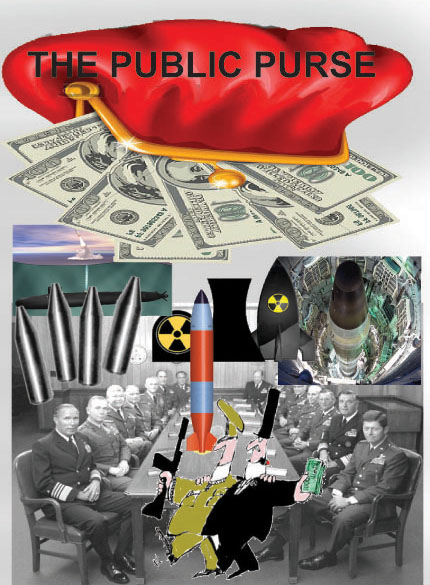
Sanders Unveils Bill to Force Pentagon to Pass Audit, Citing “Fraud” and “Waste” BY Sharon Zhang, Truthout 21 May 21,
Sen. Bernie Sanders (I-Vermont) has introduced a bipartisan bill that would require the Pentagon to pass audits beginning in fiscal year 2022 — or face fines. The Pentagon has never passed an audit.
The bill would impose a 1 percent fine on any military and Department of Defense agencies that fail to pass their audits. Sanders introduced the Audit the Pentagon Act of 2021 with Democratic Sen. Ron Wyden of Oregon and Republican Senators Chuck Grassley of Iowa and Mike Lee of Utah on Wednesday.
“The Pentagon and the military industrial complex have been plagued by a massive amount of waste, fraud, and financial mismanagement for decades. That is absolutely unacceptable,” Sanders said in a statement. The bill comes just after a Budget Committee hearing that Sanders held last week on the subject of the Pentagon’s budget “abuse.”
……… In 1990, Congress began requiring all government agencies to be audited by the Government Accountability Office. Since 2013, every other agency has been able to pass their audits — except, indeed, the Pentagon.
“The Defense Department remains the only federal agency in the United States that has been unable to pass an independent audit, despite the fact that the Pentagon consumes more than half of the nation’s discretionary budget and controls assets in excess of $3.1 trillion, or roughly 78 percent of the entire federal government,” reads the Sanders press release on the new bill.
The Defense Department was subject to its first ever agency-wide audit in 2018. It failed that audit, and the subsequent two audits it faced. Senator Grassley, at the time of the agency’s first audit, sharply criticized it for “26 years of hard-core foot-dragging [that] shows that internal resistance to auditing the books runs deep.”………….. https://truthout.org/articles/sanders-unveils-bill-to-force-pentagon-to-pass-audit-citing-fraud-and-waste/?eType=EmailBlastContent&eId=38e75c75-15fe-4ef5-9150-0ebccd5fbf3a
Nuclear newbuild – concrete projects or white elephants?
Nuclear Power in the European Union, Heinrich Boll Stiftung, 26 April 2021 by Mycle Schneider ”………………Nuclear Newbuild – Concrete Projects or White Elephants?
There are more or less credible “plans” for new nuclear plants, most of them in Eastern Europe.
The Czech government in 2020 signed a framework agreement with the national utility ČEZ to organize an international tender in order to have a decision by 2024 and start construction of two units at the Dukovany site in 2029. The potential role of Russian Rosatom is controversial. The Czech government has failed in earlier attempts to launch a new-build program. The outcome of this initiative is uncertain. In March 2021, Vaclav Bartuška, Special Envoy for Energy Security, recalled sarcastically that, as Government Envoy for Temelín [the other operating Czech nuclear plant site], he wrote in his final report to the government, he did “not believe in a nuclear project in a country that is unable to build a motorway network and high-speed train to Berlin or Munich”.[1] Reportedly, he nevertheless thinks the Dukovany project will go ahead.
In Hungary, after some 15 years of preparation, an application for a construction license for two new Russian designed reactors at the Paks site was submitted in June 2020. The project has raised significant controversy over the procedure under which the Russian contractor was chosen. In March 2021 a study published in the Journal of the Association of Hungarian Geophysicists questioned the earthquake safety of the site. At the same time, the Paks II project company has signed a contract with an engineering company to assess until the end of 2022 the conditions under which a construction license could be obtained. Some sources have suggested construction could already start in 2022. Considering the long history of delays of the project, a short-term construction start seems unlikely.
Poland has been contemplating the introduction of nuclear power since the 1970s and has started building two units in 1984, which were abandoned in 1990. No financing plan has yet been established, no technology, no sites chosen for “6–9 Gigawatt” of nuclear power by 2040. As earlier Polish plans, this one is not credible at this point………..https://eu.boell.org/en/2021/04/26/nuclear-power-european-union?dimension1=lisa2021
Sizewell nuclear project will harm Suffolk’s tourism industry
East Anglian Daily Times 20th May 2021, The construction of large-scale energy projects on the coast is of
“significant concern” to Suffolk’s tourism industry, a Planning
Inspectorate hearing on Sizewell C has heard. EDF Energy’s proposals to
build a £20billion nuclear power station are being discussed in a four-day
public hearing.
Katherine Mackie, chairman of the Aldeburgh Society, told
the hearing on Thursday a study had revealed that more than four million
tourists visit the area every year, bringing in more than £160million to
the economy. That number rose to £228m for the wider Suffolk Coast and
Heaths area of outstanding natural beauty (AONB) in 2019 with around 5,000
jobs supported, she added.
Mrs Mackie said the figures would be
“significantly impacted due to the loss of defined AONB characteristics”.
She also cited research by the Suffolk Coast Destination Management
Organisation, which found that construction of the Sizewell C project – as
well as ScottishPower’s proposed windfarm off the Suffolk coast – could
reduce visitor numbers by 17%.
https://www.eadt.co.uk/news/sizewell-c-edf-planning-inspectorate-public-hearing-7988408
China building uneconomic closed fuel cycle nuclear breeder reactors – for plutonium for nuclear weapons?

the kind of plutonium breeder reactors being built on Changbiao, they are among the least cost-effective ways to derive energy from nuclear power.
That raises the question of why China is developing these reactors for its energy use if it doesn’t make sense economically. ……. “They may be dual-purpose.”
Concerns grow over China nuclear reactors shrouded in mystery
No one outside China knows if two new nuclear reactors that are under construction and that will produce plutonium serve a dual civilian-military use. By Al Jazeera Staff, 19 May 21,
Like many of the over 5,000 small islands dotting China’s coastline, the islet of Changbiao is unremarkable in its history and geography. Jutting out from the shoreline of Fujian province like a small right-footed footprint, it has only gained recognition recently – and even then among a small handful of experts – for being home to China’s first two CFR-600 sodium-cooled fast-neutron nuclear reactors……..
The two reactors being built on Changbiao are closed fuel cycle nuclear breeder reactors. They produce plutonium. That plutonium could be reprocessed and used as a fuel source for other nuclear reactors. It could also be used to produce nuclear warheads, a lot of nuclear warheads, and produce them very quickly.
But no one outside of the Chinese officials and companies overseeing the projects knows if the intended use is purely for civilian energy, or if it serves a dual purpose for the country’s perceived nuclear deterrent needs.
That question gained even more urgency this week after a United States official accused Beijing of resisting bilateral talks with Washington on nuclear risk reduction.
The reason these breeder reactors are shrouded in mystery is that China, which had been transparent about its civilian plutonium programme until recently, stopped annual voluntary declarations to the International Atomic Energy Agency [IAEA] on its stocks of civilian plutonium in 2017 and has not added the reactors to the agency’s database to date.
While there are occasionally reporting delays of up to a year among the nine members party to the IAEA voluntary guidelines for the management of plutonium, Frank von Hippel, a senior nuclear research physicist and co-founder of Princeton University’s Program on Science & Global Security, said China’s lack of transparency is beginning to draw concern among non-proliferation experts and governments around the world.
“This is unique at this point,” von Hippel said of the silence over China’s plutonium activities.
I’m worried’
A recent paper (PDF) co-authored by von Hippel and several other nuclear non-proliferation experts drew attention to this issue. The findings stated that China could “conservatively produce 1,270 nuclear weapons by 2030 simply by exploiting the weapons-grade plutonium this program will produce” or even increase that by a factor of two or more if China used highly enriched uranium or composite uranium-plutonium cores from the reactors in bombs and missiles.
This would feed a huge increase from the number of estimated nuclear warheads in China’s arsenal, currently thought to be around 300 to 350.
“Well, I’m worried,” von Hippel said. “They may be dual-purpose.”
While the IAEA management guidelines have been something of a failure over the years, at least they “did provide transparency”, von Hippel says. Now, everyone but China is in the dark about the plutonium programme and it is starting to draw attention……..
The China Atomic Energy Authority, the agency responsible for reporting to the IAEA, did not respond to Al Jazeera’s questions about why China stopped reporting on its civilian plutonium programme. Similar requests from Al Jazeera made through China’s Ministry of Foreign Affairs, the National Energy Administration and the Ministry of Industry and Information Technology were likewise not acknowledged…….
The country has 50 nuclear reactors operating and 14 other conventional reactors under construction, not counting the two breeder reactors, according to IAEA data. China undershot its previous five-year target by around seven gigawatts, so appears to be making a major push to advance its nuclear power capacity over the next five to ten years.
But both Roth and von Hippel said, based on the experience of other countries that have tried the kind of plutonium breeder reactors being built on Changbiao, they are among the least cost-effective ways to derive energy from nuclear power.
“There’s a strong case, and we’ve seen this in other countries, that reprocessing [spent fuel] is not economical,” Roth said. “The reality is it’s cheaper not to reprocess your fuel than it is to reprocess. A once-through fuel cycle with low enriched uranium is a more economical approach.”
That raises the question of why China is developing these reactors for its energy use if it doesn’t make sense economically.
If the reactors are dual-use, it would, particularly from a China concerned about the adequacy of its nuclear deterrent, says von Hippel.
China’s actions, however, may spur others in the region, namely Japan and Korea, to speed up their own plutonium reactor plans.
“I think it’s in China’s best interest not to go down that path,” Roth said. “From an economic perspective, from an environmental perspective, and the impact it has regionally … they seem set on pursuing this reprocessing path, but I don’t think it is going to help them with their nuclear power goals.”
I think it’s in China’s best interest not to go down that path.
A commercial plutonium ‘timeout’?
The way forward, Roth says, is for the US to engage with China to find out why it stopped the declarations to the IAEA and pursue a path to disincentivise others in the region from pursuing plutonium reprocessing.
“I would hope that the Biden administration is choosing to engage with China on non-proliferation issues,” Roth said.
Requests made by Al Jazeera through the US Embassy in Beijing about whether the administration of US President Joe Biden was engaging with China on its halt in reporting on its civilian plutonium programme were declined.
These questions are becoming acutely important, von Hippel said, at a time of increased tension between the US and China, the potential flashpoint of Taiwan, and a growing chorus suggesting the two superpowers are engaged in a Cold War 2.0.
Whether there is interest in China discussing these matters with the US or countries in the region is unknown.
On Tuesday, the issue was thrown back into the spotlight after Robert Wood, US ambassador and permanent representative to the United Nations Conference on Disarmament, accused Beijing of being unwilling “to engage meaningfully” with Washington on nuclear weapons talks.
“Despite China’s dramatic build-up of its nuclear arsenal, it continues to resist discussing nuclear risk reduction bilaterally with the United States – a dialogue we have with Russia,” Wood told a UN conference.
Beijing’s representative reportedly pushed back on the claim, telling the same conference that China is “ready to carry out positive dialogue and exchange with all parties”.
The increasing acrimony that characterised US-China relations under the administration of President Donald Trump didn’t exactly instil confidence in engagement on nuclear security policy, von Hippel said.
Gregory Kulacki, a senior analyst on nuclear policy at the Union of Concerned Scientists who is now based in Japan, said that the good level of engagement built up between the US and China on nuclear policy prior to the early 2000s is something of a distant memory now, with the US side bearing much of the blame for the shroud of silence from China.
“The [George W] Bush Jr administration’s decision [in 2002] to withdraw from the ABM [1972 Anti-Ballistic Missile] treaty pretty much gutted any real interest in China in pursuing arms control talks of any substance with the United States,” Kulacki said.
The Bush administration’s moves were made due to its commitments to deploy missile
defence systems in what it saw as protecting against “growing missile threats” at the time, from a potentially nuclear-armed North Korea. China saw those actions as restricting its own military capabilities in its back yard.
According to von Hippel and his co-authors, the US should work with Japan, South Korea and China on declaring a “commercial plutonium timeout” with offers to delay breeder reactors and commercial plutonium programmes if China agrees to do the same.
If all of these countries could increase the amount of transparency related to uranium holdings and related activities, it would boost confidence for all parties to scale back those programmes, he said.
The trick is figuring out who would take the first steps. https://www.aljazeera.com/economy/2021/5/19/concerns-grow-over-china-nuclear-reactors-shrouded-in-mystery
Yet more delays in USA’s costly, troubled Vogtle nuclear project

Westport News 18th May 2021, Georgia Power Co. said Tuesday that delays in completing testing means the
first new unit at its Vogtle plant is now unlikely to start generating
electricity before January at the earliest. The unit of Atlanta-based
Southern Co. had in recent years been aiming to complete the first unit in
November, but officials told investors last month that it would probably be
finished in December. Company officials said Tuesday that testing began in
late April, would take three weeks longer than expected and is unlikely to
be completed before late June, adding more time to construction and
startup.
Rolls Royce plans fleets of small nuclear reactors. At approx £2billion per reactor (that’s approx $2.8billion) how much will each fleet cost?

Rolls-Royce expects the first five reactors to cost £2.2bn each, falling to £1.8bn for subsequent units.
SMRs could not achieve economies of scale unless developers secured a large number of orders. “How are you going to get orders for 16 of an unproven reactor type and if you don’t have orders for 16 how are you going to build a factory?”

Rolls-Royce courts investors for mini nuclear plants, Consortium led by engine group seeks £300m in funding as it prepares application for small modular reactors, Nathalie Thomas in Edinburgh and Sylvia Pfeifer in London Ft.com, 17 May 21,
A consortium led by Rolls-Royce that is hoping to build a fleet of mini nuclear power stations across Britain is talking to investors to secure £300m in funding as it prepares to submit its design to regulators later this year. The consortium, which also includes Jacobs and Laing O’Rourke, hopes to be the first “small modular reactor” developer to put its design through the UK’s rigorous nuclear regulatory assessment. The process is expected to take up to four years but would keep the companies on track to complete their first 470MW plant by the early 2030s, which would be capable of generating enough low-carbon electricity for about 1m homes.
UK prime minister Boris Johnson backed SMRs as part of his 10-point plan for a “green industrial revolution” last year. The technology is viewed within the government as a good way to create manufacturing jobs as well as delivering on Johnson’s “levelling up” agenda. Rolls-Royce believes at least 16 SMRs could be installed at existing and former nuclear sites in Britain and more could potentially be built at locations such as former coal mines. It estimates the programme could create as many as 40,000 jobs in the UK regions by 2050.
Environmental groups say the technology is unproved and point out that nuclear energy leaves behind a legacy of waste, the most toxic of which takes at least 100,000 years to decay The prime minister has promised £215m in public funds, which the consortium hopes will help it secure the £300m in private match funding needed for the project to progress.
Rolls-Royce, which has been working on SMRs since 2015, expects the first five reactors to cost £2.2bn each, falling to £1.8bn for subsequent units.
It has argued that its design, which uses pressurised water reactors similar to existing nuclear power stations and boasts an increased generation capacity from 440MW previously, is more commercially viable and lower-risk than rival plans. The company has also claimed it could compete with renewable technologies such as offshore wind. Tom Samson, chief executive of the Rolls-Royce-led consortium, said “the way we manufacture and assemble our power station brings down its cost to be comparable with offshore wind at around £50/MWh”.
But Tom Burke, chair of climate change think-tank E3G, argued that SMRs could not achieve economies of scale unless developers secured a large number of orders. “How are you going to get orders for 16 of an unproven reactor type and if you don’t have orders for 16 how are you going to build a factory?” If sufficient private funding is secured, the consortium intends to set up a special purpose vehicle this summer in which Rolls-Royce is expected to retain a significant interest. The programme could give Rolls-Royce an important new revenue stream as it looks to reduce its exposure to the commercial aerospace sector, which has been severely dented by the coronavirus pandemic.https://www.ft.com/content/11ba5955-2f75-4eb5-b3e9-73f74684eb10
Rolls Royce desperate for investors for its £2bn Small Nuclear Reactors

It’s not a good look, as Rolls Royce is in a financial crisis
Consortium led by Rolls-Royce on hunt for orders for its £2bn nuclear reactors after redesign that means each will power 100,000 more homes https://www.thisismoney.co.uk/money/markets/article-9581899/Rolls-Royce-starts-hunt-buyers-nuclear-reactor-boost.html By ALEX LAWSON, FINANCIAL MAIL ON SUNDAY 16 May 2021
A consortium led by Rolls-Royce is on the hunt for orders for its £2billion nuclear reactors after a redesign that means each will power 100,000 more homes.
The Mail on Sunday can reveal that the UK Small Modular Reactor (SMR) project has revamped the proposed mini reactors to increase their output. The factory-built reactors will now generate 470 megawatts, enough to provide electricity to a million homes.
The project, launched in 2015, aims to bring ten mini nuclear reactors into use by 2035, with the first due to enter service around 2030.
Tom Samson, chief executive of the UK SMR Consortium, said negotiations had begun with potential investors to fund the creation of the mini reactors – signalling that the project may move more rapidly than previously thought.
He said it was looking for customers, which could include energy, industrial or technology companies, to operate the sites. He added: ‘We’re ready to take this technology to market. We’re going to be pursuing orders. We’re hoping to get orders soon.’
The UK’s nuclear power industry has had a chequered recent past with the future of some huge plants thrown into doubt. Rolls-Royce hopes to create a nimbler solution to complement big power stations.
Rolls-Royce is the major share holder in the venture, which has been developed through a consortium that includes Atkins, Jacobs and Laing O’Rourke. The Government has so far invested £18million to support its design and £215million has been earmarked for the SMR programme as part of a ‘Green Industrial Revolution’.
Samson said a further £300million of private capital is now being sought to develop the reactors, which it hopes will be located both in the UK and overseas.
The initial ‘two to three’ units are likely to require Government support, but Samson hopes to move to ‘traditional debt and equity’ to fund following orders. Last week, the Government updated its nuclear policy to open its Generic Design Assessment to new nuclear technologies. UK SMR hopes to be the first to submit a proposal to Government and regulators.
Samson said 220 engineering decisions had been made in the latest designs. He said the switch from an ‘armadillo’-shaped building to one with a ‘faceted’ top allowing the roof to wrap around the inner workings made it more efficient.
The Prime Minister’s former chief adviser Dominic Cummings was a champion of the UK SMR programme, but Samson said No10 remained behind the project and it chimed with current policy.
He added: ‘We unashamedly wrap ourselves in the Union Jack. This is a really proud UK innovation that we’ve developed here at low cost. And that’s what consumers need.
We’re contributing to the Government’s levelling-up agenda. We’re also contributing to its post-Brexit global Britain agenda.’
Samson is running the rule over sites for factories to build the mini reactors, and said they were most likely to be in the North of England and the East Midlands, where Rolls-Royce is based. He is also studying potential locations for the reactors, which could include former nuclear sites in West Cumbria and Anglesey, where Japanese giant Hitachi pulled the plug on plans for a £20billion plant last year.
Samson described renewable energies such as solar and wind power as ‘weather dependent’, adding: ‘We’re not intermittent. These plants will run for 60 years. They will operate 24/7.’
Rolls-Royce rocked by a £4 billion loss

Rolls-Royce rocked by a £4 billion loss: But upbeat boss says firm is in a position to ‘thrive, not just survive’ after lockdown, This is Money, By FRANCESCA WASHTELL FOR THE DAILY MAIL, 12 March 2021 Rolls-Royce plunged to a £4billion loss last year after the collapse in air travel hammered its engines business.
The UK’s premier engineering firm warned the recovery this year would be even slower than expected after a second wave of the pandemic led to more flight cancellations.
But boss Warren East was in fighting mood and said the company was in a position to ‘thrive, not just survive’ and had built up enough cash to deal with any further setbacks.,,,,,,,
The £4billion loss – which compares with a £583million profit in 2019 – was worse than analysts had expected.
In an effort to get through the crisis, Rolls kicked off a huge restructuring last May that included cutting 9,000 jobs from its 52,000-strong workforce and selling parts of the business worth £2billion.
Rolls has also raised £7.3billion – which included arranging loans and selling new shares – and has access to £9billion.
But at its lowest point last year, the Derby-headquartered company admitted it could struggle to survive if the downturn continued.
Rolls has been burning through cash, £4billion in total last year, and expects to go through another £2billion in 2021……..
Away from civil aerospace, Rolls is also trying to establish itself as a leader in building small nuclear reactors and developing green flight technology…… https://www.thisismoney.co.uk/money/markets/article-9352005/Rolls-Royce-hit-4bn-loss-Boss-says-firm-thrive-post-lockdown.html
US Nuclear is significantly overvalued

US Nuclear Stock Gives Every Indication Of Being Significantly Overvalued, Yahoo Finance GuruFocus.com, Sat, May 15, 2021,
The stock of US Nuclear (OTCPK:UCLE, 30-year Financials) is believed to be significantly overvalued, according to GuruFocus Value calculation. GuruFocus Value is GuruFocus’ estimate of the fair value at which the stock should be traded. It is calculated based on the historical multiples that the stock has traded at, the past business growth and analyst estimates of future business performance. If the price of a stock is significantly above the GF Value Line, it is overvalued and its future return is likely to be poor. On the other hand, if it is significantly below the GF Value Line, its future return will likely be higher. At its current price of $0.57 per share and the market cap of $13.3 million, US Nuclear stock is believed to be significantly overvalued. GF Value for US Nuclear is shown in the chart below. [on original]
Because US Nuclear is significantly overvalued, the long-term return of its stock is likely to be much lower than its future business growth, which averaged 7.8% over the past five years.
Since investing in companies with low financial strength could result in permanent capital loss, investors must carefully review a company’s financial strength before deciding whether to buy shares. Looking at the cash-to-debt ratio and interest coverage can give a good initial perspective on the company’s financial strength. US Nuclear has a cash-to-debt ratio of 0.43, which ranks worse than 79% of the companies in Hardware industry. Based on this, GuruFocus ranks US Nuclear’s financial strength as 3 out of 10, suggesting poor balance sheet. This is the debt and cash of US Nuclear over the past years:
…………In short, The stock of US Nuclear (OTCPK:UCLE, 30-year Financials) gives every indication of being significantly overvalued. The company’s financial condition is poor and its profitability is poor. Its growth ranks worse than 81% of the companies in Hardware industry. https://finance.yahoo.com/news/us-nuclear-stock-gives-every-111207593.html
Cyberattacks grind Hanford nuclear energy workers’ benefit program to a halt
Cyberattacks grind Hanford nuclear energy workers’ benefit program to a halt, Seattle Times May 10, 2021 By Patrick Malone
Cyber attacks on the U.S. government have abruptly paused processing of benefit applications for workers who were sickened while working on nuclear weapons programs at Hanford and other Department of Energy sites, delaying aid to some dying workers, according to advocates.
Without warning, advocates from the Alliance of Nuclear Workers Advocacy Group received notice late last Friday that effective Monday, a vital component of the Energy Employees Occupational Illness Compensation Program would be offline for two to four months.
The Radiation Dose Reconstruction Program databases’ sudden hiatus could delay approval of new benefits for groups of workers who believe they’ve been exposed to workplace hazards.
Among them are more than 550 workers from Hanford, a mothballed plutonium processing site in Richland, who were potentially exposed to radiation and toxins when they were provided leaky respirators, according to a Seattle Times investigation last year.
Those workers are seeking inclusion in the federal benefits program administered by the Department of Labor. The National Institute of Occupational Safety and Health plays an instrumental role in determining eligibility.
Hanford, born in secrecy during World War II in a rush to develop the first atomic bomb, processed the plutonium fuel for nuclear weapons for four decades, a process that fouled the 580-square-mile site with radioactive waste and toxic vapors that sickened and killed many workers.
Washington’s U.S. Sen. Patty Murray and Rep. Adam Smith, both Democrats, sponsored legislation in response to The Times investigation that would expand benefits to include the Hanford cleanup crew who were given faulty respirators and other nuclear workers across the country who aren’t yet eligible.
Others who could be affected are some 1,378 individual workers across the country currently applying for assistance, and those with recent terminal diagnoses, who normally would be eligible for benefits awarded as quickly as a day after application. Those benefits can be worth hundreds of thousands of dollars.
“Terminally ill workers often do not have 2 to 4 months to live,” Terrie Barrie, ANWAG founder, wrote in a Monday, May 3, letter to NIOSH director to Dr. John Howard. “Will they no longer have the option to have their claim expedited so that they can receive the medical and financial benefits before they die?”
The source and nature of the cyberattacks are unclear, but in a May 4 letter to ANWAG, Howard said that an ongoing review of the energy workers’ compensation databases “identified very significant concerns about the cybersecurity integrity of the Program’s claimant database,” forcing an immediate and secret shutdown of the claims process……………………. https://www.seattletimes.com/seattle-news/times-watchdog/cyberattacks-grind-hanford-nuclear-energy-workers-benefit-program-to-a-halt/
Scientists refute Exelon’s claim about costs of replacing nuclear with renewable energy.
Exelon CEO: Replacing nuclear with renewables, storage to meet carbon goals could cost Illinois $80B Utility Dive, May 6, 2021 ”………..Achieving the same amount of zero emissions power through renewables and storage would be 12 times more expensive than continuing to run Illinois’ nuclear plants and cost the state’s consumers $80 billion, Exelon CEO Chris Crane said during the company’s Q1 earnings call on Wednesday………….
the Union of Concerned Scientists disputed Crane’s remarks regarding the cost of replacing nuclear with renewables and storage in Illinois.
“Crane’s comment that renewables plus storage would cost 12 [times] or $80 billion more than keeping the existing nuke plants running is ridiculous. I’m guessing he’s comparing the incremental cost of keeping them running (basically the subsidies) to the all-in cost of adding new renewables plus storage and the tax credits,” said Steve Clemmer, director of energy research for the UCS Climate and Energy Program. …….
In addition to the governor’s proposal, several other energy policy reform bills have been introduced in Illinois to drive the state’s energy transition and tackle climate change. Legislative leaders are meeting to develop a package from the various bills that can be considered this session,
Amid Widespread Disease, Death, and Poverty, the Major Powers Increased Their Military Spending in 2020
 | |||
Amid Widespread Disease, Death, and Poverty, the Major Powers Increased Their Military Spending in 2020 https://www.commondreams.org/views/2021/04/28/amid-widespread-disease-death-and-poverty-major-powers-increased-their-military?utm_campaign=shareaholic&utm_medium=Social&utm_source=twitter
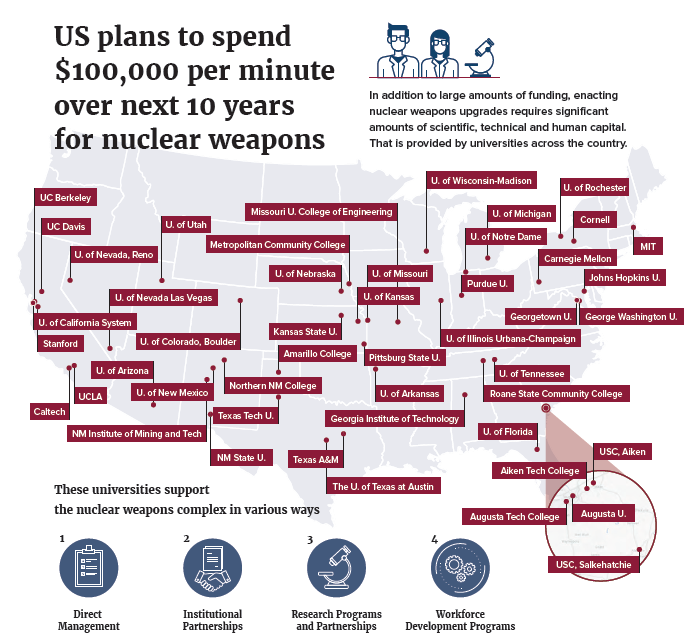
The existence of widespread poverty in the world’s mightiest military powers raises the question of what could have been done to alleviate or eliminate it, if during 2020 they had not poured nearly $1.1 trillion into preparations for war.
byLawrence Wittner Last year was a terrible time for vast numbers of people around the globe, who experienced not only a terrible disease pandemic, accompanied by widespread sickness and death, but severe economic hardship.
Even so, the disasters of 2020 were not shocking enough to jolt the world’s most powerful nations out of their traditional preoccupation with enhancing their armed might, for once again they raised their military spending to new heights.
Someday people will ask whether increasing preparations for war by these nations—mostly designed to destroy one another—was the best these governments could do as their populations sank into widespread disease, death, and poverty.
During 2020, world military expenditures increased to $1,981,000,000,000—or nearly $2 trillion—with the outlays of the three leading military powers playing a major part in the growth. The U.S. government increased its military spending from $732 billion in 2019 to $778 billion in 2020, thus retaining its top spot among the biggest funders of war preparations. Meanwhile, the Chinese government hiked its military spending to $252 billion, while the Russian government raised its military outlay to $61.7 billion.
As a result, the U.S. government remained by far the most lavish spender on the military in the world, accounting for 39 percent of the global total. Even so, the Chinese government continued its steady role in the worldwide military buildup, with its military disbursements rising for the 26th consecutive year. Indeed, China’s 76 percent increase in military spending between 2011 and 2020 was the largest among the world’s top 15 big spenders. When added together, the 2020 military expenditures of the United States, China, and Russia accounted for 55 percent of the global total.
This upward spiral in military spending coincided with a sharp rise in the number of the world’s people living in poverty, which soared by an estimated 131 million to 803 million by the end of the year.
In the United States, the richest nation in the world, 2020 produced the largest increase in poverty since the U.S. government began tracking it in 1960. By the end of the year, an estimated 50 million people were struggling with hunger, including 17 million children. Plunged into severe privation, vast numbers of Americans lined up, sometimes in caravans that stretched for miles, to obtain free food at private and public food pantries and other distribution centers. Ignoring the terrible human costs of the economic crisis plaguing the nation during his re-election campaign, President Donald Trump boasted instead of his administration’s “colossal” increase in military spending.
In Russia, where real incomes fell for five of the previous seven years, they dropped still further in 2020. In that year, the average Russian had 11 percent less to spend than in 2013. Indeed, during the first nine months of 2020, as poverty grew, an estimated 19.6 million Russians reportedly lived below the poverty line, equivalent to 13.3 percent of the population. According to a leading economist at Russia’s Institute of International Finance, the authorities “were so concerned about their external threats that they completely forgot about the domestic population.”
The situation was apparently quite different in China. Thanks to the government’s successful efforts to limit the spread of Covid-19, the Chinese economy had an easier time of it in 2020 than did the economies of other major nations. This factor, plus four decades of rapid economic growth and an ongoing campaign to improve the government’s popularity by reducing the country’s worst poverty, led to the Communist Party’s announcement that November that President Xi Jinping and the party had accomplished the miracle of eliminating severe poverty in China.
But all was not as it seemed. In 2020, China, despite its Communist pretensions, had one of the largest gaps between rich and poor throughout the world. By October, its number of billionaires had soared to 878, the highest total in any nation. In contrast, as a New York Times article reported that month, “millions of people on low incomes are working fewer hours at lower pay, depleting savings, and taking out loans to survive.” Moreover, claims as to the eradication of poverty in China were dubious, for the official poverty measuring line there was much lower than in nations with a similar level of economic development. A Brookings Institution economist pointed out that, if China used the same standard as other upper middle-income countries, between 80 and 90 percent of its population would be considered poor. “Even if you aren’t out of poverty, the country will say you’re out of poverty,” remarked a bitter Chinese farmer. “That’s the way it is.”
The existence of widespread poverty in the world’s mightiest military powers raises the question of what could have been done to alleviate or eliminate it if, during 2020, had they not poured nearly $1.1 trillion into preparations for war.
Also, of course, the vast resources used for the military buildup could have bankrolled other programs that would have substantially improved the lives of their citizens. In the United States, as the National Priorities Project noted, the military budget could have funded healthcare for 208 million adults, or 21 million scholarships for university students, or 84 million public housing units, or the employment of 9.2 million elementary school teachers, or 10 million clean energy jobs, or VA medical care for 72 million military veterans.
But, sadly, building the mightiest military forces in world history had greater appeal to the governments of the United States, China, and Russia. Perhaps, someday, people will ask whether increasing preparations for war by these nations—mostly designed to destroy one another—was the best these governments could do as their populations sank into widespread disease, death, and poverty.
France desperate to sell its flawed nuclear technology to India, Time for India to cancel Jaitapur nuclear power project.

Time for India to cancel Jaitapur nuclear power project, France keen on flogging its ‘messy’ tech to India Business May 2, 2021 By Ranvir Nayar Media India Group France remains desperate to sell its severely troubled EPR nuclear reactors to India, even though its own project at home and at both the sites outside of France have had severe cost and time overruns and continue to face safety issues.
On March 3, 2021, Electricité de France, EDF, the sole operator of nuclear power plants in France, informed the country’s nuclear safety body, Autorité de Sûreté Nucléaire (ASN), of a design anomaly on three nozzles of the main primary system of the European Pressurised Reactor that it has been building at Flamanville in north-west France.
The design flaw is serious as the main primary system contains water used to cool the reactor core and transfer energy from the nuclear reaction to the steam generators. The design dates back to 2006 and the nozzles were manufactured in 2011.
https://mediaindia.eu/business/jaitapur-nuclear-france/
1 This Month



26 September – International Day for the Total Elimination of Nuclear Weapons


PLEASE OPPOSE HR 8255 AND S.3639 – bills would accelerate satellite deployment, with no environmental review or safeguards – https://ncstd5li.quorum.us/campaign/169331/
To see nuclear-related stories in greater depth and intensity – go to https://nuclearinformation.wordpress.com
-
Archives
- September 2026 (257)
- August 2026 (330)
- July 2026 (355)
- June 2026 (287)
- May 2026 (306)
- April 2026 (356)
- March 2026 (251)
- February 2026 (267)
- January 2026 (308)
- December 2025 (358)
- November 2025 (359)
- October 2025 (375)
-
Categories
- 1
- 1 NUCLEAR ISSUES
- business and costs
- climate change
- culture and arts
- ENERGY
- environment
- health
- history
- indigenous issues
- Legal
- marketing of nuclear
- media
- opposition to nuclear
- PERSONAL STORIES
- politics
- politics international
- Religion and ethics
- safety
- secrets,lies and civil liberties
- spinbuster
- technology
- Uranium
- wastes
- weapons and war
- Women
- 2 WORLD
- ACTION
- AFRICA
- Atrocities
- AUSTRALIA
- Christina's notes
- Christina's themes
- culture and arts
- Events
- Fuk 2022
- Fuk 2023
- Fukushima 2017
- Fukushima 2018
- fukushima 2019
- Fukushima 2020
- Fukushima 2021
- general
- global warming
- Humour (God we need it)
- Nuclear
- RARE EARTHS
- Reference
- resources – print
- Resources -audiovicual
- Weekly Newsletter
- World
- World Nuclear
- YouTube
-
RSS
Entries RSS
Comments RSS
 nuclear-news