Translated from french by Hervé Courtois (D’un Renard)
 A massive amount of radioactive water is stored on the grounds of the Fukushima Daiichi nuclear plant site ravaged by the tsunami of March 2011.
December 24, 2019
The decision is not expected to be announced before the Tokyo Olympics next summer, given the diplomatic risk. Japan is expected to face strong opposition.
Releasing the radioactive water from the Fukushima Daiichi nuclear power plant to the environment (in the sea or in the air) is the only option left since experts have ruled out long-term storage, Japanese officials say.
“The option of simple long-term storage is no longer being considered,” said a state official who wished to remain anonymous. And to clarify that the government’s ambition is to make room for Fukushima Daiichi: once the reactors are demolished and the site cleaned, there should be nothing left, including no water tanks still containing at least tritium.
A massive amount of radioactive water is stored within the confines of this site devastated by the tsunami of March 2011. It comes from rain, groundwater or injections necessary to cool the hearts of reactors that have melted. Filtered several times, it ‘should’ ultimately be rid of a large amount of radionuclides, except tritium, ‘considered’ less dangerous for the environment and living beings.
A water still heavily loaded
Long-term storage, which was recommended by environmental organizations like Greenpeace, being no longer validated, three options remain considered the most feasible, from a technical and economic point of view: dilution at sea, evaporation in the air or a combination of the two.
Experts, including those from the International Atomic Energy Agency (IAEA), have been pushing for dilution at sea for years. But this is not feasible at the moment because, as recognized by the company Tokyo Electric Power (Tepco), a large part of this water is still heavily loaded with radioactive elements dangerous for the food chain.
Tepco estimates, however, that the tanks will be full in 2022.
A final decision should not be made before the Tokyo Olympics in the summer of 2020, given the diplomatic risk. A government subcommittee responsible for the file is thus studying not only the technical implications, but also the potential damage to the country’s image abroad.
Japan is set to face strong opposition, already expressed, from fishermen and farmers in the region, as well as from environmental groups and neighboring countries, starting with South Korea. Seoul did not digest a previous decision to dump radioactive water packages into the sea immediately after the Fukushima accident, without asking its advice.
https://www.sudouest.fr/2019/12/24/eau-contaminee-de-fukushima-vers-un-rejet-dans-l-environnement-6993764-706.php?fbclid=IwAR1F2iWkQMIdhZR3smVVeHAgrkYNt5whKihj0dDnP29wL5WhYn-wsQA8uw8
December 30, 2019
Posted by dunrenard |
fukushima 2019 | Fukushima Prefecture, Radioactive Water, Release |
Leave a comment
The government decided Friday to delay the removal of spent fuel from the Fukushima No. 1 nuclear power plant’s Nos. 1 and 2 reactors by up to five years, casting doubt on whether it can stick to its time frame for dismantling the crippled complex.
The process of removing the spent fuel from the units’ pools had previously been scheduled to begin in fiscal 2023.
In its latest decommissioning plan, the government said the plant’s operator, Tokyo Electric Power Company Holdings Inc., will not begin the roughly two-year process at the No. 1 unit at least until fiscal 2027 and may wait until fiscal 2028.
Work at the No. 2 unit is now slated to start between fiscal 2024 and fiscal 2026, it said.
The delay is necessary to take further safety precautions, such as the construction of an enclosure around the No. 1 unit to prevent the spread of radioactive dust and the decontamination of the No. 2 unit, the government said. It is the fourth time it has revised its schedule for removing the spent fuel rods.
“It’s a very difficult process and it’s hard to know what to expect. The most important thing is the safety of the workers and the surrounding area,” industry minister Hiroshi Kajiyama told a news conference.
The government set a new goal of finishing the removal of the 4,741 spent fuel rods across all six of the plant’s reactors by fiscal 2031.
Tepco has started the process at the No. 3 unit and already finished at the No. 4 unit, which was off-line for regular maintenance at the time of the disaster. A schedule has yet to be set for the Nos. 5 and 6 reactors.
While the government maintained its overarching time frame of finishing the decommissioning of the plant 30 to 40 years from the 2011 crisis triggered by a magnitude 9.0 earthquake and tsunami, there may be further delays.
The government said it will begin removing fuel debris in fiscal 2021 from the three reactors that experienced core meltdowns, starting with the No. 2 unit.
The process, considered the most difficult part of the decommissioning plan, will involve using a robot arm to initially remove small amounts of debris, and later take out larger amounts.
The government also said it will aim to reduce the pace at which contaminated water at the plant increases. Water for cooling the melted cores, mixed with underground water, amounts to around 170 tons per day. That number will be reduced to 100 tons by 2025, it said.
The water is being treated to remove the most radioactive materials and stored in tanks on the plant’s grounds, but already more than 1 million tons have been collected and space is expected to run out by the summer of 2022.
December 30, 2019
Posted by dunrenard |
fukushima 2019 | Fukushima Daiichi, Nuclear Cleanup |
Leave a comment
TOKYO (AP) — Japan on Friday revised a roadmap for the cleanup of the tsunami-wrecked Fukushima nuclear plant, further delaying the removal of thousands of spent fuel units that remain in cooling pools since the 2011 disaster. It’s a key step in the decadeslong process, complicated by high radiation and other risks. The government and the plant operator, Tokyo Electric Power Co., are keeping a 30- to 40-year completion target.
A look at some of the challenges:
MORE THAN 4,700 UNITS OF FUEL IN POOLS
More than 4,700 units of fuel rods remain at the three melted reactors and two others that survived the 2011 earthquake and tsunami. They pose a high risk because their storage pools are uncovered and a loss of water in case of another major disaster could cause the fuel rods to melt, releasing massive radiation. Their removal at Units 1 and 2, after repeated delays, is now postponed by up to 10 years from the initial target of 2018, with more preparation needed to reduce radiation and clear debris and other risks.
Fuel rod removal at the Unit 1 reactor pool will begin sometime in 2027-2028, after debris is cleaned up and a huge rooftop cover installed to contain radioactive dust. Fuel removal at Unit 2 pool is to begin in 2024-2026. Work at the Unit 3 reactor pool began in April 2019 and all 566 units will be removed by March 2021. TEPCO has emptied the pool at Unit 4, which was offline and only suffered building damage, and aims to have all remaining rods in reactor pools removed by 2031 for safer storage in dry casks.
1.2 MILLION TONS OF RADIOACTIVE WATER
TEPCO has been unable to release the 1.2 million tons of treated but still radioactive water kept in nearly 1,000 tanks at the plant, fearing public repercussions and the impact on the area’s struggling fishing and agriculture. The amount of water is growing by 170 tons daily because it is used to cool the melted fuel inside the reactors.
The Ministry of Economy, Trade and Industry recently drafted a proposal to release the water to the sea or the air, or a combination of both. TEPCO says it can only store up to 1.37 million tons, or until the summer of 2022. Time is limited because preparation is needed before any water release. TEPCO and the government say the tanks pose risks if they were to spill their contents in another major earthquake, tsunami or flood. They also need to free up space to build storage for melted fuel removed from reactors beginning 2021.
The water is still somewhat contaminated, but TEPCO says further treatment can remove all but radioactive tritium to levels allowed for release. Experts say tritium is not harmful to humans in small amounts and has been routinely released from nuclear plants around the world.
Removing an estimated 880 tons of molten fuel from Fukushima’s three melted reactors is the toughest and unprecedented challenge. It’s six times the amount dealt with in the aftermath of the 1979 Three Mile Island partial core melt in the United States.
Removal is to begin in 2021 at Unit 2, where robotic probes have made more progress than at Units 1 and 3. A robotic arm was developed to enter the reactor from the side to reach the melted fuel, which has largely fallen to the bottom of the primary containment vessel. A side entry would allow the simultaneous removal of fuel rods in the pool from the reactor’s top. The removal of melted fuel will begin with just a spoonful, which will be carefully measured and analyzed under International Atomic Energy Agency instructions. The government hopes to gradually expand the scale of the removal, though further expertise and robotic development is needed. The first decade through 2031 is a crucial phase that will affect future progress. Units 1 and 3 fell behind due to high radiation and water levels respectively, requiring more investigation.
770,000 TONS OF RADIOACTIVE WASTE
Japan has yet to develop a plan to dispose of the highly radioactive melted fuel and other debris that come out of the reactors. TEPCO will compile a plan for those after the first decade of melted fuel removal. Managing the waste will require new technologies to reduce its volume and toxicity. TEPCO and the government say they plan to build a site to store waste and debris removed from the reactors, but finding one and obtaining public consent will be difficult.
Additionally, there will be an estimated 770,000 tons of solid radioactive waste by 2030, including contaminated debris and soil, sludge from water treatment, scrapped tanks and other waste. They will be sorted, treated and compacted for safe storage under a plan to be compiled by 2028.
The government says Fukushima’s decommissioning cost is estimated at 8 trillion yen ($73 billion), though adding compensation, decontamination of surrounding areas and medium-term storage facilities would bring the total to an estimated 22 trillion yen ($200 billion). The Japan Center for Economic Research, a think tank, estimates that decommissioning alone would cost 51 trillion yen ($470 billion) if the water is not released and tritium removal technology is pursued.
More than 10,000 workers will be needed annually in coming years, about one third assigned to work related to the radioactive water. Securing experienced workforce for the decadeslong cleanup is a challenge in a country with rapidly aging and declining population. Nuclear Regulation Authority Chairman Toyoshi Fuketa raised concerns about a possible labor shortage following recent minor mishaps at the plant. TEPCO has expressed intention of hiring workers for the decommissioning under Japan’s new policy allowing more unskilled foreign labor, but the plan is on hold following government instructions to address language and safety concerns.

This March 11, 2012, file photo, shows three melted reactors, from left, Unit 1, Unit 2 and Unit 3 at Fukushima Dai-ichi nuclear power plant in Okuma, Fukushima prefecture, Japan. Japan revised a roadmap on Friday, Dec. 27, 2019, for the tsunami-wrecked Fukushima nuclear plant cleanup, further delaying the removal of thousands of spent fuel units that remain in cooling pools since the 2011 disaster.
This Sept. 4, 2017, aerial file photo shows Fukushima Dai-ichi nuclear power plant’s reactors, from bottom at right, Unit 1, Unit 2 and Unit 3, in Okuma, Fukushima prefecture, northeastern Japan. Japan revised a roadmap on Friday, Dec. 27, 2019, for the tsunami-wrecked Fukushima nuclear plant cleanup, further delaying the removal of thousands of spent fuel units that remain in cooling pools since the 2011 disaster. It’s a key step in the decadeslong process, underscoring high radiation and other risks.
In this Oct. 12, 2017, file photo, ever-growing amount of contaminated, treated but still slightly radioactive, water at the wrecked Fukushima Dai-ichi nuclear plant is stored in about 900 huge tanks, including those seen in this photo taken during a plant tour at Fukushima Daiichi Nuclear Power Plant in Okuma, Fukushima prefecture, northeast of Tokyo. Japan revised a roadmap on Friday, Dec. 27, 2019, for the tsunami-wrecked Fukushima nuclear plant cleanup, further delaying the removal of thousands of spent fuel units that remain in cooling pools since the 2011 disaster. It’s a key step in the decadeslong process, underscoring high radiation and other risks.
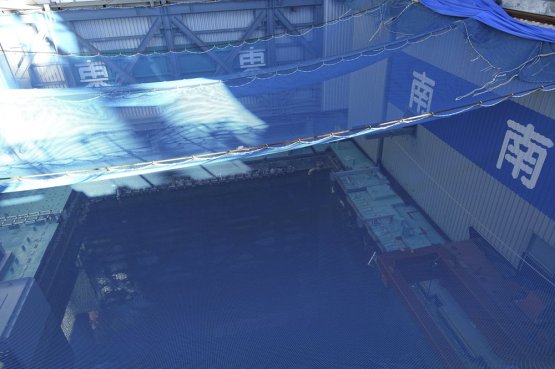
In this Jan. 25, 2018, file photo, a cooling pool where a total of mostly used 566 sets of fuel rods are stored underwater and covered by a protective net, waits to be removed in a step to empty the pool at Unit 3 of the Fukushima Dai-ichi nuclear power plant ahead of a fuel removal from its storage pool in Okuma, Fukushima Prefecture, northeast Japan. Japan revised a roadmap on Friday, Dec. 27, 2019, for the tsunami-wrecked Fukushima nuclear plant cleanup, further delaying the removal of thousands of spent fuel units that remain in cooling pools since the 2011 disaster. More than 4,700 units of fuel rods remain inside the three melted reactors and two others that survived the 2011 earthquake and tsunami.
In this Nov. 12, 2014, file photo, a Tokyo Electric Power Co. (TEPCO) official wearing a radioactive protective gear stands in front of Advanced Liquid Processing Systems during a press tour at the Fukushima Dai-ichi nuclear power plant in Okuma, Fukushima Prefecture, northeastern Japan. Japan revised a roadmap on Friday, Dec. 27, 2019, for the tsunami-wrecked Fukushima nuclear plant cleanup, further delaying the removal of thousands of spent fuel units that remain in cooling pools since the 2011 disaster.
Japan has revised a roadmap for the tsunami-wrecked Fukushima nuclear plant cleanup, further delaying the removal of thousands of spent fuel units that remain in cooling pools since the 2011 disaster.
December 30, 2019
Posted by dunrenard |
fukushima 2019 | Fukushima Daiichi, Nuclear Cleanup, Roadmap |
11 Comments
Storage tanks for radioactive water are seen at Fukushima Daiichi Nuclear Power Plant, Nov. 13. A body of experts, Monday, proposed discharging the water into the Pacific Ocean or evaporating it, and the Japanese government is likely to accept one of the options.
Korea’s government remains idle while Japan makes plans to release radioactive water from Fukushima Daiichi Nuclear Power Plant into the Pacific Ocean.
Multiple government organizations here related to the issue are passing the buck to one another, with each saying it is not in charge of the matter.
On Monday, the Japanese Ministry of Economy, Trade and Industry revealed a draft of an experts’ report on possible ways for it to deal with more than 1 million tons of contaminated water stored at the nuclear plant following the massive earthquake and tsunami in 2011 ― to discharge it into the ocean, evaporate it into the air or a combination of the two methods. The trade ministry will soon make a final decision after reviewing the draft.
These three ways are the most hazardous ― and at the same time cheapest ― options for the Japanese government to “manage” the contaminated material, according to Shaun Burnie, a senior nuclear specialist at the German branch of Greenpeace.
Environmental groups both in Korea and Japan have also opposed the idea of discharging the water into the ocean, suggesting this action will not only have a devastating effect on marine life in the immediate region but also around the Pacific Rim.
However, related government bodies here have neither taken action in response to the report nor made any official announcements to clarify their positions.
Both Korea’s Ministry of Environment and the Ministry of Oceans and Fisheries said they are not the ministries responsible for the issue. The environment ministry’s account contradicted what Environment Minister Cho Myung-rae said in early September, that he would do his best to ensure his Japanese counterpart will not discharge contaminated water into the ocean.
“As the environment ministry is in charge of the issue of fine dust coming from China, it should play an active role in the Fukushima water contamination issue as well,” Cho told reporters at the time.
The Nuclear Safety and Security Commission, which both the environment and fishery ministries pointed to as the main government body to deal with the issue, said it has not held any meetings to discuss Japan’s recent report.
The Office for Government Policy Coordination under the Prime Minister’s Secretariat said an official in charge of the matter went is on vacation and there is no one else to talk to about the issue.
The Ministry of Foreign Affairs only repeated the same stance over the issue, saying it is confirming the facts with its Japanese counterpart about the draft report and it will put top priority on the people’s safety and cooperate with related government bodies and overseas organizations in solving the issue.
Contrary to the government’s inaction, civic groups reacted quickly.
Greenpeace released a statement, Monday, saying “there is no justification for additional, deliberate radioactive pollution of the marine environment or atmosphere.”
“Any decision to discharge over 1 million tons of highly radioactive water in the Pacific or into the atmosphere is clearly a direct concern to the people of Fukushima, including fisheries,” it said. “However, this is not just a domestic issue and the government of Japan must explain to the international community including its nearest neighbors in Asia why it advocates for discharging the water into the Pacific Ocean or releasing it into the atmosphere while failing to develop alternative solutions.”
Earlier in August, Burnie said in his column published in the Korean edition of The Economist that, as Japan’s closest neighbor, Korea’s marine life and ecosystem in its territorial waters and eventually the people themselves will be influenced directly by the radioactivity.
Ahn Jae-hun, energy team manager at Korea Federation for Environmental Movements, said the Japanese government is moving to dispose of the contaminated water via the easiest and cheapest method.
“We cannot forecast how much more contaminated water will be produced from the nuclear plant. If it really is discharged, it will affect the waters of neighboring countries. Once contaminated, restoring the water quality is difficult,” Ahn said. “The discharge is entirely inappropriate.”
December 30, 2019
Posted by dunrenard |
fukushima 2019 | Fukushima Daiichi, Radioactive Water, Sea Dumping, South Korea |
Leave a comment
The ministry said a controlled release into the sea was the best option because it would “stably dilute and disperse” the waste from the plant using a method endorsed by the United Nations’ Scientific Committee on the Effects of Atomic Radiation. It also would facilitate monitoring of radiation levels in the environment.
…
In the proposal, the ministry noted that evaporation is a method that was tested and proven following the 1979 core meltdown at Three Mile Island, where it took two years to get rid of 87,000 tons of radioactive tritiated water.
The government and the plant operator, Tokyo Electric Power Company Holdings Inc., have been unable to get rid of the more than 1 million tons of radioactive liquid that has been treated and stored, due to opposition from local fishermen and residents fearing further damage to Fukushima’s reputation and recovery.
The utility has managed to cut down the volume of the liquid by pumping up groundwater from upstream before it reaches the plant, and installing a costly underground “ice wall” around the reactor buildings to prevent other water from running into the area. Tepco says it has space to store only up to 1.37 million tons of the waste liquid, and only until the summer of 2022, raising speculation that it may be released after the Tokyo Olympics next summer. Tepco and experts say the tanks get in the way of decommissioning work and that they need to free up the space to build storage for debris removed and other radioactive materials. The tanks also could spill out their contents in the event of a major earthquake, tsunami or flood….

A Tokyo Electric Power Co. (TEPCO) official wearing radiation protective gear stands in front of the Advanced Liquid Processing Systems during a press tour at the Fukushima No. 1 nuclear power plant in Okuma, Fukushima Prefecture, on Nov. 12, 2014.
Japan’s Ministry of Economy, Trade and Industry has proposed gradually releasing or allowing to evaporate massive amounts of treated but still radioactive water at the tsunami-wrecked Fukushima nuclear plant.
The proposal made Monday to a body of experts is the first time the ministry has narrowed down the options available to just releasing the water. It is meant to tackle a huge headache for the plant’s operator as storage space runs out, despite fears of a backlash from the public.
Nearly nine years after the 2011 triple meltdowns at Fukushima No. 1 nuclear power plant, the radioactive water is still accumulating as the water is needed to keep the cores cooled and minimize leaks from the damaged reactors.
For years, a government panel has been discussing ways to handle the crisis and to reassure fishermen and residents who fear potential health impacts from releasing the radioactive water as well as harm to the region’s image.
In Monday’s draft proposal, the ministry suggests a controlled release of the water into the Pacific, allowing the water to evaporate, or a combination of the two methods.
The ministry said a controlled release into the sea was the best option because it would “stably dilute and disperse” the water from the plant using a method endorsed by the United Nations’ Scientific Committee on the Effects of Atomic Radiation. It also would facilitate monitoring of radiation levels in the environment.
Releasing the entire amount of water over one year would only increase radiation levels to thousands of times less than the impact humans usually get from the natural environment.
In the proposal, the ministry noted that evaporation has been a tested and proven method following the 1979 core meltdown at Three Mile Island, where it took two years to get rid of 87,000 tons of tritium water.
The government and the plant operator, Tokyo Electric Power Co., have been unable to get rid of the more than 1 million tons of radioactive water that has been treated and stored due to opposition from local fishermen and residents fearing further damage to Fukushima’s reputation and recovery. The utility has managed to cut down the volume of water by pumping up groundwater from upstream and installing a costly underground “ice wall” around the reactor buildings to keep the water from running into the area.
TEPCO says it has space to store only up to 1.37 million tons and only until the summer of 2022, raising speculation that the water may be released after the Tokyo Olympics next summer. TEPCO and experts say the tanks get in the way of decommissioning work and that they need to free up the space to build storage for debris removed and other radioactive materials. The tanks also could spill out their contents in a major earthquake, tsunami or flood.
Experts, including those at the International Atomic Energy Agency who have inspected the Fukushima plant, say the controlled release of the water into the ocean is the only realistic option, though it will take decades.
A government panel earlier compiled a report that listed five options, including releasing the water into the sea and evaporation. The three others included underground burial and an injection into offshore deep geological layers.
The panel has also discussed possibly storing the radioactive water in large industrial tanks outside the plant, but the ministry proposal ruled that out, citing risks of leakage in case of corrosion, tsunamis or other disasters and accidents, as well as the technical challenge of transporting the water elsewhere.
December 24, 2019
Posted by dunrenard |
fukushima 2019 | Air release, Fukushima Daiichi, Radioactive Water, Sea release |
Leave a comment
Japan is less reliant on atomic energy, but concerns are growing about its return to climate-damaging fossil fuels.
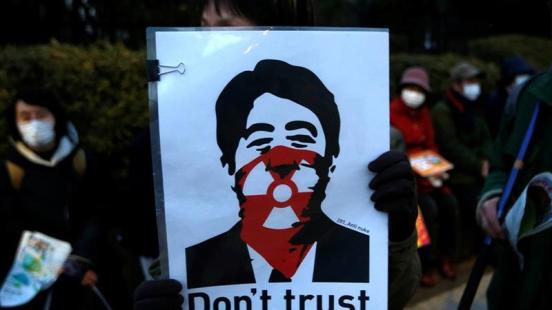 Japan’s anti-nuclear movement grew rapidly after the Fukushima disaster. Experts doubt that the country’s nuclear plants will ever generate the same levels of energy as they once did.
December 20, 2019
Tokyo, Japan – At the end of a decade in which northeastern Japan was devastated by a tsunami that triggered a nuclear disaster at Fukushima, atomic energy looks unlikely to make a comeback.
In the nearly nine years following the world’s worst nuclear accident since Chernobyl, the country’s reliance on atomic power for electricity generation has plummeted to between 3 and 5 percent from about 30 percent before the disaster, according to the Tokyo-based Citizens’ Nuclear Information Center.
And despite a period of uncertainty in the immediate aftermath of the meltdowns triggered when Fukushima’s cooling systems were overwhelmed by the tsunami created by the magnitude 9.0 undersea earthquake, the world’s third-largest economy has shown it can function with radically less nuclear power.
The public mood turned dramatically after Fukushima and the national trauma that ensued and combined with the increasing costs from aligning ageing plants with stringent post-disaster safety requirements, it is unlikely the nuclear industry will return to previous levels, according to experts, even as the government envisions nuclear power accounting for about 20-22 percent of electricity generation in 2030.
“It is obvious that it is very difficult to meet this target,” said Hajime Matsukubo, secretary-general of the Citizens’ Nuclear Information Center.
And while experts say while the anti-nuclear movement may seem to have quietened down, anti-nuclear feeling is firmly entrenched.
‘They say no’
“Japanese people’s sentiment (has) changed after Fukushima Daiichi and it is continuing until now,” said Matsukubo, whose non-profit organisation was established in 1975 by concerned atomic scientists to gather and publicise nuclear information and raise public awareness on the industry.
He said that even if people appear not as focused, if they are asked pointedly if they agree with nuclear power: “They say no.”
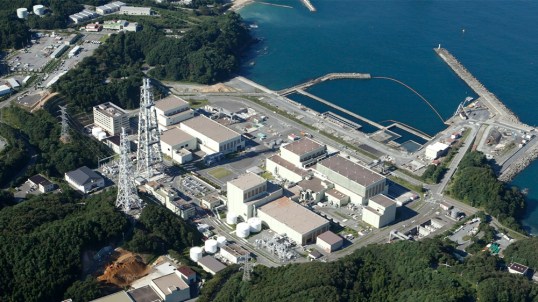 The Onagawa Nuclear Power Plant avoided the disaster at Fukushima, two-and-a-half hours’ drive south, and the government has said its No 2 reactor could be up-and-running by late next year
Before Fukushima, Japan had 54 operational reactors and for a brief time in the accident’s aftermath, not a single one was in operation. So far, nine have been restarted and authorities are considering the cases of a dozen more, according to Ministry of Economy, Trade and Industry figures. A further 24 are either under decommissioning or lined up for it.
Late last month, regulators gave initial approval for the restart of a reactor at the facility closest to the epicentre of the March 2011 quake. The No 2 reactor at the Onagawa nuclear plant could be running again late next year if further conditions are met. Onagawa was damaged in the double disaster, where the tsunami wave rose as high as 13 metres, but avoided Fukushima’s catastrophic meltdowns.
Japan imports nearly all its crude oil and natural gas. Underscoring such dependency, Prime Minister Shinzo Abe told a nationally televised news conference in 2016 that the nation could not “do without” nuclear power.
But Shinjiro Koizumi, minister for the environment and nuclear issues and the son of anti-nuclear former prime minister Junichiro Koizumi, said after his appointment in September that the country needed to wean itself off the atom.
“We will be doomed if we let nuclear accidents recur,” he said, according to Kyodo News.
Safety costs
Japan’s mass-circulation newspaper Mainichi Shimbun in an editorial after the Onagawa decision cited the newspaper’s own research that found 11 top power suppliers had spent in excess of 5 trillion yen ($45.7bn) on nuclear safety since Fukushima.
“As costs balloon, it is becoming increasingly difficult, even absurd, for the government and power companies to maintain the argument that nuclear power is ‘cheap’,” the editorial said.
“The more thoroughly safe the plants become, the more time and money is needed,” it continued. “We must ask, then: is it realistic to press on with the safety upgrade and reactor restart policy? We cannot dispel our suspicions that the answer is, in fact, ‘no’.”
Japan has clearly shown it can function on less nuclear-generated power, but the shift has come at a cost: an increasing reliance on fossil-fuel alternatives such as coal, oil and natural gas. And with concerns over climate change intensifying, that is drawing international attention.
“I’m very much aware of the challenges of Fukushima to the Japanese electrical sector,” said Paul Simpson, CEO of London-based non-profit CDP, which runs a global disclosure system that aids investors, companies and local governments in managing their environmental footprint.
Simpson, speaking at a forum on decarbonisation in Tokyo last month, stressed that coal was simply no longer an option and countries still using it must search for alternatives, citing Germany’s plan for no new coal use by 2040.
Alternative energies
“Japan needs to find a transition pathway from this, and I know this is challenging,” he said. “But coal is socially unacceptable … from a climate-risk perspective but also from an air pollution perspective.”
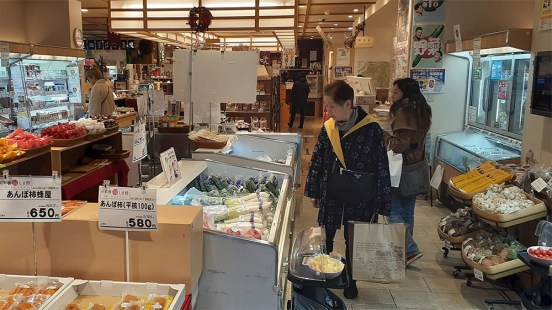 Customers browse in a Tokyo shop that specialises in products from Fukushima
According to Matsukubo, about 30 percent of Japan’s electricity generation comes from coal and 43 percent from natural gas. And the country has moved to build new coal-fired power plants since Fukushima.
“It’s disastrous,” Matsukobo said, stressing that Japan needs to move to renewable sources of energy; an area in which Simpson also pointed out Japan is lagging, even though the government has promised to increase the country’s use of renewables by 2030.
There was always some ambivalence about atomic energy in Japan – the only country to suffer a nuclear weapon attack when the United States dropped bombs on the cities of Hiroshima and Nagasaki in the closing days of World War II.
Pope Francis, visiting Japan in November, surprised no one when he condemned nuclear weapons. But the pontiff, the first to venture to the country since 1981, went so far as to suggest that nuclear energy itself was a problem.
“I have a personal opinion: I wouldn’t use nuclear energy until it is totally safe to use,” the leader of the world’s 1.3 billion Roman Catholics said in comments to reporters during his flight back to Rome from Tokyo, Kyodo reported.
Ramping down
Alexander Brown, who has studied the anti-nuclear protest movement in Japan, said that because Japan had supported atomic power for so long, there was a sense of inertia despite post-Fukushima opposition, ageing infrastructure and the remote chance of new reactors getting the green light.
“There’s a sort of built-in time limit to how long the industry as a whole can continue,” said Brown, currently a Japan Society for the Promotion of Science international research fellow at Japan Women’s University.
He also emphasised, however, that Japan’s turn against nuclear energy had also coincided with a key change in its domestic economy; less industrially robust and therefore not as hungry for energy as before.
“Why have the lights stayed on,” Brown asked rhetorically. “One is, yes, increased fossil fuel use, but another is there’s just less demand than there was in the peak time of manufacturing onshore in Japan.”
Brown calls that an “uncomfortable truth” for much of Japan’s ruling establishment – including the prime minister and his eponymous “Abenomics” economic revitalisation programme – which clings to a belief in a model of vigorous growth.
“And I think one of the amazing things when I look at the anti-nuclear movement, to me, was it was full of people looking at what are other ways that we can live,” he said.
“How can we embrace other values other than high consumption, high pollution, extreme overwork and look at things like de-growth economics.”
https://www.aljazeera.com/news/2019/12/japanese-turn-nuclear-decade-wrought-fukushima-191220000003532.html
December 24, 2019
Posted by dunrenard |
Japan | No Nuclear, Post-Fukushima |
Leave a comment
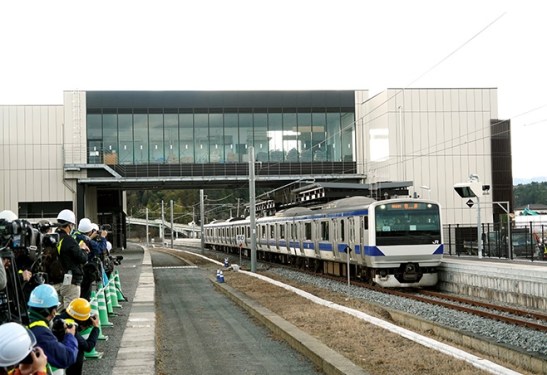
A train arrives at JR Futaba Station in Fukushima Prefecture during a test run on Dec. 18.
FUTABA, Fukushima Prefecture–A disrupted section of the JR Joban Line near the beleaguered Fukushima nuclear plant is expected to reopen March 14, bringing the entire line back in service for the first time in nine years.
A test run to check signal lights, rails and crossings started in Fukushima Prefecture Dec. 18.
As part of the test, a five-car train arrived around 10:20 a.m. at the newly built Futaba Station, about 4 kilometers northwest of the plant.
The Fukushima No. 1 nuclear power plant suffered a triple meltdown following the Great East Japan Earthquake and tsunami in March 2011, with residents in wide areas ordered to evacuate.
The tests will continue through Dec. 20, with the train making two round trips a day between Tomioka and Namie, the 20.8-kilometer section of the line that has remained out of service.
If service in the section is resumed, the Joban Line will connect Nippori in Tokyo to Iwanuma in Miyagi Prefecture, covering about 344 km.
Futaba Station features a glass-walled corridor connecting the east and west sides. However, many nearby buildings were dismantled following the disaster, leaving plots of empty land.
No residents can be seen around here as evacuation orders due to the nuclear disaster have been in place throughout the town.
As the section set to reopen is within 10 km of the nuclear plant, the train will run through the “difficult-to-return zone” that has excessive levels of radiation.
Japan Railways has been engaged in decontamination efforts in the area since March 2016 to lower radiation levels by removing trees along the tracks and replacing gravel.
Coinciding with the resumption of the entire line, evacuation orders for areas around Yonomori, Ono and Futaba stations within the section are expected to be lifted.
Orders for roads connecting the stations and areas where access is not restricted would also be lifted, allowing passengers to access the stations.
December 24, 2019
Posted by dunrenard |
fukushima 2019 | Fukushima Prefecture, Futaba, JR Joban line, Reopening |
Leave a comment

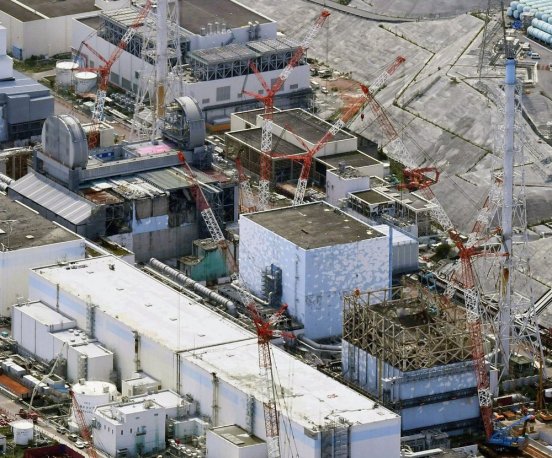









 nuclear-news