Local governments growing more reliant on nuclear taxes
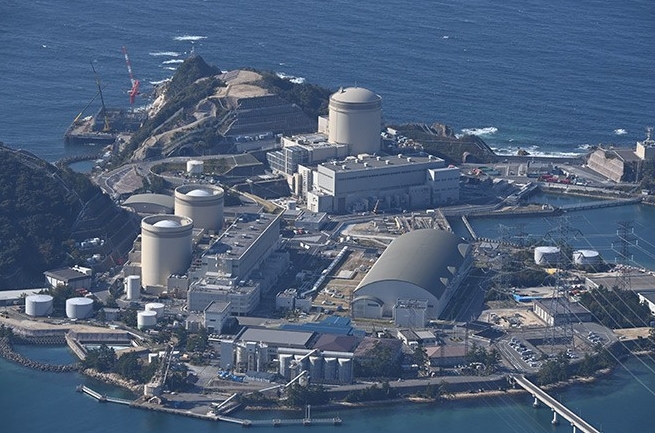
Kansai Electric Power Co.’s Mihama nuclear power plant in Mihama, Fukui Prefecture
January 20, 2021
Local governments are increasingly depending on tax revenues from the nuclear plants they host, a relationship that has deepened over the 10 years since the Fukushima nuclear disaster, an analysis by The Asahi Shimbun shows.
That follows the introduction of new tax regimes that ensure a steady flow of nuclear-related tax yields–even when reactors are idle or in the process of being decommissioned. They were brought about largely through increasing existing taxes on nuclear fuels and levying new taxes on spent nuclear fuels kept at the plants.
In fiscal 2011, right after the triple meltdown at the Fukushima No. 1 nuclear power plant, jurisdictions home to nuclear plants and related facilities yielded some 20.1 billion yen ($193.7 million) in taxes. The bulk of that came from taxes on nuclear fuel; many local governments only began collecting spent fuel taxes years after the accident.
But then the figure more than doubled to an estimated 46.7 billion yen in fiscal 2020, ending in March, despite the nuclear plants being offline.
The Asahi Shimbun studied nuclear-related tax revenues received by host municipalities and the 13 prefectures where those municipalities are located.
Local governments can impose taxes on nuclear fuel and spent nuclear fuel at plants and related facilities through approving ordinances to do so.
Of all the jurisdictions examined, Aomori Prefecture, where nuclear fuel cycle facilities are concentrated, and Fukui Prefecture, which hosts 15 reactors, the most in Japan, account for more than 60 percent earned through those taxes.
The amount for fiscal 2020 is larger than the 40.3 billion yen brought in during fiscal 2010, when the plants were operating.
Nuclear fuel taxes were originally based on the value of reactor fuel.
But all the nuclear plants went offline following the Fukushima disaster in March 2011.
As a result, six prefectures housing nuclear plants reported no tax revenues from nuclear fuel taxes in fiscal 2011.
Desperate to secure income sources even during plant closures, Fukui Prefecture introduced in autumn 2011 a new fuel-tax system based on reactor output capacity–meaning the reactors can be taxed even when shut down.
Other jurisdictions home to nuclear plants followed suit.
In 2014, Ehime Prefecture devised a tax on output capacity that can still be applied when the reactor is undergoing decommissioning. Soon after, Saga Prefecture introduced a similar system.
Nuclear plant operators must pay taxes on spent nuclear fuel to the local government as well as to the prefectural government if ordinances requiring the payment were enacted at both levels.
Ehime and Saga prefectures began taxing spent nuclear fuel in 2019.
Ikata, home to the Ikata nuclear plant in Ehime Prefecture, introduced a tax on spent nuclear fuels in fiscal 2018, after Genakai, which hosts the Genkai nuclear plant in Saga Prefecture, did the same in fiscal 2017.
Mutsu, located in Aomori Prefecture, is ready to capitalize on playing host to an interim storage facility for spent nuclear fuel, which is expected to go into operation in fiscal 2021.
The Mutsu city government established new rules in March last year so it can levy tax on spent nuclear fuels. The tax is projected to bring 9.3 billion yen to the city over five years.
Fukui Prefecture introduced a tax regime for nuclear fuels in 1976, ahead of any other local governments with nuclear facilities in the country.
Since then, tax revenues from nuclear fuels and spent fuels brought in by all jurisdictions totaled more than 1 trillion yen through fiscal 2020. And the figure is projected to grow in the years to come.
The driving force behind these local governments expanding their nuclear taxes in new and creative ways is a decline in tax revenues from fixed assets on nuclear facilities, and fewer grants and subsidies coming in from the national coffers to promote nuclear energy.
Many host communities have underlined the need to secure income from hosting nuclear plants, operating or not, to finance new roads and other infrastructure that would be used to evacuate residents in the event of a serious accident.
But a significant number of local governments used tax revenues derived from nuclear plants to cover upkeep of hot spring resorts and other seemingly unrelated facilities, the study shows.
Regional utilities added the amount of taxes on nuclear fuels and spent nuclear fuels they will pay into the electricity rates that consumers paid until 2016, when the retail electricity market became fully liberalized.
Even after the market liberalization, they can do the same to come up with funds to pay nuclear fuel and spent nuclear fuel taxes.
Dumping Fukushima’s contaminated water into the ocean could be a violation of international law
Environmental implications require an international conversation
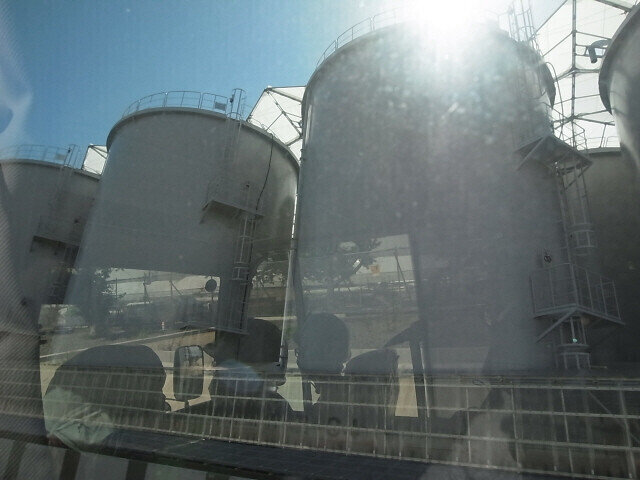
Storage tanks for radioactive water at the Fukushima Daiichi Nuclear Power Plant.
January 10,2021
At a meeting of parties to the London Convention and Protocol on Dec. 14, the South Korean Ministry of Oceans and Fisheries (MOF) clearly stated that the release of contaminated water from the Fukushima Nuclear Power Plant into the ocean was not a sovereign decision for the Japanese government to make. Its reason was that the damage would extend beyond the scope of Japan’s jurisdiction, affecting nearby countries including South Korea.
While the US and France have stated their trust in the safety of releasing the water and referred to it as a matter for the International Atomic Energy Agency (IAEA) to oversee, delegations from China, Russia, and Canada indicated their support for the South Korean government’s position. David Santillo, a Greenpeace Research Laboratories senior scientist who took part in the meeting, stressed that the matter of releasing the water into the ocean was something to be discussed at an international level.
During the meeting, the MOF worked to encourage other countries in the region to indicate their support, while also ensuring an opportunity to continue the debate at the next meeting. Despite these efforts by the South Korean government, some in South Korea still maintain that there is nothing wrong with dumping the water because it’s been treated. This conclusion is faulty.
The 1.37 million tons (as of summer 2022) that are currently set to be released into the Pacific Ocean are just the start of the issue. Even after that enormous amount has been discharged, radioactive material — hundreds of tons produced each week at the Fukushima plant — will continue to be released. Some of the radioactive substances have half-lives in the tens of thousands of years or more. The main reason for the water’s contamination has to do with three reactors that melted down in the Fukushima disaster. Cooling water has to be added daily to control the reactors as they continue to undergo nuclear fission. This means that water is going to continue to be contaminated until the reactors’ nuclear fuel and waste have been completely removed.
The amount of nuclear fuel remaining after the Chernobyl disaster, commonly viewed as the worst nuclear catastrophe in history, has been reported at around 570 tons. The Ukrainian government predicted it would take 100 years to remove it all. This means there is no way to pledge any concrete timeline. Within the Fukushima reactors, there are more than 1,100 tons of remaining nuclear fuel and waste, nearly twice as much as Chernobyl. In particular, most of the strontium, which inflicts the most biological damage, is still in the reactors.
As more water is contaminated by this highly concentrated radioactive material, it accumulates in the ecosystem. The amount of contaminated water that the Japanese government plans to release into the Pacific already exceeds 1 million tons; over the next 10 years, it could rise to 2 million. The radioactive substances in the water are another issue. As cesium and strontium deposit and accrete on the ocean floor, they can release radioactive matter over the long term. The effects on marine life are likewise severe.
The problem is that there is no way of gauging or preventing the damage ahead of time. This is why there are such strict regulations on the disposal of radioactive material into the ocean. The Japanese government has argued that its release of Fukushima water is justified by likening it to the release of cooling water from normally operating nuclear power plants, but no precedent exists where permission has been granted to discharge waste from a nuclear accident into the marine environment. As such, South Korea needs to stop the Japanese government’s decision to avoid a tragic outcome.
To begin with, Seoul has the right to demand that Tokyo perform an official environmental impact assessment. The release of the contaminated water into the ocean would be a violation of international law if it does not conform to the principle of prior notification and the obligation to perform an environmental assessment.
Even the IAEA, which has sided with the Japanese government, explicitly mentioned the need for an environmental impact assessment in its report. The South Korean government must speak out and ensure it happens.
By Chang Mari, Greenpeace energy campaigner
http://english.hani.co.kr/arti/english_edition/english_editorials/978035.html
Radiation levels at Fukushima plant found worse and more lethal than previously assumed

January 5, 2021
Radiation at the Fukushima No. 1 nuclear plant is far worse than previously thought, with the levels estimated at 10 sieverts per hour– a fatal dose for anyone who stays in the vicinity for an hour, according to experts. This means it will be extremely difficult for crews to move shield plugs, raising concerns that the plan to decommission the reactors will have to be reassessed.
Exceedingly high radiation levels inside crippled reactor buildings at the Fukushima No. 1 nuclear plant were described by nuclear regulators as an “extremely serious” challenge to the overall decommissioning of the site.
According to the Nuclear Regulation Authority (NRA), a huge amount of radioactive materials had attached to shield plugs of the containment vessels in the No.2 and No. 3 reactors.
With an estimated 10 sieverts per hour, the radiation levels are fatal for anyone who stays even an hour in the area. The finding also means that it would be extremely difficult for workers to move the shield plugs, which raised the prospect that the decommissioning plan will have to be reassessed.
Removing the highly contaminated shield plugs added to the challenge of recovering unclear fuel debris– the most taxing part of the process, said NRA chairman, Toyoshi Fuketa.
“It appears that nuclear debris lies at an elevated place,” Fuketa said at a news conference in December 2020. “This will have a huge impact on the whole process of decommissioning work.”
At normal times, the shield plug blocks radiation from the reactor core. Workers remove a shield plug to get access to the containment vessel’s interior when unclear fuels need to be replaced.

The Fukushima I Nuclear Power Plant after the 2011 Tōhoku earthquake and tsunami. Reactor 1 to 4 from right to left.
In a study that resumed in September after a five-year hiatus, the NRA conducted fresh measurements of radiation levels in the surrounding areas of the No. 2 and No. 3 reactors.
It found that the amount of radioactive cesium 137 was at 20-40 petabecquerels between the top and middle layers of the No. 2 reactor’s shield plug. This works out to more than 10 sieverts per hour– radiation at these levels can be fatal to a person if they spend an hour in the vicinity. Meanwhile, the estimated figure was 30 petabecquerels for the No. 3 reactor.
The 2011 earthquake and tsunami disaster in Fukushima caused the shield plug of the No. 1 reactor to slip out of place. It was also damaged by a hydrogen explosion at the reactor building.
As larger amounts of cesium 137 leaked from the No. 1 reactor through the damaged plug, the amount of radioactive material was estimated at 0.16 petabecquerels, lower than for the No. 2 and No. 3 reactors. On the other hand, the shield plugs, for the No. 2 and No. 3 reactors remained secure.
The Tokyo Electric Power Co. (TECPO) announced that the removal of nuclear fuel debris will be moved to 2022 or later, rather than the initially planned operation in 2021, due to a delay in the development of equipment.
55% oppose release of treated water from Fukushima plant

Numerous tanks containing contaminated water from the stricken reactors at the Fukushima No. 1 nuclear power plant occupy a large portion of the site’s premises in October.
January 4, 2021
Fifty-five percent of voters in a survey expressed opposition to the government’s plan to release treated contaminated water from the crippled Fukushima No. 1 nuclear power plant into the sea, while 32 percent support the measure.
The Asahi Shimbun survey also found that more than 80 percent of respondents fear the reputation of local seafood would be hurt if the treated water were discharged.
The government is moving to release tons of water from the stricken facility situated on the Pacific coast of northeastern Japan because the plant’s capacity to store radioactive water on its premises is projected to reach its limit in summer 2022.
This will be accomplished by removing most of the extremely hazardous radioactive substances and diluting the polluted water sufficiently so that it comfortably clears the government’s safety standards for disposal.
However, local fishermen and the national federation of fishermen’s groups, along with local municipalities, all staunchly oppose discharging the water.
Fifty percent of voters supporting the Cabinet headed by Prime Minister Yoshihide Suga and 47 percent of Suga’s Liberal Democratic Party are against the plan, outnumbering those who favor it, the survey showed.
By gender, men were sharply divided over the question, with 44 percent endorsing it and 46 percent opposing the plan.
But 62 percent of women took exception to it, compared with 22 percent who approved of the plan.
Asked whether the image of local seafood would be adversely affected after the water is released, 42 percent said they were “deeply concerned” about the matter, while 44 percent replied they were “somewhat concerned.”
The ratio of those who were “not concerned so much” came to 9 percent. Those who were “not concerned at all” stood at 2 percent.
But the survey also showed that 68 percent of voters backing the discharge said it will undermine the reputation of local seafood.
With regard to the government’s handling of the Fukushima nuclear disaster to date, 67 percent gave the thumbs down and 20 percent rated its performance highly.
Among supporters of the LDP, 56 percent had a low opinion of the government’s approach.
The survey also showed that 64 percent of respondents who took exception to government’s response were against the planned discharge of treated contaminated water into the sea.
The survey was conducted from November to December by sending questionnaires to 3,000 eligible voters nationwide selected at random. There were 2,126 valid responses, or 71 percent of the total.
Emperor’s evacuation to Kyoto weighed after Fukushima nuclear disaster
January 2, 2021
The government led by the now-defunct Democratic Party of Japan unofficially proposed that then Emperor Akihito evacuate to Kyoto or somewhere further in the west from Tokyo immediately after the start of the Fukushima nuclear disaster in March 2011, a former administration official has said.
However, the Imperial Household Agency flatly dismissed the idea, saying there was “no way” the emperor would do it at a time when people were not evacuating from Tokyo, leading to the government of Prime Minister Naoto Kan to give up the proposal.
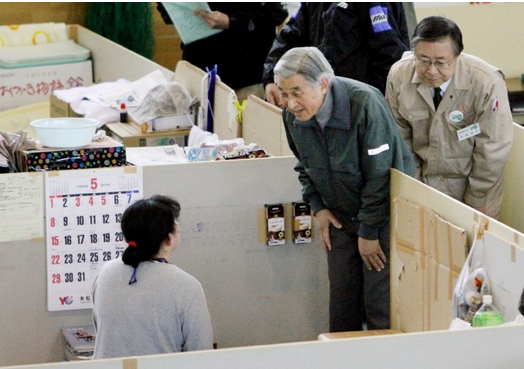
Then-Emperor Akihito speaks to an evacuee in May 2011 in Fukushima Prefecture, which hosts the Fukushima Daiichi Nuclear Power Station that was crippled in the earthquake-tsunami catastrophe of the same year.
Several former senior officials at the prime minister’s office separately said the then DPJ administration also briefly considered evacuating Prince Hisahito, the son of Crown Prince Fumihito and Crown Princess Kiko, from Tokyo to Kyoto.
Prince Hisahito became second in line to the throne when his uncle, Emperor Naruhito, ascended the Chrysanthemum Throne in May 2019. The prince was 4 years old when the Fukushima Daiichi nuclear plant suffered core meltdowns following a devastating earthquake and tsunami in northeastern Japan.
Former Emperor Akihito stepped down from the throne on April 30, 2019, becoming the first Japanese monarch to abdicate in around 200 years, his eldest son succeeding him the following day.
Kan, a House of Representatives member now belonging to the main opposition Constitutional Democratic Party of Japan, admitted he was “thinking in my head” of evacuating the emperor at the time but denied he had conveyed the idea to the then emperor or suggested it to someone else.
However, according to the former Kan administration official, at Kan’s request he unofficially asked Shingo Haketa, then chief of the Imperial Household Agency, via a mediator whether Emperor Akihito would agree to evacuate from the Imperial Palace, possibly to the Kyoto Imperial Palace in the ancient capital in western Japan.
A former agency official said he remembers the agency turned down the proposal.
Asked whether the agency actually conveyed the evacuation proposal to the emperor, he said “maybe, but only after” saying no to the administration.
The Kan administration also treated Prince Hisahito’s evacuation as among items that should be considered in case of a spike in Tokyo’s radiation levels, but eventually decided not to formally consider it, according to the former senior officials at the prime minister’s office.
On March 11, 2011, the six-reactor plant on the Pacific coast was flooded by tsunami waves exceeding 10 meters triggered by the magnitude 9.0 quake, causing the reactor cooling systems to lose their power supply.
The Nos. 1 to 3 reactors subsequently suffered core meltdowns, while hydrogen explosions damaged the buildings housing the Nos. 1, 3 and 4 units. Around 160,000 people were evacuated at one point in the nuclear disaster with a severity level rated on a par with the 1986 Chernobyl accident at maximum 7 on an international scale.
Yutaka Kawashima, who was the agency’s grand chamberlain at the time, wrote in a magazine article shortly after the triple disaster, “It is utterly inconceivable for his majesty to abandon the people of Tokyo and leave Tokyo,” as rumors had circulated about the emperor escaping the capital.
On March 16, 2011, five days after the quake and tsunami, Emperor Akihito said in an unprecedented video message he was hurt by the devastation caused by the disaster and expressed hope the people of Japan would overcome the challenges they faced by caring for each other.
He and his wife then Empress Michiko also voluntarily cut electricity at their residence in Tokyo for two hours daily as they wanted to share the hardship experienced by the people under the power rationing measure taken by electric companies, the agency said at the time.
In parts of Tokyo and its vicinity, rolling blackouts were implemented in the face of substantial power shortages stemming from the crippled nuclear power plant in Fukushima Prefecture. Areas in central Tokyo hosting government offices, parliament and the Imperial Palace were excluded from the measure.
Only 30% of Fukushima residents happy with disaster recovery progress
January 1, 2021
Nearly 10 years after the 2011 earthquake-tsunami and nuclear disasters in northeastern Japan, only 30 percent of Fukushima Prefecture residents say reconstruction has been sufficient, a Kyodo News survey showed Thursday.
The figure was notably lower than 80 percent in Miyagi and 66 percent in Iwate prefectures, which were also affected by the natural disasters.
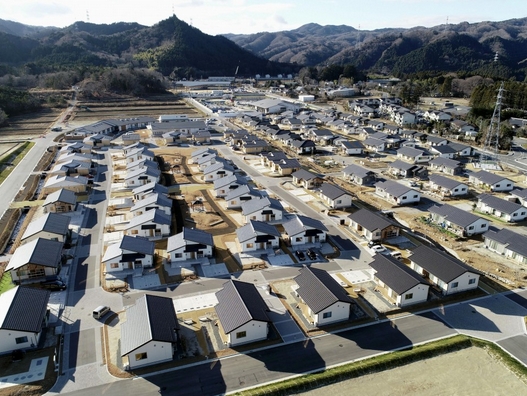
Photo taken Dec. 23, 2020, from a drone shows rows of public houses for residents who lost their homes in the disaster in Okuma, Fukushima Prefecture.
The low number in Fukushima reflects how the nuclear meltdowns at the Fukushima Daiichi power plant and subsequent evacuation orders have slowed reconstruction work.
Face-to-face surveys were conducted in November involving 100 residents in each of the three prefectures to ask about reconstruction of the communities where they lived when the magnitude-9.0 earthquake and subsequent tsunami hit the region March 11, 2011.
A total of 176 people, or 59 percent, across the three prefectures said reconstruction was “progressing” or “progressing to some degree,” while 123 people, or 41 percent, said there had not been enough progress. One person did not answer.
“My hometown is full of vacant plots of land,” said a man in his 50s who evacuated from Futaba, which hosts the Fukushima Daiichi plant, to Iwaki in Fukushima Prefecture. “I cannot imagine the town becoming a place we can return to.”
Many respondents appreciated the rebuilding of infrastructure, but some said it has taken too much time. Among Fukushima residents unhappy with the reconstruction progress, many said they are disappointed that they are still not allowed to return to their hometowns due to radioactive contamination and that townscapes have not been restored.

Photo taken on Sept. 26, 2020, in Okuma, northeastern Japan, shows the disaster-stricken Fukushima Daiichi nuclear power plant where decommissioning work is taking place
Across the three prefectures, 66 percent said their lives were back on track as they were able either to move to public housing for disaster victims or build new homes. By prefecture, the rate was 80 percent in Miyagi and 70 percent in Iwate but significantly lower at 49 percent in Fukushima.
The cost of rebuilding homes and a decrease in income have also been a burden for residents.
“To reconstruct my house, I needed to get another loan (in addition to that for the home destroyed by the disaster). I won’t finish the payments until I’m 80 years old,” said Toshiyuki Naganuma, 58, who runs a construction firm in Natori, Miyagi Prefecture.
The local government in Natori declared the completion of the city’s recovery in March 2020. More houses have been built and tourists are returning. But Naganuma said that while “it may look like the city has recovered, reconstruction is not finished.”
“Jobs are still gone. My income is unstable,” said a man in his 40s who changed jobs three times after the disasters. He used to work at a restaurant in Rikuzentakata, Iwate, but sales dropped when construction workers and others engaged in work to rebuild the city left.
Yukihisa Ojima, 49, who operates a home appliance store in Rikuzentakata, worries about the city’s declining population. “Public facilities were rebuilt but things are slack for businesses here,” he said.
For those affected by the disasters, recovery means “getting back one’s life before the disasters,” said Jun Oyane, a professor at Senshu University and head of the Japan Society for Disaster Recovery and Revitalization.
“The next step after restoring infrastructure will be to focus on the varying needs of individual residents and to stand by them in rebuilding” their lives, he said.
Forests affected by Fukushima Daiichi nuclear accident

November 22, 2020
Forestry was once a thriving industry in Fukushima – until the 2011 nuclear disaster struck. More than 70 percent of the prefecture is covered with trees, but large areas have been abandoned or neglected.
“It’s regrettable. I didn’t even imagine things were so bad,” says forester Akimoto Kimio, who visited a plantation in Tomioka, about 10 kilometers away from the crippled Fukushima Daiichi nuclear power plant. Ever since an earthquake and tsunami triggered a triple meltdown at the facility, the forest has been abandoned. Some of its most prized pine trees, more than 50 years old, have died.
Akimoto, 72, heads a local forestry cooperative that was relocated elsewhere in the prefecture following the nuclear accident. But after nine years and eight months, it returned to Tomioka on November 4.

Akimoto Kimio, the head of the Futaba district forestry cooperative.
The forestry cooperative ships timber and manages maintenance, such as thinning out trees. Akimoto oversees about 2,000 hectares, 60 percent of which is in areas subject to an evacuation order due to high radiation levels.
His cooperative used to have 20 workers. At one point, the number dwindled to just two. Akimoto has worked hard to keep it afloat, negotiating with the central government and plant operator Tokyo Electric Power Company on decontamination work and compensation. He believes forest preservation will one day help to ensure evacuated residents can return.
Unattended areas of woodland can pose various risks, including fires. A contaminated forest would be particularly hazardous in the event of a landslide, because the mud flow is likely to contain radioactive substances.
n 2017, a forest fire near Tomioka burned down trees on a 75-hectare-plot. It took 11 days to extinguish.
“Our mission is to take good care of our hometown forests and enhance the surrounding environment,” says Akimoto on the day his cooperative returned to Tomioka.
“We will help lay the groundwork to ensure residents can return worry-free. We hope many will come home.”
No radioactive water dump!

From GENSUIKIN
The Japanese government appears ready to dispose of radioactive water contaminated by tritium and other radioactive materials from the crippled Fukushima Daiichi nuclear power plant into the Pacific Ocean. GENSUIKIN is asking for your support to prevent this reckless attempt by the government. Please see the end of the article for action steps.
At GENSUIKIN, we have campaigned against any uses of nuclear technology by any country, including the commercial use of nuclear energy such as nuclear power plants, on the basis that “nuclear and humanity cannot coexist”.
On March 11, 2011, during the Great East Japan Earthquake, four of six nuclear reactors operated by Tokyo Electric Power Company (TEPCO) had core meltdowns caused by loss of cooling power. Due to the high radiation dose at the facility – 42 Sv in the containment vessel and 5150 mSv in the buildings — it is impossible to know the true extent of damage to the core while cooling water continues to be injected to prevent criticality.

There is now widespread opposition to nuclear power in Japan. Pictured: a rally in front of the Japanese Diet on October 27, 2020. (Photo courtesy of Gensuikin.)
In such a situation, it is extremely dangerous for cooling water to be contaminated by high level radioactive materials, to accumulate to as much as 1.23 million cubic meters and then, potentially, to leak into the groundwater.
At present, after decontamination by an Advanced Liquid Processing System (ALPS), the contaminated water is stored in tanks at the nuclear site. There are currently 1,044 tanks at the site. Astonishingly, to remove the contaminated water, the Japanese government and TEPCO plan to dispose of it by dumping it into the Pacific Ocean. There are a number of problems with this, around which we are organizing opposition movements in solidarity with residents in Fukushima.
1. Hitachi’s Advanced Liquid Processing System (ALPS) is not able to eliminate radioactive materials completely, especially tritium.
ALPS is supposed to eliminate other radioactive materials. However, in August 2018 Japanese media reported that ALPS had consistently failed to eliminate a variety of other radioactive elements, including iodine-129, ruthenium-106, and strontium.
It has been revealed that, in 70% of the tanks, the amount of radioactive substances present is 20,000 times the standard. TEPCO promises it will conduct secondary processing to lower the amount of radioactive substances to below standard level, but has yet to keep its promise; thus the disposal of the contaminated water is still a dangerous act. Tritium cannot be eliminated by ALPS at all. TEPCO estimates that there are 860 trillion becquerels of tritium in the contaminated water as a whole.
There are varied opinions on how hazardous tritium is. It is often pointed out that tritium absorbed through food has negative effects on cells and damages DNA. TEPCO claims that it will dilute tritium-contaminated water to below standard level and dispose of it into the ocean; however, the absolute quantity of tritium in the water has not changed, and it is pointed out that tritium’s dangerous effects of bioaccumulation of radioactive material in fish can be seen throughout the food chain.
2. The disposal of contaminated water to the ocean violates international law.
For example, article 207 and article 213 of the United Nations Convention on the Law of the Sea; [ ] article 1 and article 4 of the Convention on the Prevention of Marine Pollution by Dumping of Wastes and Other Matter of 1972; and article 4 of the 1996 Protocol to the Convention on the Prevention of Marine Pollution by Dumping of Wastes and Other Matter, 1972(London Protocol: LP).

There is justifiable concern about the contamination of the ocean and its fish stocks if the radioactive water from Fukushima is dumped into the sea. (Photo: “sushi from fukushima” by klara.kristina is licensed under CC BY-NC-SA 2.0)
The “United Nations Convention on the Law of the Sea” article 207 requests that “States shall adopt laws and regulations to prevent, reduce and control pollution of the marine environment from land-based sources”. The Convention on the Prevention of Marine Pollution by Dumping of Wastes and Other Matter of 1972 and London Protocol: (LP) forbid dumping any concentration of radioactive material into the sea.
However, insisting that “discharge” is different from “disposal”, the Japan Atomic Energy Commission (JAEC) has tried to approve dumping into the ocean without consensus. This ignores the fact that, when Russia disposed of 900 cubic meters of low-level radioactive waste liquid on October 6th, 1993, the JAEC and Japanese government criticized such disposal, thereby setting a precedent that disposal of even low-level radioactive waste liquid into the sea is not acceptable.
GENSUIKIN regards the disposal of Fukushima contaminated water to the ocean as a violation of international law, and breaking the promise made to international society to abandon the disposal of wastes into the ocean.
3. Japanese government and TEPCO have abandonedthe search for other measures with which todeal with the contaminated water.
They choose only disposal into the sea as it is the easiest and cheapest measure.
TEPCO argues that it will become too difficult to store the contaminated water due to a shortage of land required for holding tanks. However, it seems that they are making no effort to get land. While some areas are unsuitable due to radioactive contamination from the nuclear accident in Fukushima, there is some more usable land on the nuclear power plant site, contrary to TEPCO’s claims.
Furthermore, there are more options for reducing the space needed for the holding tanks. One such option is to use technology such as “Grease Solidification”, first implemented at the Savannah River Site Disposal Facility in the U.S., which solidifies highly tritium-contaminated water to be buried. TEPCO and the Japanese government have not considered these costly resolutions at all and have maintained disposal to the sea as the only option. This is not acceptable.
4. A betrayal of Japan’s fisheries.
The Fukushima Prefectural Federation of Fisheries Co-operative Associations made a request to TEPCO, stating that: “After the processing of radioactive contaminated water by ALPS, TEPCO is responsible for holding it in tanks in the nuclear power plant sites and must not dispose of the water into the sea without consent from fisheries and Japanese people”.
In August 2015, TEPCO responded that: “Without agreement from stakeholders, we will not dispose of any water and after processing by ALPS, the water will be held in the tanks at the site”.
Any such disposal now of water into the sea would be an act of betrayal to the fisheries.
Japan Fisheries Cooperatives and Fukushima Prefectural Federation of Fisheries Co-operative Associations have unanimously passed a resolution stating that they “firmly oppose the disposal of contaminated water into the sea”.

Japan’s fisheries firmly oppose the dumping of radioactive water from the Fukushima nuclear site into the Pacific Ocean. (Photo: The damaged Fukushima Daiichi Nuclear Power Station as seen during a sea-water sampling boat journey. Credit: IAEA/David Osborn/WikiMediaCommons
Moreover, Fukushima Prefecture Federation of forestry cooperatives and Central Union of Agricultural Cooperatives strongly oppose the disposal as well. Nineteen local assemblies in Fukushima Prefecture have submitted a written opinion opposing the disposal. There is no agreement on the disposal among stakeholders, which is a precondition of TEPCO’s promise to implement the disposal. TEPCO must not force the disposal.
As we explain above, there are many problems about the disposal of contaminated water into the Pacific Ocean. Therefore, there are no international and national agreements about it. In facing strong opposition to the disposal, the Japanese government postponed a cabinet council decision implementing the disposal, which was expected to be decided last October.
There is strong opposition abroad. Whether the Japanese government is forced to abandon the disposal depends on opposition from public opinion. GENSUIKIN would like to do our best in having the government abandon the disposal.
TO HELP: Please send comments no later than November 30, voicing your — our your organization’s — opposition the disposal of Fukushima radioactive waste into the Pacific Ocean.Email you comments to: office@peace-forum.top or kikosanm4004@gmail.com. Also, please also reach out to your elected officials and request that they send a message to the Japanese Consulate or Embassy in your area. The Science, ICT, Broadcasting and Communications Committee of the National Assembly of the Republic of Korea has already passed a resolution requesting that the Japanese government establish safer measures when processing the contaminated water.
Japan Congress Against A and H-Bombs (GENSUIKIN) was established in 1965, and is one of the largest anti-nuclear and peace organizations in Japan. GENSUIKIN has local organizations as members, consisting of labor unions, women’s organizations, youth organizations and civil society groups in all 47 prefectures of Japan.
Headline photo: Workers at TEPCO’s Fukushima Daiichi Nuclear Power Station work among underground water storage pools on 17 April 2013. Photo Credit: Greg Webb / IAEA / WikimediaCommons
Japan claims to be willing to consult with neighboring counties like South Korea to ensure the safe release of contaminated water from its Fukushima nuclear power plant
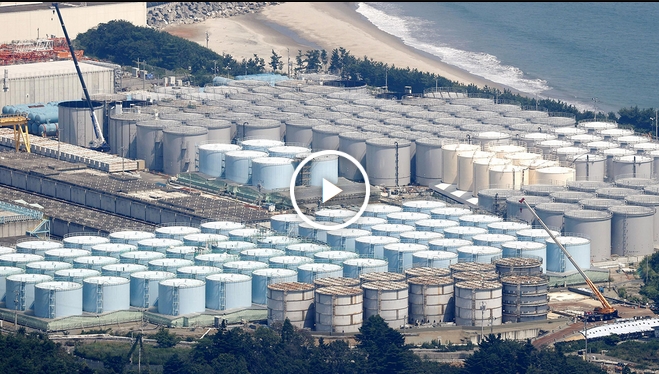
Japan to consult with S. Korea in monitoring radioactive water disposal from Fukushima plant
November 20, 2020
Japan is willing to consult with neighboring counties like South Korea to ensure the safe release of contaminated water from its Fukushima nuclear power plant.
That’s what was said by a senior Japanese embassy official in Seoul on Friday as Tokyo is expected to soon announce its plan to discharge more than one.two million tons of radioactive water into the sea possibly starting in 2022.
The official said the embassy is willing to disclose all information if Seoul participates in the monitoring process to help dispel worries raised by fisheries industries and environmental groups.
http://www.arirang.co.kr/News/News_View.asp?nseq=268158
Japanese Embassy implies likelihood of Fukushima releasing contaminated water
November. 21, 2020
A top-ranking official at the Japanese Embassy in South Korea on Friday mentioned Japan’s plan to release contaminated water that was used to cool the the first nuclear power plant in Fukushima in an interview with South Korean journalists, saying, “It is too early to affirm the plan but it may be specified within this year. We expect to release the water around summer 2022.” “The levels of radioactive substances at the time of release will meet regulatory standards,” he said.
The remarks seemingly intend to bring the issue to the surface with the aim of alleviating a backlash from South Korea. If Tokyo makes an official announcement to release contaminated water, it will serve as the first trigger for dispute between the two neighboring nations since the inauguration of the Suga administration.
Saying that the decision on the issue may not be put off indefinitely, the high-ranking official expected Tokyo to determine the timing of releasing the used cooling water before the opening of next year’s Tokyo Olympic Games at the latest. “In 2022, the site around the Fukushima power plants will be filled up with storage tanks where contaminated water is kept. Thus, there will be no space for extra tanks,” he said.
Regarding the South Korean government’s concerns about the release of contaminated water, the official replied that Japan has monitoring measures in place while promising to disclose all relevant information. However, he also remarked that the decision per se is within the domain of sovereignty, making it clear that Japan has no intention of discussing the issue. In response, the South Korean Foreign Affairs Ministry stated that it will demand that Japan should keep related information open and accessible at all times.
https://www.donga.com/en/article/all/20201121/2247772/1/Japanese-Embassy-implies-likelihood-of-Fukushima-releasing-contaminated-water
Japan Set to Decide Timing of Fukushima Water Release As Early As This Year
Japanese embassy’s official in Seoul official refuted claims that releasing the water without securing permission from regional neighbors would be an international violation.

November 20, 2020
Japan will soon decide when to start releasing radioactive water from the disabled Fukushima nuclear power plant into the ocean.
An official from the Japanese Embassy in Seoul said on Friday that the timing of the water release could be finalized as early as this year.
The official said Tokyo is open to verifying the process of treating the tainted water with Seoul and to reveal the data in a transparent manner.
Tokyo projects tank storage for the tainted water will reach its maximum limit in the summer of 2022.
The treatment process – the multi-nuclide-removing Advanced Liquid Processing System(ALPS) – is unable to remove some radioactive substances, including tritium. The official, however, stressed that the tritium-containing water would still fulfill scientific safety standards.
The official refuted claims that releasing the water without securing permission from regional neighbors would be an international violation.
Japan willing to work with S. Korea on monitoring of Fukushima water treatment: embassy official
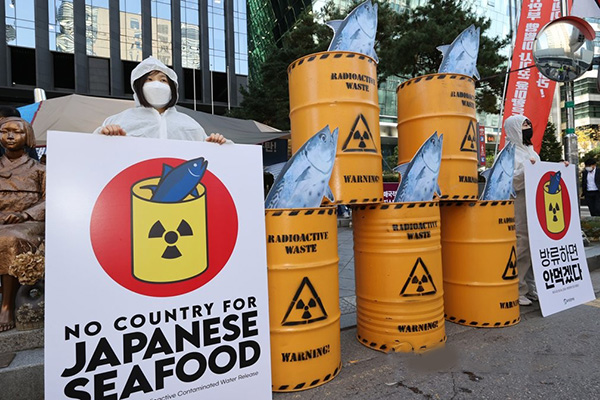
Activists stage a campaign against Japan’s envisioned plan to discharge into the sea the contaminated water from its wrecked Fukushima nuclear plant in front of the former site of the Japanese Embassy in Seoul, located in Seoul’s central Jongno district, on Nov. 9.
Nov 20, 2020
Japan is willing to work with South Korea on the monitoring of the envisioned treatment and release into the ocean of contaminated water from the wrecked Fukushima nuclear power plant, a senior embassy official said Friday.
The official’s remark comes as Tokyo is expected to soon announce its plan to gradually discharge into the sea more than 1.2 million tons of radioactive water stored in tanks since the 2011 meltdowns following an earthquake and tsunami.
Tokyo has pushed for the disposal into the Pacific Ocean, saying that the storage capacity will run out by the summer of 2022 and that it’s the most realistic and relatively harmless disposal method. But such a plan has sparked strong opposition and worries among the public in both South Korea and Japan.
“We will disclose all information if you’re interested in monitoring,” an official from the Japanese Embassy in Seoul said on condition of anonymity during a media briefing when asked if Tokyo is willing to verify the treatment process and share related data with Seoul.
Exactly how the monitoring will be carried out and shared with other countries has yet to be decided, but Tokyo intends to do it through consultations with neighboring countries, the official said.
“We are fully aware of the South Korean government’s policy and will faithfully respond to that.”
He added, though, that the actual monitoring, if decided, likely won’t take place until 2022 when the disposal process would begin in earnest.
Japan was expected to finalize the decision late last month but put off the announcement apparently due to strong opposition from the local fisheries industry.
Seoul has repeatedly called for Tokyo to provide concrete explanations as to how it will deal with the radioactive water and transparently share information related to the disposal plan.
Regarding the disclosure of related information, the embassy official stressed that the Japanese government will continue efforts to provide details so as to help dispel worries and fear harbored by South Koreans.
“We have had various occasions where we heard the opinions of many countries, including South Korea … and we’ll continue to do so. We are frequently in contact and cooperating with the South Korean government,” he said.
Environmental groups and activists, such as Greenpeace, have voiced concerns over unknown long-term effects of releasing the treated water and called for further examination.
The Tokyo Electric Power Corp., which operates the plant, says the water will be treated enough to remove all radioactive material before its release except for tritium, an element that it says is largely harmless.
Such a disposal method is also a common standard of practice already employed by other countries, according to Japanese officials. (Yonhap)
Taiwanese protest plan to dump water from Japan nuclear plant into sea
November 19, 2020
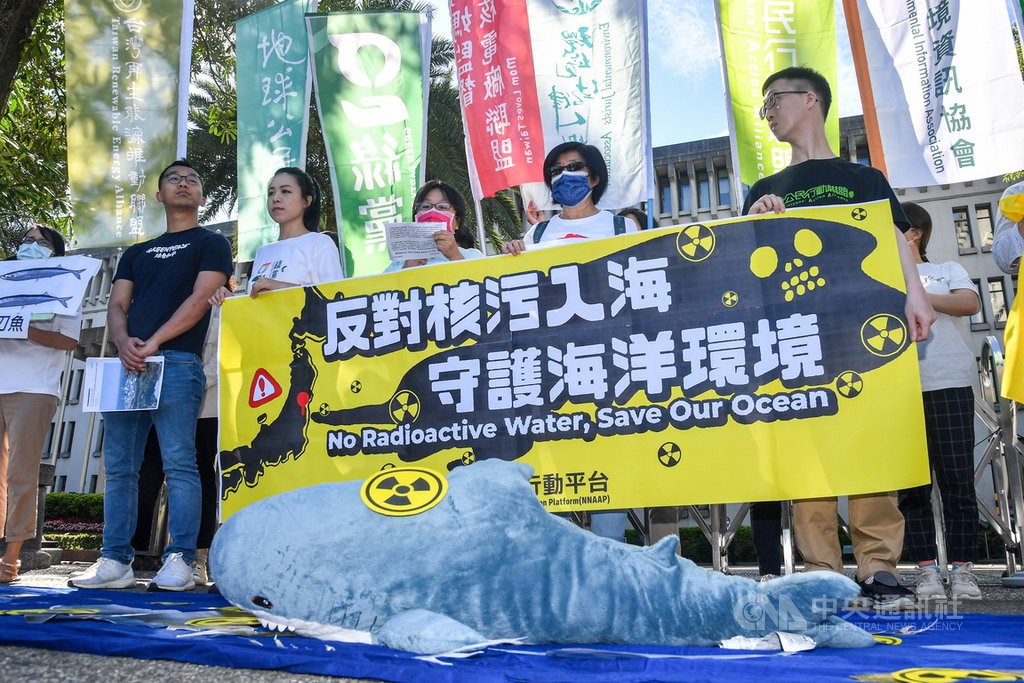
Taipei, Nov. 19 (CNA) A group of Taiwanese staged a protest in Taipei on Thursday against a plan by the Japanese government to release more than a million tonnes of water into the ocean from the disabled Fukushima nuclear power plant, starting in 2022.
At the rally in front of the Ministry of Foreign Affairs (MOFA), some 20 supporters of the “Nuclear Go Zero” movement called on the ministry to push back, via diplomatic channels, against the Japanese government’s controversial plan.
Tsai Ya-ying (蔡雅瀅), a lawyer affiliated with the Wild at Heart Legal Defense Association in Taiwan, said at the rally that releasing “contaminated” water from the disabled Fukushima Daiichi nuclear power would pose a risk to humans who might eat the many marine species that migrate in the warm current between Taiwan and Japan.
Another protester, Tsai Chung-yueh (蔡中岳), deputy CEO of the environmental organization Citizen of the Earth, said contamination of the marine ecology could last for 30-40 years, if the water is dumped into the ocean.
The protesters are opposed to a plan announced in October by the Japanese government to start releasing more than 1 million tonnes of water from the power plant, which was the site of a major nuclear disaster in 2011 when Japan was hit by a massive earthquake and tsunami.
Since then, Japan has been trying to find a way of disposing of the water that was used to cool the power plant and which has been increasing in volume due to rainwater seeping into the structure, according to international news reports.
By summer of 2022, the 1,000 huge storage tanks will reach their full capacity, and the water will be treated, diluted, and released into the Pacific Ocean over several decades, the reports said.
At a regular press briefing Thursday, MOFA spokesperson Joanne Ou (歐江安) said the Japanese government has not yet made a final decision on the issue, and MOFA will seek clarification.
She said the protesters have submitted a letter that has been passed on to the Taiwan-Japan Relations Association, which will relay their concerns to the Japanese government via Taiwan’s representative office in Tokyo.
“MOFA is also concerned about the issue, as the maritime environment, ecological conservation, and health of our citizens may be at risk,” Ou said
Release of Fukushima’s radioactive water into sea will harm entire Asia’s coasts: Indian experts
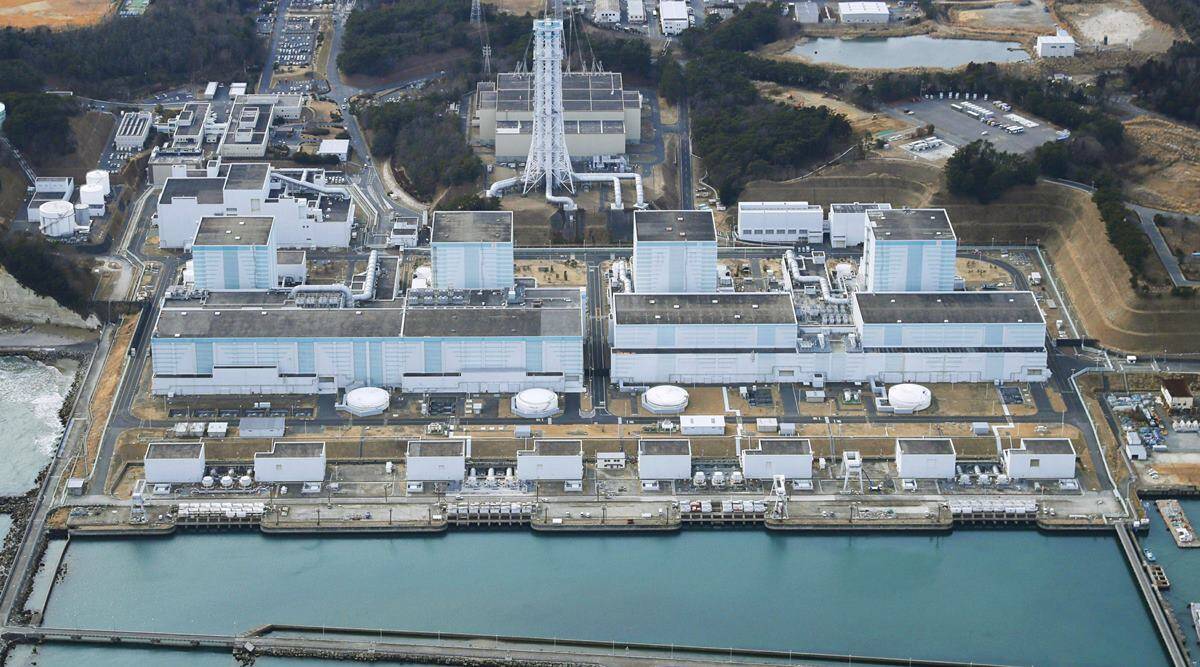
November 18, 2020
The contaminants of the massive quantities of nuclear water will include radioactive isotopes such as cesium, tritium, cobalt and carbon-12 and may take from 12 to 30 years to decay.
Japan’s decision to release radioactive contaminated water from its wrecked nuclear plant in Fukushima into the sea by 2022 has led to alarm bells ringing in India with experts warning it would set a wrong precedent and impact aquatic and human life along coastal belts of several parts of the world.
The contaminants of the massive quantities of nuclear water will include radioactive isotopes such as cesium, tritium, cobalt and carbon-12 and may take from 12 to 30 years to decay.It will destroy everything it comes in contact with almost immediately and cripple the economy related to the fishing industry and lead to a spectrum of diseases, including cancer.
“This will be the first incident of high volumes of radioactive water being released in the sea and can set a wrong precedent for others to follow. Concerns related to the environment and health are crucial for the existence of the human race. Therefore, alternative arrangements may be debated globally,” A K Singh, director general of health science at the Defence Research Development Organisation (DRDO), told PTI.
On March 11, 2011, a 9.0 magnitude earthquake struck off the north-eastern coast of Japan, triggering a 15-metre tsunami that damaged the 5,306 MW Fukushima nuclear plant. It is the second biggest nuclear disaster in the history of nuclear power generation after Chernobyl in 1986.
After the accident, 1.2 million tonnes of radioactive contaminated water released from the reactors in over 1,000 tanks were kept in a cordoned off large area near the Fukushima plant.
However, authorities are running out of space as the plant is to be decommissioned and the Japanese government has decided to release the radioactive contaminated water in the sea starting 2022.?
The decision to release the radioactive water was taken on October 16, 2020 after years of debate.
Singh, among the Indian government’s top nuclear health scientists, said the release of contaminated water into the ocean will directly impact human and aquatic life.
“The possibility of ingestion of tritium in humans will increase and since this isotope will distribute in all organs in humans and long.” Radioactivity monitoring in fish and other aquatic life in near vicinity (coastal areas) and drinking water will be necessary. Deposition of the radioactive elements on the rocks has also to be seen,? he said.
While Japanese authorities have said the water would be diluted before being released and it would only contain only tritium, other health experts who have been monitoring the issue said the risk involved should never be undermined.
Yudhyavir Singh, assistant professor of anaesthesia and critical care at the All India Institute of Medical Sciences, said the risks will depend entirely on the amount of the contaminants present in the nuclear wastewater and their nature.
“Mostly contaminants are radioactive isotopes which include cesium, cobalt, carbon-14 and tritium. The half-life of cesium is 30 years, it will take 30 years of half of the material to decay. Also the half-life of tritium is 12 years,” he told PTI.
“All the radioactive isotopes are carcinogenic and can induce cancer on prolonged exposure. In Chernobyl, it has been seen in the rise of thyroid cancer post nuclear leakage after 20 years,” he said.
Once the water is released into the ocean, it would be advisable to move and stay away from the coastal area in the region while completely avoiding seafood, added Yudhavir Singh, who has several publications on critical care and is a renowned researcher too.
“In the past, it has been seen that radioactive material discarded in France travelled to the North Atlantic and Arctic Oceans and found in the bodies of seals and Tortoises,” he said, warning that South East Asian nations will be at higher risk.
Environmentalists and several organisations, including Safecast?and Greenpeace, have urged the Tokyo Electric Power Company (TEPCO), the operator of the Fukushima plant, to build more storage tanks and keep the water stored.
Greenpeace claimed the water could change human DNA if consumed.
“Tritium is a beta emitter with low energy so causes damage to the DNA leading to genetic damage and affecting reproductions.” It will depend upon the radioisotopes contaminants in the water. Cesium has a half-life of 30 years and will be the last to decompose,??Yudhyavir Singh said.
The quantity of cesium in the nuclear waste water may take 180-300 years to decompose, he said.
Citing studies from the World Health Organisation, M C Misra, former director of AIIMS, Delhi, said an increase for specific cancers for certain subsets of the population inside the Fukushima Prefecture is very likely.
“A 2013 report predicts that for populations living in the most affected areas there is a 70 per cent higher risk of developing thyroid cancer for girls exposed as infants, a 7 per cent higher of leukemia in males exposed as infants, a 6 per cent higher risk of breast cancer in women and 4 per cent higher risk, overall, of developing solid cancers for females,” Misra told PTI.
Misra, who has dealt with all types of medical cases, including that of radiation, said Japan could have easily prevented the entire accident.
“The Japanese focused on the prevention principle without paying due attention to the mitigation principle as if it was sure that an accident was impossible. The power unit of the Fukushima plant was built on the basis of a design developed in 1960 and, therefore, the station was not ready for a crisis situation of the 21st century,” Misra said, citing the complexity of such situations.
Landside tritium leakage over through years from Fukushima Dai-ichi nuclear plant and relationship between countermeasures and contaminated water
Abstract
There has been tritium groundwater leakage to the land side of Fukushima Dai-ichi nuclear power plants since 2013. Groundwater was continuously collected from the end of 2013 to 2019, with an average tritium concentration of approximately 20 Bq/L. Based on tritium data published by Tokyo Electric Power Company Holdings (TEPCO) (17,000 points), the postulated source of the leakage was (1) leaks from a contaminated water tank that occurred from 2013 to 2014, or (2) a leak of tritium that had spread widely over an impermeable layer under the site. Based on our results, sea side and land side tritium leakage monitoring systems should be strengthened.
Introduction
The Fukushima Dai-ichi Nuclear Power Plant (FDNPP) accident released a large amount of radioactive materials into the environment since 2011. Most were in the gaseous state, released primarily through the atmosphere to the land of eastern Japan and to the north-west Pacific Ocean. The released amount was estimated to be approximately 520 PBq1, with radioactive iodine (mainly 131I), radioactive cesium (134Cs, 137Cs), and noble gases such as 133Xe accounting for most of the released amount. Tritium (3H, T1/2 12.3 y.) was an additional part of the radioactive materials released, but is considered as a “soft”, or low energy, beta emitter. The tritium beta energy is low (max 18.6 keV), and requires large quantities to deliver significant radiation doses, so that the measurement of other nuclear species was prioritized when considering human protection immediately following the accident. Therefore, data on tritium in the environment after the FDNPP accident are still limited in Japan2,3.
Tritium in a boiling water reactor is mainly produced by ternary fission. At FDNPP, 8.51 × 10¹³ Bq/month at 1.1 MW operation was produced by ternary fission4. Tritium is also produced in reactors by 10B(n, 2α)3H, 10B(n, α)7Li, 7Li(n, α)3H, or 6Li(n, α)3H, 2H(n, γ)3H5.
Cumulate 3H yields in the reactors at FDNPP have been estimated to range from 0.01% to 0.0108%6,7. According to estimates made immediately after the accident in 2011, there were reports that the inventory of 3H at the time of the accident was 1.81 × 10¹³ Bq8, but according to recent reports by Tokyo Electric Power Company Holdings (TEPCO), the inventory of 3H immediately after the accident was estimated to be 1.0 × 10¹⁵ Bq at Unit 1, 1.2 × 10¹⁵ Bq at Unit 2, and 1.2 × 10¹⁵ Bq at Unit 3, for a total of 3.4 × 10¹⁵ Bq4. As of March 24, 2016, 7.6 × 10¹⁴ Bq was in the storage tanks at the FDNPP site, 2.7 × 10¹³ Bq in the reactor building(R/B), and estimated 1.8 × 10¹⁵ Bq was released outside the reactor or in debris (Table 1)9,10.
There are three possible pathways for the release of 3H from FDNPP to the outside: ocean, atmosphere, and groundwater. Among them, direct releases to the ocean and releases to the atmosphere have been reported in detail.
An estimated 0.1–0.5 PBq of 3H flowed into the north Pacific Ocean from the accident6,11. Tritium was detected in the north-west Pacific Ocean off the coast of Hirono town, Fukushima Prefecture 1 month after the accident12.
Investigation of 3H in precipitation may be one of the easiest ways to confirm the release of 3H into the atmosphere. The highest tritium concentration in precipitation was estimated 10 days after the accident at 1342 TU (equivalent to 158 Bq/L)13. A surface water concentration of 3H at 184 (± 2) Bq/L was detected in rice paddy fields at 1.5 km from the FDNPP plant12. Since both reports greatly exceeded the natural 3H level in Japan (1.1–7.8 TU, equivalent to 0.13–0.92 Bq/L) or 6 TU (equivalent to 0.71 Bq/L)2,14, there was no doubt that the 3H was from the FDNPP accident. Also, since the samples were collected approximately 1 month after the accident, the 3H on the ground most likely originated as precipitation from the atmosphere, not via groundwater.
Leaking of 3H through groundwater is difficult to analyze. In this study, we report that 3H above natural levels has been detected continuously in groundwater sampled from 2013 to 2019 on land approximately 30 m from the FNDPP site boundary. A key aspect of this study is that the water examined was groundwater, not surface water. To reveal the hydrogeological origin of the groundwater sources, Sr isotope ratio (87Sr/86Sr) was also measured as a natural tracer of water–rock interaction and ground water mixing patterns15,16,17,18.
From 2013 to 2019, several countermeasures have been taken at the FDNPP to prevent contaminated groundwater from leaking off site. The relevance will be discussed, including the results of detailed tritium measurements in the water collected inside/outside FDNPP site.
Results
Outflow of 3H into groundwater from FDNPP
Most of the tritium present in the FDNPP was assumed to have been produced by ternary fission. As long as no re-criticality occurs, no new tritium is produced. However, it is estimated that there is 1.8 × 10¹⁵ Bq of tritium that has not been identified in the turbine buildings and in contaminated water, in addition to the amount released outside after the accident or the amount in debris10. In Japan, the limit for tritium release into the ocean is 6.0 × 10⁴ Bq/L in a typical nuclear facility, but in the case of the FDNPP, 1500 Bq/L is the regulatory limit for tritium effluent19. Therefore, over 1.2 × 10¹² L of water would be required for dilution.
Figure 1 shows a schematic diagram of the nuclear power plant site after the accident.
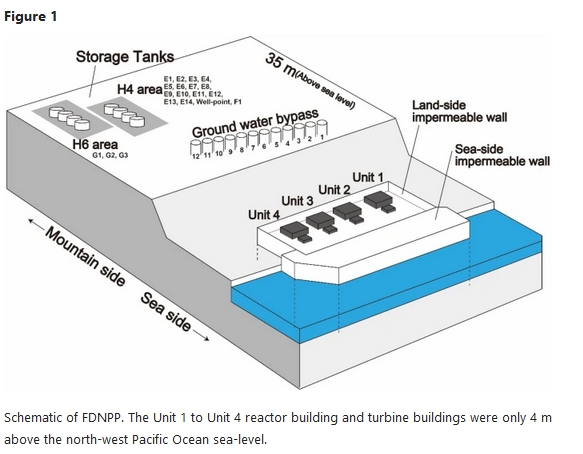
The land-side water impermeable wall (frozen soil wall) and the sea-side water impermeable wall (steel sheet pile) were installed to surround the circumference of the FDNPP and prevent 3H flow off site. Frozen soil walls block uncontaminated groundwater from getting close to reactors and buildings, while steel sheet piles block potentially contaminated groundwater from spreading into the ocean.
A series of wells were drilled at 35 m above sea level, upstream of FDNPP, to reduce the amount of groundwater flowing under the reactor building, and the well water was constantly pumped (Ground water bypass). The wells were drilled to a depth directly above an impermeable layer inside the plant’s grounds. Figure 2 shows the radioactivity of tritium in groundwater flowing through this bypass from June 2014 to June 2019. The ground water bypass system has 12 wells (No.1 to No.12)20, and the highest concentration of radioactivity was in No. 10 well on the south side. The concentration of 3H on June 2014 was 10 Bq/L, but it exceeded 3000 Bq/L in April 2016 and has been gradually decreasing since then to approximately 1400 Bq/L in 2019. No. 10 well is next to No.11, which also had levels of 3H higher than other wells, at 700 Bq/L as of June 11, 2019. No. 12 is the southernmost well, but unlike No. 10 and No. 11 wells, the tritium levels tended to decrease monotonically from a peak in April 201421.

Groundwater was estimated to flow into the ocean from the mountain side based on ground water flow modeling22.
It was not possible to determine from these data whether tritium-contaminated groundwater was still being released as tritium had already spread before the completion of the several barriers. Contaminated water may still be leaking from FDNPP site even after the barrier was completed23. The fact that tritium has been continuously detected in groundwater from the bypass installed upstream of FDNPP even after the completion of the water barrier (frozen wall) does not mean that tritium in the groundwater flows to the sea. In addition, the radioactivity trends in the neighboring wells vary widely, indicating that groundwater is moving in a complex manner.
The movement of groundwater may be impacted by the removal of the water from the wells. The amount of water removed from the wells has been changed in a timely manner in order to maintain appropriate groundwater level. If the water level was lowered too much, water flow would be induced from the reactor.
In order to evaluate the absolute amount of tritium contained in well water, information such as flow rate would be required, but TEPCO has not disclosed flow rates publicly.
3H radioactivity leakage
The concentration of 3H in the sump water collected at the sites indicated by asterisks in Fig. 3 is shown in Fig. 4. The 3H observed in sump water ranged from 15 to 31 Bq/L and was almost constant (average 20 Bq/L). The 3H exceeded the expected natural level (up to 7.8 TU(1 TU = 0.118 Bq/L), 0.92 Bq/L) of 3H, thus it is assumed that the 3H originated from FDNPP. Since the sump water were collected directly from cliffs, tritium in sump water would have passed under the ground of FDNPP site.
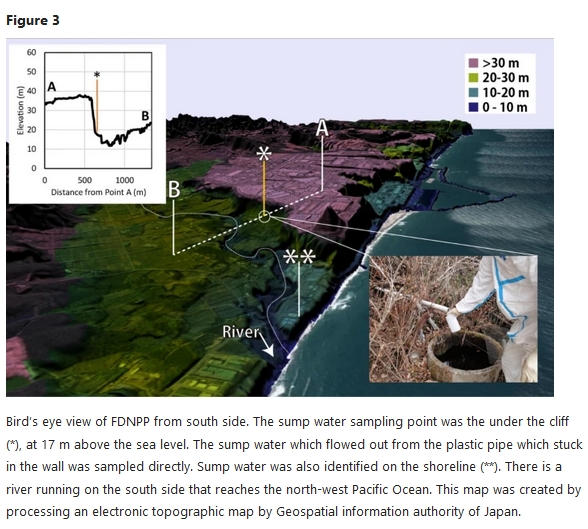
In addition, the sump water also contained radiocesium (134Cs and 137Cs). The concentration of 137Cs ranged from 3 to 4 Bq/kg, and the ratio of 134Cs/137Cs radioactivity at the time of the accident was almost 1. This also suggests that the water originated from FDNPP site24.
Tritium deposited via the air in surface water is not expected to mix with ground water. No tritium exceeding natural levels was detected in the air and precipitation around the FDNPP during the study period (2013–2019). At the FDNPP, four measures have been taken to prevent surface water from infiltrating into groundwater25..
- 1. Grouting of surfaces (to prevent from soaking rainwater into the ground) (from Oct. 2014),
- 2. Pumping of water from the sub-drain (from Sep. 2015),
- 3. Frozen soil wall around the 4 nuclear plants (from Mar. 2016),
- 4. Sea-side impermeable wall (from Oct. 2015).
It was clear that there was no direct correlation with the radioactivity of tritium contained in the leachate compared with the respective construction periods.
No tritium above the natural level was detected in the flowing-wells about 500 m away from the nuclear power plant. (see supplementary data).
The flowing-well water tritium concentration ranged from 0.003 to 0.01 Bq/L and was measured using the ingrowth method. Natural level of 3H in Japan was ranged from 0.13–0.92 Bq/L. Meanwhile the radioactivity of tritium in flowing water was below 0.01 Bq/L. The radioactivity of the water was at least one eighth. It was considered to be at least three half-lives above conservative estimates. Therefore, it was estimated that the tritium in the groundwater from the flowing-well had an age of nearly 40 years.
To read more:
Resident against Japanese nuclear reactor OK’d for restart says safe evacuation impossible
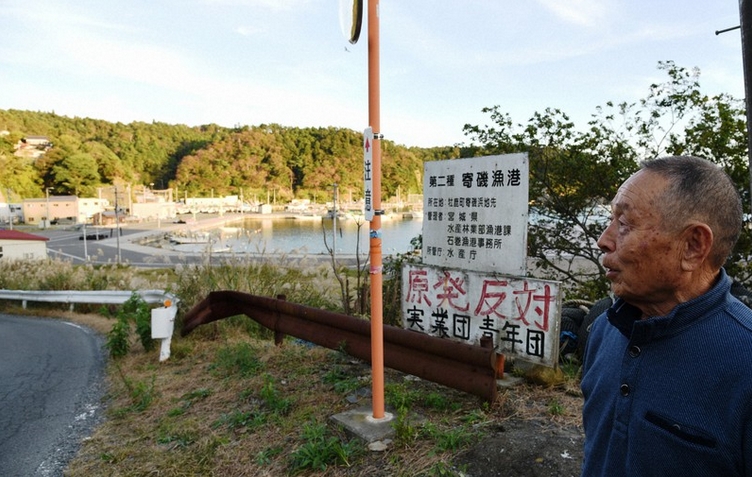
Former fisherman Yukitoshi Watanabe maintains that resuming operation of Tohoku Electric Power Co.’s Onagawa Nuclear Power Plant would be dangerous. In the Yoriisohama district of Ishinomaki, Miyagi Prefecture, as seen in this photo taken on Oct. 21, 2020, many signs protesting nuclear power have been set up by groups comprising youth in the community.
November 12, 2020
ISHINOMAKI, Miyagi — While the governor of Miyagi Prefecture, where the Onagawa Nuclear Power Plant is located, gave “local consent” on Nov. 11 to the restart of a reactor at the plant, those who live in the area remain anxious as local municipalities’ evacuation plans in the case of a major incident are said to be insufficient by residents and local assemblies alike.
The go-ahead to resume the operation of a reactor at Tohoku Electric Power Co.’s Onagawa nuclear power station came after Miyagi Gov. Yoshihiro Murai attended a meeting with the mayors of the Miyagi prefectural town of Onagawa and city of Ishinomaki, which the plant straddles.
About 1 kilometer away from the Onagawa Nuclear Power Plant is Ishinomaki’s Yoriisohama district, where residences surround a fishing harbor. Three aging signs that are set up alongside the one road that links the district to the outside world declare objections to nuclear power. They were put up by an organization of youth and others in the district.
Yukitoshi Watanabe, 80, is a former local fisherman who participated in an anti-nuclear demonstration by boat more than 40 years ago when the community wavered between hosting a nuclear power plant or not.
“Despite the incident at Daiichi Fukushima Nuclear Power Plant, in 10 years we’re back to where we were. The evacuation plan is absolutely unrealistic, and escaping safely is impossible,” Watanabe said angrily.
In August of this year, the Miyagi Prefectural Government invited officials from the Nuclear Regulation Authority (NRA), the Cabinet Office, and Tohoku Electric Power Co., and held sessions for residents to inform them of safety measures and evacuation plans that would be put into place. During the question-and-answer session, Watanabe raised his hand and asked, “Are you able to keep your head held high and tell your children and grandchildren (about restarting a nuclear reactor)?”
Including his great-grandchild, who is about to turn a year old, Watanabe lives in a family of 10 people spanning four generations. Living in the Yoriisohama district, which sticks out further east into the Pacific Ocean than the nuclear power plant, there’s no way to evacuate on land except by heading in the direction of the plant. It is unclear whether the national or prefectural government will build and maintain a highly safe evacuation route, and Watanabe says, “(An evacuation) route should be a prerequisite for deciding whether to restart the nuclear plant, and it shouldn’t have to be the local community’s responsibility to build one.”
Watanabe is considering a possible evacuation by boat, if such a measure is needed. He knows the dangers of the ocean, but he is more scared of his children and grandchildren being exposed to radiation.
“If something happens, we will have to leave this land, where our family has lived for generations, and fishing, and our home, throwing our hands up in despair. We must not leave any fears or anxieties to the future.”
(Japanese original by Nobuyuki Hyakutake, Ishinomaki Local Bureau)
1 This Month

of the week – Shut Down Drone Warfare!


Tell the Ukrainian Government to Drop Prosecution of Peace Activist Yurii Sheliazhenko

Petition to revoke the licensing of the Near Surface Nuclear Disposal Facility (NSDF) at Chalk River. https://www.ourcommons.ca/petitions/en/Petition/Details?Petition=e-7247
To see nuclear-related stories in greater depth and intensity – go to https://nuclearinformation.wordpress.com
-
Archives
- April 2026 (34)
- March 2026 (251)
- February 2026 (268)
- January 2026 (308)
- December 2025 (358)
- November 2025 (359)
- October 2025 (376)
- September 2025 (257)
- August 2025 (319)
- July 2025 (230)
- June 2025 (348)
- May 2025 (261)
-
Categories
- 1
- 1 NUCLEAR ISSUES
- business and costs
- climate change
- culture and arts
- ENERGY
- environment
- health
- history
- indigenous issues
- Legal
- marketing of nuclear
- media
- opposition to nuclear
- PERSONAL STORIES
- politics
- politics international
- Religion and ethics
- safety
- secrets,lies and civil liberties
- spinbuster
- technology
- Uranium
- wastes
- weapons and war
- Women
- 2 WORLD
- ACTION
- AFRICA
- Atrocities
- AUSTRALIA
- Christina's notes
- Christina's themes
- culture and arts
- Events
- Fuk 2022
- Fuk 2023
- Fukushima 2017
- Fukushima 2018
- fukushima 2019
- Fukushima 2020
- Fukushima 2021
- general
- global warming
- Humour (God we need it)
- Nuclear
- RARE EARTHS
- Reference
- resources – print
- Resources -audiovicual
- Weekly Newsletter
- World
- World Nuclear
- YouTube
-
RSS
Entries RSS
Comments RSS
 nuclear-news