Sapporo District Court orders injunction against operation of Tomari Nuclear Power Plant, rejects request for decommissioning

May 31, 2022
On May 31, the Sapporo District Court ruled in favor of the plaintiffs in a lawsuit filed by residents of the Tomari Nuclear Power Plant of Hokkaido Electric Power Company, demanding an injunction against the plant’s operation and its decommissioning.
The case was brought by approximately 1,200 residents of the area surrounding the Tomari Nuclear Power Plant of Hokuden, demanding an injunction against the operation of Units 1 through 3, the removal of spent nuclear fuel, and the decommissioning of the plant on the grounds that the plant is not safe enough against earthquakes and tsunami.
The case has been ongoing for more than 10 years, and arguments have been made as to whether there is an active fault line in the sea near the Tomari Nuclear Power Plant and whether tsunami countermeasures, such as seawalls, are sufficient.
In the ruling on March 31, Judge Tetsuya Taniguchi of the Sapporo District Court ruled that “the defendant (Hokuden) has failed to explain with adequate data that there is no risk of liquefaction of the ground with regard to the seawall, and that it lacks safety against tsunami and is likely to infringe on the lives and personal rights (life and body) of residents in the vicinity,” and “the danger extends within 30 km of the Tomari Nuclear Power Plant. The court ruled that “since the danger is within a 30-kilometer radius of the Tomari Nuclear Power Plant, the operation of the plant should be enjoined in relation to the plaintiffs who live within the radius.
The court dismissed the claim for removal of spent nuclear fuel, stating, “Although the danger is recognized, the plaintiffs are demanding removal of the spent fuel without limiting the destination of removal, and there is a possibility of violation of the personal rights of the residents of the destination area.” The court dismissed the claim on the grounds that “there is no danger” to the defendant. On the other hand, the court ruled that the defendant “must explain the lack of danger with reasonable data.
The court dismissed the request for decommissioning of the plant on the grounds that “even if individual preventive measures such as shutting down the reactor are necessary, it is difficult to find concrete circumstances that would make such measures necessary until the plant is abolished.
After the ruling, Hokkaido Electric Power commented, “Although we have explained the safety of the Tomari Nuclear Power Plant from a scientific and technical point of view based on the latest findings, we sincerely regret that our arguments have not been understood. We will promptly file an appeal.
https://www.uhb.jp/news/single.html?id=28578&fbclid=IwAR3i7r1omsmojtLOoTTliH2Qouj7cepCYSyhRwLM27vrcTzNtSSSW-w9BbM
Sapporo District Court orders Hokkaido Electric Power Co. not to operate Tomari Nuclear Power Plant

May 31, 2022
The Sapporo District Court has ruled that Hokkaido Electric Power Company (HEPCO) should not operate the Tomari Nuclear Power Plant in the village of Tomari in the Goshi region of Hokkaido, following a lawsuit by local residents and others claiming that the plant is not safe enough against earthquakes and tsunami.
The court ruled that Hokkaido Electric Power Company’s Tomari Nuclear Power Plant reactors No. 1 through No. 3 should be banned from operation, claiming that they are not safe enough. The court ruled in favor of the plaintiffs, claiming that the plant was “unsafe” and demanded that it be banned and decommissioned.
The plaintiffs argued that “the existence of an active fault that could cause a major earthquake was not taken into account, and that the current tsunami protection system is inadequate to prevent tsunamis. The plaintiffs argued that “there is an active fault that causes major earthquakes, but the shaking was not anticipated, and the current levees cannot prevent tsunamis.
At 3:00 p.m. on March 31, the Sapporo District Court handed down its decision, in which Judge Tetsuya Taniguchi ordered Hokkaido Electric Power Co. to stop operating the Tomari Nuclear Power Plant.
The court did not approve the decommissioning of the plant or the removal of spent nuclear fuel, which the plaintiffs had demanded.
All three units of the Tomari Nuclear Power Plant have been out of operation for 10 years since Unit 3 stopped power generation in 2012 for routine inspections. The plant has been in a state of shutdown for 10 years.
https://www3.nhk.or.jp/sapporo-news/20220531/7000047050.html?fbclid=IwAR2wXLrDKnrR0zQ9KKN3zK2m2t_hYMXgKWht4aF3BFt9dtpZu03kLmUy0vM
Nuke contaminated water from Fukushima may be out of sight, but should never be out of one’s mind

May 30, 2022
In 2011, the “3/11” earthquake in Japan caused the meltdown of the Fukushima Daiichi Nuclear Power Plant reactor core, unleashing enormous amounts of radioactive material. The operator of the plant, Tokyo Electric Power Company (TEPCO), decided to pour in seawater to cool the reactor and contain the leakage. And because the used seawater became highly contaminated with radioactive material, TEPCO had to put it in storage tanks. A decade on, the nuclear contaminated water generated by the Fukushima Daiichi Nuclear Power Plant are about 150 tons per day in 2021, and will reach the upper limit of the storage tank capacity of 1.37 million tons in the spring of 2023.
According to estimates by the Japan Center for Economic Research, it will cost 50-70 trillion yen (about $400-550 billion) to scrap and decontaminate the reactor, the bulk of which goes to the treatment of contaminated water. So in April 2021, the Japanese government announced that the problem of increasing amounts of nuclear contaminated wastewater would be addressed by dumping it into the sea. On May 18, 2022, the Japan Atomic Energy Regulatory Commission granted initial approval for TEPCO’s ocean dumping plan.
After the Fukushima nuclear accident, the Japanese government set up the “Nuclear Damage Compensation and Decommissioning Facilitation Corporation” (NDF), which is an official agency with 50.1 percent of TEPCO’s voting rights, in order to prevent TEPCO from going bankrupt. In other words, TEPCO is now under direct jurisdiction and control of the Japanese government. It is not hard to see that both TEPCO and the Japanese government are the masterminds behind the nuclear contaminated water dumping plan, because for them, this is the most expedient, cost-effective and trouble-saving way. Japan would need to spend only 3.4 billion yen (about $27 million) according to this plan. But the threat to nature, the environment and human life as a result of such reckless actions was probably never on their minds.
Nuclear contaminated water is not nuclear treated water
Monitoring data collected in 2012 showed that the concentration of Cesium in the waters near Fukushima was 100,000 becquerels per cubic meter, which is 100 times higher than what was detected in the Black Sea after the Chernobyl nuclear leak. Ten years later in 2021, 500 becquerels of radioactive elements per kilogram of weight could still be detected in the flat scorpionfish caught by Japanese fishermen off the coast of Fukushima Prefecture, or five times higher than Japan’s own standards. In the 11 years since the nuclear disaster, one or two thyroid cancer cases have been reported for every 60,000 children in Fukushima Prefecture, much higher than the normal rate.
The Japanese government and TEPCO have repeatedly claimed that nuclear contaminated water is “safe” to be dumped into the ocean because it would go through the multi-nuclide removal system (Advanced Liquid Processing System, ALPS). But it is only the radioactive substance called “Tritium” that has reached this standard. And what Japan doesn’t say is that, even after treatment, the water still contains other radioactive substances such as Strontium 90 and Carbon 14 that cause genetic mutation in the ecosystem. Since the release of the ALPS-related report, the Japanese government has not held any briefings or hearings for the public. And in order to justify the dumping plan, the Japanese government contacted citizen and groups to ask them to stop using the words “nuclear contaminated water”, and use “nuclear treated water” instead. Vigorous public relations (PR) efforts have also been carried out to whitewash the plan. In the 2021 budget of the Japanese Reconstruction Agency, PR expenses related to the Fukushima nuclear accident have increased to 2 billion yen (around $16 million), over four times than the previous year figure. The money has been used on professional teams to weaken and remove negative public opinion in Japan and abroad about the nuclear contaminated water through various propaganda programs.
Furthermore, TEPCO’s track records for handling the nuclear accident have been filled with deception and distortion. In 2007, TEPCO admitted that it had tampered with data and concealed potential safety hazards in a total of 199 regular inspections of 13 reactors in its nuclear power plants since 1977, including the cooling system failure in the Fukushima nuclear accident. One week after the 2011 nuclear accident when experts had already made the judgment that the cores of Units 1 to 3 of the Fukushima Daiichi Nuclear Power Plant had melted, the company still refused to announce the truth to the public, and instead chose to use “core damage,” a term that was significantly less alarming. With a past so bad it is hard to make one believe that TEPCO will dump “safe” nuclear contaminated water into the sea.
Waves of opposition at home and abroad
The Japanese government has so far failed to provide sufficient and credible explanations on the legitimacy of the nuclear contaminated water dumping plan, the reliability of nuclear contaminated water data, the effectiveness of the purification devices, and the uncertainty of the environmental impact. To promote the plan under such circumstances has only brought about wide criticism and questions by various communities in Japan and beyond.
Up to 70 percent of the people in Fukushima Prefecture have expressed opposition to the dumping plan. Konno Toshio, former president of Fukushima University, was opposed to advancing the ocean dumping plan without prior understanding at home and abroad, because this plan could affect future generations and must be treated with great caution. The fishery cooperatives and local councils in Miyagi Prefecture, which is adjacent to Fukushima Prefecture, believe that the dumping of nuclear contaminated water into the ocean may affect the safety of local aquatic products and cause significant economic losses to related industries. Already, 180,000 people in Japan have signed the petition to the Japanese government to adopt disposal options other than ocean dumping.
Vladimir Kuznetsov, academician at the Russian Academy of Natural Sciences, said that radioactive substances in the nuclear contaminated water can only be partially filtered, and the treated water still contains extremely dangerous radionuclides, which will pollute marine life and spread to the entire ocean through fish migration. This will gravely harm the global marine environment and cause serious harm to the health of people in the periphery. According to a research model established by GEOMAR Helmholtz Centre for Ocean Research Kiel, half of the Pacific Ocean will be polluted in less than 57 days if nuclear contaminated water is dumped at the speed announced by Japan.
Voices of justice
Japan’s ocean dumping plan of nuclear contaminated water is a serious threat to the marine environment, and it damages marine interests of the neighbors and other littoral countries. It also violates multiple international conventions such as the United Nations Convention on the Law of the Sea, the Convention on Assistance in Nuclear Accidents or Radiation Emergencies, and the Convention on Nuclear Safety as well as principles of the international law. Many countries, including China, have expressed concern over or opposition to it.
The Russian Foreign Ministry issued a statement criticizing the Japanese government for not consulting with or providing any related information to its neighbors when the decision was made, and expressing grave concern over Japan’s dumping of nuclear polluted water into the ocean. The South Korean Foreign Ministry summoned the Japanese ambassador to Seoul to make a serious protest against Japan’s unilateral decision while large crowds gathered in front of the Japanese embassy to protest. The International Atomic Energy Agency (IAEA) has launched an assessment of Japan’s plan.
The spokesperson of the Chinese Ministry of Foreign Affairs has repeatedly pointed out that Japan’s dumping of nuclear contaminated water into the ocean is extremely irresponsible, and demanded that Japan fully consult with neighboring countries, other stakeholders, and relevant international institutions to find a proper way to dispose of the nuclear contaminated water, before which the dumping into the ocean shall not be initiated.
The ocean is a treasure for all mankind and our home for survival. It is essential for sustainable development and our future. To dump nuclear contaminated water from Fukushima into the ocean is a major issue that bears on the environment for human survival and health, it is not just Japan’s internal affairs. Although keenly aware of the grave harm to the global marine environment caused by the dumping of such water into the sea, Japan has attempted to push through the plan without exhausting all other safe methods. Such an opaque and irresponsible approach is unacceptable, let alone trusted by countries in the region and the larger international community.
Fukushima citizens’ group urges TEPCO to “stop construction of facilities to discharge contaminated water into the ocean without understanding and agreement” and to Governor Uchibori, “Do not agree to the prior consent request
May 25, 2022
On May 25th, members of the Fukushima citizens’ group “Don’t Pollute the Sea Anymore! Citizens’ Council” and other members visited the Fukushima branch office of TEPCO’s Fukushima Reconstruction Headquarters and the Fukushima Prefectural Government on the morning of May 25 to submit a written request to TEPCO. They again demanded that TEPCO “stop construction of facilities for discharging contaminated water into the ocean without understanding and agreement” and that Fukushima Prefecture “not agree to the request for prior consent. Although there is still no consent from Fukushima Prefecture and there are voices of opposition, TEPCO is steadily preparing for the oceanic discharge as “construction work that does not require permission. Upon receiving the request, TEPCO asked the interviewer to leave the room to exchange opinions, but no concrete response was given. While the voices of the people are being ignored, the time for Governor Masao Uchibori to make a decision is approaching.

The “clean sea” cannot be promised.
The letter of request to TEPCO asks for five points.
(1) Stop the full-scale construction of facilities for discharging contaminated water into the ocean without understanding and agreement.
(2) Disclosure of all information, including the concentration and total amount of all radioactive nuclides to be discharged.
(3) Establish drastic measures for contaminated water, such as groundwater sealing, as soon as possible.
(4) Hold explanations and public hearings in Fukushima Prefecture and throughout Japan.
(5) Cancellation of the statement made by the director of the Nuclear Energy Center and an apology.
The group also calls on Fukushima Prefecture Governor Masao Uchibori to address the following four points.
(1) Refrain from agreeing to prior consent for oceanic discharge without understanding and agreement.
(2) Make the government and TEPCO disclose all information, including the concentration and total amount of all radionuclides to be released.
(3) Demand that the government and TEPCO establish measures to prevent contaminated water, such as groundwater sealing.
4) Demand that the government and TEPCO hold explanations and public hearings in Fukushima Prefecture and throughout Japan.
At the Fukushima branch office of TEPCO’s Fukushima Reconstruction Headquarters, Mr. Tsuyoshi Shibano of the Fukushima Public Relations Department received the written request. Four representatives from citizens’ groups took part in the exchange of opinions, but TEPCO allowed only a “head shot” to the interviewers. TEPCO asked the reporters to leave the room, saying, “We do not allow interviews in the exchange of opinions,” “We cannot speak frankly when reporters are present,” and “We do so in other situations as well. When reporters asked for interviews, they were told that they would not begin unless they left the room. According to those present, TEPCO did not make any specific comments in response to the request.
The request to TEPCO included “rescinding and apologizing for the statement made by the director of the Nuclear Energy Center,” a protest against the statement he made when he visited the TEPCO headquarters on June 13 to request the cancellation of the June construction start. When a mother who participated in the protest asked TEPCO to “promise to leave a clean sea for our children,” the director of the Nuclear Energy Center replied, “I can’t promise you that. This mother shouted “Don’t make fun of Fukushima” in front of the TEPCO headquarters. In her written request, she demanded a cancellation and an apology in a strong tone, saying, “This shows a corporate culture of ignoring residents without regard for responsibility for the nuclear accident. TEPCO’s response was limited to saying that they had not been able to confirm what she had said.


The “Promise to the Fishermen’s Federation” is heavy.
At the Fukushima Prefectural Government, Shigeru Ito, Director of the Nuclear Safety Division, responded to the four requests as follows.
The Minister of Economy, Trade and Industry also said, “We will keep our promise. The Minister of Economy, Trade and Industry has also said that he will keep his promise, and we will make sure that he keeps his word.
The Minister said, “We have asked TEPCO to reconsider the safety of the water, since there is a possibility that radioactive materials other than the 64 nuclides may be detected in the water. We are asking TEPCO to reconsider the safety of the water, as there is a possibility that radioactive materials other than the 64 nuclides will be detected.
The frozen soil barrier wall has a certain degree of water interception capacity, but it has been in use for some time. We are demanding that the government and TEPCO urgently study ways to reduce the generation of contaminated water itself to near zero.
The prefectural government will also request that the government and TEPCO provide an opportunity to explain the situation to the residents of the prefecture.
The citizens’ group said, “The time to make demands to the government and TEPCO has passed. We will not make it in time unless we have a concrete plan. It is difficult for the prefecture to hold explanatory meetings and public hearings. We will convey our request to the national government and TEPCO.
A woman from Minamisoma City said, “Even with ALPS treatment and dilution, the water is still ‘contaminated water. If a person is instructed by a doctor to cut back on salt, does it mean that he or she has cut back on salt if he or she adds hot water to miso soup and drinks it all? Isn’t it the same thing?
A woman who retired from a prefectural school and is now teaching Japanese in Vietnam said, “This is not just a Fukushima problem, but a global problem. Seawater travels around the world in a few years. It is not just a rumor, but an actual damage to the world. I want everyone’s voices to be properly conveyed to the national government and TEPCO.
A man who had worked at the nuclear power plant for many years said, “It is strange that Governor Uchibori does not oppose the discharge of water into the ocean and is doing the government’s bidding. Fukushima Prefecture is not a subcontractor of the national government. If contaminated water is discharged into the ocean, it will cause real damage. If you have money to dig undersea tunnels, increase the number of tanks.
After the meeting, Mr. Ito, who was interviewed after the meeting, said, “The ‘request for prior consent’ submitted to the prefectural government is not an examination of the pros and cons of the ocean discharge plan, but rather a confirmation of the safety aspects of the facility plan and the radiation effects on the surrounding area, which must be discussed within the framework of the safety assurance agreement. If we can scientifically confirm that there are no safety issues, there will be fewer options for not obtaining prior consent. As for when the Nuclear Regulatory Commission will respond to the “prior consent request,” he said, “We would like to make a decision after the Nuclear Regulatory Commission approves the plan and we see what the public has to say about the plan.


The people of the prefecture have not forgiven you.
Don’t pollute the sea any more! Chiyo Oda, co-chair of the Citizens’ Council, appealed to reporters at a press conference held at the Fukushima Prefectural Government Press Club.
The other day at a protest in Tokyo, I was asked, “Do the people of Fukushima allow the discharge of contaminated water into the ocean?” I was asked, ‘Do the people of Fukushima allow the discharge of contaminated water into the ocean? They said, ‘We haven’t heard much opposition from the press either. I would like to ask the Fukushima press. We are really worried. We don’t want contaminated water to be discharged into the sea. Please report our voices in the newspapers and on TV. We are really worried. We want you to stop. I don’t want people to think that the people of Fukushima have forgiven us. Please help us.”
Mr. Oda read out the written request both at TEPCO and at the Fukushima prefectural office, but his voice and hands were shaking. He was nervous, of course, but he was also trembling with anger. No matter how much he voiced his opposition, he was ignored. The construction of facilities for the offshore discharge was steadily underway, claiming that the work did not require prior approval. The local media also did not take up our voices of opposition head-on…. It was only natural that he felt the need to vent his anger at the press club.
When I pointed this out to TEPCO, they said, ‘That’s just a lie. When I pointed this out to TEPCO, they said, ‘That’s like marking the ocean. Do they think that will reassure us? As the company that caused the nuclear accident, I don’t feel that they are taking any responsibility at all.
It’s upsetting to be lumped together as a company that is ‘concerned about rumors. If they are so concerned about reputational rumors, they should just stop discharging their waste into the ocean, which would spread contamination.
Kazuyoshi Sato, a member of the Iwaki City Council, also a co-chairman, said, “The government and TEPCO think that the fishermen will give up. I think that if we add some more to the so-called “reputational measures,” the All Fishermen’s Federation will give in and the Fukushima Prefectural Fishermen’s Federation will give in as well. They are disregarding the meaning of the ocean in the ecosystem, or rather, they lack imagination,” he said. He then emphasized, “The people of the prefecture have no ‘understanding’ of the situation.
The people of Fukushima Prefecture do not ‘understand,’ and they do not want to be told that they were complicit in the discharge of contaminated water into the ocean.
Members of the citizens’ group bowed their heads at TEPCO, in front of prefectural officials, and at the press club. Nevertheless, the plan to discharge contaminated water into the ocean is steadily moving forward under the guise that it will interfere with the decommissioning work (removal of fuel debris). The voices of the people are always ignored. But we will still speak out.
http://taminokoeshimbun.blog.fc2.com/blog-entry-652.html?fbclid=IwAR01KGHyaom1xxsBYyWQex07JY3sAziwRhLberOInkX3aG5twyry8PIAEMg
Cancer patients forced to testify anonymously in Fukushima nuclear disaster case
The plaintiffs are facing a backlash as they argue that the 2011 disaster is the cause of their ill health.

29 May 2022
A court in Japan this week began hearings against the operator of a Fukushima power plant over cases of thyroid cancer in children allegedly linked to the 2011 nuclear disaster.
Six people are seeking Y616 million (£3.8 million) in damages from Tokyo Electric Power Co (TEPCO), claiming they were exposed to radiation after a massive tsunami destroyed the plant’s cooling systems and caused three of the six reactors to suffer meltdowns.
The people – all aged between 6 and 16 at the time – have been living with the effects of that day ever since.
Four had their thyroid removed entirely and will need to take hormone medication for the rest of their lives. The other two had portions of their thyroids removed. One of the plaintiffs said the cancer has spread to their lungs.
“Because of the treatments, I could not attend university, or continue my studies for my future job, or go to a concert. I had to give up everything”, testified one woman who is now in her 20s. “I want to regain my healthy body, but that’s impossible no matter how hard I wish.”
Their stories are compelling, but the four women and two men are having to testify anonymously in the landmark case – in part because many people simply do not believe them.

A culture of discrimination and misunderstanding around cancer in Japan that dates back to the Hiroshima and Nagasaki bombings of 1945 has meant they have become the target of insidious online abuse.
Some have suggested they are exaggerating or making their illnesses up. Others have accused them of damaging the reputation of Fukushima, which has tried hard to rehabilitate its image since the disaster.
One message posted on the site of a local Fukushima website said the plaintiffs’ parents were to blame because they failed to evacuate the children immediately after the disaster.
Another message said the people “appear to be annoyed that they cannot live perfect lives”.
A third person said the case was being encouraged “by an anti-Japanese, leftist group”.
The plaintiffs involved hope that this case will finally put all that to bed.
Their lawyers will argue that screening of 380,000 local children since 2011 has identified around 300 cases of thyroid cancer. That incidence rate of 77 cases per 100,000 people is significantly higher than the typical one or two cases per million and can only be linked to radiation from the accident, they say. A similar pattern was seen among children following the 1986 Chernobyl nuclear disaster in Ukraine.

“The doctor told my father that the cancer was highly malignant and had spread widely. He said it appeared to be less than five years old,” one man told local media before the hearing.
TEPCO has always maintained that there is no link between the leak of radiation from the plant and the spike in cancer cases, adding that tests of 1,080 children from three cities around the plant showed no one received more than 50 millisieverts of radiation, the annual limit for nuclear workers.
Their lawyers are set to argue that the high rate of thyroid cancers in Fukushima is the result of overtesting.
The company’s attempts to discredit them has added fuel to widespread hostility towards the plaintiffs.
“The people of Hiroshima were shunned by the rest of Japan after the atomic bombing of the city in 1945 because they did not understand about radiation and they feared they could catch it as a disease,” Chisato Kitanaka, an associate professor of sociology at Hiroshima University told The Telegraph.
“We cannot say that people do not lack information on the Fukushima case, but these people are still being singled out. They attack because they prefer to believe TEPCO or because they support the government’s plan to restart the nation’s nuclear reactors.”
In a separate case, earlier this year Japan’s Supreme Court upheld an order for TEPCO to pay damages of 1.4 billion yen (£9.5 million) to about 3,700 people whose lives were devastated by the Fukushima nuclear disaster, in the first decision of its kind.
When removing radioactive substances from contaminated water with the Advanced Liquid Processing System (ALPS)

May 28, 2022
Via Mako Oshidori
When removing radioactive substances from contaminated water with ALPS (Multi-species Removal Device), radioactive substances are accumulated in dry slurries and suction cups. Storing that crappy high-quality contaminated waste is HIC (hic: high performance containers)
No entry for 10 days at seismic intensity 4 or more because of concerns about hydrogen occurrence (which is also a scary story. Because you can’t inspect soon enough)
And there goes a tornado warning.
Japan’s plan to release toxic water into sea irresponsible

May 28, 2022
The Tokyo Electric Power Company, according to Japanese media reports, started seabed excavations on May 5 to build a drainage outlet for the nuclear-contaminated water to flow from the Fukushima Daiichi nuclear power plant to the Pacific Ocean. The seabed operation is expected to be completed in early July, meaning Japan has taken a substantive step toward discharging the radioactive water into the sea despite strong opposition at home and abroad.
In March 2011, immediately after a tsunami triggered by a massive earthquake destroyed the Fukushima Daiichi nuclear power plant, TEPCO discharged the highly radioactive water into the sea. But under great pressure from the public, it stopped its controversial move and began building tanks to store the contaminated water.
But these storage tanks can hold only 1.37 million cubic meters of water, and are expected to be full in 2023. So the Japanese government and TEPCO announced on April 13, 2021, that the radioactive water would be “discharged into the sea”.
This plan, too, has come in for severe criticism from the Japanese people and the international community, because it would cause immense damage to the marine environment, as well as human beings, especially in neighboring countries, without benefiting the Japanese people.
The Japan Atomic Energy Regulatory Commission issued “a draft of review paper” on May 18 preliminarily agreeing to the government’s plan, but will make a final decision after one month.
However, the Japanese government said the radioactive water would be treated to meet the so-called standard for discharge. After the nuclear accident, TEPCO used a kind of “purification” equipment to treat the contaminated water to make it less harmful. It claimed that all radioactive materials will be removed from the toxic water, except for tritium.
But in 2018, on studying the contaminated water treated in 2017, a group of experts found that it contained not only tritium but also other radioactive materials such as carbon 14, cobalt 60 and strontium 90, all of which are highly harmful to living beings.
TEPCO has also said the radioactive water will be discharged after being diluted with seawater. But studies show that 1 liter of the radioactive water needs to be mixed with 254 liters of clean seawater to be properly diluted, and it would take at least 30 years for the process to be completed.
The severe consequences of the Fukushima nuclear accident have been emerging over the years. The animals in the Fukushima isolation zone have been showing visible effects of radiation, radioactive materials in fish in the nearby waters are much higher than normal levels, and the incidence of thyroid cancer in Fukushima has significantly increased.
Since the marine ecosystem is a highly integrated and delicate system, the Fukushima water will be enough to contaminate the entire Pacific and beyond.
The international scientific community has reached a consensus on the cumulative effects of radioactive materials. For instance, a Greenpeace report issued in October 2020 said that if discharged into the sea, the radioactive water could also affect human beings’ DNA. And the US National Oceanic and Atmospheric Administration and other marine authorities said that once the Fukushima water enters the sea, its radioactive materials will spread across the Pacific and other oceans, causing unprecedented damage to the marine ecology.
Ever since the Japanese government decided last year to discharge the radioactive water, countries around the Pacific Rim have been opposing it. In particular, China, the Republic of Korea, Russia and some Pacific island countries have voiced serious concerns over Japan’s decision.
Many environmentalists and scholars have also criticized Japan’s plan. In Japan alone, thousands of people, mainly belonging to NGOs, as well as the National Federation of Fisheries Associations have publicly opposed the plan.
In a public opinion survey conducted by Japanese media outlets, nearly 60 percent of the respondents said they were worried about the effects of the radioactive water on the sea and marine life. And rightly so, because even 11 years after the Fukushima nuclear accident, prices of sea food, vegetables and fruits from Fukushima Prefecture, Ibaraki Prefecture, Miyagi Prefecture and nearby places are still much lower than those from places not affected by nuclear radiation.
Besides, the investigation report of the International Atomic Energy Agency’s technical work group released on April 29 did not give a final judgment on whether discharging the nuclear-contaminated water into the sea was safe, and instead suggested a series of technical improvements to reduce its environmental impact. In fact, Japan did not allow the IAEA’s technical work group to evaluate other plans. As a result, it was not possible for the agency to find the best way to deal with the problem.
But despite the strong opposition to its plan both at home and abroad, Japan is hell-bent on discharging the toxic water into the sea, which shows that it does not give two hoots to the concerns of the international community or the Japanese people.
Actually, Japan can deal with the issue in a way that would not harm the marine environment. For example, the Japan Atomic Energy Civic Committee has said that storing the radioactive water in large storage tanks installed on land or “solidification treatment with mortar” are safer ways to deal with the toxic water.
As a signatory to the United Nations Convention on the Law of the Sea, Japan knows that discharging the contaminated water into the sea will have cross-border effects. But without exhausting all safe disposal means, disclosing all relevant information, and consulting with all the stakeholders including neighboring countries, Japan has decided to go ahead with its plan in order to fulfill its selfish economic and political interests, and save costs.
Japan’s decision is a serious threat to marine life as well as human beings, and a gross violation of international rules. Therefore, Japan should change its decision, conduct a serious study on safe operational plans to deal with the contaminated water, and act like a responsible country.
http://global.chinadaily.com.cn/a/202205/28/WS62918561a310fd2b29e5f85a.html
Fukushima reactor sitting on shaky base raises quake concerns
May 28, 2022
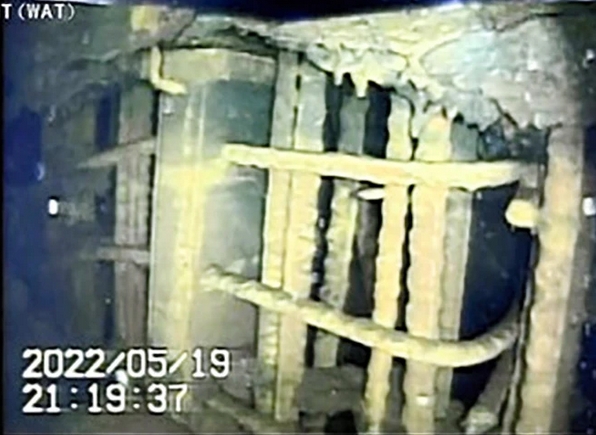
Alarm bells are sounding over signs the heavily damaged structure of the Fukushima No. 1 nuclear power plant may be too flimsy to withstand another major earthquake.
Photos taken by a remote-controlled robotic device sent into the No. 1 reactor found that a large portion of the concrete base supporting the pressure vessel appears to have melted, leaving only a metal framework holding up the pressure vessel.
Experts are now saying the remaining structure may not be strong enough to withstand a big earthquake, a troubling prediction given that the region has been hit by a number of strong temblors in recent months.
An official with the Agency for Natural Resources and Energy who is handling decommissioning work said at a May 26 news conference the remaining structure could not be described as safe, noting that a large portion of the concrete base only had the metal framework remaining.
At a news conference the previous day, Toyoshi Fuketa, chairman of the Nuclear Regulation Authority, said, “We remain concerned about whether it will withstand a strong quake.”

The Fukushima plant went into triple meltdown after the magnitude-9.0 Great East Japan Earthquake in 2011 that generated devastating tsunami.
The No. 1 reactor bore the brunt of the damage at the nuclear complex. Photos taken by the remote-controlled robot showed not only the exposed metal framework but what looked like a pile of melted fuel on top of the framework.
Officials believe the meltdown at the No. 1 reactor caused most of the fuel to melt through the bottom of the pressure vessel. The plant’s operator, Tokyo Electric Power Co., suspects the tremendous heat from the nuclear fuel may have melted the concrete of the base supporting the pressure vessel.
The cylindrical base is 1.2 meters thick with a diameter of about 6 meters. It supports the pressure vessel, which weighs about 440 tons.
A fiscal 2016 estimate by the International Research Institute for Nuclear Decommissioning said that the seismic resistance of the structure would not be an issue even if one-quarter of the base was structurally compromised, along with other damage to the interior of the pressure vessel.
But the latest photos captured only about 25 percent of the base, prompting the agency official to speculate the concrete around the entire base had melted.
TEPCO officials plan to send in another robot to take photos of the interior of the base to better grasp the seismic resistance of the structure.
Fumiya Tanabe, a former senior researcher at what is now the Japan Atomic Energy Agency, offered an even scarier possibility.
Noting that the interior of the base lies directly under the reactor core there, he said it was possible that piping hot nuclear fuel flowed into the interior.
“The metal framework in the interior of the base may even have melted,” Tanabe said.
That is a particularly worrisome thought in light of the fact that quakes with a seismic intensity of upper 6 on Japan’s maximum scale of 7 hit off the coast of Fukushima Prefecture in February 2021 and March 2022.
Tanabe said that in a worst-case scenario, another strong quake could cause the pressure vessel to topple over, making work to remove the melted fuel that much more difficult.
He recommended that work start quickly to assess the extent of damage.

Fukushima Daiichi Nuclear Power Plant, work to remove contaminated pipes suspended again due to detection of high radiation dose at level of “death by exposure for several hours

May 27, 2022
The removal work of pipes contaminated with high levels of radioactive materials between Fukushima Daiichi Nuclear Power Plant Units 1 and 2, which had been resumed by Tokyo Electric Power Co. for the first time in two months, was suspended again after extremely high radiation levels of 3 sieverts (3000 millisieverts) per hour were detected in the first cut pipe on May 23. The second disconnection scheduled for the 26th was cancelled. TEPCO will take time to reconsider the cutting method and measures to control workers’ exposure.
The radiation dose of 3 sievert per hour is high enough to cause death if a person is exposed to radiation for several hours. According to TEPCO, workers who measured the dose inside the cut surface of the pipes were exposed to a maximum of 0.41 millisieverts, which did not exceed the exposure limit that had been planned in advance.
Before cutting, the 30-centimeter-diameter pipe was covered with urethane to prevent radioactive materials from leaking out of the pipe when it was cut. However, the cut surface with the high radiation dose did not have a lid, and the inside of the other cut surface, which had a lid, was 120 millisieverts per hour.
The pipes were used for venting highly contaminated steam from the reactor to prevent the containment vessel from rupturing at the beginning of the accident in March 2011. Akira Ono, chief executive officer of the Fukushima Daiichi Decommissioning Promotion Company, said at a press conference on March 26, “The high concentration is thought to be caused by the venting. We need to work carefully and consider our procedures.
The removal of piping using remote-controlled equipment began at the end of February, but was suspended for about two months due to a series of troubles that forced a review. The plan was to cut and remove a total of 135 meters of piping in 26 installments, and the first installment was finally completed on the 23rd of this month. (The first round finally succeeded on the 23rd of this month.)
https://www.tokyo-np.co.jp/article/180011?fbclid=IwAR2XsD9rjbecMFSYfUWU8knhoQKVjtibdDHl4InGGWLwRm5DKbpypkwhRaw
Cancer patients seek damages from Fukushima nuclear plant

By Mari Yamaguchi Associated Press
May 26, 2022
A Tokyo court has begun hearings in a lawsuit seeking nearly $5 million in damages for six people who were children in Fukushima at the time of its 2011 nuclear power plant disaster and later developed thyroid cancer
TOKYO — A Tokyo court began hearings Thursday in a lawsuit seeking nearly $5 million in damages for six people who were children in Fukushima at the time of its 2011 nuclear power plant disaster and later developed thyroid cancer.
The plaintiffs are suing the operator of the nuclear plant, saying radiation released in the accident caused their illnesses.
It is the first group lawsuit filed by Fukushima residents over health problems allegedly linked to the disaster, their lawyers say.
One plaintiff, identified only as a woman in her 20s, testified from behind a screen that she had to give up plans to attend university because of repeated operations and treatments.
“Because of the treatments, I could not attend university, or continue my studies for my future job, or go to a concert. I had to give up everything,” she said. “I want to regain my healthy body, but that’s impossible no matter how hard I wish.”
She and the five other plaintiffs are seeking a total of 616 million yen ($4.9 million) in damages from Tokyo Electric Power Company Holdings for allegedly causing their cancers.
On March 11, 2011, a magnitude 9.0 earthquake and massive tsunami destroyed the Fukushima plant’s cooling systems, causing three reactor cores to melt and release large amounts of radiation. Critics say the plant operator should have known that a large tsunami was possible at the site.
The plaintiffs, who were 6 to 16 years old at the time of the accident and lived in different parts of Fukushima, were diagnosed with thyroid cancer between 2012 and 2018, their lawyers said.
The plant operator told the court that they were not exposed to enough radiation to cause cancer, citing tests of 1,080 children from three cities around the plant that showed about 55% were not exposed and none received more than 50 millisieverts, the annual limit for nuclear workers.
An increase in thyroid cancer was found among children following the 1986 Chernobyl nuclear disaster in Ukraine.
The Fukushima prefectural government tested 380,000 residents aged 18 or younger at the time of the accident for thyroid cancer. About 300 were diagnosed with cancer or suspected cancer.
That occurrence rate, about 77 per 100,000, is significantly higher than the usual 1-2 per million and can only be linked to radiation from the accident, the plaintiffs’ lawyers said.
Prefectural officials and experts have said the high level of thyroid cancer found in Fukushima is due to an overdiagnosis, which might have led to unnecessary treatment.
Kenichi Ido, one of the lawyers, said none of the cases involve an overdiagnosis and that the plant operator should be held accountable for radiation exposure unless it can prove otherwise.
The plaintiff who testified Thursday said she walked from home to her high school five days after the tsunami, just as the reactors were undergoing meltdowns.
Three other plaintiffs who attended the hearing were also behind a partition to protect their privacy because of criticism on social media accusing them of fabricating their illnesses and hurting the image of Fukushima, the lawyers said.
Ido said many people with health problems feel intimidated to speak out in Fukushima and that he hopes the lawsuit will prove a correlation between radiation and the plaintiffs’ cancers “so that we can have a society in which people can talk freely about their difficulties.”
The government was slow in responding to the crisis, and evacuations in many places were delayed due to a lack of disclosure of what was happening at the nuclear plant. Residents who fled in their cars clogged roads and were stranded for hours outside while radiation spread from the damaged reactors. Some residents headed to evacuation centers in the direction of the radiation flow.
https://www.claimsjournal.com/news/international/2022/05/27/310693.htm
Debris in sediment, bottom of Fukushima Unit 1 Neutron radiation detected at high levels

May 26, 2022
On May 26, TEPCO announced that it had detected high levels of neutron radiation, which is emitted when uranium and plutonium contained in nuclear fuel undergo nuclear fission, in sediment found at the bottom of the containment vessel at the Fukushima Daiichi Nuclear Power Plant’s Unit 1 reactor. TEPCO announced that it had detected high levels of neutron radiation, which is emitted when uranium and plutonium contained in nuclear fuel fuse. A TEPCO representative said, “It is presumed to be derived from molten nuclear fuel (debris). It is natural to assume that the debris is contained in the sediment.
TEPCO will focus on examining the thickness of the deposits near where the neutron rays were detected and the types of radioactive materials contained in the deposits.
According to TEPCO, on March 20 and 21, underwater robots were used to survey four locations at the bottom of the containment vessel, and neutron rays were detected in all of them. The values at three locations near the openings in the base of the pressure vessel were particularly high.
https://www.tokyo-np.co.jp/article/179742?fbclid=IwAR0oljxEJF2Q5XzUE859cfr1DfSmtvct8xkg6FcU2uIEpIKvtlrh3qm9aag
Class action lawsuit against the victims of thyroid cancer caused by the Fukushima Daiichi Nuclear Power Plant accident begins

May 26, 2022
On May 26, a class action lawsuit began in which six people who were children at the time of the accident at TEPCO’s Fukushima Daiichi Nuclear Power Plant are seeking compensation from TEPCO for thyroid cancer they contracted as a result of the accident.
The six, who were between the ages of 6 and 16 when the Fukushima Daiichi nuclear power plant accident occurred 11 years ago, claim that they were living in Fukushima Prefecture at the time and that they developed thyroid cancer as a result of radiation exposure from the nuclear accident.
After the accident, they were diagnosed with thyroid cancer in tests conducted by Fukushima Prefecture, and have been forced to have their thyroid glands removed and undergo lifelong hormone treatment.
The trial will begin on March 26 at the Tokyo District Court, and the plaintiffs’ lawyers have stated that, “According to statistics from a national research institute, the average number of thyroid cancer cases in children was only one to two per million people per year for the 10 years until 2007, but in Fukushima, at least 293 cases have been confirmed in the 10 years since the accident. In Fukushima, however, at least a total of 293 cases of cancer have been confirmed in the 10 years since the accident,” and that “the cancer is presumed to be caused by exposure to radiation from the accident.
A female plaintiff stated, “I prioritized treatment over my dreams for the future and had no choice but to quit my university studies. I hope that through the trial, relief for the patients will be realized,” she tearfully appealed.
According to the plaintiffs’ lawyers, this is the first class action lawsuit to hold TEPCO responsible for the health damage caused by radiation exposure from the nuclear power plant accident, and TEPCO has indicated that it will fight the case.
The next meeting will be held in September, and TEPCO is scheduled to make a rebuttal.
The Fukushima Prefecture’s expert panel and the UN scientific committee’s opinion is
The Fukushima Prefectural Expert Panel and the United Nations Scientific Committee have each expressed their opinions on whether the thyroid cancer diagnosed in some children living in Fukushima Prefecture at the time of the accident at TEPCO’s Fukushima Daiichi Nuclear Power Plant was caused by exposure to radiation from the nuclear power plant accident.
As part of its post-nuclear accident health survey, Fukushima Prefecture conducted a large-scale test using ultrasound equipment to check for thyroid cancer in approximately 380,000 people who were under the age of 18 at the time of the accident.
Fukushima Prefecture has established a committee of experts to analyze whether the cancers found were caused by radiation exposure.
Of these, 187 have been evaluated by 2019, and a report has been compiled stating that “no relationship between the thyroid cancers found and radiation exposure can be found”.
The reasons given were that the estimated radiation doses received by children in Fukushima Prefecture after the accident were much lower than those received in the 1986 Chernobyl nuclear power plant accident, and that there was no statistical bias in the regional distribution of cancer patients and no trend indicating an association with radiation exposure.
The expert panel is still analyzing the remaining 87 people diagnosed after FY2016, and the results of the evaluation have not yet been presented.
On the other hand, the UN Scientific Committee, which evaluates the effects of radiation on humans and the environment, estimated radiation doses last year based on the type and amount of radioactive materials released by the accident and the evacuation behavior of the residents, and concluded that “it is unlikely that any health effects directly attributable to radiation exposure caused by the accident will be observed in the residents of Fukushima Prefecture in the future. The report states that “the likelihood of health effects directly caused by radiation exposure in Fukushima Prefecture in the future is low.
The report also stated that the cases diagnosed in Fukushima Prefecture “are not the result of radiation exposure, but rather the result of highly sensitive ultrasound examinations that are likely to have diagnosed cancers that would not normally be detected,” and expressed a negative opinion on the causal relationship between thyroid cancer and the cases.
TEPCO “will listen to the plaintiffs’ claims in detail and respond appropriately.
TEPCO said, “We will listen to the plaintiffs’ claims and the details of their claims in detail and respond appropriately. TEPCO once again expresses its sincere apology to the people of Fukushima Prefecture and the wider community for the inconvenience and concern caused by the accident at the Fukushima Daiichi Nuclear Power Plant.
The plaintiff, a woman in her 20s, said
The six young people who filed the lawsuit claim that they were diagnosed with cancer and that it has affected the future they had envisioned.
One of the plaintiffs, a woman in her 20s from Nakadori, Fukushima Prefecture, was a junior high school student when the nuclear accident occurred.
It was in the spring, about four years after the accident, that she felt a change in her health.
She had just left her family in Fukushima and started living alone when she entered university.
Her body was swollen all over, her menstrual period came once every two weeks, her skin became rough, and she began to feel a strong discomfort in her throat and body pain.
After consulting with her family, she underwent an examination as part of the prefectural health survey conducted by Fukushima Prefecture after the nuclear power plant accident, and was diagnosed with thyroid cancer.
The woman recalls her feelings at the time, “I had hoped that the surgery would improve my health, but even after the surgery, I continued to feel ill easily, and I became increasingly worried that the cancer might recur or spread.
However, her health did not improve as expected, and she had no choice but to leave the company after about a year and a half in order to prioritize her treatment.
Even now, regular visits to the hospital and medication are essential for her. “I had longed to be a career woman who worked hard, but I now have to prioritize my health in everything I do,” she said. I am worried that it will affect my future choices of marriage and childbirth,” she confides.
Regarding the relationship between exposure to radiation from the nuclear accident and thyroid cancer, the Fukushima prefectural government’s expert panel has so far stated that “no relationship has been found.
All of the plaintiffs, including the woman, are going to trial without revealing their faces or names publicly, as some have criticized them for claiming health problems caused by exposure to radiation as Fukushima is making progress toward recovery.
The woman said, “I was afraid that I would be discriminated against if people knew that I was from Fukushima Prefecture and had thyroid cancer, so I could hardly tell anyone until now,” adding, “I thought there were many people who suffered from cancer as well and had to give up their dreams such as higher education and employment, or who could not speak up for fear of discrimination and prejudice, and I became an adult first. I decided that I would be the one to show courage. I would like to clarify the facts through the trial and seek redress for the damage.
https://www3.nhk.or.jp/news/html/20220526/k10013644951000.html?fbclid=IwAR3esCBTOE5Qt6wSYOxfbjHDypiU4KBILUC3zFy-ko35Qyb2sf1iVCh_sk4
Thyroid cancer surgery 4 times “I want to know the causal relationship

May 25, 2022
Thyroid cancer has been confirmed in approximately 300 children who were in Fukushima Prefecture at the time of the accident at TEPCO’s Fukushima Daiichi Nuclear Power Plant. The question is, “Is there a causal relationship between the accident and thyroid cancer? A man, 25, who was in the second year of junior high school at the time of the accident, had undergone four surgeries and was fearful that the cancer would recur, so he filed a lawsuit to find the answer. The first oral argument in the lawsuit by the man and six other young people demanding compensation from TEPCO will be held at the Tokyo District Court on March 26. (The first oral argument of the lawsuit will be held at the Tokyo District Court on April 26.)
◆”I am always concerned about the recurrence and metastasis of cancer.
I live my life knowing that one day the cancer will recur and affect my health,” said a man from Nakadori, Fukushima Prefecture. The man is from Nakadori in central Fukushima Prefecture and works for a company in Tokyo. Although he has to take medication for the rest of his life, he says his health is good and his work is fulfilling.
However, the fear of recurrence or metastasis always haunts him. What if I lose my voice or my health deteriorates to the point where I can no longer work? I can’t think about the future,” he says. At first, she was not positive about the trial, but now she hopes that she can help other children suffering from thyroid cancer by preserving a record of the facts of the trial.
He was 19 years old when he found out he had thyroid cancer while attending a university in Tokyo. His father did not tell him that the doctor had told him that the cancer was highly malignant, had metastasized extensively, and that he might not live five years.
Another doctor told him that it was “the same as what was seen in Chernobyl” and that it was “probably related to the nuclear accident. The father said, “When I told my son that he had cancer, he accepted it without hesitation. I cried inside. I shouldn’t have stayed in Fukushima,” he said. He still feels regret over not evacuating.
At the age of 20, the man had one thyroid gland partially removed. Six months later, he had the entire thyroid removed, but it had spread to his lymph nodes, and the surgery lasted six hours. Because he was in the same position for a long time, he could not sleep after the surgery due to severe bedsore pain. Unable to speak or even complain about the pain, he endured it while connected to a tube. His heart sank, and he could not respond to his family’s words. She thought about death for the first time, saying, “It might be easier to die.
Shocked by the document “Contraception for 6 months
At the age of 21, he underwent a third surgery for metastasis to the lymph nodes, and at the age of 24, the disease recurred. During radiation treatment after the surgery, he received a document that said, “Use contraception for six months. The man, who is married and wants to have children, was shocked that this might affect his children. The man said, “For the first time, I understood why fathers were angry about the nuclear accident and desperate to find a hospital for their children.
The government and the Fukushima prefectural government have taken the position that a causal relationship between the thyroid cancers found in Fukushima Prefecture and the nuclear accident “cannot be recognized at this time. Since filing the lawsuit, the father has also sensed an atmosphere of discrimination directed toward the men and the other plaintiffs. Some people said, “Don’t put a damper on the good progress Fukushima is making,” and some of their acquaintances left them.
After the nuclear accident, 301 young people were found to have thyroid cancer in surveys conducted by Fukushima Prefecture and other organizations. The plaintiffs’ lawyers claim that the incidence of childhood thyroid cancer is dozens of times higher than usual and that a causal link to the nuclear accident is clear.
The men say. If it wasn’t the nuclear accident, then what was it? If we don’t say anything, it will be assumed that nothing happened, and the facts will be buried. I want to make this a valuable trial.”
https://www.tokyo-np.co.jp/article/179323?fbclid=IwAR3-Lto8wP7XLmZQqRMSnkdxpRYlCwO9j4_PBFzLyDw6W351cTVC5vgeF9c
Korea not to lift Fukushima seafood import ban for CPTPP entry push: oceans minister

May 25, 2022
Korea’s oceans minister said Wednesday that the country will not lift a ban on imports of seafood from Japan’s Fukushima area for the sake of winning Japan’s support for the country’s push to join a major free trade agreement.
Seoul decided to join the Comprehensive and Progressive Agreement for Trans-Pacific Partnership (CPTPP), which involves 11 nations, including Japan and Australia, and has been working on due domestic procedures to submit an application.
Japan has been reluctant to agree to Korea’s entry, as it has banned all seafood imports from Japan’s Fukushima regions since 2013 on concerns over radiation levels following the 2011 nuclear power plant meltdown there.
“We’ve taken a resolute stance on the issue. We aren’t considering allowing imports of Japan’s Fukushima seafood as a tactic to get backing for our bid to join the CPTPP,” Oceans Minister Cho Seung-hwan said during a meeting with reporters.
Cho earlier said the issue regarding regulations on fishery products was directly linked to the health and safety of the people so that it was not a matter being discussed under any international customs agreements.
Korea needs unanimous support from the 11 member states to win membership accreditation.
As for the now-expired fisheries agreement between Seoul and Tokyo, the minister vowed efforts to resume negotiations despite stark differences in their stances amid diplomatic rows stemming from Japan’s 1910-45 colonial rule of the Korean Peninsula.
The bilateral fisheries agreement has not been renewed after expiring in 2016, as the two sides failed to narrow the gap on fishing quotas and other issues.
Officials here have said that Japan’s demand is closely related to Korea’s sovereignty over its easternmost islets of Dokdo in the East Sea.
“Japan has not been very active in resuming talks on the agreement,” Cho said. “We will continue efforts to make progress on the matter and to develop bilateral relations in a future-oriented fashion.” (Yonhap)
https://www.koreatimes.co.kr/www/nation/2022/05/120_329828.html?gonw
If a major earthquake were to occur… “Will it be safe?” concerns the chairman of the regulatory committee after the damage to the foundation of the pressure vessel at the Fukushima Daiichi Unit 1 reactor is discovered

May 25, 2022
At a press conference on May 25, Chairman Toyoshi Sarada of the Nuclear Regulation Authority of Japan (NRAJ) said, in response to an investigation that found rebar exposed in part of the reinforced concrete foundation supporting the Unit 1 reactor pressure vessel at TEPCO’s Fukushima Daiichi Nuclear Power Plant (Okuma and Futaba, Fukushima Prefecture), “I have concerns about whether it will be safe when a major earthquake occurs. I have concerns about whether it will be safe in the event of a major earthquake. If we could reinforce it, we would.
Sarada pointed out that “it is possible to speculate” about the possibility that nuclear fuel (debris) melted down during the accidental meltdown (core meltdown) and broke through the pressure vessel, melting the concrete (1.2 meters thick) of the foundation. He expressed a sense of crisis, saying, “It is necessary to consider what would happen if the foundation collapsed.
He also recognized that it would be difficult to reinforce the foundation in a nuclear reactor with extremely high radiation levels, and said, “We cannot take too long when considering earthquake resistance, and we should remove the debris as soon as possible, even if it is just an earpick, and analyze its condition.
TEPCO placed an underwater robot into the containment vessel from March 17 to 21 to investigate its interior. Near the base of the bottom of the containment vessel, several lumpy deposits were found that appeared to be debris. Although the accident caused the meltdown of Units 1-3, this was the first time that the exposure of rebar inside the concrete was confirmed. (Kenta Onozawa)
https://www.tokyo-np.co.jp/article/179502?fbclid=IwAR1Oq1_rEddpUnUyTDUjJXd494WNQk3_XfAyPMVz3zFFWVqZGcsV3X10qSY
1 This Month

of the week – Shut Down Drone Warfare!


Tell the Ukrainian Government to Drop Prosecution of Peace Activist Yurii Sheliazhenko

Petition to revoke the licensing of the Near Surface Nuclear Disposal Facility (NSDF) at Chalk River. https://www.ourcommons.ca/petitions/en/Petition/Details?Petition=e-7247
To see nuclear-related stories in greater depth and intensity – go to https://nuclearinformation.wordpress.com
-
Archives
- March 2026 (230)
- February 2026 (268)
- January 2026 (308)
- December 2025 (358)
- November 2025 (359)
- October 2025 (376)
- September 2025 (257)
- August 2025 (319)
- July 2025 (230)
- June 2025 (348)
- May 2025 (261)
- April 2025 (305)
-
Categories
- 1
- 1 NUCLEAR ISSUES
- business and costs
- climate change
- culture and arts
- ENERGY
- environment
- health
- history
- indigenous issues
- Legal
- marketing of nuclear
- media
- opposition to nuclear
- PERSONAL STORIES
- politics
- politics international
- Religion and ethics
- safety
- secrets,lies and civil liberties
- spinbuster
- technology
- Uranium
- wastes
- weapons and war
- Women
- 2 WORLD
- ACTION
- AFRICA
- Atrocities
- AUSTRALIA
- Christina's notes
- Christina's themes
- culture and arts
- Events
- Fuk 2022
- Fuk 2023
- Fukushima 2017
- Fukushima 2018
- fukushima 2019
- Fukushima 2020
- Fukushima 2021
- general
- global warming
- Humour (God we need it)
- Nuclear
- RARE EARTHS
- Reference
- resources – print
- Resources -audiovicual
- Weekly Newsletter
- World
- World Nuclear
- YouTube
-
RSS
Entries RSS
Comments RSS
 nuclear-news