Japan’s roads to have radioactive foundations

The country’s environment ministry will use irradiated soil from the Fukushima nuclear disaster to build roads, sea walls, railway lines and other public building projects
It is one of the biggest headaches of the Fukushima nuclear accident: how to dispose of vast volumes of radioactive soil, enough to fill 18 sports stadiums, contaminated by fallout from the disaster? Now the government of Japan has found an original, and controversial, answer — use it to build roads.
The country’s environment ministry is pressing ahead with a plan to use the irradiated soil as the foundations of roads, sea walls, railway lines and other public building projects. They insist that the concrete and asphalt which will cover the soil base will shield motorists and local residents from…
http://www.thetimes.co.uk/_TP_/article/japan-s-roads-to-have-radioactive-foundations-wtkvxdgsc
Power outage at Fukushima nuclear power plant causes machinery to shut down
The operator of the crippled Fukushima No. 1 nuclear power plant said Tuesday a power outage halted some systems but that no problems were detected in the cooling of the three melted-down reactors.
Machinery affected included cooling equipment for an underground ice wall, which is being set up around four reactor buildings in a bid to restrict the flow of groundwater beneath them.
Tokyo Electric Power Co. said an alarm sounded at 3:40 a.m. Tuesday, and workers found a unit that filters radioactive cesium from contaminated water had shut down.
The Nos. 1 to 3 reactors, which suffered meltdowns in the 2011 crisis, are currently being kept cool by having water poured into them every day.
Tepco said no abnormalities were detected with this equipment or in the surrounding environment.
Nuclear Policy on Back Burner in Fukushima Election Campaign
Fukushima, June 28 (Jiji Press)–Nuclear policy has been put on the back burner in the Fukushima prefectural constituency in the election campaign for the House of Councillors, the upper chamber of Japan’s parliament.
Some 90,000 residents are still evacuated in the northeastern prefecture five years after the triple meltdown at Tokyo Electric Power Co. Holdings Inc.’s <9501> Fukushima nuclear power plant.
Two main candidates, one each from the ruling Liberal Democratic Party and the major opposition Democratic Party, are both campaigning to scrap all nuclear reactors in the prefecture.
But the candidates, the LDP’s Mitsuhide Iwaki and the DP’s Teruhiko Mashiko, both incumbents, have not elaborated on nuclear policy, reflecting gaps with their respective parties’ Tokyo headquarters.
On Wednesday, when the official campaign period for the July 10 Upper House election began, Prime Minister and LDP President Shinzo Abe criticized the DP’s predecessor, the Democratic Party of Japan, for delays in reconstruction efforts in the prefecture.
Reuse of radioactive soil approved despite 170-year safety criteria estimate
An Environment Ministry decision to allow reuse of contaminated soil emanating from the Fukushima nuclear disaster under road pavements came despite an estimate that it will take 170 years before the soil’s radiation levels reach safety criteria, it has been learned.
According to the revelation, an Environment Ministry panel approved the recycling of tainted soil generated from Fukushima decontamination work despite an estimate presented during a closed meeting of a working group that it will require 170 years for radioactivity concentrations in the contaminated soil to drop to legal safety standards, shelving a decision over whether such soil should be put under long-term management.
The ministry is planning to allow reuse of the tainted soil in mounds beneath road pavements, asserting that radiation will be shielded by concrete covering such mounds. However, an estimate presented at the closed meeting of the working group on the radiation impact safety assessment states that such mounds would be durable for just 70 years, suggesting that the soil would need to be managed for another 100 years after its road use ends.
“There’s no way they can manage the soil for a total of 170 years without isolating it,” said an angry expert.
The working group is a subgroup of an Environment Ministry panel called “the strategic panel for technical development of volume reduction and reuse of removed soil in temporary storage,” and the two groups share some of their members. According to the working group’s in-house documents obtained by the Mainichi Shimbun, the closed meetings were held six times between January and May, with the attendance of over 20 people including eight group members and officials from the Environment Ministry and the Japan Atomic Energy Agency (JAEA).
Under the Act on the Regulation of Nuclear Source Material, Nuclear Fuel Material and Reactors, the safety standards for recycling metals and other materials generated from the decommissioning of nuclear reactors are set at up to 100 becquerels of radioactive cesium per kilogram. Meanwhile, the special measures law concerning decontamination of radioactive materials, which was enacted after the 2011 Fukushima No. 1 Nuclear Power Plant crisis, classifies materials whose radiation levels top 8,000 becquerels per kilogram as designated waste, and stipulates that waste whose radiation levels are 8,000 becquerels or lower can be put to ordinary disposal.
According to working group chairman and Hokkaido University professor Tsutomu Sato, the group served as a forum to “prepare itself for theoretical argument” over setting the upper radiation dose limit for reusing contaminated soil at 8,000 becquerels.
The Environment Ministry set forth the plan to reuse contaminated soil in public works such as in mounds beneath road pavements and in coastal levees on the grounds that the “radiation levels can be contained to levels on par with clearance levels” by covering tainted soil with concrete and other materials. During the second meeting of the working group on Jan. 27, a member pointed out, “The problem is what to do with tainted soil after use (in roads and other structures). If such soil is allowed to be dug over freely, it would be difficult to convince the upper limit of radiation levels (for soil reuse).”
A JAEA official presented the aforementioned estimate, saying, “For example, it will take 170 years for radiation levels to reduce to 100 becquerels if tainted soil of 5,000 becquerels is put to reuse. Because the durable life of soil mounds is set at 70 years, a total of 170 years will be required to manage that soil — both when the soil is being used in mounds and after that.”
Discussions on the soil management period never went any further, and the strategic panel overseeing the working group on June 7 approved recycling such contaminated soil on condition that the maximum radiation levels of such soil be 8,000 becquerels and that the levels should be no more than 6,000 becquerels if the soil is covered with concrete and no more than 5,000 becquerels if the soil is planted with trees.
The Environment Ministry is set to begin a demonstration experiment possibly later this year, in which radiation levels will be measured in mounds using soil with different radioactivity concentrations at temporary storage sites in Fukushima Prefecture.
Working group chairman Sato, who also serves as a member of the strategic panel, admitted the existence of the 170-year estimate, but said, “We have discussed the matter but haven’t decided anything. We just presented our initial idea for reuse (of tainted soil) this time, and we will examine the feasibility of the plan later.”
Hiroshi Ono, who headed the Environment Ministry’s decontamination and interim storage planning team, said, “We have yet to decide what to do (with the tainted soil) in the end (after reuse), but the Environment Ministry will take responsibility for that.”
Another working group set up under the strategic panel, whose members primarily comprise those from the Japan Society of Civil Engineers, has presented a view, stating, “It will be in no way easy to secure the traceability (of recycled tainted soil).”
http://mainichi.jp/english/articles/20160627/p2a/00m/0na/010000c
Next Thyroid Screening Scheduled at Tarachine Screening Center, Iwaki city on July 17, 2016

On Saturday June 25, 2016 Sun Life gave thyroid screenings in Fukushima city. A lot of people, small children and adults came to be examined.
The attending physician was Nomune Yoshihiro, a professor from the Ota Integrated Medical Development Center of Shimane University School of Medicine.
The next thyroid screening is scheduled to be performed at Tarachine, Iwaki city on July 17 2016. To schedule an appointment, those who wish to be examined should please contact Tarachine Screening Center as soon as possible. Adults as well as children can be examined.
The screening test considers cysts, and also thyroid of a state other than nodules, divided as follows:
No findings = nothing particular seen.
Yes, some Findings = cysts or nodules were observed, (follow-up required). It requires close examination by a specialist.

In addition A2 has been subdivided to three status:
A2-a Cysts that occur in the course of the A2-a anagen phase.
A2-b Anagen phase is not a reaction cyst.
A2-c Nodule (1mm ~ up to 5 mm)
The results of the echo image and the medical examination report are immediately available and given to you after the examination is finished.
Tarachine Screening Center
Onahamahanabatake-cho 11-3, Iwaki city, Fukushima Prefecture
Tel: 0246‐92‐2526
Radioactive cesium fallout on Tokyo from Fukushima concentrated in glass microparticles
Public Release: 26-Jun-2016 Goldschmidt Conference
New research shows that most of the radioactive fallout which landed on downtown Tokyo a few days after the Fukushima accident was concentrated and deposited in non-soluble glass microparticles, as a type of ‘glassy soot’. This meant that most of the radioactive material was not dissolved in rain and running water, and probably stayed in the environment until removed by direct washing or physical removal. The particles also concentrated the radioactive caesium (Cs), meaning that in some cases dose effects of the fallout are still unclear. These results are announced at the Goldschmidt geochemistry conference in Yokohama, Japan.
The flooding of the Fukushima Daiichi Nuclear Power Plant (FDNPP) after the disastrous earthquake on March 11 2011 caused the release of significant amounts of radioactive material, including caesium (Cs) isotopes 134Cs (half-life, 2 years) and 137Cs (half-life, 30 years).
Japanese geochemists, headed by Dr Satoshi Utsunomiya (Kyushu University, Japan), analysed samples collected from within an area up to 230 km from the FDNPP. As caesium is water-soluble, it had been anticipated that most of the radioactive fallout would have been flushed from the environment by rainwater. However, analysis with state-of-the-art electron microscopy in conjunction with autoradiography techniques showed that most of the radioactive caesium in fact fell to the ground enclosed in glassy microparticles, formed at the time of the reactor meltdown.
The analysis shows that these particles mainly consist of Fe-Zn-oxides nanoparticles, which, along with the caesium were embedded in Si oxide glass that formed during the molten core-concrete interaction inside the primary containment vessel in the Fukushima reactor units 1 and/or 3. Because of the high Cs content in the microparticles, the radioactivity per unit mass was as high as ~4.4×10¹¹ Bq/g, which is between 107 and 108 times higher than the background Cs radioactivity per unit mass of the typical soils in Fukushima.
Closer microparticle structural and geochemical analysis also revealed what happened during the accident at FDNPP. Radioactive Cs was released and formed airborne Cs nanoparticles. Nuclear fuel, at temperatures of above 2200 K (about as hot as a blowtorch), melted the reactor pressure vessel resulting in failure of the vessel. The airborne Cs nanoparticles were condensed along with the Fe-Zn nanoparticles and the gas from the molten concrete, to form the SiO2 glass nanoparticles, which were then dispersed.
Analysis from several air filters collected in Tokyo on 15 March 2011 showed that 89% of the total radioactivity was present as a result of these caesium-rich microparticles, rather than the soluble Cs, as had originally been supposed.
According to Dr Satoshi Utsunomiya;
“This work changes some of our assumptions about the Fukushima fallout. It looks like the clean-up procedure, which consisted of washing and removal of top soils, was the correct thing to do. However, the concentration of radioactive caesium in microparticles means that, at an extremely localised and focused level, the radioactive fallout may have been more (or less) concentrated than anticipated. This may mean that our ideas of the health implications should be modified”.
Commenting, Prof. Bernd Grambow, Director of SUBATECH laboratory, Nantes, France and leader of the research group on interfacial reaction field chemistry of the ASRC/JAEA, Tokai, Japan, said:
“The leading edge observations by nano-science facilities presented here are extremely important. They may change our understanding of the mechanism of long range atmospheric mass transfer of radioactive caesium from the reactor accident at Fukushima to Tokyo, but they may also change the way we assess inhalation doses from the caesium microparticles inhaled by humans. Indeed, biological half- lives of insoluble caesium particles might be much larger than that of soluble caesium”.
http://www.eurekalert.org/pub_releases/2016-06/gc-rcf062316.php
Radioactive “Glassy Soot” Fell Over Tokyo After the Fukushima Meltdown
It’s science no one wishes was necessary.
Most of the radioactive material that rained down on Tokyo following the meltdown at the Fukushima Daiichi Nuclear Power Plant was encapsulated in glassy microparticles, researchers have found.
The findings, which will be presented on Monday at the Goldschmidt conference in Japan, show that the radioactive fallout from the 2011 earthquake and subsequent nuclear disaster has been poorly understood. Previously, it was assumed that most of the radiation that fell dissolved in rain. This would mean that it would wash out of the soil and through the environment with the hydrologic cycle.
However, what actually happened is that, in the midst of the meltdown, molecules of radioactive caesium and nanoparticles of iron-zinc oxides became embedded in silicon oxide glass. This occurred because of the interaction between the molten core and the concrete containment units.
These tiny glass particles entered the air and fell as soot on the surrounding region. Because the radioactive molecules are contained in an insoluble medium, they will not wash out of the soil with rainwater to the same extent.
“It looks like the clean-up procedure, which consisted of washing and removal of top soils, was the correct thing to do,” says Dr. Satoshi Utsunomiya, who will present the findings on Monday. “However, the concentration of radioactive caesium in microparticles means that, at an extremely localised and focused level, the radioactive fallout may have been more (or less) concentrated than anticipated.”
Beyond the consequences for the environment, there are significant consequences for human health. Breathing caesium encased in glass particles may have a very different impact from exposure to it as radioactive rain, and it may be dangerous at a much higher or lower concentration. The half-life of the material may also depend heavily on the medium.
This information will be valuable in assessing the ongoing impacts the Fukushima disaster. Hopefully, no nuclear meltdown on that scale occurs again, but if one does, this new science will help governments better respond to the crisis.
Tepco admits they concealed the fact of meltdown 7 million Bq of all β nuclides leaked as contaminated water in Fukushima plant

According to Tepco, highly contaminated water leaked from a water storage tank on 6/26/2016.
All β nuclides density is reportedly 96,000,000 Bq/m3. Cs-134/137 density is also 700,000 Bq/m3.
Tepco states the leaked volume was 72 L. Based on their announcement, at least 6,912,000 Bq of all β nuclides leaked to contain Sr-90.
Tepco says no contaminated water spread to the outside of the tank area.
The type of this tank has unwelded joint parts, which is vulnerable for leakage.
The life of these tanks was reported to be 5 years but in 2013 Tepco admitted it has no basis.
These tanks are not bearable for the contaminated water but these are still in use.
http://www.tepco.co.jp/press/mail/2016/1301003_8708.html
http://www.tepco.co.jp/press/mail/2016/1301004_8708.html
http://www.tepco.co.jp/press/mail/2016/1301009_8708.html
Fukushima evacuees made to feel small if they don’t return

Makiko Sekine tends flowers at a public housing unit for disaster survivors in Kawauchi, Fukushima Prefecture, with her husband, Hiroshi, on June 14. That day, the evacuation order was lifted for parts of the village, including the couple’s home district of Kainosaka.
KAWAUCHI, Fukushima Prefecture–In a rush of sorts, evacuation orders are being lifted from municipalities of this northeastern prefecture that were affected by the 2011 nuclear disaster.
The order was lifted for part of the village of Katsurao on June 12, followed by an area of Kawauchi village on June 14. It will be lifted for a section of Minami-Soma city on July 12.
The central government has decided to have all evacuation orders lifted by March next year, except for in “difficult-to-return” zones where radiation levels remain elevated.
Prime Minister Shinzo Abe, having toured Katsurao and Kawauchi on June 3, said, “I want to make sure that the livelihood of the communities, as well as family and community ties, is revived as soon as possible.”
Having covered news in Fukushima Prefecture for four years, I cannot believe that everything is so rosy simply because evacuation orders are being lifted.
It is certainly good news that disaster-affected areas are becoming freely accessible again, but I know that some residents are being left behind in the process.
Hiroshi Sekine, 88, and his wife, Makiko, 81, a couple I have known for three years, are from the Kainosaka district of Kawauchi, where the evacuation order has been lifted.
They moved there from the neighboring city of Iwaki in 1959, five years before the first Tokyo Summer Olympic Games.
Deep within the mountains far from the center of the village, the couple reclaimed wasteland and turned it into farmland. They raised four children.
The Sekines, who now live in a public housing unit for disaster survivors elsewhere in Kawauchi, said they are not returning home.
Before the nuclear disaster, Kainosaka, home to 13 households, functioned as a small “community” where people helped out each other.
After five years spent in evacuation, the couple no longer have the energy to restart life in their inconveniently situated home district.
Even if they returned, they would be unable to sustain their life because nobody else is going back to Kainosaka.
“The lifting of the evacuation order is about deregulation,” a central government official told the Sekines. “It is up to you to decide whether you are going back or not.”
Once the evacuation order is lifted, however, the couple’s status switches from “those being forced by the central government into evacuation” to “those choosing to remain in evacuation despite having the option of returning.”
This new status will oblige them to feel apologetic, wary of what others may think of them.
The lifting of evacuation orders scheduled through next spring will allow around 46,000 people to return to their homes.
But many communities, like the Kainosaka district, will never be like what they were before.
How can we prevent people like the Sekines from being made to feel small because the evacuation order has been lifted? That is a complicated question about moral dignity, which cannot be solved with cash.
The Law on Special Measures for the Reconstruction and Revitalization of Fukushima was enacted a year after the onset of the nuclear disaster.
The law designates only “people who have been evacuated from zones under evacuation orders” and “people who have moved back to zones where evacuation orders have been lifted” as those entitled to coverage under the central government’s measures for “ensuring stability.”
When the law was enacted, nobody expected the cleanup of radioactive substances to take so long that it would delay the lifting of the evacuation orders, and that so many residents would choose not to return home after the orders are lifted, a central government official said.
The Sekines will be obliged to continue to live a life different from the one they had before the disaster.
I think people like the Sekines should be given the clearly defined status of “evacuees” by, for example, legally guaranteeing them the right to remain in evacuation.
Fukushima nuclear meltdown was covered up, plant operator admits
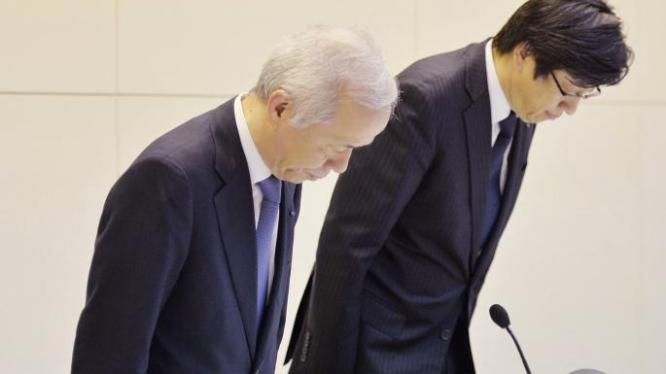
Naomi Hirose, left, TEPCO president, and Takafumi Anegawa, a director, apologise at press conference in Tokyo today
The company responsible for the Fukushima Dai-ichi nuclear power plant has admitted lying about the meltdown of its reactors five years ago, in a deliberate cover-up of the world’s second worst nuclear disaster.
It took two months for the Tokyo Electric Power Company (Tepco) to own up to the meltdown of three reactors after an earthquake and tsunami. A report commissioned by the company says that its president at the time ordered employees to speak of “damage” to the reactors and avoid the world, “meltdown”.
The company’s current president, Naomi Hirose, said: “It is extremely regrettable People are justified in…
No accountability in nuclear industry
Following the June 16 quake in Hakodate, Hokkaido, nuclear plant operators in the area reported no damage, but even if there were problems, because of Prime Minister Shinzo Abe’s new anti-democratic secrecy law, they would not necessarily report them, nor would they feel any compunction to do so. The Nuclear Village Idiots can cover their backsides very nicely with this new secrecy law.
Public safety is hardly a concern of politicians or the nuclear power plant owners. Japan’s very much a totalitarian state once again. It simply uses democratic-sounding titles to cover up the true authoritarian nature of the government and senior industrial officials. It’s Tojo’s Japan with velvet gloves. Let’s hope the gloves never come off.
ROBERT MCKINNEY
OTARU, HOKKAIDO
http://www.japantimes.co.jp/opinion/2016/06/25/reader-mail/no-accountability-nuclear-industry/
Japan Could Go Nuclear ‘Virtually Overnight’ Joe Biden Tells Chinese President

This undated picture released from North Korea’s official Korean Central News Agency (KCNA) on June 23, 2016 shows a test launch of the surface-to-surface medium long-range strategic ballistic missile Hwasong-10 at an undisclosed location in North Korea.The Musudan — also known as the Hwasong-10 — has a theoretical range of anywhere between 2,500 and 4,000 kilometres (1,550 to 2,500 miles).
U.S. Vice President Joe Biden, never one for a loss of words, told Chinese President Xi Jinping that Japan has the capacity to acquire nuclear weapons “virtually overnight.”
Biden made his disclosure while giving a speech at a Public Broadcasting Service program aired on Monday. Biden said he had urged Xi to exert influence on North Korea so it will abandon its missile and nuclear weapons developments.
Referring to North Korea’s recent nuclear test and missile launches in violation of U.N. Security Council resolutions, Biden said that if China and the U.S. fail to take effective action against North Korea, “What happens if Japan, who could go nuclear tomorrow? They have the capacity to do it virtually overnight.” Biden did not say when his conversation with Xi took place.
Biden said that China had the single greatest ability to influence North Korea, adding that North Korea is building nuclear weapons that can strike as far away the U.S. mainland.
“And I say, so we’re going to move up our defense system,” the vice president added, referring to the U.S. plan to deploy THADD (Terminal High Altitude Area Defense), an advanced missile interception system, in South Korea.
Biden quoted Xi as saying, “Wait a minute, my military thinks you’re going to try to circle us.” Earlier this month China said that deploying THADD infringes on China’s strategic interests.
The fact that Japan can easily develop nuclear weapons, however, isn’t the issue but the fact that Biden chose to tell Xi this is worthy of note, both in the context of North Korea’s nuclear ambitions and given Biden’s history of frequently making gaffes.
Tepco’s “sincere”apology!!!
With Tepco it is always the same song, they apologize for a long ago previous lie and tell the whole world how very very sorry, repenting they are, while they daily continue lying and covering-up the true happenings at Fukushima Daiichi.
FUCK TEPCO!
Press Release (Jun 21,2016)TEPCO APOLOGIZES FOR PREVIOUS LEADERSHIP’S FAILURE TO ACKNOWLEDGE MELTDOWN DURING FUKUSHIMA ACCIDENT
Responding to recent report of an investigating committee, TEPCO restates its commitment to provide comprehensive, accurate and understandable information, while making safety the utmost priority to ensure a safe and secure society
TOKYO, June 21, 2016 In its first response to the June 16 report of the committee investigating the belated acknowledgment that a meltdown had taken place at Fukushima Daiichi NPS in March 2011, TEPCO said it is clear from the report that its previous leadership gave instructions not to use the word “meltdown” in public statements.
“We deeply regret that our previous leadership failed to live up to the standards of transparency and thoroughness that we strive to meet today,” said TEPCO President Naomi Hirose (who was not the company’s leader at the time of the accident). “We sincerely apologize for it,” he said.
In more recent years, through the creation of the Nuclear Reform Monitoring Committee and many other changes, TEPCO has worked to improve the timeliness, thoroughness, and clarity of its communication with the public, both inside Japan and internationally. President Hirose stressed that TEPCO has been learning this lesson and breaking from its past, as it works to build trust with the public and with government through the implantation of its Nuclear Safety Reform Plan. Improvements in communication represent an important element of that Plan, which is overseen both by the company’s Nuclear Safety Oversight Office and by an independent Nuclear Reform Monitoring Committee chaired by the former head of the U.S. Nuclear Regulatory Commission.
“We deeply regret the shortcomings of the past,” President Hirose said, “but it is important to recognize that they do not represent the TEPCO of today while making safety the utmost priority to ensure a safe and secure society.”
http://www.tepco.co.jp/en/press/corp-com/release/2016/1300509_7763.html
To carry better the Fukushima radioactive water into the ocean

New Drainage Channels Start Operations at Fukushima Daiichi Nuclear Power Station
More Drainage “Improvements” at Fukushima Daiichi: In advance of typhoon season, rainwater drainage has been further improved by the construction of a new drainage channel. The channel runs between Units 5-6 and the cluster of Units 1-4. It carries water into two drainages, both of which empty into the protected port area and not the open ocean. The new channel helps manage the increased runoff that results from extensive hard-surfacing that has been done to reduce radiation, prevent rainwater from seeping into the ground, and in turn “improve the environment”.
http://www.tepco.co.jp/en/news/library/archive-e.html?video_uuid=tq4l2aqa&catid=69631
Living with radiation in Fukushima
In Iwaki city, Fukushima, the Tarachine “screening center” is a fully independent citizen laboratory, well equipped and employing qualified technicians to help the Fukushima population with anything involving radiation measuring or contamination testing.

For a minor fee people can come to the Tarachine screening clinic to have their foods tested, but also their house lot soil tested, or even the vacuumed dust of their house tested.
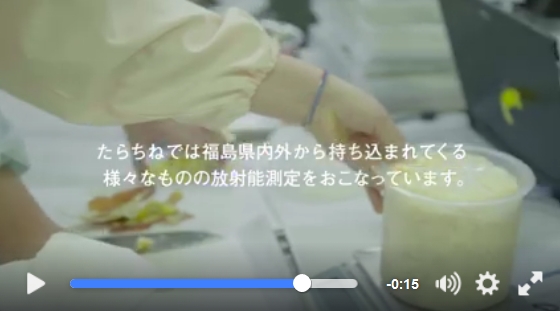
The Tarachine screening center fulfill a very important role for the Fukushima families, as families do not have the means to acquire all the necessary expensive equipment nor the technical qualifications.

As the Japanese government does not provide such vital service nor could be trusted with radiation measure numbers, some citizens organized themselves to set up such laboratories. There are at present about 100 such laboratories which have spread up, but Tarachine is certainly the most efficient and fully equipped for various types of radiation measures.
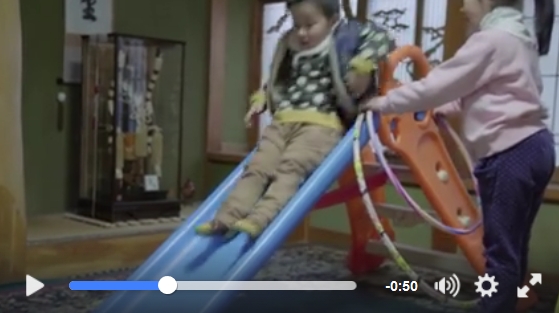
For example, since in a lot of places very young children cannot anymore play outside safely, but are kept to play indoors, it is therefore vital for the mothers to constantly control the level of contamination inside their house, thus they bring to the Tarachine center their vacuumed dust to be measured.
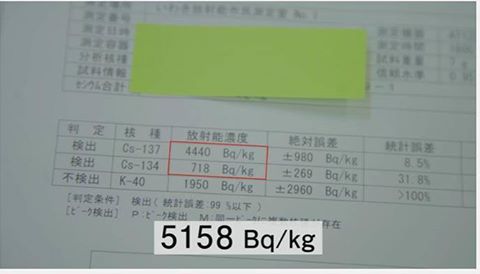
As an example this mother having brought her house vacuumed dust to be analyzed learned that it is contaminated by 4400 Bq/kg of Cesium 137, 718 Bq/kg of Cesium 134 and 1950 Bq/kg of Potassium 40, thus a total contamination of 5158 Bq/kg. The levels of Cesium 137 and Cesium 134 have too high, 4 times higher than the advised contaminated threshold and could therefore be harmful to the persons living in that house, especially for children.
As a comparison, you may see vaccumed dust from 3 different locations, one in Iwaki, Fukushima, one in Chiba, nearby Tokyo, and one in Vancouver, British Columbia,Canada:
Vacuum House Dust in Fukushima (Iwaki)
Cs 137 4440 Bq/kg
Cs 134 718 Bq/kg
Vacuum House dust in Chiba (Makuhari)
Cs 137 137Bq/kg(± 2%)
Cs 134 27Bq/kg(± 5%)
Vacuum House dust in Vancouver, BC
Cs 137 <1.08Bq/kg
Cs 134 <0.86bq/kg
The Japanese government during the past 5 years has constantly lied to the Fukushima population about the harmful radiation risks, condemning the people to stay and live with radiation. Consequently citizens have learned to rely only on their own for radiation measuring and protection.
https://www.actbeyondtrust.org/campaign/pledge/tarachine/jp/
Contact adress: Tarachine Screening center
Onahama hanabatake-cho 11-3, Iwaki city, Fukushima Prefecture, Japan
Tel: 0246‐92‐2526
-
Archives
- October 2026 (103)
- September 2026 (339)
- August 2026 (330)
- July 2026 (355)
- June 2026 (287)
- May 2026 (306)
- April 2026 (356)
- March 2026 (251)
- February 2026 (267)
- January 2026 (308)
- December 2025 (358)
- November 2025 (359)
-
Categories
- 1
- 1 NUCLEAR ISSUES
- business and costs
- climate change
- culture and arts
- ENERGY
- environment
- health
- history
- indigenous issues
- Legal
- marketing of nuclear
- media
- opposition to nuclear
- PERSONAL STORIES
- politics
- politics international
- Religion and ethics
- safety
- secrets,lies and civil liberties
- spinbuster
- technology
- Uranium
- wastes
- weapons and war
- Women
- 2 WORLD
- ACTION
- AFRICA
- Atrocities
- AUSTRALIA
- Christina's notes
- Christina's themes
- culture and arts
- Events
- Fuk 2022
- Fuk 2023
- Fukushima 2017
- Fukushima 2018
- fukushima 2019
- Fukushima 2020
- Fukushima 2021
- general
- global warming
- Humour (God we need it)
- Nuclear
- RARE EARTHS
- Reference
- resources – print
- Resources -audiovicual
- Weekly Newsletter
- World
- World Nuclear
- YouTube
-
RSS
Entries RSS
Comments RSS

