Chinese City Backs Down on Proposed Nuclear Fuel Plant After Protests
BEIJING — Bowing to days of passionate street protests, a city government in eastern China said Wednesday that it had halted any plans to build a nuclear fuel plant there. The reversal was the latest indication of how public distrust could hold back China’s ambitious plans for expanding its nuclear power industry.
The government of Lianyungang, a city near the coast of Jiangsu Province, announced the retreat in a terse message online. “The people’s government of Lianyungang has decided to suspend preliminary work for selecting a site for the nuclear cycle project,” it read, referring to a proposed plant for reprocessing used fuel from nuclear plants.
No reason was given, but it appeared clear enough. In recent days, residents have taken to the streets to oppose any decision to build the plant nearby. The main urban area of Lianyungang is just 20 miles southwest of a large and growing nuclear power plant on the coast, but the idea of a nuclear fuel reprocessing facility also being built in the area seemed to push public unease to a new height.
A 21-year-old Lianyungang resident with the surname Tang said Wednesday that demonstrators had been chanting “Oppose nuclear waste, defend our home.” Like other people contacted there, she did not want her full name used, citing fear of reprisal for talking to reporters.
“Nobody wants this kind of thing built in their own home,” Ms. Tang said.
China’s authoritarian leaders are wary of local protests escalating into broader challenges to their power. But local governments have often given ground in the face of growing public opposition to chemical plants, waste incinerators and other potential sources of pollution. Now proposed nuclear projects are also becoming increasingly troublesome.
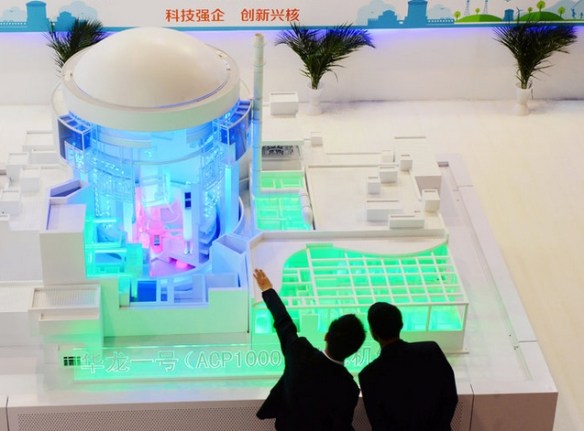
A model of a nuclear reactor on display at the stand for the China National Nuclear Corporation at an expo in Beijing last year. Across the country, the nuclear disaster in Fukushima, Japan, in 2011 has hardened public wariness of nuclear power.
“While the Chinese government does not hesitate to arrest the few political dissidents, it spends more time and energy to appease public demands,” Wenfang Tang, a professor of political science at the University of Iowa, who studies public opinion and politics in China, said in emailed comments.
“The high level of government sensitivity and responsiveness to public opinion further encourages political activism in Chinese society,” Professor Tang said. “The louder you are, the more quickly the government will respond.”
In Lianyungang and across China, the nuclear calamity in Fukushima, Japan, in 2011 has hardened public wariness of nuclear power, although the government argues that expanding the industry is essential for weaning the economy off coal, with all of its dangerous pollutants.
The biggest protest in Lianyungang took place on Saturday, when many thousands of people, including families with children, marched through the downtown area.
Despite warnings from the government, protests continued on a smaller scale this week, as residents defied ranks of riot officers with shields, according to news reports and video that people shared through social media.
“I told my daughter that she must go to this protest,” one resident said, according to Sixth Tone, an English-language news website based in Shanghai. “With every extra person, the momentum will get bigger.”
The announcement does not mean the nuclear fuel-reprocessing proposal is dead. The project is a collaboration between the China National Nuclear Corporation and a French company, Areva, and it has high-level government support, although no final agreement to build it has been signed. Five other Chinese provinces are under consideration for the initiative, and Lianyungang could lift its suspension. The two companies have said that they want to start building in 2020 and finish by 2030.
But in China, suspensions of contentious projects have a way of quietly turning into permanent cancellations, and Lianyungang appears likely to follow that pattern. The big question now will be whether public opposition coalesces in the five other areas under consideration.
All but one — Gansu Province in the northwest — is a heavily populated coastal province. Gansu is already home to China’s first civilian nuclear reprocessing plant, a small facility that has been held back by technical problems.
In 2013, officials jettisoned plans for a nuclear fuel fabrication plant in the southern province of Guangdong after protests. Preliminary proposals to build nuclear power plants inland have also ignited intense opposition.
The Chinese government has said that as it expands its fleet of nuclear power plants, it needs a plant for reprocessing spent fuel, a practice that separates unused plutonium and some uranium from waste. That unused material could be used to generate power, but critics have warned that the plutonium could be deployed for weapons. Japan has also built a full-scale reprocessing plant, but it has not started up yet.
On Chinese social media, and even on news websites, commentators said that the contention in Lianyungang showed that the public should have a bigger say in nuclear energy planning.
“In just a few days, the official stand of Lianyungang has undergone a sea change,” read a comment on Sohu.com, a Chinese news website. “Don’t underestimate just how determined the public is in opposition to nuclear waste, which is far more dangerous than wastewater from any paper pulp mill.”
http://www.nytimes.com/2016/08/11/world/asia/china-nuclear-fuel-lianyungang.html
Shikoku Electric restarts reactor under post-Fukushima regulations
Ikata nuclear power plant in Ehime Prefecture, is restarted.
After the Tepco Fukushima Daiichi earthquake/tsunami disaster and the Kumamoto recent earthquake, it is to be wondered what Japan has learned?
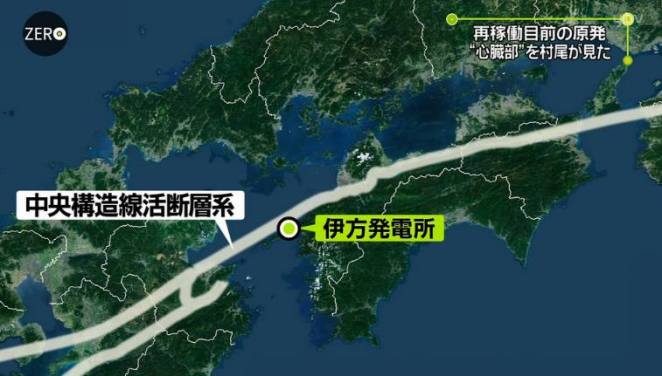
The Ikata nuclear power plant is located on the Hinagu fault zone and Futagawa fault zone, themselves extension of Japan’s largest active fault “Median Tectonic Line”.
In case of any accident, for the residents living on Sadamisaki Peninsula evacuation would be only possible by boat to Kyushu Island, such evacuation would be therefore difficult, even impossible.
Unless there would be a Japanese Moses to open the sea, such evacuation plan should be referred to as an escape from reality.
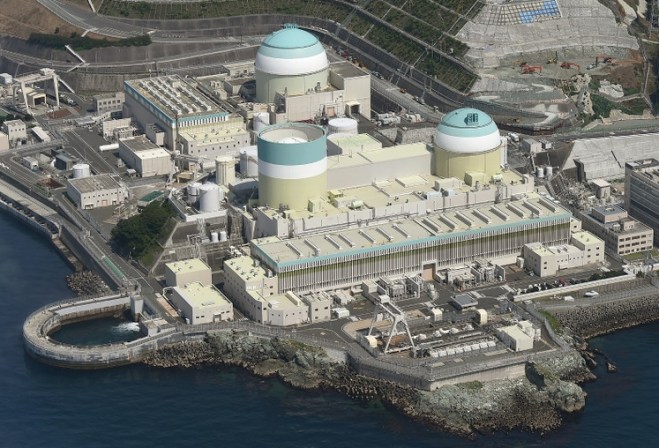
The Ikata Nuclear Power Plant in Ikata, Ehime Prefecture
MATSUYAMA, Japan (Kyodo) — Shikoku Electric Power Co. restarted a reactor at its Ikata power plant in western Japan on Friday, making it the fifth unit reactivated under tougher regulations set following the 2011 Fukushima nuclear disaster.
The No. 3 reactor at the plant in Ehime Prefecture is the only restarted unit in Japan that runs on uranium-plutonium mixed oxide, or MOX, fuel, as a court ordered Kansai Electric Power Co. in March to suspend two reactors at its Takahama plant after they resumed operations earlier this year, citing safety concerns.
MOX fuel, created from plutonium and uranium extracted from spent fuel, is a key component of the nuclear fuel recycle program pursued by the nuclear power industry and the government.
The government aims to bring reactors back online after the Fukushima crisis led to a nationwide halt of nuclear plants, as it plans to have nuclear power account for 20 to 22 percent of the country’s total electricity supply in 2030 to cut greenhouse emissions and lower imported fuel costs.
The Ikata unit is expected to reach criticality, or a state of sustained nuclear chain reaction, on Saturday and begin generating and transmitting electricity on Monday before resuming commercial operation in early September for the first time since it was halted in April 2011 for regular inspection.
“We will take steps toward criticality and resumption of power generation with priority on ensuring safety,” Shikoku Electric President Hayato Saeki said in a statement on Friday.
Meanwhile, around 70 residents and others opposing the reactor restart gathered around the seaside plant early Friday morning, chanting slogans such as “Don’t contaminate the Seto Inland Sea,” and “Stop the nuclear plant.”
Junko Saima, a 72-year-old woman from Yawatahama, adjacent to the town hosting the plant, which is located on one side of a narrow peninsula, said, “I am nervous that some kind of accident may occur.”
Opponents are concerned about the effectiveness of government-prepared evacuation plans in case of an accident and about potential major earthquakes that are not taken into account in the plans, while proponents are hailing the resumption as it could bring economic benefits.
The restart follows the reactivation of two reactors at Kyushu Electric Power Co.’s Sendai plant in Kagoshima Prefecture last year and the brief run of the Nos. 3 and 4 units at Kansai Electric’s Takahama complex in Fukui Prefecture.
The mayor of Ikata town and the governor of Ehime Prefecture have already given their consent to restart the No.3 reactor after regulators approved its restart in July last year.
In June, Shikoku Electric loaded nuclear fuel at the power plant eyeing to reboot it on July 26. However, reactivation was postponed due to problems with the reactor’s cooling system.
A group of local residents filed a suit in May seeking an injunction to halt the restart arguing that a series of earthquakes that have hit nearby Kyushu Island in April could trigger quakes along the median tectonic line running close to the Ikata reactor.
The plant is about 170 kilometers east of Kumamoto Prefecture, the epicenter of the quakes.
Meanwhile, in Kagoshima, new Gov. Satoshi Mitazono is planning to ask Kyushu Electric to suspend the two reactivated reactors at the Sendai plant to double-check any safety impact on the units from the powerful earthquakes that hit neighboring Kumamoto in April.
http://mainichi.jp/english/articles/20160812/p2g/00m/0dm/035000c
Biological effects of Fukushima radiation on plants, insects, and animals

This is a pale grass blue butterfly, one of the most common species of butterfly in Japan. Recent research has revealed major impacts on this species from the radiation leaks at the Fukushima nuclear power plant. Credit: Joji Otaki, University of the Ryukyus, Okinawa, Japan
Following the 1986 Chernobyl nuclear power plant meltdown, biological samples were obtained only after extensive delays, limiting the information that could be gained about the impacts of that historic disaster. Determined not to repeat the shortcomings of the Chernobyl studies, scientists began gathering biological information only a few months after the disastrous meltdown of the Fukushima Daiichi power plant in Japan in 2011. Results of these studies are now beginning to reveal serious biological effects of the Fukushima radiation on non-human organisms ranging from plants to butterflies to birds.
A series of articles summarizing these studies has now been published in the Journal of Heredity. These describe widespread impacts, ranging from population declines to genetic damage to responses by the repair mechanisms that help organisms cope with radiation exposure.
“A growing body of empirical results from studies of birds, monkeys, butterflies, and other insects suggests that some species have been significantly impacted by the radioactive releases related to the Fukushima disaster,” stated Dr. Timothy Mousseau of the University of South Carolina, lead author of one of the studies.
Most importantly, these studies supply a baseline for future research on the effects of ionizing radiation exposure to the environment.
Common to all of the published studies is the hypothesis that chronic (low-dose) exposure to ionizing radiation results in genetic damage and increased mutation rates in reproductive and non-reproductive cells.
One of the studies (Hayashi et al. 2014) documented the effects of radiation on rice by exposing healthy seedlings to low-level gamma radiation at a contaminated site in Fukushima Prefecture. After three days, a number of effects were observed, including activation of genes involved in self-defense, ranging from DNA replication and repair to stress responses to cell death.
“The experimental design employed in this work will provide a new way to test how the entire rice plant genome responds to ionizing radiation under field conditions,” explained Dr. Randeep Rakwal of the University of Tsukuba in Japan, one of the authors of the study.
Another team of researchers (Taira et al. 2014) examined the response of the pale grass blue butterfly, one of the most common butterfly species in Japan, to radiation exposure at the Fukushima site. They found size reduction, slowed growth, high mortality and morphological abnormality both at the Fukushima site and among laboratory-bred butterflies with parents collected from the contaminated site.
Multiple sources of exposure were included in the butterfly study. “Non-contaminated larvae fed leaves from contaminated host plants collected near the reactor showed high rates of abnormality and mortality,” explained Dr. Joji Otaki of the University of the Ryukyus in Okinawa, Japan. Some of their results suggested the possible evolution of radiation resistance in Fukushima butterflies as well.
A review of genetic and ecological studies for a range of other species at both Chernobyl and Fukushima (Mousseau 2014) revealed significant consequences of radiation. Population censuses of birds, butterflies, and cicadas at Fukushima showed major declines attributable to radiation exposure. Morphological effects, such as aberrant feathers on barn swallows, were also observed. The authors suggest that long-term studies at Chernobyl could predict likely effects in the future at the Fukushima site.
All of these studies highlight the need for early and ongoing monitoring at sites of accidental radiation release. “Detailed analyses of genetic impacts to natural populations could provide the information needed to predict recovery times for wild communities at Fukushima as well as any sites of future nuclear accidents,” Mousseau said. “There is an urgent need for greater investment in basic scientific research of the wild animals and plants of Fukushima.”
Provided by: American Genetic Association
http://m.phys.org/news/2014-08-biological-effects-fukushima-insects-animals.html
Japan urges Hong Kong to lift ban on food from areas near Fukushima plant
HONG KONG – Agricultural minister Yuji Yamamoto said in Hong Kong on Thursday that he has requested the territory to lift a food ban that restricts imports from five Japanese prefectures most affected by a radiation-leak scare following the Great East Japan Earthquake in 2011.
Imports of Japanese food, including milk, vegetables and fruits, from Fukushima, Ibaraki, Tochigi, Gunma and Chiba prefectures have been banned since March 2011 following the magnitude-9 earthquake and subsequent tsunami that led to the nuclear plant meltdowns over worries about contamination by radioactive substances.
However, meat, poultry, eggs and aquatic products can be imported with radiation certificates stating their safety.
“I made a request to (Chief Secretary for Administration Carrie Lam during a meeting Wednesday), if the regulation on the import of food from Japan could be relaxed and be eliminated,” Yamamoto told media at the opening of the annual Food Expo, where a record number of more than 250 Japanese companies are in Hong Kong promoting their products, including those from the prefectures of Fukushima and Kumamoto, which was hit by a series of earthquakes in April.
“(On Friday) I should have a meeting with Secretary for Food and Health Ko Wing-man. I expect that they will respond after very careful consideration and deliberation,” he said, adding that he wishes there could be a scientific-based analysis of products from Fukushima to eliminate the reputational damage.
Ko said monitoring will remain for the safety of Hong Kong people.
“We have been relying on a risk- and evidence-based method to decide on the prohibition of fresh food imports from five Japanese prefectures,” Ko told reporters after touring the food fair. “We have continued to examine the progress made in Japan’s handling of the Fukushima nuclear incident,” including the measures they have put in place and test results on the food, he said.
“We will look at all the information and make decisions on a scientific basis. In the upcoming meeting (with Yamamoto), we will explain to them Hong Kong’s position, which, most importantly, is that we will manage food safety based on the well-being of Hong Kong people,” he said.
The value of Japan’s agricultural, forestry and fishery exports last year reached a record-high ¥745 billion ($7.34 billion). Hong Kong remained the top destination for the 11th consecutive year, with a value of ¥179 billion, marking a 33 percent increase from 2014, according to ministry data.
The sale of dried sea cucumber, considered a healthy seafood delicacy, to Hong Kong registered a slight decline, while sales of instant noodles increased by 50 percent, which Yamamoto said was a “major surprise.”
Eliza Au, 40, owner of a startup private kitchen, said after sampling products from Kumamoto Prefecture she is confident in the quality of Japanese food.
“The fruit, the Wagyu beef, all went under strict safety inspections, and the seasoning, the mix and match are all so appealing,” Au said.
The food fair, which showcases some 1,400 exhibitors from 26 countries and regions, will run through Monday.
Shikoku Electric fires up Ehime plant MOX reactor amid protests

MATSUYAMA, EHIME PREF. – Japan restarted another nuclear reactor Friday, as Shikoku Electric Power Co. reactivated reactor 3 at its Ikata nuclear plant in Ehime Prefecture.
It will be the first time in some five years and three months for the reactor to be switched on, since it was suspended for a routine safety inspection in April 2011.
The Ikata reactor 3, which is powered by MOX fuel, is the fifth to go back online under the county’s new safety regulations, introduced in July 2013 after the March 2011 reactor meltdowns at Tokyo Electric Power Company Holdings Inc.’s Fukushima No. 1 plant.
The Ikata plant is now the second nuclear plant in operation in Japan, joining Kyushu Electric Power Co.’s Sendai plant in Kagoshima Prefecture.
On Thursday, local residents staged a protest over the restart.
“Once you put a nuclear reactor back into operation, it’s hard to stop it,” said Shinichi Naide, a 51-year-old company employee.
Aki Hashimoto, 60, who joined the rally from Koriyama, Fukushima Prefecture, questioned what the country has learned from the Fukushima meltdowns. Nuclear authorities “must hear the voices of people who suffered from the Fukushima accident,” she said.
The reactivated reactor is slated to reach criticality, or a self-sustained nuclear fission chain reaction, early Saturday morning. On Monday, it will begin the generation and transmission of electricity, reaching full capacity on Aug. 22.
Shikoku Electric aims to start the plant’s commercial operations in early September.
The Ehime reactor 3 is the only restarted unit in Japan that runs on uranium-plutonium mixed oxide, or MOX, fuel, as a court ordered Kansai Electric Power Co. in March to suspend two reactors at its Takahama plant after they resumed operations earlier this year, citing safety concerns.
MOX fuel, created from plutonium and uranium extracted from spent fuel, is a key component of the nuclear fuel recycle program pursued by the nuclear power industry and the government.
The government aims to bring reactors back online after the Fukushima crisis led to a nationwide halt of nuclear plants, as it plans to have nuclear power account for 20 to 22 percent of the country’s total electricity supply in 2030 to cut greenhouse emissions and lower imported fuel costs.
The Ikata unit is expected to begin generating and transmitting electricity on Monday and resume commercial operation in early September in its first operation since it was halted in April 2011 for regular inspection.
The restart follows the reactivation of two reactors at Kyushu Electric Power Co.’s Sendai plant in Kagoshima Prefecture last year and the brief run of reactors 3 and 4 at the Takahama complex in Fukui Prefecture.
The mayor of Ikata and the governor of Ehime Prefecture have already given their consent to restart reactor 3 after regulators approved its restart in July last year.
In June, Shikoku Electric loaded nuclear fuel at the power plant, looking to reboot it on July 26. However, reactivation was postponed due to problems with the reactor’s cooling system.
A group of local residents filed a suit in May seeking an injunction to halt the restart arguing that a series of earthquakes that have hit nearby Kyushu in April could trigger quakes along the median tectonic line running close to the Ikata reactor.
The plant is about 170 km east of Kumamoto Prefecture, the epicenter of the quakes.
Accidents will happen, but covering them up is unacceptable

Shenanigans at a nuclear power plant in Guangdong show that transparency when incidents occur is just as important as safety protocols
The official report on an incident at a nuclear power plant near Hong Kong, more than a year ago, raises some serious safety questions. As a result of a breach of operational guidelines, and an attempted cover-up, three staff at the Yangjiang nuclear plant in Guangdong, 220km from Hong Kong, received administrative warnings and their crew leader was stripped of his senior nuclear operator licence – a more severe punishment, though none lost their jobs. The Ministry for Environmental Protection said the incident occurred during maintenance in March last year. After receiving a system alert, the four staff took actions that caused a “residual heat removal pump” on one of the reactors – a crucial back-up part of the water-cooling system – to stop functioning for six minutes. They then tried to cover up the incident and did not enter it into a log book as required.
Technician shortage in China ‘threatens nuclear plant safety’
On the face of it, the incident may sound relatively trivial, especially if the unit was not running. People familiar with such operations say breaching guidelines briefly would usually fall well short of immediate safety significance. But a number of points remain unclear after an investigation that took more than a year. The statement did not say what caused the alert, what actions the four took that led to their warnings, or how the incident and the attempted cover-up came to light. Thankfully, two nuclear experts dismissed the possibility of a radioactive leak or public safety threat.
The most serious concern is the attempted cover-up. This perverts a reporting system put in place to help safeguard life and property because human error and safety incidents cannot be eradicated. The Yangjiang incident also highlighted a growing operational problem in the nuclear industry – the shortage of senior operators for a massive expansion needed to meet the country’s consumption and emissions-reduction goals. Uncompetitive pay rates for what can be a high-pressure job do nothing to help recruitment.
That said, it remains true there is no more reliable or cleaner way of producing electricity. China has earned a reputation for taking nuclear safety seriously and wanting to be seen to do so to help promotion of its nuclear technology to potential foreign buyers.
Exposure of the attempted cover-up is a reminder that transparency is as important with nuclear power plants as safety. Lessons learned with each incident can only result in safer and better reactors.
The affection of the central nervous system by incorporated radionuclides Cs-137
It has been known for a long time, and without a doubt, that even low levels of radiation in our food or water can have disastrous effects, even at levels of say 30 or 40 Bq/kG of consumed food.


And here is the study itself.
http://chernobyl-today.org/images/stories/bandazhevsky_lelevich_1995.pdf
Ikata Reactor to Restart Friday August 12

Shikoku Electric Power Co.’s Ikata nuclear power plant is shown in this photo taken in July.
Ikata nuclear reactor to be restarted this week
Workers at the Ikata nuclear power plant in western Japan are engaged in the final inspection of control rods ahead of a planned restart of a reactor there on Friday.
The Ikata plant will be the 3rd to come back online under new regulations adopted after the 2011 Fukushima Daiichi nuclear accident.
Inspectors from the Nuclear Regulation Authority are also participating in the final checkups on Wednesday at the plant’s number 3 reactor, operated by Shikoku Electric Power Company.
The checks include confirming whether 16 control rods work properly in the reactor. They are designed to operate automatically during an earthquake and other emergencies.
If the inspection finds no problems, workers will restart the reactor on Friday by pulling out the control rods. The operator plans to start generating electricity and feeding it to the grid 3 days later.
The company initially planned the restart for late July. But trouble with a water cooling pump caused a delay.
Two reactors at the Sendai nuclear plant in Kagoshima Prefecture, southern Japan, have already resumed power generation.
The regulator also approved the restart of 2 reactors at the Takahama plant in Fukui Prefecture, central Japan. But a court injunction suspended their operation.
http://www3.nhk.or.jp/nhkworld/en/news/20160810_23/
Ikata nuclear reactor to restart on Friday morning
MATSUYAMA, EHIME PREF. – Shikoku Electric Power Co. said Wednesday it will reactivate the No. 3 reactor at its Ikata nuclear power plant in Ehime Prefecture around 9 a.m. on Friday.
It will be the first time in some five years and three months for the reactor to be switched on, since it was suspended for a routine safety inspection in April 2011.
The Ikata No. 3 reactor will be the fifth to go back online under the county’s new safety regulations, introduced in July 2013 after the March 2011 nuclear accident at Tokyo Electric Power Company Holdings Inc.’s Fukushima No. 1 plant.
The Ikata plant will be the second nuclear plant in operation in Japan, joining Kyushu Electric Power Co.’s Sendai nuclear plant in Kagoshima Prefecture.
The reactivated reactor is slated to reach criticality, or a self-sustained nuclear fission chain reaction, early on Saturday morning. On Monday, it will begin the generation and transmission of electricity, reaching full capacity on Aug. 22.
Shikoku Electric aims to start the plant’s commercial operations in early September.
After Hiroshima and Nagasaki, a third nuclear atrocity: the corruption of science
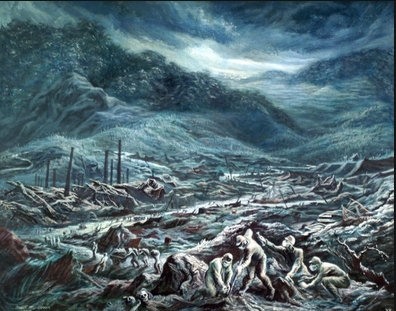
From August 6, 2015
Following the atomic bombs exploded over Japan in 1945 a second crime against humanity took place, writes Chris Busby: the deliberate falsification of science to hide the dangers of ionising radiation, perpetrated to quell public opposition to a new age of nuclear bombs and energy. The fraud continues to this day, but finally the truth is winning out.
On the 70th anniversary of the atomic bombing of Hiroshima and Nagasaki, articles are appearing everywhere discussing the historical, philosophical, scientific, public health and social meaning of this event (I almost wrote ‘war crime’).
The bombings can be extrapolated onward in time through the atmospheric testing fallout and Chernobyl, to the more recent contamination in Japan after Fukushima.
Today, the analysis of the health risks from the Japanese A-Bombs is being cleverly twisted to provide a rationale for the development of nuclear weapons and nuclear energy.
Hiroshima and Nagasaki are not just some historical tableaux that we can weep crocodile tears over, and discuss as socio-historic phenomena.
They are here today, present as ghosts, in all the manipulations and devious calculations made by the international radiation risk agencies and nuclear-industry scientists giving results that continue to permit the release into the environment of the same deadly substances that emerged for the first time in 1945.
Abusing Hiroshima to deny nuclear bomb health damage
I am currently presenting a case for the British Atomic Test veterans in the Royal Courts of Justice in London. The case pivots on the faulty radiation and health risk model that is based on the Lifespan Study of the Japanese A-Bomb survivors.
This model, of the International Commission on Radiological Protection (ICRP), is used by the Ministry of Defense in the courts to deny responsibility for the cancers in the Nuclear Test Veterans and the congenital disease in their children and grandchildren.
However, the Hiroshima model also predicts that those exposed to radiation and fallout from future nuclear ‘exchanges’ would suffer little downstream genetic damage. Thus the Doctors Strangelove and the generals can argue that a nuclear war is winnable and that the increases in cancer and genetic effects in those exposed to Depleted Uranium (DU) in Iraq somehow don’t exist.
The bogus analysis of the health outcomes from Hiroshima has left the world with a major public health problem. In an effort to refute the mounting evidence, the ICRP model was relaunched by The Lancet to coincide with the Hiroshima anniversary.
A whole issue is given over to the presentation of wacko accounts of the health consequences of Hiroshima, Chernobyl and Fukushima through articles (at least partly) written by those who hold the reins of the ICRP chariot. The key issue is accurately described at the start:
“The linkages between Hiroshima, Nagasaki and Fukushima are thus more than just symbolic, having shaped current health management practices, and the institutions that run them, as well as public responses to these events.”
However, these current health management practices are wildly in error.
Nuclear war
Everyone has seen the photos of Hiroshima. The primitive Uranium-235 bomb ‘Little Boy’ that fell on Hiroshima with an explosive power of 13 kilotons (13,000 tons of TNT, the conventional chemical explosive) flattened the city and killed some 80,000 people of which 45,000 died on the first day.
Within four months the death toll was about 140,000. Three days after Hiroshima, a 20kT Plutonium bomb ‘Fat Man’ was dropped on Nagasaki (Why? Did the US think perhaps the Hiroshima bomb might have been overlooked?). Both weapons were mostly made of Uranium.
Note that. Since then, from 1950, a study of the survivors by the US funded Atomic Bomb Casualty Commission ABCC (and later the Radiation Effects Research Foundation) has defined the relationship between radiation dose and cancer.
In passing, recall that the explosive power was 13 kilotons. Anyone who wants nightmares should buy the standard work:The Effects of Nuclear Weapons, by Samuel Glasstone, the physical chemist. The more recent versions of this book have a nifty little plastic calculator in the back where you may, by rotating the bezel, inform yourself of the radii of blast, radiation dose, building destruction etc. for any size of bomb.
The US has spent lots of money and time blowing up stuff in the Nevada and Pacific test sites to obtain these data. Modern thermonuclear warheads, of which there are currently some 15,000, pack about 800kT. Just one of these jobs would put paid to most of New York, Tehran or Jerusalem.
I visualize some poor civil defense chief sitting in a shelter somewhere desperately twisting the scales on this pretty ‘Nuclear Bomb Effects Computer’ (developed by the Lovelace Research Institute in Albuquerque, New Mexico) whilst waiting for the ground to disappear.
Nuclear war is not longer unthinkable
The problem we have in the world in 2015 is that the economic system and power relations between countries encourages those taking big decisions to think in terms of geopolitical strategies that include the use of nuclear weapons.
There are potential resource wars; there are food-production issues following changes in global weather patterns, there are technological developments in what were historically manipulatable countries. Nuclear weapons are now in the hands of nine nations including three which are not party to the non-proliferation treaty (and why should they be?): India, Pakistan and North Korea.
Negotiations with Iran are currently argued to be “of tremendous importance” in a region where Israel has the nuclear potential to wipe out all the local Arab states at a sitting. The Russians have massive nuclear capability and are being baited on their borders in Ukraine by NATO and those who control NATO.
This shit-stirring now has moved to the Baltic States. I live in Latvia, and this Spring I saw a new tank with a Latvian flag rolling though the center of Ropazi, a small town 40km west of Riga near where I live. Every day, the sky overhead had big helicopters and transport aircraft, donated to the Latvians by the US. Why?
The Baltic States and Poland are conscripting armies to defend the motherland against invasion by the Russians. What’s going on? Those who sow the wind reap the whirlwind, my grandmother would say. Let us hope not.
A systematic cover-up of nuclear dangers
In all the high level strategic thinking that is associated with this nuclear warmongering, the post attack population death yields from fallout are computed according to the ICRP risk model. But that Hiroshima model is a chimeric construction, built in the Cold War to back up the atmospheric testing.
The observable effects (increases in infant mortality, the 1980s cancer epidemic) were covered up following a 1959 agreement between the International Atomic Energy Agency and the World Health Organization, which left the IAEA, the nuclear physicists, the bomb makers, the deniers of Chernobyl and Fukushima effects, in charge of the research into health.
And so it remains today with The Lancet article ‘Long-term effects of radiation exposure on health‘, co-written by particle physicist Richard Wakeford, ex-head of research of British Nuclear Fuels at Sellafield, nuclear industry representative on the UK CERRIE committee, member of the ICRP, adviser to the Japanese on Fukushima, and so forth.
The evidence from real studies of the offspring of the test veterans, and the soldiers and civilians exposed to Depleted Uranium, is that a nuclear war will be the end of life on earth as we know it.
The test veterans have a 10-fold excess risk of children with birth defects, 9-fold in the grandchildren. Although millions will be blasted away, the real outcome will be global sterility, cancer and malformation. All the Mad Max stuff but worse: Hollywood got it right.
Evidence and errors in the Hiroshima lifespan studies
If you find that there is a doubling of breast cancer or child leukemia in those living downwind of a nuclear power station, at an ‘estimated dose’ less than external background, the ICRP model tells you that the effect cannot be due to the releases from the power station because the dose is too low.
The epidemiologist Martin Tondel found in 2004 that there was a significant excess cancer risk in Northern Sweden after Chernobyl. He was told to shut up because what he found was impossible: In other words, the dose was too low.
The same in Belarus and Ukraine where my colleague Alexey Yablokov has collected together an enormous compilation of peer reviewed evidence of appalling effects. Most recently we see the Hiroshima-based denials in the case of thyroid cancer in Fukushima prefecture (see below).
The study groups for the Atomic Bomb Casualty Commission (ABCC) probe were assembled in 1950. Thus there were five years in which those who were badly affected by the radiation could die. The study was of a “healthy survivor” group, something which the late Dr Alice Stewart demonstrated.
But that is not the worst accusation. There were roughly 109,000 individuals recruited, including six dose groups from 0 to 200 rad (0-2+ Gy) and two Not in City (NIC) groups, the 4,607 Early Entrants (NIC-EE) and 21,915 Late Entrants (NIC-LE).
These NIC groups should have been the controls, but they were not. If you look at the reports you find they were abandoned as being ‘too healthy’. The final exposure groups were defined by how far they were from the detonation.
But all groups were exposed to residual radioactivity from the bombs. The US and ABCC denied (and still denies) this. There were internal exposures to all the groups whatever their external dose had been at the detonation.
Uranium: a genetic poison that targets DNA
The origin was the “black rain” which contained Uranium-235, Uranium-238 and particularly Uranium-234, which is the missing exposure, and is probably responsible for most of the cancer effects in all the survivors. We know that the Uranium was there because it was measured by Japanese scientists in 1983.
A recently declassified US document tabulates the enormous U-234 content of the enriched Uranium used in the bombs, codename: Oralloy. The Uranium nanoparticles in the Hiroshima (and Nagasaki) black rain were available for inhalation by all the exposure groups in the ruins of Hiroshima for years after the bomb.
All the bombs were made of Uranium, about 1 ton per Megaton yield. For all those tests in Nevada, the Marshall Islands, Kazakhstan, Christmas Island, the results were the same: down came the nanoparticles to be inhaled by anyone nearby and distant.
Why does this matter? New research has been carried out on Uranium. We find that Uranium targets DNA through chemical affinity. This causes terrible and anomalous genetic damage, out or all proportion to its “dose” as calculated by ICRP. Other fallout components also bind chemically to DNA, e.g. Strontium-90, Barium-140.
Those exposed: Uranium miners, Gulf Veterans, Test Veterans, DU civilians, Nuclear Uranium workers, Nuclear Site downwinders, all suffer chromosome damage, cancer, leukemia, heart disease, the works. All this is published, as are the results of laboratory and theoretical studies showing mechanisms. But in the Lancet: nothing.
S L Simon and A Bouville who wrote the article on the health effects of the nuclear testing did not even mention Uranium there, nor in their epic 2010 study of the Marshall Islands exposures. The Nevada site data that they used for their baseline calculations ignored it totally.
In 2012, I made a presentation for the Marshall Islanders at the UN Human Rights Council in Geneva, attacking the Simon et al analysis. In their Lancet nuclear test article, Simon and Bouville major on Iodine effects. So let’s look at those.
Scientific evidence from Fukushima: massive excess of thyroid cancers
In Fukushima Prefecture, surveys have confirmed 103 thyroid cancers in 380,000 18-year olds (25 or so are still being checked out). The Lancet article by Wakeford et al. presents an excess Relative Risk culled from the Hiroshima studies of 0.6 per Sievert (Fig 2 p 473). In the very same issue, the maximum thyroid dose was given as 18mSv with the median dose as 0.67mSv.
So in the two years of screening, if everyone screened got the maximum thyroid dose of 18mSv we should expect an increase of 0.018 x 0.6 = 0.011, a 1.1% increase in the background rate. This background is about 1 per 100,000 per year or 7.6 in two years in 380,000. So the radiation should increase this to 7.7 cases (i.e. one extra case in 10 years).
There are 103, that is 95 more cases than expected, an error in the ICRP model of 95/0.14 = 678-fold. That is, there are 678 times more thyroid cancers than the Hiroshima-based ICRP model predicts.
This calculation is based on what was written in The Lancet – but nobody made the calculation. This on its own should show the authorities (and the public) that the game is up. But instead of doing the simple calculation, another article in The Lancet, written by Geoff Watts, praises the work of those at Fukushima Medical University, who are busy telling everyone that the increases in thyroid cancer cannot be caused by the radiation.
In other words, once again, the predictions from Hiroshima are believed, rather than the evidence in front of their eyes. It’s a kind of mass hypnosis (or maybe not).
Finally, someone is trying to get to the truth of the matter
In case you think this is all mad stuff, there does at last seem to be some measure of concern evolving in this area of internal radiation, though no one in The Lancet articles mentions it. The European Union radiation research organization MELODI has finally moved into action, led by the French radiation protection agency IRSN.
The matter was raised (by me) at the inaugural MELODI conference in Paris in 2011, but nothing seemed to develop. I said that there are likely to be dose estimation problems associated with internal exposure to nuclides which bind to DNA, and particularly Uranium; that this potentially falsified the Hiroshima risk model.
A hugely expensive European research project has now been proposed. It is CURE: Concerted Uranium Research Europe. In the report launching this development in March 2015 the authors wrote: a large scale integrated collaborative project will be proposed to improve the characterization of the biological and health effects associated with uranium internal contamination in Europe.
In the future, it might be envisaged to extend collaborations with other countries outside the European Union, to apply the proposed approach to other internal emitters and other exposure situations of internal contamination, and to open the reflections to other disciplines interested in the effects of internal contaminations by radionuclides.
In the future, Hiroshima should not be remembered not just for the destruction of its inhabitants, but also for being the flag for the epidemiological cover-up of the biggest public health scandal in human history, whose victims number hundreds of millions – in cancer deaths and miscarriages, infant deaths, loss of fertility and the introduction of genomic instability to all creatures on Earth.
Let us pray that it will not be allowed to sanction the final nuclear exchange, on the mistaken prediction that such an event will be winnable.
Chris Busby is an expert on the health effects of ionizing radiation. He qualified in Chemical Physics at the Universities of London and Kent, and worked on the molecular physical chemistry of living cells for the Wellcome Foundation. Professor Busby is the Scientific Secretary of the European Committee on Radiation Risk based in Brussels and has edited many of its publications since its founding in 1998. He has held a number of honorary University positions, including Visiting Professor in the Faculty of Health of the University of Ulster. Busby currently lives in Riga, Latvia.
Nuclear plant scheme halted in eastern China after thousands take part in street protests
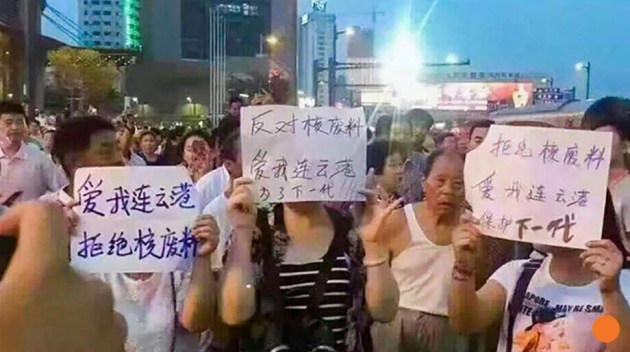
The government in Lianyungang in Jiangsu province issues brief statement saying work on nuclear fuel reprocessing plant project suspended
The authorities in Lianyungang, Jiangsu province, have suspended plans to build a nuclear fuel reprocessing plant after several days of street protests against the project.
Observers said the decision could put other nuclear projects under greater public scrutiny, and urged backers of similar schemes to improve transparency.
The Lianyungang city government announced the halt in a one-sentence statement issued early Wednesday morning.
“The government has decided to suspend preliminary work on site selection for the nuclear recycling project,” the statement said.
It came after thousands of protesters launched a series of street demonstrations from Saturday, protesting about the potential radiation risks and the alleged lack of transparency in the decision-making process for the project.
Residents used social media platforms to question the process but the comments were soon deleted by censors. “What if there is any radiation leakage? Why does the government want to make a decision on such a big issue on its own, a decision that will affect future generations?” they asked.
China National Nuclear Corporation planned to use technology supplied by French firm Areva to develop the spent nuclear fuel reprocessing plant.
The companies previously said construction would start in 2020 and be completed by 2030, but had not settled on a site.
The process has been shrouded in secrecy, with Lianyungang residents discovering that their city could be the site for the plant after the State Administration of Science, Technology and Industry for National Defence announced in a press release that a deputy head visited the city on July 26 and claimed “much progress has been made on site selection”.
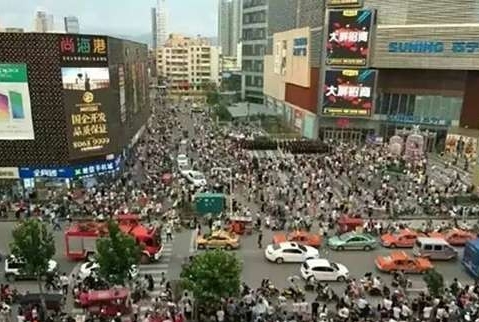
The Lianyungang city government issued a statement on Sunday to try to calm the public, saying the plans were still at an early stage and no location had been confirmed.
Sporadic protests continued on Monday and Tuesday, with video footage posted online showing police mobilised to protect the city government’s office building from protesters.
Xiamen University energy policy specialist Lin Boqiang said the plan was shelved as a result of a lack of transparency and communication by the government and state-owned nuclear companies.
Residents come out in force to protest against Sino-French nuclear project
“Public concerns can be contagious and spill over to other cities, as has been the case with various incinerator and PX [chemical] projects,” he said.
Many local governments have been forced to scrap plans for such projects after public protests over health and safety concerns.
A series of deadly blasts at industrial sites over the years has only worsened public fears and deepened distrust of government.
“China’s PX industry suffered a severe setback. If the developers of nuclear projects do not learn a lesson, they could be faced with similar problems in future,” Lin said.
China is the world’s most active builder of nuclear power plants. It has 32 reactors in operation, 22 under construction and more planned.
The government has also spent heavily to build up its ability to produce nuclear fuel and process the waste.
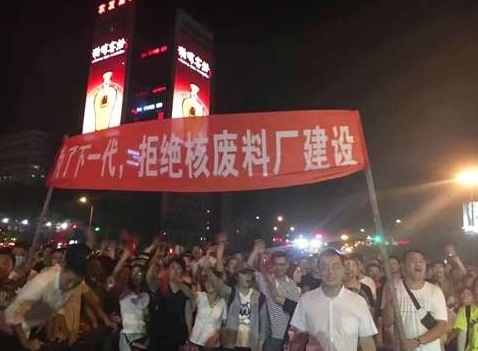
Residents come out in force to protest against Sino-French nuclear project

Rumours that Lianyungang, Jiangsu province will be site of plant sparks rally in city
Residents in Lianyungang in Jiangsu province ignored police warnings and filled a square for a demonstration over rumours the city would be the site of a Sino-French nuclear project.
The rally over a used-nuclear-fuel processing and recycling plant underscored the tension between public concern over nuclear safety and the growing pressure on China to reduce its reliance on fossil fuels.
The scene appeared to turn tense on Sunday night, the second night of the protest, with pictures posted on Weibo claiming to show police in riot gear, and messages claiming police scuffled with demonstrators. The claim could not be independently verified.
The Lianyungang city government also issued a statement late on Sunday, saying the site for the project was still being deliberated. The government pledged to ensure transparency and consult the public, but also warned it would deal with rumour-mongers severely.
Residents started to gather in a square downtown on Saturday night, with some chanting the slogan “boycott nuclear waste”, videos and photos circulating on mainland social media showed.
“The government only highlights the mass investment in the project and its economic benefit, but never mentions a word about safety or health concerns,” a local resident surnamed Ding told the Post by phone. “We need to voice our concerns, that’s why we went on our protests,” he said.
Police had issued a warning late on Friday saying that the demonstration organiser had not applied for the gathering, and calling on residents not to be misled by information circulating on the internet. Large numbers of police officers were also deployed to the demonstration venue.

Saturday’s demonstration appeared to be peaceful, with no reported conflicts.
Meanwhile over the weekend, the country conducted its first comprehensive nuclear-emergency drill, which aimed to test and improve responses to nuclear incidents, according to the State Administration of Science, Technology and Industry for National Defence, Xinhua reported.
Dubbed Storm-2016, the drill had no pre-planned scripts or expected results, Xinhua added.
China’s ambition to develop nuclear power was briefly hampered in 2011, after Beijing suspended approval for new nuclear power stations and started to conduct nationwide safety checks of all projects in the wake of the disaster in Fukushima, Japan.
The moratorium was lifted last year when at least two nuclear power plants, including one in Lianyungang, were given the green light for construction.
The nation’s five-year plan covering 2016 to 2020 calls for a dramatic increase in non-fossil-fuel energy sources, with six to eight new nuclear plants to be built each year.
China has 35 nuclear reactors in operation and 20 under construction, according to the International Atomic Energy Agency.
Six provinces – including Guangdong, Shandong , Fujian, Zhejiang and Gansu – the only inland province – are listed as candidates for the Sino-French project, according to China Business News.
However, public anger was triggered late last month when comments on a government news website hinted that Lianyungang would be the site of the new project. According to CNNC’s website, the plant was to be the biggest ever project between China and France, and would be built by CNNC using technology from Areva, France’s state-owned maker of nuclear reactors.
The dead bodies in the exclusion zone of Fukushima Daiichi Nuclear Accident and their treatment
The original blogpost has been largely shortened by the translator. For more information please refer to the article in Japanese 「東京電力福島第一原子力発電所災害に係る避難指示区域内の御遺体の取扱について」. Translated by W. Crane.
June 11, 2016
An article published by Kyodo News on March 31, 2011 immediately raised a lot of attention at the time. It was titled Hundreds to up to a thousand dead bodies within the 20 km radius evacuation zone in Fukushima. “May have been contaminated after death” say police.
Some articles in English followed, such as this one by the Rediff News on the same day:
Japan: Radiation fears leaves bodies rotting, PM for scrapping N-plant
The fear of being affected by radiation has prevented authorities from collecting around 1,000 bodies of the March 11 earthquake and tsunami victims from within the 20-kilometer-radius evacuation zone near the troubled Fukushima nuclear plant.
The Kyodo news agency quoted a local police source as saying that said bodies had been ”Exposed to high levels of radiation after death.” On Sunday, high levels of radiation were detected on a body found in Okuma, Fukushima Prefecture, about 5 km from the Fukushima Daiichi Nuclear Power Station.
The authorities are now reportedly trying to figure out other ways to collect the bodies over fears that police officers, doctors and even family members may be exposed to radiation in their attempt to recover the dead bodies.
They also raised concerns that even after handing over the bodies to relatives, the cremation process could spread further radioactive materials. High levels of radiation detected on the Okuma town victim last Sunday had forced local police to give up on retrieving the body.
””Measures that can be taken vary depending on the level of radiation, so there need to be professionals who can control radiation. One option is to take decontamination vehicles there and decontaminate the bodies one by one,”” an expert on treating people exposed to radiation said.
Or this article in the Japan Times on April 1, 2016:
Hundreds of corpses believed irradiated, inaccessible
Radiation is preventing the retrieval of hundreds of bodies from inside the 20-km evacuation zone around the Fukushima No. 1 nuclear power plant, police sources said Thursday.
Based on initial reports after the March 11 catastrophe, the number of bodies is estimated at between a few hundred and 1,000, one of the sources said, adding that high radiation is now hampering full-scale searches.
That view was supported by the Sunday find of high radiation levels on a body found in Okuma, Fukushima Prefecture, 5 km from the plant.
The rescuers are now in a bind. Even if they retrieve the bodies, anyone who comes into contact with them risks being irradiated, too, whether they’re in the evacuation zone or not.
And if the bodies are cremated, the smoke could spread radioactive materials as well, the sources said. Even burial poses a problem. When the bodies decompose, they might contaminate the soil with radioactive materials.
Authorities are considering decontaminating and inspecting the bodies where they are found, but the sources said cleansing the decomposing bodies could damage them further.
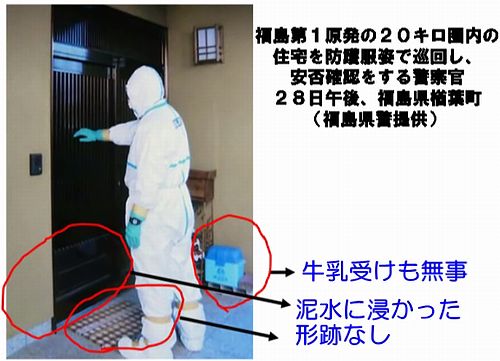
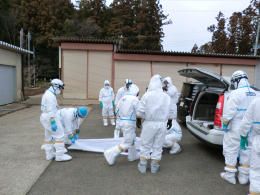
A follow up article was published on May 20 in the Kahoku Shinpo reporting that the above mentioned body was finally collected on April 1 and sent to Minamisoma city where it was diagnosed to have died of illness. No external wound was found on the body. The tsunami is ruled out of cause here completely.
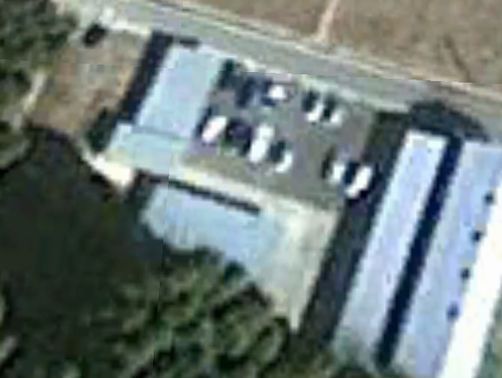
The body found in Okuma
Google Earth as of 2011/3/19
In the original article in Japanese by Kyodo News, it is described that the contamination of the body that was found in Okuma was over the detection limit of the dosimeter, which is 100.000 cpm.
In an official letter discussing what to do with all the contaminated bodies (the title of this blog post comes from this letter) the Nuclear Safety Commission says that the air dose rate of 10 μSv/h at 1 m distance from the body could be considered the equivalent of a surface contamination of 100.000 cpm. It also says that in that case the clothes have to be removed from the body before treating it because such a surface contamination is enough to cause secondary irradiation to the treating person.
If the clothes have been contaminated by a plume then the inside of the lungs must have been contaminated as well.
And this area was indeed hit by such a dense plume. The spot where the body was found was hit by a plume above 10 μSv/h first on March 13, followed by waves far higher than this (up to almost 100μSv/h, nearly 300 times the US army’s evacuation limit) on March 14 and 15. Just imagine breathing the air that was so radioactive that it contaminated the clothes so much as to cause secondary radiation.
unit:nSv/h

In the case of the people in Okuma town it would appear most likely that they died from inhaling the radiation, most probably iodine gas that was released first. But the industry, the regulators and the scientists mysteriously remain quiet about the fatal dose of when one is exposed to radiation internally. Otherwise what can be the explanation for the sudden deaths of several hundred people in a sparsely populated area? When even official sources state they were not earthquake or tsunami victims?
Maybe I am the only one but I cannot help thinking that these people whose bodies ended up being cremated and buried without identification are crying out silently that it is time to clear the real cause of their deaths. May their souls rest in peace.
Nagasaki Peace Declaration 2016

Nuclear weapons are cruel weapons that destroy human beings.
The instant that the single nuclear bomb dropped by a U.S. military aircraft on Nagasaki City at 11:02 AM on August 9, 1945, exploded in the air, it struck the city with a furious blast and heat wave. Nagasaki City was transformed into a hell on earth; a hell of black-charred corpses, people covered in blistering burns, people with their internal organs spilling out, and people cut and studded by the countless fragments of flying glass that had penetrated their bodies.
The radiation released by the bomb pierced people’s bodies, resulting in illnesses and disabilities that still afflict those who narrowly managed to survive the bombing.
Nuclear weapons are cruel weapons that continue to destroy human beings.
In May this year, President Obama became the first sitting U.S. President to visit Hiroshima, a city which was bombed with a nuclear weapon. In doing so, the President showed the rest of the world the importance of seeing, listening and feeling things for oneself.
I appeal to the leaders of states which possess nuclear weapons and other countries, and to the people of the world: please come and visit Nagasaki and Hiroshima. Find out for yourselves what happened to human beings beneath the mushroom cloud. Knowing the facts becomes the starting point for thinking about a future free of nuclear weapons.
This year at the United Nations Office at Geneva, sessions are being held to deliberate a legal framework that will take forward nuclear disarmament negotiations. The creation of a forum for legal discussions is a huge step forward. However, countries in possession of nuclear weapons have not attended these meetings, the results of which will be compiled shortly. Moreover, conflict continues between the nations that are dependent on nuclear deterrence and those that are urging for a start of negotiations to prohibit nuclear weapons. If this situation continues, then the meetings will end without the creation of a roadmap for nuclear weapons abolition.
Leaders of countries possessing nuclear weapons, it is not yet too late. Please attend the meetings and participate in the debate.
I appeal to the United Nations, governments and national assemblies, and the civil society including NGOs. We must not allow the eradication of these forums where we can discuss legal frameworks for the abolition of nuclear weapons. At the United Nations General Assembly this fall, please provide a forum for discussing and negotiating a legal framework aimed at the realization of a world without nuclear weapons. And as members of human society, I ask you all to continue to make every effort to seek out a viable solution.
Countries which possess nuclear weapons are currently carrying out plans to make their nuclear weapons even more sophisticated. If this situation continues, the realization of a world without nuclear weapons will become even more unlikely.
Now is the time for all of you to bring together as much of your collective wisdom as you possibly can, and act so that we do not destroy the future of mankind.
The Government of Japan, while advocating nuclear weapons abolition, still relies on nuclear deterrence. As a method to overcome this contradictory state of affairs, please enshrine the Three Non-Nuclear Principles in law, and create a “Northeast Asia Nuclear Weapons-Free Zone”
(NEA-NWFZ) as a framework for security that does not rely on nuclear deterrence. As the only nation in the world to have suffered a nuclear bombing during wartime, and as a nation that understands only too well the inhumanity of these weapons, I ask the Government of Japan to display leadership in taking concrete action regarding the creation of a nuclear weapons-free zone, a concept that embodies mankind’s wisdom.
The history of nuclear weapons is also the history of distrust.
In the midst of this distrust between nations, countries with nuclear weapons have developed evermore destructive weapons with increasingly distant target ranges. There are still over 15,000 nuclear warheads in existence, and there is the ever-present danger that they may be used in war, by accident, or as an act of terrorism.
One way of stemming this flow and turning the cycle of distrust into a cycle of trust is to continue with persistent efforts to create trust.
In line with the peaceful ethos of the Constitution of Japan, we have endeavored to spread trust throughout the world by contributing to global society through efforts such as humanitarian aid. In order that we never again descend into war, Japan must continue to follow this path as a peaceful nation.
There is also something that each and every one of us can do as members of civil society. This is to mutually understand the differences in each other’s languages, cultures and ways of thinking, and to create trust on a familiar level by taking part in exchange with people regardless of their nationality. The warm reception given to President Obama by the people of Hiroshima is one example of this. The conduct of civil society may appear small on an individual basis, but it is in fact a powerful and irreplaceable tool for building up relationships of trust between nations.
Seventy-one years after the atomic bombings, the average age of the hibakusha, atomic bomb survivors, exceeds 80. The world is steadily edging towards “an era without any hibakusha.” The question we face now is how to hand down to future generations the experiences of war and the atomic bombing that was the result of that war.
You who are the young generation, all the daily things that you take for granted – your mother’s gentle hands, your father’s kind look, chatting with your friends, the smiling face of the person you like – war takes these from you, forever.
Please take the time to listen to war experiences, and the experiences of the hibakusha. Talking about such terrible experiences is not easy. I want you all to realize that the reason these people still talk about what they went through is because they want to protect the people of the future.
Nagasaki has started activities in which the children and grandchildren of the hibakusha are conveying the experiences of their elders. We are also pursuing activities to have the bombed schoolhouse at Shiroyama Elementary School, and other sites, registered as Historic Sites of Japan, so that they can be left for future generations.
Young people, for the sake of the future, will you face up to the past and thereby take a step forward?
It is now over five years since the nuclear reactor accident in Fukushima. As a place that has suffered from radiation exposure, Nagasaki will continue to support Fukushima.
As for the Government of Japan, we strongly demand that wide -ranging improvements are made to the support provided to the hibakusha, who still to this day suffer from the aftereffects of the bombing, and that swift aid is given to all those who experienced the bombing, including the expansion of the area designated as having been affected by the atomic bomb.
We, the citizens of Nagasaki, offer our most heartfelt condolences to those who lost their lives to the atomic bomb. We hereby declare that together with the people of the world, we will continue to use all our strength to achieve a world without nuclear weapons, and to realize everlasting peace.
Tomihisa Taue
Mayor of Nagasaki
August 9, 2016
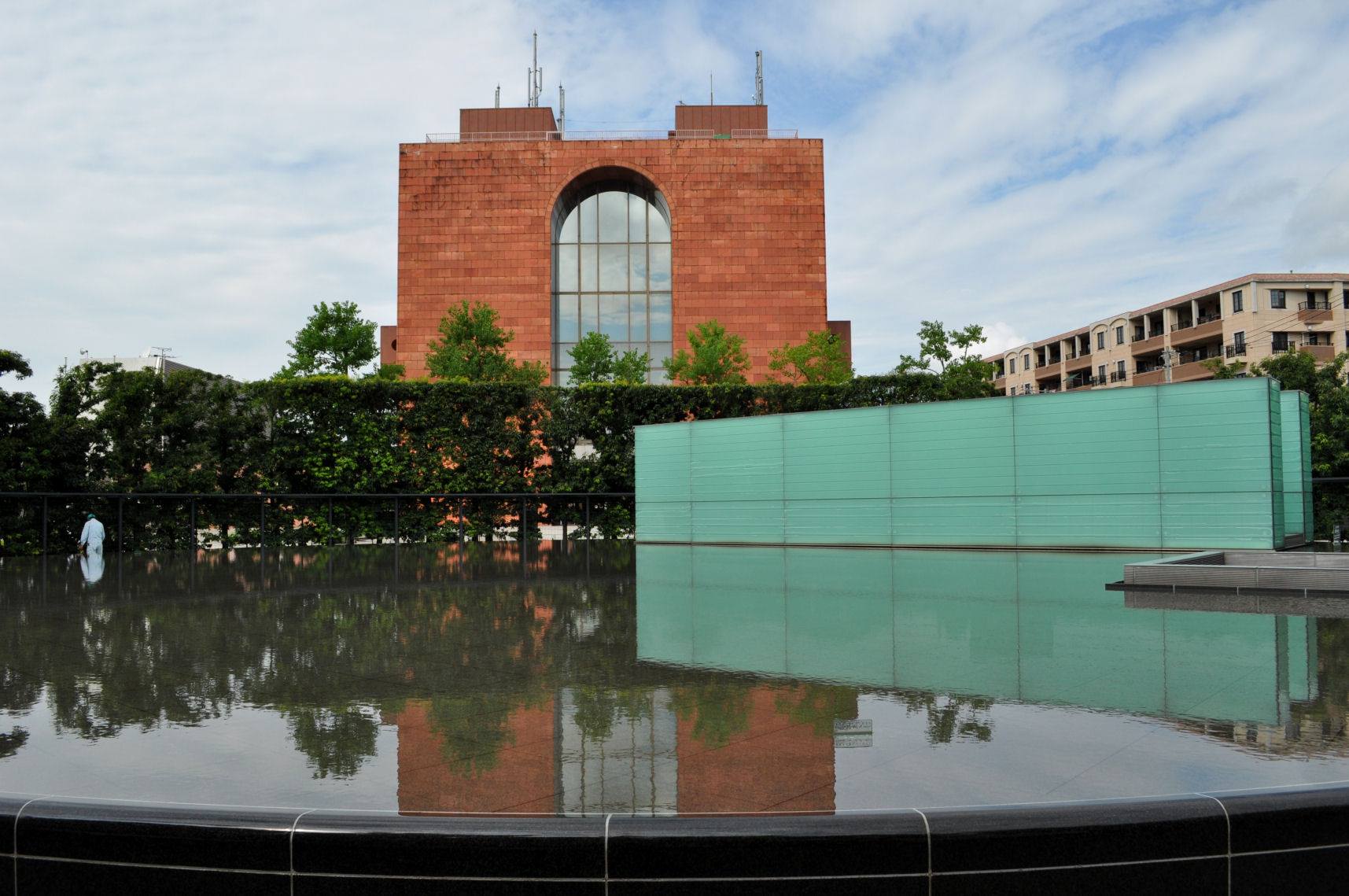
Hiroshima Bombing 71st Anniversary
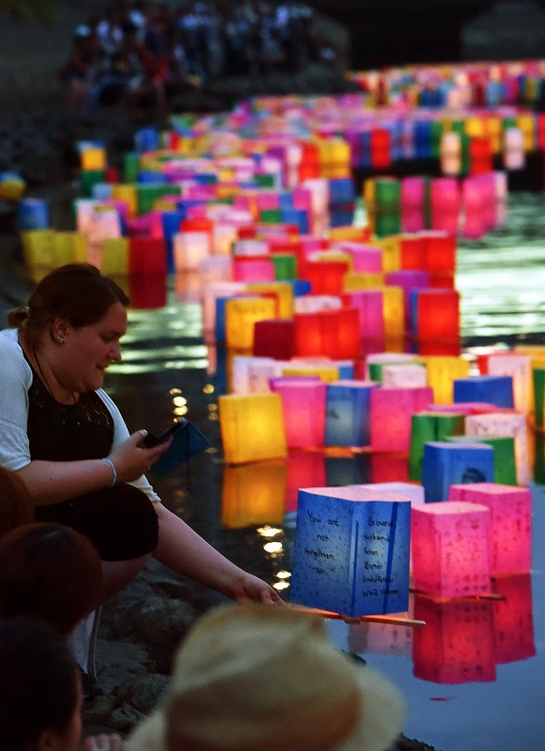
Colorful lanterns float down the Motoyasu River near the Atomic Bomb Dome in Hiroshima’s Naka Ward on the evening of Aug. 6, 2016, in memory of the victims of the U.S. atomic bombing of the city in 1945 and in prayer for peace around the globe. Hiroshima marked the 71st anniversary of the bombing with numerous memorial services across the city. Among attendees at the peace ceremony held at Hiroshima Peace Memorial Park were representatives from 91 countries and the European Union.
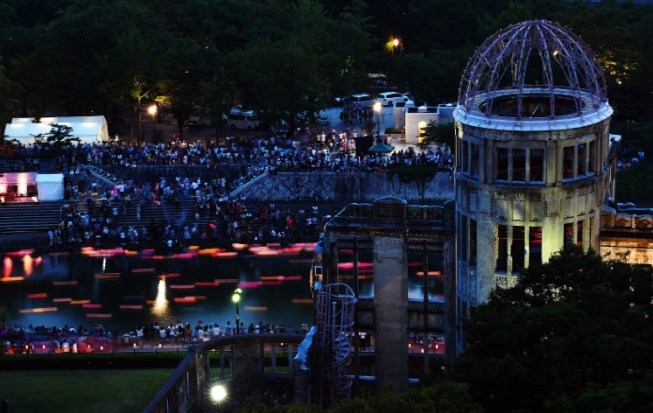
Colorful lanterns float down the Motoyasu River near the Atomic Bomb Dome in Hiroshima’s Naka Ward on the evening of Aug. 6, 2016.
Nagasaki commemorates 71st anniversary of atomic bombing
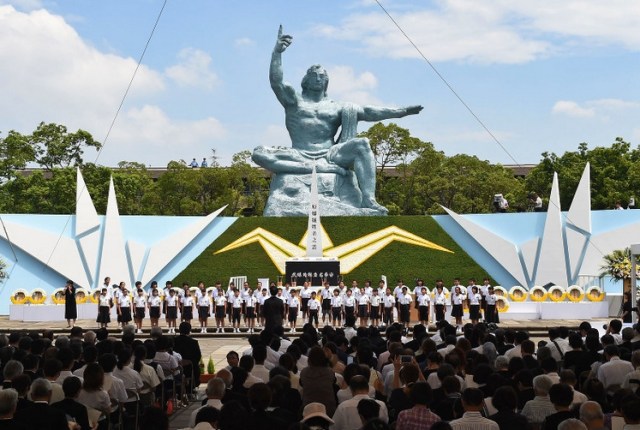
Students of Nagasaki Municipal Yamazato Elementary School sing at Nagasaki Peace Park during a memorial ceremony for the Nagasaki atomic bombing, on Aug. 9, 2016.
NAGASAKI (Kyodo) — Nagasaki began marking Tuesday the 71st anniversary of the U.S. atomic bombing of the city, with Mayor Tomihisa Taue expected later in the day to urge international society to draw upon collective wisdom in order to realize a world without nuclear weapons.
Full text of Nagasaki peace declaration on 71st anniversary of atomic bombing
http://mainichi.jp/articles/20160809/p2g/00m/0dm/054000c
In his Peace Declaration to be delivered at an annual ceremony in the city’s Peace Park, at which representatives of 53 nations and the European Union, as well as the United Nations, will attend, Taue plans to urge the Japanese government to enshrine into law its three non-nuclear principles of not producing, possessing or allowing nuclear weapons on Japanese territory.
He will also urge the government to create a nuclear weapons free zone as a security scheme without relying on nuclear deterrence.
In his speech, Taue plans to touch on the significance of U.S. President Barack Obama’s Hiroshima visit in May and call on the leaders of all countries to visit Nagasaki and Hiroshima to see the reality of atomic bombings.
Three days after the United States dropped the world’s first atomic bomb on Hiroshima, it dropped a second nuclear weapon on Nagasaki on Aug. 9, 1945. An estimated 74,000 people died from the bombing and its aftereffects by the end of the year.
The number of hibakusha — atomic bomb survivors with documents certifying they experienced a nuclear attack in 1945 — at home and abroad stood at 174,080 as of March — of which 32,547 lived in Nagasaki — and their average age was 80.86.
The Nagasaki city government has confirmed the deaths of 3,487 hibakusha over the past year, bringing the death toll to 172,230.
http://mainichi.jp/english/articles/20160809/p2g/00m/0dm/016000c
1 This Month





PLEASE OPPOSE HR 8255 AND S.3639 – bills would accelerate satellite deployment, with no environmental review or safeguards – https://ncstd5li.quorum.us/campaign/169331/
To see nuclear-related stories in greater depth and intensity – go to https://nuclearinformation.wordpress.com
-
Archives
- October 2026 (91)
- September 2026 (339)
- August 2026 (330)
- July 2026 (355)
- June 2026 (287)
- May 2026 (306)
- April 2026 (356)
- March 2026 (251)
- February 2026 (267)
- January 2026 (308)
- December 2025 (358)
- November 2025 (359)
-
Categories
- 1
- 1 NUCLEAR ISSUES
- business and costs
- climate change
- culture and arts
- ENERGY
- environment
- health
- history
- indigenous issues
- Legal
- marketing of nuclear
- media
- opposition to nuclear
- PERSONAL STORIES
- politics
- politics international
- Religion and ethics
- safety
- secrets,lies and civil liberties
- spinbuster
- technology
- Uranium
- wastes
- weapons and war
- Women
- 2 WORLD
- ACTION
- AFRICA
- Atrocities
- AUSTRALIA
- Christina's notes
- Christina's themes
- culture and arts
- Events
- Fuk 2022
- Fuk 2023
- Fukushima 2017
- Fukushima 2018
- fukushima 2019
- Fukushima 2020
- Fukushima 2021
- general
- global warming
- Humour (God we need it)
- Nuclear
- RARE EARTHS
- Reference
- resources – print
- Resources -audiovicual
- Weekly Newsletter
- World
- World Nuclear
- YouTube
-
RSS
Entries RSS
Comments RSS

