The Implications of The Massive Contamination of Japan With Radioactive Cesium by Steven Starr
Everything You Didn’t Want, Or Do Want To Know About The Dangers Of Nuclear Radiation by Steven Starr, Senior Scientist, Physicians for Social Responsibility
Director, University of Missouri, Clinical Laboratory Science Program
At the Helen Caldicott Foundation Fukushima Symposium, New York Academy of Medicine, 11 March 2013
Japan mulls having new utilities help pay Fukushima victims
“Japan is considering having new electricity suppliers shoulder some of the cost of compensating those affected by the 2011 Fukushima Daiichi meltdown — a first since the market was opened up to companies besides the big regional utilities.”
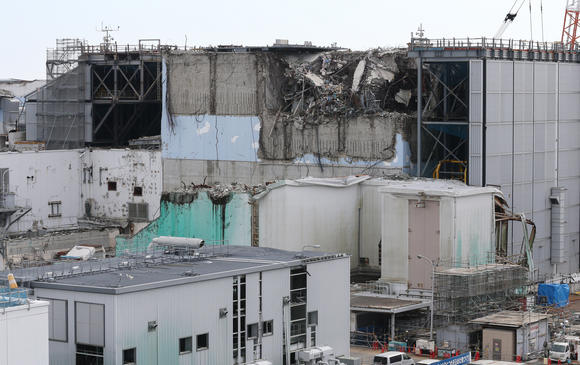
The cost of scrapping Fukushima Daiichi will remain squarely on Tepco’s shoulders.
TOKYO — Japan is considering having new electricity suppliers shoulder some of the cost of compensating those affected by the 2011 Fukushima Daiichi meltdown — a first since the market was opened up to companies besides the big regional utilities.
The expense has been covered by interest-free government loans to Tokyo Electric Power Co. Holdings, which operated the disaster-stricken nuclear plant. This debt is being repaid not only by Tepco, but also other major power companies such as Kansai Electric Power and Chubu Electric Power. Some 6 trillion yen ($57 billion) has already been paid out, more than the 5.4 trillion yen estimated in fiscal 2013, and the total is expected to rise by trillions of yen.
With consumers gradually switching from regional utilities to independent power providers, the Ministry of Economy, Trade and Industry plans to ask these new players to pay a share of the compensation. Details such as how to split the burden between established and new power providers will be worked out going forward. New suppliers’ customers will be asked to contribute as well, on the grounds that they used nuclear power before the market opened up, though this could meet with a backlash from some of the companies affected.
But the cost of scrapping Fukushima Daiichi will remain squarely on Tepco’s shoulders, and the ministry will not approve rate hikes to recoup these expenses. Annual outlays are expected to soar to hundreds of billions of yen, from 80 billion yen now, once Tepco starts extracting melted fuel from the reactors in the 2020s.
The ministry plans to set up a fund to cover decommissioning costs, with the money to come from Tepco’s yearly profits. The utility will be permitted to draw from the fund to cover approved decommissioning plans. Funding gaps will be covered by government loans to be repaid by Tepco.
The company will be exempted for the time being from a requirement to cut electricity transmission charges levied on electricity retailers if profits from power transmission and distribution rise too high. The aim is to avoid placing a further burden on taxpayers while ensuring that decommissioning goes smoothly.
Kagoshima governor accepts restart of reactor at Sendai plant
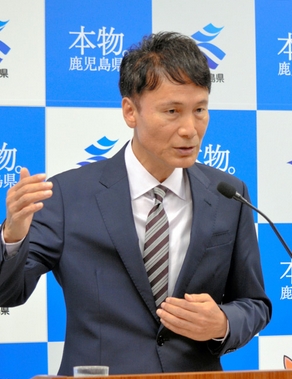
KAGOSHIMA–Despite campaigning on a pledge to immediately suspend operations at the Sendai nuclear plant, Governor Satoshi Mitazono has now accepted the scheduled restart of a reactor there amid mounting pressure from the plant operator.
“I have no (legal) authority over whether (the reactor) can restart or not,” Mitazono said of the No. 1 reactor at the plant at a news conference on Oct. 28. “Kyushu Electric (Power Co.) will bring it back online anyway no matter how I respond.”
After being elected in July, Mitazono twice called on the utility in August and September to immediately shut down the plant in Satsuma-Sendai in the prefecture for additional safety checks.
Each time, the company turned him down.
Mitazono stopped making a similar request to the company, saying he would likely receive the same response.
After the No. 1 reactor went offline early this month for regular maintenance, the media focus has shifted to whether the new governor would accept the reactor’s scheduled restart around Dec. 8.
A governor does not have the legal authority to order a halt to the operation of a nuclear power plant.
Mitazono, a former TV journalist, won the gubernatorial race due, in part, to growing calls from the public for extra safety checks on the plant and the overhaul of the existing evacuation plan, which was compiled by his predecessor.
Concerns about the soundness of the plant mounted among voters since a series of powerful earthquakes struck Kumamoto Prefecture, Kagoshima Prefecture’s northern neighbor, in April.
Many of the roads and other infrastructure were damaged in the temblors in Kumamoto Prefecture, hindering residents from swiftly evacuating.
At that time, the No. 1 and No. 2 reactors at the Sendai plant were the only two units operating in the nation. They were the first two reactors signed off on meeting the new regulations set after the 2011 Fukushima nuclear disaster.
Mitazono’s news conference was the first since he gave one in late July right after he took office.
He had signaled previously that he would decide on the restart of the No. 1 reactor based on the discussion of an expert panel he intended to set up at the prefectural government to examine the safety of the Sendai plant.
But he stopped short of laying out a specific time frame for forming the panel.
“I am hoping to do it as soon as I can,” he said at the news conference.
The governor has yet to submit a budget request needed to assemble the panel to the prefectural assembly.
The prefectural assembly is expected to convene in late November in the next session, meaning that the panel will not be established ahead of the No. 1 reactor’s restart.
Mitazono also said he expects to inspect the Sendai plant alongside other experts on nuclear energy next month.
The inspection is aimed at examining details of “special checks” Kyushu Electric promised to conduct, in addition to the regular maintenance of the No. 1 reactor.
“I am hoping to put together my thoughts about the plant’s safety through discussions with experts,” Mitazono said. “If necessary, I want to take some measures.”
Japan’s vote against nuke ban talks mocks its anti-nuke credo
The first round of negotiations on a nuclear ban treaty is expected to be held in March next year. The United States and other nuclear powers have indicated they will boycott the talks. But Kishida has said Japan will be at the negotiating table.
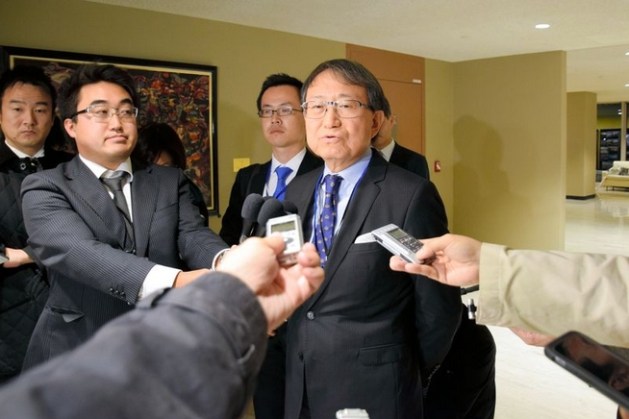
Toshio Sano, Japanese ambassador to the Conference on Disarmament, meet reporters at the United Nations headquarters in New York on Oct. 27 after Japan voted against a resolution calling for negotiations on a treaty that would outlaw nuclear weapons.
The first round of negotiations on a nuclear ban treaty is expected to be held in March next year. The United States and other nuclear powers have indicated they will boycott the talks. But Kishida has said Japan will be at the negotiating table.
Japan’s vote against a United Nations resolution calling for talks on a treaty to ban nuclear arms has made a mockery of its pledge to lead the movement toward a world without nuclear weapons, as the only country that has suffered nuclear attacks.
The U.N. General Assembly First Committee on Disarmament and International Security adopted a resolution to start formal negotiations next year on a treaty to outlaw nuclear weapons. In the vote, 123 nations supported the resolution, with 38 opposed.
The United Nations’ decision to embark on full-fledged discussions on a legal framework to ban nuclear arms represents a historic move.
But Japan, along with nuclear powers the United States, Russia, Britain and France, voted against the measure.
Japan has been cautious about negotiating such a treaty. But its vote against the resolution is tantamount to declaring that it is now taking a position closer to those of the nuclear powers. It is hard to fathom the reason for Japan taking this extremely regrettable action.
No wonder the Japanese government’s action has triggered a barrage of criticism by hibakusha, or the survivors of the 1945 atomic bombings of Hiroshima and Nagasaki, as well as various non-governmental organizations devoted to the cause of world peace both at home and abroad.
It is obvious that the use of nuclear weapons is inhumanity at its worst. But there is no international law that bans nuclear arms.
Austria and other non-nuclear states that have sponsored the resolution have made a convincing case for negotiating a legally binding instrument to prohibit nuclear weapons as a first step toward their elimination.
The United States has expressed especially strong opposition to the move. The principal reason for Washington’s vehement objection is that the proposed treaty would disturb the delicate balance of international security based on nuclear deterrence.
The United States has also called on its allies protected by its “nuclear umbrella,” including Japan and NATO members, to vote against the resolution, claiming that their security, too, would be affected by the envisioned treaty.
As a result, South Korea, Australia and Germany, as well as Japan, were also among the countries that opposed the measure.
The U.N. committee adopted a separate resolution promoted by Japan calling for gradual cuts in the global stockpile of nuclear weapons. The United States supported this resolution.
Explaining Tokyo’s vote, Foreign Minister Fumio Kishida said starting negotiations on a nuclear ban treaty is inconsistent with Japan’s basic approach to nuclear disarmament.
Many Japanese government policymakers believe the protection of the deterrent effect of the U.S. nuclear arsenal is essential for Japan’s own national security at a time when the security environment in East Asia is deteriorating due partly to North Korea’s continued development of nuclear arms and missiles.
But the proponents of a ban treaty are not calling for an immediate end to dependence on the extended U.S. nuclear deterrence. These non-nuclear states are only advocating the beginning of talks on such a treaty.
How to pursue both nuclear arms reductions and national security is a challenge the world should tackle through international negotiations.
The nuclear powers are acting too inflexibly by opposing even the establishment of a conference for such negotiations.
Japan and other U.S. allies that have followed Washington’s lead will face some serious questions about their independence.
The resolution is now set to be adopted in a U.N. General Assembly session by the end of this year. The first round of negotiations on a nuclear ban treaty is expected to be held in March next year.
The United States and other nuclear powers have indicated they will boycott the talks. But Kishida has said Japan will be at the negotiating table.
The rift between nuclear and non-nuclear states is deeper than ever before.
Japan should now try to play an active role in the efforts to narrow the gap between the positions of both camps by persuading the nuclear powers to join the negotiations.
That’s the way for Japan to maintain the credibility of its commitment to the elimination of nuclear arms as the nation that was once devastated by atomic bombs.
Survivors of A-bomb protest Japan opposing nuke ban treaty
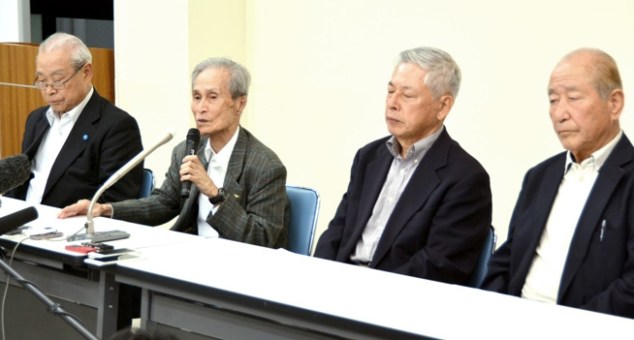
Representatives of groups of atomic bomb survivors protest the Japanese government’s opposition to the U.N. resolution to convene negotiations on a treaty banning nuclear arsenals at a news conference in Nagasaki on Oct. 28.
Atomic bomb survivors lashed out at their government for siding with the United States and opposing the start of talks to outlaw nuclear weapons, despite Japan being the only nation to be victimized by nuclear bombs.
“Japan ended up going along with the United States, which flexes its muscles with nuclear weapons,” said Toshiki Fujimori, an atomic bomb survivor of Hiroshima and a senior official at the Japan Confederation of A- and H-Bomb Sufferers Organizations, known as Hidankyo.
Hidankyo immediately lodged a protest with the government on Oct. 28, sending a letter that said Japan’s opposition to the start of treaty talks “trampled on the wishes of hibakusha.”
The U.N. General Assembly First Committee on Disarmament and International Security adopted a resolution on Oct. 27 to start negotiations in 2017 on a “legally binding instrument to prohibit nuclear weapons, leading toward their total elimination.”
Japan was among 38 countries that voted against it, along with the United States and other nuclear powers.
Fujimori, 72, said Japan’s stance reminded him of the stinging criticism hurled at him when he visited the committee in New York early this month to press for the urgency of such a treaty.
An ambassador of a non-nuclear power nation spearheading anti-nuclear arsenals efforts suggested Japanese should lobby their own government first if they were so keen to see the treaty take shape.
The ambassador was criticizing that Japan, relying on the U.S. nuclear deterrence, was reluctant to support negotiations on the treaty from the outset.
Fujimori also said he disagreed with what a Japanese foreign ministry official said at a symposium on nuclear disarmament in September.
The diplomat described U.S. President Barack Obama’s historic visit to Hiroshima in May as an attempt to bridge the divide between nuclear and non-nuclear powers.
But Fujimori noted that Obama expressed no apology for the 1945 U.S. atomic bombing of Hiroshima and Nagasaki in the address delivered in the Hiroshima Peace Memorial Park. In addition, the president avoided a direct reference to the bombing, saying, “Death fell from the sky and the world was changed.”
And five months later, Japan, together with the United States, voted against the U.N. resolution.
“The Japanese government is supposed to lead global calls for abolishing nuclear weapons, but it only appears to be a spokesman of Washington,” Fujimori said. “It should speak up by siding with hibakusha, not with the United States.”
Sunao Tsuboi, 91, co-chairperson of Hidankyo, also expressed dismay, calling Tokyo’s position “deplorable.”
Tsuboi shook hands with Obama when he visited Hiroshima, the first sitting U.S. president to do so.
But Washington pressured Japan, an ally, and other allied nations, to vote against the U.N. resolution when the step toward a nuclear ban was under discussion.
“It is sad for humans,” Tsuboi said of the opposition by Japan and other countries. “Countries should be united, seeing the issue of nuclear weapons from a humanitarian perspective.”
Toyokazu Ihara, 80, who gave a peace pledge at the annual peace ceremony in Nagasaki on Aug. 9, said he “was appalled” by Japan’s vote against it.
He said he urged Prime Minister Shinzo Abe to “act in a way only Japan can do” when they met after the ceremony.
“I am sorry that our voices were not reflected,” he said. “A global trend toward prohibiting nuclear weapons will not stop. Japan may find itself isolated in the world.”
Nagasaki Mayor Tomihisa Taue said while he welcomed the U.N. resolution as a “landmark step” to pave the way for nations to forge a legally binding path to outlaw nuclear weapons, he “was extremely disappointed” by the Japanese government’s opposition to it.
Hiroshima Mayor Kazumi Matsui echoed a similar sentiment.
Matsui said he sent a letter to Foreign Minister Fumio Kishida, a lawmaker from a constituency in Hiroshima, in which he criticized the government’s position as “extremely regrettable.”
Industry ministry unveils plan to split nuclear power division from TEPCO

The Economy, Trade and Industry Ministry is planning to spin off Tokyo Electric Power Co. (TEPCO) Holdings Inc.’s nuclear power generation division and aim for an alliance between the new subsidiary and another power company.
The ministry unveiled the plan at an Oct. 25 meeting of an expert panel on reform of TEPCO and issues related to the tsunami-hit Fukushima No. 1 nuclear plant. The possibility has emerged that realignment of the major utilities’ nuclear power divisions will be led by the government as the planned reactivation of idled nuclear reactors has stalled.
As part of TEPCO reforms this past April, the company’s thermal power, power retail and power transmission and distribution divisions were transformed into subsidiaries and placed under the umbrella of the newly established TEPCO Holdings.
However, TEPCO Holdings has retained its nuclear power division because the company needs to decommission the crippled Fukushima nuclear complex and pay compensation to victims of the nuclear disaster, which broke out in March 2011.
Under the ministry’s plan, a subsidiary would be set up to take over TEPCO’s nuclear power business, excluding the Fukushima No. 1 plant, with an eye to forming an alliance between the new firm and another major utility.
The costs of decommissioning the crippled power station’s reactors are likely to far surpass the initial estimate. The ministry released a revised projection at the Oct. 25 expert panel meeting stating that the annual decommissioning bill will likely balloon from the current 80 billion yen into the hundreds of billions, due to work to remove melted nuclear fuel from the reactors and other factors.
The panel discussed TEPCO reforms to raise funds to cover the massive expense of dealing with the accident, such as compensation payments and decontamination of areas tainted with radioactive substances emanating from the nuclear disaster, plus decommissioning.
The committee is aiming to increase TEPCO’s profitability by promoting the realignment of the firm’s nuclear power division and other cost-cutting efforts.
TEPCO set up a joint venture, JERA Co., with Chubu Electric Power Co. in April 2015 to gradually integrate their thermal power station fuel procurement and overseas power generation divisions. TEPCO has also formed a business tie-up with SoftBank Group Corp. to bundle electricity and communications device contracts.
The industry ministry furthermore proposed that TEPCO’s power transmission and distribution subsidiary, which is highly profitable thanks to a large number of customers in the Tokyo metropolitan area, strengthen its alliances with other utilities.
The expert committee is poised to work out the details of a plan to spin off TEPCO’s nuclear power division and how the subsidiary should join hands with other companies. The panel will draw up a draft of its proposals possibly by the end of this year, and incorporate the recommendations in TEPCO’s corporate rehabilitation plan to be released next year.
http://mainichi.jp/english/articles/20161026/p2a/00m/0na/004000c
Ionizing radiation May Contribute to Development of Alzheimer’s

University of Southern Denmark
More humans than ever are exposed to higher levels of ionizing radiation from medical equipment, airplanes, etc. A new study suggests that this kind of radiation may be a confounding factor in the neurodegenerative disease Alzheimer´s.
Alzheimer’s disease is the leading cause for dementia in the elderly, and its global prevalence is supposed to increase dramatically in the following decade – up to 80 million patients by 2040.
– It is crucial that we investigate the potential factors behind this disease, says postdoc Stefan J. Kempf, University of Southern Denmark. His research focuses on possible connections between radiation and cognitive impairments.
In a new study, he and an international consortia involving colleagues from Italy, Japan, Germany and Denmark show that low doses of ionising radiation induce molecular changes in the brain that resemble the pathologies of Alzheimer’s.
The study has been published in Oncotarget. Co-authors are from Institute of Radiation Biology/Institute of Pathology, Helmholtz Zentrum München, German Research Center for Environmental Health and Institute for Environmental Sciences in Japan.
Large numbers of people of all age groups are increasingly exposed to ionizing radiation from various sources. Many receive chronic occupational exposure from nuclear technologies or airline travel. The use of medical diagnostics and therapeutic radiology has increased rapidly – for example more than 62 million CT scans per year are currently carried out in USA.
Approximately one third of all diagnostic CT examinations are scans of the head region.
– All these kinds of exposures are low dose and as long as we talk about one or a few exposures in a lifetime I do not see cause for concern. What concerns me is that modern people may be exposed several times in their lifetime and that we don’t know enough about the consequences of accumulated doses, says Stefan J. Kempf.
Recent data suggest that even relatively low radiation doses, similar to those received from a few CT scans, could trigger molecular changes associated with cognitive dysfunction.
In their new study, the researchers have elucidated molecular alterations in the hippocampus of mice. The hippocampus is an important brain region responsible for learning and memory formation and it is known to be negatively affected in Alzheimer´s.
The authors induced changes in the hippocampus by two kinds of chronic low-dose-rate ionizing radiation treatments. The mice were exposed to cumulative doses of 0.3 Gy or 6.0 Gy given at low dose rates of 1 mGy over 24 hours or 20 mGy over 24 hours for 300 days.
– Both dose rates are capable of inducing molecular features that are reminiscent of those found in the Alzheimer’s disease neuropathology, says Stefan J. Kempf.
When a patient gets a head scan, the doses varies between 20 and 100 mGy and lasts for around one minute. When a person flies, he or she gets exposure to ionising radiation coming from space but the rates are by far smaller than a CT scan.
– When you compare these figures you will find that we exposed the mice to a more than 1000 times smaller cumulative dose than what a patient gets from a single CT scan in the same time interval. And even then we could see changes in the synapses within the hippocampus that resemble Alzheimer´s pathology.
According to Stefan J. Kempf, the data indicate that chronic low-dose-rate radiation targets the integration of newborn neurons in existing synaptic wires.
###
Paper: Chronic low-dose-rate ionising radiation affects the hippocampal phosphoproteome in the ApoE?/? Alzheimer mouse model. Forfattere: Stefan Kempf, Dirk Janik, Zarko Barjaktarovic, Ignacia Braga-Tanaka III, Satoshi Tanaka, Frauke Neff, Anna Saran, Martin Røssel Larsen, Soile Tapio. OncoTarget, 20. september 2016.
https://www.eurekalert.org/pub_releases/2016-10/uosd-ctr102716.php
Fukushima museum receives pro-nuclear signs for safekeeping
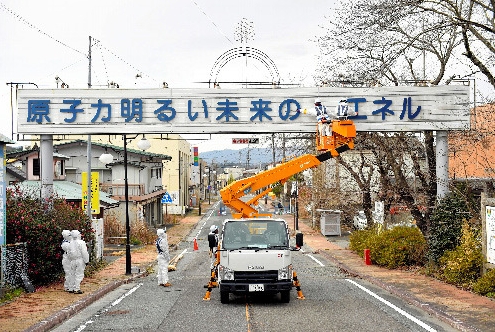
Workers in protective gear remove the banner lauding nuclear energy in Futaba, Fukushima Prefecture, in December.
AIZUWAKAMATSU, Fukushima Prefecture—Pro-nuclear propaganda signs that became the ironic symbol of a town evacuated in the 2011 Fukushima nuclear disaster have been moved to a museum’s storage ahead of their possible public display as a warning from history.
The Fukushima Museum in this city took over care of the signs this month on behalf of the town government of Futaba, which co-hosts the crippled Fukushima No. 1 nuclear power plant.
The most well-known of the banners, which residents campaigned to save, reads: “Genshiryoku–Akarui Mirai no Energy” (Nuclear power is the energy of a bright future).
Yuji Onuma, a 40-year-old former resident of Futaba who now lives in Kogawa, Ibaraki Prefecture, came up with the slogan as a sixth grader at a Futaba school. The town hall adopted it to promote nuclear energy.
Onuma, who fled the town amid the triple meltdown, said the move to the museum is welcome in terms of keeping them in good condition.
“But I am hoping that they will be shown to the public as soon as possible,” he said.
The signboards were removed between December and March along with other panels of slogans promoting nuclear energy in the town. The town government cited the danger of the tall steel structures collapsing because of old age.
They had been kept in a barn wrapped in blankets until the prefectural museum came forward with the offer of storage space early this month.
“The signboards will be kept from deteriorating at the museum where the temperature and humidity can be easily adjusted,” a Futaba official said of the transfer to the museum.
The town hall had initially sought to remove and dispose of the prominent signs, saying they were nearly 25 years old and may fall off at any time.
But after the town announced the decision to do so in March 2015, Onuma and other like-minded people scrambled to start a petition to call for their preservation as historically important items.
“The signs should be stored and exhibited as a ‘negative legacy’,” said Onuma, who recalled that he had once been proud of co-hosting a nuclear power station as he believed it would lead the town to a promising future.
But after the disaster, he decided he was wrong and switched to the solar power generation business in Kogawa.
In the end, the town government agreed to preserve them after they were removed from the original site.
A Futaba official said the signs could be featured at a facility to pass down the records of and lessons learned from the powerful quake, tsunami and the nuclear disaster which the prefectural government is planning to construct.
UN Oks Nuclear Arms Ban Resolution, Japan in Complete Denial of Hiroshima and Nagasaki Bombings Opposed it
Finally, 71 years after the dropping of atomic bombs that destroyed Hiroshima and Nagasaki, the international community is ready to start negotiations on a new treaty banning nuclear weapons. Although this is a historical moment, it was very sad that Japan and the US opposed the UN resolution.
UN committee OKs nuclear arms ban resolution
A UN General Assembly committee has approved a resolution calling for a treaty to ban nuclear weapons.
Japan, the only country that has suffered atomic bombings, was among the countries that opposed it, along with nuclear powers including the United States.
The resolution was adopted on Thursday by a majority vote at the General Assembly’s First Committee on Disarmament.
The resolution submitted by about 50 non-nuclear weapons states calls for starting negotiations on a legally binding treaty in New York in March.
123 countries voted in favor, while 38 voted against. 16 countries abstained.
Among the nuclear powers, the United States and Russia opposed it. China and India abstained.
Japan voted against it. The country has been calling for the abolition of nuclear weapons, while under the US nuclear umbrella. But it said disarmament should be done in stages with the cooperation of nuclear and non-nuclear states.
Austrian disarmament ambassador Franz Josef Kuglitsch called the resolution the fruit of years of huge effort and conscience-building by many countries and civil society. Austria is one of the proponents of the resolution.
If adopted at a General Assembly session in December, treaty negotiations will start in March.
http://www3.nhk.or.jp/nhkworld/en/news/20161028_12/
U.S., Japan oppose and China abstains as U.N. votes to launch talks on nuclear arms ban
UNITED NATIONS – A U.N. General Assembly committee on Thursday voted to launch negotiations on a new treaty banning nuclear weapons despite fierce opposition from the world’s nuclear powers.
A resolution presented by Austria, Ireland, Mexico, Nigeria, South Africa and Brazil was adopted by a vote of 123 to 38, with 16 abstentions, following weeks of lobbying by the nuclear powers for “no” votes.
The nonbinding resolution provides for negotiations to begin in March on the new treaty, citing deep concern over the “catastrophic humanitarian consequences of any use of nuclear weapons.”
Four of the five U.N. Security Council nuclear powers — Britain, France, Russia and the United States — voted against the resolution, while China abstained, as did India and Pakistan.
Japan, which has long campaigned against the use of nuclear weapons, voted against it, as did South Korea, which is facing a nuclear threat from North Korea.
Opponents argued that nuclear disarmament should be addressed within negotiations on the Nuclear Non-Proliferation Treaty.
Beatrice Fihn, executive director of the International Campaign to Abolish Nuclear Weapons, described the vote as a “historic moment” in the decades-long drive for a nuclear-free world.
“This treaty won’t eliminate nuclear weapons overnight. But it will establish a powerful, new international legal standard, stigmatizing nuclear weapons and compelling nations to take urgent action on disarmament.”
The measure is expected to go to the full General Assembly for a vote in late November or early December.
Although Japan voted against the resolution due to pressure exerted by the U.S., Foreign Minister Fumio Kishida said Friday that Japan intends to join U.N. negotiations to outlaw nuclear weapons.
“At present, I hope to proactively join in the negotiations and firmly present our stance,” which stresses cooperation between nuclear and nonnuclear powers, Kishida told reporters, adding that the government as a whole will make the final decision.
Kishida said Japan opposed the draft resolution as it did not match the country’s stance to pursue a world free of nuclear weapons by “concrete and pragmatic measures” amid the growing threat posed by North Korea’s nuclear and missile development and the need for nuclear deterrence.
“The resolution further deepens the rift and encourages opposition” between countries possessing nuclear weapons and those that do not, Kishida said.
Japan also took note of the votes by other key countries in making the decision, Kishida said. All of the countries possessing nuclear weapons, including the United States, opposed the draft resolution, while North Korea voted in favor.
The resolution calls for talks to be held twice next year — the first round from March 27 to 31 and the second from June 15 through July 7 in New York — to negotiate a treaty to prohibit nuclear weapons.
Despite the U.S. and other nuclear powers’ objection to the motion, Robert Zuber, director of Global Action to Prevent War, a nongovernmental organization, is upbeat about its prospects.
“We believe that a ban treaty could help contribute to a robust international framework to which the nuclear weapon states could eventually accede,” he said.
But the decision by Japan, the only country to have ever suffered a nuclear attack, to vote against the draft disappointed some anti-nuclear campaigners.
The government is “still captured by a very old-fashioned idea on security. They still believe nuclear weapons are necessary for their own security. However, it is already clear that it is nuclear weapons that are posing a threat to global security and survival of human kind, as testified by many survivors of Hiroshima and Nagasaki,” said Akira Kawasaki, director of Peace Boat Hibakusha Project.
UN votes to start negotiating treaty to ban nuclear weapons
Australia votes with major nuclear powers against the resolution – including US, Russia and Israel – but 123 nations vote in favour
United Nations member states have voted overwhelmingly to start negotiations on a treaty to ban nuclear weapons, despite strong opposition from nuclear-armed nations and their allies.
In the vote in the UN disarmament and international security committee on Thursday, 123 nations were in favour of the resolution, 38 opposed and 16 abstained.
Nuclear powers the United States, Russia, Israel, France and the United Kingdom were among those that opposed the measure.
Australia, as forecast last week, and as a long-time dependant on the US’s extended nuclear deterrence, also voted no.
The resolution now goes to a full general assembly vote some time in December.
The resolution aims to hold a conference in March 2017 to negotiate a “legally binding instrument to prohibit nuclear weapons, leading towards their total elimination”.
Support for a ban treaty has been growing steadily over months of negotiations, but it has no support from the nine known nuclear states – the US, China, France, Britain, Russia, India, Pakistan, Israel and North Korea – which includes the veto-wielding permanent five members of the security council.
But Australia has been the most outspoken of the non-nuclear states.
During months of negotiations, Australia has lobbied other countries, pressing the case for what it describes as a “building blocks” approach of engaging with nuclear powers to reduce the global stockpile of 15,000 weapons.
Australia has consistently maintained that as long as nuclear weapons exist, it must rely on the protection of the deterrent effect of the US’s nuclear arsenal, the second largest in the world.
When he appeared before Senate estimates last week, the Department of Foreign Affairs and Trade’s assistant secretary, Richard Sadleir, forecast Australia’s rejection of the vote: “Consistent with the position to that we took to the open-ended working group (into nuclear disarmament) report, we will be voting no with respect to that resolution.”
Sadleir said Australia’s position on nuclear disarmament was “consistent and clear”.
“We do not support a ban treaty,” he said. “A ban treaty that does not include the nuclear weapons states, those states which possess nuclear weapons, and is disconnected from the rest of the security environment, would be counterproductive and not lead to reductions in nuclear arsenals.”
Professor Tilman Ruff, founding chair of the International Campaign to Abolish Nuclear Weapons and co-president of the International Physicians for the Prevention of Nuclear War, said the vote was a “historic step” for the world that “heralds an end to two decades of paralysis in multilateral nuclear disarmament”.
“The numbers are especially encouraging given the ferocious pressure on countries to vote no by the nuclear-armed states, who see that this will fundamentally challenge their continued possession of nuclear weapons,” he said.
“The treaty will fill the legal gap by which the most destructive of all weapons – nuclear weapons – are the only weapon of mass destruction to not yet be outlawed by international treaty.”
Ruff said Australia should reverse its opposition “and get on the right side of humanity”.
“Australia is doing dirty work for Washington, and is willing for US nuclear weapons to be used on its behalf, and potentially with its assistance,” he said.
“It is inconceivable that Australia would not eventually sign up to a treaty prohibiting the last to be banned and worst [weapons of mass destruction]. We’ve signed every other treaty banning an unacceptable weapon, and on some, like chemical weapons, we were a leader.”
Ruff said that given there were no nuclear disarmament negotiations under way or planned, a ban treaty was the only feasible path towards ridding the world of nuclear weapons available now.
The efficacy of a ban treaty is a matter of fierce debate.
Without the participation of the states that actually possess nuclear weapons, critics argue it cannot succeed. But proponents say a nuclear weapons ban will create moral suasion – in the vein of the cluster and landmine conventions – for nuclear weapons states to disarm, and establish an international norm prohibiting nuclear weapons’ development, possession and use.
Non-nuclear states have expressed increasing frustration with the current nuclear regime and the sclerotic movement towards disarmament.
With nuclear weapons states modernising and in some cases increasing their arsenals, instead of discarding them, more states are becoming disenchanted with the nuclear non-proliferation treaty and lending their support for an outright ban.
EDITORIAL: Cost estimate needed first to decommission Fukushima plant
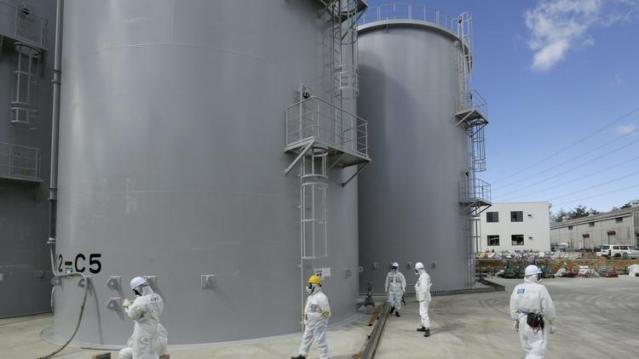
An industry ministry panel of experts is tackling two key questions concerning the decommissioning of the crippled Fukushima No. 1 nuclear power plant.
One is how much money will be needed to decommission the plant’s reactors, three of which melted down. The other is who should foot the bill and how.
However, there are some serious flaws in the way the expert panel is working on these knotty questions, which could lead to a huge financial burden on the public.
First of all, the panel’s meetings are not open to the public. The main points of the discussions are published later, but many details, including who made specific remarks, are omitted.
The fate of Tokyo Electric Power Co., which operates the Fukushima plant and is responsible for its decommissioning, will be largely determined by whether it can restart its Kashiwazaki-Kariwa nuclear power plant in Niigata Prefecture.
Panel members include many business leaders who have been promoting nuclear power generation.
The outcome of the recent Niigata gubernatorial election underscored the strong opposition of local residents against TEPCO’s plan to bring the plant back online.
The panel’s lineup raises concerns that its discussions may be based on the assumption that the Kashiwazaki-Kariwa nuclear plant will eventually be restarted, despite the situation in the prefecture.
Another troubling fact is that the government has yet to announce any estimate of the total decommissioning cost.
In the panel’s first meeting, some members urged the government to swiftly present an estimate of the cost. In the second meeting, however, the Ministry of Economy, Trade and Industry only said that annual spending could grow to several hundreds of billions of yen from about 80 billion yen ($703 million) spent now.
The ministry says a specific estimate of the total cost will be announced as early as the end of the year, along with a plan for management reforms at TEPCO and a package of related measures the government will take.
But this timetable doesn’t make sense. Pinning down the overall decommissioning cost should be the starting point for the panel’s discussions.
With the conditions of the melted nuclear fuel remaining unclear, it is certainly difficult to accurately estimate the cost.
Still, an estimate should first be shown to ensure substantive debate on whether the method used for the work is appropriate and whether there are ways to curb the cost.
As for financing, the panel has supported the proposal that TEPCO should secure the necessary funds on its own through management reform over other options, such as the utility’s liquidation involving debt forgiveness by its creditors, tax financing by the government and a continuation of the current state control of TEPCO.
In an apparent attempt to stress the importance of TEPCO’s own efforts to save itself, the panel has also recommended that the Kashiwazaki-Kariwa nuclear plant should be spun off from TEPCO and integrated with the nuclear power business of another utility.
There is no disputing that TEPCO should push through thorough management reforms to prevent the public from shouldering part of the cost through tax financing or hikes in electricity rates.
The question, however, is whether the embattled utility’s own efforts will be enough to cover the entire decommissioning cost, expected to reach several trillions of yen.
If a plan based on the company’s own efforts fails and disrupts the decommissioning process, the reconstruction of disaster-hit areas in Fukushima Prefecture could be seriously delayed.
It is vital for the panel to win broad public support for its proposals on the national challenge of decommissioning the Fukushima No. 1 nuclear power plant.
This requires careful, exhaustive and reasonable debate, open to the public, on the cost and the financing method.
http://www.asahi.com/ajw/articles/AJ201610270028.html
Men Over 30 Whole-Body Counter Examination increasing at Iwaki city Mothers Radiation Lab
Since 2014 the number of men over 30 years old having whole body counter examination(Radioactivity measurement of the whole body) is increasing at the Tarachine Mothers Radiation Lab in Iwaki city, Fukushima,. Most of them are decontamination workers.
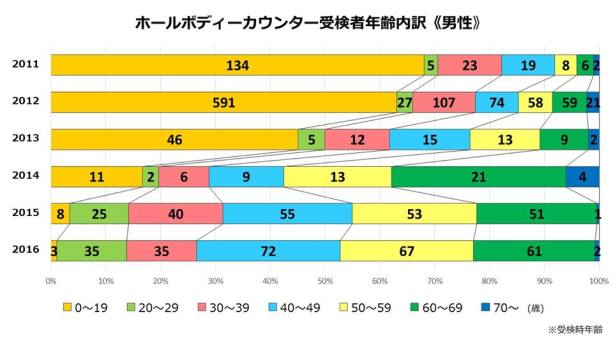
Whole-body counter men examinees breakdown by age.
Japan won’t support U.N. resolution urging nuclear weapons ban

Hiroshima bombing
TOKYO — Japan has decided not to support a draft U.N. resolution urging the start of negotiations in 2017 to outlaw nuclear weapons, a senior Japanese official and other sources close to the matter said.
Japan, the world’s sole victim of atomic bombings, will consider either abstaining or voting against the draft at the General Assembly this week because it would only “further deepen the rift between nuclear and non-nuclear states and meaningful treaty negotiations cannot be expected,” the senior official said.
Although the draft is likely to be adopted by a majority vote, the United States and other states possessing nuclear weapons are expected to boycott the negotiations.
Foreign Minister Fumio Kishida and other senior members of the government of Prime Minister Shinzo Abe are expected to make a final decision soon on Japan’s position, the sources said.
The draft, submitted by Austria and others to the First Committee on disarmament and security issues at the General Assembly on Oct. 13, sets out to establish a mandate on a “legally binding instrument to prohibit nuclear weapons, leading towards their total elimination.”
The United States has been urging Japan to oppose the draft, the sources said. It remains to be seen whether Japan, which comes under the U.S. nuclear umbrella, will decide to join the talks to ban nuclear weapons expected to start in March next year.
The draft resolution had drawn support from nearly 50 countries in Southeast Asia, Africa, Latin America and other regions by the end of last week. The submitting countries have stressed the humanitarian impact of the use of nuclear weapons.
The Japanese Foreign Ministry is unsupportive of the resolution, questioning its effectiveness with nuclear powers reluctant to join the treaty negotiations. The ministry also believes the draft does not take into consideration security aspects such as the impact of the loss of nuclear deterrence, the sources added.
But such a stance by the Japanese government could trigger opposition at home and disappoint states supportive of the resolution.

Hiroshima bombed
The Different Dangerosity of Some Radioactive Elements.

Japanese Flawed steel Components at the Center of French Nuclear Crisis – Major Questions & Implications for Japanese Reactors Safety
25 October 2016, Tokyo – The safety and regulation of the Japanese nuclear fleet is called into serious question by the discovery of Japanese-manufactured flawed steel components installed in operating French nuclear reactors forced to shut down last week by the French nuclear safety regulator ASN, according to a new Greenpeace report. The threat to nuclear reactor safety in Japan is due to the supply of steel components to the nuclear industry from both Japan Casting and Forging Company (JCFC) and the Japan Steel Works (JSW), according to the technical report (http://bit.ly/2eMqJMm) released today by Greenpeace Japan, by the nuclear engineering consultancy, Large&Associates of London. Evidence of astonishingly high levels of excess carbon far outside regulatory limits with the associated loss of steel toughness and significant increase in the risk of catastrophic failure of primary containment components, have been discovered in JCFC-manufactured components installed in steam generators in 12 reactors owned by the French state-utility, EdF. The independent French nuclear agency, IRSN, recently warned that due to the excess carbon content, there was an increased risk of failure of the affected steam generator leading to a potential reactor core meltdown.(1)

These components are so fundamental to reactor safety, and consequences so potentially severe, that in every country with nuclear reactors across the planet, nuclear regulators require that these components must not have any possibility of failure under any operating circumstance over the lifetime of the reactor – so-called “break-preclusion” for the reactor safety case. For this reason the French regulator warned its worldwide counterparts, including the Nuclear Regulation Authority (NRA) in Japan, of the potential enormity of the situation should their nuclear power plants have similarly flawed components installed.
During the period 1994-2006, JCFC supplied flawed components to France, which somehow managed to pass through the quality assurance controls of JCFC, the supplier Areva, and the French regulator to be installed in operating reactors. How the defects were not detected along the supply chain has not yet been disclosed. A commissioner from the NRA is visiting France this week to discuss the crisis.
From 1984-1993, JCFC also supplied steam generator components to the following Japanese reactors: Takahama 3&4, Sendai 2, Tomari 1&2 and Tsuruga 2; JCFC steam generator and reactor pressure vessel components are installed in a total of 14 Japanese reactors (not including two reactors at Fukushima Daiini).
“As a result of substandard manufacturing in Japan, citizens in France have been unknowingly exposed to the risk of catastrophic failure of critical reactor components which could result in a reactor core meltdown. Japanese-supplied steel is now at the center of France’s unprecedented nuclear crisis the scale of which has never been seen in any country. All 12 reactors supplied by JCFC are either in forced shutdown or about to be. It lacks all credibility that the Japanese nuclear industry would claim that there are no implications for the safety of their own nuclear reactors. The steel production records released in France did not reveal the scale of excess carbon, which was only found after physical testing. There are currently no plans for such tests in Japan. That is wholly unacceptable. There are many urgent questions that need to be answered by the industry and the NRA, and with full public disclosure and transparency,” said Shaun Burnie, senior nuclear specialist at Greenpeace Germany.
The French nuclear safety regulator has been investigating components supplied by both JCFC and the Japan Steel Works (JSW). Test results obtained by Greenpeace in June 2016 indicated that there was a possibility of excess carbon problem in JSW-manufactured components in the steam generator boiler pods – there are 3 or 4 steam generators in each pressurized water reactor PWR nuclear power plant, each weighs upwards of 300 to 400 tonnes and, typically, the cost of replacement is around US$130 to 150 million.
Since the French publication of the JCFC and JSW component test results, it has been claimed that JSW components are free of excess carbon. However, no tests results proving this have been disclosed and Large&Associates research raises questions over the credibility of this claim. The non destructive testing that has been conducted in France is incapable of identifying the scale of excess carbon. Large&Associatess recommends destructive testing as the only guaranteed method for proving carbon concentration.
“The fact that French nuclear reactors have been operating with flawed Japanese-supplied critical components is astounding. This is an utter failure of both nuclear regulation and on the part of the Japanese steel suppliers to meet quality control requirements. The implications for Japan may be even greater, as JSW is also implicated in this scandal because it supplies the forged steel parts that make up the reactor pressure vessel, which is the very heart of both PWR and boiling water reactors (BWR) used in Japan. Every reactor in Japan has critical components from these two suppliers and they must all undergo non destructive testing, with the priority being the two reactors currently in operation, Ikata-3 and Sendai 2, which must be immediately shutdown and tested, in addition reactors slated for decommissioning must have their components destructively tested, ” said John Large, head of Large&Associates.
The Japanese utilities are required to submit documentation to the NRA by 31 October 2016 detailing the quality of the steel components supplied by Japanese companies, JCFC, JSW and the other steel supplier, JFE. This is however only a paper exercise and not the result of actual physical testing of components installed in reactors.
Greenpeace has today sent a copy of the Large&Associates report to the NRA. A series of urgent questions will be submitted, via a member of the Japanese Diet, to the NRA in the coming days.
Priority reactors to be assessed and tested in Japan due to their status: operating, possibility of early operation or approval by the NRA for restart are: Ikata 3, Sendai 2, Takahama 2, Takahama 3&4 (under appeal by Kansai Electric); and next in line for approval by NRA – Genkai 3&4 and Kashiwazaki-kariwa 6&7.
Notes:
(1) The Japanese supplied components under investigation in France are designated Class 1, by which they are not permitted under any circumstances to fail during operation due to the potentially severe consequences. Specifically the components are Steam Generator tube support plates, elliptical domes, and bottom channel heads; as well as Reactor Pressure Vessel upper and lower heads, rings and pressurizers. The French governments Institute for Radiological and Nuclear Safety (IRSN) warned in August that there was a risk of reactor fuel melt down if steam generators with excess carbon operated. A maximum carbon limit is set by regulation to prevent a reduction in the toughness of the steel in the steam generators and Reactor Pressure Vessel, reduced toughness can lead to thermal shock induced fast fracture, where the steel shatters like glass. See, IRSN, 2016 2016-00275 Objet: EDF – REP – Paliers CP0, CPY et N4 – Ségrégations en carbone des fonds primaires de générateurs de vapeur – Analyse de sûreté et mesures compensatoires, 5th August 2016.
Download the report
For further information:
Shaun Burnie, senior nuclear specialist, Greenpeace Germany (Tokyo): shaun.burnie@greenpeace.org, +81 (0)80 3694 2843
Kendra Ulrich, senior global nuclear campaigner, Greenpeace Japan: kendra.ulrich@greenpeace.org, +81 (0) 90 6478 5408
Chisato Jono, communications officer, Greenpeace Japan: chisato.jono@greenpeace.org, +81 (0)80-6558-4446
http://www.greenpeace.org/japan/ja/news/press/2016/pr201610251/
Ministry mulls 2020 start for Monju decommissioning after nine-month activation
Just before the 2020 Tokyo Olympics, very nice…. Is the ongoing catastrophe at Fukushima Daiichi, yet not under control, yet unsettled, not enough for them???
“Under the plan, a nine-month trial period will be created from the spring of 2019 during which the reactor will run for four months in a bid to minimize the risk of accidents.”

The science and technology ministry overseeing the trouble-prone Monju fast-breeder reactor is considering starting decommissioning of the facility in 2020, ministry sources said Tuesday.
It is the first time a specific time frame for decommissioning work for the Monju reactor in Fukui Prefecture on the Sea of Japan coast has been revealed in a proposed plan by the Ministry of Education, Culture, Sports, Science and Technology.
The move comes as the government is fundamentally reviewing the Monju project, including the decommissioning of the reactor, which has been plagued with a series of safety problems and has come under fire for being costly.
The plutonium-burning Monju has hardly operated over the past 20 years, due to a spate of problems and incidents, despite its intended key role in Japan’s nuclear fuel recycling policy.
The plan to start scrapping the reactor is on the condition of running the reactor for a short period of time to obtain necessary data for the future development of fast reactors.
Under the plan, a nine-month trial period will be created from the spring of 2019 during which the reactor will run for four months in a bid to minimize the risk of accidents.
Other countries have also shown interest in fast-reactor technology due to its purported use in radioactive waste reduction among other benefits.
But the Nuclear Regulation Authority has been reluctant to allow the reactor’s restart.
During a government panel meeting held Oct. 7, the ministry presented an estimate that if Monju is reactivated, at least ¥540 billion ($5.2 billion) would be necessary over a 16-year period.
One of the sources said the cost of running the reactor for only a short period of time would be ¥200 billion at most. With necessary safety measures in place following the Fukushima nuclear meltdowns in 2011, the ministry believes no additional work is needed to meet regulatory requirements for its brief operation.
The government will continue to discuss the matter through the panel and formally decide by the end of the year.
The Monju reactor dates back to 1980, when the nation began trying to reduce its reliance on fossil fuels. Almost all oil, coal and gas burned in Japan is imported.
Still, the reactor was costly and suffered under mismanagement and repeated accidents, only going live for a few months during its more than three decades of existence.
Monju first reached criticality in 1994 but was forced to shut down in December 1995 after a leak of sodium coolant and a fire. There was a subsequent attempt at a cover-up.
In November 2012, it emerged that the operator, Japan Atomic Energy Agency, had failed to properly check as many as 10,000 of the reactor’s components, as required by the safety rules in place at the time.
In November last year, the Nuclear Regulation Authority declared that the government-affiliated JAEA was “not qualified as an entity to safely operate” the facility.
It told the government either to find an alternative operator or scrap the project. The government was unable to find new management.
1 This Month

To see nuclear-related stories in greater depth and intensity – go to https://nuclearinformation.wordpress.com
-
Archives
- September 2026 (194)
- August 2026 (330)
- July 2026 (355)
- June 2026 (287)
- May 2026 (306)
- April 2026 (356)
- March 2026 (251)
- February 2026 (267)
- January 2026 (308)
- December 2025 (358)
- November 2025 (359)
- October 2025 (375)
-
Categories
- 1
- 1 NUCLEAR ISSUES
- business and costs
- climate change
- culture and arts
- ENERGY
- environment
- health
- history
- indigenous issues
- Legal
- marketing of nuclear
- media
- opposition to nuclear
- PERSONAL STORIES
- politics
- politics international
- Religion and ethics
- safety
- secrets,lies and civil liberties
- spinbuster
- technology
- Uranium
- wastes
- weapons and war
- Women
- 2 WORLD
- ACTION
- AFRICA
- Atrocities
- AUSTRALIA
- Christina's notes
- Christina's themes
- culture and arts
- Events
- Fuk 2022
- Fuk 2023
- Fukushima 2017
- Fukushima 2018
- fukushima 2019
- Fukushima 2020
- Fukushima 2021
- general
- global warming
- Humour (God we need it)
- Nuclear
- RARE EARTHS
- Reference
- resources – print
- Resources -audiovicual
- Weekly Newsletter
- World
- World Nuclear
- YouTube
-
RSS
Entries RSS
Comments RSS
 nuclear-news