The Japanese people are going to have to come to grips with a fundamental question if they wish to exert some control over the country’s future: Why is plutonium still being separated from irradiated nuclear fuel when the future of nuclear power in Japan is far from certain?
Tokyo says nuclear reactors should be restarted but this raises a question of why. This matter was raised by Dr. Gordon Edwards – co-founder Canadian Coalition for Nuclear Responsibility (CCNR) – in a note to Pressenza. It will be recalled by those following the nuclear industry that the recent Tokyo municipal elections brought into office a pro-nuclear candidate, Yoichi Masuzoe, who got 30% of the vote. Ironically, more people voted for the two anti-nuclear candidates than those who voted for the pro-nuclear candidate, yet the pro-nuclear side won!
The newly-elected Governor supports Prime Minister Abe in his determination to restart many of the 54 nuclear reactors in the country, all of them currently shut down due to public anger over the collusion between government and industry in relation to the Fukushima disaster. The nuclear fleet in Japan has been reduced from 54 to 48 by the simple fact that none of the six reactors at Fukushima Dai-ichi will ever operate again.
Gordon Edwards gave a background briefing on those who stand against further development of Japan’s nuclear industry and adds a concluding comment as follows:
At least three Japanese ex-Prime Ministers are completely opposed to continuing Japan’s nuclear energy dependence and instead are speaking out publicly for an immediate nuclear phase-out in Japan.
(1) Naoto Kan was Prime Minister of Japan when the Fukushima disaster struck. As Scientific American has reported:
On March 10, 2011, Prime Minister Naoto Kan felt assured that nuclear power was safe and vital for Japan. By the evening of the next day, following the massive Tohoku earthquake, the ensuing tsunami and the beginnings of the crisis at the Fukushima Daiichi nuclear power plant, he had changed his thinking “180 degrees.”
Mr. Kan has since toured the world with a strong anti-nuclear message, not only for Japan, but for everyone.
The site of the Fukushima nuclear disaster in Japan remains a post-apocalyptic landscape of abandoned towns, frozen in time. Science correspondent Miles O’Brien got a rare tour inside the plant, where three nuclear reactors melted down after the earthquake and tsunami in 2011, to learn more about the long-term solutions for stemming the radioactive contamination.
PBS special on Fukushima starts tonight with rare look inside plant — Correspondent loses arm after filming in Japan — “Amputated after an apparently minor injury”
Published: February 28th, 2014 at 11:31 am ET
By ENENews
PBS NewsHour, Feb. 27, 2014: Three years after a massive earthquake and subsequent tsunami triggered meltdowns at the Fukushima Daiichi Nuclear Power Plant, PBS NewsHour Science Correspondent Miles O’Brien returned to Japan for an update on clean-up efforts and the continuing impact of the radioactive spill. Friday, February 28: Inside Fukushima: Covered head to toe in protective gear and wearing a respiration mask, Miles O’Brien offers NewsHour viewers a rare look inside one of the most dangerous places on earth […]
Media Bistro, Feb. 28, 2014: The first of Miles O’Brien‘s reports from Japan airs tonight on “PBS NewsHour.” O’Brien, the program’s science correspondent, was packing up from the reporting trip on Feb. 12 when one of the equipment cases fell on his left arm. A seemingly innocuous accident resulted two days later in the amputation of his arm, above the elbow.
Washington Post, Feb. 26, 2014: His left arm was amputated after an apparently minor injury quickly worsened — TV journalist Miles O’Brien thought it was no big deal when a heavy crate full of camera gear fell on his left arm nearly two weeks ago. His arm hurt, for sure, but O’Brien decided to shrug it off and continue a reporting trip in Japan and the Philippines […] “PBS NewsHour” spokeswoman Anne Bell said O’Brien had been reporting for the program on the aftermath of the Fukushima nuclear power plant disaster and the typhoon in the Philippines. […] O’Brien is moderating a panel discussion on climate change Thursday […]
Nuclear Energy Institute, Feb. 27, 2014: One reporter we follow very closely is PBS science reporter Miles O’Brien. He’s reported a number of stories on the nuclear industry […] As my colleague John Keeley noted in 2011, “O’Brien is a solid journo with a reputation for resisting the melodramatic and sensational in favor of substantive and balanced pieces.” Needless to say we were shocked and concerned when O’Brien reported on his own website that a freak accident had resulted in doctors having to amputate his left forearm just above the elbow. […]
Miles O’Brien, Feb. 25, 2014: I had finished my last shoot after a long reporting trip to Japan and the Philippines and was stacking the Pelican cases brimming with TV gear onto my cart. As I tried to bungee cord them into some semblance of security for movement, one of the cases toppled onto my left forearm. Ouch! It hurt, but I wasn’t all “911” about it. It was painful and swollen but I figured it would be okay without any medical intervention. Maybe a little bit of denial? The next day, February 13, things seemed status quo. It was sore and swollen but seemingly no worse. Then, that night, things got worse. […] The doctor […] was clear that the problem was progressing rapidly and there was a clear and present threat to my limb. […] And when I lost blood pressure during the surgery due to the complications of compartment syndrome, the doctor made a real-time call and amputated my arm just above the elbow. […]
Nuclear news had been promoting Riseup.net as an encrypted service suitable for activists. However, recent information given to this blogger has thrown doubt on the ability of riseup and other “encrypted” online services to be able to deliver a secure service.
I contacted them via email and have not received a reply after about 2 weeks. The delay in reporting this was because i had to interview my sources at Japanese Against Nuclear UK to confirm the situation and give riseup staff a chance to reply. It might be that riseup never received the email and so i am posting this article to catch their attention and give them a chance to respond.
The scenario
I have been working with many bloggers from Japan and Japanese in the UK to get, what is now, censored information direct from Japanese sources. To try to protect my sources i can not be more specific in some details of internet restrictions, hacking and general harassment but for those that remember tokyobrowntabby (who worked with EXSKF amongst others) had her original youtube channels deleted and videos constantly challenged for copyright even though she was using them for educational purposes only. She retired after such harassment unfortunately but understandably as did the UK based bloggers on YouTube with Japanese contacts.
Other bloggers in the early days of Fukushima were also working with Japanese contacts that were able to do the hard work in translating Japanese to English and vise-versa were also targeted and, stopped blogging because of the stresses involved.
3 years later and just after Japans new secrecy law was posited now the Japanese in the UK are being targeted by persons unknown.
I have been targeted myself on multiple occasions by “unknown” assailants but have carried on regardless (I have been made jobless, homeless and have been attacked using financial strategies) [I have taken out some bits of this article as it doesnt reflect the content of the email correctly. I took the description of the content of the email seriously out of context. Sorry about the delay in correcting the article -Arclight2011]
An email was sent to the subscription list recently. JANUK use riseup.net emails and use the subscribers service offered by riseup.net as well. However, a member that uses riseup.net got the initial email but certain words had been deleted, making the email mostly unreadable.
A second attempt at contacting the members was blocked completely and the sender of the email was further harassed via the internet to make sure some unknown point was driven home.
It was very effective at frightening and discouraging all activists concerned (including me)
I will carry on blogging anyway and am adjusting my life style accordingly to cope with this ever changing situation. My autobiography will be interesting i suspect (not planned yet)!
The main points are that JANUK and other UK based activists are constantly being manipulated and divided (ref George Monbiot splitting the anti nuclear movement in the UK that STRATFOR was VERY concerned about, and the results speak for themselves unfortunately! George helped destroy the movement that STRATFOR and the UK nuclear lobby were previously so concerned about).
Anyone involved in translation and dissemination of Fukushima information is under severe restrictions or suffers punitive actions.
[Nuclear power in Britain is, in effect, finished: on Saturday, the EU revealed that it had prohibited the government’s latest desperate attempt to keep it afloat with massive subsidies. G Monbiot 2002]
I await a response from riseup.net on the hacking issue to support the above anecdotal evidence or to clarify that there was no hacking. I will update this article and post a new one to clarify the situation.
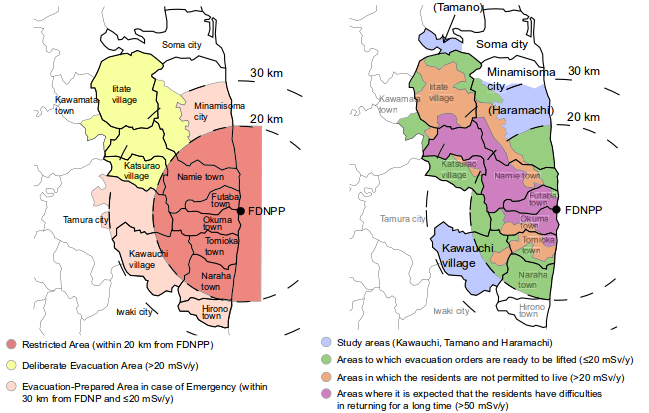
Kouji H. Harada et. al. “Radiation dose rates now and in the future for residents neighboring restricted areas of the Fukushima Daiichi Nuclear Power Plant” PNAS 2014 ; published ahead of print February 24, 2014, doi:10.1073/pnas.1315684111
The external radiation exposure was measured using personal dosimeters, while the internal exposure was determined through examination of what the test subjects ate and the measurement of atmospheric dust.
The researchers found the annual average exposure, excluding average natural doses in Fukushima Prefecture before the March 2011 nuclear accident, was 2.51 millisieverts for Tamano district residents, 1.51 millisieverts for Haramachi district residents and 0.89 millisieverts for residents of Kawauchi village.
The study estimates that residents of the Tamano district, starting from the age of 1 in 2012, will be exposed to 42.8 millisieverts by the time they turn 89, the highest of the three areas.
The study said the radiation exposure in the Tamano district would raise the risk of cancer by 0.71 percentage points for men and 1.06 percentage points for women compared with normal levels.
About 44 percent of men and 32 percent of women develop tumors in their lifetime.
Exposure study: 1-year-old girls face slight hike over lifetime
In Tamano, the rate was 0.82 point higher than average for 10-year-old girls, 0.71 point higher for 1-year-old boys and 0.59 point higher for 20-year-old women.
The lifetime risk of developing cancer has risen slightly among 1-year-old girls in an area affected by the crisis at the Fukushima No. 1 nuclear plant, according to a study published online in a U.S. science journal Monday.
The assessment was based on an August-September 2012 study by Japanese researchers conducted about a year and a half after the March 2011 nuclear disaster started. The study checked the radiation exposure of around 460 residents living near the crippled plant.
Censorship or Content Restrictions: The media expressed a wide variety of views without restriction. Some NGOs continued to criticize press clubs for encouraging similar news coverage by fostering close relationships among media personnel, officials, and politicians.
Libel Laws/National Security: Former Prime Minister Naoto Kan announced in July that he would sue current Prime Minister Shinzo Abe for defamation related to an article written by Abe that called into question Kan’s role in the supervision of the Fukushima nuclear crisis. Former Prime Minister Kan demanded 11 million yen ($112,000) in compensation, and the deletion of the article from Prime Minister Abe’s website.
A plaintiff suing journalist Minoru Tanaka for 67 million yen ($680,000) in damages for defamation and court fees following the publication of an article linking him to questionable activities in the nuclear industry dropped the lawsuit in August prior to cross-examination of the plaintiff.
The government generally provided adequate shelter and other protective services in the aftermath of the March 2011 earthquake, tsunami, and nuclear power plant disaster in Fukushima Prefecture and sought to provide permanent relocation or reconstruction options. The press criticized the National Reconstruction Agency, citing administrative disorganization or slow progress in housing reconstruction and decontamination of radiation-affected areas. On July 30, the National Reconstruction Agency announced that 35 percent of its fiscal 2012 budget slated to rebuild areas affected by the disasters was unused. According to agency statistics as of August 12, out of the approximately 290,000 evacuees, there were 105 persons in evacuation centers while approximately 274,000 continued to live in nonpermanent housing.
The documentary heads to Australia revealing the hidden side of nuclear power: uranium — where it comes from, where it goes to and the dangerous left-overs from the mining process. You can order the DVD including various subtitles and additinal film material on our homepage starting from 12 Euro: http://www.strahlendesklima.de/en/ura…
Strahlendes Klima e.V. is a non-commercial registered organisation.
Wow, How did this get flagged and taken down off of YouTube for “inappropriate content”!? It got flagged yesterday. So did RedButtonStudio’s remix of the same video… but RumorECurioso still had it up safe and sound. I did a little editing from the original, but not much. I don’t know how to find out What “inappropriate content” WAS, nor Who Flagged it, but I have a pretty good idea.
Here’s the original
Fukushima: Top TEPCO Exec Admits Leaks ARE Out of Control update 9/13/13 http://youtu.be/RFuWdY61mRo
Published on Sep 13, 2013
TEPCO official: Leakage ‘not under control’ http://tinyurl.com/ktke9za
TEPCO official says Fukushima plant situation “out of control” […] A [Tepco] senior official […] said Friday that situation in the stricken plant was “out of control,” according to local media. The remark was made by Kazuhiko Yamashita, who holds the executive-level title of fellow, at a meeting with Japanese opposition lawmakers in the city of Koriyama in Fukushima prefecture, said Japan’s Kyodo News. His words came less than a week after Prime Minister Shinzo Abe assured the world at a meeting of the International Olympic Committee (IOC) at Argentina that the situation in the damaged nuclear plant is “under control.” … http://tinyurl.com/mw7wrgg
Euronews, 9/13/13 A senior [Tepco] official…admitted that the situation there is “not under control”. However, within hours Tepco released a statement saying the official, Kazuhiko Yamashita, meant to say something different. His comments came in response to a question at a meeting with the opposition Democratic Party. The politician asked whether the company considered the situation at the plant to be under control. “I’m sorry, but we consider the situation is not under control,” came the reply from Yamashita. In its subsequent statement, Tepco said what the official meant to say was that there were continuous problems with storage tanks, and when radioactive water leaked out it remained in front of the plant….
Tritium rises in groundwater in Fukushima Daiichi
The operator of the Fukushima Daiichi nuclear power plant says that it found sharply rising tritium levels at a monitoring well near a wastewater storage tank.
Tokyo Electric Power Company says the level of radioactive tritium at one of the wells rose to 130,000 becquerels per liter on Thursday. That’s more than twice the government-set level for its release into the sea.
One of the storage tanks leaked more than 300 tons of highly radioactive water in August. The water is likely to have seeped into the soil.
The company has since increased the numbers of monitors to check the radioactive materials in groundwater near the tank.
The tritium level in the well was 64,000 becquerels per liter on Tuesday and rose to 97,000 becquerels on Wednesday. The well is located 20 meters north of the leaking tank.
Meanwhile, the tritium in another well on the southern side of the tank was 290 becquerels per liter. The level is declining slightly.
Officials say the rise was apparently caused by a leak from the tank last month, but they can’t exactly determine how that happened. They are also investigating past leaks from pipes connecting the tanks.
9/13/13
These articles just posted but not in today’s update:
TEPCO lowers radioactive water leakage estimate
Japan seeks methods to stop tainted water leaks
TEPCO under-reported cesium measurements
enenews.com
Fukushima melted fuel “could have burned through floor and now in earth underneath reactors”
Report: Senior official admits Fukushima plant “out of control” — Tepco then claims he “meant to say something different” (VIDEO)
Energy Analyst: Concern a ‘reverse tsunami’ of radioactivity now moving back into Pacific from Fukushima plant — Nuclear catastrophe remains out of control and hemorrhaging
AFP: Fukushima nuclear reactor spews steam, Japanese operator clueless about cause — Time: Scientists have not yet explained why it would start appearing
Hawaii TV: Fukushima plume to reach coast of U.S. next year — “Radiation increase will be measurable” (PHOTO)
Microbiology Professor: “Gov’t needs to ban all fish imports from all regions of Japan” — Nuclear Professor: “No one can block fish migration along with sea currents”
Award-winning Filmmaker on Fukushima: “People have low white blood cell counts… children and adults experiencing more nosebleeds and rashes” -Japan Times
National Geopraphic: Fears are mounting that Fukushima radiation could lead to dangerous contamination levels in seafood from Pacific — At least for now fish are not glowing so ‘eat up’!
Japan Times: Talk of Olympics being taken away from Tokyo if problems at Fukushima worsen over next couple of years
Gundersen: Fukushima Unit 4 fuel racks distorted from quake and roof falling into pool — Nuclear rods likely to snap and won’t be able to be removed (AUDIO)
Song by HumbleHorse called When the Bombs Fall on Soundcloud
Nuclear experts believe that the overall decommissioning of the earthquake and tsunami battered plant in Japan’s northeast is expected to take around 40 years, with the removal of all nuclear fuel from the No. 4 reactor building being completed by the end of this year.
TEPCO has stated, however, that it had only successfully removed around 9 percent of more than 1,500 unused and spent fuel assemblies in the wrecked reactor building’s storage pool.
Japan’s Nuclear Regulation Authority (NRA) blasted Tokyo Electric Power Co. Wednesday for its inappropriate handling of fuel rods at its Kashiwazaki-Kariwa plant in Niigata Prefecture which caused some of the highly volatile rods to be damaged.
The NRA said that workers at the plant had tried forcibly to jam the rods into fuel assemblies when they wouldn’t fit, leaving some 26 fuel assemblies with “abnormalities.”
NRA Chairman Shunichi Tanaka stated that the safety culture at TEPCO has “serious problems,” adding that the fuel handling problems could only be seen from inside the utility.
The nuclear regulator added that some of the rods were actually found to be touching each other in the assemblies and that the NRA was not made aware of the problem until 2012.
Initially the NRA considered the danger to be a Level 1 accident on a scale of 8, but on further investigation downgraded its assessment of the danger from being an “anomaly.”
By comparison the March 2011 tsunami-triggered multiple meltdowns at the accident-prone utility’s Fukushima Daiichi plant were judged to be a Level 7 accident, according to the NRA’s judgments.
The NRA found that workers at the plant had been mishandling the fuel rods and the assemblies at least until 1998, when procedures were changed.
On Tuesday, TEPCO said of its stricken Daiichi nuclear power plant in Fukushima prefecture that cooling operations were stopped at its No. 4 reactor unit’s spent fuel pool, due to workers damaging an electrical cable.
TEPCO said that workers damaged the cable while they were drilling near electrical equipment, causing an alert and the shut down of cooling operations at the No. 4 spent fuel pool, as well as the halting of an ongoing operation to remove hundreds of spent nuclear fuel rods from the pool.
The operator of the plant also said Tuesday a fire was triggered by the damage to the cable, although workers were able to extinguish this, the utility said.
Though the Japanese government on Jan. 15 announced injecting 4 trillion yen (38.3 billion U.S. dollars) in additional state backing to help the ailing utility deal with a string of mishaps at its facilities as it works towards decommissioning its stricken, yet volatile reactors, the problems continue, much to the consternation of Tanaka.
On Feb. 13. samples of water TEPCO tested contained radioactive cesium at records not seen at the Fukushima plant since the 2011 disaster.
Image: Protestors outside County Offices – this issue has been hidden by the media and given no attention by national mainstream environmental groups – why is this when the proposed radioactive and chemical discharges to groundwaters are of a magnitude never before seen.
Today in Kendal without any fanfare or any media fuss Lillyhall Landfill was given the go ahead to dump High Volumes of so called Very Low Level wastes – this will increase with more devious permissions by the Environment Agency to Low Level waste – Intermediate Waste and no doubt ultimately a Radioactive Waste Incinerator without so much as a by your leave to councillors or the public.
Councillors say the decision is “out of their hands” as the Environment Agency has already given Lillyhall a permit to dump “exempt” and High Volume Very Low Level radioactive wastes- not quite true the Council could have and SHOULD HAVE refused an extension to the life of this landfill. The council could engage the services of a more ethical operator who does not take lucrative government contracts to dump radioactive wastes alongside household waste. The option to refuse the extension to the permit was not even discussed.
One thing is for sure – the Environment Agency are supposed to be an autonomous environmental watchdog looking after the public’s health and well being. In practise they look like an increasingly wheedling poodle-like tool of government who will carry on giving ever nastier permits UNLESS the Gate is Locked on the dispersal of nuclear wastes to the environment.
The following is taken from handwritten notes during the meeting – any mistakes are mine.
FIELD NOTES FROM LILLYHALL LANDFILL MEETING 26th Feb
Alan Clark – Chair: This committee is concerned with the extension to the life of the landfill and not concerned with nuclear waste
MEMBERS OF THE PUBLIC
Marianne Birkby on behalf of Radiation Free Lakeland: (Delivery of 153 letters – more delivered separately)
The good news is that Cumbrians have done well at reducing, reusing and recycling their waste, so much so that there is a large spare capacity at Lillyhall landfill. The bad news is that the nuclear industry want to fill that spare capacity with radioactive waste. We understand that councillors feel as though they are powerless and that decisions are taken away from them in this matter as the Environment Agency has already granted a permit to Lillyhall to accept High Volumes of Low Level Radioactive wastes.
The European Union is already calling Lillyhall a Radioactive Waste Repository with planned routine releases of radiation to groundwaters – well that is news to most people in Cumbria. The Council have advised setting a limit on the waste at 200bq a gm – This is not good enough – this is the amount there is an admitted adverse risk to health (EA Kingscliffe evidence). Councillors have a voice and they should use it – they have the wherewithal whether or not to extend the permits for this landfill – or whether to bring in new operators who will guarantee not to dump radioactive waste. Lock the Gate on nuclear waste in landfill
Irene Sanderson – Cumbrian: To bury toxic material in a hole in the ground is a technique with a rather poor record (think of Dounreay) It should not be a first choice or even a choice at all. In particular, the danger presented by any low level radioactive waste remains controversial. Some experts dismiss it as almost negligible others consider it to be significant. Certainly the standards for exposure to radioactivity have become stricter over the last decades, which would seem to indicate that at some time in the future it will become unthinkable to dispose of radioactive materials in this way (Irish Sea). Location of the site 1.6 miles from Distington Community School and Beckstone Primary School and St Mary’s Catholic School is far from ideal -why should this site be chosen.
It seems to me that the answer to this question is a mixture of convenience (site already exists and is closish to Sellafield) and political feasibility (that is, there is more political support of the nuclear industry than in other areas) Neither of these reasons is adequate. More worringly if the hurdle of local opposition can be overcome more toxic material will be on the way “it is proposed to allow an increase in the volume of material to be limited to 200bq a gram until the permit is amended by the Environment Agency…” ” The applicant proposal would include the disposal of wastes up to 400bq/g i.e. that which falls within the lower end of Higher Activity Low Level Waste…” So in summary, wrong disposal technique, wrong site, wrong reasons and a worrying future.
Published: February 27th, 2014 at 8:30 pm ET
By ENENews
KRQE, Feb. 27, 2014 at 7:44p ET: Disturbing new development in the WIPP radiation leak. Surprising words today that 13 workers at the WIPP near Carlsbad tested positive for radiation exposure after the leak almost 2 weeks ago. […] No one knows yet how bad the situation is in that storage area […] DOE said 13 WIPP staff who were working above ground the day of the leak have tested positive for radiation. Officials said it is too early to know what that means for the workers’ health, but that people in contact with them are not at risk. Residents are still concerned. “I don’t think the people really know what’s going on at WIPP,” said Carlsbad resident, Robert Ortiz. […] In a letter to the people of Eddy and Lea counties, DOE said the radiation that got into the air Valentine’s Day was likely at very low levels, no more risky than a chest X-ray. […] The next priority is testing the employees who worked the day after the leak.
KRQE, 7:39p ET: What went wrong and why — those are some of the questions swirling around a radioactive leak at a waste storage facility near Carlsbad that contaminated 13 people.
Eddy County Manager Rick Rudometkin: “Whenever you have a disaster of any kind, there are always issues. You always mitigate the disaster and you move forward.”
The deal was signed by Shaikh Abdullah bin Zayed Al Nahyan, UAE Foreign Minister, and Fumio Kishida, Japan’s Minister of Foreign Affairs.General Shaikh Mohammed bin Zayed Al Nahyan, Crown Prince of Abu Dhabi and Deputy Supreme Commander of the UAE Armed Forces, and Japan’s Prime Minister, Shinzo Abe, on Wednesday witnessed the signing ceremony of a number of agreements and Memoranda of Understanding (MoUs).
The two sides signed the schedules on amending the Air Services Agreement between the UAE and Japan. The deal was signed by Shaikh Abdullah bin Zayed Al Nahyan, UAE Foreign Minister, and Fumio Kishida, Japan’s Minister of Foreign Affairs.
The two foreign ministers also signed a MoU on the development of joint cooperation committee work between the UAE’s Ministry of Development and International Cooperation and Japan’s Ministry of Foreign Affairs.
It aims to boost joint cooperation and understanding over the implementation of international development initiatives and international aid in areas of interest and concern.
The UAE Energy Minister, Suhail bin Mohammed Faraj Faris Al Mazrouei, and Japan’s Minister owf Economy, Trade and Industry, Toshimitsu Motegi, signed a MoU on the peaceful use of nuclear energy in the UAE.
Abdullah Saeed Al Darmeki, CEO of Khalifa Fund for Enterprise Development, and Hiroshi Takada, Chairman and CEO of Small and Medium Enterprise and Regional Innovation in Japan, signed an agreement on extension and amendment of the MoU between them
The document below is 35 years old, but even more relevant today. The plutonium in this document is still in the environment, along with Chernobyl and Fukushima plutonium and other plutonium emitted from the nuclear industry, since that time. Were you ever warned about plutonium in your fish and especially in fish whose bones are eaten, like sardines? We were not! We were warned about mercury in tuna, but not about this!
A reminder:
“Plutonium-239 is an isotope of plutonium. Plutonium-239 is the primary fissile isotope used for the production of nuclear weapons…Plutonium-239 is also one of the three main isotopes demonstrated usable as fuel in nuclear reactors…Plutonium-239 has a half-life of 24,100 years…In any operating nuclear reactor containing U-238, some plutonium-239 will accumulate in the nuclear fuel…A small percentage of plutonium-239 can be deliberately added to fresh nuclear fuel. Such fuel is called MOX (mixed oxide) fuel, as it contains a mixture of uranium oxide (UO2) and plutonium oxide (PuO2)” http://en.wikipedia.org/wiki/Plutonium-239
From a US EPA document “Metal Bioaccumulation in Fishes and Aquatic Invertebrates: A Literature Review,” by Phillips and Russo, December 1978.
The Tomioka government has recently established a hunter group comprising 14 residents with hunting licenses. The town is considering paying 20,000 yen per pig from April this year to catch more unwanted wild animals.
TOMIOKA, Fukushima — An increasing number of wild “iron age pigs” — a cross between wild boars and domestic pigs — has been seen in this town near the crippled Fukushima No. 1 nuclear plant, destroying homes and crops while residents have been evacuated due to the triple disaster.
Following the onset of the Fukushima plant accident in March 2011, some 20 iron age pigs that were being raised for meat in Tomioka escaped. The Ministry of the Environment and the local government set up traps in the area and had captured around 120 iron age pigs by January this year. While it is difficult to distinguish iron age pigs from wild boars, officials believe most of the captured boars are the former, and that they had reproduced in great numbers.
The town’s industry promotion section sub chief Shinya Kurosawa, 46, said, “There are many more iron age pigs left. We have no idea how many.”
When Mainichi reporters went to Tomioka this month, we saw five wild iron age pigs, including piglets, wandering around the town in less than an hour. In December last year, a door to the agricultural cooperative’s storage house was found broken, and 3 tons of rice (worth about 600,000 yen) inside the storehouse had been eaten. An investigation found two-towed tracks all over the place near the site.
The population of wild boars also has been increasing near the Fukushima plant. The town of Namie, where all residents have been ordered to flee following the plant accident, has seen 43 reported cases of damage to homes caused by wild boars from April last year to Feb. 24. In November, Namie residents who were making a brief visit to their home were attacked by wild boars.
Hiroshi Sakai, chief of the nature conservation section of the Fukushima Prefectural Government, explained that wild boars that have been multiplying in deserted evacuation zones have been wandering about in nearby areas.
Meanwhile, reported sightings of raccoons — designated as an invasive alien species — in the prefecture is also on the rise. In the city of Date, 1,100 raccoons were captured between April last year and this January, marking an increase of some 600 from the same period last year.


 )
)



 The two sides signed the schedules on amending the Air Services Agreement between the UAE and Japan. The deal was signed by Shaikh Abdullah bin Zayed Al Nahyan, UAE Foreign Minister, and Fumio Kishida, Japan’s Minister of Foreign Affairs.




 nuclear-news