
To our dear friends and colleagues over at the very pro nuclear World Nuclear news (WNN). A happy new year to you all and the fight continues! 🙂 I still say our headline versions and pictures are better than yours, but thanks for your hard work in getting nuclear information out to the Russians (According to Alexia they are your biggest fans). Your efforts at bridging the cold war gap are noticed and appreciated by us all here at nuclear-news.net. Good job Na Zdorovie!
JAIF president urges reactor restarts to fight climate change LOL
30 December 2016 WNN
Japan needs to work towards bringing its reactors back online if the country is to meet its climate goals, Akio Takahashi, president of the Japan Atomic Industry Forum, said last week. Nuclear energy currently accounts for just 1.1% of Japan’s electricity production and commercial operation has been resumed at only three of the country’s nuclear power plants – Sendai 1, Sendai 2 and Ikata 3.
But are all three actually in operation currently?

From Nuclear Insider:
Dec. 15, 2016—Kyushu Electric Power Co. on Dec. 8 began the process of restarting Sendai 1. The 846-megawatt reactor was initially restarted in August 2015 followed by Sendai 2 in October 2015. Sendai 1 was taken off-line in October for a two-month routine outage. It is the first reactor to undergo a periodic inspection following its restart after meeting new Japanese regulatory standards. Kyushu Electric said it expects the facility to resume commercial operations the first week of January. The company also said it expects to take Sendai 2 off-line for maintenance and refueling on Dec. 16.
Of Japan’s 42 operable reactors, only Shikoku Electric Power Co.’s Ikata 3 and the Sendai reactors are in commercial operation. Takahama 3 and 4 were restarted but have been idled after a court injunction lodged by anti-nuclear activists. Japan’s Institute of Energy Economics said Dec. 13 it estimates seven reactors will be restarted by the end of March 2017 and another 19 by March 2018.
From this it appears that Sendai 1 is supposed to be re-opening sometime this week (and so was presumably not operating on Dec. 30th and Sendai 2 was due to be taken offline on December 16th and may or may not have re-opened.
As for Ikata 3: “Ikata 3 had been idle since being taken offline for a periodic inspection in April 2011. However, Shikoku began the process to restart Ikata 3 on 12 August [2016] and the reactor attained criticality the following day. The 846 MWe pressurized water reactor resumed power generation on 15 August and since then output from the unit has been gradually increased.” So as far as I know it is continuing to operate.
January 3, 2017
Posted by arclight2011part2 |
Uncategorized |
Leave a comment

01/01/2017 | Kennedy Maize
http://www.powermag.com/blog/as-a-u-s-business-nuclear-power-stinks/#.WGtBqz_Cxyo.facebook
Regardless of one’s views of the social values of nuclear power — compelling cases can be made all around — as a business proposition nuclear stinks.
The latest evidence comes from the giant Japanese conglomerate Toshiba, which saw a third of its market value vanish in two days of trading (20% in one day, a free-fall stopped only by a limit to trading losses imposed by the Japanese stock market). Credit rating agencies promptly downgraded the company’s debt.
Toshiba’s stock crash was a result of billions in reported losses from its Westinghouse Electric subsidiary and Westinghouse’s ruinous investment last year in nuclear engineering and construction behemoth CB&I Stone & Webster, itself the product of an ill-fated merger. Toshiba’s nuclear business has been hemorrhaging money at its U.S. construction projects in Georgia and South Carolina. Westinghouse is years behind schedule and billions of dollars over budget at its two construction projects: Southern’s Vogtle and Scana Corp.’s Summer units, a total of four Westinghouse AP1000 reactors under construction. Toshiba faces the possibility that its nuclear troubles will lead the company to a negative net worth.
My colleague Aaron Larson describes the gory business details well. The bottom line is that Westinghouse threatens to bring Toshiba to its financial knees, although the firm is too large to fail entirely. It may well require a Japanese government bailout.
Then there is France’s Areva, which has been bleeding red ink for more than a decade and would have expired but for its French government owners, and a recent bailout. The company is far behind schedule and vastly over budget on construction projects in Finland and France. Late last year, discovery of quality control problems in carbon steel forgings from Areva’s Le Creusot Forge shocked the company. The allegations closed 20 of France’s 58 operating reactors, which also could jeopardize regulatory approval for extended operation at the aging plants.
In late December reports surfaced that Areva employees for decades hid problems in reactor parts it manufactured at Le Creusot Forge. Inspectors from the U.S., France,
China, and the U.K. descended on Areva to examine records and investigate the allegations. “I’m concerned that there keep being more and more problems unveiled,” Kerri Kavanagh, who leads the U.S. Nuclear Regulatory Commission’s unit inspecting Le Creusot, told the Wall Street Journal.
The business case for existing nukes in the U.S. is also ominous. Just last week, an Ohio newspaper reported that Akron-based FirstEnergy will close or sell its long-troubled, 900-MW Davis-Besse nuclear unit this year or next, without counting on a state bailout. “We have made our decision that over the next 12 to 18 months we’re going to exit competitive generation and become a fully regulated company,” CEO Chuck Jones said. “We are not going to wait on those states to decide what they are going to do there.” This comes on top of multiple closings of U.S. nukes unable to compete in competitive markets in recent years, state subsidies in Illinois and New York to keep uneconomic plants open, and threats of even more shutdowns.
At the same time as the Davis-Besse warning, Environmental Progress, a pro-nuclear group, released an analysis that concluded that a quarter to two-thirds of operating U.S. nuclear plants could face premature closure. If it weren’t for actions by state governments in Illinois and New York, the picture would look worse.
The Environmental Progress analysis counts 35 GW of nuclear capacity as at “triple risk” because “they are in deregulated markets, uneconomical (according to Bloomberg New Energy Finance) and up for relicensing before the end of 2030.” Facing greatest jeopardy for early closure? D.C. Cook in Michigan, Seabrook in New Hampshire, Millstone in Connecticut, and Davis-Besse in Ohio.
January 3, 2017
Posted by arclight2011part2 |
Uncategorized |
Leave a comment

Gloria Galloway
OTTAWA — The Globe and Mail
Published Sunday, Jan. 01, 2017
http://www.theglobeandmail.com/news/politics/grassy-narrows-chief-urges-trudeau-to-cleanup-mercury-in-river/article33466149/
The chief of a small Northern Ontario First Nation whose people are being poisoned by mercury from a defunct paper mill is urging Prime Minister Justin Trudeau to engage the federal government in the cleanup of the river that is the source of the community’s fish.
Simon Fobister, the Chief of the Grassy Narrows First Nation, has written twice to Mr. Trudeau – in May and in September – and Mr. Fobister’s predecessor, Roger Fobister, wrote to the Prime Minister in March. All of the letters told Mr. Trudeau: “We invite you to visit our community to announce alongside us that the mercury in our river system, our source of life, will finally be cleaned up.”
The chief says he has received no response to those invitations, though the Prime Minister’s Office acknowledged to The Globe and Mail that it had received them. A spokeswoman for Mr. Trudeau pointed out that a representative of the Indigenous Affairs department visited the community in June along with provincial ministers.
Many First Nations in Canada are coping with the negative environmental consequences of development on or near their territories, but few have endured hardships like those suffered in Grassy Narrows, where 90 per cent of residents are showing signs of mercury poisoning.
The current chief said in his most recent letter that Mr. Trudeau’s silence on the matter of Grassy Narrows is troubling.
“You have made important election promises to repair Canada’s relationship with First Nations and to right many of the wrongs that have been done to First Nations people,” wrote Mr. Fobister. “We consider those promises to be sacred and we are hopeful that you will honour your word.”
Responsibility for the mercury problems straddles provincial and federal jurisdictions and, so far, the province of Ontario has borne much of the blame for the fact that the contamination has persisted in the Wabigoon River for six decades. But David Sone of Earthroots, a conservation advocacy group, says there are at least three reasons for the federal government to get involved.
“There is at least still some [federal] responsibility for fisheries where they are part of a cultural fishery” like the one at Grassy Narrows, said Mr. Sone. “There is a responsibility for the health of First Nations. And there is the broader treaty and fiduciary responsibility for the well-being of First Nations.”
The federal government counters that the zone of contamination does not include federal lands, so its own Contaminated Site Action Plan does not apply and, it says, responsibility for addressing the contamination belongs to Ontario. It also points out that Health Canada has been monitoring the mercury levels in the people of Grassy Narrows for decades.
From 1962 to 1970, mercury from Reed Paper’s chemical plant in Dryden, Ont., upstream from Grassy Narrows, was dumped into the English-Wabigoon River system. A former worker at the paper mill has also confessed to participating in the 1972 burial of salt and liquid mercury in a pit behind the facility.
A report commissioned by the Grassy Narrows First Nation and released earlier this year says remediation of at least some parts of the river is feasible. The first step, the report says, would be to stop any further release of mercury from its source. After that, it says, there are several options for cleaning the water, the best of which would be to add low-mercury solids to the water, allowing them to settle on the bottom and dilute the mercury into the sediment.
Ontario Premier Kathleen Wynne has not acted on those recommendations, saying she is concerned that moving sediment on the bottom of the river could cause further problems.
But John Rudd, one of the world’s foremost experts on mercury remediation and the lead author of the report, says he believes the Ontario government misread what he wrote. “The top-rated options were two very benign approaches that we don’t think would cause any damage at all,” said Dr. Rudd in a telephone interview. “They also happen to be the least expensive.”
Dr. Rudd headed the first federal-provincial studies of Grassy Narrows in the 1980s and says there is much the federal government could do to assist in the river’s cleanup. “We would like to have their input,” he said, “and if their people are busy, we could do with funding, for sure.”
Japanese researchers have been studying the effects of mercury on the human population in Grassy Narrows for four decades and say symptoms of poisoning can be seen even in those who were not yet born when the plant was operational.
In 1985, the federal and provincial governments, along with Reed and Great Lakes Forest Products, which had bought the plant, agreed to pay nearly $17-million to the people of the First Nation to compensate them for their health problems. But the contamination remains.
Mercury concentrations in the walleye in Clay Lake, which is part of the Wabigoon River watershed, are still two to 10 times higher that normal, according to Dr. Rudd and his colleagues.
“Imagine a community anywhere in this country where it was reported that 90 per cent of the population had been exposed to mercury poisoning. There would be officials on the ground immediately and there would be an action plan,” said Charlie Angus, the indigenous-affairs critic for the federal New Democrats.
Instead, said Mr. Angus, “We have a Prime Minister who hasn’t even bothered to return letters to the community. The disinterest of federal officials over this catastrophe is absolutely astounding.”
January 3, 2017
Posted by arclight2011part2 |
Uncategorized |
Leave a comment
January 02, 2017
Jan Hakka Seva Samiti, which has been opposing proposed N-plant, says news reports indicate govt. is going ahead with project
Article source; http://www.thehindu.com/news/cities/mumbai/Jaitapur-to-witness-anti-nuclear-plant-protest-again/article16974634.ece
MUMBAI: Following reports of the Indian government asking French and American nuclear companies interested in building atomic plants in the country to furnish details of functional reactors designed by them, the group opposing a nuclear power plant at Jaitapur has announced a one-day protest on January 25.
French company EDF proposes to build six European Pressurised Reactors (EPR) of 1,600 MW each in Jaitapur. The project was earlier with another French company, Areva, in whose reactor business EDF has now acquired a 51 per cent share.
Senior officials with the Department of Atomic Energy (DAE) were anonymously quoted in several news reports seeking to know how the technology works. The Indian government now wants to see the reference nuclear plant built using similar technology, which is functional.
Interestingly, despite the environmental clearance given to the project six years ago and completion of the land acquisition process, no nuclear plant was set up at Jaitapur as the Nuclear Power Corporation of India Limited (NPCIL) and the French company are yet to sign certain techno-commerical agreements.
“What the government is doing now is ridiculous. If the DAE wants to inspect functional EPR, they should have placed this demand before giving environmental clearance. This only proves how badly the whole project was designed,” said Satyajit Chavan, president, Jan Hakka Seva Samiti, an umbrella organisation for groups fighting the project.
Mr. Chavan said the government’s stand clearly shows that it intends to go ahead with the project. “We have been consistently opposing the project for more than eight years now. Though we have stayed away from politics, this year we will try to create political pressure as the Zilla Parishad and Panchayat Samiti polls are scheduled for February.”
The Samiti will be targeting various organisations and particularly the youth for their participation in the protest. Besides the nuclear power project, the government has also begun surveying land for an oil refinery in the vicinity. “Why do projects which lead to pollution come to Konkan? Power projects, refineries, mines are set to destroy the natural wealth of this area. The January 25 protest will be the beginning of opposition to such projects,” Mr. Chavan said.
Despite claims to the contrary, the French company is yet to set up a functional power plant with EPR. Two nuclear power plants at Flamville in England and Taishan in China are presently under construction, and may be used as a reference project by the Indian government.
January 3, 2017
Posted by arclight2011part2 |
Uncategorized |
Leave a comment
The nuclear reactor industry is pushing hard for global indemnification against financial risk from nuclear accidents and is, in the case of GE-Hitachi, holding back from building 6 new ESBWR reactors (a new, untested design) in India without that indemnification. For its part, India does not want to commit to the project without an operating ESBWR “reference” reactor. Enter DTE (Detroit Edison) and its license to build and operate Fermi 3 a GE-Hitachi ESBWR reactor; the future of which is uncertain and we hope will not be built.
If the nuclear reactor industry does not think its product is safe and recognizes that the financial loss it would incur in an accident is unsustainable, why should we the public, the victims accept the consequent illness, morbidity, genetic mutations, financial loss, and permanent displacement?
The U.S. nuclear power industry would not exist and no commercial nuclear reactors would have been built without the indemnification, of the reactor suppliers and owners, provided by the Price-Anderson Act of 1957, as renewed in 2005. Private money would not provide adequate insurance to reactor suppliers and owners, recognizing the level of risk posed by nuclear reactors, and the catastrophic damage to the public that occurs in nuclear accidents.
The moral hazard of U.S. Government financed indemnification of the commercial nuclear industry against liability for catastrophic public injury and loss is that it results in less safe design and operation of reactors.
The Price-Anderson Act is a singular protection of the nuclear industry; something not available to other industries. It protects the most dangerous commercial activity in the world——nuclear reactor suppliers and operators——and allows them to continue making profit in the midst of permanently poisoning people and the biosphere. It leaves the public unprotected. It is a sinister and unparalleled failure of government—-outside of the awareness of most of the public——to protect its citizens.
DTE (Detroit Edison) has been granted a license to build and operate a new nuclear reactor, Fermi 3, a GE-Hitachi “Economically Simplified Boiling Water Reactor” (ESBWR). However, the issuance of that license by the U.S. Nuclear Regulatory Commission (NRC) is being challenged in the Court of Appeals in Washington, DC by a coalition — including Beyond Nuclear, Citizens for Alternatives to Chemical Contamination, Citizen Environmental Alliance of Southwestern Ontario, Don’t Waste MI, and Sierra Club MI Chapter —that has resisted Fermi 3 since 2008. It has been joined by additional allies, such as the Alliance to Halt Fermi 3, as well as Citizens Resistance at Fermi Two, and others.
Quoting from that document: “Nuclear suppliers have exerted major pressure since the beginning of the industry to be exempt from liability. They want this protection because they fear the enormous costs of a nuclear accident and don’t want to pay for the risks their products create.
At present, they don’t have the level of protection they want, so they are now in a desperate scramble since the Fukushima disaster to fill in any gaps in their protections. They want to prevent anything that might allow the nuclear operator or nuclear victims to seek compensation from them in the event of a nuclear disaster.
The companies that supply reactors and other nuclear equipment, such as GE, Hitachi and Toshiba, clearly care for their company assets first, and have little regard for the victims of accidents that could be caused by their products.
These nuclear supplier companies do not believe their reactors are safe, in sharp contrast to their sales pitches, or else they wouldn’t lobby so hard for national liability indemnification and the protections offered by the CSC….”
The public is left with the need to speak clearly and effectively on its behalf and recognize that its own government is, along with reactor suppliers and operators, a serious threat to public safety and survival.
20318 Edmunton St.
St. Clair Shores, MI 48080
586-779-1782
Posted here by Art Myatt
January 3, 2017
Posted by arclight2011part2 |
Uncategorized |
Leave a comment

Nikita was just 18 months old when his mother took him in her arms and brought him to a clinic in Eastern Ukraine in the hope that the “Irish doctors” would soon return to fix her son’s little heart. Nikita was born with a congenital defect that surgeons call “Chernobyl Heart”.
Little Nikita’s grandfather, Alexander, was just one of the 700,000 volunteers known as the “liquidators” who entered the contamination zone in the days and weeks after the disaster in an effort to contain the radiation pouring from the exploded reactor. Alexander’s daughter was born with a heart defect, and now his grandson was also born with a heart defect known as “Chernobyl Heart”.
Sadly, Nikita and his family have paid the price for his grandfather courage and bravery, which potentially saved the lives of thousands.
Nikita is now recovering from his open heart surgery, and his future is bright and full of hope, thanks to the generosity of the Irish public. To donate to our Cardiac “Flying Doctors” Programme, follow the link below
Donate
January 3, 2017
Posted by arclight2011part2 |
Uncategorized |
Leave a comment

Radiation and contamination episodes, spillages of active materials and fires in the Sellafield facility happen regularly
EXCLUSIVE by KIERAN DINEEN Public Affairs Correspondent
31st December 2016, 9:16 pm
MORE than 450 safety blunders have occurred at the Sellafield nuclear plant — just 170km from Ireland — since 2001.
Radiation and contamination episodes, spillages of active materials and fires in the facility happen regularly, a UK report claims.
The British government insists Sellafield is safe but admitted it was a “uniquely challenging” place to work.
It follows a recent BBC Panoroma documentary which contained allegations of problems from past and present employees. A report from the Office for Nuclear Regulation, seen by the Irish Sun on Sunday, shows issues are routinely documented that are of concern to Ireland — if a disaster similar to Chernobyl or Fukushima occurs.
It cites 12 lifting events which had “nuclear safety implications” and notes that “smouldering, smoking material or fire” was discovered five times up to March 2012. In September 2014, a “lagging blanket on high-pressure steam pipework ignited” at the plant while in July 2013, smoke was seen coming from a gas turbine.
There were 24 cases of “radiation or contamination” events affecting personnel and 33 incidents involving the “unplanned leak or spillage of active or potentially active process liquor or material”, up to March 2012.
Calling for the closure of Sellafield, Sinn Fein MEP Matt Carthy told the Irish Sun on Sunday: “One EU member state is putting the lives and the environment of another at risk. There is no evidence the Irish Government has ever taken this issue seriously, and it is beyond time for them to start.
“It must be closed and there should be a halt to construction of any further nuclear power plants near the Irish Sea.”
Documents, released under the 30-year rule this week, reveal Ireland attempted to use the horror of the 1986 Chernobyl nuclear accident in the former Soviet Union to press for a halt to all Sellafield discharges.
January 3, 2017
Posted by arclight2011part2 |
Uncategorized |
Leave a comment
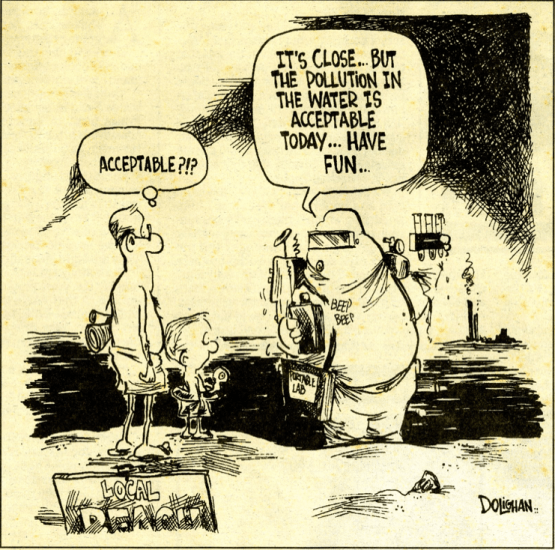
Image source; http://toronto.mediacoop.ca/audio/cnscs-marc-drolet-20mins-radioactive-contamination-peterborough-area/11040
January 1, 2017 8:55 Pm
Article source ; http://www.tri-cityherald.com/news/local/hanford/article124127169.html
Radioactive contamination is spreading within one of Hanford’s huge processing plants, and the problem could escalate as the plant, unused since the 1960s, continues to deteriorate.
A new report on the Reduction-Oxidation Complex, more commonly called REDOX, recommends that $181 million be spent on interim cleanup and maintenance of the plant. REDOX is not scheduled to be demolished until about 2032, or possibly later because the nearby 222-S Laboratory in central Hanford will be needed to support the Hanford vitrification plant for another 30 to 40 years.
REDOX is highly contaminated, after processing eight times more fuel per day than earlier processing plants.
Doing some work on the building soon could reduce the threat of contamination spreading outside the building, including by animals, a break in a utility pipe or a fire, according to the report. Recommended work also would help protect Hanford workers.
REDOX was used from 1952-67 to process about 24,000 tons of irradiated uranium fuel rods to remove plutonium for the nation’s nuclear weapons program and also to recover uranium to reuse in new fuel rods. It is highly contaminated, after processing eight times more fuel per day than earlier processing plants.
The main building is huge, measuring 468 feet long, 161 feet wide and 60 feet tall, with additional underground processing area.
Each annual inspection of some parts of the plant from 2012-15 found an escalation in the spread of radioactive contamination, including by precipitation that has leaked through the roof and joints of the concrete building.
Spread of contamination has been observed throughout the buildings and will intensify as the facilities continue to degrade.
DOE report on REDOX
Salt used to neutralize the contaminated processing system after it was shut down in 1967 appears to have corroded through some of the stainless steel process piping, according to an earlier Defense Nuclear Facilities Safety Board staff report.
Plastic bags were taped on one processing line to catch any drips of residual plutonium nitrate in places where leaks were anticipated. Two of the bags hold significant amounts of plutonium nitrate, which will spread if the bags leak, the DOE report said.
Signs of animal intrusion and deteriorating asbestos have been found in inspections of several areas.
The main part of the plant — a long, high “canyon” — has not been entered since 1997. But “based on current conditions in areas where surveillance inspections are performed, water accumulation, animal intrusion, structure deterioration and contamination spread are expected,” the report said.
REDOX was used from 1952-67 to process about 24,000 tons of irradiated uranium fuel rods to remove plutonium for the nation’s nuclear weapons program and also to recover uranium to reuse in new fuel rods.
The report considered three plans to slow down deterioration and take action to confine contamination and reduce its spread, recommending the most extensive of the three alternatives. The plans range in cost from $148 million to $181 million.
Actions would include tearing down the plant’s radioactively contaminated Nitric Acid and Iodine Recovery Building and the main plant’s attached annexes. Two underground, single-shell tanks used to hold up to 24,000 gallons each of hexone also would be removed, if possible. Hexone was used in the process to extract plutonium from fuel rods.
Elsewhere in the plant, steps would be taken to reduce current hazards, which also could help prepare for the eventual demolition of the plant. Waste could be stabilized by isolating it or covering it with a fixative. Piping out of the plant could be plugged, fluids could be drained from piping and equipment, and some equipment could be removed.
Modifications to the plant’s ventilation system would be needed for some of the work.
The actions also target maintaining a skilled workforce at the Hanford Site that is experienced in contaminated deactivation and decommissioning work, which will be needed when major funding becomes available in the future.
DOE report on REDOX
Doing the proposed work would help retain workers experienced in decommissioning nuclear facilities at Hanford. They will be needed as more federal money becomes available for central Hanford environmental cleanup in the future, the report said.
DOE will consider public comments before a decision is made to proceed with work. Work would be done over the next several years as money is available and as the need for the work at REDOX is balanced against other Hanford cleanup priorities.
Public comment may be sent until Jan. 20 to REDOXEECA2016@rl.gov or to Rich Buel, DOE; Richland Operations Office; P.O. Box 550, A7-75; Richland, WA 99352.
Continue reading →
January 3, 2017
Posted by arclight2011part2 |
Uncategorized |
Leave a comment

As nuclear power plants age, risks rise. The environment, workers and communities are left to pay for America’s failed energy investment.
By Christine Legere clegere@capecodonline.com
Article source; http://www.mpnnow.com/news/20170101/failed-energy
SEABROOK, N.H. – Paul Gunter steps out of his Jeep in a near-empty parking lot off Seabrook’s Ocean Boulevard, unfolds his 6-foot-7-inch frame and tugs the bill of a well-worn cap against the sun. Behind him, anglers hang lines into Hampton Harbor from a nearby pier, and kayakers and swimmers play in the water. They take no notice of the Seabrook Station nuclear power plant, which looms from the other shore.
But Gunter notices, and has noticed for more than 40 years now. It was in 1976, at a picnic table near here, that he and a small band of like-minded citizens formed the Clamshell Alliance, one of the nation’s oldest and most active anti-nuclear groups.
The Seabrook power plant was just in the planning stages back then. But incidents at existing plants had raised alarms: In 1966, a blocked cooling system caused a partial fuel meltdown at the Fermi reactor in Michigan; 10 years later, a fire broke out at the Browns Ferry reactor in Alabama, started by a candle being used to check for fuel leaks.
All this as President Richard Nixon, in 1973, pledged to make the U.S. energy-independent by building 1,000 nuclear power plants – touted by proponents as a source of clean, inexpensive energy – by the year 2000.
Gunter and his associates mobilized. They named their movement for the environmentally sensitive marshes and clam beds that bordered the planned site of the Seabrook plant. They pledged to oppose all nuclear power in New England and, along the way, became a model for the mass nonviolent anti-nuke demonstrations that swept across the country.
The movement was successful. One Seabrook reactor was ultimately completed, but 10 years after its initially projected startup and at a $7 billion cost that bankrupted the public utility group behind the endeavor. A second planned reactor at Seabrook was never built.
Gunter is 67 now. In the U.S., the promise of nuclear power was never realized; barely 10 percent of the projected plants were ever built, and so far none has experienced the kind of catastrophic events seen at Chernobyl in Ukraine or Fukushima in Japan.
So far. For Gunter, those are the operative words. He’s now director of nuclear oversight for Beyond Nuclear, a national group that works to educate the public about the dangers of nuclear power and the benefits of renewable energy sources such as wind and solar. And these days, he tries to get people to understand that the fallout of America’s nuclear plants is much more pervasive than a potential radiation leak.
Rather, that fallout includes long-term damage to the environment and safety risks posed by the tons of radioactive spent fuel left at reactor sites.
“We realized even then that nuclear power was going to be dirty, dangerous and expensive,” Gunter says as he squints toward Seabrook. “These are things we said back then, and the same holds true today.”
What it means for communities
Fifty years after the U.S. launched a bold plan to invest in nuclear power, most of the promises of clean, inexpensive energy have failed to materialize. Plants often cost far more than projected and took years longer to build – driving up rates for consumers. Many plants were never completed, instead becoming a debt utility companies passed on to ratepayers.
In New York state, the Ginna Nuclear Power Plant that has operated since 1970 in the town of Ontario, Wayne County, was recently earmarked for shutdown with much cheaper forms of energy such as natural gas making it hard to compete. Basically, nukes need more money than they now make in the wholesale market.
Then along came the governor’s plan to pump up renewables. Under Gov. Andrew Cuomo’s Clean Energy Standard, 50 percent of New York’s electricity will come from renewable energy sources by 2030. Cash flow for producers of renewables such as wind, solar and nuclear will come from a monthly fee customers see on their electricity bill, not more than $2 for the average household, according to the governor. Barring success of lawsuits over the plan, Ginna’s future looks secure, at least through its current contract to 2029.
For the Rochester region’s more than 300,000 Rochester Gas & Electric customers, whether or not Ginna closes will have no effect on service. The $150 million Ginna Retirement Transmission Alternative Project (GRTA) now underway is upgrading the RG&E system to break free of reliance on Ginna. “When we finish this project, we will have the capacity to disconnect,” said John Carroll, spokesman for RG&E parent company Avangrid.
The project is expected to wrap up by the end of March 2017.
RG&E has been dependent on Ginna “as a critical clog,” Carroll said. GRTA will change that. RG&E will continue tapping into the power generated by the nuclear power facility in Wayne County, along with other sources in the mix such as natural gas, hydro-electric, wind and coal. But if the nuclear plant were to close, RG&E would experience no hiccups, and customers wouldn’t notice. A RG&E surcharge (about $2 a month for an average household) that customers have been paying due to Ginna power will go away over time, Carroll said.
However, all electricity customers statewide can look forward to a monthly charge due to the state’s Clean Energy Standard. The governor has said the charge won’t be more than $2 for an average household.
Reason to fear?
Meanwhile, the direst fears of anti-nuclear activists also have not played out. Although there are rashes of safety incidents, the most serious U.S. incident being the 1979 partial meltdown of a reactor at Three Mile Island, there has never been the kind of catastrophe seen at the Chernobyl plant or, more recently, at the Fukushima reactor.
But skeptics such as Gunter say risks are still with us. As reactors age, they are more prone to accidents caused by worn-out parts. In some cases, operating licenses are being renewed far beyond a plant’s planned shelf life, meaning expensive upgrades and extra-vigilant maintenance – things not always tended to by strapped utilities.
Of even greater concern to the nuclear watchdogs: the vast and growing piles of spent nuclear fuel. There is still no known way to store used fuel long-term that guarantees it won’t leak during the tens of thousands of years some components remain radioactive. The 76,000 metric tons of dangerous nuclear waste that already has been generated now sits on plant sites across the country. To give that number perspective, if existing radioactive fuel assemblies were stacked end to end and side by side, they would stand more than two stories high and cover a football field.
And there is another impact – one that perhaps even the most ardent of anti-nuclear activists did not envision. Across the country, communities expanded and grew dependent on the nuclear plant in their backyards. Now, as many of those plants cut back or are decommissioned, economic vitality is gutted. Jobs and middle-class lifestyles disappear. Housing prices collapse. Tax bases dwindle, undermining everything from school budgets to road repairs.
Out of work
Continue reading →
January 3, 2017
Posted by arclight2011part2 |
Uncategorized |
Leave a comment
BERLIN (Reuters) – RWE will be able to pay the 6.8 billion euros ($7.15 billion) requested by the government to fund the storage of nuclear waste in one lump sum by the middle of 2017, newspaper Die Welt reported, citing the firm’s chief executive.
German utilities RWE, E.ON , EnBW and Vattenfall [VATN.UL] agreed with the government in October to start contributing this year to a 23.6 billion euro fund in exchange for shifting liability for nuclear waste storage to the state, giving investors greater clarity over their future finances.
The companies had been pushing to get favourable terms of payment and the October deal allows them to transfer the funds at one stroke or in several more costly instalments over the next decade.
“We don’t need to draw on the possibility of payment by instalments,” RWE CEO Rolf Martin Schmitz said in an interview with the daily newspaper published on Monday, adding that RWE was “well positioned” after raising billions in a stock listing of a minority holding in energy group Innogy .
But the firm will step up cost-cutting efforts and cut 2,300 jobs in Germany, the Netherlands and Great Britain between 2015 and 2020 to cushion the impact of low wholesale electricity prices, Schmitz said.
(Reporting by Andreas Cremer; Editing by Robin Pomeroy)
January 2, 2017
Posted by arclight2011part2 |
Uncategorized |
3 Comments
January 2, 2017
In major blow to the nuclear programme of Pakistan, the US slapped sanctions on 7 Pakistani entities who were involved in its missile programme.
http://postcard.news/major-blow-pakistan-nuclear-program-us-slaps-sanctions-7-pak-entities-acting-national-security/
An official notification of the US Department of Commerce said that the 7 entities have been added to the Export Administration Regulations (EAR). The reason cited for the sanctions is that the US government has determined that these entities were acting in contradiction to the foreign policy & national security interests of the US.
They have been identified as – Ahad International, Air Weapons Complex, Engineering Solutions Pvt Ltd, Maritime Technology Complex National Engineering & Scientific Commission, New Auto Engineering, & Universal Tooling Services.
The US has determined this on the basis of specific facts that these governmental, parastatal, & private entities in Pakistan have been involved in activities that are contrary to the foreign policy interests of the United States.
What the sanctions mean?
- A licence requirement for all items subject to the EAR
- A licence renew policy of presumption of denial
- The licence requirements apply to any transaction in which items are exporter, re-exported, or transferred to any of the entities or in which such entities act as purchasers, intermediate consignee, ultimate consignee, or end-user
- Also, no licence exceptions are available for exports, re-exports, or transfers to the persons being added to the entity list
As usual Pakistan denies that any of these entities are involved in any wrongdoings. It is a down-in-the-dumps economy surviving on Chinese money & support, yet it has the world’s fastest growing nuclear program,& wants the world to believe it needs nuclear weapons. In 2016, Pakistan received around $700-800 million in FDI, whereas India received around $45 billion – this shows the trust that the world has in Pakistan’s economy, & where its headed for.
Even so, Pakistan isn’t ready to see the writing on the wall. It has severe power & water crisis, unemployment is rising rapidly, terror is eating it up from the inside…all this is happening yet all that Pakistan cares about is how it can create missiles to deter India from engaging in a conflict.
Although, the relevance & impact of these sanctions will be known with time, the mere act of imposing sanctions by Pakistan’s ‘historical friend’ is significant in itself. It could very well be seen as a drastic shift of the US toward India, & with Donald Trump soon to govern the nation, numerous such pro-India moves might be seen.
January 2, 2017
Posted by arclight2011part2 |
Uncategorized |
1 Comment

The United Nations non biased official rapporteur for peace in the world was surprised!
PYONGYANG – Top leader of the Democratic People’s Republic of Korea (DPRK) Kim Jong Un said Sunday in a televised New Year address that the DPRK would continue to strengthen national defense including nuclear capabilities as long as nuclear threat from the United States exists.
“Unless the United States and its vassal forces stop nuclear threat and blackmail and unless they stop the war exercises which they stage right at our noses under the pretext of annual exercises, the DPRK would keep increasing the military capabilities for self-defense and preemptive striking capacity with nuclear force as a pivot,” he said.
Kim emphasized the need to foil challenges posed by anti-reunification forces at home and abroad who are against the national desire for reunification.
Kim also called for taking active measures to improve north-south relations and defuse military conflict and the danger of a war between the two Koreans, appealing to the whole nation that a wide avenue should be paved toward independent reunification through joint efforts.
“All the Koreans in the north and the south and abroad should solidarize and get united on the principle of subordinating everything to national reunification, the cause common to the nation and activate the reunification movement on a nationwide scale,” Kim added.
On economic growth, he stressed that in 2017, efforts should be concentrated on implementing the five-year strategy for national economic development with a focus on self-reliance to elevate the country’s economy to a higher level.
Electricity, metal and chemical industrial fields should take the lead, he said.
Kim also reviewed the achievements made in the year 2016, calling it “a year of revolutionary and auspicious event and great turn.” He added that the DPRK has emerged as “a nuclear and military power in the East.”
Kim Jong Un vows to strengthen nuclear capabilities in New Year address
January 2, 2017
Posted by arclight2011part2 |
Uncategorized |
Leave a comment

The conflicts between Washington and Moscow keep on growing: Ukraine and Syria, rival war games, “hybrid” wars and “cyber-wars.” Talk of a new Cold War doesn’t do justice to the stakes.
Summing Up Russia’s Real Nuclear Fears
“My bottom line is that the likelihood of a nuclear catastrophe today is greater than it was during the Cold War,” declares former U.S. Secretary of Defense William Perry.
If a new Trump administration wants to peacefully reset relations with Russia, there’s no better way to start than by canceling the deployment of costly new ballistic missile defense systems in Eastern Europe. One such system went live in Romania this May; another is slated to go live in Poland in 2018. Few U.S. actions have riled President Putin as much as this threat to erode Russia’s nuclear deterrent.
Only last month, at a meeting in Sochi with Russian military leaders, to discuss advanced new weapons technology, Putin vowed, “We will continue to do all we need to ensure the strategic balance of forces. We view any attempts to change or dismantle it, as extremely dangerous. Our task is to effectively neutralize any military threats to Russia’s security, including those posed by the newly-deployed strategic missile defense systems.”
Putin accused unnamed countries — obviously led by the United States — of “nullifying” international agreements on missile defense “in an effort to gain unilateral advantages.”
Moscow has reacted to this perceived threat with more than mere words. It is developing new and deadlier nuclear missiles, including the SS-30, to counter U.S. defenses. It has rebuffed new arms control negotiations. And it has provocatively stationed nuclear-capable Iskander missiles in the Russian enclave of Kaliningrad to “target . . . the facilities that . . . start posing a threat to us,” as Putin put it last month.
If a new arms race is underway, it’s not for lack of warning. The Russians have voiced their concerns about missile defenses for years and years, without any serious acknowledgment from Washington. From their vantage point, the apparent bad faith of successive U.S. administrations, Democratic as well as Republican, is a flashing red light to which they had to respond.
Russia’s Nightmare
From the earliest days of President Reagan’s Strategic Defense (“Star Wars”) Initiative to make ballistic missiles “impotent and obsolete,” an alarmed Moscow has viewed U.S. efforts to build a missile shield as a long-term threat to their nuclear deterrent.
In 2002, President Bush one-upped Reagan and unilaterally canceled the Anti-Ballistic Missile Treaty of 1972. He did so after Russia’s foreign minister, Igor Ivanov publicly pleaded with Washington not to terminate this landmark arms control agreement.
Writing in Foreign Affairs magazine, Ivanov warned that such a move would set back recent progress in Russian-U.S. relations and destroy “30 years of efforts by the world community” to reduce the danger of nuclear war. Russia would be forced, against its desire for international cooperation, to build up its own forces in response. The arms race would be back in full force — leaving the United States less secure, not more.
But with Russia still reeling from the neoliberal “shock therapy” that it suffered through during the 1990s, the neoconservatives (then in charge of U.S foreign policy) were confident of winning such an arms race. In 2002, President Bush adopted a National Security Strategy that explicitly called for U.S military superiority over every other power. To that end, he called on the Pentagon to develop a ground-based missile defense system within two years.
Since then, that program has lined the pockets of major U.S. military contractors without achieving any notable successes. Critics – including the U.S. General Accountability Office, National Academy of Sciences and Union of Concerned Scientists – have blasted the program for failing more than half of its operational tests. Today, after the expenditure of more than $40 billion, it enjoys bipartisan support mainly as a jobs program.
Russia fears, however, that it’s only a matter of time before the U.S. perfects its missile shield technology enough to erode the deterrent capabilities of Moscow’s nuclear arsenal.
Source links and More of the story on this link;
Summing Up Russia’s Real Nuclear Fears
January 2, 2017
Posted by arclight2011part2 |
Uncategorized |
1 Comment
SEOUL, Jan. 2 (Yonhap) — North Korea’s submarine-launched ballistic missile could strike the entirety of South Korea when armed with a 1-ton nuclear warhead, foreign missile experts said recently.
The claim was made in a report, titled the “North Korean Ballistic Missile Program,” released in the December edition of the Korea Observer published by the Institute of Korean Studies (IKS).
Theodore A. Postol, an emeritus professor at MIT, and Markus Schiller, an aerospace engineer at Munich-based ST Analytics, said there are many uncertainties in our current knowledge of the KN-11 system, but there is enough known to provide at least a lower bound estimate of its capabilities.
The KN-11 SLBM is capable of carrying a 1.5-ton warhead nearly 450 kilometers or a 1-ton warhead to 600 km or more. It could have a range of 800 km with a 1-ton warhead though more details are necessary to finalize the maximum range of the long-range missile, the IKS report said.
“This means that when the KN-11 is eventually deployed on diesel-electric submarines, it will almost certainly have the payload and range to carry a heavy first-generation nuclear warhead designed for ballistic missile delivery from large areas of ocean,” it said.
Missile defenses like the Terminal High Altitude Area Defense (THAAD) that are designed to intercept incoming missiles from a relatively well-defined direction will not be able to readily engage such an “all azimuth” SLBM, the experts said.
North Korea successfully conducted an SLBM test in August, sending the missile some 500 kilometers over the East Sea, the greatest distance the communist nation has achieved since it began SLBM tests last year. Two other tests were conducted in April and July that ended in failure.
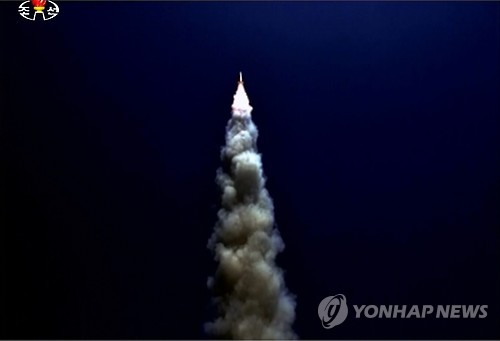
This Yonhap News TV image shows an SLBM fired from a North Korea submarine on Aug. 25, 2016. (For Use Only in the Republic of Korea. No Redistribution) (Yonhap)(ie NOT FOR VIEWING BY THE WEST by orders of the Pentagon in case it scuppers their nuclear wet dreams_ Arclight)
In a separate paper titled “North Korea’s Stockpiles of Fissile Material,” Siegfried S. Hecker, a senior fellow at the Center of International Security and Cooperation at Stanford University, said the North is rapidly increasing the size and sophistication of its nuclear arsenal after conducting five nuclear tests in the past decade.
“Increased sophistication, particularly the ability to miniaturize nuclear devices, requires more nuclear tests. The size of the arsenal is limited primarily by the stockpile of fissile material — plutonium and highly enriched uranium (HEC),” Hecker said.
Pyongyang currently holds 20-40 kilograms of weapons-grade plutonium, sufficient for the manufacture of four to eight plutonium bombs. It is expected to have an additional 6 kg of plutonium each year, he said.
http://english.yonhapnews.co.kr/news/2017/01/02/0200000000AEN20170102002851315.html
January 2, 2017
Posted by arclight2011part2 |
Uncategorized |
1 Comment
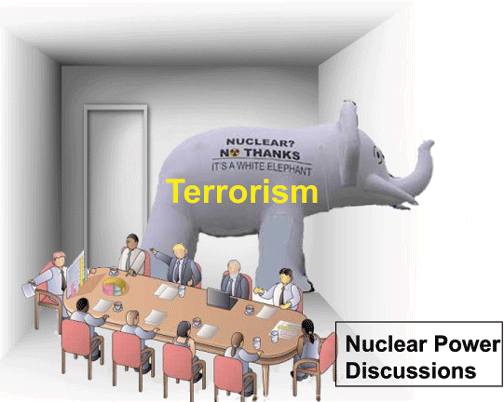
ISLAMABAD/NEW DELHI: India and Pakistan exchanged a list of their nuclear installations on Sunday, a measure which is a part of the treaty signed between the two countries since 26 years.
January 02, 2017
https://www.thenews.com.pk/latest/176217-India-Pakistan-exchange-list-of-nuclear-installations
As part of the Agreement on the Prohibition of Attack against Nuclear Installations between India and Pakistan, the two nuclear-armed neighbours exchanged a list of each other’s nuclear installations on Sunday. The exchange was done through proper diplomatic channels in New Delhi and Islamabad.
“India and Pakistan today exchanged, through diplomatic channels simultaneously at New Delhi and Islamabad, the list of nuclear installations and facilities covered under the Agreement on the Prohibition of Attack against Nuclear Installations between India and Pakistan,” read an official statement from the Indian External Affairs Ministry.
Sunday marked the 26th such exchange of list between India and Pakistan, who have both honoured the agreement since it was signed on December 31, 1988 and came into force on January 27, 1991. The first exchange of list took place in January 01, 1992. The treaty binds both nations to inform each other of their nuclear installations and facilities that will be covered under the agreement on January 1 of each calendar year.
Relations between both nuclear armed neighbours are tense since Indian security forces committed atrocities in occupied Kashmir after the killing of freedom fighter Burhan Wani. After Wani’s killing, thousands of protesters in held Kashmir took to the streets and protested against the Indian government, who resorted to opening fire and killing more than 80 unarmed protesters. Thousands were injured by the Indian security forces’ use of pellet guns.
Relations further suffered between the two states when 19 Indian soldiers were killed in the Uri attack. India blamed the incident on Pakistan, which Pakistan vehemently denied. Since the past couple of months, both countries have exchanged fire across the Line of Control and had to suffer casualties.
THE REASON?
ISIS and nuclear Armageddon? – Exclusive to nuclear-news.net
December 24, 2016
“…Following the article (Link ref 1 below) I picked up from India and posted to nuclear-news.net, I shared it to Fukushima 311 Watchdogs (F311W) . As an Admin on F311 W I later checked the statistics and found a small number of posts not getting any hits. Its as though they were being blocked. I had discovered in 2013 that this was possible and did a video (Link ref 2 below) showing that evidence.
I then did a video (Link ref 3 below) showing the issue of the blocked posts on the Uranium story and also showed that the Uranium story was being ignored by all the western Main Stream Media and that Google was blocking the nuclear-news.net story About 5 hours after posting the video the Google block to the nuclear-news.net story became unblocked.
I then checked out the stats on the video (Screenshot ref 4 below) and saw that some parties in the United Arab Emirates, Saudi Arabia and Pakistan were interested in that post. Also i noted that Pakistan came up on the stats earlier but with no observable clicks (maybe Pakistan Secret Service computer whizz kids were trying to cover their tracks?). It looks like ISIS are seeking and succeeding in their efforts to acquire nuclear materials
So, what did I conclude with on all this? Firstly a non story about Donald Trump was beginning to go “viral” and in this Post Truth world I wondered why? The USA and Russia had already said they would be renewing and expanding their nuclear weapons arsenal and also with “safer” mini nukes earlier on in the year.
The fact that many outlets in India were posting articles on the story led me to think that the western Trump Tweet story was being manufactured to hide the Indian story that was going viral there….”
ISIS and nuclear Armageddon? – Exclusive to nuclear-news.net
January 2, 2017
Posted by arclight2011part2 |
Uncategorized |
1 Comment








 nuclear-news