Dave Sweeney 13 February 2017
— ‘A uranium sales deal between the country that fuelled Fukushima and the one that gave the world Chernobyl doesn’t sound like a good idea.’
~ Dave Sweeney
EARLIER this week, without much fanfare, the Federal Parliamentary Treaties Committee recommended the conditional ratification of the nuclear co-operation agreement with Ukraine — a plan initiated by Tony Abbott and advanced by Julie Bishop.
At first glance, a uranium sales deal between the country that fuelled Fukushima and the one that gave the world Chernobyl doesn’t sound like a good idea.
And all the subsequent glances confirm that it’s not.
There are serious and unresolved nuclear security, safety and governance concerns with the plan — putting more unstable nuclear material into a deeply politically unstable part of the world, that is experiencing active armed conflict, is force-feeding risk.
In a recent ABC report, the Ukrainian ambassador to Australia, Dr Mykola Kulinich, observed that the renewed violence in Ukraine could be a “precursor to something much worse”.
The assumptions about safety and safeguards underpinning the proposed sales plan have not been tested, while the Department of Foreign Affairs and Trade’s (DFAT) National Interest Analysis (NIA) was deeply deficient.
In relation to key safeguards and security concerns and the implications of the Russian conflict, the NIA noted that:
‘ … political tensions currently exist between Ukraine and Russia’.
This banal assessment completely fails to recognise or reflect the gravity of the situation.
Unlike DFAT, Dr Kulinich was clear:
‘There is a war in the middle of Europe right now…’
The ABC report concludes with an assessment of the current conflict that should be required reading for Australia’s atomic decision makers:
‘It is small, it is relatively contained. But it could spread by accident or design. And even far away Australia may not be immune to what could come next.’
In addition to the present conflict, historical experience would also suggest a cautionary approach.
Three decades ago, the Chernobyl nuclear disaster spread fallout over large swathes of eastern and western Europe and five million people still live in contaminated areas in Belarus, Ukraine and Russia.
Serious containment and waste management issues remain at Chernobyl with a massive new concrete shield the latest attempt to enclose the stricken reactor complex and reduce the chances of further radioactive releases.
Against this backdrop, there are deep concerns over those parts of the Ukrainian nuclear sector that are not yet infamous names — including very real security concerns about nuclear facilities being targeted in the current conflict with Russia.
The Zaporizhia nuclear facility is Europe’s largest and is only 200 kilometres from the conflict zone in eastern Ukraine. Some commentators have described nuclear plants in the region as pre-deployed nuclear targets and there have already been armed incursions during the recent conflict period.
This threat is more than a theoretical possibility. In September 2016, a report in The Times documented concerns about high level Russian plans to destabilise the Zaporizhia administrative region.
Earlier acts of apparent sabotage have already seen the dangerous practise of emergency power unloading at nuclear power plants in Ukraine — including the Zaporozhskaya and South Ukrainian reactors.
Australia has already suspended uranium sales to Russia and it makes scant political or security sense to now start selling uranium to Ukraine. Along with security concerns, there are serious and unresolved safety and governance issues with the proposed sales plan.
The Treaties Committee’s report found:
‘Australian nuclear material should never be placed in a situation where there is a risk that regulatory control of the material will be lost.’
Yet this could happen under the inadequate checks and balances that apply to exported Australian uranium.
The report clearly states the Australian Government must undertake a detailed and proper risk assessment and develop an effective contingency plan for the removal of “at risk” Australian nuclear material. There can be no justification for seeking to fast-track uranium sales based on this report.
Ukraine has 15 nuclear reactors — four are currently running beyond their design lifetime, while a further six will reach this in 2020. Two-thirds of Ukraine’s nuclear reactors will then be past their use-by date.
When quizzed on this by the Parliamentary Committee, a senior DFAT bureaucrat attempted to reassure committee members by saying:
“Yes, they [Ukrainian authorities] are seeking to upgrade them [Ukrainian nuclear reactors] to 21st century standard.”
Oh, that’s okay then.
The current deeply contested series of license renewals, and the related European Bank for Reconstruction and Development (EBRD) financing of a programme to upgrade safety features at Ukrainian nuclear facilities, has highlighted serious deficiencies in governance, operations and compliance with contemporary international standards.
On top of that, there is growing regional concern about the risks associated with the Poroshenko Administration’s focus on keeping the reactors running.
In rushing to extend operating licences, Ukraine is cutting process and safety corners and not complying with its obligations under the Espoo Convention — an international framework agreement around transboundary environmental impact assessment. In April 2013, the UN Espoo monitoring group found that licence renewals at the Rivne nuclear facility were not compliant with Espoo procedures.
In 2013, the Eastern Partnership, a leading East European civil society forum, declared the absence of environmental impact assessment for nuclear projects posed:
‘ … a severe threat to people both in Ukraine and in neighbouring states, including EU member states.’
Nearby nations, including the governments or Slovakia, Romania and Hungary, have formally and unsuccessfully called for Ukraine to provide further detail on its nuclear projects and to facilitate increased regional dialogue on this unresolved issue of concern.
These concerns have been amplified after a series of recent shutdowns, fires and safety concerns at Ukrainian nuclear facilities.
The Ukrainian Government’s response to continuing domestic and international disquiet over the operations of its nuclear sector was a 2015 decree preventing the national nuclear energy regulator from carrying out facility inspections on its own initiative.
This, coupled with increased pressure on industry whistleblowers and critics, has done nothing to address the real risks facing the nation’s ageing nuclear fleet.
None of these issues have been meaningfully identified, let alone addressed, in the treaty action or analysis to date.
Any plan to supply Australian uranium to such a fraught region deserves the highest level of scrutiny. Instead, we have tick-a-box paperwork, cut-and-paste assurances and a profound retreat from responsibility.
Dave Sweeney is the nuclear free campaigner with the Australian Conservation Foundation. You can follow him on Twitter @nukedavesweeney.
Link to more tweet source and video; https://independentaustralia.net/politics/politics-display/australiaukraine-nuclear-deal-because-fukushima-turned-out-so-well,10021
February 15, 2017
Posted by arclight2011part2 |
Uncategorized |
Leave a comment
As usual, we are warned after the fact.
And of course, the IRSN will carefully avoid telling us who is responsible for this pollution.
Iodine-131, a radionuclide of artificial origin, was detected in January 2017 as traces in air at ground level in Europe. The first report refers to a detection carried out during the second week of January in the extreme north of Norway. Other detections of iodine-131 have been observed since in Finland, Poland, Czech Republic, Germany, France and Spain until the end of January.
Iodine-131 is a radionuclide with a short radioactive period (8.04 days). The detection of this short-lived radionuclide shows a relatively recent release.
Report in French;
http://www.irsn.fr/FR/Actualites_presse/Actualites/Pages/20170213_Detection-iode-radioactif-en-Europe-durant-le-mois-de-janvier-2017.aspx#.WKQDlWebz7B
February 15, 2017
Posted by arclight2011part2 |
Uncategorized |
2 Comments
Doug Parr / Greenpeace Energydesk
14th February 2017
http://www.theecologist.org/blogs_and_comments/commentators/2988642/keep_uk_taxpayers_off_the_hook_for_moorside_nuclear_black_hole.html
The main company due to build UK’s ‘flagship’ nuclear power project at Moorside in Cumbria is on the ropes, writes Doug Parr, thanks to its multi-billion dollar nuclear losses on in the US. The obvious solution, (almost) all our politicians insist, is to ignore cheaper, faster, cleaner renewables, and make the taxpayer pick up the cost of yet another nuclear white elephant.
There simply is no case for a special case for nuclear. It can’t survive the market disciplines that other forms of generation have to achieve, there are better alternatives now available, and there’s no reason to subsidise it.
It would appear that the UK government’s nuclear power policy is taking another hit.
Toshiba’s financial state is so bad – as a result of the disastrous losses in its nuclear business in North America – that it was expected to announce today a $6.3 billion writedown.
In the event it decided to keep quiet for now, giving rise to speculation that the truth is even worse. After a disastrous few months for Toshiba’s investors, the company began the day with a further 9% fall, and the resignation of its chairman.
Toshiba was also expected announce today that it’s pulling out of the NuGen project, taking 60% of the funding for the three reactors planned for Moorside in Cumbria with it. That didn’t happen either – but it still looks very much on the cards.
Its official position is that it “remains committed” to the project. By way of clarification, Toshiba president Satoshi Tsunakawa told reporters in Tokyo his firm was still involved “with the condition that we don’t take responsibility over construction work”. Or, presumably, financing.
By way of further clarification, a the company indicated that it was looking to sell its stake, but not yet. A spokesman also explained to the BBC that Toshiba had never actually committed to building the plant in the first place.
What it will take: billions, or rather tens of billions, of our money
Right on cue, stories have appeared in the press saying that government is thinking about or even “under pressure“ to inject huge amounts of taxpayers cash into the project in order to get it built.
The same issue is emerging over at the proposed nuclear project at Wylfa on Anglesey. One of these reports notes that “proposals for public investment [are] being pushed primarily by industry rather than ministers.” Well, of course.
Now let’s get this straight: If the UK government takes stake in these projects, it would be expensive. A 25% share in both NuGen and Anglesey could cost over £7 billion – and that’s before taking into account the cost overruns synonymous with nuclear projects.
This would still leave over £20bn other investment to find, but is a substantial commitment of public money. So it is worth spending a few moments to consider why direct government funding of these nuclear stations is such an eccentric and ill-conceived idea.
First, why do these projects need public funding? The obvious answer is that private investors think they are too risky and too poor a return, even at the high price of £92.50 (2012 prices) that EDF got for their Hinkley Point plant.
So why are they risky? Well, one of key reasons Toshiba is in such deep financial trouble is that its reactor design, the AP1000, has never been completed and operated, and is actually more costly and difficult to build that it thought. Its four AP1000 reactors now under construction in the US are ruinously late and over-budget.
Which is very likely why the other private investor in the Moorside consortium, Engie, is also reportedly trying to pull out.
Meanwhile the Japanese company Hitachi are planning to build the proposed plant in Anglesey. In their favour four actual ABWR reactors have been built, in Japan. The downside? Their reliability has been poor.
The 2011 accident at Fukushima closed down all Japanese reactors, but according to IAEA the load factor – the proportion of time the reactors were generating power – for those ABWRs in the period between 2007-11 had been below 50%.
Neither proposed plant is crying out as a good bet for a private investor. So why would it be a better investment for a government? Or for British taxpayers?
‘Special nuclear’
It might be considered that government involvement would lower the interest rate and reduce the cost. Indeed it would. But if one sets aside the consideration that other detrimental things are being done to reduce government financial liabilities, what’s so special about nuclear?
Solar, offshore wind, tidal power and heat networks would help with decarbonisation, are all capital intensive, and would have costs reduced for billpayers if government got involved. They would also likely value this kind of support.
So the only reason for this marked departure from normal economics is because the UK government considers that nuclear has a “crucial role“ in decarbonisation of the power sector.
Because their own (unpublished and therefore unverifiable by informed external experts) “analysis tells us that decarbonisation of the power sector can be achieved most cheaply, securely and reliably if nuclear remains a core part of the UK’s energy system.”
This is an increasingly contentious statement.
Alternatives – quicker, cheaper, cleaner
Other cheaper forms of low carbon power have had their funding stopped because “as costs continue to fall it becomes easier for parts of the renewables industry to survive without subsidies. We’re taking action to protect consumers”.
This taking action to protect consumers does not extend to nuclear power, where the real costs have not come down in 50 years, and despite the hype there appears to be no prospect of them doing so.
Government has also failed to pursue other, cheaper forms of decarb like energy efficiency. And even other forms of low carbon power are undercutting nuclear, with offshore wind set to be cheaper than nuclear long before the first nuclear power station is built.
Intermittency can be dealt with to a significant degree solved by combination of interconnection (see below), demand response and storage, the latter of which are coming down sharply in price.
Bloomberg now talk about “base cost renewables“ as being the most sensible basis for low cost power in the future, and the argument that we need the kind of ‘baseload’ power that nuclear provides has been dismissed by former head of National Grid as outdated.
Brexit: we lose again
Interconnection is very valuable to UK consumers, and although hard to estimate the actual household savings, it is probably tens of pounds per year.
It lowers bills because the UK is currently part of the single EU market in electricity, something it appears UK government may be keen to retain as part of Brexit negotiations. But if we’re part of a single market we’ll need to stick to the market rules, and direct state funding of new nuclear power stations is not obviously compatible with that.
So the proposal to directly fund expensive nuclear, in addition to the direct costs, would sacrifice membership of the single market which saves hard-working families at least tens of pounds per year.
There simply is no case for a special case for nuclear.
If it can’t survive the market disciplines that other forms of generation have to achieve, there are better alternatives now available, and there’s no reason to subsidise it.
Dr Doug Parr is Policy Director of Greenpeace UK.
This article is an updated version of one originally published on Greenpeace Energydesk.
February 15, 2017
Posted by arclight2011part2 |
Uncategorized |
Leave a comment

http://nuclearhotseat.com/2017/02/15/nuclear-hotseat-295-code-red-x-100-danger-reports-the-nuke-industry-hides-journalist-karl-grossman/
Podcast: Download
This Week’s Featured Interview:
- Award-winning journalist Karl Grossman shares insights on the Indian Point Closure agreement, the hidden manipulation tactics of the Institute of Nuclear Power Operators, and gives us examples of how activists have successfully scuttled nuclear industry plans.
Karl Grossman’s Links:
Suggested Groups:
Numnutz of the Week (for Nuclear Boneheadedness):
One picture is worth a thousand words… but a selfie with the nuclear football? Pictured: Trump cronie Richard DeAgazio (r in top photo) and the hapless aide-de-camp charged with carrying the nuclear launch codes (l in top photo – face obscured for security reasons). Lower picture shows hapless aide-de-camp carrying briefcase with the President’s nuclear launch codes into Trump’s Mar-A-Lago resort. Guess which one of those two guys undoubtedly lost his elevated position in the world? (HINT: It probably wasn’t the guy on the right.)

European Report with Shaun McGee:
The Missing Link:
February 15, 2017
Posted by arclight2011part2 |
Uncategorized |
1 Comment
Published time: 14 Feb, 2017 18:22
More than 5,000 rounds of depleted uranium (DU) ammunition were used in two attacks on Islamic State oil tankers in eastern Syria, the US military has confirmed. The US-led coalition previously pledged it would not use the controversial ordnance.
A spokesman for the US Central Command (CENTCOM) told Foreign Policy that 5,265 armor-piercing DU rounds were used in November 2015, during two air raids against Islamic State (IS, formerly ISIS/ISIL) oil tanker convoys in the Deir ez-Zor and Hasakah provinces in eastern Syria.
A-10 ground attack aircraft fired the projectiles from their 30mm rotating cannons, destroying about 350 tanker trucks, according to CENTCOM spokesman Major Josh Jacques.
In March 2015, spokesman for the US-led coalition John Moore had explicitly ruled out the use of the controversial ammunition, saying that “US and coalition aircraft have not been and will not be using depleted uranium munitions in Iraq or Syria during Operation Inherent Resolve.” The Pentagon explained that armor-piercing DU rounds were not necessary because IS did not have the tanks it was designed to penetrate.
Investigative reporter Samuel Oakford first brought up the use of DU ammunition by the coalition in October 2016, when a US Air Force congressional liaison told Representative Martha McSally (R-Arizona) that A-10s flying missions over Syria had fired 6,479 rounds of “combat mix” on two occasions. The officer explained that a fifth of the “combat mix” consisted of high-explosive incendiary (HEI) rounds, while the rest were DU armor-piercers.
The first attack took place on November 16, near Al-Bukamal in the Deir ez-Zor province, with four US planes destroying 46 vehicles. The strike took place entirely in Syrian territory. According to CENTCOM, 1,790 rounds of “combat mix” were used during the strike, including 1,490 rounds of DU.
The combination of Armored Piercing Incendiary (DU) rounds mixed with HEI rounds was used to ensure a higher probability of destruction of the truck fleet ISIS was using to transport its illicit oil,” Major Jacques told RT.
Depleted uranium is prized by the US military for exceptional toughness, which enables it to pierce heavy tank armor. However, airborne DU particles can contaminate nearby ground and water and pose a significant risk of toxicity, birth defects and cancer when inhaled or ingested by humans or animals.
The coalition’s promise not to use DU munitions in Iraq was made after an estimated one million rounds were used during the 1991 Gulf War and the 2003 invasion. Between Iraq and the Balkans, where they were also used in the 1990s, DU rounds have been blamed on a massive increase in cancer and birth defects.
DU is also the prime suspect in the medical condition dubbed the “Gulf War Syndrome” afflicting US veterans of the 1991 conflict and some peacekeepers deployed in the Balkans.
Article source with video; https://www.rt.com/usa/377345-depleted-uranium-isis-syria/
February 14, 2017
Posted by arclight2011part2 |
Uncategorized |
Leave a comment

The explosion that ripped through an EDF plant at Flamanville last week, injuring five workers, was in a “non-nuclear area”. Thank goodness for that. But the damage it has inflicted on the reputation of France’s nuclear industry is radioactive enough and it could not have come at a more sensitive time. Across the Channel, an army of engineers is starting work on EDF’s new £18 billion nuclear station at Hinkley Point.
Questions persist over the enormous cost of the Hinkley scheme. EDF, the world’s biggest nuclear generator, has brushed aside criticism of the cost and subsidies lavished on the project by pointing to its engineering prowess and record of building and operating nuclear plants. That reputation appears to be unravelling amid a catalogue of problems…….
Want to read more?
Register with a few details to continue reading this article.
In other relevant news;
February 13, 2017
Posted by arclight2011part2 |
Uncategorized |
1 Comment
A flaw in Russia’s flagship nuclear reactor line, which was originally hushed up by officials, could affect three plants Russian state corporation Rosatom is building at home and in Europe
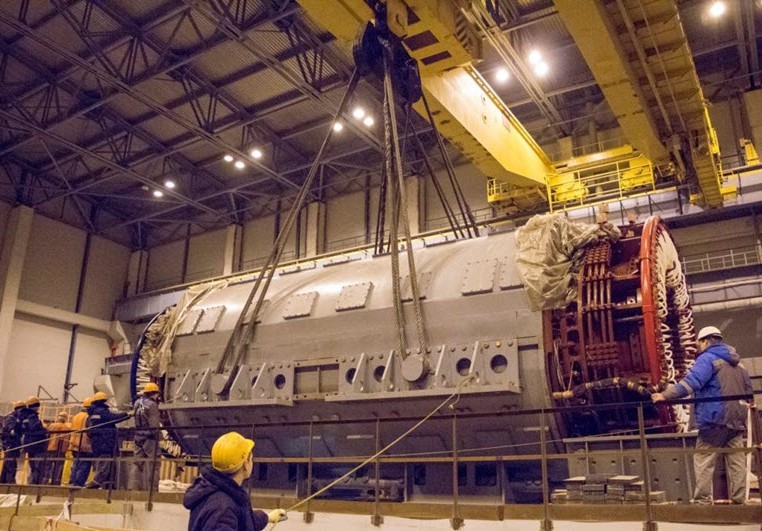
 A generator much like the one that burned out tat the AES-2006 at the Novovoronzezh plant. (Photo: power-m.ru)
A flaw in Russia’s flagship nuclear reactor line, which was originally hushed up by officials, could affect three plants Russian state corporation Rosatom is building at home and in Europe.
The flaw originally caused a short circuit in a generator at the AES-2006 reactor at the Novovoronezh plant, which took the reactor off the grid for two and a half months while the plant worked to repair it.
Rosenergoatom, Russia’s nuclear utility, originally kept the flaw under wraps until anonymous sources fed dire reports to a local newspaper, prompting the utility to go public on its website with the cause of the malfunction.
Even that cover up involved a cover up: The short circuit scrammed the reactor on November 10, but Rosenergoatom didn’t come clean about it until November 16.
The utility later backdated that report to make it look like it was published on the day of the incident apparently to stem media speculation that a serious accident had taken place.
 A view of the Novovoronezh reactor AES=2006 reactor’s machine hall. (Credit: novnpp.rosenergoatom.ru)
The muddy shell game of hushing the defect then obfuscating when the problem was identified makes one thing clear: The reactor is a key offering on Russia’s markets abroad and a valuable foreign policy tool to boot.
The AES-2006 reactor, also known as the VVER-1200, is under construction at the Belarus Nuclear Power Plant and the Leningrad Nuclear Power Plant II. Further afield, Finland is building one. Turkey has ordered four and Bangladesh and Hungary are in line to build two each.
The problem at the AES-2006 at Novovoronezh turned out to be a defect in the so-called stator winding mechanism, which plays a role in cooling the reactor. Initially presented by a Rosenergoatom spokesman as a relatively minor fix, it was serious enough for technicians to altogether replace the part in the plant’s second AES-2006 reactor.
The company that makes the generator, St. Petersburg’s Power Machines, said it had done the repairs at the Novovoronezh AES-2006 reactors, and further added it would undertake “modernization” of the same generator line installed in the AES-2006 reactors at the Belarus Nuclear Power Plant, as well as at the Leningrad Nuclear Power Station II.
The rush to get the AES-2006 out the door – and gag any screw-ups along the way – was predictable. With fluctuating oil and gas prices, nuclear energy, specifically the new reactor, is another foothold for Moscow in the European energy market.
Lateral moves between president Vladimir Putin’s administration and Rosatom brass make clear the role nuclear energy plays in state policy.
In October, Sergei Kiriyenko moved from Rosatom to the become deputy head of Putin’s administration. He was replaced by Aleskei Likhachev, an economics minster. Likhachev has since made it his business to promote the AES -2006 reactor.
Earlier this month, Putin himself went to Hungary to push Rosatom’s controversial deal to build two AES-2006 reactors at the country’s €12 billion PAKS II Nuclear Power Plant. The European Union, thanks to lobbying by France and the United Kingdom, seems ready to green light the reactor construction, nudging the door to Europe’s nuclear market open for Rosatom.
Russia has a habit of conducting foreign policy by choking, then reviving, natural gas supplies to the EU. Disputes between Russia and Ukraine, which remain bitter, led to cuts in Europe’s gas supply from Russia in 2006 and 2009. This drove Europe to diversify just whom it was depending on for its winter heat.
But locking into Russia’s start-to-finish nuclear deals, beginning with Finland and with Hungary, is a big step back toward dependence on Moscow.
To build its two AES-2006s Hungary would take a loan from Russia to finance 80 percent of the project and putting it in hock to Moscow for decades. Rosatom would also effectively operate the plant for 50 years, supplying it with all of its fuel and much of its technical know-how.
Such dependence has had scary side effects when a country finds itself on Moscow’s bad side.
In 2014, at the height of EU-Russia tensions over Moscow’s annexation of Crimea, Kremlin officials threatened to cut nuclear fuel supplies to Ukraine’s Soviet built reactors, raising the specter of Moscow forcing a calamitous nuclear accident.
Kiriyenko eventually walked that back, but the lurid message in Moscow’s head-fake at a second Chernobyl was clear: Russian-built reactors are a useful form of post-Cold War nuclear blackmail.
It is, of course, unlikely that the Kremlin wants a meltdown so close to its own borders. It’s dealt with such hassles before.
But the EU might want to think about how much it wants to depend on Moscow to keep it safe. The AES-2006 has only been in commercial operation for a year and the generator short circuit might be only the first of its problems.
If the EU finds itself in another tense argument with Moscow over Crimea – or anything else – it could find the AES-2006 repair hotline temporarily disconnected.
Andrei Ozharovsky contributed to this report.
February 13, 2017
Posted by arclight2011part2 |
Uncategorized |
Leave a comment

2017/02/13 15:41:16
Taipei, Feb. 13 (CNA) Nuclear-free advocates around Taiwan have organized three parades through the online “Nuclear Go Zero” action platform, in a national protest action set for March 11 in Taipei, Kaohsiung and Taitung simultaneously.
The parades will take place on Ketagalan Boulevard in Taipei, the Labor Park in Kaohsiung, and the Tiehua Pedestrian Zone in Taitung, with the theme of “Zero Nuclear, Low Carbon, Sustainable Energy,” the organizers said Monday.
The government will be urged to accelerate efforts to realize its campaign promise to replace existing energy sources with green ones, to decommission three operating nuclear power plants as scheduled, and to find the best solution for the disposal of nuclear waste, the organizers said.
This year, they will also demand that the government resolve problems relating to carbon emissions and air pollution. “The government should accelerate its steps, and come up with concrete plans and schedules for the implementation of its nuclear-free policy,” the organizers said.
Transforming Taiwan into a nuclear-free country was one of the major political platforms presented by Tsai Ing-wen (蔡英文) of the Democratic Progressive Party (DPP) in her race for the presidency in 2016.
Tsai won the presidential election on Jan. 16 last year, the same day that her party, the DPP, defeated the then-ruling Kuomintang in the legislative elections, giving it a legislative majority.
As soon as it was inaugurated, the Tsai administration announced that it will make the country nuclear-free by 2025.
The “Nuclear Go Zero Action” action platform was established by more than 100 civil anti-nuclear groups around Taiwan in 2013, after some 220,000 people took to the streets on March 9 that year to take part in protest marches in northern, central, southern and eastern Taiwan, demanding that the fourth nuclear power plant project should be scrapped.
In April 2014, then-Premier Jiang Yi-hua (江宜樺) announced that the nearly completed power plant, located in New Taipei, was to be mothballed. The plant entered mothball status in July of the following year.
(By Wu Hsin-yun and Elizabeth Hsu)
ENDITEM/J
http://focustaiwan.tw/news/asoc/201702130014.aspx
February 13, 2017
Posted by arclight2011part2 |
Uncategorized |
1 Comment
“They were kind of really scared and concerned what the implications of this whole unraveling is going to be,” he said. Chris Gadomski

February 13, 2017
Sometime today, Japan’s Toshiba, owner of Pennsylvania-based nuclear power icon Westinghouse Electric, will reveal an impairment charge to Westinghouse, Kallanish Energy learns.
More than a month ago, Toshiba told shareholders to expect a multi-billion-dollar writedown charged to Westinghouse – expected to be roughly $6 billion – due to the nuclear company’s purchase of Chicago Bridge & Iron’s (CB&I’s) Stone & Webster nuclear construction company two years ago.
Last month, Toshiba CEO Satoshi Tsunakawa told reporters Toshiba is likely to exit the nuclear construction business outside of Japan, which would make Westinghouse a technology designer and service provider – not a nuclear plant builder.
Bloomberg New Energy Finance’s head of nuclear research, Chris Gadomski, said he thinks the company might be better off with a narrowed business philosophy, the Pittsburgh Post-Gazette newspaper reported.
“There’s a big difference between building equipment for nuclear power plants and managing the process,” Gadomski said. “If Westinghouse says, ‘Hey, we’re just going to build components’ — that’s fine. Actually, that simplifies the process completely.”
But the uncertainty over the company’s future is rattling markets and customers. On a recent visit to South Carolina, where Westinghouse is building two AP1000 nuclear reactors for the utility South Carolina Electric & Gas Co. — multi-billion-dollar projects — Gadomski said the anxiety was palpable.
“They were kind of really scared and concerned what the implications of this whole unraveling is going to be,” he said.
The South Carolina project and a similar project in Georgia are currently under construction.
Westinghouse employees are similarly uncertain of what awaits them. The company employs 12,000 worldwide.
https://www.kallanishenergy.com/2017/02/13/westy-may-be-forced-out-of-nuclear-plant-construction-business/
February 13, 2017
Posted by arclight2011part2 |
Uncategorized |
3 Comments
Posted: Friday, February 10, 2017 10:00 pm | Updated: 7:10 am, Sat Feb 11, 2017.
By Dennis Carroll
For The New Mexican
http://www.santafenewmexican.com/news/local_news/new-health-survey-at-nuclear-test-site-details-decades-of/article_4cfc0b66-67ae-5a5d-a542-6977b5164e7d.html
More than 70 years after the detonation of the first atomic bomb, residents of Southern New Mexico who were unwittingly exposed to the fallout, as well as their descendants and advocates, have released a new report that details the decades of illnesses and deaths they believe were caused by the Trinity Site test, and other detrimental effects to their communities.
The health impact assessment, titled “Unwilling, Unknowing and Uncompensated,” focuses on four main ways that families have been affected by the Manhattan Project blast in 1945: generations of illnesses and deaths, lack of access to health care, economic struggles and fears of severe health problems for future generations.
The document was commissioned by the Tularosa Basin Downwinders Consortium, an organization that for years has been advocating for these residents. It was paid for with a $35,000 grant from the Santa Fe Community Foundation, with help from the Kellogg Foundation. The overriding purpose of the assessment, said consortium co-founder Tina Cordova, is to present a case for why the downwinders should be included in the federal Radiation Exposure Compensation Act, a law that provides benefits to many people exposed to nuclear fallout during bomb testing but excludes those living near Trinity.
The downwinders report examines the results of 800 health surveys conducted in Otero, Socorro, Lincoln and Sierra counties, and the comments of people who participated in several community forums. It offers personal accounts of their experiences.
One 16-year-old girl quoted in the report said she is afraid to have children in the future because she fears passing on radiation-mutated genes, leading to more sickness and death. The girl’s mother said her daughter had been robbed of her childhood because she is terrified of not if but when “she or her other family members will develop cancer.”
Emphasizing the personal experiences of the Tularosa Basin residents “creates a significantly different story than the historical narrative of a deserted and uninhabited region surrounding the bombsite,” the report says.
One man who grew up in Tularosa spoke of the many illnesses that his family members suffered: breast cancer, gout, blood disorders, prostate cancer, thyroid disease, throat cancer, stomach problems and kidney disease. The man said he has three siblings living on one kidney each.
The report includes information from a 10-year study of historical records by the U.S. Centers for Disease Control and Prevention, which calls for further investigation of health and environmental issues in the areas surrounding Trinity Site, as well as areas near Los Alamos National Laboratory, where the atomic bomb was built.
The CDC says residents were never warned before or after the Trinity blast and never advised to avoid ingesting radiation-contaminated water and food, or to avoid exposure to the fallout.
The downwinders health assessment, largely written by Myrriah Gómez of Pojoaque, an assistant professor in The University of New Mexico’s Honors College, will be rolled out in public gatherings in Tularosa and Socorro this weekend and in Albuquerque on Wednesday.
The Radiation Exposure Compensation Act, passed by Congress in 1990, provides up to $150,000 in payouts and other health benefits to military personnel and scientists present at the Trinity test in July 1945, as well as those living downwind from the 1950s nuclear tests in Nevada and the Pacific islands. The measure also allows payouts to surviving loved ones of those who have died from illnesses related to the blasts.
But the law doesn’t provide compensation for the people who were living on Southern New Mexico ranches, in villages and in the Mescalero Apache community not far from Trinity Site — some within 15 miles of the detonation — and it doesn’t include their descendants.
New Mexico’s Democratic U.S. Sens. Tom Udall and Martin Heinrich recently introduced legislation that would include the Trinity downwinders in the law.
Similar measures have been offered up over the past few years by New Mexico’s congressional delegates and other lawmakers, but they have all gone nowhere. There has never been a hearing on any of the proposals.
Cordova said the new report shows that federal compensation would improve the health of Southern New Mexico residents, many who travel long distances for medical care. It is demeaning and tragic, she said, for families to have to hold bake sales to buy painkillers for their sick and dying parents, spouses and children.
The U.S. also owes an apology to the downwinders for what some consider a surprise nuclear attack on their neighborhoods, Cordova said.
“After the Trinity bomb detonated,” the report says of one family, “their chickens died. The family dog died. The … mother hung bed sheets on the windows and wet them to keep the dust out of the house.”
Descendants of people living downwind and downstream of the Trinity blast can trace the health problems of later generations back to the cultural practices and agrarian lifestyle of the 1940s, the report says. As farmers, ranchers, fishermen and hunters, the downwinders relied on the environment for their survival.
One woman spoke at a community forum about how, as a child, she and her siblings “drank the milk from the cows and skimmed the fat (cream) off the milk,” the report says. “They played in the acequias (ditches). They butchered cows and hunted deer.
“Now,” the woman said, “families who engaged in those practices and were contaminated by radiation are ‘wiped out.’
February 13, 2017
Posted by arclight2011part2 |
Uncategorized |
Leave a comment
Sunny Freeman | February 10, 2017 4:38 PM ET
Uranium market conditions in 2016 were the toughest that Cameco Corp. CEO Tim Gitzel has seen in his 30 years in the business, but he says he remains cautiously optimistic about the long-term picture.
“We’ve been saying for some time that uranium prices are neither rational nor sustainable,” Gitzel told investors during a conference call Friday to discuss its dismal 2016 earnings. “Current prices are failing to incent the investment decisions required to ensure reliable supply is available to meet growing demand out into the future.”
Cameco reported a fourth-quarter net loss attributable to shareholders of $144 million, or 36 cents per share, which was more than 10 times larger than the loss of $10 million, or three cents per share, reported in the year-earlier period. The fourth quarter of 2016 included an impairment charge of $238 million. The company booked a $210 million impairment charge in the 2015 quarter.
Revenues fell nine per cent to $887 million during the quarter. The company’s full-year loss was $62 million.
Still, Cameco said it is encouraged by Kazakhstan’s announcement that it will cut 2017 production by 10 per cent, bolstering optimism about long-term fundamentals of uranium. Spot prices have increased by 40 per cent and term prices are up about eight per cent since a low in December.
“But let me be clear, our optimism is best described as cautious optimism — we are far from a true incentive price for sustainable production” and further cuts might be needed, unless term contracts return in meaningful quantities, Gitzel said.
“Optimistic because it appears that the pain of low uranium prices is driving meaningful supply discipline and this discipline is provoking a strengthening uranium price. Cautious because market challenges continue, challenges that might frustrate recent increases in the uranium price.”
The entire nuclear industry is still feeling the aftershock of the 2011 Fukushima nuclear disaster, with prices in the doldrums and customers re-evaluating contracts as they eye prices much lower than those in deals previously struck with Cameco.
Cameco said earlier this month it has rejected Tokyo Electric Power Company Holdings Inc.’s attempt to cancel its contract — a move that would mean $1.3 billion in lost revenue — as the Saskatoon-based uranium giant works to protect deals signed with customers before the market tanked. Cameco said it is pursuing legal action.
Financial Post
http://webcache.googleusercontent.com/search?q=cache:_vX5W8gOyzkJ:business.financialpost.com/news/energy/uranium-market-conditions-last-year-were-the-worst-in-30-years-says-cameco-corp-ceo+&cd=3&hl=en&ct=clnk&gl=ie&client=ubuntu
February 13, 2017
Posted by arclight2011part2 |
Uncategorized |
Leave a comment
This is the second article on Nara Visa residents’ concerns over a nuclear waste research project taking place in their backyards. The first article can be found here.
Strong public opposition to Atlanta based ENERCON and DOSECC Exploration Services’ efforts to drill a three mile deep borehole in Nara Visa to research nuclear waste storage continues, as the Canadian River Municipal Water Authority (“CRMWA”) has expressed strong concerns. In a letter obtained by the New Mexico Politico, dated February 10, 2017, the CRMWA addressed Quay County Commissioners, stating in part:
The Canadian River Municipal Water Authority supplies over ½ million people with water that comes from the Canadian River. Needless to say, we are VERY concerned about the prospect of high level nuclear waste being disposed of in our water shed…. [a]lso, the Canadian River is a tributary to the Arkansas River, then the Mississippi, and finally the Gulf of Mexico. The magnitude of this issue is obvious.
Not only is our water shed and the Canadian River a concern for us, but the Ogallala Aquifer is as well. It is the dominate aquifer in this area. The wrong combination of events could conceivably contaminate it also.
DOE, by its own admission, has billions of dollars of infrastructure maintenance backlogs because of the lack of planning and funding for life cycle costs. Many government agencies, such as the DOE, are not adequately funded. This means corners must and will be cut and with a project like this, a cut corner could be catastrophic for a long, long, time.
The CRMWA closed their letter by giving their recommendation to Commission:
We believe this project should go back to Yucca Mountain where the science has been completed and is on government owned and controlled land. In closing, the Canadian River Municipal Water Authority strongly opposes this project and would be happy to supply a more in depth response on this issue if needed.”
Quay County residents are also disputing the over-all economic and educational benefits touted by Peter Mast, President of Enercon Federal Services. According to the recorded minutes of an October 2016 Quay County Commission meeting, Mast anticipated “the project to require 20 employees off and on with the possibility of 6-12 permanent positions.” ENERCON representatives have also mentioned the overall benefits of bringing a 40 million dollar contract to the area.
During last week’s Nara Visa informational meeting hosted by ENERCON, Quay county resident Bart Wyatt voiced his skepticism, stating in a letter handed out to attendees:
“Virtually no materials or equipment is going to come from Quay County so no tax revenue from sales. Income tax from any jobs will go to the state, not county. Gross receipts taxes, after giving the state their cut, would give the county a tax income of $100,000 per year over 5 years. Worth a nuclear dump?”
Regarding Mast’s jobs claims, Wyatt offered the following observation:
“These contractors have all the management position filled by out of state professionals taking their wealth with them when they go.”
After reviewing Wyatt’s claims, I reviewed ENERCON’s website regarding its construction of nuclear site characterization and the work appears to be highly specialized, meaning local job creation is unlikely.
Ranch owner Patty Hughs also offered a major concern shared by the agricultural community:
“How is trading Quay county’s base economy of farming, ranching, and real estate for a polluting economy going to benefit this community long term?”
Patty Hughs’ concerns are worth noting when looking at agriculture statistics from the USDA and New Mexico Department of Agriculture. In 2012, the market value of agricultural products sold out of Quay County topped $36,700,000.
In 2015, the total value of cattle in the county was estimated at $56,615,000.
The total value of farms, land, buildings, and overall agricultural land use was a staggering $508,402,000.

To be sure, many legitimate questions arise on what would happen to farm and ranch land values, and to the agricultural community’s ability to protect their way of lives if nuclear waste storage becomes a reality.
Would banks change lending practices to farmers and ranchers because of the attendant risks of nuclear waste storage? Would real estate values be decimated? Would insurance companies even cover agricultural operations where radiation exposure would render the land unusable for a thousand years?
In the short term, its conceivable that restaurants and other local businesses could see a small bump in revenue from out-of-state drillers. But long term? They may stand to lose the base economy that has kept their doors open for years.
One thing is for certain, an all important meeting for residents will take place with the Quay County Commission in Tucumcari February 13th, 2017 at 9 a.m. to potentially decide the fate of ENERCON’s drilling operation. The majority of residents that have spoken with the New Mexico Politico are hoping and praying the Commission will rescind Resolution No. 27.
The New Mexico Politico will report on the Commission’s decision tomorrow.
Disclosure: My wife is related to the owners and operators of the Hat T Ranch in Nara Visa. The white church image used in the story is courtesy of Connie Payne.
http://www.nmpolitico.com/nuclear-waste-research-companys-promises-ring-hollow-locals/
February 13, 2017
Posted by arclight2011part2 |
Uncategorized |
Leave a comment
NEW DELHI: Downplaying Pakistan Prime Minister Nawaz Sharif ‘s adviser on foreign affairs Sartaj Aziz’s comments where he held India responsible for the ‘nuclearisation’ of the Indian Ocean, Defence experts have opined that Islamabad is perturbed because New Delhi is getting equipped.
Asserting that Pakistan had no issue with ‘nuclearisation’ until India was not active, Defence expert P.K Sehgal said, “Pakistan never got intimidated when China got equipped but now they are raising this issue because India also possesses nuclear power. And we will increase in our nuclear power.”
Treading the same path, another defence expert Qamar Agha said that India has always been committed in maintaining tranquility in the Indian Ocean and that Aziz’s comments were unwarranted. “Pakistan and China are responsible for ‘nuclearisation’ in Indian ocean. They are increasing their presence there.
Whatever India is doing in this regard is for defence. We got nuclear weapons because China and Pakistan were developing in the same path. Indian Ocean is India’s part and India maintains peace and decorum in its boundaries and is still doing it. Sartaz Aziz’s comments are totally wrong,” said Agha.
Pakistan would go all out to contain grave threats to peace and security in the Indian Ocean primarily due to nuclearisation started by India, said Aziz, while speaking at the International Maritime Conference in Karachi.
February 13, 2017
Posted by arclight2011part2 |
Uncategorized |
Leave a comment
by
Jason Clenfield
and
Yuji Nakamura
13 February 2017, 00:03 GMT 13 Updated February 2017, 00:40 GMT
If you want to understand why Toshiba Corp. is about to report a multi-billion dollar write-down on its nuclear reactor business, the story begins and ends with a one-time pipe manufacturer with roots in the swamp country of Louisiana.
The Shaw Group Inc., based in Baton Rouge, looms large in the complex tale of blown deadlines and budgets at four nuclear reactor projects in Georgia and South Carolina overseen by Westinghouse Electric Co., a Toshiba subsidiary.
On Tuesday, Toshiba is expected to announce a massive write-down, perhaps as big as $6.1 billion, to cover cost overruns at Westinghouse, which now owns most of Shaw’s assets. The loss may actually eclipse the $5.4 billion that Toshiba paid for Westinghouse in 2006 and has forced the Japanese industrial conglomerate to put up for sale a significant stake in its prized flash-memory business. Toshiba had to sell off other assets last year following a 2015 accounting scandal.
Toshiba made a big bet on a nuclear renaissance that never materialized, in part because it couldn’t build reactors within the timelines and budgets it had promised. The company had anticipated that Westinghouse’s next-generation AP1000 modular reactor design would be easier and faster to execute — just the opposite of what happened. Now the Japanese company may exit the nuclear reactor construction business altogether and focus exclusively on design and maintenance.
“There’s billions and billions of dollars at stake here,” says Gregory Jaczko, former head of the U.S. Nuclear Regulatory Commission (NRC). “This could take down Toshiba and it certainly means the end of new nuclear construction in the U.S.”
Toshiba confirmed it will unveil a “huge loss” on Tuesday; a spokeswoman declined further comment. In January, Satoshi Tsunakawa, Toshiba’s president, said the company may sell shareholdings, real estate or other assets if needed to strengthen its balance sheet. “We will keep considering all options as needed and promptly, and take all necessary steps,” he said at a briefing in Tokyo.
New Start
When Toshiba bought Westinghouse a decade ago, the U.S. Congress had just started dangling loan guarantees and other incentives aimed at restarting a dormant nuclear industry. In 2008, Westinghouse signed deals to build four new reactors for utilities Southern Co. and Scana Corp., the first U.S. nuclear plants since the 1979 accident at Three Mile Island to be approved for construction by regulators.
In a 2015 interview with Bloomberg Businessweek, Southern Chief Executive Officer Thomas Fanning said his utility’s two reactor projects at Plant Vogtle in Georgia were “going to be one of the most successful mega-projects in modern American industrial history.”
To build that mega-project, Westinghouse turned to Shaw, a newcomer to nuclear work. Shaw was founded in 1987 by James Bernhard Jr., who distinguished himself through his deal-making acumen. He got his start paying $50,000 for the assets of a bankrupt pipe fabricator, and grew via one acquisition after another. In 2000, Bernhard swooped in at a bankruptcy auction and, during an 18-hour bidding war, bought Stone & Webster Inc., a once-venerable engineering firm that had already agreed to a deal with a much bigger rival.
Stone & Webster had built the Massachusetts Institute of Technology’s campus and many of the country’s nuclear plants from the 1950s to the 1970s, but it was a shell of its old self when Bernhard bought it. Still, the name gave Shaw new credibility in the nuclear field, which it capitalized on to win all of Westinghouse’s contracts. “They weren’t necessarily qualified, but they had the heart and the go-get-them to take it on,’’ says Jeffrey Keller, a retired construction project controller who worked for Shaw at its nuclear sites.
Bernhard declined to comment for this story.
Building nuclear reactors is a tall order, given the regulatory complexity and consortium of contractors required to get the job done. And in fairness to Westinghouse and Shaw, plenty of other companies have missed deadlines. “Nuclear construction on-time and on-budget? It’s essentially never happened,’’ said Andrew J. Wittmann, an analyst who covers the industry for Robert W. Baird & Co.
Modular Design
It’s easy to see why Shaw wanted Toshiba’s business, but harder to understand why Toshiba chose Shaw. More established contractors simply may not have wanted the work, but Bernhard also used his deal-making skills to sweeten the agreement by taking on a chunk of Toshiba’s debts temporarily. “If you want to have a business, you have to get plants up and running, so they went forward even if it wasn’t a perfect match– that was the calculation for Toshiba,” says David Silver, an analyst at Morningstar in Chicago.
Westinghouse executives hoped its AP1000 reactors’ main components, or modules, could be built efficiently at specialized work yards, then shipped to a plant site and snapped together like enormous steel-and-concrete Legos.
On top of that, the U.S. government in 2005 gave nuclear developers a package of tax credits, cost-overrun backstops, and federal loan guarantees. In the next few years, U.S. utilities filed dozens of applications to build new reactors.
After Westinghouse hired Shaw to handle construction in 2008, it wasn’t long before the company’s work came under scrutiny. By early 2012, NRC inspectors found steel in the foundation of one reactor had been installed improperly. A 300-ton reactor vessel nearly fell off a rail car. The wrong welds were used on nuclear modules and had to be redone. Shaw “clearly lacked experience in the nuclear power industry and was not prepared for the rigor and attention to detail required,’’ Bill Jacobs, who had been selected as the state’s monitor for the project, told the Georgia Public Service Commission in late 2012.
The troubles were only starting. At Southern’s two new reactors in Georgia — a massive construction site on the edge of the Savannah River– thousands of workers have logged more than 25 million man-hours, yet the project is years behind schedule.
0riginally planned to open in 2016 and 2017, they’re now slated for 2019 and 2020–and that may be a stretch. To hit the new targets, Westinghouse would have to accelerate the pace of work to “over three times the amount that has ever been achieved to date,” Jacobs, the state’s project monitor, told the utility commission last year.
In November, Westinghouse said 33.4 percent of the construction was complete, but a utility supervisor with Southern who asked not to be identified said he’s skeptical. The hardest part of the project – the reactor’s center – has just started, he said.
Shaw Acquisition
Just as problems began to surface, in July 2012 Shaw agreed to sell itself for $3.3 billion to Chicago Bridge & Iron Co., a much larger engineering firm that wanted in on the envisioned nuclear renaissance. But three years later, with little progress to show for itself, CB&I decided to cut its losses. It sold the bulk of Shaw’s assets to Toshiba for $229 million, accepting the significantly lowered price in exchange for shedding liabilities related to the projects.
But in April 2016, four months after the deal closed, Toshiba concluded it had miscalculated and accused CB&I of inflating Shaw’s assets by $2.2 billion, and asked to renegotiate. CB&I balked and sued Toshiba for breach of contract last July. A preliminary decision in December ruled in favor of Toshiba’s request to renegotiate. CB&I has appealed that ruling. “We remain confident this issue will come to a resolution favorable to CB&I,” said Gentry Brann, a spokeswoman for the company. CB&I has argued that at least some of the reactor problems have been because of Westinghouse and its AP1000 designs.
Westinghouse has turned to another construction contractor, Fluor Corp., to help get its projects back on track, but it’s too early to say how much progress they’re making. Meanwhile, the NRC continues to press Westinghouse about problems with its AP1000 design after a neutron shield block, which contains radiation, failed during testing. Regulators will hold a hearing this week at which Westinghouse is expected to explain its work on the issue; Toshiba meanwhile declined to comment.
Those troubled projects in the American South are now threatening the Japanese icon’s foundations. The value of Toshiba shares has been cut in half over the last six weeks, wiping out more than $7 billion in market value.
And what of the U.S. nuclear renaissance? Westinghouse’s projects for Southern in Georgia and Scana in South Carolina had once been viewed as part of a rebirth of the U.S. atomic power industry. However, stumbles with those projects, the nuclear disaster in Fukushima and a flood of cheap natural gas that lowered U.S. power prices made new reactors increasingly expensive and risky. Of the 30-odd applications for new reactors that started in the mid-2000s, only the four Westinghouse units have gone forward.
One figure who seems to have come out of the Westinghouse mess pretty much unscathed is Shaw founder Bernhard. He completed the sale of his firm to CB&I in 2013, pulling in $3.3 billion for himself and other shareholders. Bernhard, whose stake was worth about $50 million at the time of the sale, now runs a private equity firm in Baton Rouge.
“They got out whole and then some,” said Silver, the analyst with Morningstar. “It was a good deal for them but only because they were able to unload the hot potato.”
https://www.bloomberg.com/news/articles/2017-02-13/toshiba-s-nuclear-reactor-mess-winds-back-to-a-louisiana-swamp
February 13, 2017
Posted by arclight2011part2 |
Uncategorized |
Leave a comment
“It is difficult to see how any safety case presented from now on that relies in any way upon the UK VPF, whether on the roads, the railways or in the nuclear industry, such as the new nuclear power station at Hinkley Point C in Somerset, could stand up to test in court. More modern and accurate methods exist, but the regulators are not using them.”
Published 13 February 2017

New research has shown that the benchmark used by the U.K. Office for Nuclear Regulation for judging how much should be spent on nuclear safety has no basis in evidence and places insufficient value on human life. The review suggests it may need to be ten times higher — between £16 million and £22 million per life saved.
New research has shown that the benchmark used by the U.K. Office for Nuclear Regulation for judging how much should be spent on nuclear safety has no basis in evidence and places insufficient value on human life. The review suggests it may need to be ten times higher — between £16 million and £22 million per life saved.
The research review led by Professor Philip Thomas from the University of Bristol and Dr. Ian Waddington and published in the journal Nuclear Future, examined the evidence for the “value of a prevented fatality” (VPF) currently used as a safety guideline by the Office of Nuclear Regulation, the Health and Safety Executive and numerous government departments.
Bristol U says that the VPF figure of £1.83 million (published in July 2016) emerged from a 20-year-old small-scale opinion survey of 167 people and its interpretation method has recently been shown to be too flawed to be credible.
The VPF study team came up with the current U.K. figure after setting aside the results of their first opinion survey, but a recent re-analysis has shown that the discarded valuations were actually entirely rational and understandable and the VPF study team rejected the wrong survey. An up-to-date interpretation of the first opinion survey would suggest that the VPF should be set about ten times higher than at present, at between £16 million and £22 million per life saved.
The Judgement- or J-value, a new method pioneered by Professor Thomas that assesses how much should be spent to protect human life and the environment that has recently been validated against pan-national data, would value life about four times higher, closer to the value used by the US Department of Transportation ($9.1 million in 2012).
Philip Thomas, Professor of Risk Management in the Department of Civil Engineering, said: “The Office of Nuclear Regulation and other national bodies clearly have a problem with how they should assess the right level of expenditure to protect people from nuclear and other accidents.
“It is difficult to see how any safety case presented from now on that relies in any way upon the UK VPF, whether on the roads, the railways or in the nuclear industry, such as the new nuclear power station at Hinkley Point C in Somerset, could stand up to test in court. More modern and accurate methods exist, but the regulators are not using them.”
Bristol U notes that in the past, the Rail Safety and Standards Board (RSSB) asked some members of the VPF team to investigate how much people wanted to spend to counter railway accidents with multiple fatalities. The team reported their opinion surveys as showing no appetite for extra expenditure to guard against rail accidents causing many deaths. However, the methods used by the RSSB study team were recently proved to be systematically biased against anyone wanting more to be spent against deaths in large accidents, and so they should not have been used. Consequently RSSB’s recommendation to cut expenditure against big rail accidents by 66 per cent has not been justified.
— Read more in Philip Thomas and Ian Waddington, “What is the value of life? A review of the value of a prevented fatality used by regulators and others in the U.K.,” Nuclear Future (forthcoming)
http://www.homelandsecuritynewswire.com/dr20170213-u-k-nuclear-safety-regulations-place-too-low-a-value-on-human-life
Image source; http://www.uranium-stocks.net/home/nuclear-power-uk-must-learn-from-french-reactor-concerns.html
Further reading for UK Government policy
The tolerability risk from nuclear power stations UK 1992 version from the HSE;
Click to access tolerability.pdf
February 13, 2017
Posted by arclight2011part2 |
Uncategorized |
3 Comments

 A generator much like the one that burned out tat the AES-2006 at the Novovoronzezh plant. (Photo: power-m.ru)
  A view of the Novovoronezh reactor AES=2006 reactor’s machine hall. (Credit: novnpp.rosenergoatom.ru)




 nuclear-news