Heard by the Parliament this Wednesday, November 8, Pierre-Franck Chevet, president of ASN, said that “the economic and budgetary difficulties” of the French nuclear giants were “worrying in terms of safety”.
“The operating safety is at a globally satisfactory level,” said the president of the Nuclear Safety Authority, Pierre-Franck Chevet, to the members of the National Assembly’s Sustainable Development Commission, who were questioning him about the state of the French park.
“This does not mean that there are no anomalies that occur,” he said, noting that “three level 2 incidents have been recorded since the beginning of summer.”
“We need nuclear power to preserve the climate”, says New Areva CEO
Pierre-Franck Chevet considers, however, that “the medium-term context is worrying”. He once again pointed out the economic and financial difficulties currently facing EDF and Areva, the French nuclear giants.
“I do not announce a risk in the short term, but in the long term it (this situation) does not bring positive things for the safety in the medium term. The situation is worrying and we must take care of it”.
Nuclear: “there are unprecedented safety issues and on the other side companies with economic difficulties” @decodeurseco pic.twitter.com/Z2VBsZsoh2 – BFM Business (@bfmbusiness) October 16, 2017
The industrial reorganizations and recapitalizations decided by the government are, according to the president of the nuclear gendarme, a response to this situation. “Now it has to come to an end and it’s paying off,” he says.
The European Union has decided to lift import control on some agricultural produce and seafood from Japanese prefectures affected by the 2011 Fukushima nuclear accident.
Currently, food products from 13 Japanese prefectures remain under control even after gradual easing by the EU. These products cannot enter EU nations without a radiation safety certificate to prove the product is within the EU safety standards.
Starting on December 1st, the European Commission, the EU’s executive arm, will phase out the certificate on some products from 10 prefectures.
Those products include rice from Fukushima Prefecture, yellowtail fish, red sea bream, some mushrooms and mountain vegetables. All products from Akita Prefecture will have been cleared.
No restriction on Fukushima rice will mean that rice from other prefectures will no longer need a certificate. Observers say this would encourage rice farmers across the nation to export more.
The Japanese government has been asking the EU to lift restrictions on all the remaining controlled products.
“We do not believe that ions are dangerous – the danger comes from the pollutants. The ions merely assist the particles to stick to the lungs. If there are no dangerous particles in the air to attach to the ions, there is no risk of ill health.” Source 2015 Charged particle concentrations near busy roads can exceed that under power lines.
Nuclear-news just published two stories to note that go with the above link to the Charged particle paper and article.
The first is the new findings from Prof. Chris Busby and the second is the report of a plume of Ruthenium 106 Beta particles in the air throughout Europe. Why is it that no actual plume chart videos were released to explain the way that the plume got to Europe from the Urals region? (NILU and other organisations have the software to do this. It would have decreased the speculation that always arises from these cases).
So, the findings from Chris Busbys recent interview on Libbe Halevy`s Nuclear Hotseat Podcast show, that Beta type nano sized particles would collect around high power voltage lines and contaminate the air around them at a higher density than is being reported.
It does give one some “food for thought” that for the last month that at least some people may have been more at risk than the nuclear industry itself was aware. The fact that the Paper that Prof Busby refers to is still not published at a time when it would be topical and relevant is a shame but at least in some quarters of the anti nuclear activist campaign are discussing the issue.
Criirad, an independent French scientific NGO has been monitoring the situation as best as it was able and managed to garner some relevant facts and make some points on concerns of the health of people near the main accident site.
The problem could be caused by anything from forest fires, as happens in the contaminated forests of Chernobyl frequently, to accidents, purposely dumped waste, fuel fabrication, medical reactors etc. We have not been told what other isotopes were present (if any) and any actual measurements. So much for transparency!
Try to get the word out to friends and family. Both these accidental and purposeful releases are constant and travel far (even upwind it would appear). As it happens I checked the Jet stream at the time and realised that there was a break in it in parts of Europe and heading to the far east, so it is plausible that the plume moved against the prevailing winds;
Note; It is very useful for the nuclear industry, supported by the IAEA to release details of these pollution incidents up to some months after the fact. IRSN, Bellona and CRIIRAD are three organisations that are left to find and report on these situations. So, lets give them some support so they can pay to access NILU data etc for more comprehensive reporting of the incidents. Regards Shaun aka arclight2011
Valencia, November 10, 2017 (11H)
Commission of Research and Information
Independent on Radioactivity
29 courses Manuel de Falla / 26000 Valence / France
. 33 (0) 4 75 41 82 50 / bruno.chareyron@criirad.org
RUTHENIUM 106
Contamination with ruthenium 106
Radioactive releases are considerable and would come from Russia or from nearby countries!
Officials are finally concerned about the importance of the ruthenium 106 discharges
from September 2017, and the risks incurred as close as possible to the source term! At first, the Official releases have simply emphasized the absence of risk in France and Europe.
The CRIIRAD had alerted as early as October 5, but to no avail, about the risks incurred by local populations. However, we know since Chernobyl that we must act very quickly because the exposure is major in the first days and the first weeks.
Reminder: Abnormal presence of ruthenium 106 1 in European air detected at the end of September
In a press release 2 of 4 October 2017, IRSN stated that ruthenium 106 had been
detected in the air of several European countries and concluded, without any reservations on the levels at the accident site and in nearby areas: “Very low levels of contamination atmospheric ruthenium 106 observed to date by the European monitoring networks are without consequences for the environment and for health. Nevertheless, IRSN maintains vigilance monitoring of this presence of ruthenium in the air “. CRIIRAD expressed concern on 5 October
In its communiqué of 5 October 2017, CRIIRAD stated: “The origin of the
phenomenon and risk levels closer to the source term “. “It is important that the origin of these rejections of ruthenium 106 is found. From this point of view, the lack of information is worrying. Yes, the installation at the origin of the discharges is not aware of it, it has not been able to put in place radiation protection, while the doses to residents or workers concerned may not be be negligible. If it is concealment, the situation is even more problematic. ” The Russian track
More than a month has elapsed and, to our knowledge, the exact origin of this contamination is not elucidated. Simulations carried out by French radiation protection agencies (IRSN) and German (BfS), evoked an origin south of the Urals. The Russian authorities had reacted by denying any responsibility.
1
Ruthenium 106 is an artificial radionuclide (fission product), a radiation emitter beta period relatively long (1.02 years). It disintegrates, giving birth to rhodium 106, a radiation emitter beta and gamma period 29.8 seconds.
2 http://www.irsn.fr/FR/Actualites_presse/Actualites/Pages/20171004_Detection-ruthenium-106-en-
europe.aspx # .WgSLhXbkV8x
3
1 / 3A colossal rejection between the Volga and the Urals?
In a new press release of 9 November 2017, IRSN states that the assumption of the impact on earth of a ruthenium-containing satellite was rejected by the IAEA (International Atomic Energy).
Assume then that ruthenium 106 comes from landfill releases, and from
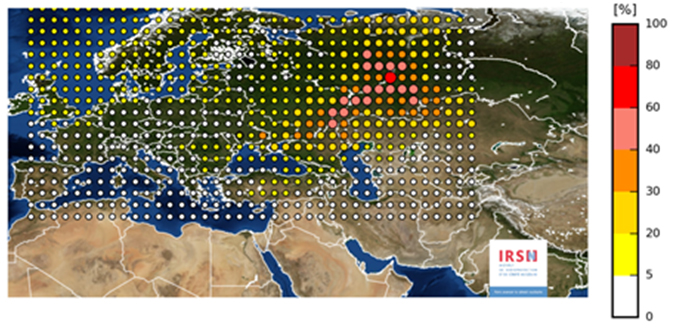
the simulation database, IRSN indicates “the most plausible zone of rejection lies between the Volga and the Urals without it being possible, with the available data, to specify the exact location of the point of discharge.
Indeed, it is in this geographical area that the simulation of a rejection of ruthenium makes it possible to better to reproduce the measurements obtained in Europe “and” For the most plausible rejection zone, the quantity of ruthenium-106 rejected estimated by the IRSN simulations is very important, between 100 and 300 terabecquerels. The release, accidental with regard to the quantity released, would have occurred during the last week of the month of September 2017 “.
If it is a question of emissions coming from a single installation of up to 300 Terabecquerels,
corresponds to a colossal amount, 300 thousand billion becquerels is a figure, as a
comparison, 375,000 times the maximum allowed annual discharge 6 of the Cruas nuclear power plant.
Ruthenium 106 is an artificial fission product that, once dropped on the ground and on the plant cover, will induce a lasting contamination, it takes more than a year for its radioactivity to be divided by two.
As the IRSN notes: “Due to the quantities rejected, the consequences of an accident of this magnitude in France would have required locally to implement measures to protect populations on a radius of the order of a few kilometers around the place of rejection. With regard to foodstuffs exceedances of maximum allowable levels (NMA) (1250 Bq / kg for ruthenium-106 and for products other than milk) would be observed over distances of the order of a few ens of kilometers around the point of rejection “.
It was therefore essential, as requested by CRIIRAD on 5 October 2017, to identify
the installation at the origin of the ruthenium 106 pollution and to implement
protection for the nearby population. And all the more because, as CRIIRAD has denounced several [times?]
Once again, the criteria for intervention 7 adopted by the French authorities to implement protective measures are excessively high. However, the documents analyzed by CRIIRAD show that, as a first step, the official services in Europe have simply insisted on the absence of health consequences on the European territory.
This situation raises many questions about the effectiveness of the IAEA (International Energy AgencyAtomic) and official radiation protection agencies of European countries.
At the scale of Europe and France, why controls on aircraft likely to have
flew over the offending sectors have not been put in place?
Why did the embassies of the European countries not quickly put in place
in countries that are likely to be at the origin of these massive releases of
ruthenium 106 (collection of soil samples, plant cover, foodstuffs)?
5 http://www.irsn.fr/FR/Actualites_presse/Actualites/Pages/20171109_Detection-Ruthenium-106-en-france-et-en-
europe-result-of-investigation-from-IRSN.aspx # .WgR77nbkV8x
6
For fission and activation products beta and gamma emitters such as ruthenium 106.
7
IRSN for example refers to the applicable Maximum Admissibility Levels (NAM) for radioactive contamination food after a nuclear accident or other radiological emergency. CRIIRAD recalls that it has defeated against the adoption of these limits set at excessively high levels and based on a ratio expertise riddled with anomalies. In addition, the device should only be used in case of contamination massive barrier to access to uncontaminated food. Who wants to eat mushrooms containing 100 ruthenium becquerels 106 per kg on the pretext that in the event of an accident the authorized limit is 1,250 Bq / kg?
Consumers have the right to know and choose.
Ruthenium 106 Europe
CHAREYRON – CRIIRAD
2 / 3
If the European States did not underline the potential gravity of the situation for the populations and workers close to the facility, they could have at least worried about the protection of their nationals traveling or staying in the offending countries.
Protect people close to the place of emmision
To have lost more than 1 month to alert effectively is a serious mistake. In case of massive rejection of radioactive substances in the atmosphere, action must be taken quickly to limit the doses to populations close to the offending facility. In the absence of protective measures, the doses suffered could have gone well beyond health limits.
If it is probably too late to limit the risks associated with inhalation in the plume (we can think since the discharges have stopped for several weeks), the populations close to the facility are radiation-related radiation from ruthenium 106 and contamination by
ingestion of contaminated food. It is therefore important, depending on the levels of fallout, put in place appropriate countermeasures (evacuation or decontamination of soil).
It is equally important to advise them not to consume food that has been
foliar deposition or delayed contamination.
To the extent that some States are not able to ensure the radiological protection of citizens, it is more than ever necessary to support local NGOs and develop independent radiological controls . For the French authorities there is nothing more to do?
With regard to the risks for people living in France, IRSN considers “on the one hand that the probability of a scenario that would see the importation into France of foodstuffs (especially mushrooms) contaminated with ruthenium-106 in the vicinity of the source of releases is extremely low and on the other hand, the potential health risk associated with this scenario is also very low. It does not appear necessary to put in place systematic controls of the contamination of imported food. This position is taken up by ASN in its communiqué 8 of 9 November. CRIIRAD considers, on the contrary, that it is essential to mobilize all States’ means Europeans (controls on foodstuffs and products from the offending areas, actions at embassies) to precisely determine the origin of the discharges and to weigh benefit from protective measures (even if they are late). We must think of local people and to nationals of foreign countries likely to be closer to the source term!
A systematic control of the imported food is not necessarily the most suitable, on the other hand, it is necessary for a specific radiological monitoring program to be implemented at European Union to verify ruthenium-106 contamination of risky foods from incriminated countries, but also by other less mobile radioactive substances that could be present in the local fallout without being detectable in the air at great distances.
Editor: Bruno CHAREYRON, nuclear physics engineer, director of the CRIIRAD laboratory.
Contact: bruno.chareyron@criirad.org
8 https://www.asn.fr/Informer/Actualites/Ruthenium-106-dans-l-air-ambiant-en-France-pas-de-risque-identifie-
for the population
Ruthenium 106 Europe
CHAREYRON – CRIIRAD
Pope Francis has condemned the ‘false sense of security’ created by nuclear weapons
Nuclear weapons create a “false sense of security” and serve a “mentality of fear” that affects the entire human race, Pope Francis said today.
Condemning the escalation of the arms race and the price of modernising and developing weaponry, he said the result is that “the real priorities” such as the fight against poverty, the promotion of peace, the undertaking of educational, ecological and healthcare projects, and the development of human rights, are relegated to second place
“Nor can we fail to be genuinely concerned by the catastrophic humanitarian and environmental effects of any employment of nuclear devices,” he added.
Pope Francis was addressing participants in an International Symposium, “Prospects for a World Free from Nuclear Weapons and for Integral Disarmament”, organised by the Vatican’s Dicastery for Promoting Integral Human Development.
The conference follows the approval of the “Treaty on the Prohibition of Nuclear Weapons”, signed by 122 countries including the Holy See in New York on 7 July 2017, which determined that nuclear weapons are not only immoral, but also should be regarded as an illegal means of warfare.
In Rome for the conference are eleven Nobel Peace Laureates, UN and NATO top representatives, diplomats from the Russian Federation, United States, South Korea and Iran as well as top experts on armaments and weapons and the heads of major foundations and other organisations involved in the debate.
Particularly significant is the presence of Masako Wada, assistant secretary general of Nihon Hidankyo, one of the last survivors of the Hiroshima’s nuclear attack, representing the victims of nuclear weapons and of nuclear experiments.
Pope Francis referred explicitly to the “witness” of the survivors of the bombing of Hiroshima and Nagasaki, together with other victims of nuclear arms testing. “May their prophetic voice serve as a warning, above all for coming generations,” he said.
He warned of the risk of accidental detonation, condemning the threat of the use of nuclear weapons as well as their very possession. “For they exist in the service of a mentality of fear that affects not only the parties in conflict but the entire human race,” he said.
“International relations cannot be held captive to military force, mutual intimidation, and the parading of stockpiles of arms. Weapons of mass destruction, particularly nuclear weapons, create nothing but a false sense of security. They cannot constitute the basis for peaceful coexistence between members of the human family, which must rather be inspired by an ethics of solidarity.
“Furthermore, weapons that result in the destruction of the human race are senseless even from a tactical standpoint. For that matter, while true science is always at the service of humanity, in our time we are increasingly troubled by the misuse of certain projects originally conceived for a good cause. ”
He warned that nuclear technologies are spreading, also through digital communications, and that the instruments of international law have not prevented new states from joining those who already have them. “The resulting scenarios are deeply disturbing if we consider the challenges of contemporary geopolitics, like terrorism or asymmetric warfare.”
But he also welcomed the recent UN vote, describing it as “historic”. He said: “At the same time, a healthy realism continues to shine a light of hope on our unruly world.”
This year marks the fiftieth anniversary of the Encyclical Letter Populorum Progressio of Pope Paul VI which set forth the notion of integral human development and proposed it as “the new name of peace”. Pope Paul VI stated in this letter that “development cannot be restricted to economic growth alone. To be authentic, it must be integral; it must foster the development of each man and of the whole man.
COLUMBIA, S.C. — The South Carolina House speaker is proposing six laws aimed at protecting consumers from the consequences of a failed project to build two nuclear reactors.
South Carolina Electric & Gas Co. and the state-owned utility Santee Cooper have sought to insulate themselves from the hemorrhaging costs of their ill-fated joint venture at the V.C. Summer Nuclear Station, which they abandoned on July 31 after Westinghouse, the chief contractor, declared bankruptcy. The utilities had already spent more than $9 billion by then, collecting nearly $2 billion in interest from ratepayers along the way.
House Speaker Jay Lucas of Hartsville announced his proposals on Thursday, saying they would “gut existing laws” that allowed utilities to charge customers before the reactors were complete, and help avoid another expensive construction failure.
“The legislation introduced today lowers current rates and prevents consumers from paying a single penny more for the costly failed project,” the Republican’s statement said.
Lucas’ legislation would cut SCE&G customer rates by 18 per cent, the amount they’re currently paying for the project. A typical residential customer would save about $27 per month. The hit to SCE&G would total about $37 million per month, or nearly $450 million per year.
Another proposal would allow refunds of what customers have already paid, if regulators conclude there had been “poor management” by SCE&G. Still another would prevent Santee Cooper from collecting money to reimburse itself the costs of ending the project.
Currently, Santee Cooper is not subject to Public Service Commission oversight. The proposed legislation would change that, and shake up its management structure as well, removing Santee Cooper’s board of directors, the Public Service Commissioners and even the panel that that interviews prospective members of the regulatory panel. Their replacements would be required to pass rigorous qualifications.
Lucas also would give the Office of Regulatory staff, a state watchdog agency, more power.
Santee Cooper spokeswoman Mollie Gore said the utility is reviewing the proposals. SCE&G had no immediate comment, but previously dismissed such ideas as “radical and disruptive.”
Incoming CEO Jimmy Addison of SCANA, SCE&G’s parent company, said making the utility pay its share of the project would scare off investors and lenders, making it harder to finance day-to-day operations, including purchasing fuel, hiring contractors for repairs and paying employees. Already, SCANA stock has dropped 25 per cent, reducing the company’s market capitalization to $6.3 billion, since the project was abandoned.
A cloud of radioactive pollution over Europe in recent weeks indicates that an accident has happened in a nuclear facility in Russia or Kazakhstan in the last week of September, French nuclear safety institute IRSN said on Thursday.
The IRSN ruled out an accident in a nuclear reactor, saying it was likely to be in a nuclear fuel treatment site or centre for radioactive medicine. There has been no impact on human health or the environment in Europe, the IRSN said.
IRSN, the technical arm of French nuclear regulator ASN, said in a statement it could not pinpoint the location of the release of radioactive material but that based on weather patterns, the most plausible zone lay south of the Ural mountains, between the Urals and the Volga river.
This could indicate Russia or possibly Kazakhstan, an IRSN official said.
Note; Looking over EURDEP radiation mapping i could only find a few high peaks in Greece (Data points stop after 28th October) and Macedonia. There was also some missing data points found near the Chernobyl disaster site. These are similar geographically to past releases from Europes IAEA Isotope medical reactor in located in Hungary. The IAEA tried to blame Pakistan then Japan for the release in 2011.
In a recent interview with Edward Snowden in Japan he discussed the implications of the Japanese Secrets Act of 2013 (that was used to stop any information from whistleblowers concerning the Fukushima nuclear disaster).
The interview is 1 hour long and during the session he described how Japan had to enact the Secrets Act legislation for them to be able to access the 5 Eyes surveillance network. He explains that Japan will only be a 2nd tier partner because only white privileged countries (like the UK, Canada, Australia, New Zealand and of course the USA) can be part of the 1st Tier partners.
The UK enacted a similar Secrets Act in April 2014 that would make nuclear information “Official Sensitive”, meaning that this data would not be available to the media and civil society groups. The UK also added that nuclear and health data from both public and private companies would have this type of information censored from before the Act was made law.
During the 2012 Olympics in the UK civil society groups were targeted by police and the security services and this damaged the confidence in the public to voice opposition and largely continues up to today with new anti extremist laws being used against activists.
Two recent cases of abuse by the state have come to my notice concerning stakeholder groups in the UK. I was informed that Richard Bramhall has been having serious problems with both his emails disappearing and data being removed from the Low Level Radiation Campaign website. Prof Chris Busby, in a recent interview, explained how he was chased around a Swedish airport by a London based man with no luggage whilst heading towards a UK based government meeting (The Minister who was supposed to show up did not). I have experienced CND UK main offices having their phones blocked (2015) in strange ways and I also have many experiences of hacking and overt operations against me (I had to leave the UK in the end).
The full interview explaining why these surveillance systems are bad for Japans democracy and legal system. There are Japanese subtitles and the audio is in English.
Turkey’s announcement over the summer that it had signed a deal with Russia’s State Atomic Energy Corporation (ROSATOM) — of Hillary Clinton’s Uranium One stardom — to begin building three nuclear power plants in the near future is cause for concern. The $20 billion deal, which has been in the works since 2010, involves the construction in Mersin of the Akkuyu nuclear power plant — Turkey’s first-ever such plant — will be operational in 2023.
ROSATOM already has nuclear cooperation deals with Iran, Jordan and Saudi Arabia, among others. Turkey is just the latest to benefit — possibly along with Iran and North Korea, both of which have been openly threatening to destroy America — from Moscow’s play for power in the Middle East and the Mediterranean. It is also a source of desperately-needed revenue for Russia, hurt by sanctions imposed on Moscow following its invasion of Ukraine.
Like Iran, Turkey claims that its budding nuclear program is for civilian purposes only. Ankara’s interest in nuclear energy dates back to the 1960s, when it conducted a study on the feasibility of building a 300-400 megawatt nuclear power plant, three decades before the rise of President (formerly Prime Minister) Recep Tayyip Erdogan and his AKP party.
Although it is true is that Ankara is currently incapable of meeting the country’s electricity demands, and relies heavily on imported natural gas even to manage that, it would be wishful thinking to assume this is Turkey’s only goal. Even though its state-controlled conventional power plants are dilapidated, since 2001, no public companies in Turkey have been allowed to invest in them.
Before international sanctions were imposed on Iran — prior to the 2015 never-signed Joint Comprehensive Plan of Action (JCPOA) — Tehran and Moscow were Turkey’s main suppliers of fossil fuels for the operation of the conventional plants. Ironically, it was the hindrance to commerce with Iran that led Turkey to consider nuclear energy a viable option to supplement the natural gas imports on which it relies heavily.
Russia is not the only country to strive to profit from Turkey’s nuclear energy ambitions. China, too, evidently wants a share. Last year, Beijing ratified the nuclear agreement it reached with Turkey in 2012. In 2015, China’s arch-rival, Japan, also signed a deal with Turkey: $20 billion for the construction of four nuclear power plants at Sinop, along the Black Sea.
In 2008, Turkey reached an “Agreement for Peaceful Nuclear Cooperation” with the United States. Two years later, it signed a memorandum of understanding on nuclear cooperation with South Korea.
Let us not be lulled by Ankara’s touting of the need to accommodate what it claims is the “highest rate of growing energy demand among OECD countries over the last 15 years.” The West would also do well not to feel secure in the knowledge that Turkey is a party to the Non-Proliferation Treaty (NPT). The ever-radicalizing Erdogan regime, which exploited the opportunity created by the failed coup in 2016 to imprison thousands of judges, journalists, academic, generals and anyone else suspected of being critical of the ruling party and its policies, has made no secret of its hegemonic ambitions in an already volatile and war-torn region. Nuclear reactors in the hands of a repressive Islamist authoritarian such as Erdogan could be turned into weapons factories with little effort. This potential for disaster must be taken into account and monitored.
Debalina Ghoshal, based in India, is an independent consultant specializing in nuclear and missile and missile defense related issues.
In this Podcast interview with Lonnie Clark, Prof Chris Busby starts off by discussing a new paper that he has been working on.
The Paper centres around 2 studies that looked at the correlation between nuclear fallout/releases and high voltage power lines causing leukemia to children living close to the power lines.
The mechanism for this is outlined in the interview linked (60 mins but Prof Busby discusses this extensively at the start of the show). The paper has been approved through peer review process and should be published in the coming week. The findings show that the nuclear fallout from atmospheric weapons testing was attracted to the power lines causing an increase in the dose to infants and babies. This mechanism would also hold true for children living near nuclear power stations (especially those near the high voltage power lines coming from the plants).
Prof Busby has been working on this theory for some time and after nearly three years of research in his spare time, Prof Busby has now had the theory accepted by his peers.
The interview can be seen on You Tube at the above link or here;
A state Public Service Commission member has resigned her post as the utility oversight board prepares to consider whether SCE&G customers should get their money back for a failed nuclear project.
Nikiya “Nikki” Hall, a commissioner since 2010, said she is leaving to take a job with Pepco, a utility in the Washington, D.C., area, where she will be director of regulatory strategy and services. She was paid $107,000 as a PSC member.
Hall’s resignation leaves the seven-person PSC one member short while it weighs some of the most controversial and potentially difficult cases it has heard in years. Those cases center on SCE&G’s bungled V.C. Summer nuclear expansion project in Fairfield County. The company charged its ratepayers $1.7 billion to pay for that project before abandoning construction July 31.
Two cases before the PSC seek to recover money for ratepayers. Hearings related to those requests are scheduled later this month and in December.
Hall, who was not available to comment, did not mention the pending nuclear issues when she announced her departure at an Oct. 25 PSC meeting in Columbia.
“I’ve made this decision to take on this wonderful opportunity that I just couldn’t refuse,’’ Hall said in a transcript of the meeting. “ I should be so lucky to find colleagues (in Washington) of similar integrity and kindness.’’
Gov. Henry McMaster has a candidate in mind to replace Hall and may announce his choice as early as next week, spokesman Brian Symmes said. State law allows the governor to pick a replacement if the Legislature is out of session. That person would serve until the Legislature votes on a new, full-time commissioner.
It’s unknown when elections will be held because a committee that screens PSC candidates has postponed its reviews in the aftermath of the nuclear crisis. Among the seats to be filled is the one Hall vacated.
“The PSC is an important part of what we’ve got going on with the nuclear energy situation in South Carolina, and any voice on the PSC that is going to ask the tough questions, the governor thinks that is necessary,’’ Symmes said.
State Rep. James Smith, a Democratic candidate for governor, said he supports McMaster naming a replacement.
“We have some of the most important decisions to be made by the PSC in many years ahead,’’ Smith said. “Having a full commission there is, I believe, important for the ratepayers of our state.’’
Friends of the Earth adviser Tom Clements, whose organization has asked the PSC to give ratepayers back their money for the failed nuclear project, said McMaster should fill the vacancy with someone interested in looking out for the public interest. Clements says the PSC has been too willing to side with utilities, particularly on decisions that allowed SCE&G to charge its customers for the reactor project.
McMaster “really could try to beef up the (commission) by putting someone on there who is really going to ask tough questions,’’ Clements said.
Hall, who represented the state’s 6th District in Congress on the PSC, is an attorney who formerly was a prosecutor in the Columbia area. With the PSC, she was on a committee of the National Association of Regulatory Utility Commissioners.
Picture shows contamination of ground or leaves 100 times above background levels. Date video released 5th November 2017
Further reading;
….To finish this summary of his talk it would seem that the recent drive for tourism in the nuclear damaged Fukushima prefecture would actually be impacted during and after the Olympics. As the deadline for the games approaches clean up from the tsunami and nuclear disaster would be diverted into the Olympic infrastructure program as the tough IOC deadline approaches for July 2020…..
Rooppur Nuclear Power Plant (RNPP) project is given separate conditional licences for the design and construction of the power plant from Bangladesh Atomic Energy Regulatory Authority (BAERA).
Bangladesh Atomic Energy Commission (BAEC) has received the conditional licence from BAERA as a supportive part of the inauguration of First Concrete Pouring (FCP) program of the main construction of RNPP.
The licence was handed over to Dr. Dilip Kumar, the chairman of BAEC by Dr Naiyyum Choudhury, the chairman of BAERA in a program arranged at the Hotel Sonargaon in the city on today.
The BAEC has been implementing the 2,400 RNPP project at a cost of $12.65 billion. Russian nuclear agency Rosatom is working as its contractor. Prime Minister Sheikh Hasina will formally inaugurate the main phase construction on November 30th this year.
A set of conditions are set by the BAERA authority as targets which includes some safety and environmental, Quality of Service and efficiency standards in building the power plant. These targets must need to be met. Sources claimed that, the final licence will be given to BAEC in the next March once it manages to reach the target.
Dr Naiyyum Choudhury presided over the program while Science and Technology Minister Yeafesh Osman was the chief guest. Abul Kalam Azad, chief coordinator for SDG affairs at the Prime Minister’s Office, and BAEC Chairman Dilip Kumar Saha, among others, spoke at the ceremony.
South African MP says says David Mahlobo clearly appointed energy minister to force the thing through
DA stands ready to interdict nuclear deal
The DA will not hesitate to interdict any attempt by Minister of Energy, David Mahlobo, to force through a nuclear deal despite the fact that South Africa does not need or afford the estimated R1 trillion deal.
Media reports today indicate that the Energy Department has been forced to work overtime to ensure the Integrated Resource Plan (IRP) is ready by 14 November, a full four months ahead of when it was due.
With each passing day, it becomes clear that Minister Mahlobo was appointed to make sure that the necessary nuclear deal would be pushed through.
We will not allow Mahlobo to appease his friends, the Russians, at the expense of millions of South Africans who are struggling to survive with no jobs in a flat economy.
The DA will use every legal and Parliamentary tool at our disposal to ensure that the generations to come will not be shackled to massive debt that will compromise South Africa’s future.
Statement issued by Gordon Mackay MP – Shadow Minister of Energy, 5 November 2017




 South African MP says says David Mahlobo clearly appointed energy minister to force the thing through




 nuclear-news