Japan’s nuclear reactors predicted to restart by July 2014

The Institute of Energy Economics Japan says that their forecast is that the first nuclear reactor to restart will be by July 2014. This is also in line with what Nuclear Regulation Authority commissioner Kenzo Oshima said last month, in that they are projecting that some of the units may restart a year from now, but as of now they do not know how many that will be.
Out of Japan’s 50 reactors, only two have been online since they were forcibly shut down in 2011, following the nuclear meltdown at the Fukushima Daiichi plant. With the rising costs of fossil fuel imports and the country’s strong reliance on nuclear power for its electricity supply, there is an enormous pressure to bring the reactors back online. This is in spite of the growing public disapproval of nuclear power.
The NRA has already begun accepting applications from utility operators that can comply with the new safety requirements issued. But the regulator has said it will take at least a year for them to finish all the necessary checks and evaluations needed to ensure that bringing them back online would not endanger anyone, particularly the residents who live near the plants, which is one of the painful lessons learned from the Fukushima disaster. “It is hard to imagine that all the applications would be rejected, though we don’t know what the outcome will be at the moment,” Oshima said earlier this month.
With that forecast, if Japan restarts 16 reactors by March 2015, annual fossil fuel imports would have increased by 7 trillion yen by that period, as compared to March 2011. They are also predicting that Japan will reach record highs in importing liquefied natural gas (LNG), with an increase of 1.7 percent to 88.3 million tons from March 2012 to March 2014, and another 1.5 percent to 89.7 million tons from March 2014 to March 2015. At present, Japan is already the third largest importer of LNG globally.
http://japandailypress.com/japans-nuclear-reactors-predicted-to-restart-by-july-2014-0633444/
Painter with bag of rags destroys US submarine?
COST OF BAG OF RAGS £11.20 OR ABOUT $20 DOLLARS
Image source ; http://www.carchem.co.uk/vacuum-packed-rags-10kg-p-176.html?zenid=92bh7i14jr65ivjlo63h9t64b2
…..”I want to emphasize just the colossal nature of the repair required to restore Miami to service,” he told reporters in a conference call, noting the job was four times the amount of any previous repair job. “We’re talking about the whole forward front end of the ship gutted.”….
….The Miami was ravaged while undergoing repairs at the Portsmouth Naval Shipyard in Kittery, Maine, in May 2012 when a civilian painter used a bag of rags to ignite a fire because he wanted to leave work….


Citing tight budgets, U.S. Navy decides to scrap fire-damaged sub
* USS Miami burned in blaze set by shipyard painter
* Estimated cost of repairs had risen to $700 million
* Move will free funds for other delayed maintenance
By David Alexander
WASHINGTON, Aug 7 (Reuters) –
The U.S. Navy said on Wednesday it will scrap a nuclear-powered submarine damaged by an arsonist last year rather than repair it, saying the $700 million repair cost could not be justified in a time of tight budgets.
The decision to deactivate the USS Miami nuclear attack submarine, which had been scheduled for another decade of service, was the second example in as many days of the balancing act facing the Pentagon as it attempts to deal with effects of huge across-the-board budget cuts.
The department announced on Tuesday that it had found ways to trim $1 billion in planned spending, enabling it to reduce the unpaid leave it is forcing on some 650,000 civilian employees this fiscal year to six days from 11.
Rear Admiral Rick Breckenridge said the decision to deactivate the USS Miami, which involves removing the nuclear fuel and preparing the vessel to be taken apart, followed a reassessment that projected a jump in likely repair costs to about $700 million from the initial $500 million.
“I want to emphasize just the colossal nature of the repair required to restore Miami to service,” he told reporters in a conference call, noting the job was four times the amount of any previous repair job. “We’re talking about the whole forward front end of the ship gutted.”

The $37 billion across-the-board budget cut imposed on the Pentagon in March kept the Navy from accomplishing as much work on the Miami this year as it expected, he said, and it would have taken $390 million in the next fiscal year starting on Oct. 1 to repair the vessel.
“Miami casts a fairly large shadow over an already pressurized maintenance and repair effort,” Breckenridge said. “We just don’t have that money within the Navy without substantially affecting critical maintenance on other warships and submarines.”
The Miami was ravaged while undergoing repairs at the Portsmouth Naval Shipyard in Kittery, Maine, in May 2012 when a civilian painter used a bag of rags to ignite a fire because he wanted to leave work.
Nuclear Insurance Corporations still scamming the Tax Payer? RIMS pleads for mercy!!
The report, written by three members of RIMS’ external affairs committee, concludes that an extension to TRIA should require the inclusion of coverage of acts of terrorism involving the use of nuclear, biological, chemical or radiological devices.
“TRIA, as currently constructed, neither includes nor excludes NBCR events,” RIMS noted, adding carriers;
“have largely relied on long-standing standard exclusions for nuclear and pollution risks to include exclusions for NBCR events in terrorism policies.”
But without such coverage, RIMS argues, policyholders suffering catastrophic losses due to an NBCR attack
“are at risk of going under”

DAILY NEWS Aug 7, 2013 3:20 PM
Risk and Insurance Management Society Inc. (RIMS) is calling on the U.S. government to extend its Terrorism Risk and Insurance Act, in some form, beyond 2014.
TRIA was first passed into law in 2002 and, in essence, requires insurers to offer terrorism coverage to commercial clients. One of its aims is to ensure the “widespread availability and affordability of property and casualty coverage” for terrorism risk, with the U.S. government acting as a backstop under certain circumstances, according to a report released Tuesday by RIMS.
TRIA has been extended several times and currently has an expiry date of Dec. 31, 2014, though Congress is considering proposals to extend it.
“RIMS affirms its view that for the protection of insurance policyholders and the stability of the country’s economy, TRIA should be continued in some form,” RIMS wrote in the report, titled Terrorism Risk Insurance Act: The Commercial Consumer’s Perspective.
RIMS stated most companies “cannot afford to absorb the costs of terrorism related losses without the benefit of an insurance backstop.”
BBC: Water crisis at Fukushima has only just begun — “Plant sits smack in the middle of an underground aquifer” — It’s rapidly being overwhelmed deep beneath ground (VIDEO)
Published: August 6th, 2013 at 3:14 pm ET
By ENENews
Title: Fukushima radioactive water leak an ‘emergency’
Source: BBC News
Date: August 6, 2013
Transcript Excerpts
Rupert Wingfield-Hayes, BBC News, Tokyo: […] Engineers are now facing a new emergency. The Fukushima plant sits smack in the middle of an underground aquifer. Deep beneath the ground, the site is rapidly being overwhelmed by water. […]
It’s now so high, the water will soon reach the surface. Then it will start flowing over-ground into the sea. […]
Even if the government does step in, it’s not clear what it could do. The only other solution is to pump out the contaminated groundwater and put it in storage tanks. […] Most of them are already filled up.
At least 400 tons of new water pours into the site every day. It’s going to continue for years and years.
Fukushima’s water crisis has only just begun.
Fukushima I Nuke Plant Accident: The Blind (METI) Still Leading the Blind (TEPCO)
http://ex-skf.blogspot.co.uk/2013/08/fukushima-i-nuke-plant-accident-blind.html
6 August 2013
So Nuclear Regulatory Authority finally butted in, formed its own committee and started ordering TEPCO to do something (probably wrong “something”, again, but…) over the groundwater saturating the embankment at Fukushima I Nuclear Power Plant because of TEPCO’s ill-conceived underground impermeable wall.
I was wondering why it took NRA until very recently to actively participate in dealing with the accident, until I read independent journalist Ryuichi Kino’s tweet just now. It is because Ministry of Economy, Trade and Industry (METI) is in charge of decommissioning the plant:
福島第一の現場で何かが行われているのか、何を基準に工法や、工事の優先順位を決めているのか、この判断理由が外からはまったく見えない。事故収束作業の管理監督をしているのは資源エネルギー庁を事務局とする廃炉対策推進会議だけども、エネ庁はコストの確認をしていない。
What is going on at Fukushima I Nuke Plant? Who decides what method of construction to use on what criteria, and who decides which construction to be given the priority? From outside, the decision-making is completely opaque. The entity in charge of managing and supervising the works to control the plant is the Council on Decommissioning Measures with the Agency of Natural Resource and Energy [under Ministry of Economy, Trade and Industry] acting as the secretariat, but the Agency does not know the cost of works at the plant.
The Council was set up by the Ministry of Economy, Trade and Industry as of February 8, 2013, and so far has had 5 meetings. The members are (information from TEPCO):
- Chairman: Minister of Economy, Trade and Industry
- Deputy Chairman: Vice Minister of Economy, Trade and Industry
- Council members: President of TEPCO, Director General of JAEA, President of Toshiba, President of Hitachi
- Secretary: Advisor to Minister of Economy, Trade and Industry in charge of energy and technology
- Observer: Nuclear Regulatory Authority/Nuclear Regulatory Agency
Nuclear Regulatory Authority/Nuclear Regulatory Agency is just an observer, which in case of Japan has a privilege to sit in the meeting and literally “observe” the meeting but not say much (or at all).
Ministry of Economy, Trade and Industry (METI) had to relinquish NISA (Nuclear and Industrial Safety Agency) in September last year when the new nuclear regulatory body (NRA) was created. Or so I thought.
Reuters’ article from yesterday quoting Mr. Kinjo, who is the observer to this Council, fails to mention that it is still good old METI in charge of decommissioning work.
Kino says the Secretary to the Council is a career bureaucrat, and the current one was rotated into this position in June this year. Just a part of career stepping stone for bureaucrats at the Agency of Natural Resources and Energy.
Minister of Economy, Trade and Industry is ex-McKinsey consultant Toshimitsu Motegi, who just dispensed consulting advice to “the parties concerned” regarding Kashiwazaki-Kariwa Nuclear Power Plant.
For politicians and bureaucrats, it’s “Après moi, le déluge”. Literally.
ICAN – Future Fund should divest from nuclear weapons
Published on 5 Aug 2013
On 6 August 2013 — the 68th anniversary of the US atomic bombing of Hiroshima — ICAN delivered 1,000 paper cranes to David Gonski, the chair of the Australian government’s Future Fund, which invests in nuclear weapons companies.

CLICK ON PICTURE TO SIGN THE PETITION
SOUTH KOREA’s snowballing nuclear scandal
SOUTH KOREA’s snowballing scandal over compromised safety issues at its nuclear power plants has uncanny similarities with the beleaguered nuclear industry in Japan. By Gomati Jagadeesan
6 July 2013
Subscription only
(Not surprising that BAD nuclear news is left behind a firewall!! Though you can enter your details for more…. 🙂 arclight2011part2)
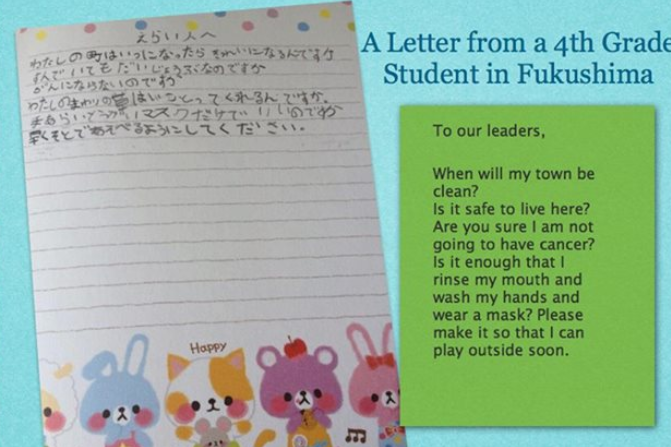
You Won’t BELIEVE What’s Going On at Fukushima Right Now

“…The fact that radioactive substances are still being released into the ground, the sea and the air is irrefutable proof that the nuclear disaster of March 2011 is not over. The responsible parties must take this situation gravely ….”
Submitted by George Washington on 08/01/2013 14:23 -0400
ZERO HEDGE
http://www.zerohedge.com/contributed/2013-08-01/fukushima-worse-you-know
You’ve heard bad news about Fukushima recently.
But it’s worse than you know.
The Wall Street Journal notes that radiation levels outside the plant are likely higher than inside the reactor:
NRA [Nuclear Regulation Authority] officials said highly contaminated water may be leaking into the soil from a number of trenches, allowing the water to seep into the site’s groundwater and eventually into the ocean.
***
Both radioactive substances are considered harmful to health. An NRA official said Monday that the very high levels were likely to be even higher than those within the reactor units themselves.
***
It was by far the highest concentration of radioactivity detected since soon after Japan’s March 2011 earthquake and tsunami ….
How could it be more radioactive outside the nuclear reactors? The reactors have lost containment, and experts have no idea where the nuclear cores are.
And the problems which have been detected at ground-level are only the tip of the iceberg. Japan Times points out:
Cesium levels in water under Fukushima No. 1 plant soar the deeper it gets, Tepco reveals
***
Tepco found 950 million becquerels of cesium and 520 million becquerels of beta ray-emitting radioactive substances, including strontium, in the water from 13 meters [~43 feet] underground.
Water from 1 meter down contained 340 million becquerels, and a sample from 7 meters down contained 350 million becquerels.
***
Cesium, a metallic element, is subject to gravity.
Yomiuri reports that highly-radioactive groundwater could start coming to the surface at the Fukushima plant:
TEPCO spokesman Noriyuki Imaizumi revealed the water level of the tainted groundwater in a test well located on the sea side of the No. 2 reactor has risen rapidly.
“If the water level continues to rise, it could reach the ground surface,” Imaizumi, an acting general manager of the company’s nuclear power-related division, said at a press conference Monday.
According to the company, the water level has risen about 70 centimeters over the past 20 days.
***
To prevent contaminated groundwater from leaking into the sea, TEPCO is working to reinforce the ground foundation of seawalls. The rising water level in the test well means the measures to prevent leakage have been working.
However, the company apparently failed to give much thought to the fact that the groundwater would have nowhere else to go ….
Even Tepco admits that the groundwater problems are due to a lack of planning. NHK points out:
[Tepco] learnt on Wednesday that its efforts to prevent radiation-tainted groundwater from seeping into the sea are failing.
***
TEPCO has been trying to solidify the embankment of the crippled power plant.
***
TEPCO says water levels in one of the contaminated wells have risen by about 1 meter since the work began in early July.
It says this is likely the result of its work to solidify the ground [to a depth of 16 meters], using chemicals.
The company says soil up to 2 meters below the ground cannot be hardened, and water may be seeping out.
In addition, a top expert says that radioactive water could be flowing beneath the seafloor … and could well up outside of the port “containment” zone:
Atsunao Marui, head of the Groundwater Research Group at the National Institute of Advanced Industrial Science and Technology, said, “Groundwater also flows beneath the seafloor, so it’s possible that contaminated groundwater could spring up outside the port.”
Marui added that water outside the port also needs to be carefully checked.
Reuters notes that the bolts in Fukushima’s tanks will corrode in just a few years, and a plant workers reveal — “Tepco says it doesn’t know how long tanks will hold”:
Experts say Tepco is attempting the most ambitious nuclear clean-up in history, even greater than the Chernobyl disaster ….
***
Radioactive water that cools the reactors …]mixes with some 400 tonnes of fresh groundwater pouring into the plant daily.
Abe pledges to seek to eliminate nuclear weapons
HIROSHIMA —
Aug. 06, 2013

Japan on Tuesday marked the 68th anniversary of the atomic bombing of Hiroshima with a somber ceremony to honor the dead and pledges to seek to eliminate nuclear weapons.
Some 50,000 people stood for a minute of silence in Hiroshima’s peace park near the epicenter of the 8:15 a.m. blast on Aug. 6, 1945, that killed up to 140,000 people. The bombing of Nagasaki three days later killed tens of thousands more, prompting Japan’s surrender to the World War II Allies.
Prime Minister Shinzo Abe said that as the sole country to face nuclear attack, Japan has the duty to seek to wipe out nuclear weapons.
The anniversary comes as Japan is torn over restarting nuclear power plants shut down since the massive earthquake and tsunami in 2011 damaged reactors at a plant in Fukushima, causing meltdowns. More than 100,000 people remain displaced because of radioactivity near the plant. Abe favors restarting plants under new safety guidelines, while many Japanese oppose such restarts.
In a “peace declaration” speech, Hiroshima’s mayor, Kazumi Matsui, chided the government for its efforts to restart the nuclear plants and to export nuclear technology to other countries.
“This summer, eastern Japan is still suffering the aftermath of the great earthquake and the nuclear accident. The desperate struggle to recover hometowns continues. The people of Hiroshima know well the ordeal of recovery,” Matsui said.
“We urge the national government to rapidly develop and implement a responsible energy policy that places top priority on safety and the livelihoods of the people,” he said.
A recent agreement on discussing nuclear energy cooperation with India, he said, would likely hinder efforts to abolish nuclear weapons.
The Allied powers have long argued that the twin attacks brought a quick end to the war by speeding up Japan’s surrender, preventing millions more casualties from a land invasion planned for later in the year.
Many atomic bomb survivors, known as “hibakusha”, oppose both military and civil use of nuclear power, pointing to the tens of thousands who were killed instantly in the Hiroshima blast and the many more who later died from radiation sickness and cancers linked to the attack.
Botswana – Radiation issue resurfaces after inspectorate is allocated land
Sebusang said of most concern is the fact that the minister of Infrastructure, Science and Technology, Johnie Swartz, under whom the RPI falls, never addressed the residents over the issue since the discussions started a few years ago.
by Reuben Pitse
04-08-2013
After a long battle, the Radiation Protection Inspectorate (RPI) has finally been awarded a piece of land by the Ngwato Land Board where a radiation facility will be constructed in Pilikwe Village in Tswapong North.
The issue has re-ignited divisions between villagers and government with the pressure group, which is against the project, threatening to sue the government over the issue.
The Director of the Radiation Protection Inspectorate, Thapelo Otukile, has confirmed to Sunday Standard that his department had been awarded a piece of land by the Ngwato Land Board that they have long applied for.
“The department has finally been allocated a piece of land in Pilikwe where the facility will be constructed,” he said.
He explained that the project was planned for implementation during the National Development Plan 10 when funds are available.
Otukile revealed that the facility is expected to be constructed before the year 2016, adding that “it should be emphasized that the facility is not a disposal site but an area where disused radiation source can be reconditioned to be brought back to the use or repackaged and sent back to the manufacturer”.
He said that it should be clearly understood that Botswana does not generate nuclear waste since there is no nuclear power plant that generates both liquid and solid nuclear waste.
He further stated that the country has no capacity and capability as well as land to dispose of such waste if it happened that the country has the capability of producing nuclear waste.
Otukele said his department was never at loggerheads with Pilikwe residents but instead, they engaged all the concerned parties and will continue to consult with their stakeholders because it is an ongoing process.
He pointed out that RPI mandate is to provide safe use of nuclear technology to protect the public, environment and users against adverse effects of ionizing technology.
“I am aware of the issue but as you know, I was elected early this year as the new councilor therefore I am not in a good position to comment on the issue as yet until after being briefed,” said Ace Moinami, the area councilor.
Village headman Bokopano Koodibetse declined to comment saying that he could not issue contradictory statements as there is a task force looking at the matter.
Dr Sebusang Sebusang, a member of the task force selected by the villagers, said he is very disappointed by the Ngwato Land Board for allocating RPI with a piece of land before they can conclude the negotiations.
“What the Land Board has done is really embarrassing,” he said.
He threatened that even though the department may have won and was allocated the site, the battle is not yet over as the task force may consider taking the legal route as a last resort.
“We want both parties to engage each other rather than taking the legal route, which should not be the case,” he said.
Sebusang said of most concern is the fact that the minister of Infrastructure, Science and Technology, Johnie Swartz, under whom the RPI falls, never addressed the residents over the issue since the discussions started a few years ago.
“We still want the minister to address the residents of Pilikwe,” he said.
Sebusang added that they have realized that there is no political will to address the issue.
He appealed to the government for an amicable resolution of the matter.
Meanwhile some residents say that they “will do what it takes to defend our village as the project will bring disaster to our village”.
They claimed that there are few individuals within the village and in Gaborone who they labeled as “sell outs” who they allege go against the will of the people as they have connections with the high ranking officials.
“We know these sell outs as well as their agenda and will do our best to defeat their intentions.”
http://www.sundaystandard.info/article.php?NewsID=17490&GroupID=1
Amber warning: Britain’s ageing nuclear submarines a risk
HMS Tireless suffered a reactor coolant leak off the west coast of Scotland in February, which lasted 192 hours. In a separate incident, the same sub released radioactive air into the environment which the MoD insisted was “well within the normal permitted limits for discharges to the environment”.
“It seems as if admirals in Whitehall have overruled nuclear safety by demanding that the remaining elderly boats are held in service as a string and sticky-tape stopgap measure,” said Large.

http://www.scenereleases.eu/amber-warning-britains-ageing-nuclear-submarines-a-risk-navys-watchdog/
5 August 2013
Five Trafalgar class submarines, some of which are almost 30-years-old, are suffering reliability issues with their nuclear reactors, according to a report put online by the Ministry of Defense (MoD) that covers 2012-2013. The UK’s Royal Navy nuclear safety watchdog, the Defense Nuclear Safety Regulator (DNSR), said that while at the moment problems are being dealt with, it issued an amber warning that “attention is required to ensure adequate safety performance.”
The hunter-killer submarines, which were launched between 1984 and 1991, are expected to operate for at least 33 years with the final sub in the class, HMS Triumph, not expected to be mothballed until 2022. “As a result, the Trafalgar class are operating at the right hand end of their ‘bathtub’ reliability curves”, warns the DNSR. This means that the number of reliability problems experienced by the boats increases dramatically as they reach the ends of graphs shaped like bathtubs.
All technical issues which have emerged in the last few years “can be directly attributed to the effects of aging,” the MoD states. The Trafalgar class subs were already meant to have been in the knackers yard but have been forced into staying at sea longer because of prolonged delays with their replacement Astute class boats.
After billion pound budget overruns on top of serious construction and teething problems, only two of the seven planned attack submarines are in service with the Navy. There have been several accidents on board Trafalgar class submarines in recent years.
In the Dark With Tepco: Fukushima’s Legacy for Nuclear Power
The Asia-Pacific Journal, Vol. 11, Issue 30, No. 3, August 5, 2013.
In the Dark With Tepco: Fukushima’s Legacy for Nuclear Power
Andrew DeWit
The sad saga of Fukushima, with its recurrent revelations of incompetence and obfuscation, carries on. Among the latest, as related in detail in this July 31 Reuters article, are radioactive releases into the sea, unexplained ventings of steam, and the lack of a credible plan to deal with a daily 400-tonne influx of groundwater. Tokyo Electric, or TEPCO, is clearly unable or unwilling to devote the resources necessary to resolve this crisis, which will continue for decades. As United Nations University research fellow Christopher Hobson argues, the only solution is for the government to take over.
Tepco is desperate to survive. Japan’s most loathed firm – and a millstone for the global nuclear business – it recently hired British-American Lady Barbara Judge, chair of the UK Atomic Energy Authority from 2004 to 2010, and still its honorary chairwoman, to oversee its safety campaign. This employment of a foreign woman, to put a new face on Tepco was announced in early July. But that aggressive public relations move did not stop Tepco from being chary with the truth on the release of radioactive water into the ocean. Tepco had denied these releases for months, in the face of accumulating evidence and a chorus of criticism that included the Japanese Nuclear Regulation Authority (NRA). It apparently confirmed the releases on July 18.
Barbara Judge with Tepco President Hirose Naomi
But true to form, Tepco appears to have held back official release of this information pending the outcome of the July 21 Upper House elections.
Moreover, as the following article highlights, a Reuters investigation from last December showed that Tepco is making limited, if any, use of overseas business expertise on the various aspects of reactor decommissioning and clean–up. So its deployment of Lady Judge does indeed appear – to recycle an apt phrase – to be putting lipstick on a pig.
One narrative emerging from nuclear advocates is that the Fukushima Daiichi reactors were outdated and poorly maintained because Tepco ran them as a cash cow while focusing resources on fixing its Kashiwazaki-Kariwa reactors. So perhaps we can understand the recent ineptness at Fukushima as more of the same. The seven reactors at Kashiwazaki-Kariwa comprise the world’s largest nuclear plant, which had been shut down by the 2007 Chuuetsu offshore earthquake. The earthquake caused fire and radiation leaks, severely damaging the seven reactors. Tepco was eager to get them back online before Fukushima; and now its prospects of returning to profitability rely heavily, if not entirely, on restarting at least some of the power generation capacity at this plant.
Indeed, the July 2012 partial nationalization of the utility by the hapless Democratic Party government was predicated on a March 2013 restart of some of the Kashiwazaki-Kariwa reactors. The promise of restarts was the assurance of viability in order to encourage the banks to continue lending to the utility.
Kashiwazaki-Kariwa reactors
Seen from another perspective, Tepco’s shenanigans at Fukushima Daiichi are all the more incredible. For one thing, restarts at Kashiwazaki-Kariwa remain opposed by Niigata Prefecture Governor Izumida Hirohiko, and Tepco just handed him a whole lot of political capital and credibility on this point.
Moreover, restarts are contingent on safety checks that include inspection of seismic zones. Japan’s NRA has limited staff, and only about 80 in 3 teams of inspectors. The NRA will now be forced to focus more scarce resources on Fukushima Daiichi while being even more careful in inspecting the 10 reactors at 5 plants for which four utilities have filed restart applications. These inspections were already expected to take several months, per reactor. Compounding Tepco (and the other utilities’) problems is the fact that the risk of earthquakes in Japan appears to have been increased by the major series of seismic events centered on the March 11, 2011 magnitude 9.0 Great East Japan Earthquake.
Another Tsunami?
Considering the goings-on at Fukushima, it is impossible to imagine what mischief Tepco and its allies are up to. But they may be in the path of another tsunami. As Keio University’s Kaneko Masaru points out in a new Iwanami Shoten booklet (published August 3) titled (in Japanese) “Nuclear Costs More than Conventional Thermal Power,” the monopoly utilities are probably bankrupt. He shows in careful detail that once all the costs of Fukushima and other matters are added up and priced into power, nuclear generation is an astounding YEN 23.5 per kilowatt-hour, well over the YEN 8-9/kWh for thermal power and a far cry from the YEN 5-6/kWh calculated for nuclear back in 2004.
Scandal in South Korea Over Nuclear Revelations
“… With each new revelation, South Koreans — who, like the Japanese, had grown to believe their leaders’ soothing claims about nuclear safety — have become more jittery. Safety is the biggest concern, but the scandals have also caused economic worries. At a time of slowing growth, the government had loudly promoted its plans to become a major builder of nuclear power plants abroad.
The scandal, Professor Suh said, “makes it difficult to continue claiming to build reliable nuclear power plants cheaply.” …”
SEOUL, South Korea
NY Times
4th August 2013
— Like Japan, resource-poor South Korea has long relied on nuclear power to provide the cheap electricity that helped build its miracle economy. For years, it met one-third of its electricity needs with nuclear power, similar to Japan’s level of dependence before the 2011 disaster at its Fukushima plant.
Seoul city employees used fans on Friday to cope with power shortages. The closing of nuclear reactors has set off a campaign to save energy.
Now, a snowballing scandal in South Korea about bribery and faked safety tests for critical plant equipment has highlighted yet another similarity: experts say both countries’ nuclear programs suffer from a culture of collusion that has undermined their safety. Weeks of revelations about the close ties between South Korea’s nuclear power companies, their suppliers and testing companies have led the prime minister to liken the industry to a mafia.
The scandal started after an anonymous tip in April prompted an official investigation. Prosecutors have indicted some officials at a testing company on charges of faking safety tests on parts for the plants. Some officials at the state-financed company that designs nuclear power plants were also indicted on charges of taking bribes from testing company officials in return for accepting those substandard parts.
Worse yet, investigators discovered that the questionable components are installed in 14 of South Korea’s 23 nuclear power plants. The country has already shuttered three of those reactors temporarily because the questionable parts used there were important, and more closings could follow as investigators wade through more than 120,000 test certificates filed over the past decade to see if more may have been falsified.
In a further indication of the possible breadth of the problems, prosecutors recently raided the offices of 30 more suppliers suspected of also providing parts with faked quality certificates and said they would investigate other testing companies.
“What has been revealed so far may be the tip of an iceberg,” said Kune Y. Suh, a professor of nuclear engineering at Seoul National University.
Ian Crane interviewed on Fracking in the UK and includes BBC banned interview!
This video is the first that UK column has refused the embed option for bloggers. I will endeavour to find out if this is a YOU TUBE block or a decision by the UK column team. I will leave a message for the team and report on this below when i find out.
Streamed live on 1 Aug 2013
Louise Collins and Brian Gerrish with a news update from the UK Column, following which Patrick Henningsen will interview Ian Crane about the increasing opposition to fracking in the UK. The interview begins at about 32 minutes. Ian Crane talks about his banned BBC interview, Having his web site hacked during a media pro fracking campaign, Halliburtons use of depleted uranium munitions to start fracking wells.
Ian Crane also discusses the financial pressures on politics and media to accept the industry statements on safety. Mr Crane also discusses how local communities are bribed to accept the industry but not informed of other issues such as house price drop, contamination issues and pressure on local infrastructure from the industries business activities.
The issue of a lack of transparency is discussed.
-
Archives
- October 2026 (104)
- September 2026 (339)
- August 2026 (330)
- July 2026 (355)
- June 2026 (287)
- May 2026 (306)
- April 2026 (356)
- March 2026 (251)
- February 2026 (267)
- January 2026 (308)
- December 2025 (358)
- November 2025 (359)
-
Categories
- 1
- 1 NUCLEAR ISSUES
- business and costs
- climate change
- culture and arts
- ENERGY
- environment
- health
- history
- indigenous issues
- Legal
- marketing of nuclear
- media
- opposition to nuclear
- PERSONAL STORIES
- politics
- politics international
- Religion and ethics
- safety
- secrets,lies and civil liberties
- spinbuster
- technology
- Uranium
- wastes
- weapons and war
- Women
- 2 WORLD
- ACTION
- AFRICA
- Atrocities
- AUSTRALIA
- Christina's notes
- Christina's themes
- culture and arts
- Events
- Fuk 2022
- Fuk 2023
- Fukushima 2017
- Fukushima 2018
- fukushima 2019
- Fukushima 2020
- Fukushima 2021
- general
- global warming
- Humour (God we need it)
- Nuclear
- RARE EARTHS
- Reference
- resources – print
- Resources -audiovicual
- Weekly Newsletter
- World
- World Nuclear
- YouTube
-
RSS
Entries RSS
Comments RSS

