And the mass media in these situations have no options but to follow the government line. It’s not just limited to the Japanese media; look at what happened to the U.S. media after the Sept. 11, 2001, terrorist attacks.
Computer read article for convenience (reasonable quality), article transcript below
In December 1990, journalist Toyohiro Akiyama made headlines the world over when he blasted off aboard a Soviet rocket to become the very first “space correspondent” in history.
The Soyuz capsule with the 47-year-old Tokyo Broadcasting System reporter strapped inside later docked with the Mir space station as part of an unprecedented $10 million (¥1.5 billion) deal between the USSR’s cash-starved space agency and the ratings-hungry private TV network.
Akiyama then spent nine days in space, broadcasting live his zero-gravity experiences and describing experiments he was conducting.
Besides being the first reporter in space, Akiyama was also the first Japanese to ever leave Earth’s atmosphere. That distinction fell to him because Mamoru Mohri, who the National Space Development Agency of Japan had selected for an earlier NASA mission to the Space Station, had to endure a delayed departure following the 1986 Challenger disaster.
For Akiyama, who underwent more than a year of medical checks, training, lectures on space engineering — and Russian-language study — in and near Moscow, his Dec. 2, 1990 liftoff from Baikonur Cosmodrome in present-day Kazakhstan was a perfect opportunity to fulfill his dream of reporting news live from space.
Throughout his long career, which has included covering politics and diplomacy in Tokyo and Washington, he says he always believed in the power of TV journalism and the impact on viewers of live broadcasting.
Nonetheless, in 1995 — just five years after he’d marveled at the beauty of the Earth from 400 km away — he quit the TBS network and moved to the countryside. He insists that was no career change, but the natural extension of his journalistic drive for hands-on knowledge and experience — in this case of eating, “the most basic human activity,” as he sees it, and food production.
At that time Akiyama left his wife and two children behind in Tokyo and settled in the Fukushima Prefecture town of Takine, nestled in the Abukuma Mountains that stretch from Ibaraki Prefecture in the south to Miyagi Prefecture in the north. There, he started growing vegetables to eat, as well as shiitake mushrooms that he sold for a living.
But just as fate had intervened to make him Japan’s first-ever astronaut, Akiyama’s life was again changed by events beyond his control — this time the Great East Japan Earthquake of March 11, 2011, and the meltdowns of three reactors that followed at the Fukushima No. 1 nuclear power plant operated by Tokyo Electric Power Co. (Tepco).
His Takine home was only 32 km from there and, though he neither had a television nor newspapers delivered to his home, he was quick to react. On March 12, he packed a few valuables, hung a portable radiation detector around his neck and drove his truck to the city of Koriyama 60 km away from the disabled nuclear plant.
As a former newsman, Akiyama was well aware not only of official reactions to the 1986 Chernobyl disaster and other nuclear accidents in the past, but also of the workings of Japan’s “nuclear village” — the cozy pronuclear network of politicians, government officials, bureaucrats, power-company elites and the media. Consequently, he knew that the Tokyo government would withhold vital information on radiation risks to “maintain law and order,” he says.
So, as the nuclear crisis continued seemingly unchecked, he moved further away to Gunma Prefecture, where a farmer friend offered refuge. As he says, he has had no option but to abandon his Fukushima home and business, as the mushrooms are now contaminated with radiation.
Then, in November 2011, Akiyama took a post as a professor at Kyoto University of Art and Design. It was there, in a prefab hut beside a vegetable field atop a hill on the main campus, that the 71-year-old Tokyo native sat down for a three-hour chat with The Japan Times. As well as recalling his childhood, his career as a journalist and his pioneering trip into space as a reporter, he also shared his thoughts on the political environment that made the Japanese TV network’s space project a reality, why he thinks farming is a journalistic endeavor — and the challenges facing the antinuclear movement and its possibilities.
Let me first ask you about your childhood. I was surprised to read that you say you were rather withdrawn when you were young. Is that really so?
I grew up in the Seijo district of Setagaya Ward in Tokyo as an o-bocchama (a boy from a well-to-do family). I was withdrawn and didn’t want to be away from my nanny, who raised me.
Hiroshi Komiyama, head of the Mitsubushi research institute discusses Japans energy future with Matthias Kleiner who oversaw the move away from nuclear in Germany
[Editors note ; i am not responsible for the content of this video 🙂 Arclight2011)
Published on 9 Aug 2013
This week, the Japanese government announced that it believes stricken nuclear reactors at Fukushima are leaking 300 tons of radioactive water into the ocean every day. LinkAsia speaks with Dale Klein, former chairman of the US Nuclear Regulatory Commission and current head of Tokyo Electric and Power Company’s Nuclear Reform Monitoring Committee, about the leak.
PHOTO: A worker walks in front of water tanks at Tokyo Electric Power Company’s (TEPCO) tsunami-crippled Fukushima Daiichi nuclear power plant in Fukushima prefecture June 12, 2013. REUTERS/Noboru Hashimoto
TEPCO starts pumping to prevent water leak The operator of the Fukushima Daiichi nuclear power plant has begun pumping up radioactive groundwater there to keep it from flowing into the sea. Tokyo Electric Power Company dug a small well near an embankment facing the sea and began the pumping at about 2 PM on Friday. The pumped-up water is moved to an underground trench and then stored in tanks in the plant’s compound. The utility has hardened soil near the embankment since last month to prevent tainted groundwater from seeping into the sea.
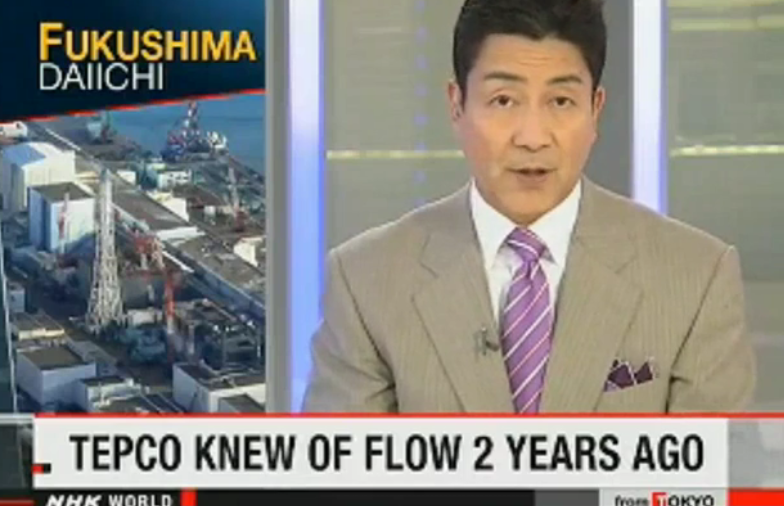
TEPCO knew about water flow two years ago A spokesperson for Tokyo Electric Power Company says the company has known for the past 2 years that a massive amount of groundwater was flowing beneath the Fukushima Daiichi power plant. Masayuki Ono said on Friday that TEPCO experts estimated hundreds of tons of the water could reach the ocean daily. Ono said the estimate was based on rough records of groundwater that TEPCO workers had collected. Until last month, TEPCO officials had denied the possibility that contaminated groundwater was leaking into the ocean. Ono said he is unable to explain why it took two years to disclose this fact. Aug. 10, 2013 – Updated 07:48 UTC
TEPCO:Underground wall not effective against leaks The operator of the damaged Fukushima nuclear power plant has confirmed that an underground wall is unable to keep contaminated groundwater from seeping into the sea. Officials of the Industry Ministry estimate that 300 tons of groundwater pass through the contaminated area before flowing into the Pacific Ocean every day. Engineers with Tokyo Electric Power Company have hardened the soil along the coast to create a 100-meter-long underground wall. They injected chemicals into the ground to a depth of 16 meters. But it is technically difficult to harden the soil up to 1.8 meters from the surface. The workers recently dug a well just inside the wall to see how the level of underground water has risen due to the construction of the wall. They found that the water level in the well was about 60 centimeters higher than the top of the wall. The operator began pumping up contaminated groundwater on Friday, as a temporary measure to lower the water level.
A deal has been struck between Iran and the Zimbabwe government which would see the country sell raw materials for nuclear weapons to the Middle Eastern state, Telegraph report.
Gift Chimanikire, the Zimbabwean Deputy Mining Minister, told the Times newspaper that a memorandum of understanding had been signed to export uranium to Tehran, a move likely to prompt alarm in western capitals, particularly in Washington.
The United States and the European Union have imposed crippling sanctions on Iran over its nuclear programme, which Tehran insists is for peaceful energy uses but which they fear is intended to build a bomb.
Zimbabwe is also subject to international sanctions over its human rights record and its state-owned mining companies are banned from international trade, but a deal with Tehran circumnavigates such restrictions.
A report compiled by the United Nations’ nuclear watchdog more than two years ago warned of such an outcome, detailing a visit from Iran’s then Foreign and Co-operative Ministers to Zimbabwe to strike a deal, with the Iranians also sending engineers to assess uranium deposits.
Chimanikire told the Times that a deal had been reached last year.
A Chinese company has been surveying yellow-cake deposits in the far northeast of the country and the Zimbabwe government has been actively looking for buyers, according to Mr Chimanikire, who, as an opposition politician, served in the outgoing coalition Government under President Robert Mugabe.
TAIPEI, Taiwan – Taiwan’s government watchdog has said a small leak at one of the island’s three nuclear power plants has yet to be halted 3 1/2 years after it started.
The report comes as the island’s legislature is mired in a debate on whether to hold a referendum on operating a fourth nuclear plant, scheduled to open in 2016.
Officials at the Shihmen plant, north of Taipei, say the leak cited by the watchdog body is condensate from vapour generated by routine maintenance and posed no threat to the environment or to plant staff.
Nuclear power is a lightning rod issue in Taiwan, particularly after the 2011 Fukushima disaster in nearby Japan.
No Advisories – program content screened and verified.
Summary: Dr. Sternglass has had his books burned along with others on the dangers of mercury and how to fight polluters. Most destructive to the ozone layer are radioactive gases. Nuclear power plants are designed to leak radioactive gasses even when operating properly. Milk around nuclear power plants is diluted and shipped out of State and into big cities to obscure the effect nuclear power plants have on milk causing low birth weights and miscarriages. A few months after Chernobyl there was a sharp increase in the number of AIDS cases. Exposure to continuous low level radiation increases ones likelihood of developing Cancer and AIDS. Radiation exposure depletes the immune system. If the immune system is strengthened one can cope with or overcome these diseases.
The Arizona Geological Survey has a new report on the age of young volcanic rocks near the Palo Verde nuclear power plant. The report was produced over concern of geologic hazards near the generating station.
You can download the full report here and a video abstract here.
The report concerns the Sentinel – Arlington volcanic field which extends over about 50 miles from Sentinel volcanic field west of Gila Bend northeastward to Arlington volcano west of Buckeye. That puts it within 6 miles of the power plant.
Arlington Volcano is located 6 miles southeast of the power plant. Six potassium-argon radiometric dates of basalt rock samples from Arlington volcano range from 1.28- to 3.28 million years old. Although there is a two-million-year spread in the age dates, AZGS notes that the Arlington “volcano is geologically simple, consisting of a single, small, low-relief volcano with no soil horizons between flows. Most likely it was erupted in a single volcanic episode of short geologic duration (<10,000 years), …about 2.1 million years ago.
Gillespie volcano occurs about 12 miles south of the Palo Verde Nuclear Generating Station. It is a morphologically similar low shield volcano without soil horizons or multiple eruptive centers. Four of five potassium-argon dates range from 2.67- to 3.6 million years, suggesting an age of 3 million years. AZGS infers that this eruption temporarily dammed the Gila River.
The report goes on to discuss other volcanoes more distant from the Palo Verde nuclear station. The AZGS report concludes with a caveat:
“The Sentinel – Arlington volcanic field produced extensive, low relief basalt lava flows and small, gently sloping basalt shield volcanoes. Available geochronologic data suggest that the Sentinel – Arlington volcanic field has erupted intermittently over the past 1.1-3.5 Ma, with no clear migration of volcanic activity within the field. Although there is no geochronologic evidence for eruptions during the past one million years, the large range of geochronologic dates from the Sentinel volcanic field, the uncertainties inherent in many of the older potassium-argon dates, and the large number of eruptive centers, allow for the possibility of more recent activity that is as yet undocumented.”
…The group also called for the Japanese government to abolish the upper limit on medical bills for overseas atomic bomb victims, to share the medical records of overseas victims, and to apply the victims’ support act to victims living in North Korea…
An estimated 10,000 Koreans perished in the 1945 bombing; most had been forcibly mobilized to Japan
Posted on : Aug.10,2013
Ethnic Korean residents of Japan and descendants of the Korean victims of the 1945 nuclear bombing of Nagasaki, along with members of civic groups, hold a moment of silence at a commemorative event in Nagasaki, August 9. (by Ahn Gwan-ok)
By Ahn Gwan-ok, Gwangju correspondent in Nagasaki
A commemorative gathering to bring peace to the souls of Koreans killed in the nuclear attack was held in Nagasaki on Aug. 9, exactly 68 years after the nuclear bomb was dropped on the city. On Aug. 9, 1945, the US dropped a nuclear bomb on Nagasaki, a city of 240,000 people.
73,884 people were killed in the blast, including an estimated 10,000 Koreans who were living in Nagasaki at the time. About 200 people, including members of a citizen group for defending the human rights of Korean-Japanese in the Kyushu region of Japan and North Koreans living in Nagasaki, took part in the 68th commemorative gathering for bomb victims.
The gathering took place in front of a cenotaph for Korean victims of the nuclear attack, which is located near a park in Heiwa-machi, Nagasaki, which marks ground zero of the blast.
“Japan calls itself the only country in the world to have been attacked by a nuclear bomb, but it ignores the existence of Koreans who suffered the double and triple damage of being pressed into work gangs [during the Japanese colonial occupation of Korea] and then being hurt in the nuclear attack,” said Yasuhiro Takazane, president of the group, during his address.
For Seoul residents, South Korea’s decision to keep four nuclear reactors offline because of faked safety reports means power shortages, and a summer of sweltering homes and offices. Lee Jin Gon has bigger concerns.
“We feel unsafe day and night,” Lee said, pointing at the cause of his nervousness, one of the closed reactors in the town of Yangnam, a four-hour journey southeast of the capital. “We became worried about nuclear safety after the Fukushima accident. Now it’s worse,” he said, adding that locals have held protests to close the whole plant.
Lee, 60, is emblematic of growing opposition to atomic power in South Korea, a movement galvanized by the meltdown of three reactors in neighboring Japan’s Fukushima in 2011. It gained more support when an investigation found nuclear plants were using components with faked safety certificates. That cost Kim Kyun Seop his job as head of state-run Korea Hydro & Nuclear Power Co., which runs the 23 operating reactors.
The anti-nuclear lobby is forcing President Park Geun Hye to take note. Her administration said it will review the role of nuclear power to reflect “social acceptability” in its energy plan due by the end of this year. The government had planned to build more reactors to cope with electricity demand it forecast to surge almost 60 percent by 2027.
Surveys show nuclear power is becoming increasingly socially unacceptable. Sixty-three percent of respondents to a March survey by pollster Hangil Research said they consider domestic reactors unsafe. That compared with 54 percent in a year earlier poll by the non-profit Korean Federation for Environmental Movement.
Reactor Isolation
In Yangnam, Lee, head of the local branch of Nonghyup, the nationwide cooperative federation of farmers, says concern that nuclear power isn’t safe is damaging sales of the area’s rice and other farm produce.
In the aftermath of yet another Pakistani transgression, we are back to the tired old arguments about whether or not India should be talking to Pakistan. Proponents argue that nothing has been gained whenever India stopped talking to Pakistan, as it did after every major provocation. Their opponents argue that dialogue has not stopped Pakistan’s provocations.
Both sides are right and therein lies the simple truth that New Delhi refuses to acknowledge: dialogue or the lack of it has little impact on Pakistan. The reason Pakistan continues to provoke is that India has eschewed any retaliation for fear of nuclear escalation. Because Pakistan does not fear Indian retaliation, India’s deterrence is dead. To prevent Pakistani provocations, India needs to resurrect its deterrence and that requires considering using military force.
Pakistan’s nuclearisation has ended India’s ability to deter Islamabad from provocations. Consequently, Pakistan has provided unprecedented levels of support to terrorist groups, which includes not only terrorist attacks in India but also against the Indian mission in Afghanistan.
Fearing nuclear escalation, both the BJP and the UPA governments have limited their responses to diplomatic protests and calling off dialogue. These are ineffectual responses that only serve to illustrate Indian helplessness. Pakistan knows that India will eventually have to return to talks.
Strategic Stupidity
It is not as if Indian leadership has been unaware of the problem. After Kargil, then defence ministerGeorge Fernandes and army chief General VP Malik suggested that India could explore limited conventional war options that would punish Pakistan without risking escalation.
Unfortunately that idea has not been pursued. After Operation Parakram, the Indian Army proposed a “cold start” doctrine. It was a plan for faster mobilisation because one lesson of Operation Parakram was that Indian military mobilisation took very long, which allowed international pressure and strategic secondguessing to undermine the Indian leadership’s will to order a military retaliation. But Cold Start envisaged a much larger war and it might not be an appropriate response for anything but a catastrophic terrorist attack.
Also, Pakistan’s introduction of short-range tactical nuclear weapons has increased New Delhi’s apprehensions. In any case, at least formally, the Indian Army has discarded Cold Start.
Indian leaders have further undermined our deterrence by repeatedly proclaiming that they do not want war. This is the one point on which there is consensus in New Delhi but consensus is not wisdom. Even if war is not an option, taking it off the table is the height of strategic stupidity. As long as India is unable to threaten Pakistan with military retaliation, Pakistan has little incentive to stop supporting terrorist actions against India. Diplomacy provides few useful responses.
Stopping the dialogue is a shortterm measure that will not deter Pakistan. Seeking international support is equally useless because even if the other powers support India diplomatically — which itself is a mighty big if considering Pakistan’s talent for leveraging its strategic location — it will have little impact on Pakistan, as they have repeatedly demonstrated. Diplomacy can aid military power but it cannot replace it.
Retaliatory Option
India needs to consider all of its options, including the use of force. While force should not be the first option for all problems, force has to be an option at least in responding to attacks. The fear that any military operation would automatically result in nuclear escalation is halfbaked wisdom from a superficial reading of Cold War history.
The nuclear relationship between Washington and Moscow was very different because both sides deployed nuclear weapons on a hairtrigger, which meant that the slightest disturbance had the potential to set off a nuclear conflagration.
That is not the situation in South Asia where neither side deploys ready-to-use nuclear weapons. Pakistan refuses to join India in adopting a no-first-use of nuclear weapons pledge, which is understandable, given their inferiority in conventional military strength.
But this is taken as an indication of Pakistan’s irrationality, which only strengthens Pakistan’s deterrence because it effectively paralyses the Indian leadership.
Pakistan might have a first-use doctrine but it is first-use as last resort, much as Israel keeps nuclear weapons to ensure its survival. First use does not mean Pakistan will lob nuclear bombs as soon as the first Indian soldier crosses the border. As long as Indian action does not threaten the survival of the Pakistani state, it is unlikely that Pakistan will reach for nuclear weapons.
India does have the option of engaging in limited military retaliation, especially in PoK. Civilian and military leaders need to jointly reconsider the Fernandes-Malik proposals so that military retaliatory options are available to deter Pakistan and, if deterrence fails, to respond to Pakistan’s provocations.
Without it, we will be condemned to repeat the facile dialogue-no dialogue debate after the next provocation, which is surely coming.
The writer is Professor of International Politics, JNU, Delhi
SMRs will still present enormous financial risks, but that risk would be shifted from the reactor site to the supply chain and the assembly lines. Shifting from the present behemoths to smaller unit sizes is a financial risk shell game, not a reduction in risk.”
PR Newswire
$90 Billion in Initial Manufacturing Order Book Needed, Requiring Massive Involvement by the Chinese or Taxpayer-Backed Federal Subsidies; Major Implications Seen for Companies and SMR Test Sites in FL, MO, NC, OR, PA, SC, and TN.
WASHINGTON, Aug. 8, 2013 /PRNewswire-USNewswire/ — A shift to “small module reactors” (SMRs) is unlikely to breathe new life into the increasingly moribund U.S. nuclear power industry, since SMRs will likely require tens of billions of dollars in federal subsidies or government purchase orders, create new reliability vulnerabilities, as well as serious concerns in relation to both safety and proliferation, according a report issued today by the nonprofit Institute for Energy and Environmental Research (IEER) think tank .
The IEER report has implications for SMR companies headquartered or with planned test sites in Florida, Missouri, North Carolina, Oregon, Pennsylvania, South Carolina, and Tennessee.
Titled “Light Water Designs of Small Modular Reactors: Facts and Analysis,” the IEER report focuses on light water reactor (LWR) SMR designs, the development and certification of which the U.S. Department of Energy (DOE) is already subsidizing at taxpayer expense. The four leading SMR designs are: mPower Reactor by Charlotte, NC-headquartered Babcock & Wilcox Company, which, in partnership with the Tennessee Valley Authority, could get from the DOE up to $226 million in federal funding, of which $79 million has been secured; Westinghouse Electric, headquartered in Pittsburgh, PA., and now working with Missouri-based utility Ameren to secure DOE funding for design and certification of the Westinghouse SMR; Jupiter, FL-based Holtec, the subject of a DOE agreement for the construction of a Holtec SMR test unit at the Savannah River Site, a nuclear-weapon materials facility near Aiken, S.C. and NuScale Power, a Corvallis, OR. Company, which has signed an agreement with the DOE to build a NuScale Power SMR demonstration unit at the Savannah River Site.
Key conclusions of the IEER report include the following:
$90 billion manufacturing order book could be required for mass production of SMRs. As the report notes: “SMR proponents claim that small size will enable mass manufacturing in a factory and shipment to the site as an assembled unit, which will enable considerable savings in two ways. First, it would reduce onsite construction cost and time; second, mass manufacturing will make up in economies of volume production what is lost in economies of scale. In other words, modular reactors will be economical because they will be more like assembly-line cars than hand-made Lamborghinis ?¦ A hundred [mPower] reactors, each costing about $900 million, including construction costs ?¦ would amount to an order book of $90 billion, leaving aside the industry’s record of huge cost escalations. This would make the SMR assembly- line launch something like creating a new commercial airliner, say like Dreamliner or the Airbus 350 ?¦ SMRs will still present enormous financial risks, but that risk would be shifted from the reactor site to the supply chain and the assembly lines. Shifting from the present behemoths to smaller unit sizes is a financial risk shell game, not a reduction in risk.”
Who pays?: China or massive federal subsidies … or both. As the report notes, the industry’s forecast of relatively inexpensive individual SMRs is predicated on major orders and assembly line production. However, “China, where 28 reactors are under construction, already has a much better supply chain than the United States. So the U.S. government subsidies to B&W, TVA, and Westinghouse and others may pave the way for an assembly line in China! In fact, Westinghouse has already signed a memorandum of understanding with China’s State Nuclear Power Technology Corporation ‘to develop an SMR based on Westinghouse SMR technology.’ … The alternative to Chinese manufacture would be federal government subsidies to set up manufacturing in the United States.” Westinghouse has claimed that U.S. reactor orders would be sourced in the U.S. ?? but would require two supply chains. Already, there is discussion of billions of dollars in additional federal subsidies for SMRs to do what the private marketplace will not.
SMRs will lose the economies of scale of large reactors. As the report notes: “Nuclear reactors are strongly sensitive to economies of scale: the cost per unit of capacity goes up as the size goes down. This is because the surface area per kilowatt of capacity, which dominates materials cost and much of the labor cost, goes up as reactor size is decreased. Similarly, the cost per kilowatt of secondary containment, as well as independent systems for control, instrumentation, and emergency management, increases as size decreases ?¦ For these reasons, the nuclear industry has historically built larger and larger reactors in an effort to benefit from economies of scale. The four designs would reduce the size of each reactor considerably: by a factor of five (Westinghouse) to a factor of 25 (NuScale) relative to the reactors now being built in Georgia and South Carolina. Such large size reductions imply significant increases in unit cost due to loss of economies of scale.” It is highly questionable whether mass manufacturing cost reduction can make up for the cost escalation caused by loss of economies of scale.
Arjun Makhijani, Ph.D., nuclear engineer and president, Institute for Energy and Environmental Research, and author of the SMR report, said: “SMRs are a poor bet to solve nuclear power’s problems and we see many troubling ways in which SMRs might actually make the nuclear power industry’s current woes even worse. SMRs are being promoted vigorously in the wake of the failure of the much-vaunted nuclear renaissance. But SMRs don’t actually reduce financial risk; they increase it, transferring it from the reactor purchaser to the manufacturing supply chain. Given that even the smaller risk of projects consisting of one or two large reactors is considered a ‘bet my company’ risk it is difficult to see that Wall Street would be interested in betting much larger sums on financing the SMR supply chain without firm orders. But those orders would not be forthcoming without a firm price, which cannot be established without a mass manufacturing supply chain. This indicates that only massive federal intervention with tens of billions of dollars in subsidies and orders could make mass-manufacturing of SMRs a reality in the United States.”
M.V. Ramana, Ph.D., Nuclear Futures Laboratory and Program on Science and Global Security, Woodrow Wilson School of Public and International Affairs, Princeton University, said:“SMRs would likely increase proliferation risks. My colleagues at Princeton University and I analyzed the proliferation risks of SMRs of various kinds ?¦ and concluded that the proliferation risks would increase significantly unless specific design and safeguards steps were taken to mitigate them. Left unaddressed risk increases by about 45 percent compared to current light water reactors for an equivalent power capacity. This risk increase does not include the inspection problems attendant upon a larger geographic dispersal that may accompany small modular reactors. The safeguarding of the reactors and spent fuel would be a more difficult and complex task than with the large reactors of today.”
Dr. Makhijani added: “Without huge federal subsidies, the SMR supply chain is likely to emerge in other countries, probably China, even if the designs are proven and tested in the United States. Why would China order large numbers of U.S. reactors when it can set up its own supply chain and can manufacture industrial goods more cheaply? It is fanciful and impractical to believe that SMRs can bring large numbers of industrial jobs to the United States in a globalized world economy governed by World Trade Organization rules. Efficiency improvements and wind-generated electricity, are already cheaper than new large reactors. On the other hand, commercialization of SMRs will require mass manufacturing facilities for the entire supply chain, which will take a decade or more, if there are sufficient orders. By that time, a distributed grid based on renewable energy is likely to be a reality, eliminating the need for a new generation of nuclear reactors large or small.”
Other key report findings include the following:
SMRs could reduce some safety risks but also create new ones, particularly if current reactor rules are relaxed. Key elements of SMRs would be underground. “These [safety] features [of SMRs] would reduce some risks. But they could create new problems as well. For instance, they could aggravate the problem of flooding ?¦ Safety improvements may be reduced because SMR proponents are already arguing for changes in regulations to reduce costs. For instance, the current mPower design would have just three personnel for operating for two reactors ?? an operator for each reactor and one supervisor overseeing them both. This raises serious safety questions ?? will three operating staff be able to adequately respond to and manage a serious accident? Reducing security requirements, the plant exclusion zone, and the 10-mile emergency planning zone are other industry regulatory goals for SMRs.”
It breaks, you bought it: No thought is evident on how to handle SMR recalls. “Millions of cars, presumably made to high quality control are routinely recalled. The most comparable example in terms of the size of the supply chain and overall order books for SMRs would be passenger aircraft. Boeing Dreamliners were presumably rigorously designed, tested, and certified before they entered into service. But battery failures, including a fire in flight resulted in a worldwide grounding of all the planes. How would a similar situation with SMRs be handled? Would they all be shut down pending resolution of an issue of comparable significance? What about grid stability, if SMRs supply almost 25 percent of the electricity by 2035 (as has been suggested).”
The nonprofit Institute for Energy and Environmental Research provides interested parties with understandable and accurate scientific and technical information on energy and environmental issues. IEER’s aim is to bring scientific excellence to public policy issues in order to promote the democratization of science and a safer, healthier environment.
SOURCE Institute for Energy and Environmental Research, Washington, DC.
MINSK, 7 August (BelTA) – Specialists from the mobile radiometric laboratory of the Pinsk border detachment have carried out an examination of 35 school children and seven grown-ups from the Japanese prefectures affected by the Fukushima disaster, BelTA learnt from the Belarusian State Border Committee.According to bilateral agreements between Belarus and Japan, the Japanese kids are currently on recuperative holidays at the Belarusian recreation and training center Zubrenok in Belarus.
The examination showed that the internal radiation exposure….
“did not exceed”
….permissible limit.
“Probably this can be attributed to the fact that the necessary civil protection measures were timely taken after the disaster in Japan. The recuperation in Zubrenok has done them good too,” the State Border Committee noted.
The Japanese delegation praised the work of the mobile radiometric laboratory and thanked the Belarusian side for the rehabilitation assistance provided to the prefectures after the disaster.
The State Border Committee enjoyed fruitful cooperation with the Japanese government while implementing the project for modernizing the Belarusian state border system to counteract illegal turnover of nuclear and radioactive materials (RADBEL). The project helped considerably improve radiation control at the border.
Similar humanitarian assistance was provided to Japan in 2012. Back then, at the invitation of the head of state, 10 teenagers from Fukushima Prefecture came to Belarus for a two-week recuperative vacation at Zubrenok.
Radical theater in Belarus performs under pressure
August 07. 2013 5:40AM Associated Press
(AP) Two emotions course through spectators at the Belarus Free Theater excitement at watching avant-garde drama and fear that police will haul them away.
The theater, in a cramped and run-down house, is a rare crucible of dissent and experimentation in the country known as Europe’s last dictatorship, taking on topics such as political oppression and homosexuality.
Abroad, performing in such renowned settings as the Edinburgh Fringe festival in Scotland, the troupe has earned rave reviews and the support of theater luminaries such as Tom Stoppard, and the late Harold Pinter and Vaclav Havel. At home in the capital, Minsk, the theater suffers heavy fines and intimidating police visits, while its actors are blocked from work at the approved stages.
In the latest attempt to bully the 8-year-old company, a court recently fined the theater’s administrator for “improper use of the building.”
From the outside, the building appears barely usable for anything a shabby little one-story structure with a dented and corroded metal roof, set amid unkempt vegetation. Inside, there’s space for only a few dozen spectators on cramped benches or sitting on the floor. The actors are almost within arm’s reach.
It is underground theatre in the true sense of the word. Performances are advertised only by word of mouth. Its director and founders fled to London and communicate with the company in Minsk on Skype.
Police frequently raid the performances. Everyone found inside the theater is carted away in buses to police stations, where they are held for a few hours while their documents are checked. “The checking of documents of all the actors and all the audience is already the norm,” said Svetlana Sugako, the current administrator.
The theater now has a dozen productions in its repertoire. “Generation Jeans” is about the repression of young activists’ attempts at opposition. “Minsk 2011,” dealing with sexuality, won an Edinburgh Fringe prize “for innovation and outstanding new drama.”
Sometimes the police pressure is more than intimidation, as when the theater was showing the film “Europe’s Last Dictator,” about authoritarian President Alexander Lukashenko. About 10 minutes into the showing, “riot police broke in and put us all up against the wall, hands behind our head,” said actor Kirill Konstantinov. “Without explanation, they took us to the police station, put handcuffs on us.”
In his 40 years of involvement at nuclear plants in Fukushima Prefecture, Yukiteru Naka witnessed the safety myth surrounding nuclear energy grow to levels that left him sleepless on occasion.
Everything changed after the March 2011 accident at the Fukushima No. 1 nuclear plant.
Naka, a former General Electric Co. engineer, is now promoting measures to reconstruct areas hardest hit by the nuclear disaster, including some radical ideas. But he says it is up to the affected communities to raise their voices and spark debate on how to rebuild.
A native of Okinawa Prefecture, Naka says he does not want Fukushima residents to feel abandoned by fellow Japanese—much as Okinawans felt.
“That is the last hope of an engineer who has lived with nuclear plants in Fukushima,” says Naka, chairman of Tohoku Enterprise Co., which provides services for Tokyo Electric Power Co., operator of the crippled Fukushima No. 1 plant.
Excerpts from his interview follow:
* * *
Q: You can hear children playing at a park through the window of your office in Iwaki, Fukushima Prefecture.
A: (Children can play outside) because radiation levels are relatively low here. We have to let them grow up in a safe environment. My heart aches when I think about children still evacuating from home to escape radiation.
Q: Some residents have returned to municipalities in Futaba county just around the Fukushima No. 1 plant. What is their situation?
A: Only elderly people have returned. Some say they will not be able to live meaningfully if their children or grandchildren cannot visit them.
It will take a long time to decommission reactors (at the Fukushima No. 1 plant). The slow pace of government response has been unbelievable.
The former “nuclear village” may have been disbanded, but I wonder if a new nuclear village has been born.
It gets worse. There is a developing emergency situation at one of the reactors and it is spinning out of TEPCO’s control: Japan’s Nuclear Regulatory Authority has confirmed that radioactive material has breached a security barrier. In other words, TEPCO has lost control of the situation.
ad news from Fukushima. Over two years since the nuclear explosion which wrecked the facility after the 2011 earthquake and tsunami, the Pacific Ocean is being poisoned daily with lethal doses of highly toxic substances. This has been going on for over two years and according to some analysts, millions of people are at risk. Including in the USA.
Michael Snyder is among many researchers investigating the tonnes of toxic waste pouring every single day from Fukushima for some 750 days, and it continues, every single second of every minute of every day, week and month. In his article “Radioactive Water From Fukushima Is Systematically Poisoning The Entire Pacific Ocean” published originally in the website The Truth on August 6, 2013, he claims that “a massive amount of highly radioactive water is escaping into the Pacific Ocean from the ruins of the destroyed Fukushima nuclear facility in Japan.”
The article identifies tritium, cesium and strontium as the toxic substances pouring into the Pacific Ocean and being spread far and wide by ocean currents, rain and wind. Due to the fact that these substances are toxic and are almost certainly in the food chain, then people consuming contaminated Pacific seafood are probably already contaminated and possibly have rising levels of toxicity building up inside them.
Let us see what the operator of the plant, TEPCO, or Tokyo Electric Power Company, has to say. On Monday the operator admitted that since May 2011, between twenty and forty trillion becquerels of radioactive material have poured into the Pacific Ocean. So much for the official line that the contaminated water was contained in the holding tanks under the plant.
It gets worse. There is a developing emergency situation at one of the reactors and it is spinning out of TEPCO’s control: Japan’s Nuclear Regulatory Authority has confirmed that radioactive material has breached a security barrier. In other words, TEPCO has lost control of the situation.
400 metric tonnes, every day, is being pumped into the reactor, radioactive water is getting into the sea, cancer-causing elements are leaking into the Pacific Ocean. But it gets worse still – the levels of radioactive materials is rising: levels of Caesium-134 rose by 90 times over the weekend and Caesium-137 rose by 86 times between Friday and Monday, according to TEPCO.
Quite how polluted the Pacific Ocean is and how far the contamination has spread is still a mystery. When people start dropping dead in California and Australia, we may find out.
Because radioactive materials started to get detected in June this year in observation holes along the embankment in orders they didn’t expect, TEPCO hastily decided in early July to inject waterglass in the soil of the embankment to create an impermeable wall in the ground. Since it is hot during the day at the plant, they made the workers work at night in full protection gear, from 7PM to 7AM, in the area with high radiation.
According to the articles below, we now know what many of us may have been suspecting all along. The idiom “Haste makes waste” exists for TEPCO.
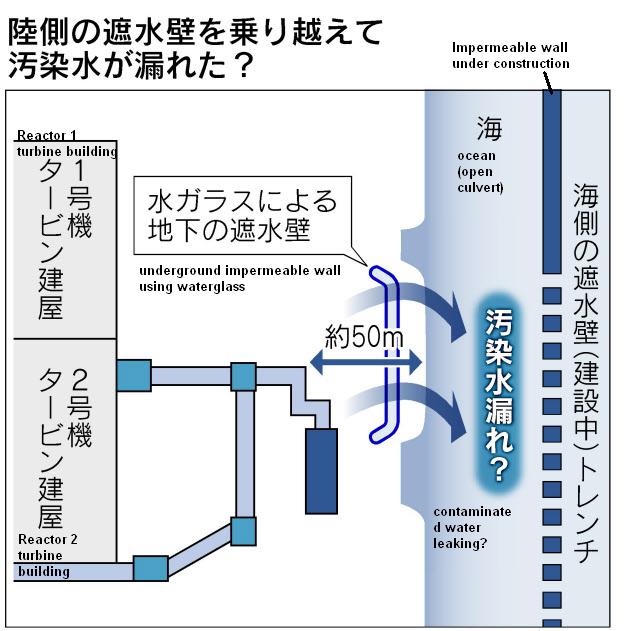
It turned out that injection of chemicals to create the impermeable wall was too successful. It not only stopped the flow of groundwater, but raised the groundwater level significantly. So now, the groundwater is probably going up and over the hastily built underground impermeable wall, and through the porous, top part of the embankment into the open culvert.
The embankment is artificial, built on top of a natural sandy beach which had existed before the plant was built. There is no way to inject chemicals to solidify the top 1.8 meters. Even if it is possible, the water will simply go around the sides.
(The opening sentence of Nikkei’s article below is wrong, though. There is no highly contaminated water leaking from the plant, yet. The highly contaminated water is mostly in the underground trenches, where it has been since 2011. Some may be leaking into the groundwater flowing from the west and that groundwater may be leaking into the open culvert.)
Regarding the problem of highly contaminated water leaking from Fukushima I Nuclear Power Plant, it was revealed on August 2 that it was highly likely that the contaminated water is going over the underground “impermeable wall” and leaking into the ocean. Nuclear Regulatory Authority’s working group met on August 2, and commissioners including Toyoshi Fuketa pointed out the possibility and TEPCO admitted to the possibility. As there are worries over the effect on marine creatures including fish, Nuclear Regulatory Authority ordered TEPCO to come up with emergency countermeasures.
In order to prevent the underground contaminated water from leaking into the ocean, TEPCO has been injecting special liquid called waterglass [sodium silicate solution] along the embankment to solidify the soil and build an impermeable wall since early July. The wall is set deeper than 1.8 meters from the surface.
The working group came to the conclusion that because the underground impermeable wall stopped the flow of groundwater, the level of groundwater rose recently, and went over the top of the wall. Not only the groundwater could go over the impermeable wall but go around the wall and leak from the sides of the wall.
TEPCO will start digging wells near the impermeable wall to draw groundwater and lower the water level. The company hopes to finish by the end of this month. Groundwater is flowing in from the mountain side (west) at the rate of 100 tonnes per day, and TEPCO needs to draw more than that amount. Storage of the water thus drawn will be discussed later.
(Diagram from Nikkei Shinbun, English labels are by me.)
Now, what is the point of drawing the contaminated groundwater along the embankment? In haste? Particularly when the levels of cesium, all-beta, and tritium in the open culvert have not risen in a significant manner? Do they even stop and think?
They have to somehow stop the groundwater upstream, before it reaches the space between the turbine buildings and the embankment and gets contaminated.
According to an article by Mainichi Shinbun that only appeared in Fukushima local edition (7/24/2013), the embankment was a landfill:
This area was reclaimed in the 1960s when the plant was being constructed. TEPCO explains that the land was made by piling up mudstones and sandstones on the beach.