Even as a last-ditch effort, he said, nuclear weapons can’t work using existing warheads but only with new, even larger nuclear explosives than exist in any arsenal. “A lot more people have been recorded to have died from nuclear weapons than have been recorded to have died from asteroid impacts,” he warned.
WASHINGTON — When geophysicist H. Jay Melosh attended a meeting of U.S. and ex-Soviet nuclear weapons designers in May 1995, he was surprised by how eager the Cold Warriors were to work together against an unlikely but dangerous extraterrestrial threat: asteroids on a collision course with Earth.
After Edward Teller, the father of the hydrogen bomb, urged others meeting at the Lawrence Livermore National Laboratory in California to consider building and orbiting huge, new nuclear weapons for planetary protection, some top Russian weapons experts lent their support.
“It was a really bizarre thing to see that these weapons designers were willing to work together – to build the biggest bombs ever,” said Melosh, an expert in space impacts who has an asteroid named after him.
Ever since, he has been pushing back against scientists who still support the nuclear option, arguing that a non-nuclear solution – diverting asteroids by hitting them with battering rams – is both possible and far less dangerous.
But Melosh’s campaign suffered a setback last month when Energy Secretary Ernest Moniz signed an agreement with Russia that could open the door to new collaboration between nuclear weapons scientists in everything from plutonium-fueled reactors to lasers and explosives research. A Sept. 16 Department of Energy announcement cited “defense from asteroids” as one potential area of study.
President Barack Obama has committed the United States to seeking a world without nuclear weapons. But NASA is spending hundreds of thousands of dollars a year to study their use against asteroids, and the U.S. nuclear weapons labs appear to be itching to work with their Russian colleagues on the problem.
Moreover, weapons experts in both countries are citing the asteroid threat as a reason to hold onto – or to build – very large-yield nuclear explosives, which have declining terrestrial justification.
David Wright, co-director of the Union of Concerned Scientists’ Global Security Program, said he hoped any joint asteroid defense work would not become a “jobs program” for weapons scientists.
“When you’ve got the weapons labs sort of pushing for this in the various countries, it starts to make me feel a little uneasy,” he said. “Which doesn’t mean it’s not a legitimate thing to do, but you want to know it’s being done for legitimate reasons.”
To some critics, the idea smacks of bad science fiction, something out of the 1998 Bruce Willis action film “Armageddon,” which shows a team of deep-sea oil drillers landing on an Earth-bound asteroid, planting a nuclear warhead and neatly blowing the rock in halves that just miss Earth.
Critics also note that depending on the nature of the work, it could run afoul of several international pacts, including the 1967 Outer Space Treaty signed by 129 countries that prohibits deploying nuclear weapons in space.
Some experts worry that radioactive debris from blasting an asteroid could itself wreak havoc on Earth.
Bong Wie, the director of Iowa State University’s Asteroid Deflection Research Center, said he has a three-year, $600,000 grant from NASA to design a “hypervelocity nuclear interceptor system,” basically an ICBM-borne warhead fitted with a battering ram.
The ram would separate from the bomb before impact, gouging a crater in the asteroid so the bomb could then blast it to bits.
Keith Holsapple, an engineering professor at the University of Washington, said NASA has given him a five-year, $1.25 million research grant to study how either an impact device or a nuclear explosion could deflect an Earth-bound asteroid from its path.
PARIS (Reuters) – French nuclear group Areva is ready to join the EDF-led consortium that plans to build a nuclear plant at Hinkley Point in the UK, Bloomberg reported on Wednesday, quoting people with knowledge of the matter.
Bloomberg said China General Nuclear Power Corp. would also become a shareholder and that Areva and EDF’s boards would meet next week to approve the deal.
Areva and EDF declined to comment on the report.
Areva would take a stake in the project from French utility EDF, allowing EDF to share the cost of building two Areva-designed EPR reactors estimated at 14 billion pounds (16.5 billion euros).
On Sunday, British Energy Minister Ed Davey said Britain was “extremely close” to sealing a deal with EDF unit EDF Energy to build the country’s first new nuclear power station since 1995, adding there would also be Chinese involvement in the talks.
The British government and EDF have long been in talks over financial terms to build a new nuclear plant at Hinkley Point in Somerset, southwest England.
The Financial Times reported on Saturday that British Finance Minister George Osborne would sign a memorandum of understanding this week to back Chinese General Nuclear Power Group (CGNPG) entering a deal with EDF for the planned Hinkley Point plant.
(Reporting by Geert De Clercq; editing by David Evans)
George Osborne will hail a new dawn for Britain’s civil nuclear programme on Thursday as the chancellor announces a deal between Chinese investors and EDF Energy to build the first nuclear power station in the UK in a generation.
The Chinese General Nuclear Power Group and the French energy company are expected to sign a letter of intent as the two sides finally agree a deal for a planned new plant at Hinkley Point in Somerset. The main commercial details of the agreement will be announced on Monday by Ed Davey, energy secretary.
The first reactor to be built in Britain since Sizewell B began operating in 1995, ministers hope the deal will unlock the construction of several new nuclear power stations across the UK.
British officials have been travelling the world trying to entice investment in new nuclear, relying on French and Japanese technology and Chinese funding to fuel the renaissance of the British industry.
But Mr Osborne’s determination to announce the deal on his trip to China has infuriated Mr Davey, who has done much of the legwork. He travelled to China last month to meet officials ahead of the chancellor’s visit.
“Football fans might say he is the John Terry of government,” remarked one Liberal Democrat on Thursday, a reference to when the Chelsea captain changed into full kit to lift the Champions League trophy – despite having not played in the match. “He [Mr Osborne] was as close to the real negotiations and the work as Pluto is to the earth.”
TOKYO (Reuters) – A typhoon killed 17 people in Japan on Wednesday, most on an offshore island, but largely spared the capital and caused no new disaster as it brushed by the wrecked Fukushima nuclear power station, the plant’s operator said.
More than 50 people were missing after the “once in a decade” Typhoon Wipha roared up Japan’s east coast. About 20,000 people were told to leave their homes because of the danger of flooding and hundreds of flights were cancelled.
Sixteen people were killed on Izu Oshima island, about 120 km (75 miles) south of Tokyo, as rivers burst their banks. The storm set off mudslides along a 2 km (1.2 mile) stretch of mountains.
Television footage showed roads clogged with wreckage and houses with gaping holes smashed into them.
“I heard a crackling sound and then the trees on the hillside all fell over,” a woman on Izu Oshima told NHK television.
The storm brought hurricane-force winds and drenching
rain to the Tokyo metropolitan area of 30 million people at the peak of the morning rush hour.
A woman was swept away by a swollen river in western Tokyo and more than 50 people were missing, the government said, including two schoolboys engulfed by waves on a beach.
About 20 people were hurt by falls or being struck by flying debris.
The operator of the Fukushima nuclear plant, Tokyo Electric Power Corp, cancelled all offshore work and secured machinery as the storm approached.
RAINPUMPEDOUT
The operator, known as Tepco, has been struggling to contain radioactive leaks since a 2011 earthquake and tsunami caused extensive damage and triggered the world’s worst nuclear crisis since Chernobyl in 1986.
A Tepco spokesman said Typhoon Wipha had caused no new problems at the plant, which is on the coast 220 km (130 miles) north of Tokyo.
The storm dumped heavy rain and it had to be pumped out of protective containers at the base of about 1,000 tanks storing radioactive water, the by-product of a jerry-rigged cooling system designed to control wrecked reactors.
The rainwater was checked for radioactivity and released into the sea, the company spokesman said.
Wipha was down-graded to a tropical depression by 0700 GMT. It was off the coast of northeastern Japan and moving northeast at 95 kph (59 mph), according to the Japan Meteorological Agency.
At its height, it had sustained winds at its centre of 126 kph (78 mph) and gusts of up to 180 kph (112 mph).
More than 500 flights at Tokyo’s Haneda and Narita airports were cancelled, and thousands of schools closed. Bullet train services were halted but resumed by Wednesday afternoon.
Typhoon Wipha was the strongest storm to hit the region since October 2004. That cyclone triggered floods and landslides that killed almost 100 people, forced thousands from their homes and caused billions of dollars in damage.
(Additional reporting by Chris Meyers, Billy Mallard and Antoni Slodkowski and Yuka Obayashi; Editing by Robert Birsel)
NASHVILLE, Tenn. (AP) – A recent congressional study shows Tennessee’s nuclear plants had a total of 258 safety violations between 2000 and 2012.
The Associated Press obtained a copy of the Government Accountability Office report that’s awaiting release.
Nuclear Regulatory Commission figures cited in the report show the Sequoyah plant in Soddy-Daisy had 125 violations, of which all but two were lower-level violations. Watts Bar in Spring City had 133 violations. Only three were higher-level status.
According to the report, while the West has the fewest reactors, it had the most lower-level violations during that time period, more than two-and-a-half times the Southeast’s rate per reactor.
The Southeast, with the most reactors of the NRC’s four regions, had the fewest such violations.
The Emirates Nuclear Energy Corporation, ENEC, today announced its official Patronage of the World Energy Council (WEC), the world’s principal network of energy leaders and practitioners.
As Patron, ENEC joins an exclusive group of leading energy companies that work alongside energy policy makers and key stakeholders who seek to engage the WEC network to help catalyse new thinking on energy policy and strategy. Patrons actively support WEC Global and Regional Agendas, and can provide in depth involvement through specific project partnerships.
“Energy is one of the most pressing issues of our time,” said Mohamed Al Hammadi, Chief Executive Officer of ENEC. “Through our collaboration with WEC, we enter a unique platform of global energy thought leaders and look forward to our active role in promoting the energy policy of the UAE.” Christoph Frei, Secretary General of the World Energy Council, added: “We are delighted that ENEC has decided to become a Patron of the World Energy Council. ENEC joins a select group of companies at a key time for the energy sector. We look forward to working with ENEC in the coming years. I am sure their support will enhance our work.
The WEC represents the entire energy spectrum, with more than 3,000 member organizations located in over 90 countries and drawn from governments, private and state corporations, academia, NGOs and energy-related stakeholders.
“Working with our fellow Patrons and alongside the UAE national committee, we endeavor to encourage and support better understanding of the role that safe and peaceful nuclear energy can play in helping nations tackle climate change,” added Mr. Al Hammadi. “Over the next decade, our nation will effectively transform its energy and water generation portfolio to achieve greater energy security and sustainability. Nuclear energy is an important part of this transformation, providing a safe and sustainable contribution to our future energy portfolio.” The WEC’s Patron Programme was established in 1998 and is comprised of companies or institutions which are members of a WEC Member Committee and through their contributions to the WEC Foundation, are committed to play a fundamental role in helping the World Energy Council achieve its mission to promote the sustainable supply and use of energy, for the greatest benefit of all.
ENEC is building four nuclear energy plants in the Western Region of Abu Dhabi. Units 1 and 2 are currently under construction and are expected to enter commercial operations in 2017 and 2018 respectively. With all four plants grid-connected by 2020, the UAE will receive up to a quarter of its electricity needs from nuclear energy, whilst saving up to 12 million tons of Greenhouse Gas (GHG) emissions every year.
ENEC’s Chief Executive Officer, Mohamed Al Hammadi, is also the Chairman of the Global Agenda Council on Energy Security of the World Economic Forum (WEF), an advisory committee that identifies and discusses energy security challenges across the world and recommends achievable solutions for governments to compose more robust energy policies. – Emirates News Agency, WAM
BOSTON — The number of safety violations at U.S. nuclear power plants varies dramatically from region to region, pointing to inconsistent enforcement in an industry now operating mostly beyond its original 40-year licenses, according to a congressional study awaiting release.
Nuclear Regulatory Commission figures cited in the Government Accountability Office report show that while the West has the fewest reactors, it had the most lower-level violations from 2000 to 2012 — more than 2½ times the Southeast’s rate per reactor.
The Southeast, with the most reactors of the NRC’s four regions, had the fewest such violations, according to the report, a copy of which was obtained by The Associated Press.
The striking variations do not appear to reflect real differences in reactor performance. Instead, the report says, the differences suggest that regulators interpret rules and guidelines differently among regions, perhaps because lower-level violations get limited review.
The study also says that the NRC’s West region may enforce the rules more aggressively and that common corporate ownership of multiple plants may help bolster maintenance in the Southeast.
However, the reasons aren’t fully understood because the NRC has never fully studied them, the report says. Right now, its authors wrote, the ”NRC cannot ensure that oversight efforts are objective and consistent.”
Told of the findings, safety critics said enforcement is too arbitrary and regulators may be missing violations. The nuclear industry has also voiced concern about the inconsistencies, the report said.
The analysis was written by the GAO, the investigative arm of Congress, at the request of four senators. Before the government shutdown, the report had been set for public release later this month.
Steven Kerekes, a spokesman for the industry group Nuclear Energy Institute, declined to comment pending release of the report. The NRC’s public affairs office had no comment, citing the government shutdown.
The GAO analysis focuses on lower-level safety violations known as ”nonescalated.” They represent 98 percent of all violations identified by the NRC, which regulates safety at the country’s commercial reactors.
Lower-level violations are those considered to pose very low risk, such as improper upkeep of an electrical transformer or failure to analyze a problem with no impact on a system’s operation, such as the effect of a pipe break. Higher-level violations range from low to high safety significance, such as an improperly maintained electrical system that caused a fire and affected a plant’s ability to shut down safely.
The GAO’s analysis shows 3,225 of these violations from 2000 through the end of 2012 across 21 reactors in the West. By contrast, there were 1,885 such violations in the Southeast. Yet that region is home to 33 reactors — 12 more than in the West. The West registered 153.6 violations per reactor, while the Southeast saw just 57.1.
The Midwest, with 24 reactors, had 3,148 violations, for a rate of 131.2 per reactor. The 26-reactor Northeast also fared worse than the Southeast, with 2,518 violations, or 96.8 per reactor.
Radiation levels in seawater outside one of the crippled Fukushima reactors has spiked to the highest level in two years. That’s according to TEPCO, the operator of the Fukushima nuclear power plant. It said that radiation levels on Wednesday, the day six workers were exposed to highly radioactive water, jumped 13 times the previous day’s reading. A TEPCO spokesman said that the sudden spike in radiation was caused by construction work near the No. 2 building.
This week’s significant spike in radiation levels is seen as the latest setback for TEPCO. It has repeatedly been slammed for its handling of the nuclear disaster after a massive quake and tsunami that hit the Fukushima nuclear plant in March 2011, triggering three reactor meltdowns.
TEPCO, which is pouring hundreds of tons of water to keep reactors cool, has struggled to contain the build-up of radioactive water at the plant.
In the latest incident, six workers were exposed to radiation after a pipe connected to a contaminated water treatment system was mistakenly detached. As a result, at least 7 tons of contaminated water escaped the system.
Meanwhile, Japanese officials have said that there is no environmental threat to other countries as radiation will be diluted by the sea. Tokyo, despite lingering concerns over the long-term safety situation at Fukushima, was selected last month to host the 2020 Olympic Games.
The Voice of Russia spoke with Arnie Gundersen, Chief Engineer at Fairewinds Energy Education, on this issue.
Does everyone really understand the real troubles posed by Fukushima disaster? Is there anything else to discover?
This is a problem that doesn’t seem to go away. And there are 3-4 pieces to it. There is buildup of order in thousand tanks, each tank has a thousand cubic meters of water in it and there is a thousand of those tanks, some of which are leaking directly into the ground. That is problem number one. But problem number two is that the building basements are also leaking and the building basements have lots of radiation left over from the meltdown 2 years ago. So, water flowing in from the ground is in contact with the radiation and now all the buildings on the site are highly radioactive as well. So, Tokyo Electric solution is to build a wall of ice all the way around the entire reactor about 2 km long but the problem is they won’t have it done for at least 2 years. So, the problems we are experiencing now are going to get worse over the next 2 years before Tokyo Electric can begin to turn the corner.
Is the wall of ice the best solution in this case or is there something that would work faster and more effectively?
I had proposed an idea 2 years ago that would have been better. I had proposed instead of keeping the water from leaking into the Pacific, the right solution is to keep clean water from leaking into the building. It is like having a bathtub. Tokyo Electric choice is to build the sides of the bathtub higher to keep the water in the bathtub. My solution is to turn the tap off and prevent the water from filling the tub in the first place. I was told 2 years ago that Tokyo Electric couldn’t afford that. But the solution they are proposing is much more costly. That really gets to the root of the problem. Your question is right on the mark. Tokyo Electric is not an engineering front and they have been asked to do engineering when in fact they’ve been an operating company. And on top of that they don’t have enough money, the Japanese government isn’t giving them enough for an adequate cleanup. So, you have an inadequate firm underfunded from the Japanese government and until those 2 problems get solved we will have leaks and building failures in the future.
How much of a risk is this for the rest of the world and why haven’t members of the worldwide community really stepped in to offer help, to offer funding and consulting services to help liquidate the disaster?
The Japanese government hasn’t asked for help and I don’t know whether that pride or fear that they might find out how bad things really are. Just last week Prime Minister Abe asked for help. But I’ve been contacted by three Americans firms who’ve gone over and bagged to give them their technology and they’ve been rebuffed by the Japanese. So, I really don’t believe that the Japanese want to have an adequate solution here because they can’t afford it. And on the environmental effects of the Pacific, we are contaminating the Pacific Ocean. There was some caesium in the ocean from bomb testing, from mainly the US and Russian programs but also others, but Fukushima is putting in 10 times more caesium than there was before the accident happened. And that is going to work its way up to food chain. The organisms on the bottom of the ocean will become contaminated and then those who eat that will be contaminated and ultimately it will show up in the top fish, the salmon and the tuna.
Read more: http://voiceofrussia.com/2013_10_14/Japanese-government-doesnt-give-enough-money-for-cleanup-after-Fukushima-disaster-expert-2649/
The best way to “make sure the memories of the disaster don’t fade away,” Hiroki Azuma tells the Asahi Shimbun, is promote the destroyed No 1 Nuclear Power Plant as “a sightseeing spot”.
He proposes that a nearby disused sports facility should be converted into “an immense visitor centre for both amusement and education”, which would “allow people to tour the plant as the cleanup work continues”.
Opponents say that Azuma has no personal stake in the fate of Fukushima, and so should avoid “butting in”, reports the newspaper.
But he contends that Chernobyl, which eventually developed a museum and embraced visitors after years of “dark tourism” shows the value of such an approach.
It wasn’t about “building a theme part on a disaster site,” he tells the AsahiShimbun, but encouraging “a complete disclosure of information”.
The UK Daily Telegraph in a report from August, has more detail on the proposal supported by Azuma:
Tourists will be able to check into hotels that have been constructed to protect guests from elevated levels of radiation that are still to be found in pockets in the area. The village will also have restaurants and souvenir shops, as well as a museum dedicated to the impact the disaster has had on local people …
Dressed in protective suits and wearing respirators, tourists will be able to take photos of the shattered reactor buildings and the workers who are still trying to render the reactors safe.
It wasn’t about “building a theme part on a disaster site,” Azuma tells the AsahiShimbun, but encouraging “a complete disclosure of information”.
For the survivors of the 2011 earthquake and tsunami, he says, “their greatest fear is that memories of the accident will fade”, while they note “the therapeutic effort and self-affirmation talking about their experience in the disaster gave them”.
And the import goes wider than that, he says. A tourist attraction also operates as a sort of warning. “This accident doesn’t just affect Fukushima, it affects all of humanity.”
The crippled Fukushima Dai-ichi nuclear facility again grabbed headlines in recent weeks after reports of radioactive water leaks into the Pacific Ocean and repeated exposure of plant workers to dangerous levels of radiation once more focused attention on the disaster and its aftermath. A massive earthquake and ensuing tsunami in March 2011 damaged the Japanese plant’s reactor containment and cooling systems, triggering explosions and three core meltdowns. After a string of troubling revelations surrounding Tokyo’s bid to host the 2020 Olympic Games, the Japanese government has finally expressed a more open attitude toward international help to deal with the crisis.
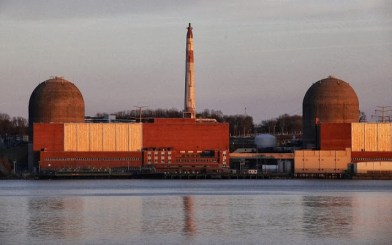
While Japan’s problems seem far away, anti-nuclear activists in the United States say a similar disaster — or perhaps one even worse — could happen at a nuclear plant just 25 miles north of New York City, at Entergy Corp.’s Indian Point Energy Center. Although that is dismissed as fearmongering by the nuclear industry, anti-nuclear campaigners say Indian Point poses a grave risk to 20 million people who live in the New York metropolitan area.
On Tuesday, Oct. 8, Naoto Kan, the former Japanese prime minister who was in office at the start of the Fukushima crisis, joined Gregory Jaczko, a former chair of the Nuclear Regulatory Commission (NRC); Peter Bradford, a public-utilities expert; Arnie Gundersen, a nuclear engineer turned anti-nuclear activist; and consumer advocate Ralph Nader to discuss what they say are the untenable risks of nuclear power.
All called for Indian Point to be shuttered.
“Technically it is impossible to eliminate nuclear power plant accidents. There is only one way to eliminate accidents, which is to get rid of all nuclear power plants,” Kan told an audience of about a hundred people at the 92nd Street Y in Manhattan.
“Our policymakers like to think that a nuclear accident can happen anywhere else, but not America,” said Gundersen, who serves as chief engineer at consulting group Fairewinds Energy Education.
The nuclear power industry has faced a tough time since March 2011, when an earthquake and tidal wave hit the Fukushima nuclear power plant causing a meltdown in three of its reactors. Many countries have lost interest in nuclear power, whilst others have increased the safety regulations regarding nuclear power plants.
In order to improve the safety of nuclear reactors, and reduce the chance of a meltdown, people have been researching and inventing new designs for producing energy from nuclear fusion reaction.
The NY Times has written an article detailing one idea that could become popular, that of Jose N. Reyes, co-founder and chief technology officer at NuScale Power. Who has designed a nuclear reactor that is so small, that if any problems were to occur, then the core would be small enough to cool on its own, in a fairly in a short space of time.
The reactor is basically just a mini version of reactors that are being built at traditional power plants across the US, which tower over 200 feet into the air and 120 feet in diameter. Reyes’ design, housed in a sealed container, would measure just 80 feet tall and 15 feet in diameter, producing approximately one twentieth of the power of normal reactors.
The compact size of the reactors allows them to be submerged in giant 10 million gallon tanks of water, which Reyes claims will reduce the chance of a meltdown to a thousandth of those of conventional reactors.
During a computer simulation, NuScale Power demonstrated that if a pump failed in the reactor and the water began to boil over, the steam would hit the walls of the container, which are kept permanently cool due to the giant water tank that it is submersed in, and then condense, and fall as water back down into the reactor chamber, cooling the reactor once more. They claim that this makes their reactor completely safe, and virtually immune to meltdowns.
NuScale Power has applied to the Nuclear Regulatory Commission (NRC) for a permit to begin production, one day hoping to begin commercial sales in the US. Unfortunately achieving a license to produce the reactors could cost as much as $1 billion.
Some critics have claimed that even with a license from the NRC, the designs may prove worthless. The tiny size of the reactors means that they produce far less power, so investors need to be convinced that this design will require less stringent containment structures, smaller evacuation zones, and fewer personnel to operate them. If not, then economies of scale suggest that building larger reactors will be more profitable.
Japan neglected carrying out safety checks on at least 40% of nuclear reactor parts exported over a decade, a report said Monday, in the latest controversy to strike its troubled nuclear industry.
Nuclear reactor parts—including pressure vessels which contain the fuel in power plants—worth about 51.1 billion yen ($520 million) were shipped to 17 countries, as well as Taiwan, without undergoing safety checks, the Mainichi Shimbun newspaper reported.
Britain, Germany, Australia, Russia and Italy were among the countries that took delivery of the potentially unsafe equipment, the daily said, citing manufacturers and an industrial body among its sources.
Japan exported nuclear reactor parts worth 124.8 billion yen to more than 20 countries from 2003-2012, the Mainichi Shimbun said, citing official trade figures.
But safety checks, entailing simple examinations of documents, were only required for exports tied to loans from the state-run Japan Bank for International Cooperation or guarantees by the public agency Nippon Export and Investment Insurance, the daily said.
The unchecked parts included reactor pressure vessels shipped to Taiwan in 2004 and control rod drives, which regulate the rate of nuclear fission, supplied to Sweden and Brazil, Mainichi said.
The rest of the exports are thought to have undergone government safety checks before being shipped to China, the United States, France, Belgium and Finland, the daily said, citing the country’s Agency for Natural Resources and Energy.
But much of the data disclosed by the agency was blacked out, raising the possibility that those exports may too have been shipped without being checked, Mainichi said.
Safety has been a huge concern for Japan’s nuclear industry since a massive earthquake and tsunami ravaged the country’s northeast coast and triggered a meltdown at the Fukushima nuclear power plant in March 2011.
But the country has continued overseas sales of nuclear reactor technology, with Prime Minister Shinzo Abe assuring buyers the industry is among the world’s safest.
This weeks calamities for this blogger included, all dongle data Sims were blocked for half a day, I was unable to get into WordPress to post for whilst I availed my self of the free wireless network at my local library, During another session at the library my wireless became defunct.
Not a boring week by any means..
I thought I would get some thoughts down as the Internet seems to dislike me for some reason..
Heres why,
I uncovered a document where the UK Government body called DECC (Department foe Energy and Climate Change) instructed the UK Science media Centre to “manage” the news on Geo-Engineering, This got me thinking as you might well imagine.
The Science Media Centre (SMC) received a £300,000 boost to their income in the charity fiscal year of 2011. As I have previously mentioned that this “charity” sent a mental health professional to deal with the disaster at Daichi, as far as I could work out the psychologist was paid by a secondary aim of the “charity” that deals in mental health issues.
Considering the recent hurried push to sign nuclear contracts in the UK and get control of the epidemiological research, it makes sense that the SMC was advised by the UK government to shut the bad news down concerning Fukushima nuclear disaster in Japan, The Home office even sent diplomats to play cricket in Fukushima prefecture the day before the Japanese won the Olympic 2020 bid.
So, we have DECC instructing the SMC to manage the Geo engineering news and it is obvious that the SMC UK was behind the coverup of Fukushima with Ogilvey and Maher from the WPP group (Tony Blair works for WPP for a large retainer).
I have been made aware that the government is possibly undermining representations being made by NGO`s and civil pressure groups and have been helping find the data on this and that is likely why I had was targetted for disruption this week,
I am still awaiting an official statement on behalf of the NGO`s etc and will post the statement when it arrives on my email.
The recent showing of Pandora’s box and many “nuclear is the only solution to climate change” articles and videos are designed to show how pro nuclear the UK is and how ready for nuclear investment the UK is. Offers from China (The BBC does their children’s programming), Japan (Japan is ensnared into the nuclear fuel cycle and decommissioning strategies) and from a broke EDF (currently trying to pollute the whole of the English channel, north sea and just about anywhere they can get away with it) are flowing into the UK as quickly as the dissolution process for the nuclear fuel rods that pollutes our air space and waterways flows outwards. And the UK government wants lots of little La Hagues and Sellafields poisoning the waterways for multiple generations to come and MOX run reactors that give a guaranteed BIG BANG if there are any serious cooling lose incidents (ref; Daichi 3 nuclear reactor).
DECC has reported that the private companies will not share the technical data nor even the names of persons involved with the data. There is also some idea that there are no independent epidemiologists who will be accepted by the private corporations, so therefore they support Richard Wakefords (Ex BNFL) posit of “no effect from nuclear accidents worth talking about”.
I am not going to bash the BBC at this point as they tie in to every aspect of this marketing of nuclear materials and cash because it would make the article to long.. But you can imagine…
In short, DECC appears to be going all out for the large and very expensive nuclear projects that will not reap any rewards for a number of years and likely push Fracking as the interim solution. Meanwhile BP, the Anglo American corporation, is still drilling for the oil like there will be no tomorrow.
EDF charge about £65.00 per mega watt in France whilst in the UK the spot price, on offer, seems to be settling around £100.00? EDF are pretty broke and still have to find a cheap solution to the nuclear waste problem for their existing nuclear sites.
I will be reporting more on the processes that are being used and the new ideas that they are thinking of to cut costs at a later date.
In the recent government report it shows that they value cost cutting as a priority issue and following up that with secrecy concerning epidemiological research. And they didnt seem to interested in any other science from Yablakovs New York Academy of Science presented book that is now in its second edition with the needed corrections. Nor do they take into account the voices of dissent in the nuclear industry in Belgium, USA, Japan, Belarus and UK. Instead they close ranks and hide everything and everyone who might be responsible for a future UK nuclear health tragedy (though radiation has already reached Norway and Ireland (AM241 found near Dublin Bay recently in growing amounts).
That all I have to report for now, UKColumn is doing an in depth investigation on the BBC next week, I will post a viideo up. They have connected the BBC to WPP and they are generally not happy with our great British broadcaster, that appears to be now an arm of the global advertising and media corporations.
“Fusion could be just 30 years away, but probably not though!”
Published on 11 Oct 2013
Fusion has taken two major leaps forward according to new papers. Firstly, scientists at the National Ignition Facility in California have, for the first time, managed to get more energy out of a Fusion reaction than they put in. Secondly, a team at the Ecole Polytechnique in France have found an improved method of fusing boron and hydrogen, vastly more powerful than previous experiments and creating a more easily harvested energy.
The Treasury is blocking an attempt by Toshiba to build three reactors at Sellafield in an inter-departmental row over money that threatens to hold back Britain’s nuclear programme.
A consortium led by the Japanese nuclear group wants to buy the Nugen project in Cumbria from its developers Iberdrola, ScottishPower’s parent company, and GDF Suez, of France.
However, the option to build the reactors will expire in October next year because so little work on the project has been completed. The Department of Energy and Climate Change wants to extend the option to allow the deal with Toshiba to go ahead….. Subscription only