,,,,EDF also has plans to build a new nuclear plant at Sizewell in Suffolk. Once it has planning permission to build reactors there, it will be required to release another site it owns, Bradwell in Essex. A person familiar with the matter said EDF could sell the Bradwell site to CGN, for the construction of its own reactor….
Under the deal, the government will give its backing to Chinese General Nuclear Power Group entering EDF Energy’s planned new nuclear plant at Hinkley Point in Somerset as a co-investor.
The memorandum of understanding will also see Britain backing CGN’s plans to build a nuclear reactor in the UK and play a “supporting role” in operating it, according to people familiar with the matter.
That could ring alarm bells with some MPs, unions and regulators, amid concerns about the robustness of China’s nuclear safeguards.
The government will also express its support for China getting its nuclear technology through the UK regulatory approval process, known as the generic design assessment. It is unclear at this stage whether the reactor design will be CGN’s, or that of another Chinese nuclear group. A person close to the talks said UK officials have asked Beijing to select just one company’s technology for a UK rollout.
Chinese involvement is seen as essential if the £14bn Hinkley Point project – a centrepiece of government ambitions for a low-carbon economy – is to go ahead.
The shift to non-fossil-fuel energy such as nuclear is seen as crucial if Britain is to meet its binding targets for cutting carbon emissions and keep the lights on.
However, given the sensitivities surrounding nuclear power, the idea of allowing a Chinese state-backed company to play such a prominent role in the UK’s nuclear new build programme is likely to raise a welter of national security concerns
….Greenpeace has issued its refutations of the Investigative Committee’s allegations and I tend to believe them.
“Any claim that illegal drugs were found is a smear, it’s a fabrication, pure and simple,” Greenpeace said.
The Arctic Sunrise operated out of Kirkenes, Norway, which, as a country, has as dour a drug policy as you are likely to find this side of Malaysia. And Norwegian customs, which has searched the boat many times, found nothing untoward prior to its departure to the September 18 protest at Prirazlomnaya.
I would go even further than Greenpeace to call the drug allegations total rubbish. Russian cops stopping pedestrians and planting drugs on them is one of the oldest routines in their stale shake down repertoire. White bags of powder have routinely been planted by customs officials in the luggage of Western pop acts coming to tour Russia, as happened with REM…..
In an announcement surprising only in its tardiness, the Russian Investigative Committee said yesterday it discovered hard drugs aboard Greenpeace’s Arctic Sunrise vessel, which the Russian Coast Guard took by force on Sept 19 after two activists tried to scale a Russian oil rig to protest Arctic drilling.
In yesterday’s statement, infused with an appropriately stiff facsimile of indignation, Investigative Committee chair Vladimir Markin, said that, “During a search of the [Arctic Sunrise], drugs (apparently poppy straw and morphine) were confiscated.”
“In view of the data obtained while investigating the criminal case, charges are expected to be adjusted,” the committee said. It added that “a number of detainees will be presented with charges of committing other grave crimes.”
Greenpeace rightfully mocked the new allegations. “The Investigative Committee ‘found’ narcotics. We are waiting for it to find an atomic bomb and a striped elephant,” it said on Twitter. “This is possible in Russia these days and can hardly surprise anybody.”
Tsk, tsk, tsk, you tree-hugging dope heads.
Despite the stereotypes the Investigative Committee is counting on to grow this opium field of accusations, international maritime law – as dictated by the World Health Organization (WHO), and enforced by the International Labor Organization (ILO) – makes it illegal for certain classes of vessels not to carry their fair share of smack-based happy pills.
And the list of medications available in a ship’s sickbay doesn’t stop at morphine, a heavy opium based painkiller. The list provided by the WHO suggests a number of other opioid derivatives that are the stuff of junkie shopping in any typical urban emergency room, highly addictive downers like Valium, and a slew of other mother’s-little-helpers that have a higher value on the street than the Arctic Sunrise would have at auction.
Further, the ILO doesn’t require that these drugs be dispensed by a doctor on many classes of ships, which makes the presence of a bona fide physician among the Arctic Sunrise’s detainees, as confirmed by both Greenpeace and the Investigative Committee, a nearly air-tight defense against the imbecilic new allegations.
Pursuant to that, Greenpeace yesterday issued a completely believable statement saying, “We can only assume the Russian authorities are referring to the medical supplies that our ships are obliged to carry under maritime law.”
Just as laughable to anyone who’s been to high school and experimented with drugs are the Investigative Committee’s assertion that “dual-purpose” equipment was found on the Arctic Sunrise, that “could be used not only for ecological purposes.”
I am assuming from that little vagary that Russian authorities are postulating that the chemistry set for measuring various ecological hazards reportedly aboard the ship was used for smoking or injecting narcotics, or mixing various concoctions in the spirit of BreakingBad meets Lillyhammer.
Last month a high level source speaking with Infowars revealed insider details of a nuclear weapons transfer within the domestic United States that was executed without an official directive or paper trail. One expert noted that such re-positioning of nuclear warheads doesn’t happen unless they “plan on using them.”
Curiously, just a day later, Senator Lindsey Graham warned that a failure to attack Syria could lead to a nuclear weapon being detonated in South Carolina. It was a notion that raised eye brows in mainstream media, but more so throughout alternative media circles, which suggested that the sequence of events were indicative of a false flag attack.
Yesterday, we learned that a senior member of U.S. nuclear command and head of the Air Force’s nuclear arsenal was relieved of his command. This has prompted questions about what is going on in the secret nuclear control centers around the country and it’s raising concerns about the security of America’s nuclear weapons.
Now, a report from the Associated Press goes further down the rabbit hole.
Together, the Carey and Giardina dismissals add a new dimension to a set of serious problems facing the military’s nuclear force.
The ICBM segment in particular has had several recent setbacks, including a failed safety and security inspection at a base in Montana in August, followed by the firing of the colonel there in charge of security forces. In May, The Associated Press revealed that 17 Minuteman 3 missile launch control officers at Minot Air Force Base, N.D., had been taken off duty in a reflection of what one officer there called “rot” inside the ICBM force.
In an inspection that the Air Force publicly termed a “success,” the AP disclosed that launch crews at Minot scored the equivalent of a “D” grade on missile operations. In June the officer in charge of training and proficiency of Minot’s missile crews was fired.
The sidelined launch officers were “not taking the job seriously enough,” causing their bosses to worry that they failed to understand what it takes to “stay up to speed” on nuclear missile operations, the Air Force chief of staff, Gen. Mark Welsh, told Congress in May. What it boiled down to, he said, was a lack of “proper attitude.”
Were the recent firings of top military brass a result of indiscretions and alcohol induced misbehavior as the official narrative would have us believe, or could a more sinister plot be developing?
Is it possible that nuclear war heads were, in fact, re-positioned by rogue elements within the ICBM nuclear command group without proper authorization?
And would these senior command terminations have occurred had the story about these weapons not been made public?
It’s all speculation at this point, but what we do know is that the U.S. government under the Obama Administration has been operating under a heavy veil of secrecy that has taken unprecedented steps to identify and prosecute whistle blowers and security leakers, making it difficult for the truth to make it to the public.
The fact that the military graded Air Force missile operations with a “D” should give us pause. That’s a gaping hole in our national security and one that could be capitalized on by those who would do us harm.
Thus, at this point, nothing is outside the realm of possibility, the least of which is the notion that a rogue element operating within the government apparatus may be planning a manufactured crisis on U.S. soil.
The 5th Estate: Dr. Wilcox, there appears to be a lack of national or local media coverage on Fukushima and the ongoing radiation leaks there. What is the situation regarding this in Tokyo at this point
Wilcox: Since the beginning of this man-made disaster, the media in Japan has covered it up, there has always been a time-lag between what is happening at the site and the reality versus the cover the government and TEPCO give it so this is not new.
There has been non-stop leakage of substantial amounts of radiation into the Pacific, and the Japanese media has been under pressure from the government not to tell the truth on this. The nuclear industry in Japan has substantial influence over the media.
At a conference of Japanese media about a year ago Japanese journalists said they would be fired from their publications if they reported the truth on Fukushima radiation fallout dangers. In reality it is a Japanese media blackout to a large extent.
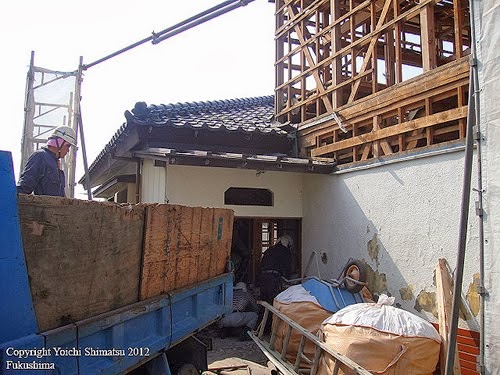
A Fukushima worker oversees removal of radioactive waste
The 5th Estate: How are Tokyo residents reacting to this threat now?
Wilcox: Overall, the average Japanese citizens are in denial about the reality of the actual situation. A few express concern about irradiated seafood and vegetables however prefer not to discuss it, at least publicly. People here in Tokyo seem to just ignore the problem unless they are actually confronted with it on a personal level.
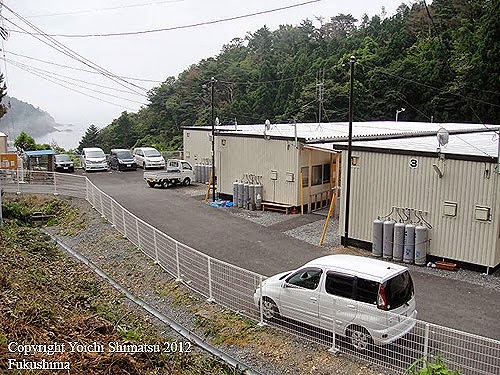
Temporary shelter for Fukushima evacuees
The 5th Estate: Are the Japanese people totally detached from reality?
Wilcox: Of course the suffering people of Fukushima certainly are not. Just yesterday, TEPCO announced that they are spending millions to start yet another reactor while the Fukushima victims that are supposed to receive monetary assistance for relocation have not received anything. So TEPCO is now diverting money away from these victims whose lives have been arbitrarily destroyed, to a fruitless project to restart a reactor that will never transpire in any event given the situation at Fukushima now. TEPCO’s credibility and its ability to deal with the situation has now completely collapsed. Even the Japanese NRC (Nuclear Regulatory Commission) has denounced TEPCO’s handling of the disaster.
….workers were tested for thyroid gland doses from radioactive iodine after a significant delay, through procedures that failed to account for iodine-132 and iodine-133, which have short half-lives of 2 hours and 20 hours, respectively….
TOKYO (Reuters)
(Reporting by Lisa Twaronite; Editing by Robert Birsel)
– Japanese authorities may have underestimated by 20 percent the radiation doses workers got in the initial phase of the Fukushima nuclear power plant disaster, a Japanese newspaper reported on Saturday, citing a U.N. panel. A big earthquake and tsunami in March 2011 damaged the power station north of Tokyo, operated by Tokyo Electric Power Co (9501.T), causing three partial reactor meltdowns. The company has struggled to contain leaking radiation since then.
The U.N. Scientific Committee on the Effects of Atomic Radiation (UNSCEAR) raised doubts about the dose estimates of the government and Tokyo Electric, or Tepco, in a summary of a report on October 12, according to the Asahi Shimbun. The U.N. committee analysed radiation doses in 25,000 people who worked at the plant on or before October 2012, using data provided by the government,
Tepco and others, the newspaper said. It determined that the tests used on workers did not take into account some types of radiation. In particular, workers were tested for thyroid gland doses from radioactive iodine after a significant delay, through procedures that failed to account for iodine-132 and iodine-133, which have short half-lives of 2 hours and 20 hours, respectively.
The Asahi Shimbun said if the U.N. panel’s assessment was accurate, more workers would be eligible for free health checks. It did not give any detail of the implications on the health of the workers. Increased radiation exposure has been linked to greater rates of cancer and thyroid disorders. A spokesman for Tepco was not immediately available for comment.
(Reuters) – Sumitomo Mitsui Banking Corp. and 27 other financial institutions have agreed to roll over a roughly 77 billion yen ($783 million) syndicated loan for Tokyo Electric Power Co. (9501.T) due to mature at the end of the month, the Nikkeibusiness daily reported on Saturday.
Tepco has lost $27 billion since the 2011 disaster at its Fukushima Daiichi nuclear plant, and faces massive liabilities as it decommissions the facility, compensates tens of thousands of residents forced to evacuate, and pays for decontamination of an area nearly the size of Connecticut.
The SMBC-led group includes Sumitomo Mitsui Trust Bank, Gunma Bank (8334.T), Chiba Bank (8331.T), and a number of prefecture-based agricultural cooperatives.
Tepco’s major banks are prepared to provide 500 billion yen in financing in December – 200 billion yen in loan rollovers and 300 billion yen in new financing, a person involved in the talks told Reuters last month. ($1 = 98.3050 Japanese yen)
(Reporting by Lisa Twaronite; editing by Ron Askew)
Experts say Valindaba, South Africa’s big new nuke idea could be a viable niche or an expensive failure.
Valindaba, once the heart of South Africa’s nuclear weapons programme, could be dusted off to play a key part in plans to enrich uranium.
But analysts, academics and experts have raised concerns about the possibility of it just being a vanity project – using technology that can be used for fuel or weapons – and whose costs, could be hidden under the shroud of national security.
The costs of major government infrastructure projects and procurements – from the projected nuclear programme and the president’s Nkandla residence to the arms deal – have all ballooned beyond initial estimates, and decision-making has been hidden in the name of state security.
Uranium enrichment could provide a viable niche for South Africa but experts are concerned it could follow the same pattern of expensive secrecy – although much more worrying, considering its nuclear weapons applications. They are asking whether it is being driven by politics and egos.
Several issues come to the fore:
South Africa’s previous enrichment programme, driven by military imperatives and sanctions, had a blank cheque, but revitalising Valindaba would have to be economically viable.
It hinges on the nuclear construction programme, which remains vague. But, if the country builds a fleet of nuclear power stations, it will need a secure supply of fuel rods for the next 50 to 60 years.
Although safety is a concern in the wake of the Fukushima reactor disaster, environmental organisations say the more stringent regulations will push up the costs.
The pebble bed modular reactor, our most recent foray into nuclear energy, cost nearly R10-billion but was mothballed when further funding could not be found.
Uranium has been declared a strategic mineral, and all nuclear facilities are national key points, which means that information regarding them is restricted.
From the Nuclear Energy Corporation of South Africa’s (Necsa) Pelindaba campus in Hartbeespoort, tall smoke stacks rise out of the veld. Some belong to the Safari-1 nuclear reactor, which produces molybdenum-99, a valuable medical diagnostic tool used to identify cancer. It is exported to 60 countries and brings in about R800-million a year.
Quietly baking
But some stacks stand quietly baking in the hot spring sun; they belong to Valindaba, where South Africa used to enrich uranium for the Koeberg power station and for nuclear weapons.
In isiZulu, Pelindaba means “we don’t talk about this anymore”, and Valindaba means “we don’t talk about this at all”.
Necsa chief executive Phumzile Tshelane told the Mail & Guardian his board is “seized” about whether to reopen the country’s enrichment facilities. “We want Necsa to stand on its own and not rely on government funding.”
In the 2012-2013 financial year, Necsa received R455-million from Parliament to subsidise its operations, an amount that gets smaller each year.
The nuclear energy programme, as laid out in the government’s energy policy, makes provision for the addition of 9.6GW to South Africa’s electricity capacity from a new fleet of nuclear power stations and is an opportunity for the parastatal to “localise the back end of this procurement; we should localise as much as we can”.
“First enrichment, then fuel fabrication,” Tshelane said, adding that no decision has been taken yet. “We are thinking very hard about it and will announce plans in the next few months.”
The Communist Party of India (Marxist) has ruled out supporting any move to dilute the Civil Liability for Nuclear Damage Act. Its Polit Bureau member Sitaram Yechury pointed out to French Ambassador François Richier that such a step was inconceivable especially after the Fukushima accident.
There could not be any leeway with the rules of the Act as “we are very happy” that while the world woke up to inadequacies in their legislation after the Fukushima melt- down, India had put in place a law that addresses this aspect, Mr. Yechury, who also heads the party’s International Department, told Mr. Richier who called on him on Thursday.
Mr. Richier later told PTI: “I expressed to him our constant position on the liability issue. We respect the law of the country we are working in. We also discussed nuclear cooperation and the issue of liability, which is an important element. As you know, CPI(M) has a strong stand over the liability issue. We spoke about the trend and growing cooperation of the nuclear electricity production.”
Paris’ interest flows from the French civil nuclear giant company Areva having been awarded a civil nuclear park in Maharashtra, where it will set up six reactors.
Only about half of the designated evacuation sites in 44 prefectures are quake-resistant, according to a survey conducted by the Board of Audit.
Out of the 90,262 shelters designated by 1,615 municipalities, 50,964, or 56.5 percent, could adequately withstand earthquakes, the board said Wednesday. The survey did not cover Iwate, Miyagi and Fukushima prefectures. The survey has brought to the fore questions regarding the resistance of evacuation centers, as about 44 percent of them are not well prepared for secondary damage caused by aftershocks. Yet many people are expected to stay at such shelters if there is a massive quake, such as a Nankai Trough earthquake or a quake directly under the metropolitan area. The Education, Culture, Sports, Science and Technology Ministry aims to complete reinforcing the school buildings against earthquakes by fiscal 2015.
The spot uranium price fell to $US34.50/lb U3O8 in late July, a price not seen since December 2005 during the upswing of a spectacular price bubble which peaked in June 2007 at $US138. The 12 per cent price slump in July was the biggest monthly loss since March 2011.
Since July, the spot price has fallen further still, to $US34, before surging to $US35 where it sits now. Recent prices are just over half the spot price of $US66.50 on March 11, 2011, the first day of the triple-disaster in northeast Japan.
The long-term contract price has been reasonably stable in recent months at $US57/lb. (At that price, the value of annual global uranium requirements for power reactors is around $US10 billion.)
The issue of low uranium prices discouraging new supply is not just one of the spot price itself but one of the marginal cost of new supply. Producers suggested to Ux that the average marginal cost of production of operating mines is around where the spot price is now, but the marginal cost of developing a new mine is more like $US65-70/lb. From the nuclear energy prospective, respondents rated the most significant demand-side influences as, in descending order of influence, Japanese reactor restarts, Chinese reactor build, the premature shutdown of older US reactors and the emergence of newcomer countries to nuclear energy (about equal), and the upcoming French nuclear licence renewals.
Raymond James analyst David Sadowski expects an average spot price of $40 per pound this year, $52 in 2014, and $70 in both 2015 and 2016. Michael Angwin from the Australian Uranium Association expects low prices until about 2017/18, and a nasdaq.com article states that “the road to recovery for this battered commodity will be a long haul”. Rob Atkinson, outgoing CEO of Energy Resources of Australia, says the uranium spot price is woeful, making it extremely difficult to make the case for developing a new mine, and the market will remain difficult for at least another two years.
The industry hopes that reactor restarts in Japan will improve the situation − but restarts will be slow and in many cases strongly contested. FNArenareported on October 1: “Macquarie now believe the uranium market will remain in surplus throughout their five-year forecast period, Japanese restarts or no Japanese restarts. The industry hopes that new build in China will improve the situation − but pre-Fukushima nuclear growth projections have been sharply reduced and China now plans to approve a “small number” of new reactors projects each year.
The industry hopes that the end of the US-Russian ‘Megatons to Megawatts’ program − downblending highly enriched uranium (HEU) from weapons programs for use in power reactors − will improve the situation. But mine production has met an increasing proportion of demand in recent years − 78 per cent in 2009 and 2010, 85 per cent in 2011 and 86 per cent in 2012 (the shortfall was around 10,000 tonnes of uranium in 2011 and 2012). This suggests that the end of the Megatons to Megawatts program will have a moderate impact. There is scope for weapons material to continue to supply the civil market regardless of future bilateral US-Russian agreements.
Ux Consulting noted last year that reduction in demand stemming from the Fukushima accident “essentially negates much of the reduction in supply resulting from the end of the US-Russia HEU deal”. Utilities have built up uranium stockpiles in recent years as a result of low uranium prices (the World Nuclear Association estimated commercial inventories totalling 145,000 tonnes of uranium in 2010 − enough to supply global demand for two years).
On the Megatons to Megawatts program, FNArenastates that “the hole left will only prove incremental, say the analysts, given supply of alternative Russian secondary material and growing supplies from global reprocessing.”
Jeb Handwerger, described by Uranium Investing News as a “uranium bull and stock guru”, says that “Smart money recognizes the bottom.” But smart money is heading for the door. At the Paydirt Uranium Conference in February 2012 in Australia, it was clear many companies were looking elsewhere, prompting an industry veteran to quip that copper and gold had never before enjoyed so much airtime at a uranium conference. A year later, attendance was so poor that the conference was reduced from two days to one day and shifted from the Hilton Hotel to a less opulent venue.
Smart money also recognises that utilities have huge stockpiles. FNArenanotes that uranium inventories across all major consumers sit at record highs. Japan has stockpiles of around 7500 tonnes, while US inventories would satisfy two years of consumption − the highest level in decades. And the nuclear power industry in the US is being battered from pillar to post with the cancellations of plans for new reactors and the closure of operable reactors.
The Progressive Mind is a collection of articles and annotated links to sites, articles, publications and editorials expressing progressive and humanistic viewpoints. The editor is an active supporter of efforts to uncover the truth about the horrible events on Sep 11, 2001
10 October 2013
It started this June in California. Speaking about the problems at the troubled San Onofre nuclear plants through the perspective of the Fukushima nuclear complex catastrophe was a panel of Naoto Kan, prime minister of Japan when the disaster began; Gregory Jaczko, chairman of the U.S. Nuclear Regulatory Commission (NRC) at the time; Peter Bradford, an NRC member when the Three Mile Island accident happened; and nuclear engineer and former nuclear industry executive Arnie Gundersen.
This week the same panel of experts on nuclear technology–joined by long-time nuclear opponent Ralph Nader–was on the East Coast, in New York City and Boston, speaking about problems at the problem-riddled Indian Point nuclear plants near New York and the troubled Pilgrim plant near Boston, through the perspective on the Fukushima catastrophe.
Their presentations were powerful.
Kan, at the event Tuesday in Manhattan, told of how he had been a supporter of nuclear power, but after the Fukushima accident, which began on March 11, 2011, “I changed my thinking 180-degrees, completely.” He said that in the first days of the accident it looked like an “area that included Tokyo” and populated by 50 million people might have to be evacuated.
“We do have accidents such as an airplane crash and so on,” said Kan, “but no other accident or disaster” other than a nuclear plant disaster can “affect 50 million people…no other accident could cause such a tragedy.”
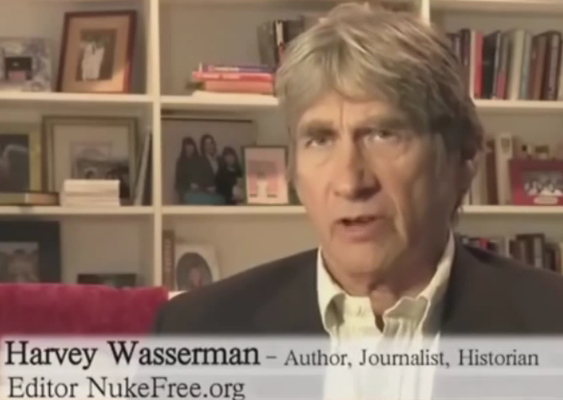
Journalist, author, activist and historian Harvey Wasserman has been reporting on, and participating in, the nuclear free movement for decades. In that time, by his judgment, only one other event matches the danger to the world posed by the Cuban Missile Crisis. That event is the ongoing nuclear disaster at Fukushima.
Haven’t heard about it in the corporate media? That’s because the deadly and dying global nuclear industry and its allies don’t want you to know.
That’s why he has organized a petition drive to the UN advocating international expert oversight of, and participation in, management of the Fukushima crisis.
In this interview, he explains why we must all be involved in this world-historical challenge to human and planetary survival.
The study from the Government Accountability Office said only China and Russia still produce significant amounts of lithium and the supply may be drying up, The New York Times reported Wednesday.
The possible shortage of lithium — critical to the operation of 65 out of 100 American nuclear reactors — “places their ability to continue to provide electricity at some risk,” the GAO report said.
The material in question is lithium-7, a byproduct of the production of tritium, the fuel that powers hydrogen bombs.
The United States stopped production of lithium-7 in 1963 when it had a large surplus, now mostly used up. With the U.S. nuclear weapons inventory shrinking, there has been little need to create tritium.
China and Russia apparently still have production capability, but because it is related to their weapons program outsiders do not know how much capacity they might have, experts said.
Per Peterson, the chairman of the nuclear engineering department at the University of California, Berkeley, told The Times it would be “pragmatic” for the United States to re-establish production of lithium-6 from lithium-7, something the GAO report said would take five years and $10 million to $12 million.
Preventing the spread of nuclear weapons and seeking their eventual abolition have long been official objectives of the international community. Who would not want to prevent more states from obtaining nuclear weapons? Who would oppose the goal of a world free of them? These lofty ideals have given rise to a powerful institution, which we call in our new article the nonproliferation complex, a collection of international and governmental agencies, think tanks, and NGOs spanning from the IAEA to the Monterey Institute to the Pugwash conference. Indeed, there are so many nonproliferation institutions now that new umbrella networks, like the EU Non-Proliferation Consortium, have recently formed. Steady, generous funding comes from many governments and large foundations, making the further growth of the complex a good bet.
Like most institutions, the complex has come to privilege its own interests over the founding principles which guided those concerned with nuclear weapons in the 1950s and 1960s. They aimed to prevent nuclear world war by twinning nonproliferation with general disarmament. The complex has over the years, and especially since the end of the Cold War, hitched its wagon to the status quo policies advanced by the great nuclear powers, especially the United States. By doing so, it has been able to secure lavish financial support and wield enviable influence. But this has come at a price. Its refusal to antagonize the nuclear “haves” has perverted the original mission, turning the founding principles into a regime dedicated only to stopping the spread of the bomb to nations opposed to the West. And when a powerful international institution gets gamed, bad things eventually happen.
The invasion of Iraq in 2003 stands as example number one. We do not wish to blame the war on the complex; the invasion might well have happened without it. But the nonproliferation complex’s perpetual alarm about the dangers of proliferation provided the war’s architects with an unchallengeable justification for their adventures. The Bush administration merely took the decade-long warnings about Iraq’s nuclear proliferation potential seriously and decided to, finally, do something radical about them. Even those within the complex who opposed the war at the time, and there were not many, were caught in a trap of their own making: how can you vociferously oppose a war when your own arguments are being used to justify it? This trap has not gone away, and we will likely see it snap again. Will it be Iran, North Korea, or somewhere else unforeseen?
(Reuters) – Britain’s licensing process for Hitachi’s (6501.T) nuclear reactor that will allow the design to be used in the country’s new nuclear plants is expected to finish by the end of 2017, regulators said on Wednesday.
The Japanese company plans to build up to six new nuclear reactors in Britain using its and GE’s (GE.N) Advanced Boiling Water Reactor (ABWR) at sites in Oldbury and Wylfa which it acquired last year.
The Office for Nuclear Regulation (ONR) and the Environment Agency, which together license new nuclear reactors in Britain through the so-called Generic Design Assessment (GDA), said on Wednesday that lessons learned from previous assessments would shorten Hitachi’s approval process.
“We are estimating that the UK ABWR GDA could be complete in four years from the start of our assessment, i.e. by the end of 2017,” the two bodies said in a joint progress report published on Wednesday.
The regulators finished the GDA process for EDF’s (EDF.PA) European Pressurised Water Reactor (EPR) earlier this year after four and a half years.
It was the first nuclear reactor to be licensed through the newly introduced GDA system.
The ONR and Environment Agency said they would expand their team working on Hitachi’s GDA this autumn and that they expected Hitachi to provide the first technical documents this month and in December.
Britain has an ambitious plan to build new nuclear power stations by the middle of the next decade to replace ageing and polluting plants that are set to shut down.
EDF and Hitachi are two of the companies planning to build new nuclear plants.
A joint venture between France’s GDF Suez (GSZ.PA) and Spain’s Iberdrola (IBE.MC) has also announced a nuclear new build project. Iberdrola is in talks to sell its stake in the joint venture to Toshiba’s Westinghouse unit.