China and France to build Europe’s first nuclear plant since Fukushima

….Britain’s government and main opposition parties support nuclear power and anti-nuclear sentiment among the population is muted by comparison with other parts of Europe….
BECAUSE OF THE BBC AND SCIENCE MEDIA CENTRE UK
Arclight2011
http://in.reuters.com/article/2013/10/20/britain-nuclear-hinkley-idINL6N0I81SA20131020
First new nuclear contracts in Europe since Fukushima
* China’s CGN to help fund, build 14 billion pound project
* Project’s state aid needs clearance from EU competition body
* Critics warn of risks in fixing power price decades ahead
By Karolin Schaps and Geert De Clercq
LONDON/PARIS, Oct 20 (Reuters) – Britain is set to sign a deal with France’s EDF for the first nuclear plant to start construction in Europe since Japan’s Fukushima disaster raised safety concerns worldwide, at a cost estimated at around $23 billion.
Under the deal, expected to be announced on Monday, the French utility will lead a consortium, including a Chinese group, to construct two European Pressurised Water Reactors (EPRs) designed by France’s Areva.
Industry estimates, based on other nuclear projects, put the
cost at around 14 billion pounds or more than 16 billion euros.
EDF’s long-time partner China General Nuclear Power Group (CGN), possibly in combination with China National Nuclear Corporation (CNNC), is expected to have a 30 to 40 percent stake in the consortium, with Areva taking another 10 percent, according to newspapers including France’s Les Echos and Britain’s Sunday Telegraph.
EDF and the British prime minister’s office declined to comment on the media reports.
Hinkley Point’s first impact will be to add to consumers’ bills
…The UK would be agreeing to buy electricity from Hinkley Point at £93 per megawatt hour – roughly twice the current market rate….
The deal is still to be signed, but already some extraordinary claims are being made about Hinkley Point in Somerset, which will be the first nuclear plant to be built in the UK since 1995.
Here’s chancellor George Osborne‘s take: “If it wasn’t Chinese investment or French investment, it would have to be the British taxpayer. I would rather British taxpayers were spending their money on our schools and hospitals and those things, and let’s get the rest of the world investing in our energy.”
Put like that, you might assume UK taxpayers have hit the jackpot, that EDF of France and China General Nuclear Power Corporation (CGNPC) will bear all the financial risks and that energy bills in the UK are bound to fall sometime around 2020 as cheap nuclear energy comes on stream.
Forget it. The UK will be agreeing to buy electricity from Hinkley Point for 35-40 years at £93 per megawatt hour or thereabouts, according to the whisper from Westminster.
That is roughly twice the current market rate for electricity, and far in excess of the £40 per megawatt hour that was airily waved around by the Department of Energy only half a decade ago.
Nuclear power, it seems, can only be bought at a cost roughly equivalent to on-shore wind, complete with its subsidies to landowners. Maybe that is the price that has to be paid for secure low-carbon supplies, but at current energy prices, the first impact of Hinkley Point will be to add to consumers’ bills, just as wind does today.
“In the long term,” the chancellor continued, new nuclear should lead to “lower and more stable energy bills.”
The key phrase there is “long term”. The claim rests on the assumption that the costs of other sources of energy will continue to rise and make £93 appear a bargain sometime in the future. That assumption may or may not prove correct – but coming from a government that supposedly thinks fracking will revolutionise the energy market, it’s a strange argument to hear.
But is £93 the real cost anyway? The devil will be in the detail of this contract – specifically, in the indexation formula for the strike price. If Hinkley Point’s entire output is tied to the rate of inflation for 40 years, we could be staring at a truly astronomical cost by the end of the contract.
“The government surely can’t be that dumb,” comments one City analyst. One assumes not. But what proportion of Hinkley Point’s operating costs and uranium purchases will inflate automatically? The answer is critical to any assessment of value for money.
So, too, is the size of the loan guarantees given to EDF and the Chinese. If they amount to 70% of the debt raised to fund the £14bn construction costs of two reactors, the UK taxpayer is firmly on the hook. And, given that EDF’s recent construction experience in France is massive cost over-runs, is the UK backstopping that risk as well?
The Department of Energy and Climate Change refuses to comment until the talks are completed, but Steve Thomas, professor of energy policy at the University of Greenwich, has a blunt assessment of where negotiating power lies: EDF has the government “over a barrel” and the contract may be an “absolute disaster” for taxpayers.
Strictly speaking, judgment must be reserved until the contract is signed and published. But Osborne’s Chinese spin should make us nervous.
How is it meant to be good news that, among all the possible sources of capital to partner EDF at Hinkley Point, we have ended up with a company controlled by the Chinese Communist party?
Remember the history here. Centrica, the UK’s supposed energy champion, dropped out of the EDF-led consortium, preferring to take a £200m hit than continue down a nuclear path where the costs and risks only ever seem to increase.
In the face of homegrown scepticism, guarantees from the UK taxpayer have now persuaded Beijing to climb aboard. This does not sound like a triumph in the making. It sounds instead like the latest instalment in the 30-year saga of the UK’s shambolic and short-termist energy policy.
Tiny Bit Of Spent Nuclear Fuel Found Near Chernobyl Is Still Shockingly Radioactive (VIDEO)
By Ryan Grenoble Posted: 10/18/2013
It has been nearly 27 years since the meltdown at Chernobyl, the world’s largest nuclear accident, yet the area still has pockets of surprising radioactivity.
There may be no better evidence of this than a YouTube video produced by Carl Willis, a nuclear engineer with a delightfully disconcerting hobby: poking around radioactive sites with a Geiger counter and documenting his encounters. In a video from 2011, Willis explores Chernobyl’s Number 5 reactor, eventually finding a “hot spot” he traces down to a tiny speck no larger than a grain of salt.
After some rudimentary tests, Willis concludes the small particle is a fragment of spent nuclear fuel, likely ejected in 1986 when the Number 4 reactor exploded.
In an email to The Huffington Post, Willis said that, despite its radioactivity, the particle didn’t present an immediate health hazard, so long as he kept a distance from it. “You would not want to eat or breathe this particle,” he cautioned. “Outside your body, it’s a non-issue though.”
“Most people don’t get to fool around with spent nuclear fuel,” he added.
How well does this radioactivity represent the ongoing crisis at Japan’s Fukushima Daiichi, the world’s second-largest nuclear disaster? According to Willis, not all that well.
Put simply, he says, “the Fukushima accident happened in a very different way from Chernobyl. … [Y]ou will not find chunks of fuel around Fukushima.” Additionally, he notes, “Understanding of Fukushima is still evolving. Indeed, the situation there itself is still evolving.”
How Accurate Are The Instruments in Nuclear Reactors?
Published on 17 Oct 2013
Fairewinds
How Accurate Are The Instruments in Nuclear Reactors? About This Podcast
Accurately measuring the reactor water level in a nuclear power plant is critical to safe operation, yet nuclear power reactor water monitoring systems do not work correctly. What would happen today if your car’s speedometer read 60 miles per hour, but in actuality, you might be driving at 40-mph or even 95-mph? Listen to today’s Fairewinds Energy Education podcast as Dave Lochbaum from the Union of Concerned Scientists and researcher Lucas Hixson discuss the dangerous dilemma reactor operators face when a reactor has an emergency shutdown and operators simply do not know if the reactor has enough water to keep it cool! http://fairewinds.org/podcast/flat-so…
Today we’re doing a special show about reactor water level monitoring. We have as our guests nuclear researcher Lucas Hixson and Dave Lochbaum, nuclear expert with the Union of Concerned Scientists. This is not one of our typical podcasts in that this is a very technical podcast, but it’s for you geeks out there. A lot of people have written in to us and asked for this kind of material, and even if you’re a layperson I think that you will really, really find this interesting and it’ll give you insight into how difficult it is to operate a nuclear power reactor.
we’re going to be speaking about what is called the Reactor Water Level Monitoring System at nuclear power plants. Water is used in the nuclear reactor as a critical neutron moderator and coolant. Water levels in a nuclear reactor are not monitored directly, but rather through an indirect monitoring system, which incorporates a reserve tank which is termed a reference leg. There have been some reported flaws with this cooling system throughout the years, some of the most notable being brought forth by Paul Blanche in the early 1990’s.
PODCAST TRANSCRIPT
DL: Yes. Paul found some problems with the level instrumentation used in boiling water reactors like Fukushima in Japan and Pilgrim and Browns Ferry here in the United States. As you mentioned, in that type of reactor, the water boils right in the reactor vessel. It’s difficult to measure the level of water that’s vigorously boiling. If you imagine a pot of boiling water on the stove, you see all that froth level at the top, what is the level of water in the pot? So what boiling water reactors do is use the reference leg, which is just a non-boiling column of water, and compare the pressure or the weight of that water to the weight of water in the reactor. And we can judge the density of the water in the reactor vessel easier than we can determine its actual height. And we can use that differential pressure between what the weight of the water in the reactor is versus the weight of the water in that reference column to determine what the level of the water in the reactor vessel is. If you look at a bottle of soda pop and you shake it up and then crack the top, the water level — the beverage level jumps from a nice low level to spewing out the open top. Because the non-condensable gases inside that soda have become freed by the agitation. Likewise, what Paul noted was that if the pressure of a reactor vessel were suddenly to drop, as it could happen during an accident, the non-condensable gases inside the water can cause the water in the reference column to all of a sudden change dramatically as bubbles come out of that water due to the pressure drop, which is similar to cracking a soda pop. Its pressure drops and the bubbles form. We hadn’t accounted for that in the water level instrumentation. As those bubbles formed under that situation, the indications of level to the operator could become vastly wrong — several feet, dozens of feet wrong. And the reactor core is only 12 feet tall and if the level instrumentation is off by 20 feet, you’ve got a big problem.
LH: Is there any other method for operators to determine the water level if the reactor water level monitoring system is not providing accurate data?
DL: The operators are provided about five sets of water level instrumentation for boiling water reactors. They’re calibrated at hot conditions, high pressure, high temperature, as well as cold conditions where the reactor is shut down and the reactor vessel’s head is off, the water is less than 212 degrees. The problem is that during an accident, you go from high temperature, high pressure to high temperature, low pressure as this pipe breaks and water flows out. The operators must choose amongst these five sets of instrumentation to figure out which one is most accurately monitoring the conditions at that moment; and that indication will shift from instrument to instrument, and it’s the operator’s guess as to which one’s providing the most accurate indication. And when you have 100 tons of reactor core to deal with… a wrong guess comes at a high cost.
continued http://tinyurl.com/monv35o
Nuclear Testing in China’s Western Territory – Exclusive interview with a Chinese military veteran
“The CCP treated us like non-humans during nuclear tests. Three minutes after detonation, 30,000 soldiers were sent to the field. Tank forces, armored troops, and cavalry had to drive to the bombing site for training. Of course the high-ranking leaders were not there. Each time we carried out a mission at the bombing site, we had to live there for months,” Liu said.
http://www.theepochtimes.com/n2/china-news/nuclear-testing-in-chinas-western-territory-204617.html
Last Updated: March 18, 2012

Lop Nor was once a 1.3 million acre lake in the Taklamakan desert of Xinjiang Autonomous Region until the Chinese military set up a secret nuclear test site in June 1959, detonating 45 nuclear bombs between 1964 and 1996. A Chinese military veteran, using the alias Liu Qing, told The Epoch Times in an exclusive interview about his experiences while serving in the nuclear unit and being sent for prolonged military exercises at ground zero.
Liu is from Urumqi, the capital of Xinjiang, and now lives in Australia. He said for 32 years approximately 100,000 soldiers participated in nuclear tests without any sort of protective gear, and the radiation they were exposed to has turned their lives into a nightmare.
But while taking sample radiation measurements from exposed soldiers, and keeping secret files, the Chinese government never acknowledged the soldiers’ health problems, and few of them have received any compensation.
Exposure
In 1979, the then 18-year-old Liu was enlisted and served in the “Nuclear 8023” unit that was designated to test nuclear weapons. During the following 10 years, Liu went five times to the explosion field where nuclear weapons were tested. He lived at the site for about six months and walked around at the center of the site where a nuclear bomb had just been detonated.
Liu said he touched the remains of the iron tower that held China’s first atomic bomb in 1964. The only protection he had during these encounters was his military uniform. When soldiers left the bombing site, no one conducted any tests or measurements on them, Liu said.
“We did not have any protection measures at that time. Our military uniforms were our only protection. We did not know the dangers of exposure to nuclear radiation. The damage is invisible and the victims could not feel it right away. The destruction is especially serious to the brain. I did not know of the permanent, lifelong adversities until later. The Chinese Communist Party’s (CCP’s) policy of withholding information from the public entrapped and hurt a lot of people during the decades of nuclear testing. During the ten years I was in the military, I was never taught about the extreme dangers of nuclear radiation.
India – PAC seeks more autonomy for nuclear safety regulator to instill public trust
…The panel was shocked to learn that not only are the fines under current regulation as low as Rs 500, the penal provisions have not been invoked in the 50 years that the department of atomic energy has conducted operations….
NEW DELHI: Pointing to “grave weaknesses” in India’s laws intended to prevent nuclear accidents, the public accounts committee (PAC) has recommended the proposed nuclear safety regulator should be made more autonomous to inspire public trust.
In its report on a nuclear safety audit conducted after a radiation exposure in Delhi’s Mayapuri area in 2010 that claimed one life and injured seven persons, the parliamentary panel said the nuclear safety regulatory authority (NSRA) bill needs significant changes.
The panel said that the bill’s clauses relating to removal of the regulator’s chairperson, power of the Centre to issue directions and, most crucially, the government’s option to supersede the authority, need to be deleted or drastically amended.
The report also notes that authorities admitted that it is not possible to regulate some 57,000-odd X-ray machines that are unregistered. The panel said it hopes the government will soon implement a roadmap to regulate or register medical X-ray units.
On the NSRA bill, the report goes on to say, “The department of atomic energy should seriously re-examine provisions of the bill and take necessary steps to ensure the nuclear regulator becomes independent and credible and at par with regulators in other nations.”
The committee said the legal status of India’s atomic energy regulatory board is that of a subordinate body unlike in countries like Australia, Canada, France and the US that have independent and empowered regulators.
“The failure to have an autonomous regulator is fraught with grave risks as bought out by the commission that examined the Fukushima nuclear accident,” the panel said.
The Nuclear Odyssey of Naoto Kan, Japan’s Prime Minister during Fukushima
…But he noted that already a new energy prospect is visible off the Fukushima coast, where a floating wind turbine is being tested. It has been dubbed “Fukushima mirai,” which means “Fukushima future” in Japanese. “In Japan,” Kan said, “we see that even without nuclear power plants we can actually supply energy to meet our demands.”…
Having led Japan through the 2011 nuclear crisis, the elder statesman is now campaigning for a world without nuclear power
17 October 2013
h/t http://michelekearneynuclearwire.blogspot.co.uk/2013/10/the-nuclear-odyssey-of-naoto-kan-japans.html
On March 10, 2011, Prime Minister Naoto Kan felt assured that nuclear power was safe and vital for Japan. By the evening of the next day, following the massive Tohoku earthquake, the ensuing tsunami and the beginnings of the crisis at the Fukushima Daiichi nuclear power plant, he had changed his thinking “180 degrees.”
Kan could not help but wondering how much worse the Fukushima meltdowns might get on the dark nights spent in his office after March 11, 2011. “What was going through my mind at the time?” Kan said through a translator during a public event at the 92nd Street YMCA in New York City on October 8. “How much worse is this going to get, and how can we stop this from getting even worse?”
Kan commissioned a report for the worst-case scenario from the Japan Atomic Energy Commission, which confirmed his worst fears: a potential evacuation area reaching as far as 250 kilometers from the stricken power plant—a zone of exclusion that would have reached all the way to Tokyo and affected roughly 50 million people. The potential for disaster was so great because the Fukushima area houses a total of 10 reactors and 11 pools that store used nuclear fuel. By March 15, three of those reactors were experiencing at least partial meltdowns, and four, thanks to a spent-fuel pool that also lost water cooling of the still-hot rods, had suffered hydrogen explosions.
Gruff and dark-haired, Kan is a circumspect man, with a history of admitting mistakes and showing impatience with those who do not. In 1996, as Japan’s Minister of Health, Labor and Welfare, he apologized for the government’s responsibility in allowing blood bearing the human immunodeficiency virus (HIV) to spread among hospitals in years past. In 2010, as prime minister from the Democratic Party of Japan, he apologized to South Korea for Japan’s annexation of that country a century earlier. Now the one-time nuclear supporter is campaigning for an end to power from fission. “There is no other disaster that would affect 50 million people—maybe a war,” Kan observed. “There is only one way to eliminate such accidents, which is to get rid of all nuclear power plants.”
The earthquake and tsunami killed more than 15,000 people, whereas the multiple meltdowns at Fukushima have not caused any fatalities to date and are “unlikely” to cause any detectable health effects, such as increased cancers, according to the United Nations Scientific Committee on the Effects of Atomic Radiation. But even today, more than two and a half years after the earthquake, the nuclear disaster is ongoing. Water contaminated with radioactive particles from the meltdowns continues to reach the Pacific Ocean, and radiation levels at the stricken power plant recently spiked. Typhoons, earthquakes and other natural disasters continue to threaten further disasters at the site and a total teardown may take decades. “The cause of this catastrophe is, of course, the earthquake and the tsunami but, additionally, the fact that we were not prepared,” Kan said. “We did not anticipate such a huge natural disaster could happen.” He also noted that the information supplied to him by the nuclear power industry in the aftermath of the meltdowns proved false.
Senior adviser for Fukushima cleanup says foreign assistance needed
Oct 17, 2013

Image source ; http://www.npg.org.uk/collections/search/portraitLarge/mw216053/Barbara-Singer-Thomas-Judge-Lady-Judge

One of the senior advisers of the Fukushima cleanup said that Tokyo Electric Power Co. (TEPCO) needs foreign assistance. The utility operator may have already sought foreign assistance, but the ones currently available seem to be not enough to ensure that the defunct nuclear plant causes no more trouble.
“They need to have a number of foreign firms to come in and assist them with the cleanup,” said Lady Barbara Judge in an interview in Tokyo. Lady Judge, a lawyer by profession, was in charge of the U.K. Atomic Energy Authority (UKAEA) from 2004 until 2010. During her tenure as head of the agency, a number of nuclear plants were decommissioned while overseeing the cleanup of plutonium and uranium leak at the Thermal Oxide Reprocessing Plant (THORP) at Sellafield in Cumbria of northwestern England. She currently holds a position of Chairman Emeritus at the UKAEA.
Lady Judge also said that the incidents happening in Fukushima are not surprising, admitting that nuclear plant cleanups in the U.K. also had a number of unforeseen problems. “When people built nuclear power plants, they never thought of decommissioning,” the 66-year old lawyer and lobbyist reminded. “This is a very challenging job in every country.”
Despite the series of controversies hitting TEPCO, Lady Judge, echoing other nuclear experts, doubts that the latest leaks from Fukushima nuclear plant impose public health risks. But she acknowledged that the current events are not helping TEPCO’s reputation. “For TEPCO right now, it’s a question of learning as you go.” She also believes that the utility should be allowed to resume operating two reactors at the Kashiwazaki-Kariwa, the largest nuclear power plant in the world, in Niigata Prefecture in order to improve its financial status.
Greenpeace petition.. Stop this ridiculous situation now! Free the Arctic 30!
This week Anthony (below) along with Peter, Paul, Hernan, Anne, Mannes, Iain, David, Jonathan, Colin, Ruslan, Alexandre, Francesco, Cristian, Ana Paula, Ekaterina, Gizem, Camila, Sini, Tomasz, Marco, Phil, Faiza, Dima, Alexandra, Frank, Denis, Kieron, Roman and Andrey, were in court again. Sadly, the judge refused to release them on bail.
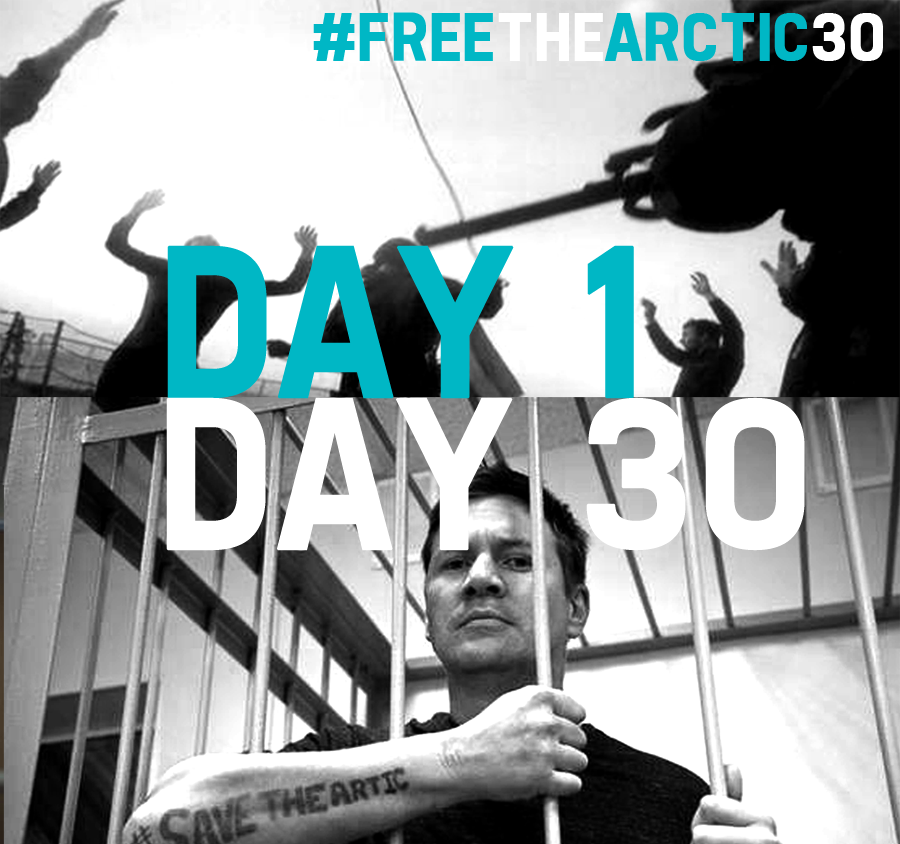
It has been 30 days since Russian agents stormed the Arctic Sunrise and arrested all 30 people on board. It has been 30 days of injustice but pressure is mounting.
This week, 11 Nobel Peace Prize winners including Desmond Tutu and Betty Williams wrote to President Putin to ask him to ensure the piracy charges against the Arctic 30 are dropped. In a personal phone call German Chancellor Angela Merkel expressed her concern over the imprisonment of the 30 and hoped the case would be resolved soon.
The UK’s foreign minister William Hague has spoken to his Russian counterpart and the Prime Minister David Cameron said in parliament this week that he’s asking for daily updates on their situation. They join a growing list of senior politicians, including from Brazil, the US and the Netherlands, who have spoken out publicly about the Arctic 30.
Public pressure is working and will make a difference. It’s critical that we make sure the fate of our friends and fellow activists doesn’t fall off the news agenda – and we can all help.
Please share the picture above on Facebook and forward this email to your friends, telling them they can email the Russian ambassador by going to www.greenpeace.org/freethearctic30
Let’s keep doing all we can to get them out,
Fran
PS it’s difficult to write on your own arm when you’re on your own in a cold Russian jail cell. Spelling slip-ups will always be forgiven 🙂
.The Fukushima Mothers’ Chorus Association at the 2nd Japan-US Chorus Festival.
Carnegie Hall Will Host Three Manhatanville Alumane
17 October 2013
….The Fukushima Mothers’ Chorus Association is made up of 750 members split into 32 groups all hailing from Fukushima prefecture, Japan, an area recently devastated by the earthquake and a subsequent nuclear power plant failure in 2011. Although many of the members were forced to evacuate and live in temporary homes they still actively perform around the world…..
Image source ; http://www.fukushimaminponews.com/news.html?id=233
 Manhattanville College will be well represented at Carnegie Hall on Oct. 19 as three alumnae will share the stage with the Fukushima Mothers’ Chorus Association for the 2nd Japan-US Chorus Festival.Alexis DePersia-Norelli ’06, MA ’13, Stephanie Ofshinsky 06’, MAT’09, and Sabrina Doolittle ’07, MAT ’13, all regularly travel, compete and perform with the Harmony Celebration Chorus. The New Jersey-based group is a barbershop-style chorus made up of more than 60 women that sing a variety of different musical selections. Manhattanville College will be well represented at Carnegie Hall on Oct. 19 as three alumnae will share the stage with the Fukushima Mothers’ Chorus Association for the 2nd Japan-US Chorus Festival.Alexis DePersia-Norelli ’06, MA ’13, Stephanie Ofshinsky 06’, MAT’09, and Sabrina Doolittle ’07, MAT ’13, all regularly travel, compete and perform with the Harmony Celebration Chorus. The New Jersey-based group is a barbershop-style chorus made up of more than 60 women that sing a variety of different musical selections.
“I am really excited,” DePersia-Norelli said adding that their final rehearsal Wednesday night went really well and that she is looking forward to performing. We are going to be singing and dancing at Carnegie Hall that is crazy.” The Fukushima Mothers’ Chorus Association is made up of 750 members split into 32 groups all hailing from Fukushima prefecture, Japan, an area recently devastated by the earthquake and a subsequent nuclear power plant failure in 2011. Although many of the members were forced to evacuate and live in temporary homes they still actively perform around the world. The Harmony Celebration Chorus will be the third act to take the stage, just before the Fukushima Mothers’ Chorus Association and the two groups will perform two songs together. The two groups won’t be meeting until Saturday when they have a short rehearsal before the concert, however despite their different styles and backgrounds DePersia-Norelli expects all of them to connect through music. “For me, music is one of those cool things that translates across cultures,” she said. Other acts include the Japan Choral Harmony “Tomo” and the Manhattan Symphonie. People can donate to On the Road to Fukushima, an organization helping achieve environmental recovery to Fukushima, either at the concert or in advance. Contact Mike Shirota for more information on donations. The concert will begin at 7 p.m. Tickets are $10 and seating is on a first come, first served basis. Contact the Carnegie Hall box office for tickets, 212-247-7800. Visit the concert’s website for more information. |
UN Says Fukushima Workers Radiation Exposure 20 times Higher Than Japanese Officials State
Published on 17 Oct 2013
The UN has found that Fukushima workers have been exposed to much higher levels of radiation than Japanese officials having been reporting.
Reference: UN questions Japan estimates of Fukushima worker radiation doses
http://america.aljazeera.com/articles…
A Review and Critical Analysis of the Effective Dose of Radiation Concept by Alexey Yablokov.
- 10-9-2013
- Categorized in: Chernobyl, NUCLEAR POWER, PUBLIC HEALTH
Alexey Yablokov l Blacksmith Institute (Journal of Health and Pollution) October 2013
Link to downloadable article: http://blacksmithjournal.org/ojs/ojs-2.2.4/index.php/journalhealthpollution/article/view/71/95
“Radioactive pollution and its effects are some of the least visible but most dangerous man-made changes of the biosphere. Though above-ground nuclear weapons testing has been banned since the 1960s, mankind has continued to find new ways to exploit radionuclides. To protect people from anthropogenic radiation contamination, it is necessary to determine an acceptable level and range of exposure. Today, the system of radiation safety endorsed by the U.N. and other multi-national groups is based on the concept of an effective dose—the measure of cancer risk toan entire organism from radiation exposure to its various parts. This review posits there are serious problems with both the concept of an effective dose and the methodology behind its calculation, and that a new framework is needed. In order to study the issues and drawbacks of the official concept of radiation safety, and to assist readers in understanding the basis of his argument, the author sums up and critiques the current system’s main basic postulates and conclusions.”
http://blacksmithjournal.org/ojs/ojs-2.2.4/index.php/journalhealthpollution/article/view/71
http://blacksmithjournal.org/ojs/ojs-2.2.4/index.php/journalhealthpollution/article/view/71/95
From this source
Numerical Modeling of the Releases of 90Sr from Fukushima to the Ocean: An Evaluation of the Source Term
Abstract

A numerical model consisting of a 3D advection/diffusion equation, including uptake/release reactions between water and sediments described in a dynamic way, has been applied to simulate the marine releases of 90Sr from the Fukushima power plant after the March 2011 tsunami. This is a relevant issue since 90Sr releases are still occurring. The model used here had been successfully applied to simulate 137Cs releases. Assuming that the temporal trend of 90Sr releases was the same as for 137Cs during the four months after the accident simulated here, the source term could be evaluated, resulting in a total release of 80 TBq of 90Sr until the end of June, which is in the lower range of previous estimates. Computed vertical profiles of 90Sr in the water column have been compared with measured ones. The 90Sr inventories within the model domain have also been calculated for the water column and for bed sediments. Maximum dissolved inventory (obtained for April 10th, 2011) within the model domain results in about 58 TBq. Inventories in bed sediments are 3 orders of magnitude lower than in the water column due to the low reactivity of this radionuclide. 90Sr/137Cs ratios in the ocean have also been calculated and compared with measured values, showing both spatial and temporal variations.
The International Olympic Committee says there are no health worries in Japan despite problems in Fukushima
Berlin (dpa) – The International Olympic Committee (IOC) on Tuesday said it has no health-related concerns about Tokyo hosting the 2020 Olympics, despite the continued critical state of the damaged facilities at the Fukushima Daiichi Nuclear Power Station.

Image source ; http://rt.com/news/fukushima-children-thyroid-cancer-783/
“The IOC received assurances from the highest authority in Japan that the levels in Tokyo and surrounding area are safe, and there is no reason to believe that this will not be the case during the Games,” the IOC told the German press agency dpa, without answering further detailed questions.
However, problems at the plant continue to such an extent that the Japanese government has once again turned abroad for help on the question of the plant, since operator Tepco seems to be overextended.
Japanese Prime Minister Shinzo Abe in early October asked for international support during a Kyoto conference of researchers from abroad.
Shortly before the vote on the host of the 2020 Olympics, Abe reassured members of the IOC that life in Tokyo is normal and “everything is under control.” But bad news has not stopped since the earthquake and tsunami disaster on March 11, 2011, in Fukushima, 250 kilometres to the north of Tokyo.
Contaminated water has seeped from leaky cooling tanks into the Pacific Ocean. More leaks are feared.
The government is now planning to erect a 1.4 kilometre-long protective wall around the reactors. In addition, pipes with chemical cooling agents will be laid around the buildings that contain reactors 1 to 4.
The IOC awarded the 2020 Olympics to Tokyo last month, over Istanbul and Madrid.
At least 17 dead, 50 missing as Typhoon Wipha grazes Japan
A typhoon killed 17 people in Japan on Wednesday, most on an offshore island, but largely spared the capital and caused no new disaster as it brushed by the wrecked Fukushima nuclear power station.
Typhoon Wipha roared up Japan’s east coast, forcing the evacuation of about 20,000 people from their homes because of flooding and the cancellation of hundreds of flights.
Sixteen people were killed on Izu Oshima island about 120 kilometres south of Tokyo, as rivers burst their banks.
Meanwhile, the island’s local authority says it has not been able to confirm the whereabouts of 50 of Izu Oshima’s more than 8,300 residents.
The storm set off mudslides along a two-kilometre stretch of mountains.
Television footage showed roads clogged with wreckage and houses with gaping holes smashed into them.
“I heard a crackling sound and then the trees on the hillside all fell over,” a woman on Izu Oshima told NHK television.
The once-in-a-decade storm brought hurricane-force winds and drenching rain to the Tokyo metropolitan area of 30 million people at the peak of the morning rush hour.
A woman was swept away by a swollen river in the west of the capital, the government said, while about 20 people were hurt in falls or struck by flying debris.
More than 500 flights at Tokyo’s Haneda and Narita airports were cancelled, and thousands of schools closed. Bullet train services were halted but resumed by Wednesday afternoon.
The operator of the Fukushima nuclear plant, Tokyo Electric Power Corporation (TEPCO), cancelled all offshore work and secured machinery as the storm approached.
TEPCO has been struggling to contain radioactive leaks since a 2011 earthquake and tsunami caused extensive damage and triggered the world’s worst nuclear crisis since Chernobyl in 1986.
A TEPCO spokesman said the typhoon had caused no new problems at the plant, which is on the coast 220 kilometres north of Tokyo.
The storm dumped heavy rain which had to be pumped out of protective containers at the base of about 1,000 tanks storing radioactive water, the by-product of a jerry-rigged cooling system designed to control wrecked reactors.
The rainwater was checked for radioactivity and released into the sea, the company spokesman said.
Typhoon Wipha was downgraded to a tropical depression by 5:00pm AEST. It was off the coast of north-eastern Japan and moving northeast at 95 kph, according to the Japan Meteorological Agency.
At its height, Wipha had sustained winds at its centre of 126 kph and gusts of up to 180 kph.
It was the strongest storm to hit the region since October 2004.
That cyclone triggered floods and landslides that killed almost 100 people, forced thousands from their homes and caused billions of dollars in damage.
Reuters/AFP
1 This Month





PLEASE OPPOSE HR 8255 AND S.3639 – bills would accelerate satellite deployment, with no environmental review or safeguards – https://ncstd5li.quorum.us/campaign/169331/
To see nuclear-related stories in greater depth and intensity – go to https://nuclearinformation.wordpress.com
-
Archives
- October 2026 (81)
- September 2026 (339)
- August 2026 (330)
- July 2026 (355)
- June 2026 (287)
- May 2026 (306)
- April 2026 (356)
- March 2026 (251)
- February 2026 (267)
- January 2026 (308)
- December 2025 (358)
- November 2025 (359)
-
Categories
- 1
- 1 NUCLEAR ISSUES
- business and costs
- climate change
- culture and arts
- ENERGY
- environment
- health
- history
- indigenous issues
- Legal
- marketing of nuclear
- media
- opposition to nuclear
- PERSONAL STORIES
- politics
- politics international
- Religion and ethics
- safety
- secrets,lies and civil liberties
- spinbuster
- technology
- Uranium
- wastes
- weapons and war
- Women
- 2 WORLD
- ACTION
- AFRICA
- Atrocities
- AUSTRALIA
- Christina's notes
- Christina's themes
- culture and arts
- Events
- Fuk 2022
- Fuk 2023
- Fukushima 2017
- Fukushima 2018
- fukushima 2019
- Fukushima 2020
- Fukushima 2021
- general
- global warming
- Humour (God we need it)
- Nuclear
- RARE EARTHS
- Reference
- resources – print
- Resources -audiovicual
- Weekly Newsletter
- World
- World Nuclear
- YouTube
-
RSS
Entries RSS
Comments RSS

