Evidence of sharp features in the Fukushima plume over Southwestern British Columbia […]
Naively [naive: deficient in worldly wisdom or informed judgment] one could expect a diffuse and well-mixed plume reaching the West Coast, especially in the boundary layer – – Nevertheless important small scale features are observed in the plume […]
Dispersion modelling indicates that there are indeed small scale / sharp features in the plume even after several days travel times […]
Horizontal diffusion does not play a major role in the horizontal spread of the plume […]
http://globalvoicesonline.org/2013/12/02/20-bitter-voices-rise-from-fukushima-after-japans-2011-nuclear-disaster/

南相馬市60代男性「自宅一軒、竹中工務店に560万円で除染を依頼し、現場の
下請けはピンハネされまくって、70万円で
作業をする。末端の作業員は日当約8千円。除染が終了したら仕事がなくなるから、皆、
いい加減な仕事しかしない。それで雇用が確保され、経済が回る。それ
が除染ビジネスの実態」
A man in his 60s, Minamisoma city:
“A request for decontamination of one home with the Takenaka
Firm will cost 5,600,000 JPY. At the actual scene the
subcontractor has lots of bribes and kickbacks pilfered
from him and it costs 700,000 JPY to do the job.
It’s about 8,000 JPY per day for the final workers.
Because the jobs disappear when the decontamination is finished,
 everyone’s doing real sloppy work. By doing that, they’re
guaranteed long-term employment, and the economy turns. That’s
the real state of the decontamination business.”

福島の仮設・20代女性「子どもがいるので被ばくについて勉強したいと思い、県内の講演会等に
行くようにしている。しかし
偉い先生の講演会は、「放射線量はほとんどゼロ」「内部被ばくなどない」「福島は大丈夫」ばかり。
正確な情報が、手に入らない。それを声に出すと、さらに
非難される」
A woman in her 20s, Fukushima provisional housing:
“Because I have children I think I’d like to learn about
radiation exposure, so I’m making a point of going to
lectures within the prefecture.
However, a lecture of an esteemed professor was all ‘The
radiation level is nearly zero,’ ‘there is no such internal
radiation exposure,’ and ‘Fukushima is perfectly
fine.’
I can’t get any accurate information. If you raise your
voice about that, you’ll get criticized all the more.”
9:30-10:30am, 5th December Royal Courts of Justice, Strand, London WC2 Map: http://tinyurl.com/mkqm3ov Nearest tube: TempleSupport the Irish National Trust’s High Court challenge against Hinkley C
On Thursday, the High Court in London will hear a judicial review brought by An Taisce, Ireland’s equivalent of the National Trust, regarding the legality of the decision by the UK Energy Secretary, Ed Davey to grant permission to build two new nuclear reactors at Hinkley Point in Somerset.
The legal challenge is on the grounds that the people of the Irish Republic were not consulted before this decision was made, even though the Irish people could well be adversely affected if there was an accident at the new power station resulting in the release of radiation. The group is questioning whether the development complies with both the EU’s Environmental Impact Assessment directive and the UK’s own regulations on trans-boundary impacts and consultation.
In May 2013 An Taisce launched judicial review proceedings in London to challenge the legality of UK Secretary of State Ed Davey’s decision to grant permission to build and operate a nuclear power station at Hinkley Point in the Bristol Channel, Somerset, 150 miles from the Irish coast In papers issued in the High Court in London by lawyers Leigh Day, we have challenged the legal compliance of the decision by the Government with the Environmental Impact Assessment Directive and the UK’s own regulations on transboundary impacts and consultation.
Despite the nuclear power plant being nearer to the coast of Ireland than it is to Leeds, the UK decided not to consult with the Irish public about the decision before it granted consent in March. The first time many Irish people learned about the nuclear power plant proposal was when the decision was announced. Their views were not therefore taken into consideration as part of the UK government’s decision and assessment process.
It is argued that consultation would allow both regional governments and the potentially effected population in Ireland to contribute to the consultation and decision making process and would allow the UK to properly and fully consider the impacts and effects of the plant across boundaries.
There is a contrasting approach on consultation adopted by other countries including Finland, Lithuania, the Netherlands, and the Czech Republic, who have contacted neighbouring countries in relation to their plans to develop nuclear power facilities.
Rosa Curling from Leigh Day who is representing An Taisce, said:
“The UK Government decided to grant permission to build and operate a nuclear power plant at Hinkley Point without consulting the Irish public or taking into account significant potential risks of the power plant across national boundaries.
The failure to consult or consider these transboundary impacts renders the decision to grant permission for the nuclear power plant unlawful and we will be seeking to challenge it in the High Court to give the Irish public a voice.”
James Nix, Policy Director for An Taisce said:
“This case is not about interfering with the right of the UK authorities to make their own decisions, nor about being pro or anti nuclear. It is about ensuring that the rights and interests of the Irish public and their concern for their environment are not excluded from those decisions, and that the Irish public is properly consulted in accordance with the law on a project of this nature.
Ireland’s agriculture, food, fishing and tourism – which are our essential indigenous industries – are critically dependent on the quality of our environment, as is the health of our people. This is therefore a matter of considerable importance and concern for Irish people, and for our interest in our environment.
An Taisce views compliance with environmental law as a fundamental building block in our mission to protect Ireland’s built and natural environment. We seek the assistance of the UK courts in determining the correctness of this decision, which is important not only in respect of this nuclear power plant decision, but also the manner in which other decisions in the pipeline will be treated in the future, including the nuclear plant proposed for Anglesey, which is even closer to Ireland and in an area which is prone to earthquakes.”
…..”The government cannot escape that clear fact by talking about ‘support mechanisms’ and ‘insurance policies’ instead of ‘subsidies’,” the committee said in a report.
EDF declined to comment…..
Brussels to look at UK state aid for nuclear power plant after government offers EDF Energy a set price for 35 years
The government’s deal to underwrite the £16bn Hinkley Point nuclear power station plan faces delay and possible rejection after the European commission said it was ready to launch an in-depth inquiry into the agreement.
The EU competition commissioner said Brussels was likely to investigate the deal, which guarantees a minimum power price for 35 years, to make sure it conformed with state aid rules. The commission frowns on national governments offering deals to companies that stifle competition and distort the market.
Joaquín Almunia said: “We are starting to analyse what is in the British proposal. Probably we will open a formal investigation because many people are asking the same question [whether the UK’s agreement was too long].”
Energy secretary Ed Davey gave the go-ahead in October for a consortium led by France’s EDF Energy to build the Hinkley Point C plant in Somerset. Its two reactors will cost £8bn each and will provide enough power to supply 7% of Britain’s homes for 60 years.
Davey agreed a minimum price of £92.50 for every megawatt hour (MWh) of energy that Hinkley Point generates – almost twice the current wholesale cost of electricity. The deal with EDF was unprecedented and made the UK the first European country to offer a set price over 35 years for a new nuclear project.
EDF laid off workers at Hinkley Point in April to cut costs when talks with the government were making slow progress. The company was said to be spending £1m a day on the project.
The government has said it is confident the deal will stand up to EU scrutiny but a formal probe could take years and cast prolonged doubt over the plan. The government has said the new plant is vital to make Britain more self-sufficient and to cut use of fossil fuels.
A non-profit group in the US state of Arkansas is planning to mark the anniversary of the largest hydrogen bomb ever tested by the US military.
Bikini’s largest nuclear test to be commemorated in Arkansas (Credit: ABC)
Organisers say it’s the first event of its kind and will commemorate the 60th anniversary of the devastating Bravo nuclear detonation at Bikini Atoll on the first of March,1954.
Arkansas has the largest number of Marshall Islander victims outside of the Marshall Islands.
They had voluntarily halted production after radioactive cesium exceeding government standards was detected in some of the dried fruit products.
But this year, testing showed that radiation levels in persimmons from some areas have fallen. So the Fukushima prefectural government and producers’ groups decided to restart shipping dried persimmons that have passed safety tests.
A ceremony was held in Date city on Monday to mark the resumption of shipments from the area.
Fukushima Governor Yuhei Sato said the revival of agricultural and fishery production is a prerequisite to the restoration of Fukushima. He said the return to market of dried persimmons will contribute significantly to this goal.
Before being accepted for shipment, the dried persimmons must pass radiation tests. Those confirmed to have radiation levels below national limits will have seals that certify product safety attached to their boxes.
The head of the producers’ group said their 2 years of perseverance has finally been rewarded. He added that he hopes shipments of dried persimmons will soon be resumed from other areas as well.
Arnie discussses his early whistleblowing life, his thoughts on the Daichi unit 3 explosion and his concerns about the use and abuse of Depleted Uranium.
PTI/Mumbai : India needs to tweak its civil nuclear liability law if it. wants to attract foreign companies in a big way to help the country achieve its ambitious target in atomic power generation, a senior Canadian diplomat has said.”The way the liability has been framed in the civil nuclear liability Act deviates from the global standards and it is our view if it is not modified, it is hard to see any foreign supplier coming in a big way to India,” Canada’s Consul General Richard Bale told PTI on the sidelines of the Nuclear Summit here over the weekend.
Under the Act, an operator of a nuclear plant (so far only NPCIL) will be liable for damages worth up to Rs 1,500 crore. However, there is a provision for the right of recourse for the operator. If written into the contract, the operator can claim the liabilities from the manufacturer and supplier. Most of the suppliers, domestic as well as international, are concerned over whether they will have to bear over Rs 1,500 crore in the event of a nuclear disaster.
The Canadian diplomat further said there is a need for more clarity on the policy front. “The problem is that it is not clear where the line is. If you are a supplier of reactors, then it is a problem. At the same time, if you are a sub-contractor, even then there is a problem as there is no clarity on who should be held responsible. India needs to tweak the liability law,” he said.
India plans to expand its nuclear power generation capacities exponentially and has set an ambitious target generating 63,000 MW of atomic power by 2032. By 2020, India’s installed nuclear power generation capacity is expected to increase to 20,000 MW.
India and Canada have signed a civil nuclear cooperation agreement in 2010 that allowed them to initiate negotiations for uranium supply.
The huge Sellafield plant in Cumbria is regarded as the most dangerous industrial site in western Europe, not least because it houses 120 tonnes of plutonium, the largest civilian stockpile in the world. Photograph: David Moir/Reuters
The bill for cleaning up the huge Sellafield nuclear plant in Cumbria will rise even higher than its current estimated level of £70bn as operators struggle to assess the full scale of the task, according to sources close to the project.
The warning comes just days before private sector managers face a grilling from the public accounts committee, which is investigating activities at the facility.
It was hoped that the huge bill – eight times the cost of staging the London Olympics – would be capped at £70bn, but well-placed sources have told the Guardian that the operators are convinced they are still “not at the top” of the cost curve.
Sellafield is regarded as the most dangerous and polluted industrial site in western Europe, not least because it houses 120 tonnes of plutonium, the largest civilian stockpile in the world.
The cost of decommissioning the Calder Hall reactor plus a magnox fuel reprocessing plant at Sellafield has been rising steeply, but the biggest task comes from “ponds” and “silos” filled with old equipment and deteriorating, highly toxic waste.
Nuclear Management Partners (NMP), the private sector consortium that manages the site, declined to comment, but other sources said those engaged in the clean-up were still some way from knowing exactly what was in the storage facilities. “Record-keeping in the past was clearly not what it should have been,” said one.
The soaring cost of decommissioning, along with the apparent inefficiency of NMP – and the £230m of dividends it has received – will come under the spotlight on Wednesday at a meeting of the public accounts committee, which is chaired by Margaret Hodge, the straight-talking MP for Barking and Dagenham.
…Yamamoto’s character is a relative who tries to persuade the family to move to Okinawa, Japan’s southernmost island, as they suffer through futile efforts to decontaminate their strawberry fields and one of them develops cancer.
It is now being screened at about 10 independent movie theaters and cinema complexes in Japan…
….The film taps into the strong feelings of critics who accused the Japanese government and nuclear industry of jointly downplaying the severity of the Fukushima disaster and dragging their heels on releasing information…..
Japanese film director Takafumi Ota had a problem. He needed studio financing for a film that was harshly critical of the nuclear industry in the aftermath of Fukushima, but no one was interested in funding his project the traditional way.
Large sections of Japan’s movie industry wanted nothing to do with it, and he was told that influential sponsors did not want to be associated with anything that criticized the powerful atomic sector.
“It wasn’t only major film distribution companies but also DVD companies — who usually get interested in investing in films to share copyright — who showed no interest in my plan,” said the 52-year-old Ota, whose previous work includes the critically acclaimed 2006 film “Strawberry fields,” which screened at the Cannes International Film Festival.
“A senior film director told me ‘Don’t do this. You’ll never be able to make commercial films.’“
With few options to make the film, but a groundswell of anti-nuclear feeling in post-Fukushima Japan, Ota turned to the public to make his film in another example of how crowdfunding is changing the face of traditional financing.
The practice sees individuals or firms raise micro-donations from small investors over the Internet. While still small, the market has been booming, with companies such as the pioneering KickStarter offering donation-based funding for creative projects.
Globally, the crowdfunding market grew 81 percent last year and was on track to raise $5.1 billion in 2013, with investments in everything from business startups and philanthropic projects to films and music, according to research firm Massolution.
For Ota, raising money through his blog from a public suspicious of the nuclear industry got him the crucial 10 million yen ($100,000) that he needed to make “Asahi No Ataru Ie” (The House of Rising Sun), a film about a family pulled apart by a Fukushima-like nuclear crisis. Each donor was offered the chance to see their name on the credits.
“The 10 million yen budget is extremely low for a feature-length film, but actors and other staff got on-board despite low salaries,” Ota said. Among them was Taro Yamamoto, a 39-year-old actor who is a household name in Japan thanks to his appearances in movies, television dramas and on variety shows.
Amir Adnani, the founder and Chairman of Brazil Resources and CEO of Uranium Energy Corp joins us to discuss everything from the real world costs of mining one ounce of physical gold, to the HUI hitting new lows while major stock market indexes soar to new highs. It’s been a multi-year bloodletting for anyone who owns mining stocks, and with Brazil Resources (Full Disclosure: I own none) back down near its IPO price, we wanted Amir’s take on the beaten down, unloved precious metals mining sector — a contrarian play if ever there was one. Adnani says, ‘The cycles are necessary and create opportunities… we need these down periods because these are the windows where you can substantially grow your company, you can acquire assets for cents on the dollar.”
Regarding the current prices of silver and gold being below the costs of production for many miners, even as every government on earth is printing fiat currency as fast as possible, Adnani says, “This is the disconnect, almost of a lifetime… and again it creates incredible opportunities, and you have to do something with it.”
As for uranium and the nuclear power sector, I ask Amir the tough questions about Fukushima. Can nuclear power generation really ever be safe? Given the absolute environmental catastrophe caused by the Fukushima Daiichi nuclear power plant, what is the future of nuclear power, a major energy source for the world? Adnani answers the tough questions and shares his insights candidly in this nearly 40-minute long interview.
The content in my videos and on the SGTbull07 channel are provided for informational purposes only. Use the information found in my videos as a starting point for conducting your own research and conduct your own due diligence (DD) BEFORE making any significant investing decisions. SGTbull07 assumes all information to be truthful and reliable; however, I cannot and do not warrant or guarantee the accuracy of this information. Thank you.
Those first moments , the most terrible nuclear catastrophe.
Those who daily continue to fight against the worsening situation.
Those who will replace them for many years.
To the families and their relatives.
Here is a message of gratitude and sympathy that comes from France .
If you can not count on your employers and managers to treat you correctly, and you ‘re not only provided for and discredited in the face of insurmountable problems that you face.
Although this is a small consolation to thousands of kilometers , strangers, ordinary people like you , are with you in thought and thank you from the bottom of their hearts for your courage and determination .
You are important people who deserve respect, by the responsibilities that rest on your shoulders, and because of that you do not really get in return recognition or rewards.
You can not blame the worker who disconnected the wrong pipe, pressing the wrong button or overfilled tank , due to a lack of training, specific instructions, or means of control.
You can not blame the worker who loses morale because he is faced with difficult working conditions and dangerous .
People like us, who are on your side , who rely on you , which offer you their trust and moral support that you do not forget , there are thousands and even millions surely worldwide .
We do not know you , but we are human beings like you , citizens of the Earth. We know the difficulty of your situation, and if we can not do much for you, we would like to say thank you for what you do , thank you for the risks you take for all of us . We are with you .
Thank you to the “Fukushima 50” and all the courageous people who from the first day of the disaster did not hesitate to put their lives at risk to prevent a more serious situation occuring.
Thank you to all the people that we never talk about that every day at their level, involved in the huge task of curbing the radioactive risk to the Fukushima nuclear plant .
Our moral support and our thoughts are with you and your families, and to the relatives of the victims who lost their health or their lives in this struggle.
☢ ~ ~
Here is the same text as PDF , translated into several languages. My first goal is that the message reaches the Japanese Fukushima workers . Post this text, pass it , for it has a chance to reach its recipients. (Please share the links below, not the files themselves or their direct links , so that I can maintain visibility into their use . )
The title of this article, “Full Tyvek jacket” , probably something to remind many of you . This is not innocent.
The Tyvek is a material made from non-woven polyethylene fibers , a chance discovery of DuPont in the 50s. This is the constituent outfits white protective or sometimes blue , supposed to be worn by all workers who work on the site of Fukushima Daiichi and decontamination sites in prohibited areas . This type of combination is widely used in many industrial or artisanal activities as disposable protective clothing against soiling .
For what concerns us , so they protect
mainly workers against contamination by radioactive dust . But absolutely not against penetrating radiation, gamma rays or neutron beams. To do this, we must have recourse to the lead or tungsten-based composites , used for example in Chernobyl or Fukushima, by some very exposed stakeholders during work on the reactor 3 building.
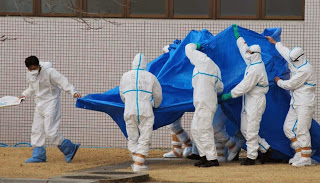
They do not protect either risk caused by faulty adjustment of all protective elements of the outfit, due to missing or insufficient instructions , or parts unsuitable equipment . It will be recalled eg irradiated workers in March 2011 in the reactor building flooded unit 3, the highly contaminated water they waded having seeped into their boots too low and poorly fitting clothes . By cons , it is noted that “for the photos “, where their colleagues hide behind a cover at their disposal to receive care , everyone seems sealed and taped everywhere. Or almost …
Here is the only armor against radiation available to the vast majority of workers in Fukushima : overalls polyethylene . Full Tyvek jacket …
http://www.youtube.com/watch?v=b151VLqRwHg&feature=share&list=UU-J6bDRfeGYfexcoaP4LeWQ
( 3’30 ” In st Fr)
Russia Today recently published a short report on the conditions of workers in charge of the work of post- Fukushima rehabilitation. Here subtitled in French .
It includes Tomohiko Suzuki, courageous investigative journalist who worked clandestinely in Fukushima for a month and a half during the summer of 2011 , and has published a book titled ” The Yakuza and the nuclear industry .”
Although a bit long , I suggest you look at this conference in December 2011 in two parts, translated into French , in which Mr. Suzuki describes his experience at the Fukushima plant , with some photos and video footage taken on the spot . Two main themes are :
– The state of the plant , despite the official declaration of ” cold shutdown ,” the risks to workers and the shortcomings of TEPCO and the Japanese government.
– Involvement for many years Yakuza mafia organizations in the Japanese nuclear industry .
(Part 1 , 47’12 ” , Jp + st In Fr)
(Part 2 , 55’02 ” , Jp + st In Fr)
Now here is the testimony of some;
( 8’16 ” De st Fr)
Fukushima workers who contacted the studios of the ZDF in Tokyo in October 2011: “Those that are often called heroes, those who do the cleaning, gave their version of their harsh working conditions, without any idea doses of actual radioactivity there. Even if nuclear disaster is out of the head of most people , for those who work there, it continues … ”
( 25’36 ” In st Jp + Fr)
The months and years pass, some things change. Now back to more than 40 years ago, with the uplifting documentary N. Röhl , ” Nuclear Ginza ” , where he gives the word has multiple victims , sent to be irradiated without protection or training in the most dangerous areas, and parents of a worker even 30 years which left her skin there . I’ve already devoted an article there one year. If you have already read, go read it , review this video . This is also nuclear, in the beautiful nation of Japan, moving towards a bright future …
I think it would be unfair not to mention also those which are often the early major disasters frontline firefighters, and the military. Certainly , they are more likely to chose their profession without being picked up in some shallows by the Yakuza . But whether in Ukraine or Japan , how many of them paid with their lives for their willingness to fight a battle in which they were not prepared , and brought relief to others ? We ‘ll never know , it is in the interest of any government or authority to recognize and disclose exactly what kind of things when it comes to nuclear power.
( 4’33 ” Jp st Fr)
However, here is a testimony about the death of a member of the special rescue unit of firefighters, who has not been officially confirmed or reported in the mainstream media. It includes Taro Yamamoto, who had not yet paid policy. Since it also tries to make him pay a high price for the truths he tries to highlight …
Here is also a PBS documentary “Inside Fukushima ‘s meltdowns ” American chain , unfortunately only in English, which pays tribute to these brave men .
The English transcript is available by following this link .
It seems difficult to conclude this article,
( 3’43 ” Fr)
Yet dedicated workers Fukushima, let alone France . Can we think that France , the situation of nuclear workers is better ? Among us , it is not the mob that provides all-comers intermittent nuclear . And here, not Fukushima , for the moment. But there is much to say on the subject, which deserves a folder alone .
Here are just ” The convicts nuclear ” , a montage made in August 2011 , based on pictures of Vincent Capman . He also worked with men he photographed in central Cattenom and Paluel in 2008 and 2009. He shared their lives, their workdays , their rest periods.
NUMO members and Japanese camera crew visited ANDRA in France, SKB in Sweden, POSIVA in Finland and NAGRA in Switzerland between late May and early June for filming a documentary on their HLW disposal programs for introducing current advanced situations. This documentary film covers photographs of their relevant facilities such as for R&D and PR activities, including interviews with their technical experts and PR representatives, regulators, residents of local communities. This documentary film will be released in March 2014 on the NUMO website.
Published: November 30th, 2013 at 11:14 pm ET
By ENENews
Vancouver Sun, Nov. 27, 2013: Michael Harris, executive-director of the Pacific Whale Watch Association […] said he’s been working in Puget Sound and the Strait of Georgia for 30 years and has “never ever seen this kind of behaviour going on. They must sense this is a safe place to be.” […] Wild Whales Vancouver had up to 10 close encounters this season in the southern Strait of Georgia, mainly near Galiano Island […] The whales typically rolled on their backs and sides next to the boat and looked up at the passengers. One even placed its head on the boat while spyhopping, a behaviour in which the whale rises up vertically to look above the water […]
Global News, Nov. 27, 2013: Capt. Jim Maya […] who runs Maya’s Westside Whale Watch Charters, has been working on the waters of the Pacific since 1965 and says he has never seen anything like what they saw that day. […] Maya says he estimates the whale was about 35 to 40 feet long and was an immature female. She hung around the boat for about an hour […] Chad Nordstrom, a researcher with the Cetacean Research Lab at the Vancouver Aquarium, says they have been receiving more and more reports of humpback whale sightings along the B.C. coast, especially in the lower Strait of Georgia.
Vancouver Sun, Nov. 28, 2013: Andrea Hardaker, manager of Wild Whales Vancouver [said] “The passengers loved it. But they don’t know what to expect on the trip. Whatever they see they think is normal. For our guides and the captains, we know it isn’t normal.” […] [Hardaker] believes these are the first such reports in local waters.
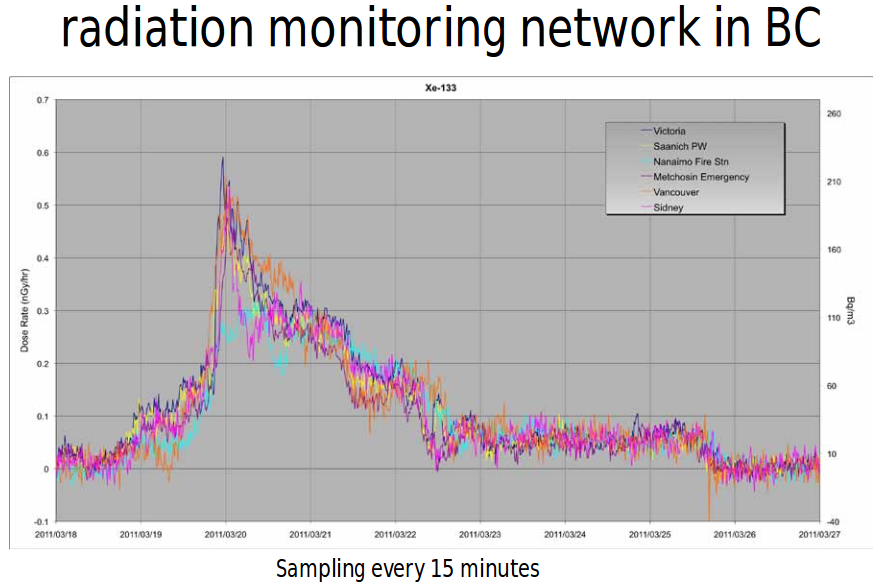
 Image source ;
飯能の柿。
Image source ;
飯能の柿。 Article source ;