Indian Point Nuclear Power Plant Supervisor Gets $500 Fine For Falsifying Facility Records
WILSON admitted that he had fabricated the test results so that Indian Point would not have to shut down.
Submitted by Tyler Durden on 01/16/2014
The infamous ‘scourge on insider-traders everywhere’ Preet Bharara has taken a day off from Wall Street duties to focus on what could be considerably more of a concern. The NY Attorney General just disclosed that Daniel Wilson – the Chemistry Manager at the Indian Point Nuclear Power plant – falsified and fabricated test results for diesel fuel contamination used to power emergency generators.. in order that the plant would not have to be shut down. Have no fear though US public… especially those who live near White Plains, Bharara’s punishment for this potentially disastrous ‘deliberate misconduct’ – a $500 fine and 18 months probation. Well that will teach him, eh?
Full statement:
Former Indian Point Supervisor Sentenced In White Plains Federal Court For Falsifying Nuclear Facility Records
FOR IMMEDIATE RELEASE
Thursday, January 16, 2014
Preet Bharara, the United States Attorney for the Southern District of New York, announced that DANIEL WILSON was sentenced today in White Plains federal court to 18 months’ probation for engaging in deliberate misconduct while serving as Chemistry Manager at Indian Point Energy Center (“Indian Point”), a nuclear power plant in Westchester County. WILSON was sentenced by United States District Judge Nelson Román, who also imposed a $500 fine.
U.S. Attorney Preet Bharara stated: “The safe operation of the Indian Point nuclear power facility is of critical importance to our communities in and around it. This Office will be vigilant about prosecuting criminal misconduct that takes place at the facility.”
According to the felony Information to which WILSON pleaded guilty, the Complaint, and information provided for purposes of sentencing:
Indian Point maintains a backup system of emergency generators for use in part to provide power in the event of a power outage and shutdown. WILSON, the Chemistry Manager at Indian Point from 2007 through 2012, was responsible for, among other things, ensuring that certain aspects of the operation at Indian Point were in compliance with technical specifications required by the Nuclear Regulatory Commission (“NRC”).
One such requirement related to the amount of particulate matter in the diesel fuel used to power emergency generators at Indian Point, which could not exceed a set limit. In 2011, tests of the diesel fuel maintained for use in powering the emergency generators at Indian Point showed that the ratio of particulate matter in the diesel fuel exceeded the limit set by the NRC.
In February 2012, WILSON concealed material facts from his employer and the NRC by fabricating test data, falsely showing that resampling tests of diesel fuel tested below the applicable NRC limit. In fact, no such resamples were taken, and the purported test data were fabrications. Later in February 2012, WILSON, in response to questioning by other employees of Indian Point in advance of an inspection by the NRC, wrote a report – the kind on which the NRC ordinarily relies in inspecting nuclear facilities for safety – in which he gave a false explanation for the lack of supporting documentation for his fabricated test results. In a subsequent interview with NRC personnel, WILSON admitted that he had fabricated the test results so that Indian Point would not have to shut down.
In April 2012, Wilson resigned from Indian Point.
On October 16, 2013, WILSON pleaded guilty to a one-count Information charging him with deliberate misconduct in connection with a matter regulated by the NRC, in violation of Title 42, United States Code, Section 2273.
* * *
Mr. Bharara praised the efforts of the NRC Office of Investigations in connection with the investigation.
The prosecution is being handled by the Office’s White Plains Division. Assistant U.S. Attorney Benjamin Allee is in charge of the prosecution.
Tepco measured 5,100,000 Bq/m3 of Strontium-90 from groundwater in August 2013 / Concealed for 5 months
Posted by Mochizuki on January 15th, 2014
Following up this article.. Tepco concealed wrong analysis of seawater for over 6 months / Tepco “Too busy to verify” [URL]
5,100,000 Bq/m3 of Strontium-90 was measured from groundwater last August, but Tepco didn’t publish the data for 5 months.
For press’s question about why Tepco doesn’t publish Strontium-90 data of seawater and groundwater samples, Tepco explained it is because they found technical errors in some of the analysis data.
On 1/15/2014, Tepco released the concealed Strontium-90 data along with the wrongly analysis data.
The newly published data reveals the fact that Tepco was aware of the significant Strontium-90 contamination in groundwater and seawater.
Except for the samples still “under analysis” for 6 months, Tepco measured Strontium-90 from all the groundwater samples taken from the seaside of reactor1 and 2. The highest reading was 5,100,000 Bq/m3 (8/22/2013). This is 94 times much as the former highest reading measured last May.
Also, Strontium-90 was measured from 97% of seawater samples taken in Fukushima plant port. The data shows Strontium-90 was detected in various locations in the port, from upper layer and lower layer, and also the entrance of port. The highest reading was 720,000 Bq/m3 (9/22/2013). This is 97 times higher than the former highest reading measured last June.
http://www.tepco.co.jp/nu/fukushima-np/f1/smp/2014/images/2tb-east_14011502-j.pdf
The 4 Myths The Nuclear Industry Wants You to Believe
via Fairewinds.org / January 16, 2014 /
h/t http://fukushimaupdate.com/what-are-the-4-myths-the-nuclear-industry-wants-you-to-believe/
In order to produce more nuclear electricity, the nuclear corporations and proponents need you to believe that nuclear power is safe, no one has ever died or become ill from nuclear power accidents, nuclear power will counteract global warming, and it is the cheapest form of power. Listen to Fairewinds’ Arnie Gundersen tell you the truth about these myths.
History of Bomb Strontium and Cesium Isotopes in Pacific Compared to Fukushima Sources
The weakness of this approach is that there are other pressures (ocean acidification, warming, oxygen depletion) on the marine environment that one could qualitatively say might make the ecosystem more vulnerable to these very small increases in radiation. But again the increases in exposure are orders of magnitude lower than organisms are presently exposed to by the uptake of naturally occurring Po-210.
via Daily Kos / January 15, 2014 / The purpose of this diary is to compare the concentrations of Sr-90 and Cs-137 in the North Pacific Ocean over the last 50 years to the concentrations predicted to arrive on the west coast associated with waters affected by release of radionculides from the Fukushima-Daiichi Nuclear Power Plant. Given present levels that are being measured in the eastern Pacific and barring release rates that significantly exceed past rates in March-April 2011 the impact on marine organisms and the marine environment is going to be very minimal. What follows below the fold is a comparison of the concentrations measured and predicted over much of the Pacific owing to Fukushima to the concentrations that were present in the mid-1960s from the fallout of atmospheric weapons testing that is free from any discussion of safe doses or models of radiation exposure to organisms.
Let us consider Cs-137 and Sr-90 both because they are potentially dangerous to marine organisms through bioaccumulation, they have similar half-lives and persistence in the environment, and because their history in the North Pacific and release from Fukushima are relatively well understood (Povinec and others (2013) Biogeosciences, Casacuberta and others (2013), Povinec and others (2012) ES&T). Of course there is a whole suite of radionuclides that were released by weapons tests and from Fukushima but we can use Cs and Sr to trace the distribution and impact I think.
A total of about 950 PBq (PBq = 10^15 Bq) Cs-137 and 600 PBq Sr-90 were released through weapons test with about 600 PBq Cs-137 and 380 PBq Sr-90 deposited to the oceans. This resulted in maximum concentrations of Cs-137 of 80 mBq/L and similar concentrations of Sr-90. These concentrations decreased up until the Fukushima disaster (with a perceptible bump from Chernobyl in 1986) through decay, mixing and sinking of isotopes associated with particulate matter. Cs-137 had an effective half-life in the surface of 13 yr and Sr-90 had a half-life of 14 yr.

Temporal variations of 137Cs concentrations in surface water of the western North Pacific: (A) subtropical gyre (25–36° N); (B) mixed region (36–45° N); black circles, open ocean waters; empty squares, coastal water off Tokai; blue squares, coastal water off the Fukushima Dai-ichi NPP
Fukushima inputs are much smaller in magnitude and despite ongoing release unlikely to exceed weapons fallout.
Fukushima No. 1 engineer’s warning to Taiwan: Nuclear power unstable
h/t http://fukushimaupdate.com/fukushima-no-1-engineers-warning-to-taiwan-nuclear-power-unstable/
via Japan Times / January 16, 2014 / A Japanese engineer who helped build reactor 4 at the Fukushima No. 1 nuclear plant said such plants are inherently unstable, urging Taiwan to ditch atomic energy for renewable resources.
Mitsuhiko Tanaka (pictured), arriving in Taipei on Tuesday with a delegation of Diet members for a six-day visit, told a press conference Wednesday that the 1986 Chernobyl disaster changed his views on nuclear power.
“Nuclear accidents are bound to happen someday, only that we don’t know when they will happen,” he said.
Tanaka, who helped build part of reactor 4 while working at Hitachi Ltd. in 1974, quit the company in 1977 and became a writer. He chronicled the discovery of a manufacturing defect in reactor 4, and the subsequent coverup, in a book in 1990.
When he went in 1988 to the then-Ministry of International Trade and Industry to report the cover-up, the government refused to investigate it and Hitachi denied his accusations.
Little did he know that the manufacturing defect would resurface decades later after the March 11, 2011, magnitude-9 earthquake off the Pacific coast rocked the plant, spawning a tsunami that robbed it of all power and disabled its cooling systems, triggering three core meltdowns.
NPR Affiliate: Fukushima cesium detected in Alaska salmon sample — Radioactive plume has already reached West Coast — Concerned fishermen forced to pay for tests since officials not doing it — “People don’t trust gov’t… they don’t trust corporations” (AUDIO)
Published: January 16th, 2014 at 9:10 am ET
By ENENews
Loki Fish Co., Jan. 7, 2014: […] In response to customer concerns over radiation releases into the Pacific Ocean from Fukushima, fisherman-owned Loki Fish Company [paid for] radiation testing on seven stocks of wild salmon. […] Although the FDA contends that there is no evidence that radionuclides from Fukushima are present in Alaskan and Pacific Northwest seafood at a level that would be harmful to human health, it has not published results. […] Of the seven samples, five did not register detectable levels of radionuclides. Two of the samples registered at trace levels – Alaskan Keta at 1.4Bq/kg for Cesium 137, and Alaskan Pink at 1.2Bq/kg for Cesium 134 [Cesium-134 is a “clear fingerprint” for Fukushima’s nuclear contamination].
Pete Knutson, fisherman and co-owner of Loki Fish Co.: “As fishing families who put salmon on the table of consumers, we are as concerned as anyone about the health of our marine ecology.”
Oregon Public Broadcasting (NPR Affiliate), Jan. 16, 2014: Scientists Say Stop Worrying About Fukushima Radioactivity In Fish[…] Japan’s nuclear disaster released hundreds of millions of gallons of radioactive water in 2011**, sparking rampant speculation that a contaminated plume would reach the waters of North America’s West Coast. […] There is radioactive material from Fukushima making its way across the Pacific Ocean and it has already reached the West Coast in small amounts. […] Scientists are still debating how high those radioactivity levels could be. […]
**After years of denials, Fukushima plant officials have recently admitted around 400 metric tons of radioactive water has been flowing into the Pacific every day for nearly 3 years
More from Loki Fish Co. co-owner Pete Knutson: “We had people passing on our fish this year. It was directly because they were worried about Fukushima. […] People do not trust governmental authorities. They don’t trust corporations. They don’t trust explanations and they don’t have a good science background.”
And the scientists demanding the public ‘stop worrying about Fukushima radioactivity in fish” may want to tell their colleagues the same thing and see how they respond:
- Senior Scientist: I’m very concerned about sea life on West Coast accumulating radioactive material; Some contamination will arrive in concentrated pockets (AUDIO)
- CBC Headline: Radiation from Fukushima arrives on Alaska coast — University scientists concerned — “Is the food supply safe?… I don’t think anyone can really answer that”
- Physician in Canada on Cancer Estimates: Epidemic of Fukushima radiation-related deaths from fish in Pacific may have started — “Vast implications for human health” — “I eat so much salmon… I’m vulnerable”
Related Posts
- Tokai Mayor: “We don’t trust the govt’s nuclear policies” — “We cant feel safe unless the mistrust is resolved” (VIDEO) October 27, 2011
- “They’re All Gone”: Shock as sardines vanish off California — Fishermen didn’t find a single one all summer — Scientist: This is about the entire Pacific coast… Canada, Mexico, U.S. — NOAA: We don’t know why; The young aren’t surviving January 14, 2014
- Gundersen: Radioactive plume to impact West Coast in a year — Not going away after it hits… likely to only get stronger — Fukushima will keep releasing contamination for years to come — Must demand officials test fish and make data public (AUDIO) August 27, 2013
- Senior Scientist: Plume of Fukushima nuclear material from initial releases to reach U.S. West Coast before August 2014 — Will continue for years as contamination never stopped flowing into ocean (AUDIO) August 9, 2013
- More cancers in Fukushima children — Mother: We don’t know what’s actually going on, I can’t trust gov’t — TV: Private hospital finds cysts after ‘official’ tests were all clear (VIDEO) November 13, 2013
New Director Watches Over URI Nuclear Reactor
Keeping it running is also cheaper than shutting it down, as the estimated cost to decommission the URI plant is about $30 million. The cost of building a new one at URI or anywhere else would be even more.
“As far as life, as long as we keep replacing fuel as it gets used up, there is no real age limit,” Goodwin said.
By TIM FAULKNER/ecoRI News staff
http://www.ecori.org/renewable-energy/2014/1/13/new-director-watches-over-uri-nuclear-reactor.html
NARRAGANSETT — Rhode Island’s nuclear reactor has a new boss overseeing several changes to the little-known research and test facility. Cameron Goodwin, 35, took over in September as director of the Rhode Island Nuclear Science Center, a state agency operated in partnership with the University of Rhode Island and other area universities.
The 50-foot cement box that houses the small nuclear reactor stands in plain sight on URI’s Bay Campus, but hardly draws much attention. Academic research is the primary function, with some testing conducted by the biomedical industry. High-school science classes also take tours and participate in laboratory experiments using radiation.
Within the past few months, the facility has been visited or used by students and researchers from URI, Providence College, Brown University, The Greene School, Three River Community College in Connecticut, Central Falls High School, Rogers High School in Newport, BioPAL Laboratories of Worcester, Rhode Island Hospital and even the Boy Scouts.
“We’re really here just to promote education and research,” Goodwin said.
Nuclear in New England
New England is home to four nuclear power plants: the Millstone Power Station in Waterford, Conn.; Pilgrim Nuclear Power Station in Plymouth, Mass.; Vermont Yankee Nuclear Power Station in Vernon, Vt.; and Seabrook Station in Seabrook, N.H. Less known are three nuclear research and test reactors at the Massachusetts Institute of Technology, the University of Massachusetts Lowell and the one at URI. All were built about 50 years ago as part of a federal initiative to promote atomic research.
Japan approves Tepco temporary turnaround plan, clears way for more state funding (as funders from europe exit TEPCO shares)
- Tokyo Electric Power (TKECF, TKECY) wins government approval for a restructuring that will help pave the way for another ¥4T ($38.3B) in additional state funding.
- An important part of the plan is for the restart of two reactors at another facility in northern Japan, which faces strong criticism after the company failed to take proper precautions at the Fukushima plant, which was hit by an earthquake and tsunami in 2011.
- The new plan does not offer a clear path for a return to financial health as Tepco struggles with the high costs of cleaning up Fukushima and compensating those in the area affected by the release of high levels of radiation.
Troubled nuclear company USEC announces bankruptcy plans, rakes in millions in spending bill – MOST APPRECIATIVE
Updated 5:06 p.m. ET, 1/16/2014
Washington (CNN) – Tucked into the $1.1 trillion dollar spending bill racing toward passage in Congress this week is a provision sending tens of millions of dollars to a uranium enrichment company that just last month announced it is filing for bankruptcy.
USEC, a government supported company formerly known as the United States Enrichment Corporation, has already received nearly a quarter billion in federal subsidies in the last two years, and billions over the last two decades. The latest multimillion dollar lifeline to USEC comes even though it has been rejected for loan guarantees by the federal government, despite support from House Speaker John Boehner and other members of the Ohio congressional delegation.
Ryan Alexander with Taxpayers for Common Sense, a government watchdog, points out USEC is in such dire straits the company’s stock was nearly de-listed by the New York Stock Exchange last year.
That was not the company’s only setback in 2013. USEC also closed its only functioning uranium enrichment plant, an outdated facility located in Kentucky that dates back to the early years of the Cold War.
“If you just look at the facts it seems absurd that we continue to throw money at a company that’s failing, that announces, ‘We’re about to declare bankruptcy,’” Alexander said.
USEC, the last remaining American-owned company still in the uranium enrichment business, announced December 16 it planned to file Chapter 11 bankruptcy in the first quarter of 2014.
The company admits it’s been hit hard by plummeting demands for nuclear fuel in the aftermath of the disaster at the Fukushima nuclear power plant nearly three years ago. A USEC spokesperson declined a request for an interview. But in a statement provided to CNN, a USEC spokesman said the company appreciates the latest infusion of federal support.
The new Japanese secrecy law takes effect concerning radiation health effects
 Arclight2011 OpEd
15 January 2014
nuclear-news.net
 Image source ; http://www.dianuke.org/thoughts-on-3-11-and-9-11-linda-ayres/
The Japanese Secrecy Law might actually have begun when the IAEA and the Fukushima Medical University reached an agreement to cover up the future health effects of ionising radiation and toxic/metal poisoning as reported here;
Fukushima Medical University Signed Secrecy Pact With IAEA
Fukushima government refused to our formal request of age breakdown and more detailed information concerning of thyroid cancer victims since March 2011… It was disclosed that Fukushima had the investigation committee had several secret meetings, I feel the response concerning this issue is unthinkable for a democratic nation.
http://fukushimavoice-eng2.blogspot.co.uk/2014/01/tokyo-shimbun-article-regarding.html
And to do this they had to stop any information getting out that might connect future health effects from being connected with the triple meltdowns at the beleaguered Fukushima Daichi nuclear plant.
The Japanese government had already stopped a genetic test that needed to be done within three years of the disaster. In 2013 the Japanese government said they could not do this test as the families might discover illegitimate children and so, the government would need to debate the simple genetic test on grounds of ethical reasons. No such debate has happened since and no genetic test on blood have been done.
The only other way to test for radiation damage and possible future health effects on the population is by an even more simple white blood cell count (WBC) test. This was done but the full results have been blocked from publication although the ultrasound test results have been published, and a link to that is here;
小児甲状腺エコーの結果は公表されるが、小児血液検査の結果は公表されないまま
第7回検討委員会(2012年6月12日)配布資料
http://www.pref.fukushima.jp/imu/kenkoukanri/240612shiryou.pdf
I might point out I found some a report on WBC tests on radiation workers in the fukushima prefecture, where there was some slight findings though mostly non definitive and they also tested for the red blood cell count and Hemoglobin content test or hematocrit test. A link to that 2012 report under this paragraph. (I might point out that the study done in 2010 and 2012 was deeply flawed as it did not input any personal epidemiological data concerning nuclear worker smokers whose white blood cells could swamp any readings relevant to ionising radiation). Also the temporary Yakuza employed homeless would be given the high dose jobs that would quickly get them over the 500 millisievert maximum dose in a very short time so they dont get the regular health checks the more protected full time workers get so the study will be slewed.
http://www.mhlw.go.jp/english/topics/2011eq/workers/tepco/lhc/pr_130920_a02.pdf
The study also says nuclear workers should be regularly tested and better epidemiological practice to be put in place for 2013. In 2013 we found out about various scandals concerning the workers from criminal gangs running operations and employing homeless people (who likely would be smokers?) and disabled people. How could good nuclear health practise be put in place? heres an extract from the legal requirements concerning nuclear workers;
General medical examination is required at the time of employment and once within every year (every 6 months for those engaged in specified work such as radiation work) on a regular basis.
So are there health effects? Are there any deaths attributable to the nuclear disaster? We have reported health effects such as polydactyl as well as a raft of symptoms in the local population in the early months of the disaster such as the only epidemiological census that was taken (I will post the video at the bottom of this article).
There appears to be a high incidence of the younger generations dying being reported at the obituaries section of the local Fukushima prefectural newspaper. Below is a sample of the paper showing the ages of people under 58 years of age that died and you can compare that with amount of older deaths. The Japanese population in that area has a large percentage of elderly people
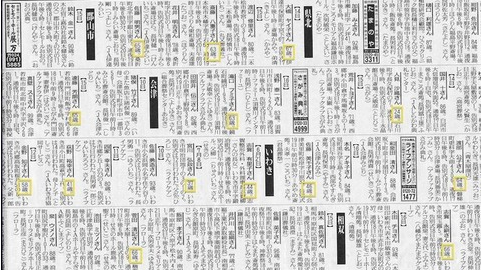 Obituary page from local news paper covering Fukushima prefecture
享年が若すぎる福島の新聞のお悔やみ欄。
24歳、34歳、37歳、41歳、44歳、46歳、53歳、58歳…..
The above are the ages of the youngest and they are highlighted on the above page and show in various places around the Fukushima prefecture.
All the above information is liable to come under the new secrecy act that looks to place Japanese bloggers under threat of a five year prison sentence.
From this link
http://blog.livedoor.jp/home_make-toaru/archives/7493393.html
There will be no hope for the “transparency” that Geraldine Thomas (UK Academic) has called for and I am sure that the IAEA and ICRP will find a statistical way to confound the startlingly high incidence of thyroid cancers in young children.
In todays Democracy Now (15 Jan 2014) in an interview with David Mc Neil (A UK connected academic/journalist) said that the childrens thyroid cancer incidence was confounded because no studies have been done in other prefectures . It seems no one wants to admit there is a problem with these confirmed cancer incidences and the nuclear accident timing is likely to be just a coincidence?
Geraldine Thomas @ 12 mins in;
http://www.youtube.com/watch?v=9vX_Jurl8Cs&feature=youtu.be&t=6m43s12%20Jan
More info on the plight of the children of Fukushima here;
https://nuclear-news.net/?s=school
A health survey in Fukushima covered up by the Japanese national Media?
An independent local news source did what the big boys couldn’t here;
Fukushima breaking news; GREBES DEAD on the Great Salt Lake in HUGE NUMBERS, Kevin D. blanch 1/15/14
Published on 15 Jan 2014
The Bald Eagle ACUTE UTAH Deaths are being correlated with the GREBES acute death,
“Every time grebes die,” she says, “we send some of the dead birds to a laboratory for testing. Usually, avian cholera jumps out as the cause of death. This year, though, the initial laboratory results were not as conclusive. That led us to believe that something else might have killed the grebes this year.”
Nuclear Hotseat #134: NIRS New Head Tim Judson + India’s Kumar Sundaram

Regarding the nuclear that Japan has sold overseas and wants to sell to India: in the case of a nuclear accident, it is the Japanese taxpayers who are obliged to pay (be inevitably billed for) damages. The boys in the manga are like, “Wh…What?!”
LISTEN HERE:
DOWNLOAD HERE:
http://lhalevy.audioacrobat.com/download/f6d50b6e-8387-69b7-4fb0-1dd602808c06.mp3
INTERVIEW: Long-time anti-nuclear activist Tim Judson took over as Executive Director of the Nuclear Information and Resource Service (NIRS) on the first of the year. Hear what this long-time anti-nuclear activist sees as the strategies our movement can use against entrenched, monied nuclear interests, as well as a fascinating revelation about Entergy that exposes the vulnerable underbelly of that underfinanced nuclear slumlord.

Tim Judson, Executive Director of NIRS
Kumar Sundaram, anti-nuclear firebrand and organizer in India, offers insights into the upcoming nuclear-fueled visit to India of Japanese Prime Minister Shinzo “Pinnochio” Abe-baby and shows us how to join the massive protests by way of a poster and a selfie. FULL INFO HERE:
https://www.facebook.com/events/262774790547186/

Take a selfie w/this poster and send it to Kumar Sundaram for the anti-nuke demonstrations in India when Abe-baby comes to town.
NUMNUTZ OF THE WEEK: Shinzo “Pinnochio” Abe-Baby. Prime Ministers say the darndest things!
PLUS:
- SPECIAL OCEAN REPORT, with Woods Hole Oceanographic Institution’s Ken Buessler organizing a crowdsourced Pacific Ocean water sampling project to determine radionuclides in the water. To participate, go to: www.whoi.edu
- Race for governor of Tokyo heats up w/former Prime Minister and now anti-nuclear candidate Hosokawa joining the fight;
- New Japanese study confirms what we’ve known all along: there’s no way to evacuate from a nuclear disaster before the radiation plume hits;
- and between the Fort Calhoun and St. Lucie nuclear reactors, nukes can’t seem to keep operating if it snows or rains. What a wimpy, flawed technology!
- RadCast w/Mimi German, of course!
LINKS:
- BONUS: How Radioactive is Your Gourmet Jam? Cesium 127 found in European gourmet and organic fruit preserves. Full story from Enformable and Lucas Hixon here: http://www.fukuleaks.org/web/?p=12058
Fukushima Parents “Stop having students practice outside ! Don’t cause any more students to have leukemia !”
Posted by Mochizuki on January 15th, 2014
Following up this article.. High schooler leukemia→School had students “clean” the swimming pool last summer [URL]
On 1/13/2014, a Japanese columnist posted on Twitter. He commented the parents’ association of this high school posted this notice.
<Translate>
A student had leukemia in a school of Fukushima. This school had the students clean (decontaminate) the pool. The parents are angry.
In this country, they leave the decontamination waste soil in a park and serve food for school lunch, which was labelled as “safe” from the manipulated safety standard. TV doesn’t even report this leukemia case, but broadcast cooking program.
(The post reads)
Stop having the students practice outside ! Don’t cause any more students to have leukemia !
<End>
![[Twitter info] Parents' association "Stop having students practice outside ! Don't cause any more students to have leukemia"](https://i0.wp.com/fukushima-diary.com/wp-content/uploads/2014/01/proxy-1-450x337.jpg "[Twitter info] Parents' association \"Stop having students practice outside ! Don't cause any more students to have leukemia\"")
福島で、プールの除染作業を生徒にやらせてた学校から白血病が出て、親御さんたちが怒ってる。汚染土を公園に置いたり給食に高い汚染基準値の食材使う国だもの。こういう話を放送しないで、ニュースでグルメ紹介する国だもの。 http://t.co/7YFDyU6Dhg
— 松野大介 (@daisumatsu) 2014, 1月 13
Fukushima – School students forced to clean swimming pool without proper safety equipment! – 未成年が除染作業を強いられている-福島県郡山市
Published by nuclear-news.net
by Arclight2011
10 May 2013
h/t Mia
HAS THE UN “OPTIONAL PROTOCOL” FAILED
FOR THE CHILDREN OF
FUKUSHIMA?
…On a more technical point, it was explained that annual exposure to radiation was at the level advised by the International Commission on Radiological Protection (ICRP)….
Japanese government delegation statement to the UN concerning the Fukushima Nuclear disaster April 2013
High school students were forced to clean their swimming pool!
未成年が除染作業を強いられている-福島県郡山市

Koriyama City in Fukushima Prefecture
The students were allowed to clean the swimming pool (Gieger showing 0.51 uSv/h) without wearing any safety equipment. They just had their school uniforms for protection!
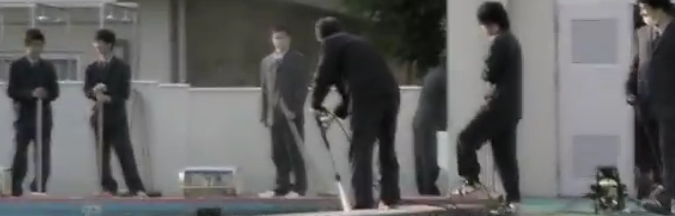
Nearby were students doing vigorous exercise, as dust and moisture droplets were being made airborne.

The Reading here was 0.50 mcSv/h, an air reading taken approximately 1 metre off the ground.

This is the video footage from the high school in Koriyama City in Fukushima Prefecture showing the work being done;
Published on 8 May 2013
2013年5月8日
福島県立郡山高等学校の生徒が教諭の命令によりプールの除染作業を強いられています。
The Japanese Government has allowed decontamination work to be done by minors!
Committee on Economic, Social and Cultural Rights considers Report of Japan
Committee on Economic, Social
and Cultural Rights
30 April 2013
[Extracts]
[…]
Regarding those that survived the atomic bombing, their medical needs related to their exposure was subsidised and this would allow them to maintain a suitable level of living.
TV: Fukushima “is the most important issue going on in the world, everyone should stop what they’re doing and work together” — Newspaper Editor: Gov’t afraid to look into Fukushima as it could lead to destruction of fishing industry on West Coast (VIDEO)
Published: January 13th, 2014 at 7:45 pm ET
By ENENews
Daily Nexus (UC Santa Barbara), Opinion Editor Emile Nelson, Jan. 9, 2014: Start Thinking Fukushima […] it is impossible to avoid seeing and feeling the effects of this tragedy, even here in sunny Santa Barbara. […] Recently, there has been a great deal of concern surrounding the potential consequences of this kind of radiation: Is our seafood still safe to eat? Is the Pacific Ocean still swimmable? How far could the radiation reach if it is actually a part of the Pacific’s ecosystem? […] Fearing that exploring these questions further could lead to the destruction of the fishing industry of the Pacific Ocean, it is a difficult topic for any official government agency to address and, thus, the uncertainty remains. […] Santa Barbara needs to start paying attention to how the aftermath of the crisis at Fukushima is being handled because it will absolutely affect our future, one way or another. If we want to keep our community safe from the effects of this tragedy, we need to remind the world that we are watching and paying attention and that we will not simply stand by as our world deteriorates. Think something, write something, say something or do something, just don’t ignore the fact that one day, safely surfing or even walking the beach at UCSB may be nothing but a bittersweet memory.
Breaking the Set, RT, Jan. 9, 2014 (at 24:00 in):
Abby Martin, host: This is the most important issue going on in the world. Everyone should stop what they’re doing and work together. What can the average person do? Because I’m feeling really helpless […] I’m from California, my family’s there — what can we do to combat this, any advice?
Mimi German, RadCast.org: I think that we have to look at mitigation. We can’t get rid of the fallout, we can’t get rid of what’s happening at Fukushima. No one can, that’s the problem with Fukushima. It’s going to be a perpetual disaster to us everywehere on the planet for thousands of years to come. What we can do is if we got monitors for instance, we can do our own testing in our own area.
Seafood Industry Counters Fukushima “Misinformation”
Alaska Seafood Marketing Institute >>counters<< scaremongering claims of radioactive salmon (I think not – arclight2011, read on)
POSTED: 07:11 PM AKST Jan 05, 2014
ASMI (AZ’-me) communications director Tyson Fick says the institute has seen a resurgence of unsubstantiated, scaremongering articles designed to generate advertising revenue by curious readers clicking on websites.
Fick tells the Kodiak Daily Mirror (http://bit.ly/1crItqr) that the latest wave of misinformation claims Alaska fish has been contaminated by radiation from a Japanese nuclear power plant damaged in a 2011 earthquake.
Fick says ASMI previously have countered misinformation that Alaska salmon contained mercury or PCBs.
He says ASMI refers people to the Food and Drug Administration website. The FDA has found has no evidence of dangerous Fukushima radiation in the U.S. food supply.
;;;;;;;;;;;;;;;;;;;;;;;;;;;;;;;;;;;;;;;;;;;;;;;;
Berkeley Lab and Cal State Long Beach Researchers Launch ‘Kelp Watch’ to >>Determine Extent of Fukushima Contamination<<
Researchers from California State University, Long Beach (CSULB) and the Lawrence Berkeley National Laboratory have launched “Kelp Watch 2014,” a scientific campaign designed to determine the extent of radioactive contamination of the state’s kelp forest from Japan’s damaged Fukushima nuclear power plant following the March 11, 2011, earthquake and tsunami.
Initiated by CSULB Biology Professor Steven L. Manley and the Berkeley Lab’s Head of Applied Nuclear Physics Kai Vetter, the project will rely on samples of Giant Kelp and Bull Kelp from along the California coast.
“The California kelp forest is a highly productive and complex ecosystem and a valuable state resource. It is imperative that we monitor this coastal forest for any radioactive contaminants that will be arriving this year in the ocean currents from Fukushima disaster,” said Manley, an expert in marine algae and kelp.
“I receive calls and emails weekly from concerned visitors and Californians about the effect of the Fukushima disaster on our California marine life,” he continued. “I tell them that the anticipated concentrations that will arrive are most likely very low but we have no data regarding its impact on our coastal ecosystem. Kelp Watch 2014 will provide an initial monitoring system at least in the short-term.”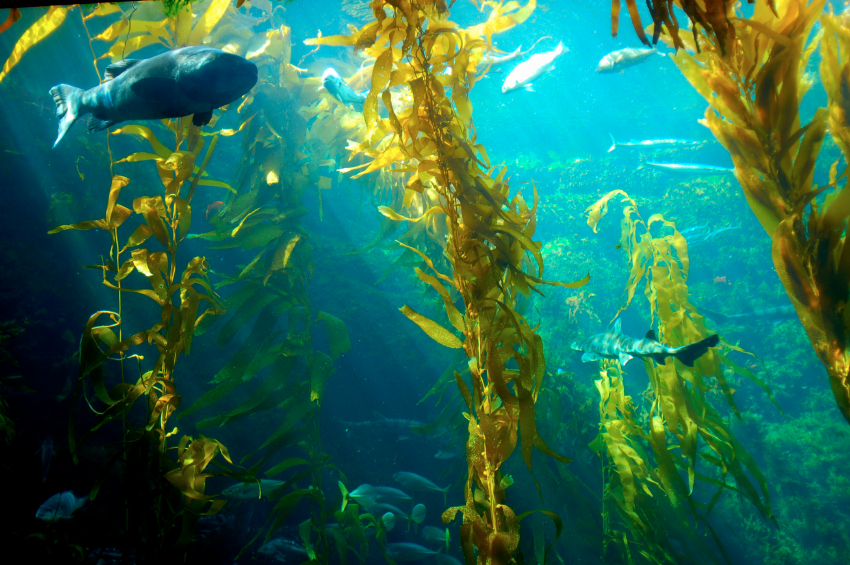
The project includes the participation of 19 academic and government institutions and three other organizations/businesses. These participants will sample kelp from the entire California coastline as far north as Del Norte County and as far south as Baja California. The sampling will begin in mid-February and will end in late winter.
1 This Month





PLEASE OPPOSE HR 8255 AND S.3639 – bills would accelerate satellite deployment, with no environmental review or safeguards – https://ncstd5li.quorum.us/campaign/169331/
To see nuclear-related stories in greater depth and intensity – go to https://nuclearinformation.wordpress.com
-
Archives
- October 2026 (74)
- September 2026 (339)
- August 2026 (330)
- July 2026 (355)
- June 2026 (287)
- May 2026 (306)
- April 2026 (356)
- March 2026 (251)
- February 2026 (267)
- January 2026 (308)
- December 2025 (358)
- November 2025 (359)
-
Categories
- 1
- 1 NUCLEAR ISSUES
- business and costs
- climate change
- culture and arts
- ENERGY
- environment
- health
- history
- indigenous issues
- Legal
- marketing of nuclear
- media
- opposition to nuclear
- PERSONAL STORIES
- politics
- politics international
- Religion and ethics
- safety
- secrets,lies and civil liberties
- spinbuster
- technology
- Uranium
- wastes
- weapons and war
- Women
- 2 WORLD
- ACTION
- AFRICA
- Atrocities
- AUSTRALIA
- Christina's notes
- Christina's themes
- culture and arts
- Events
- Fuk 2022
- Fuk 2023
- Fukushima 2017
- Fukushima 2018
- fukushima 2019
- Fukushima 2020
- Fukushima 2021
- general
- global warming
- Humour (God we need it)
- Nuclear
- RARE EARTHS
- Reference
- resources – print
- Resources -audiovicual
- Weekly Newsletter
- World
- World Nuclear
- YouTube
-
RSS
Entries RSS
Comments RSS

