US Sailor Crippled by Fukushima Radiation Speaks Out
Published on 20 Jan 2014
Published on Jan 14, 2014
Fukushima
Involved in the USS Ronald Reagan’s rescue efforts following the 2011 Fukushima nuclear plant meltdown, Steve Simmons began experiencing devastating symptoms several months after returning home.
“You’re starting to run fevers, your lymph nodes start swelling, you’re having night sweats, you’re getting spastic and you’re losing sensation in your legs, and you can’t feel your legs when you’re getting 2nd degree burns on them, and how do you explain those things?” Simmons told WUSA 9 News
Nwo World News: http://www.nworeport.me
Original video – http://www.youtube.com/watch?v=DmgKG8…
Thanks to Qronos16 – ” http://www.youtube.com/user/Qronos16 “
Cash wanted to help monitor Fukushima ocean radioactivity
A lot of articles online have linked the Fukushima spills to events such as starfish die-offs near California. What is your response to them?
There’s been a lot of undue alarm. In some terms it’s like shouting fire in a crowded theatre. It should be stopped. It’s not accurate. Radioactivity can cause harm and genetic damage, but not at the levels we’re expecting. A lot of those reports of effects on the US west coast were even before this radioactivity showed up. How does that work? It hasn’t even shown up on our coast.I certainly wouldn’t change my behaviour, stop swimming in the Pacific or stop eating seafood.
[…]
The estimate was that someone who eats five times the amount of fish that an average American does, and eat only contaminated tuna for a year, would end up with a dose that would cause an extra two cancers in ten million people. The risk was not zero, but it was very small
Scientist launches crowd-funded survey of US west coast but says health concerns are overblown.
Ken Buesseler on a boat off the Fukushima Daiichi plant, after the 2011 tsunami caused meltdowns at three of its reactors.
Ken Buesseler was one of the first scientists to analyse the sea water off the coast of Fukushima, Japan, after the nuclear meltdowns that followed a devastating tsunami there in March 2011.
This week, the marine chemist, based at the Woods Hole Oceanographic Institution in Massachusetts, launched How Radioactive Is Our Ocean?, a crowd-funding website that urges people to support the collection and analysis of seawater samples along the west coast of the United States.
Although larger, wind-blown debris from the Japanese tsunami began to be spotted on North American shores shortly after the disaster, and migratory fish such as bluefin tuna have already shown up off California carrying radioactive isotopes from the spill, oceanic currents move much slower. The Fukushima spill therefore is unlikely to have anything to do with reports such as the mysterious die-off of sea stars in California. Now, however, contaminated sea water is finally due to arrive on the eastern side of the Pacific, and so it is time to start keeping watch.
How did you end up working on Fukushima fallout? Isn’t Woods Hole about as far as it’s possible to get from Japan?
I did my PhD looking at fallout from the 1960s nuclear-weapons testing. 1986 was the year I defended [my thesis], which of course was the year of the Chernobyl disaster. So I started out looking at artificial radionuclides in the ocean.
When Fukushima happened, the first things we saw were some of the numbers from the Tokyo Electric Power Company [which ran the reactors at the plant], and they had measured levels of the caesium isotopes 137 and 134 on scales of tens of millions of becquerels per cubic metre. The number pre-disaster was one or two of those units. We thought this was unprecedented for the ocean and we really need to find out how that’s being dispersed.
In terms of total release of radioactive materials — as opposed to local concentrations — how do the Fukushima leaks compare to those from previous radioactive releases, such as from weapons testing in the 1960s?
The total global fallout number for caesium from the 1960s tests was around 950 petabecquerels (a unit of quantity, rather than concentration). Chernobyl was around 100. Fukushima? We’re still debating that number. Fifteen to 30 is a rough estimate.
How concerned should people in the US be about this radioactive contamination reaching their seas?
Worried about radioactive ‘Fukushima’ fish in the US? Don’t be, scientists say
“To actually get a harmful dose of tuna you have to eat 2.5 tons of tuna a year,” Martini says. “I really love Tuna, but I don’t love it that much.”
[…]
So the elder Knutson sent seven samples of his Pacific salmon off to a lab.
When the results came back, he says, “we found that these fish were clean… There were two samples that maybe had a trace of barely detectable, so we feel very good about the results.”
[…]
Neville has sampled more than 60 fish since Fukushima (2011). The levels of Cesium traced to Fukushima were so low that his lab couldn’t see it at all until he concentrated the samples.
[…]
Audio on link
Pete Knutson and his son Dustin sell local Pacific salmon at outdoor markets around the Seattle area. The sign on their stall at a recent market in Seattle’s Ballard neighborhood reads, “In response to multiple customer inquiries regarding the Fukushima incident, we’ve had our salmon tested for radiation. We’re pleased to announce that there is no reason to be concerned about eating our salmon this year.”
Pete Knutson’s Loki Fish company offers all kinds of salmon products and the Sunday Ballard farmer’s market in Seattle—whole, pickled, smoked, canned—whatever your pleasure.
Knutson’s been in the business of catching and selling fish for more than 40 years. But recently he had to do something new to meet his customers’ demands: test his fish for radiation.
Ever since the Fukushima meltdown, Knutson’s son Dustin says, people have expressed concerns.
“We had regulars at the U District market,” the younger Knutson says, “and they were saying, ‘sorry we’re not coming by any more.’ It was directly because they were worried about Fukushima.”
So the elder Knutson sent seven samples of his Pacific salmon off to a lab.
When the results came back, he says, “we found that these fish were clean… There were two samples that maybe had a trace of barely detectable, so we feel very good about the results.”
The barely detectable substance was Cesium. It’s a radioactive isotope that was released in the Fukushima meltdown. But the levels in the fish were hundreds of times below federal safety standards.
Of course seven fish is a pretty limited sample, but Knutson’s results are in line with other tests of Pacific fish since Fukushima.
Delvan Neville, a Ph.D candidate in Radiation Health Physics at Oregon State University, has analyzed dozens of samples of albacore tuna caught in the Pacific since the meltdown.
He says the highest level of radioactive contamination he’s found “is more than 1,000 times lower than the point where the FDA would even think about whether or not they need to let people eat that food.”
Tuna are top predators, and tend to concentrate any pollutants that are in the food chain. But what Neville’s found are Cesium levels so low he’s comfortable eating his samples.
Which was actually kind of fun, he says, “because then I was telling people as we were eating at the table what their approximate dose was due to Fukushima from the food they were eating, and it’s this ridiculously small number.”
A day in the life of a blogger – 20 January 2014

This post was not stopped by the owner
More to come in the next few days…
I wonder what happened? 🙂
arclight 2011
Russia advances some $14 Bln for Hungarian nuclear reactor build-out in dicey environmental bet

Russia has agreed to provide Hungary with billions of dollars upfront to finance the planned extension of the Paks nuclear power plant south of Budapest – yet the deal is raising hackles over the lack of a proper bidding process and the absence of public consultation.
Russian state nuclear corporation Rosatom agreed yesterday to expand the Paks plant for some $13.6 billion, doubling its size in the largest construction project in Hungary’s post communist history, and something Rosatom is portraying as a major move onto the EU nuclear market.
Russian President Vladimir Putin said that he and visiting Hungarian Prime Minister Viktor Orban had signed an agreement on the project at Paks, which already runs four Russian-made VVER-type reactors built in the 1980s. The new project will see two new reactor blocks built of the VVER-1200 type, which will boost the plant’s capacity to 4000 MW.
Putin and Orban added the Paks station was already responsible for producing 40 percent of the energy consumed in the EU member country. Vladimir Slivyak, co-chair of Russia’s Ecodefense, wrote in a blog on the independent radio station Echo of Moscow that bumping the output of the Paks plant to supply 80 percent of the country’s electricity seemed absurdly high.
Hungarian government ministers told news agencies that 80 percent of the financing would be covered by a 30 year loan from Russia, and the remainder would be financed by Hungary.
Environmental activists in Hungary are outraged over the decision between Putin and Orbin because it fails to take into account local public opinion about the giant nuclear build out.
As recently as last year, Hungarian environmentalists also expressed outcry over their government’s plan to repatriate to Russia a batch of spent nuclear fuel that was severely damaged during chemical treatment in 2003, saying the fuel transfer would openly neglect public health and environmental concerns. (arclight added info on hungary)
By Russian law, Moscow is obligated to take back spent nuclear fuel from fuel that it has supplied to other countries. But Bellona’s Andrei Ozharovsky, a nuclear physicist and frequent contributor to Bellona.ru, has argued that the degree of damage suffered by the fuel rods in question warrants their reclassification as waste, which would imply a whole new set of legislative safeguards in accepting it.
The damaged fuel assemblies, some of which are broken, are currently being stored at the Paks’ plant’s cooling pool at it’s No 2 reactor. The No 2 unit, from which the fouled fuel rods were removed in 2003, had to undergo 18 months of repairs before coming back online.
Rosatom’s expansion abroad amid troubles at home
But much of Rosatom’s financial strategy is banking on building nuclear power plants abroad, as well selling and repatriating fuel from foreign nuclear power plants.
As a sign of how poorly things are going on its domestic market, Rosatom announced in November that it would be slashing its ambitious “2008 Roadmap” plans to construct 35 nuclear reactors in Russia by 2020 in half, cutting the number to a more humble 12.
But, since the March 11, 2011 disaster at the Fukushima Daiichi nuclear power plant in Japan, Rosatom has shored up more than 20 nuclear reactor building contracts and has a foreign order portforlio totaling more than $74 billion, RIA Novosti reported.
Among other countries that have contracts with Rosatom are India, Iran, China, Belarus, Bangladesh, Jordan, Bulgaria, Vietnam, Ukraine, Armenia, Turkey and Finland. Clearly, Rosatom is placing its bets abroad. The Moscow Times reported that Russia has another 40 nuclear construction contracts under consideration.
Welcome to Fukushima Part 1 of 5
Go to the You Tube link for the other parts of the video (you will see them listed on the right
Published one March 14th, 2013 Director (S):
Alain de Halleux Pays: Belgium
During two years, the director followed of the inhabitants and the families of the town of Minamisoma, located 20 km away from the nuclear power plant of Fukushima Daichi. Between revolt and resignation, they raise the question: to move or remain on the spot, live with the contamination and the fear of the future?
Fukushima Mother: Then Yuka started to get panic attacks. She got headaches, stomach aches, sore throats… It would change every day. Shortly after around the end of April she would spend her days crying in here room. It all made me very nervous. Kento was edgy allo the time, too. […]
Fukushima Father: Perhaps she didn’t really know she was doing, but she made several attempts to jump from the first floor. She even tried to kill herself by dousing herself with petrol and setting it alight.
Fukushima Mother: She led a normal life until March 11 last year, when there was the accident at the nuclear power plant. She can’t forgive herself for being this way. Every time she cries she asks, “Why did this nuclear disaster happen to us?”
Through some parallel segments: – a family decides to leave the site and moves/– another, whose father worked in a power station at the time of the accident, became a florist which become very profitable because of the many burials and commemorations/– An old a forest ranger attends the metamorphosis of the landscape (the forests and mountains) and questions the traditional report with nature, now upset by the catastrophe.

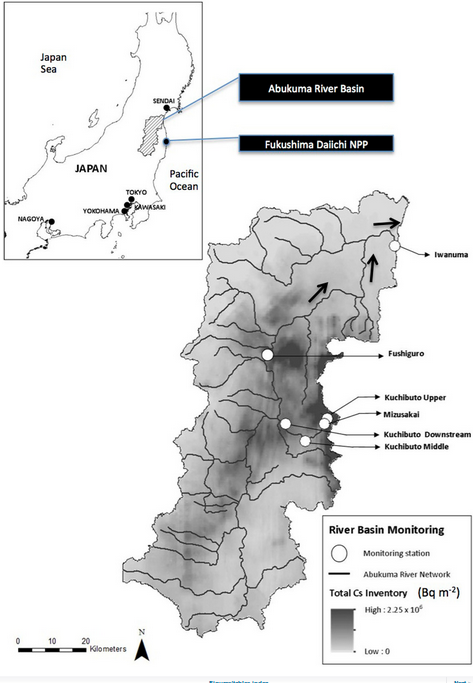
Quantify the flux of radiocesium in the Abukuma Basin (5,172km2)
Personal thanks to KitagawaTakashi
【速報】水脈による放射能汚染状況:
”This study aimed to quantify the flux of radiocesium in the AbukumaBasin (5,172km2), the largest river system affected by fallout fromthe Fukushima Daiichi Nuclear Power Plant (FDNPP) event.
Inthe period from 10 August 2011 to 11 May 2012 an estimated 84 to 92%of the total radiocesium transported in the basin’s fluvial systemwas carried in particulate form.”
極めて重要な情報が公開された。
振り落ちた放射能物質は、多くはそこに留まる。
風に乗りプルームによって運ばれたものも、
雨などによって降下し、多くはその場所に留まる。
その後、土壌に浸潤し、一部は、植物、動物などを通じ、
食物連鎖に入る。多くの移動は、環境循環による。
その最大のものが、水脈によるものである。(一部は海に流れる)
この懸念は、当初からあったが、その詳細が初めて公開された。
(Published16 January2014)
図は、阿武隈川流域の水脈と、現実にどの程度放射能物質が、
どの範囲に広がっているかの詳細図である。
色の濃さが、汚染度を表すが、濃い部分は、200万ベクレル/m^2にまで達している。
この図は、放射能汚染被害の範囲、ホットスポットの場所、
その汚染の程度を、地域ごとに詳細に示すものとして極めて有用であり、今後の基礎資料となるものであろう。
”
Duringthis monitoring period Typhoon Roke (September 2011) was observed toinduce a significant and temporally punctuated redistribution ofradiocesium. The storm-mobilised radiocesium was an estimated 6.18Terabecquerels corresponding to 61.4% of the total load delivered tothe coastal zone during the observation period.
The totalflux of radiocesium into the Pacific Ocean estimated at the outletstation (basin area 5,172km2) was 5.34TBq for 137Cs, and 4.74TBq for134Cs, corresponding to 1.13% of the total estimated radiocesiumfallout over the basin catchment (890TBq).
This wasequivalent to the estimated amount of direct leakage from FDNPP tothe ocean during June 2011 to September 2012 of 17TBq and the Level 3Scale Leakage on 21August 2013 (24TBq).”
Source: Published16 January 2014
“Initial flux of sediment-associatedradiocesium to the ocean from the largest river impacted by FukushimaDaiichi Nuclear Power Plant” By Yosuke Yamashiki, Yuichi Onda,Hugh G. Smith, William H. Blake,et.al.”
http://www.nature.com/srep/2014/140116/srep03714/full/srep03714.html
The activity concentrations of 137Cs, 134Cs, 90Sr, 238Pu, 239,240Pu, 241Pu and 241Am in soil and in animals causing transgenerationally-transmitted damage
Personal thanks to Jan Hemmer
Japan, listen: “The activity concentrations of 137Cs, 134Cs, 90Sr, 238Pu, 239,240Pu, 241Pu and 241Am in soil and in animals were measured at five monitoring sites with different ground deposition of radionuclides at different distances from the destroyed reactor.
The observed temporal pattern of the radionuclide activity concentration in the studied animal populations reflects the changes in biological availability of these isotopes for biota, mostly due to fuel particle destruction and appearance of dissolved and exchangeable forms of radionuclides.
Maximal values of the whole-body absorbed dose rates occurred during the year of deposition, followed by a decrease in the subsequent period. Generally, this decrease was monotonic, mainly determined by the decrease of the external c-ray dose rate, but there were exceptions due to the delayed maximum of internal exposure.
The inter-individual distributions of radionuclide concentrations and lifetime whole-body absorbed doses were asymmetric and close to log-normal, including concentrations and doses considerably higher than the population mean values.”
http://www.enfants-tchernobyl-belarus.org/extra/pdf-divers/telecharge.php?pdf=etb-037.pdf
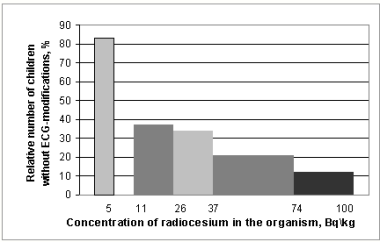 Image source ; http://belrad-institute.org/UK/doku.php?id=publications:articles:mesures_of_radiation
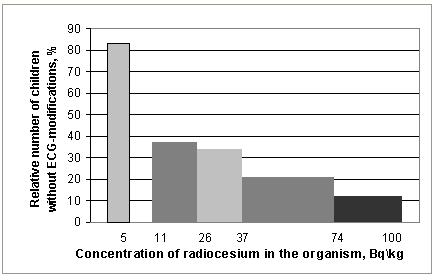
“Transgenerational accumulation of radiation damage in small mammals chronically exposed to Chernobyl fallout” PDF:http://www.enfants-tchernobyl-belarus.org/extra/pdf-divers/telecharge.php?pdf=etb-068.pdf“With regard to the continuous buildup of transgenerationally-transmitted damage in the course of chronicradiation exposure of the parental generations, we will shortly speak of the transgenerational accumulation of transmitted biological damage” ignored by World’s Science.
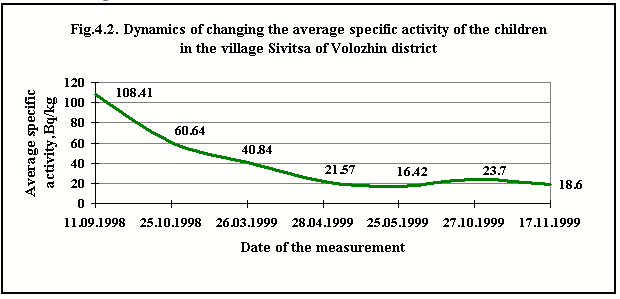
Maps of Belarus:Whole Body Counter Check ups of Children (Cesium 137).
I got these “maps” from BELRAD (http://belrad-institute.org/).Yablokov / Nesterenko showed a few in their famous study “Chernobyl: Consequences of the Catastrophe for People and the Environment”. Here you can see all of them. I did this article about my trip and the information you can see on them:http://tekknorg.wordpress.com/2012/04/14/children-radiation-maps-2/
Detected to Plutonium and Uranium at Takahagi City, Ibaraki Prefecture. 茨城県高萩市
Detected to Plutonium and Uranium 茨城県高萩市

On April 5 2013
We had detected the plutonium and uranium in Takahagi City, Ibaraki Prefecture.
Many children has been living also in this city.

[[ Special Thanks ]]
Yuko Sugimoto
Fukushima report: Plutonium should be in the leakage! 汚染水問題に関する小出先生のコメント、報道するラジオより。 追加報告:プルトニウムも汚染水に混じっているはず! (repost)
Op Ed by Mia (JANUK)
http://fukushimaappeal.blogspot.co.uk/
…..The last one was plutonium241, which had radiation dose about 50 times as much as the total of the other three(PU238, PU239 & PU240)…..
….The underground tanks were meant to store low level of radioactive water after being filtered through ALPS. But they have been using them to store high level of radioactive water (including β (beta) emitting nuclide, Strontium and α (alpha)emitting nuclide, Plutonium)…..

Thursday, 18 April 2013
A MBS radio interview with Prof. Koide: the repeated leaking problems at Fukushima Crippled Plant. Additional report: Plutonium should be in the leakage! 汚染水問題に関する小出先生のコメント、報道するラジオより。 追加報告:プルトニウムも汚染水に混じっているはず!
The most recent report on the leakage problem said that about 22 liters of radioactive water had leaked from gaps between the pipes used to transfer it from underground water storage tank into an another tank, and that the level of radioactivity in the water was 290,000Bq/m3.

Tepco has been trying to get ALPS to work for some time but it’s still in its trial stage. ALPS is supposed to filter 62 radioactive nuclides. However Tepco seems not wanting to mention the α (alpha) emitting nuclide isotopes.

The last one was plutonium241, which had radiation dose about 50 times as much as the total of the other three(PU238, PU239 & PU240).A Plutonium contamination map by MEXT published on 12/8/12.
[…Prefecture – city/town/village – 緯度 latitude – 経度 longitude – PU241(lower limit of detection)-…]
by MEXT on 30/9/11Half life: PU238(88y) decays into PU234(245,000y), PU239(24,100y), PU240(6,600y), PU241(13.2y) decays into Am241(=silver, 433y)Multi-nuclide Removal Equipment (ALPS)
(Reference) http://blog.goo.ne.jp/tarutaru22/e/a8f8b3e66c246ef3c3df8699b3a2ec45http://home.hiroshima-u.ac.jp/er/ReneN_P_P1.html
“….There’s a lot of Pu-241 produced in reactor fuel – more activity
of Pu-241 than any other actinide (with the exception of
short-lived Np-239). The Pu-241 decays to Am-241 and thence
to Np-237 and decay series nuclides, adding to the
radio-toxicity.Given the copious amounts of Pu-241 produced
(on the order of 10^5 curies per ton of fuel)
it shouldn’t surprise anyone that it’s showing up.
It should also be no surprise that potential dose from Pu-241
is higher than from other nuclides since there’s so much
of it produced……”
Leaked TEPCO report: 120 billion Becquerels of plutonium, 7.6 trillion Becquerels of neptunium released in first 100 hours — Media concealed risk to public
Published: October 15th, 2011 at 8:21 pm ET
By ENENews
Amy Goodman gets behind the truth of the now empty town of Futaba (Fukushima)

17 January 2014
On our final day of our special broadcast from Tokyo, we speak with a Japanese resident from the town that housed part of the Fukushima Daiichi nuclear power plant who is participating in weekly protests against the resumption of nuclear power in her country. “We couldn’t bring anything from our houses. We didn’t have a toothbrush, we didn’t have a blanket. We didn’t have towels. We had nothing. It was truly hell, and we thought it would be much better to die. But now, we are here, and we can’t really give up. We want to fight for this cause,” Yukiko Kameya said as she attended a demonstration outside Prime Minister Shinzo Abe‘s official residence. “We told the prime minister many times, every week here, that we are against the re-opening of the nuclear facilities, but it doesn’t seem that he gets it. He just does whatever he wants to do anyway.”

We speak with Katsutaka Idogawa, former mayor of the town of Futaba where part of the Fukushima Daiichi Nuclear power plant is located. The entire town was rendered uninhabitable by the nuclear disaster. We ask him what went through his mind after the earthquake and tsunami hit on March 11, 2011. “It was a huge surprise, and at the time I was just hoping nothing that had happened at the nuclear power plant. However, unfortunately there was in fact an accident there,” Idogawa recalls. He made a decision to evacuate his town before the Japanese government told people to leave. “If I had made that decision even three hours earlier, I would have been able to prevent so many people from being exposed to radiation.” For years he encouraged nuclear power development in the area; now he has become a vocal critic.
Click here to go directly to the channel, and please visit S2e TV to watch at anytime!
Fukushima: An Ongoing Warning to the World – Amy Gooman
Here in Tokyo, Sophia University Professor Koichi Nakano says of the new law, “Of course, it concerns primarily security issues and anti-terrorist measures. But … it became increasingly clear that the interpretation of what actually constitutes state secret could be very arbitrary and rather freely defined by government leaders. For example, anti-nuclear citizen movements can come under surveillance without their knowledge, and arrests can be made.”
Posted on Jan 15, 2014
 |
By Amy Goodman
http://www.truthdig.com/report
TOKYO—“I write these facts as dispassionately as I can in the hope that they will act as a warning to the world,” wrote the journalist Wilfred Burchett from Hiroshima. His story, headlined, “The Atomic Plague” appeared in the London Daily Express on Sept. 5, 1945. Burchett violated the U.S. military blockade of Hiroshima, and was the first Western journalist to visit that devastated city. He wrote: “Hiroshima does not look like a bombed city. It looks as if a monster steamroller had passed over it and squashed it out of existence.”
Jump ahead 66 years, to March 11, 2011, and 600 miles north, to Fukushima and the Great East Japan Earthquake, which caused the tsunami. As we now know, the initial onslaught that left 19,000 people dead or missing was just the beginning. What began as a natural disaster quickly cascaded into a man-made one, as system after system failed at the Fukushima Daiichi nuclear power plant. Three of the six reactors suffered meltdowns, releasing deadly radiation into the atmosphere and the ocean.
Three years later, Japan is still reeling from the impact of the disaster. More than 340,000 people became nuclear refugees, forced to abandon their homes and their livelihoods. Filmmaker Atsushi Funahashi directed the documentary “Nuclear Nation: The Fukushima Refugees Story.” In it, he follows refugees from the town of Futaba, where the Fukushima Daiichi plant is based, in the first year after the disaster. The government relocated them to an abandoned school near Tokyo, where they live in cramped, shared common areas, many families to a room, and are provided three box lunches per day. I asked Funahashi what prospects these 1,400 people had. “There’s none, pretty much. The only thing the government is saying is that [for] at least six years from the accident, you cannot go back to your own town,” he told me.
Wide Gulf and Angry Words In Indian Point Labor Talks
“We made it very clear,” said Melia, “that we are determined to get a fair shake. Entergy is playing fast and loose with the welfare of thousands of people, and fast and loose with the nuclear power facilities they own and operate.
http://spoonsenergymatters.wordpress.com/
January 17, 2014
By Roger Witherspoon
Rye, N.Y. – Two days of contract talks with federal mediators ended Thursday night with angry union negotiators and no deal in sight on the last day of the contract between Entergy Nuclear and nearly 400 workers at the Indian Point power plant.
Talks between company representatives and the Utility Workers Union of America, Local 1-2 broke up shortly before 10 PM Thursday at the Rye Hilton, where both sides have been sequestered since Wednesday morning. Union local President James Slevin huddled with mediators from the U.S. Federal Mediation and Conciliation Service after angrily leaving the contract discussions.
“The company doesn’t seem like it’s ready to get serious about negotiating a fair contract,” said UWU spokesman John Melia. “They haven’t put anything on the table except takeaways and a regressive offer. It doesn’t seem like they are ready to negotiate in good faith. It seems as if Entergy is trying to provoke a labor dispute.
“They have a pattern of doing this. They are very anti-labor and have a mindset that every shareholder should get rich and no one else.”
Melia referred to the five-week lockout by Entergy of UWU members at its Pilgrim Nuclear Power Station in Massachusetts in June, 2012. The lockout occurred during negotiations and after union leaders had agreed to two contract extensions so the talks could continue without a plant interruption. At the time of the lockout, Entergy was demanding concessions in pay, benefits, health care, and work rules. The final contract included 3% raises for the unionized workers.
Entergy representatives declined to comment Thursday. Neither of the parties nor the mediators are publicly discussing contract specifics. However, Entergy is believed to be seeking – at least in its initial stage of discussions – wage cuts and increased employee contributions to health care.
China Moon Landing Seen As Nuclear threat
Japan already has approximately four times as many major warships as the British Navy and more tanks than Germany. Despite being an island nation that emphasizes sea and air power, Japan has trained special-forces, a fleet of sophisticated diesel-electric submarines and is working with the U.S. Marines on amphibious capabilities.
[…]
Most nations in Asia have opposed a renewal of Japanese nationalism and a military build-up as an existential threat. But the moon landing and threats to free passage through international waters are being seen as intentional demonstrations of “coercive power” by China.
From: Chriss Street
http://bizlawnews.com/news/48101/china-moon-landing-seen-nuclear-threat/
China’s December 15th soft-landing of an unmanned spacecraft on the moon was celebrated by the Xinhua news agency as, “The dream for lunar exploration once again lights up the China Dream”. China’s neighbors saw the action as a nightmare demonstration of China’s ability to launch a Multiple Reentry Vehicle ballistic missile, whose payload can deploy multiple nuclear warheads aimed to hit a group of targets. With the United States becoming a less reliable guarantor of peace in the region, China’s provocative military moves are creating a muscular arms race in Asia.
Carnegie Endowment for International Peace published a major report last May arguing China would be a “coercive power” in enforcement of its way with Japan, but emphasized that economic interdependence with the United States and the rest of Asia would prevent a major Cold-War style confrontation with China in the region. Carnegie claimed that despite hawkish rhetoric from Japan’s new Prime Minister Shinzo Abe, Japan’s economic troubles and political paralysis would prevent it from countering China’s increasing military capabilities. Carnegie obviously failed to consider Japan’s last two decades of increasing militarization. When it comes to intimidation, Japan and an increasing number of Asian nations will aggressively confront China.
Kazahkstan – Nazarbayev urges to develop nuclear energy

Image source ; http://www.telegraph.co.uk/news/politics/tony-blair/9102135/Why-is-Tony-Blair-lending-credibility-to-Kazakhstans-dictator.html
17 January 2014, 13:05
http://www.inform.kz/eng/article/2621983
ASTANA. January 17. KAZINFORM – President Nursultan Nazarbayev urged to get rid of “Fukushima syndrome” and develop nuclear energy, this has been announced during his annual address to the people of Kazakhstan in the Palace of Independance.
“We should not forget about the prospects of nuclear energy development. The word’s need of cheap nuclear power in the foreseeable future will only grow. And since this type of energy will be demanded as clean energy, we can not fall behind”, said the President.
The President stressed that Kazakhstan is one of the world leaders in the production of uranium, that is why it is necessary to develop nuclear power plants’ fuel production and build atomic power stations.
My article on nuclear power as a viable option for Croatia
Russia’s Rosatom is gobbling up new build projects across Europe now in the nuclear sector, even getting its proverbial foot in the door in Finland and the United Kingdom. Thus, there are clearly new nuclear plant projects out there—as good as Rosatom is, this needs to be a competitive arena with US and Canadian participation, too.
The entire article is only available in the print edition, but my article on nuclear power as an option for sustainable energy in Croatia is the lead article in the new issue of SEE: A Fortnight in Review, one of Eastern Europe’s leading business/finance trade journals:
I’m very glad they ran this article, because having worked on energy issues in earnest over the past year especially in Serbia and Croatia, I have found the current approaches of these emerging nations to largely ignore nuclear as a future option. While Croatia has partial ownership of a nuclear power plant, its discussions for future plants have often began in earnest yet been sidelined by uninformed opposition or the mistaken view that natural gas, oil, and hydroelectric are better alternatives to nuclear. The problem is, while Croatia should be praised for their innovative applications of hydroelectric and other non-fossil fuel power generation approaches, it is doubtful these modalities will ensure independent power in the long run without some reliance on Russia or other oil/gas producers. Serbia’s situation is more dire and the Serbs have been less inclined to even examine nuclear.
1 This Month





PLEASE OPPOSE HR 8255 AND S.3639 – bills would accelerate satellite deployment, with no environmental review or safeguards – https://ncstd5li.quorum.us/campaign/169331/
To see nuclear-related stories in greater depth and intensity – go to https://nuclearinformation.wordpress.com
-
Archives
- October 2026 (74)
- September 2026 (339)
- August 2026 (330)
- July 2026 (355)
- June 2026 (287)
- May 2026 (306)
- April 2026 (356)
- March 2026 (251)
- February 2026 (267)
- January 2026 (308)
- December 2025 (358)
- November 2025 (359)
-
Categories
- 1
- 1 NUCLEAR ISSUES
- business and costs
- climate change
- culture and arts
- ENERGY
- environment
- health
- history
- indigenous issues
- Legal
- marketing of nuclear
- media
- opposition to nuclear
- PERSONAL STORIES
- politics
- politics international
- Religion and ethics
- safety
- secrets,lies and civil liberties
- spinbuster
- technology
- Uranium
- wastes
- weapons and war
- Women
- 2 WORLD
- ACTION
- AFRICA
- Atrocities
- AUSTRALIA
- Christina's notes
- Christina's themes
- culture and arts
- Events
- Fuk 2022
- Fuk 2023
- Fukushima 2017
- Fukushima 2018
- fukushima 2019
- Fukushima 2020
- Fukushima 2021
- general
- global warming
- Humour (God we need it)
- Nuclear
- RARE EARTHS
- Reference
- resources – print
- Resources -audiovicual
- Weekly Newsletter
- World
- World Nuclear
- YouTube
-
RSS
Entries RSS
Comments RSS

