Anti nuclear blogger in Japan responds to recent death threats!
Published on 7 May 2013
It appears someone wants to threaten my life. We don`t do that; EVER!
You Tube should ban this person now!
preventingextinction
Fukushima – A Young Girl Died of Leukemia and others from heart attacks!
Published on 7 May 2013
From a weekly protest gathering outside the Prime Minister’s official residence.
On April 12, 2013.
Filmed by Koki Kiyose
http://www.youtube.com/user/starslife…
Translated by Fukushima Voice
http://fukushimavoice-eng.blogspot.co…
Edited by the Fukushima Collective Evacuation Trial Team
http://fukushima-evacuation-e.blogspo…

Nastya, from Belarus was only three years old when she was diagnosed with cancer of the uterus and lungs. According to local doctors the region has seen a huge increase in childhood cancer cases since the Chernobyl disaster.
End the nuclear age
Greenpeace
We need an energy system that can fight climate change, based on renewable energy and energy efficiency. Nuclear power already delivers less energy globally than renewable energy, and the share will continue to decrease in the coming years.
Despite what the nuclear industry tells us, building enough nuclear power stations to make a meaningful reduction in greenhouse gas emissions would cost trillions of dollars, create tens of thousands of tons of lethal high-level radioactive waste, contribute to further proliferation of nuclear weapons materials, and result in a Chernobyl-scale accident once every decade. Perhaps most significantly, it will squander the resources necessary to implement meaningful climate change solutions. (Briefing: Climate change – Nuclear not the answer.)
The Nuclear Age began in July 1945 when the US tested their first nuclear bomb near Alamogordo, New Mexico. A few years later, in 1953, President Eisenhower launched his “Atoms for Peace” Programme at the UN amid a wave of unbridled atomic optimism.
But as we know there is nothing “peaceful” about all things nuclear. More than half a century after Eisenhower’s speech the planet is left with the legacy of nuclear waste. This legacy is beginning to be recognised for what it truly is.
Things are moving slowly in the right direction. In November 2000 the world recognised nuclear power as a dirty, dangerous and unnecessary technology by refusing to give it greenhouse gas credits during the UN Climate Change talks in The Hague. Nuclear power was dealt a further blow when a UN Sustainable Development Conference refused to label nuclear a sustainable technology in April 2001.
The risks from nuclear energy are real, inherent and long-lasting.
http://www.greenpeace.org/international/en/campaigns/nuclear/
A terrible silent tragedy is happening in Fukushima! The lone horseman of Itate speaks out!
“I would like to welcome anybody who is concerned to contact me. I request vets and radiation specialists to come and investigate my horses.”
http://blog.goo.ne.jp/rainbowgarnet1/e/6d51ec6ae9dd6c4314d2175bb18e4005
(Abstract)
(Translated by Mia)
7 May 2013

Iitate village (In Fukushima Prefecture) is surrounded by beautiful mountains and forests. And the village and setting still looks beautiful, even after being heavily contaminated by the fallout from the Fukushima disaster.
Mr. Tokuei Hosokawa (60 years old), a third-generation livestock dealer working in the family business, is one of a few who has remained at this village since the disaster.
He has kept quiet about the condition of his horses up until now, but as the condition of his horses has been deteriorating, he has decided to warn others that there is something terribly wrong going on, by making people aware of what has been happening to his horses.
He kept a carcass of one of his horse that died a month ago, he said;
“I want to bury it, but I preserved it so that I could show it as proof to Tepco”.

“I hear that lots of cows have been dying of hunger in 20k radius of the crippled plant. My horses have been looked after and fed well but four out of thirty two horses are getting very weak, unable to stand up well, with weakness in their knees.”

One of them, a little white pony, has been in the worst condition with its coat in a very poor condition.
The vet came to look at the little pony and diagnosed that it developed jaundice with a malfunctioning liver.
Also, 14 out of 15 foals died within 1 week to 1 month.
He asked a health care-centre for blood tests for his horses.
And there was no evidence of contagious disease or malnutrition found in the test results.
He was told that the blood test were not enough to find out the reasons behind his horses getting weak. He said;
“I think that it is to with the fallout from the Fukushima disaster. I can’t prove it scientifically, but I know it from my many years of experience in working with my horses. “
While he was running his family farm, he was also involved in various volunteering activities using these horses.
Various shrine ritual events such as “Soma Nomaoi”, the most famous traditional war game using horses.He even appeared on some TV period dramas such as ”水戸黄門”, the Tokugawa Shogun Mito Mitsukuni, a historical drama loved by all generations in Japan.

He was also actively involved with local primary school events and also held horse therapy sessions at an educational facility for the blind.
He evacuated with his family out of the village, but couldn’t bare to leave his horses behind, so he returned on his own to look after them.
He has been helping to save other cows and horses owned by other people in the same situation. So far, he saved 87 horses by himself and found a second home for them in different places in Japan.
He asked Tepco for the compensation of the cost of re-housing and caring for these horses but Tepco has rejected his appeals with the reason that there is no proof he looked after them.
He has been rejecting all personal health checks including the radiation “whole body counter”. For him it doesn’t seem to be an important issue to check his health because he has made the decision to stay, for the rest of his life, with these horses.
And although he feels that he is getting to the end of his tether, he still cannot bring himself to kill them. They have been in his family for generations, so he feels honour bound to return to return the help the horses have provided his family. He feels he should show gratitude and give respect to these wonderful creatures for their many years of work by keeping them company until they die, no matter the personal cost.
A week after this interview, as he had guessed, the little white pony had died (at the end of March 2013.)

During the interview Mr. Hosokawa kept saying;
“Japan is in a mad situation! From now on, even more terrible things will happen!”.
A personal plea by Mr. Hosokawa:
*A personal pleas by Mr. Hosokawa:“I would like to make public about the situation of my horses, my name, address and telephone numbers are below. I would like to welcome anybody who is concerned to contact me. I request vets and radiation specialists to come and investigate my horses.”細川牧場 細川徳栄さん福島県相馬群飯舘村臼石字町123-1090-9742-3141Tokuei HosokawaHosokawa Farm,123-1, Usui Aza-machi,Iitate village,Soma-gun, Fukushima prefectureTel: 090-9742-3141
h/t ;http://fukushimaappeal.blogspot.co.uk/2013/05/a-terrible-silent-tragedy-is-happening.html
Shortages in supply of Medical Radioisotopes -The lobby to stop alternative technologies and price fixing and Iran?


In addition, they should cease subsidising Mo production at existing reactors and refrain from doing that at planned new/replacement reactors or for alternative technologies, as this endangers the universal implementation of full-cost recovery and could create undesirable additional capacity in the supply chain.
NEA report – The Supply of Medical Radioisotopes
20 February 2013
The OECD Nuclear Energy Agency (OECD/NEA) and its High-level Group on the Security of Supply of Medical Radioisotopes (HLG-M) have issued the final report of the HLG-MR and a summary of the report. This report provides the findings and the analysis of two years of extensive examination of the molybndenum-99/technetium-99m (99Mo/99mTc) supply chain by the HLG-MR and key stakeholders. In addition, it includes a comprehensive policy approach to ensure the long-term supply security of these important medical radioisotopes, detailing the essential steps taken by governments, industry and the health community.
These documents are available here on the OECD/NEA website.
Medical radioisotopes
The use of medical radioisotopes is an important part of modern medical practices. Each year, over 40 million people around the world benefit from nuclear medicine testing. Medical radioisotopes are used in non-invasive nuclear diagnostic imaging techniques to help identify common illnesses such as heart disease and cancer at an early stage. They are used to track disease progression and provide predictive information about the likely success of alternative therapy. This information helps health care professionals to accurately manage diseases and to make informed medical decisions on treatment options such as surgical intervention.
Supply shortages
Disruptions in the radioisotope supply chain can interrupt the availability of medical testing for millions of patients around world. Over the last few years there have been a number of supply shortages of the most widely used medical radioisotope, molybdenum-99 (99Mo), and its decay product, technetium-99m (99mTc). With a half-life of 66 hours for 99Mo and 6 hours for 99mTc, these isotopes must be produced continually and used efficiently in order to meet demand. Until recently, five multipurpose research reactors, all over 45 years old, have been producing over 95 percent of the world’s supply of 99Mo. These aging facilities face challenges in maintaining a consistent supply to the health community and will likely be retired from service within the next 15 years.
As Price of Nuclear Energy Drops, a Wisconsin Plant Is Shut
“Once these old nuclear reactors shut down — as we’re seeing now — it will take 60 years and hundreds of millions of dollars to decontaminate them,” Mr. Markey said in a statement. “Taxpayers should have assurances that these nuclear relics don’t outlive their corporate owners and their ability to fund nuclear cleanup costs, leaving ordinary Americans to foot the bill.”
By MATTHEW L. WALD
Published: May 7, 2013
Image source ; http://paulflynnmp.typepad.com/my_weblog/2008/05/nuclear-insanity.html
WASHINGTON — The Kewaunee nuclear power plant in Wisconsin shut down for the last time on Tuesday, but it is preparing to break new ground for the American nuclear industry.
It may go to sleep, Snow White-style, for 50 years, to be awakened when its radioactivity has subsided. Or it may be dismantled in the next decade or so. In either case, the responsibility and the expense, probably near $1 billion, will be borne for the first time by a for-profit company, not a regulated utility.
The Kewaunee plant, which opened in 1974, was sold in 2005 to Dominion, based in Richmond, Va., by its owners, the Wisconsin Public Service Corporation and Wisconsin Power and Light. In the past, the lengthy decommissioning process that nuclear power requires was in the hands of local companies, which have had the option to go to a public service commission and ask for a rate increase to pay for the job if it proved unexpectedly difficult.
But Kewaunee was a “merchant” plant, a sort of free agent on the grid, selling its electricity on contract, at a price set by the market, not by the government.
Dominion says it has reserved enough money to do the job, and a big enough bank account if the reserve fund does not suffice. So far, the Nuclear Regulatory Commission agrees, although a commission expert said the actual budget was open to question. But “when you try to do any of these calculations beyond seven years, I’ll be frank with you,” said Michael Dusaniwskyj, an economist with the commission. “It’s a shot in the dark.”
Fukushima forests found to be radioactive
Published on 30 Apr 2013
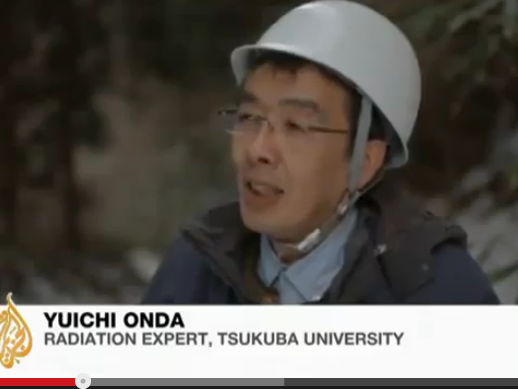
“Do NOT come to Fukushima and do NOT eat the food products!” – Support evacuation instead!
“They said they just need to wait patiently and let the land to heal from the radioactive contamination by itself, and hope for the best.Removing the radioactive contamination from the leaf moulds is impossible. And anyway, getting rid of the leaf moulds would be detrimental to the environment because the most important aspect of the leaf moulds is that the forests water retention capability would be lost if the mould were removed.Therefore, decontamination of the forest wouldn’t work for us. We would lose our jobs. Fukushima prefecture is 70-80% mountainous. If they decontaminate the land, they need to do all of it (according to what he described, it’s impossible) or Japan admits the extent of the contamination in Fukushima prefecture and acts accordingly. That’s the only way to show the world our sincerity, and then we can only start to gain our trust from the rest of the world.”

Fukushima residents fear govt. underestimates radiation risks
Published on 30 Apr 2013
Ready-to-air-story People living near Japanas Fukushima nuclear power plant damaged in the March earthquake fear the government is playing down the contamination risks.

Radiation reading taken at ground level in Fukushima City ( 60 Km from the nuclear plant disaster danger zone edge

Image source ; http://www.greenpeace.org/international/en/multimedia/photo-essays/Shadowlands/
Fukushima Exclusion Zone – A short story about cows – Video
Published on 1 May 2013
FREE HIROSHI HOSHI, and LEO HOSHI, Fukushima Animal Rescuers
-
-
Petition by

http://www.change.org/petitions/free-hiroshi-hoshi-and-leo-hoshi-fukushima-animal-rescuers
-
- Hiroshi Hoshi and Leo Hoshi were arrested on January 28th and are still in custody at the Futaba Police station. They are under arrest for “allegedly” breaking laws. We believe that that they are being targeted and unjustly detained due to their animal rescue of Fukushima animals. They have actively rescued, cared for, vetted and adopted out over 200 animals left to die inside the Nuclear Zone by the Government of Japan. FREE HIROSHI AND LEO HOSHI! Please sgin as an individual or if you are an animal group we need your support. Please read our letter below in English and Japanese and share it . We thank you.


Fukushima Japan, Chief Prosecutor Toru Sakai
On behalf of the Hachiko Animal Federation, Inc, a non-profit organization in the United States we humbly request that you release the Hoshi Family, Hiroshi and Leo on their own merit and without any bail.
The Hoshi’s have actively rescued, cared for and placed animals in adoptive families for almost two years. Because of the unforeseen disasters in Japan, unfortunately, many of these animals were sadly left behind in the Fukushima Exclusion Zone, or Nuclear Zone. It appears that there were no plans in place to deal with such drastic human circumstances and much less to include the animals that were people’s household pets. The Hoshi’s have actively rescued over 200 animals on their own with very limited monetary resources. The Hoshi Family is a humanitarian group and their sole mission has always been and remains one of altruism; to help reunite animals with their families or to find new families for animals in need.
The Hachiko Animal Federation was formed to honor your national treasure and our mascot, Hachiko, the loyal Akita dog. Our mission was and remains to assist animal shelters in Japan as well as animal rescue groups and volunteers who received little or no aid from the Japanese government. Our group will continue to assist Fukushima animals and animals around the world.
Fukushima…a Dire SOS Message from Thom Hartman
Published on 2 May 2013
Since the Fukushima nuclear disaster first began back in March of 2011, there have been near-daily updates on the condition of that stricken plant, updates which have been getting worse and worse, painting a very dire scene at the Dai-ichi nuclear power plant.
From the moment the earthquake and tsunami devastated the plant, officials have been struggling to contain the leaks of radioactive waste, fuel, and cooling water.
In February, for example, officials discovered a fish in a nearby water intake station for the plant that contained more than 7,400 times the recommended safe limit of radioactive cesium.
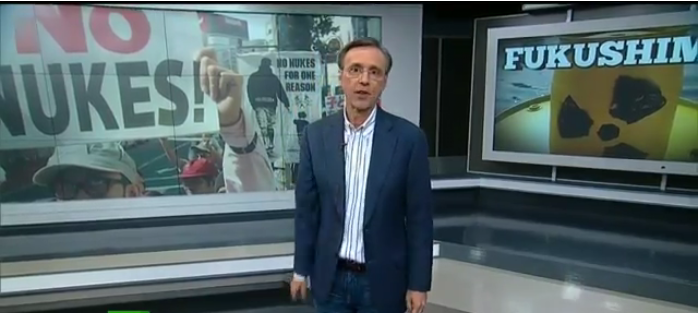
And now, officials are concerned that, because of all of the leaks, power outages, and glitches that have occurred, the Dai-chi nuclear power plant could begin to break apart and cause an even worse nuclear disaster, when a decades-long clean-up process finally begins.
Sister Megan Rice and two others in federal court for nuclear breach

Image source ; http://oakridgetoday.com/
- Three peace activists face trial this week for breaching a nuclear weapons site
- The incident last year took place at the Y-12 facility in Oak Ridge, Tennessee
- If convicted, they could face 20 years in prison
(CNN) — When an elderly nun and two fellow peace activists walked undetected onto one of the nation’s most secure nuclear facilities last year, they wanted to call attention to the dangers of nuclear weapons.
Yet their actions in Oak Ridge, Tennessee, triggered a very different concern:
If three older peaceniks can easily trespass onto the Y-12 National Security Complex — once considered the “Fort Knox” for highly enriched uranium — just how safe are the nation’s nuclear weapons facilities from terrorists?
World Nuclear Power Reactors & Uranium Requirements
3 May 2013
This table includes only those future reactors envisaged in specific plans and proposals and expected to be operating by 2030.
The WNA country profiles linked to this table cover both areas: near-term developments and the prospective long-term role for nuclear power in national energy policies. They also provide more detail of what is tabulated here. (Click on picture to enlarge)
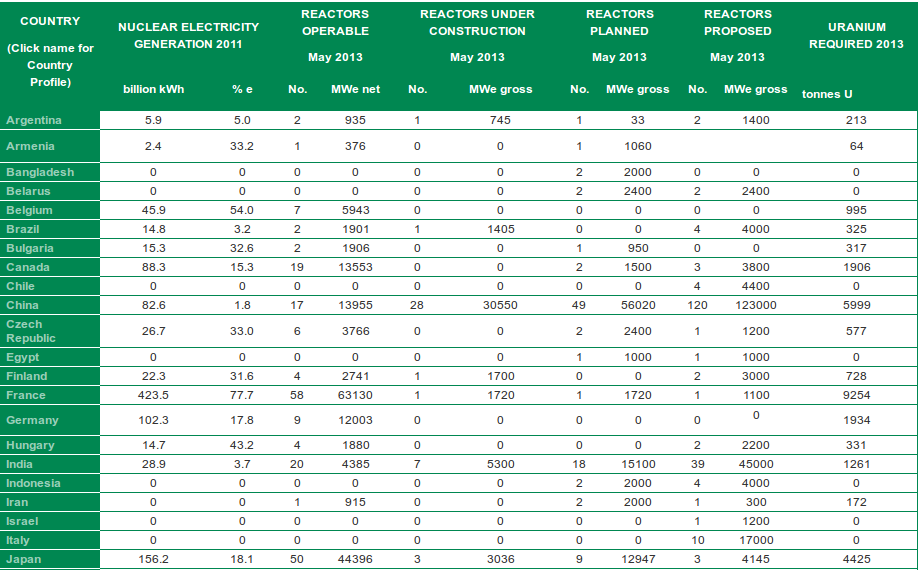

Reactor data: WNA to 3/5/13 (excluding 8 shut-down German units)
IAEA- for nuclear electricity production & percentage of electricity (% e) 13/4/12.
WNA: Global Nuclear Fuel Market report Sept 2011 (reference scenario) – for U.
Operable = Connected to the grid;
Under Construction = first concrete for reactor poured, or major refurbishment under way;
Planned = Approvals, funding or major commitment in place, mostly expected in operation within 8-10 years;
Proposed = Specific program or site proposals, expected operation mostly within 15 years.
New plants coming on line are largely balanced by old plants being retired. Over 1996-2009, 43 reactors were retired as 49 started operation. There are no firm projections for retirements over the period covered by this Table, but WNA estimates that at least 60 of those now operating will close by 2030, most being small plants. The 2011 WNA Market Report reference case has 156 reactors closing by 2030, and 298 new ones coming on line.
TWh = Terawatt-hours (billion kilowatt-hours), MWe = Megawatt (electrical as distinct from thermal), kWh = kilowatt-hour.
66,512 tU = 78,438 t U3O8
** The world total includes 6 reactors operating on Taiwan with a combined capacity of 4927 MWe, which generated a total of 40.4 billion kWh in 2011 (accounting for 19.0% of Taiwan’s total electricity generation). Taiwan has two reactors under construction with a combined capacity of 2700 MWe, and one proposed, 1350 MWe. It is expected to require 1291 tU in 2013.
Note: This table is routinely updated approximately every two months, and more frequently as required.
Earlier tables on link
Caesium gas and the worlds first atomic clock – Putting waste to work!
….developed by Symmetricon for military applications in drones and cruise missiles…..
03 May 2013
http://www.world-nuclear-news.org/ON_Pocket_atomic_clock_0305131.html
London watchmaker Hoptroff has produced the world’s first watch with true atomic-clock accuracy.
Several manufacturers already offer affordable watches that synchronise to the radio signals transmitted from atomic clocks around the world, but Hoptroff’s ‘No.10’ movement is different because it actually features a miniature atomic clock of its own. A first production run of only 12 seagoing-style pocket watches for collectors is intended.
 |
| The back and the front of the Hoptroff No.10 movement and a potential face for the watch |
The watch will use a Quantum SA.45s ‘chip scale atomic clock’ developed by Symmetricon for military applications in drones and cruise missiles. Despite being only around 4.1 cm across and 1.1 cm thick, this contains caesium gas at a controlled temperature, a laser exciter and a microwave resonator that combine to stimulate the caesium, measure its vibrations and mark the passage of time.
Researched and written
by World Nuclear News
A quick nuclear roundup of news for the start of May

USA – Offshore Wind vs Nuclear Energy for Mid-Atlantic
Energy Collective, 06/05/2013
USA – Entergy says no to NY plan for nuclear waste storage
CNYcentral.com, 05/05/2013
USA – Millstone Gets OK To Expand Nuclear Waste Storage
CBS Local, 02/05/2013
USA – New Mexico – Repository wins environmental recognition
WNN, 01/05/2013
Irish challenge to UK approval of new nuclear plant in Somerset
BBC News, 02/05/2013
Twitter row after Oettinger dubs UK nuclear plans ‘Soviet’
EurActiv, 01/05/2013
Russia to spend over $30 billion in nuclear energy development
RT, 01/05/2013
Andreyeva Bay and Lepse nuclear service ship remain major nuclear dangers to Northwest Russia
Bellona, 30/04/2013
Japan’s Nuclear Plan Unsettles U.S.
Wall Street Journal, 01/05/2013
Leaks, Rats and Radioactivity: Fukushima’s Nuclear Cleanup Is Faltering
TIME, 01/05/2013
Japan signs Turkey nuclear deal
BBC News, 03/05/2013
Japan, UAE set to sign nuclear agreement as Abe visits
GlobalPost, 02/05/2013
Japan eyes opportunities in UAE’s new nuclear age
The National, 01/05/2013
US may face inevitable nuclear power exit and France too!
Mar 01, 2013.
Published by Phys.org
….The breadth and depth of the data and analysis presented by the authors in all three Nuclear Exit issues make clear that this question has no simple, one-size-fits-all answer. They make something else clear: The question deserves a serious, considered answer in every country with a commercial nuclear power industry…..
In a 2012 report, the Obama administration announced that it was “jumpstarting” the nuclear industry. Because of the industry’s long history of permitting problems, cost overruns, and construction delays, financial markets have been wary of backing new nuclear construction for decades. The supposed “nuclear renaissance” ballyhooed in the first decade of this century never materialized. And then came Fukushima, a disaster that pushed countries around the world to ask:
Should nuclear power be part of the energy future?
In the third and final issue in a series focused on nuclear exits, the Bulletin of the Atomic Scientists, published by SAGE, turns its attention to the United States and looks at whether the country’s business-as-usual approach may yet lead to a nuclear phase-out for economic reasons.
The Obama administration injected significant funding into two new nuclear reactor projects in Georgia in 2012. But this investment—the first of its kind in three decades—belies an overall dismal US nuclear power landscape.
Where Japan and many European countries responded to the Fukushima disaster with public debate and significant policy shifts in the nuclear arena, the US has scarcely broached the subject.
According to former Nuclear Regulatory Commission Commissioner Peter Bradford, current market forces challenge the economic viability of existing nuclear power plants, with new reactors representing an extremely unattractive investment prospect.
Long Shadow of Chernobyl (3): Dried Mushrooms from Italy Still Found With 170 Bq/kg of Cesium-137
http://ex-skf.blogspot.co.uk/2013/05/long-shadow-of-chernobyl-3-dried.html
One of the scientific researchers that I follow who goes by the name of “Tomynyo” on Twitter has been measuring all sorts of things after the Fukushima nuclear accident – soil accumulated on top of his apartment complex in Yokohama City with high levels of radioactive cesium to bamboo shoots and mushrooms served in the kindergarten lunch.
His latest tweets is not about the domestic mushrooms but about mushrooms from Italy:
イタリア製のボルチーニ茸6検体を測定したところ全ての検体からセシウム137が検出されました。 最大は170.3±18.0Bq/kg、最低は31.6±6.2Bq/kgでした。スーパーの乾椎茸はほとんど九州産ですから、普通に買える乾椎茸より汚 染されていると思います (link)
We measured 6 samples of [dried] Italian porcini mushrooms, and all samples were found with cesium-137. Maximum was 170.3±18.0Bq/kg, and minimum was 31.6±6.2Bq/kg. Dried mushroom you buy at a supermarket are almost all grown in Kyushu, so we think these Italian mushrooms are more contaminated than the dried Japanese mushrooms you can buy at a supermarket.
ボルチーニは水戻しした場合セシウム濃度は1/4になるそうです。… 3.11以前からそれなりの汚染された食品食べていた可能性があることは認識すべきです。(link)
If porcini mushrooms get rehydrated, the density of radioactive cesium would be one-fourths, we are told. We should recognize that we may have been eating food with certain levels of contamination even before March 11, 2011.
Just like the wood pellets from trees in Shikoku, Japan tested by one of my Twitter followers, cesium-137 is most likely from the atmospheric testing and the Chernobyl accident.
I happened on this video, supposed to be the raw footage of Chernobyl soon after the accident. I got scared watching workers with scant protection dumping loads of what looks like concrete debris:
Posted by GlobalSuperstorm
Other “Long Shadow of Chernobyl” posts:
Startling new find! – Boars “radioactive” in the woods of Valsesia NE Italy More than 600 Bq/Kg

ALARM – “We need to immediately extend the analysis to other wild animals as soon as possible and make clear the sources of contamination,” said Coldiretti. “The boars are animals sentinel pollution conditions in the areas where they live, because they provide precise information thanks to a certain way of exploiting the environment,”

Italy doesnt look to bad.. what about somewhere nearer to ground zero?
6,000 Bq/kg of Cesium-137 found in mushrooms from Bulgaria — EU-wide food safety alert issued
June 12th, 2011
http://enenews.com/6000-bqkg-cesium-137-found-mushrooms-bulgaria-eu-wide-food-safety-alert-issued
1 This Month


10 March A LIVE WEBINAR THE REAL EFFECTS OF NUCLEAR POWER
What the Industry Isn’t Telling Us
1:00 PM Mountain, 2 pm Central, 3 pm Eastern. Live on the Keepers of the Water Facebook page


18 March Webinar @ 1 PM EST: An Assessment of SMR Projects: The Case of Canada
register for the zoom:
https://us02web.zoom.us/webinar/register/WN_o8BIIOUvQ2ONJR1nta65DQ#/registration


of the week – STOP SMALL MODULAR REACTORS IN CANADA
To see nuclear-related stories in greater depth and intensity – go to https://nuclearinformation.wordpress.com
-
Archives
- March 2026 (76)
- February 2026 (268)
- January 2026 (308)
- December 2025 (358)
- November 2025 (359)
- October 2025 (376)
- September 2025 (258)
- August 2025 (319)
- July 2025 (230)
- June 2025 (348)
- May 2025 (261)
- April 2025 (305)
-
Categories
- 1
- 1 NUCLEAR ISSUES
- business and costs
- climate change
- culture and arts
- ENERGY
- environment
- health
- history
- indigenous issues
- Legal
- marketing of nuclear
- media
- opposition to nuclear
- PERSONAL STORIES
- politics
- politics international
- Religion and ethics
- safety
- secrets,lies and civil liberties
- spinbuster
- technology
- Uranium
- wastes
- weapons and war
- Women
- 2 WORLD
- ACTION
- AFRICA
- Atrocities
- AUSTRALIA
- Christina's notes
- Christina's themes
- culture and arts
- Events
- Fuk 2022
- Fuk 2023
- Fukushima 2017
- Fukushima 2018
- fukushima 2019
- Fukushima 2020
- Fukushima 2021
- general
- global warming
- Humour (God we need it)
- Nuclear
- RARE EARTHS
- Reference
- resources – print
- Resources -audiovicual
- Weekly Newsletter
- World
- World Nuclear
- YouTube
-
RSS
Entries RSS
Comments RSS
 nuclear-news