The Rand Corporation speaks of war in Europe
25.11.26 – Montreal, Canada – Samir Saul – Michel Seymour
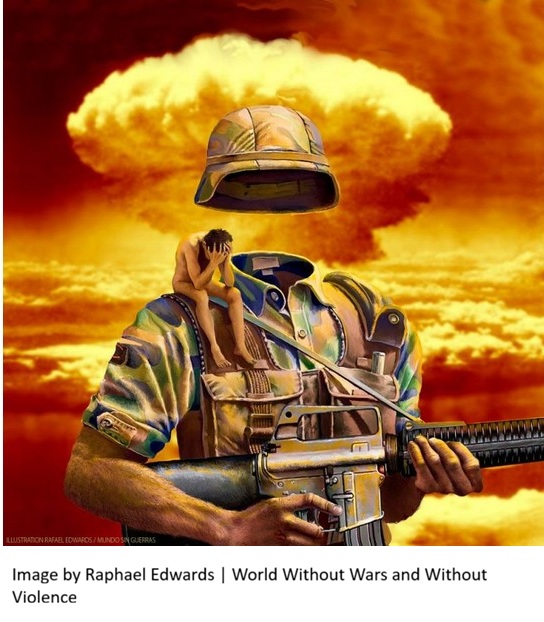
European elites have been in a war frenzy for months. Their belligerence emerged in early 2025 when the newly inaugurated Trump expressed a willingness to negotiate with Russia regarding the conflict in Ukraine. The sky fell on both sides of the Atlantic. In a flurry of restless activity unseen since early 2022, European and American neoconservatives sounded the alarm, monopolizing the airwaves to voice their anguish at the utterly intolerable possibility that a settlement could be reached without Russia suffering a “strategic defeat” and, why not, before its regime is overthrown by a color revolution and the country is carved up into 13 rump states, a wet dream for the most fervent.
As the primary losers of the “sanctions” imposed on Russia at the instigation of the United States, with their economies spiraling out of control and social and political unrest simmering across the continent, they could have seized the opportunity to reduce their involvement in a conflict that is leading them to ruin. On the contrary as if on autopilot, they continued down the same path, even ramping up the military and financial escalation. The United States, having realized that war against Russia is unwinnable and reluctant to keep spending on lost causes, is quite glad to shift the Ukrainian burden on to Europe. It has other wars to fight and can no longer afford to wage several simultaneously. The enthusiasm of European leaders to accept the invitation and confront Russia is one of the revelations of the last two years. Europe is in a pre-war state, an eve-of-battle atmosphere. War is becoming the cement of a European Union divided by its economic difficulties.
The other revelation is the limited influence Trump wields as president over foreign policy. At the helm of a state apparatus controlled by his neoconservative enemies, Trump is too weak, too isolated, and too inexperienced to impose his own policy, if indeed he has one. Having surrounded himself with neoconservatives and lacking any idea how to fulfill his campaign promise to end the conflict in Ukraine, Trump has fallen into line and continued the war, albeit with less funding. Satellite surveillance and intelligence on target coordinates, vital to Ukrainian forces, continue to be provided by the United States.
Rand chimes in
Did not European governments and chiefs of staff point to 2029 or 2030 as the starting date for a Euro-Russian war? Lo and behold, the Rand Corporation, the think tank to which the Pentagon outsources its strategic thinking, duly published a document for Great Britain outlining preparations for a 2030 war (Ready for War 2030: A Scenario). “It is no longer a question of whether a war is feasible, but whether we will be prepared to meet the challenge.” (p. 3) Rand seems to have recently realized what appears to be an obvious fact, namely that, “from a Russian perspective, conventional warfighting would be an extension of what they perceive as an ongoing strategic confrontation with NATO.” (p. 3) This confrontation would involve competition across the full range of domains (full spectrum of competition, these catch words of the military establishment occur six times in the document).
The document’s premise is the growing risk that NATO will find itself in a defensive war against Russia before 2030. This reasoning raises several questions. First, it posits that Russia would attack NATO, and NATO would defend itself. But would Russia attack if NATO does not provide a pretext ? Is not it more likely that NATO would provide that pretext, rather than Russia taking the initiative to trigger an open confrontation with NATO through a gratuitous attack ? This week, the presence of European troops in Ukraine was made public. Furthermore, why would Russia observe the 2030 timeframe to attack ? Why not 2027 or 2028, if it feels like it ? Why would this alleged aggression wait until the completion, scheduled for 2029, of the present European rearmament program?
Rand offers a “hypothetical scenario” for a war in Europe in 2030, complete with a timeline:
January –March 2027 – death of Putin and struggle for succession
April 2027 – ceasefire in Ukraine
July 2027 – formal peace negotiations in Ukraine reach a stalemate
from 2028 – hybrid campaign against NATO
June 2029 – crisis in South America becomes a priority for the United States
January -April 2030 – intensification of the conflict by Russia
May 2030 – outbreak of war
June –October 2030 – large-scale battles
November 2030 – preliminary ceasefire
January 2031 – uncertain future
Then come 12 “vignettes” analyzing in detail NATO’s state of preparedness in terms of societal resilience, supply chains in a war economy, threats to critical infrastructure, managing pressures on the healthcare system, cybersecurity, space, human mobilization, industrial mobilization, threats to air and missile defense, threats to critical military capabilities, deterrence and escalation management, end of war, and post-war security architecture. (pp. 9-50)
Incredulity and shock
A sentence in large print across the entire right-hand column of page 46 gives pause for thought. “Ultimately, it is unclear how the UK (and NATO without the United States) can fight and win a conventional war without risking triggering (potentially nuclear) escalation – the core question is therefore how to signal to [the] Russian leadership that they can lose a conventional war operationally and tactically while surviving a NATO victory.” They would be addressing the world’s largest nuclear power and assuming that Europe would prevail against it. Strategic planning turns into magical thinking. One rubs one’s eyes in disbelief at such perilous fantasies. To wage a direct, high-intensity war involving three nuclear powers and hope that nuclear weapons will remain sheathed is sheer blindness. To speculate that a party in difficulty would not resort to its nuclear arsenal is wishful thinking. To think that a war can be both unlimited and limited is taking leave if one’s senses. All of these amounts to saying to Russia: “You have the means to destroy us, but please don’t, and we promise you your life will be spared after your defeat.” Be the judge of the seriousness of this attitude. Rather than inserting this unfortunate sentence into the text, the exercise should have begun by frankly posing the question that determines all that follows : are you prepared to consider a nuclear war that would devastate Europe ?
No comments yet.
1 This Month

Tell Congress: Prevent Nuclear Catastrophe in Iran

Tell Congress: Prevent Nuclear Catastrophe in Iran

Read the Public Inquiry Report, the Commissioners’ report, Surrendering Australia: The AUKUS Deception is available to download for free at aukuspublicinquiry.com. Or just watch the replay of the National Press Club Luncheon.


Shut down the radiation-damaged Heysham nuclear reactors now
To see nuclear-related stories in greater depth and intensity – go to https://nuclearinformation.wordpress.com

Say No to NASA’s Reckless Nuclear Reactor on the Moon
Say No to NASA’s Reckless Nuclear Reactor on the Moon
-
Archives
- November 2026 (269)
- October 2026 (302)
- September 2026 (339)
- August 2026 (330)
- July 2026 (355)
- June 2026 (287)
- May 2026 (306)
- April 2026 (356)
- March 2026 (251)
- February 2026 (267)
- January 2026 (308)
- December 2025 (358)
-
Categories
- 1
- 1 NUCLEAR ISSUES
- business and costs
- climate change
- culture and arts
- ENERGY
- environment
- health
- history
- indigenous issues
- Legal
- marketing of nuclear
- media
- opposition to nuclear
- PERSONAL STORIES
- politics
- politics international
- Religion and ethics
- safety
- secrets,lies and civil liberties
- spinbuster
- technology
- Uranium
- wastes
- weapons and war
- Women
- 2 WORLD
- ACTION
- AFRICA
- Atrocities
- AUSTRALIA
- Christina's notes
- Christina's themes
- culture and arts
- Events
- Fuk 2022
- Fuk 2023
- Fukushima 2017
- Fukushima 2018
- fukushima 2019
- Fukushima 2020
- Fukushima 2021
- general
- global warming
- Humour (God we need it)
- Nuclear
- RARE EARTHS
- Reference
- resources – print
- Resources -audiovicual
- Weekly Newsletter
- World
- World Nuclear
- YouTube
-
RSS
Entries RSS
Comments RSS


Leave a Reply