Who’ll pay for overruns on the Darlington small modular reactor? Plus other unanswered questions
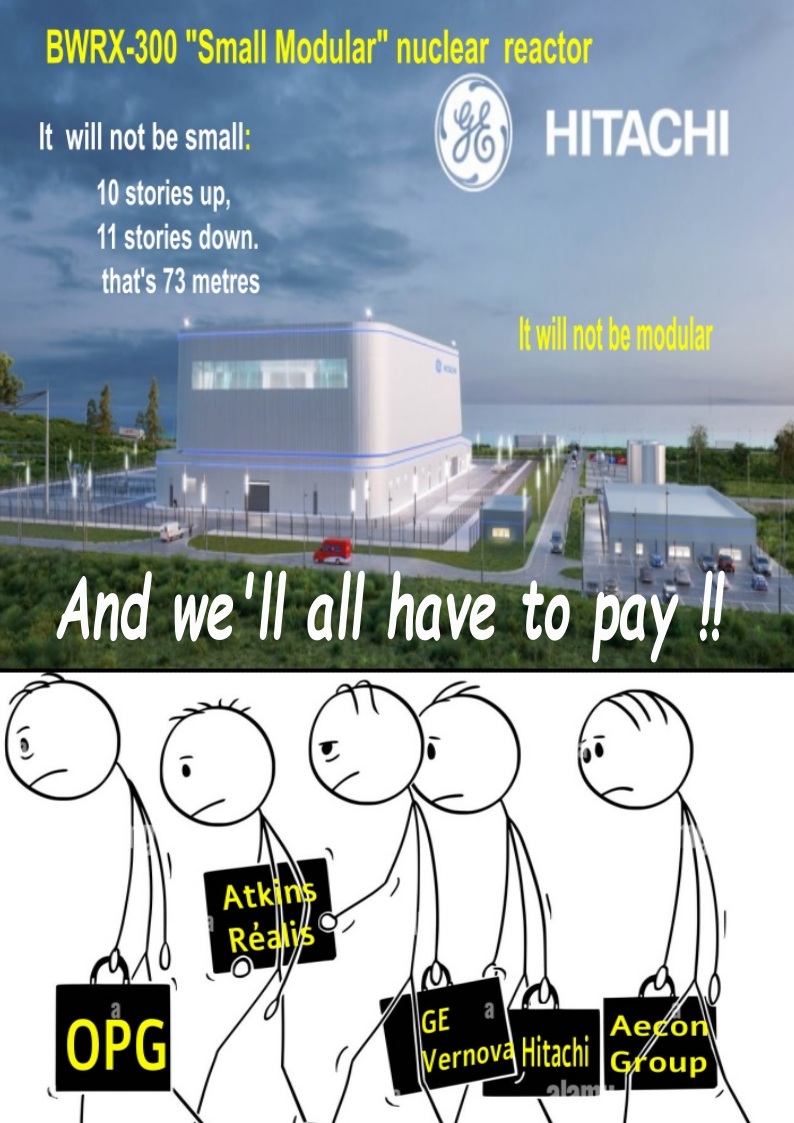
The DNNP is being executed under what’s referred to as a “integrated product delivery model,” under which OPG, GE Vernova Hitachi, architect-engineer AtkinsRéalis Group Inc. and construction company Aecon Group Inc. share risks. A portion of their fees can be withheld if certain objectives aren’t met.
A senior OPG executive told reporters in 2025 that if the DNNP went late or over budget, “all of us – the partners and OPG – will have to share the risk of that overrun.”
Matthew McClearn, (Nov. 26, 2026), https://www.theglobeandmail.com/business/article-wholl-pay-for-overruns-on-the-darlington-small-modular-reactor-and/
Just months into construction, Canada’s most ambitious nuclear project in four decades has already suffered serious setbacks.
Construction of a new nuclear power plant officially began in April when the foundation for its first reactor building was set in place. Located in Clarington, Ont., Ontario Power Generation’s Darlington New Nuclear Project (DNNP) contemplates building four small modular reactors (SMRs) known as BWRX-300s, a model that has never been built before. The project’s overall budget was $20.9-billion, $7.7-billion of which was for the first unit. But on Nov. 10, OPG announced that it no longer expects that first reactor to meet its approved budget, nor will it enter service by October 2030 as promised.
Nuclear projects are notorious for suffering massive cost overruns and taking far longer than promised, often with significant consequences for consumers. Here’s what to know about the DNNP’s setbacks, and what past failed nuclear projects reveal about what might happen next.
How bad are the overruns?
OPG is offering few details, however the original budget already included significant contingencies and escalations intended to cushion setbacks. The utility said it launched “a comprehensive assessment” to determine a new schedule and budget, expected to be completed by mid-2027.
OPG did not respond to queries from The Globe and Mail about which aspects of the project are behind schedule. An analysis of OPG disclosures by The Globe suggests key project milestones have already been missed by months.
For example, OPG was to have completed assembly of a tunnel-boring machine by February 2026. But that was achieved sometime during the three months ended Sept. 30.
OPG’s deadline for drilling the station’s marine intake was Oct. 31. However, as of Nov. 10, OPG reports show it had not yet even commenced tunnel boring; it expected to do so by the end of this year.
How much those and other delays set back the project as a whole isn’t apparent, but there are hints. The timing of OPG’s original plan – reflected in its Dec. 2025 rate application to the Ontario Energy Board, covering 2027 through 2031 – indicated the first unit would begin generating electricity in October 2030. In a Nov. 10 report, the OPG notified the Ontario Energy Board that it would remove the DNNP entirely from the application, suggesting startup will be not before 2031, making it at least 14 months late. However, that is not definitive: The same document elsewhere contemplated the possibility Unit 1 might enter service earlier.
What caused the overruns?
In financial statements published Nov. 10, OPG attributed the overruns to GE Vernova Hitachi Nuclear Energy’s “ongoing engineering” work. That, in turn, “has impacts on construction execution and supply chain performance.”
GE Vernova Hitachi is responsible for designing the BWRX-300 reactor at the plant’s heart, as well as procuring major components and providing engineering and support. OPG began construction without a detailed set of plans.
Why does that matter? Can’t OPG work on other parts of the project while GE Vernova Hitachi’s engineers catch up?
Such reasoning has spelled disaster for countless nuclear projects, particularly those involving “first-of-a-kind” reactors such as the BWRX-300. Much project management literature counsels proponents to not rush to begin construction, because problem-solving and delays cost a lot less during the planning phase.
Consider this: OPG’s financial statements indicate it’s spending roughly $100-million a month on the DNNP. Earlier this year, it reported having as many as 1,500 workers on site on a typical day.
Surely OPG was aware of these risks.
It was. In past interviews with The Globe, OPG officials said that the facility’s design would be sufficiently advanced that “first-of-a-kind” risks would be eliminated before construction began. In May 2025, Ontario’s government reported that “OPG has completed their engineering and design work for the first SMR” and developed a “‘high-confidence’ budget and schedule.”
When The Globe asked in May about the status of the BWRX-300’s detailed design, OPG replied that “standard plant design was substantially completed in December 2025 as planned.”
However, experts told The Globe that “standard plant design” is very different from “detailed” design. The latter includes three-dimensional representations of every pipe, cable and duct, exact weld specifications and a whole lot more. That’s what’s required to actually build a nuclear power plant. It’s unclear what detailed design work has been completed and what remains outstanding.
What happened to other nuclear plants that began construction without detailed plans?
Bad things.
“You don’t want to have 1,500 people just sitting around,” said Koroush Shirvan, an associate professor of nuclear engineering at the Massachusetts Institute of Technology.
“Because that’s going to eat through your budget and contingency very, very fast.”
France’s Flamanville-3, completed a dozen years behind schedule and massively over budget, offers a good example. A report by Jean-Martin Folz, former head of French automaker Peugeot, found that the plant’s construction began without a complete set of validated plans. The result was that the design continuously changed during construction, and lots of work had to be redone. Flamanville-3 blew its budget many times over.
In Burke County, Georgia, two units at the Alvin W. Vogtle plant, the U.S.’s largest nuclear station, began construction in 2009; they were the first to feature Westinghouse’s AP1000 reactor. The U.S. Nuclear Regulatory Commission licensed the AP1000’s design prior to completion, but the missing elements led to myriad problems during construction and huge cost overruns. Similar problems occurred with two nearly identical AP1000s in South Carolina, V.C. Summer Units 2 and 3, which were abandoned in 2017 after billions of dollars had been spent.
“These lessons have been repeated over and over and over again,” Dr. Shirvan said.
The financial fallout from Vogtle and V.C. Summer led to the bankruptcy of Westinghouse, the main contractor and reactor designer on both projects.
Who’ll pay for the DNNP overruns?
The DNNP is being executed under what’s referred to as a “integrated product delivery model,” under which OPG, GE Vernova Hitachi, architect-engineer AtkinsRéalis Group Inc. and construction company Aecon Group Inc. share risks. A portion of their fees can be withheld if certain objectives aren’t met. A senior OPG executive told reporters in 2025 that if the DNNP went late or over budget, “all of us – the partners and OPG – will have to share the risk of that overrun.”
However, in a statement to The Globe, AtkinsRéalis spokesperson Daniela Pizzuto wrote that the overruns would not have a material financial impact on her company because “our risk is capped.”
Vogtle and V.C. Summer demonstrate how, even when private companies were contractually obligated to deliver a nuclear power plant under a fixed-price contract, the public ended up paying dearly. Georgia Power raised residential electricity rates significantly to cover Vogtle’s construction costs and overruns. South Carolina’s utility, Santee Cooper, owed US$3.6-billion for the unfinished V.C. Summer units, which its customers pay for on their monthly bills despite never receiving a single kilowatt hour.
“Contracts don’t fix problems, they fix blame,” said James Little, a member of South Carolina’s Governor’s Nuclear Advisory Council, in April at a hearing at which the potential restart of construction at V.C. Summer was discussed.
“Relying on contracts to manage risk, it’s a false hope.”
Who will protect Ontarians’ interests concerning the DNNP overruns?
The Ontario Energy Board sets the rates OPG can charge for electricity generated by its nuclear power plants, and is mandated to provide information to consumers. “We will never lose sight of the individual rate payers, the consumers, the people of Ontario,” the regulator asserts on its web site.
The Globe requested an interview with the OEB to explore how consumers might be exposed to the DNNP overruns. Spokesperson Tom Miller denied the request and said such questions should be directed to OPG.
Could overruns halt or kill the DNNP?
With the extent of the overruns unclear, it’s difficult to gauge OPG’s ability to adapt and respond. The utility reported that construction will continue. It did not answer questions about how it has adjusted its on-site work plans in response to incomplete engineering work. Aecon, the constructor, declined an interview request, as did GE Vernova Hitachi.
Critics of Ontario’s nuclear-focused electricity strategy were quick to pounce on the DNNP’s troubles; the Ontario Clean Air Alliance demanded its cancellation.
“The most head shaking part of this risky project is that Ontario willingly chose to be a guinea pig for an unproven American (GE-Hitachi) nuclear technology,” director Angela Bischoff wrote in a statement.
“While other jurisdictions stood back and said ‘after you,’ Ontario rushed forward and recklessly committed to a design that has not been built anywhere in the world.”
The provincial and federal governments have shown no indications they are reconsidering their commitments – and some observers say they shouldn’t.
Chris Gadomski, a nuclear analyst at BloombergNEF, said first-of-a-kind nuclear projects are exceptionally difficult to deliver, invariably suffer delays and are painfully expensive. It was “disheartening,” he added, that DNNP proponents hadn’t learned from Vogtle and V.C. Summer.
But, following missteps during construction of the first unit, “the question to be asking is: Will OPG and General Electric Hitachi learn from their mistakes and get the second, third and fourth one right?” he said.
“It would be a shame if they stopped after one…the worst thing they could possibly do is stop the project.”
.
The Rand Corporation speaks of war in Europe
25.11.26 – Montreal, Canada – Samir Saul – Michel Seymour
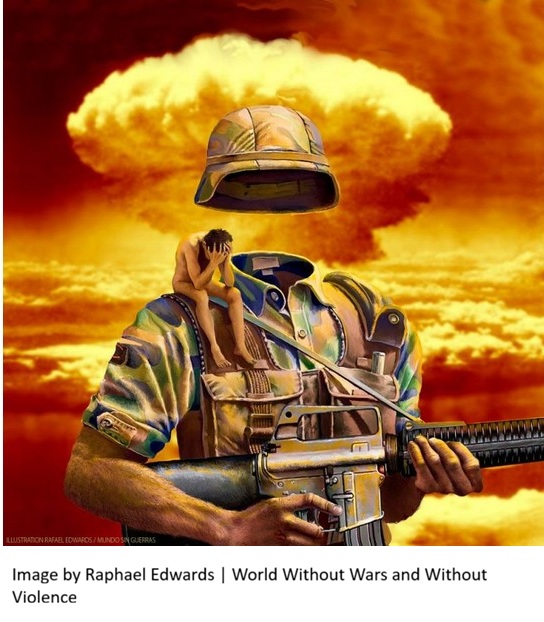
European elites have been in a war frenzy for months. Their belligerence emerged in early 2025 when the newly inaugurated Trump expressed a willingness to negotiate with Russia regarding the conflict in Ukraine. The sky fell on both sides of the Atlantic. In a flurry of restless activity unseen since early 2022, European and American neoconservatives sounded the alarm, monopolizing the airwaves to voice their anguish at the utterly intolerable possibility that a settlement could be reached without Russia suffering a “strategic defeat” and, why not, before its regime is overthrown by a color revolution and the country is carved up into 13 rump states, a wet dream for the most fervent.
As the primary losers of the “sanctions” imposed on Russia at the instigation of the United States, with their economies spiraling out of control and social and political unrest simmering across the continent, they could have seized the opportunity to reduce their involvement in a conflict that is leading them to ruin. On the contrary as if on autopilot, they continued down the same path, even ramping up the military and financial escalation. The United States, having realized that war against Russia is unwinnable and reluctant to keep spending on lost causes, is quite glad to shift the Ukrainian burden on to Europe. It has other wars to fight and can no longer afford to wage several simultaneously. The enthusiasm of European leaders to accept the invitation and confront Russia is one of the revelations of the last two years. Europe is in a pre-war state, an eve-of-battle atmosphere. War is becoming the cement of a European Union divided by its economic difficulties.
The other revelation is the limited influence Trump wields as president over foreign policy. At the helm of a state apparatus controlled by his neoconservative enemies, Trump is too weak, too isolated, and too inexperienced to impose his own policy, if indeed he has one. Having surrounded himself with neoconservatives and lacking any idea how to fulfill his campaign promise to end the conflict in Ukraine, Trump has fallen into line and continued the war, albeit with less funding. Satellite surveillance and intelligence on target coordinates, vital to Ukrainian forces, continue to be provided by the United States.
Rand chimes in
Did not European governments and chiefs of staff point to 2029 or 2030 as the starting date for a Euro-Russian war? Lo and behold, the Rand Corporation, the think tank to which the Pentagon outsources its strategic thinking, duly published a document for Great Britain outlining preparations for a 2030 war (Ready for War 2030: A Scenario). “It is no longer a question of whether a war is feasible, but whether we will be prepared to meet the challenge.” (p. 3) Rand seems to have recently realized what appears to be an obvious fact, namely that, “from a Russian perspective, conventional warfighting would be an extension of what they perceive as an ongoing strategic confrontation with NATO.” (p. 3) This confrontation would involve competition across the full range of domains (full spectrum of competition, these catch words of the military establishment occur six times in the document).
The document’s premise is the growing risk that NATO will find itself in a defensive war against Russia before 2030. This reasoning raises several questions. First, it posits that Russia would attack NATO, and NATO would defend itself. But would Russia attack if NATO does not provide a pretext ? Is not it more likely that NATO would provide that pretext, rather than Russia taking the initiative to trigger an open confrontation with NATO through a gratuitous attack ? This week, the presence of European troops in Ukraine was made public. Furthermore, why would Russia observe the 2030 timeframe to attack ? Why not 2027 or 2028, if it feels like it ? Why would this alleged aggression wait until the completion, scheduled for 2029, of the present European rearmament program?
Rand offers a “hypothetical scenario” for a war in Europe in 2030, complete with a timeline:
January –March 2027 – death of Putin and struggle for succession
April 2027 – ceasefire in Ukraine
July 2027 – formal peace negotiations in Ukraine reach a stalemate
from 2028 – hybrid campaign against NATO
June 2029 – crisis in South America becomes a priority for the United States
January -April 2030 – intensification of the conflict by Russia
May 2030 – outbreak of war
June –October 2030 – large-scale battles
November 2030 – preliminary ceasefire
January 2031 – uncertain future
Then come 12 “vignettes” analyzing in detail NATO’s state of preparedness in terms of societal resilience, supply chains in a war economy, threats to critical infrastructure, managing pressures on the healthcare system, cybersecurity, space, human mobilization, industrial mobilization, threats to air and missile defense, threats to critical military capabilities, deterrence and escalation management, end of war, and post-war security architecture. (pp. 9-50)
Incredulity and shock
A sentence in large print across the entire right-hand column of page 46 gives pause for thought. “Ultimately, it is unclear how the UK (and NATO without the United States) can fight and win a conventional war without risking triggering (potentially nuclear) escalation – the core question is therefore how to signal to [the] Russian leadership that they can lose a conventional war operationally and tactically while surviving a NATO victory.” They would be addressing the world’s largest nuclear power and assuming that Europe would prevail against it. Strategic planning turns into magical thinking. One rubs one’s eyes in disbelief at such perilous fantasies. To wage a direct, high-intensity war involving three nuclear powers and hope that nuclear weapons will remain sheathed is sheer blindness. To speculate that a party in difficulty would not resort to its nuclear arsenal is wishful thinking. To think that a war can be both unlimited and limited is taking leave if one’s senses. All of these amounts to saying to Russia: “You have the means to destroy us, but please don’t, and we promise you your life will be spared after your defeat.” Be the judge of the seriousness of this attitude. Rather than inserting this unfortunate sentence into the text, the exercise should have begun by frankly posing the question that determines all that follows : are you prepared to consider a nuclear war that would devastate Europe ?
Zionism Unmasked
.

Chris Hedges ScheerPost, November 25, 2026, https://scheerpost.com/2026/11/25/zionism-unmasked/
Benjamin Moser, in his book profiles Jewish opponents of Zionism to expose its inherent manipulation, deceit and cruelty
Dr. Alina Margolis-Edelman, one of the founders of Médecins du Monde, stayed in my apartment during the war in El Salvador when she worked in the refugee camps. Alina, who was in the Warsaw ghetto, was married to Dr. Marek Edelman, a deputy commander of the Warsaw Ghetto Uprising. She and Marek saw in the Palestinians the plight of the ghetto fighters.
Alina and Marek remained in Poland after the war. They were outspoken critics of Israel’s dispossession of the Palestinians. They supported the Palestinian struggle, including armed resistance. Needless to say, while Israel mounted a relentless campaign to appropriate the ghetto uprising and the Holocaust in defense of the Zionist project, the uprising’s last surviving commander was persona non grata in the Jewish state.
Benjamin Moser’s “Anti-Zionism: A Jewish History” rips back a veil on the sordid origins of Zionism, its repugnant ideology and its belief that any crime — no matter how heinous — is justified by its quest to build an ethnonationalist state in historic Palestine.
Moser implodes the fatuous claim that Zionism is intertwined with Jewish belief, writing that Zionism was a “new religion, fundamentally opposed to Judaism.” He celebrates those Jews who stood — or stand — unequivocally with the oppressed. And he details the savage campaign waged by Zionists to silence critics. He seeks to illuminate “a hidden side of the Jewish intellectual and moral legacy.”
The dream of a “Jewish homeland” in Palestine is rooted in Biblical myth and the erasure of historical truths. It was propagated in fin-de-siècle Austria by Theodor Herzl, a journalist and undistinguished playwright who at one point proposed that antisemitism would be solved by a mass conversion of millions of Jews in the Austro-Hungarian Empire, to Catholicism, in an elaborate ceremony presided over by the Pope.
Zionism, Moser notes, redefined “Judaism into a secular, nationalist identity by stripping it of its religious core. From the beginning, Zionism was aggressively secular. Its ideological antecedents were not in Judaism but in Christian eschatology and Romantic nationalism: in the very kind of chauvinism and jingoism that the Jews had forsworn. It embraced a definition of the Jews as a ‘race’ that, the rabbis noticed, was the same definition the antisemites used.”
I was aware of Moser’s erudition and talent as a writer from his biography of Susan Sontag, who I knew, and which won the Pulitzer Prize. What I was not aware of was his moral courage. He knew that writing this book, especially as a Jew, would see him excoriated by the cabal of liberal Zionists who run interference for Israel in publications such as The New York Times, The New Yorker and The Atlantic. He exiled himself from the club, much like the 12 anti-Zionists he profiles in the book. His critics, as is always the case when Zionists feel under threat, accuse him of things he did not write and beliefs he does not hold.
Yet, despite what he knew would be the inevitable onslaught, Moser refuses to flinch. Consistency, he writes, “was never a hallmark of Zionism. Its hallmark, from the very beginning, was opportunism, and a willingness to exploit Jewish fears and tragedies.”
If there is one constant in Zionism, which Moser traces from its inception to the present, it is that anyone who does not kneel before the Zionist Moloch becomes its victim. Jews are not spared, including one of the earliest opponents of Zionism, Jacob Israël de Haan.
De Haan was a Dutch Jewish writer, poet, journalist, lawyer and an ardent Zionist when he moved to Jerusalem in 1919. He quickly soured on the settler-colonial project when he saw how Zionist colonists abused the indigenous Palestinians, along with the Palestinian rabbis and Orthodox believers who saw Zionism as blasphemous.
In an 1878 census by the Ottoman Empire, before the first major wave of Zionist immigration, Jews made up about 3 percent of the population of Palestine. Jews in Palestine saw themselves as Palestinian Jews, “just as their neighbors considered themselves as Palestinian Muslims or Palestinian Christians.” Following two waves of Zionist immigration to Palestine between 1882 and 1914, that figure rose to an estimated 9 percent in 1917, the year of the Balfour Declaration, which committed the British to establishing a “national home for the Jewish people in Palestine.”
De Haan became one of Zionism’s most vociferous and influential critics. He was assassinated by the Haganah, a Jewish paramilitary organization, as he exited a synagogue in Jerusalem on June 30, 1924. True to form, Zionists blamed the killing on Arab Palestinians.
The British occupiers empowered the new Jewish colonists. Elections, because of the Arab majority, were banned. Palestinians were relegated to second-class citizenship. The British and the European Zionists created “a dual economy in which a new foreign element – armed with capital, technical knowledge, and strong international connections – was implanted and supported by the British administration, while the indigenous Arab economy was increasingly marginalized,” writes Moser, drawing on the 1947 work of Egyptian Jewish writer Ahmad Sadiq Saad. The economy was reoriented to producing crops profitable in international markets “rather than toward wheat and barley, despite the fact that this [left] the Palestinian masses hungry.”
Perhaps the most sordid chapter in the history of Zionism — one Zionists work overtime to deny — is their collaboration with the Nazis. Yitzhak Shamir, later prime minister of Israel, led the Jewish terrorist group Lehi — also known as the Stern Gang — which sought alliances with the Nazis to fight the British. The terrorism of Jewish underground groups, which Hannah Arendt condemned for the massacre of Palestinians at Deir Yassin, the assassination of Count Folke Bernadotte and other crimes, would, she warned, result in a state of endless wa
The German Zionist Federation, the Jewish A00gency and the Palestine Land Development Company, in 1933, negotiated the Ha’avara Agreement with the Nazis. It facilitated the stripping of the Jews of their property — German Jews were permitted to 0transfer the equivalent of £1,000 sterling to a bank in Tel Aviv — in exchange for passage to Palestine. The cost meant only the wealthy or the Menschenmaterial — Herzl’s term for “human material” — could immigrate. As part of the agreement, the Zionists agreed to break the boycott of German goods, designe0000000d to halt the oppression of German Jews, making Nazi Germany the largest exporter to Palestine.
The Zionists opposed sending German Jewish children to Britain and 20,000 children to the United States to save them from Nazi persecution. At the 1938 Évian Conference, they blocked proposals to provide safe passage for German Jews to Kenya, Manchuria and the Dominican Republic.
After all, if Jews could live safely in other countries, it negated the central tenet of Zionism, which is that Jews can only be safe in a Jewish state.
“If I knew that it was possible to save all the children of Germany by transporting them to England, and only half by transferring them to the Land of Israel, I would choose the latter, for before us lies not only the numbers of these children but the historical reckoning of the people of Israel,” David Ben-Gurion, who later became the first prime minister of Israel, said in 1938.
He meant it.
On March 19, 1944, SS officer Adolf Eichmann — kidnapped after the war by Israeli agents in Argentina and sentenced to death in Israel — arrived in Budapest to oversee the mass deportation of Hungarian Jews.
The Jewish leader Rezső Kasztner, assassinated in Israel in 1957, oversaw thecollection of gold, money and diamonds from 1,684 wealthy Jews, including many members of his own family, to buy passage to Palestine. He abandoned the rest of Hungary’s 800,000-strong Jewish community to its fate, assuring Jews left behind they were being transported to work sites rather than death camps. Some 550,000 Hungarian Jews were murdered, most in the gas chambers of Auschwitz-Birkenau.
In Israel Kasztner became the spokesman for the Ministry of Trade and Industry.
The betrayal by Kasztner and the Zionists of fellow Jews in Hungary was one of several that embittered the Edelmans.
I once asked Alina what her first impression of Israel was
“A nation run by collaborators,” she replied acidly.
“To this Jew this role of the Jewish leaders in the destruction of their own people is undoubtedly the darkest chapter of the whole dark story,” Hannah Arendt — another target for Zionists and a refugee from Germany — wrote of Jewish organizations, including the “Jewish councils” and the Zionists.
The Zionist slander of Arendt was unrelenting after she published “Eichmann in Jerusalem.”
“Self-hating Jewess Writes Pro-Eichmann Book,” in a typical broadside, read the headline in The Intermountain Jewish News.
Arendt’s book, which excoriated Zionist collaboration with the Nazis, was not published in Israel until 1999, four years after the first translation of “Mein Kampf.”
“To keep at bay the most fundamental questions — questions that go to the heart of Zionism’s legitimacy and morality — its propagandists lawyer every comma in every critique,” Moser writes. “It makes no difference how delicately phrased this critique might be; or how eminent the person making it; or whether the person is Jewish, or Israeli, or a Holocaust survivor, or even a Jewish Israeli Holocaust survivor. Every journalist, every editor, every professor, knows someone who has been attacked for reporting indubitable facts; bullied and boycotted, kicked out of jobs and homes. These attacks have the effect of installing a little Zionist censor inside a writer’s head, constantly asking what one is allowed to say and how one is allowed to say it.”
Zionists, who at first ridiculed the survivors of the Holocaust as “sheep to the slaughter,” and as sabonim, the Hebrew word forsoap, — derived from a rumor that Nazis used Jewish bodies to make soap — soon found that appropriating the Holocaust was very lucrative. This appropriation, as Arendt pointed out, was one of the principal reasons behind the Eichmann trial.
“By means of Auschwitz — which has become over the years Israel’s main reference in its relations with a world defined repeatedly as anti-Semitic and forever hostile — Israel rendered itself immune to criticism, and to a rational dialogue with the world around,” writes Israeli historian Idith Zertal.0
Israel, after World War II, was faced with a dilemma. Two-thirds of European Jews had perished in the Holocaust. If they were to populate Israel after its creation in 1948, they would need the large populations of Jews in the Middle East, especially those in Egypt and Iraq, where a quarter of Baghdad’s population was Jewish. Jews had lived in Iraq since at least 597 BC. The Zionists sent undercover agents to Baghdad to carry out bombings at sites frequented by Jews, including cafes, businesses and places of worship, in order to sow panic among the Jewish communities. By 1951, 110,000 Jews from Iraq had departed for Israel.
Israeli historian Avi Shlaim — whose family was one of those who fled Baghdad — in his book, “Three Worlds: Memoirs of an Arab-Jew,” uncovered proof of Israel’s secret bombing campaign. His family, when they arrived in Israel, were treated like vermin. They were sprayed with DDT and housed in camps, some of which were surrounded by barbed wire. In Israel’s class-ridden society, the Ashkenazi or European Jews dominated. Arab Jews, the Sephardim, were held in contempt.
You can see my interview with Shlaim here.
“We do not want the Israelis to turn into Arabs,” Ben-Gurion — born David Grün in Poland — intoned. “We must fight against the Levantine spirit, which corrupts men and societies, and preserve the authentically Jewish values which have been developed in the Diaspora.”
In 1954, Zionist agents made plans to firebomb sites in Egypt, including libraries, train stations, cinemas and institutions associated with Britain and the United States. The campaign was designed as a false-flag operation that would be blamed on the Muslim Brotherhood. The belief was that the attacks would discredit the government of Gamal Abdel Nasser and see Egyptian Jews flee to Israel. But Israeli agents were caught and tried, effectively casting Cairo’s Jews as potential traitors.
When Israel, along with Britain and France, invaded Egypt in 1956 to seize the Suez Canal, it marked the death blow to the Jewish community in Egypt. Egyptian Jews, numbering around 75,000 to 80,000, along with Greeks, Italians and Armenians, emigrated. Egyptian Jews had resided in Egypt since before the Roman occupation. There are reportedly only three Jews left in Cairo today.
Zionism has not mutated. It is the same beast. It spews the same venom and deceit. It slanders and lynches critics, especially its Jewish critics. Its chauvinism and celebration of Jewish supremacy were always destined to end in a campaign to annihilate the Palestinians. If you doubt me, read Moser’s book….
UK veterans win 40-year battle for inquiry into Cold War nuclear tests they say damaged health

LONDON (AP) — Britain’s prime minister has authorized an inquiry into the impact of nuclear weapons tests on military veterans after a 40-year campaign by survivors who say they were used as guinea pigs for tests that damaged their health and that of their children.
Nov. 25, 2026, By Danica Kirka The Associated Press, https://www.thestar.com/news/world/europe/uk-nuclear-test-veterans-win-40-year-battle-for-inquiry-into-cold-war-tests-they-say-damaged-health/article_375bb04e-e28d-5bad-99c1-f6d264997e7e.html
LONDON (AP) — Britain’s prime minister has authorized an inquiry into the impact of nuclear weapons tests on military veterans after a 40-year campaign by survivors who say they were used as guinea pigs for tests that damaged their health and that of their children.
Andy Burnham made the announcement Tuesday night on the BBC’s “Newsnight” program, saying the panel’s chairman would be “relentless in his pursuit of the facts.” An estimated 22,000 British military personnel witnessed Cold War-era nuclear weapons tests in the Indian and Pacific oceans from 1952 to 1967.
Japan to revise national security policy, weaken postwar non-nuclear commitments
China has objected to what it calls efforts to re-militarize Japan, claiming the move will lead to the breaking of the post-war world regional order and will create instability in the region.
Abdul Rahman, November 25 2026, https://breakthroughnews.org/2026/11/25/japan-to-revise-national-security-policy-weaken-postwar-non-nuclear-commitments/
Japan’s ruling Liberal Democratic Party (LDP) claimed on Monday, November 23, that it will revise the country’s three security documents by the end of the year and possibly acquire nuclear-power submarines soon.
Civil society groups on China and Japan have been opposing the decision, calling it a move towards remilitarization. They also claim such a move would be disastrous for regional peace and security and for the post-war regional order.
Keitaro Ohno, a leader of the LDP and a member of Japanese parliament reportedly reiterated that Japan has rejected the proposal to get a nuclear-powered submarine in the wake of strong popular opposition and objections raised by China.
He also claimed there is a consensus within the ruling coalition on the matter. The conservative LDP, along with the right wing Japan Innovation Party (JIP), holds a supermajority in the House of Representative (lower house) of Japan’s National Diet (parliament).
On Friday, Japan’s civil society groups had submitted 47,000 signatures to the country’s Defense Ministry, urging it to abandon the plan to acquire nuclear-powered submarines and amendments in the security documents.
Japan has also recorded several popular mobilizations against the Sanae Takaichi-led government’s moves to revise the three security documents, including its three non-nuclear principles, which prohibit its government from acquiring, producing, or introducing nuclear weapons.
Still, reports indicate that the Japanese government is aiming to make changes in its National Security Strategy, one of the three security documents, within the next few months, to allow nuclear weapons to be brought in the country during an “emergency.”
Civil society groups expressed concerns at the Takaichi government’s attempts to introduce nuclear weapons in the country even under this pretense, claiming it violates one of the three non-nuclear principles of not introducing the weapons.
They claimed once Japan moves ahead with the acquisition it will fundamentally alter the country’s status from a non-nuclear weapons’ state to a nuclear weapons state and this will go against its stated responsibility to promote nuclear disarmament.
Japan’s commitment to nuclear disarmament is rooted in the fact that it remains the only country in the world which has faced nuclear attacks.
Impact on relations with China
China has warned successive Japanese governments including Takaichi against any attempt to re-militarize the country claiming any such move would shake the balance in the region and will lead to instability and arms race.
China has demanded that the international community check the Japanese government to keep it from violating its commitments to the post-war order, drawing their attention to Japan’s imperial past and its devastating impact on all other nations in the region, including China.
Though several Japanese governments in the last few years have expressed “revivalist” intentions and talked about re-militarization of the country, the Takaichi government has made significant efforts in that direction despite Chinese objections and risks of confrontation.
Earlier this year, Takaichi even talked about military intervention in case China attempts to integrate Taiwan militarily. She made the comments despite a long standing Japanese commitment to “One-China” policy.
China reacted strongly to her statement and demanded she apologize. However, Takaichi refused to apologize or withdraw her statement, which created prolonged diplomatic tension between the two countries.
During last week’s visit to Shenzen, China for the Asia-Pacific Economic Summit (APEC) she, however, reaffirmed her government’s commitments to the 1972 Japan-China Joint Statement and four political documents signed by the two countries, indicating moderation.
Reacting to her statement, Guo Jiakun, spokesperson of China’s Ministry of Foreign Affairs, said last week that Japan must fulfill its political responsibility and legal obligations towards China as described in the four documents – not just verbally but through “concrete action.”
“For Japan, the pressing priority is to correct the erroneous words and moves on the Taiwan question, adopt a correct attitude on historical issues, and form an objective and rational perception on China,” Guo said.
Outer Space Arms Race: Can it be prevented?

| International Physicians for the Prevention of Nuclear War, By Xanthe Hall on November 25, 2026 |
It is surely no coincidence that the first day of the 4th session of the UN Open-Ended Working Group on Preventing an Arms Race in Outer Space (PAROS) on Monday coincided with international media reports that intelligence services believe Russia is planning on sending a nuclear weapon into space within the next 60 days.
It is alleged that Russia has developed „Sputnik-S“, a satellite that can carry a nuclear weapon, which is currently stored near Moscow, ready to be deployed. The Russian embassy in Berlin denied these allegations, claiming they are part of a propaganda campaign and reiterating that their activities in space are only for peaceful purposes.
Next year, the Outer Space Treaty (OST) celebrates 60 years of existence. The treaty bans any deployment of nuclear weapons in space. Quite clearly, if Russia were to launch a satellite carrying a nuclear weapon, it would be in contravention of international law[1]. Russia does not dispute this fact, it merely denies that there is any truth in the matter. However, the Treaty does allow for measures to be taken to verify compliance, such as (reciprocal) visits or consultation. These require time and visits only cover the moon and celestial bodies, not anything in orbit. Better verification measures for the OST are therefore a priority.
A spokesman for the US says that once a nuclear weapon is deployed in space, there is little that can be done. The use of such a weapon could not be effectively prevented.
The use of space has so massively changed in recent years. Humankind has become completely reliant on satellites for telecommunication, navigation, monitoring and disaster response, financial transactions, agriculture and weather forecasting. At the same time, space assets are vulnerable and fragile. Any threats to them, be they natural or human-made, threaten our daily lives.
It is unlikely that a nuclear weapon would be used to strike at targets on Earth, says John Kirby, former US president Joe Biden‘s national security spokesperson. It is more likely that one could be used to shut down a network of satellites, such as Space X‘s Starlink, that has been used in the past to aid strikes on Russian targets by the Ukrainian military. Holland et al explain how that works in an article for Foreign Policy Research Institute:
„…electrons become trapped in the Earth’s magnetic fields in bands known as Van Allen belts, exposing orbiting satellites to repeated doses of damaging radiation. This phenomenon was first observed in the United States in the 1960s.“[2]
Both Russia and the United States have tested nuclear weapons in high altitudes in the 1960s: the U.S. nuclear test — Starfish Prime — was exploded 400 km above the earth and knocked out about one third of the satellites in orbit at the time, including Telstar 1, the first commercial communications relay satellite. Power went down in Hawai‘i, as well as telecommunication and technical equipment. Such tests were banned by the 1963 Partial Test Ban Treaty.
The effect of a nuclear explosion in space, however, would be much greater that simply shutting down or destroying satellites. The Electromagnetic Pulse (EMP) of a nuclear weapon would lead to a broad technical failure of electric systems on Earth. This would, in turn, disrupt power, navigation and communication, creating major difficulties for health and other systems.
Is it even true?
In this world of fake news, on the other hand, it is almost impossible to judge which states, if any, are telling the truth. Does Sputnik-S actually exist, and if it does, is it actually nuclear-capable? No-one has independently verified these claims. The German media report cite Western security sources. The US Defense Intelligence Agency published an assessment in October 2026, stating that Russia is developing a nuclear-capable satellite.
On the other hand, it is perfectly plausible that Russia might consider developing a nuclear-capable satellite as a form of deterrence. As yet, it has not deployed it in space and has therefore not contravened international law. Given the use of Space X satellites in defence of Ukraine, they may want to signal that they will not continue to tolerate such an outside intervention in the war against Ukraine. Indeed, it would seem that the use of Starlink satellites in the war has been suspended for the time being.
Need for more regulation
For decades now, there has been debate in the United Nations on wider regulation to prevent an arms race in space. The Prevention of an Arms Race in Outer Space (PAROS) has been on the agenda of the Geneva Conference on Disaramament (CD) since the 1980s. Russia and China have consistently demanded stronger international law on the use of space for military purposes. Majority support exists for UN General Assembly resolutions they co-sponsor, such as the Egyptian resolution on „Prevention of an Arms Race in Outer Space“. That resolution was supported by 180 nations in the UN first committee last month and only two states opposed: Israel and the United States.
At the same time, Western states are more focussed on halting so-called destructive testing of Anti-Satellite Weapons (ASATs). India and Russia conducted such tests in 2019 and 2021. The United States and China have also conducted such tests, but not since 2008.
Russia is also accused of hostile behaviour in space. On Monday in the OEWG, France cited an example of a Russian satellite threatening to collide with a commercial satellite[3], The delegate stated that the strategic context in which the talks in Geneva are taking place have changed and have become more urgent. He also cited the alleged report that Russia is threatening to launch a nuclear-capable satellite.
In other words, the debate is deadlocked in all UN fora. Russia and China are in favour of a comprehensive approach and in 2008 they submitted to the UN a draft Treaty on a Prohibition of the Placement of Weapons in Outer Space and the Threat or Use of Force against Outer Space Objects (PPWT). This was revised in 2014. The United States and their allies reject this treaty.1
In 2017, a Group of Governmental Experts (GGE) was mandated by the UN to make recommendations on substantial content for a legally-binding agreement on PAROS. They were unable to reach a consensus………………………………………………………………………………………………………………………………….. https://peaceandhealthblog.com/2026/11/25/outer-space-arms-race-can-it-be-prevented/.
Ukraine strikes commercial vessel in Gulf of Finland in war first.
by Tyler Durden, Sunday, Nov 22, 2026 – https://www.zerohedge.com/geopolitical/ukraine-strikes-commercial-vessel-gulf-finland-war-first
On Saturday a Russian ship has been struck in the Gulf of Finland, with major rescue efforts underway hours after the attack, with the cargo ship on fire and drifting.
The ship, the Sparta II, was reportedly hit by drones close to Russia’s maritime border, but has now drifted into Finnish territorial waters. Ukraine is of course the main suspect at this time, though the precise origin of the drones has not been initially confirmed.
A Finnish Border Guard patrol plane has while investigating the scene of the incident observed flames and thick smoke coming from the rear of the ship. The patrol took photographs, confirming the incident.
Authorities say the vessel heading to the Russian exclave of Kaliningrad which borders Lithuania and Poland, with Kaliningrad Governor Alexey Besprozvannykh having stated that Russia’s initial assessment was that two drones were involved.
Politico has cited Finnish government officials in the following:
Defense minister Antti Häkkänen said Finnish forces had detected a drone attack in international waters, adding that national authorities had taken “the necessary measures” and are in touch with allies.
“The damaged vessel has currently drifted from international waters into Finnish territorial waters in the Eastern Gulf of Finland,” the Finnish border guard said in a statement.
While Finland doesn’t appear to have been behind the attack, it is quite openly and provocatively defending Ukraine’s ‘right’ to mount such attacks.
Finnish Prime Minister Petteri Orpo wrote on X that “war is spilling over into our immediate vicinity.“
But he followed with: “The Finnish authorities are handling the situation in the Gulf of Finland, where a drone strike has hit a Russian merchant vessel. Ukraine has the right to fight back against the aggressor.”
Finland’s Border Guard stated that the targeted ship is known to have links to the Russian armed forces, while state-run TASS has described the cargo vessel as transporting “paints and coatings,” according to its unnamed source. Ukraine’s tactic has been to say that civilian vessels have ‘military transport’ items on board, and thus are ‘military targets’.
Russian rescue crews may be trying to access the stricken vessel even while it drifts into Finnish territorial waters:
The more precise location of the initial attack is being described as west of Gogland Island. Finland after the attack was reported implemented air and sea traffic restrictions over the whole area.
“The Border Guard is preparing to evacuate people and assist in firefighting operations,” Finnish authorities announced. It appears the Russian side has tried to send aerial assets for a rescue, which could get tricky in Finnish waters.
Recently, Scandinavian countries have reportedly been quietly lobbying the Zelensky government to avoid bringing the war into northern European and Baltic waters
Earlier this month, on Nov.12-13, a Russian warship had been reported struck while traversing the Gulf of Finland. That incident involved a small Russian navy ship that later returned to St Petersburg under its own power.
Finland’s Defense Minister Antti Hakkanen has said that Helsinki raised the issue of the provocative and dangerous strikes in regional with the Zelensky government.
“We have told the Ukrainians this time, and a little earlier too, how sensitive this narrow stretch of the Gulf of Finland, right between us and Estonia, is in terms of environmental safety and the safety of civilian shipping,” he said as cited in Finnish broadcaster Yle.
He said it is urgently important that things don’t escalate in the narrow waterway, as for now “You can still cruise with peace of mind.”
Why Britain Should Stay Out of Ukraine to Avoid Another 1914
A conversation with Godfrey Bloom
Ian Proud, Nov 23, 2026, https://thepeacemonger.substack.com/p/why-britain-should-stay-out-of-ukraine?utm_source=post-email-title&publication_id=3221990&post_id=226095148&utm_campaign=email-post-title&isFreemail=true&r=1ise1&triedRedirect=true&utm_medium=email
The war in Ukraine is not our war even if people like Boris Johnson and a large cast of characters in Westminster has egged it on.
That is the simple position taken by former MEP and military historian Godfrey Bloom in a recent conversation. He draws a direct line between the conflict today and the outbreak of the First World War in 1914. In both cases, he argues, Britain was pulled into a fight that had nothing to do with it.
How the Great War Started by Accident
Bloom believes most wars begin by accident rather than design. In 1914, after Bismarck left the scene, the European powers stopped talking to each other. A local conflict between Serbia and the Austro-Hungarian Empire spiralled because no one could unwind the alliances. Britain had no treaty obligation to France. The Treaty of London, which guaranteed Belgian neutrality, was signed by Britain, France and Germany. Once Germany invaded Belgium, that treaty was void. Yet Britain went to war anyway, largely on the basis of a vague “moral obligation” pushed by Francophile officers and the press.
The result was four years of attritional slaughter. Millions died. Britain went from creditor to debtor nation. Nothing was gained that could not have been achieved by staying out.
The Parallel with Ukraine
Bloom sees the same pattern repeating. Ukraine, like Serbia in 1914, is a smaller ally that has drawn a larger power into a conflict. There is no treaty binding Britain to Ukraine. The country is far away and has no strategic importance to the United Kingdom. The idea that a Russian victory would lead to an invasion of Poland or the Baltic states is, in his view, propaganda of the same kind that filled the Northcliffe press in 1914.
He is particularly critical of the way the war has been sold to the British public. Politicians and journalists talk as if Russia is about to roll across Europe, while ignoring the practical realities of modern warfare. Britain lacks the industrial base, the energy supplies and the combat experience to fight a high-intensity war. Russia has spent years preparing for precisely this kind of conflict.
Diplomacy Versus Warmongering
Bloom is not a pacifist. He served in the British Army and comes from a military family. His argument is that war should be avoided whenever possible through negotiation. In 1914 there was almost no diplomacy. Today, he says, the same failure is on display. European leaders have shown little interest in talking to Russia and have instead outsourced policy to a committee that cannot agree on what it wants.
He points to the early talks in Istanbul that were reportedly close to a deal before they were abandoned, following pressure on Zelensky from Britain and the US. Those talks, he argues, could have saved hundreds of thousands of lives. Instead, the war has continued as an attritional struggle in which neither side is likely to achieve a decisive victory.
The Cost to Britain
The economic consequences are already clear. Higher energy prices and a further decline in Britain’s relative strength are the predictable results of a war that serves no British interest. Bloom’s conclusion is straightforward: Britain should stay out. It made the same mistake in 1914. There is no reason to make it again.
You can watch the full conversation here:
Korean Atomic Bomb Survivors Bring Tribunal Judgment to UN Nuclear Ban Conference

November 24, 2026
Following a landmark judgment in Seoul, Korean survivors will visit New York to demand U.S. accountability and advance nuclear justice.
NEW YORK / SEOUL, November 24, 2026 — Korean atomic bomb survivors who secured a historic judgment at an international people’s tribunal in Seoul earlier this month will travel to New York to present its findings on U.S. responsibility for the 1945 atomic bombings of Hiroshima and Nagasaki. They will participate in the First Review Conference of the Treaty on the Prohibition of Nuclear Weapons (TPNW), beginning November 30, and call for U.S. acknowledgment of responsibility, an official apology, compensation, and guarantees of non-repetition.
The delegation will include Korean atomic bomb victims who served as claimants before the Tribunal, as well as Attorney Koo Ryang-ok, the Tribunal’s Legal Rapporteur. The survivors plan to address the Review Conference during the NGO presentations, and the delegation will formally submit the Tribunal’s Preliminary Judgment, Obligations, and Recommendations to the Conference.
From the Seoul Tribunal to the United Nations
The International People’s Tribunal on the 1945 U.S. Atomic Bombings convened in Seoul on November 13–15, 2026. After three days of testimony from survivors and international experts, four judges, presided over by Professor Emeritus Richard Falk, announced their Preliminary Judgment, Obligations, and Recommendations.
The Tribunal concluded that the bombings violated international law and constituted war crimes and crimes against humanity. It found that the United States was obligated to acknowledge the unlawfulness of the bombings, issue an official apology, and compensate Korean victims.
Approximately 70,000 Koreans were exposed to the atomic bombings, and an estimated 40,000 died by the end of 1945. Many had been brought to Japan under Japanese colonial rule. More than 80 years later, survivors and their descendants continue to seek justice.
Park Jeong-sun, a 93-year-old first-generation survivor and claimant, stated after the judgment: “After receiving this Judgment here in Seoul at the age of 93, I feel that I can now close my eyes without any regrets.”
The Tribunal also emphasized nuclear-armed states’ obligations to end nuclear threats, advance disarmament, and prevent the repetition of nuclear harm.
Two Side Events in New York on November 30
The Tribunal’s International Organizing Committee and SPARK (Solidarity for Peace and Reunification of Korea) will hold two events:
10:00 AM | UN Conference Room A
From Recognition of Accountability to Nuclear Justice: The Voices of Korean Atomic Bomb Survivors — A Report from the International People’s Tribunal in Seoul
2:00 PM | Church Center for the UN, 777 UN Plaza, 2nd Floor
The Seoul International People’s Tribunal on the 1945 U.S. Atomic Bombings — Preliminary Judgment, Obligations, and the Path Forward
The Tribunal’s Presiding Judge, Professor Emeritus Richard Falk, and Vice-President, Professor Marjorie Cohn, will deliver remarks on the Tribunal’s findings through prerecorded video messages and live participation via Zoom.
Advancing Nuclear Justice
The delegation will seek international support for implementing the Tribunal’s findings, particularly in relation to the TPNW’s Articles 6 and 7 on victim assistance, environmental remediation, and international cooperation.
Interviews with Korean atomic bomb survivors and claimants, as well as Attorney Ku Ryang-ok, the Tribunal’s Legal Rapporteur, are warmly welcomed. Journalists interested in interviews or covering the events are encouraged to contact the organizers.
About the International People’s Tribunal
Held in Seoul on November 13–15, 2026, the independent International People’s Tribunal examined the illegality of the U.S. atomic bombings and U.S. responsibility toward Korean victims. It was coordinated by SPARK in collaboration with international legal experts, peace organizations, and atomic bomb survivors.
| Preliminary Judgment, Obligations, and Recommendations |
| November 30 Side Events & Registration |
| Two events will be held on November 30 to present the Tribunal’s findings and discuss follow-up actions. You may register for either or both events using the link below. |
 |
Scottish ministers withhold science advice on 50MW data rule
By Vicky Allan, Herald 23rd Nov 2026.
Ministers have cited independent scientists to justify new rules governing Scotland’s booming data centre industry while refusing to reveal what those experts actually told them, campaigners have revealed.
The Scottish Government has redacted in full the substantive advice it received from the Scottish Science Advisory Council (SSAC) before introducing a new 50MW threshold at which proposed data centres require an Environmental Impact Assessment………………………………………………. https://www.heraldscotland.com/news/26751516.scottish-ministers-withhold-science-advice-50mw-data-rule/
Prime Minister to set up panel to probe possible nuclear test records ‘cover up’
The Prime Minister Andy Burnham will set up an independent panel to look
into a potential “cover-up” over debilitating health problems suffered
by British veterans who conducted nuclear bomb tests, it has been reported.
The Ministry of Defence (MoD) has been accused of concealing evidence of
the devastating health consequences. On Tuesday, Mr Burnham will set up an
independent panel to examine the so-called “nuked blood” scandal and
invite the head of the Hillsborough probe to be chair, according to the
Sunday Times.
North Wales Live 22nd Nov 2026, https://www.dailypost.co.uk/news/north-wales-news/prime-minister-sets-up-enquiry-34950673
Moltex Energy, including FLEX, its small modular nuclear reactor, sold for more than £6m after administration

Warrington Guardian, 24th November, By Lois Dean
A WARRINGTON company has been sold in a deal worth more than £6 million after it entered administration.
The assets of Moltex Energy Limited, a nuclear technology business headquartered in Birchwood, have been acquired by Canadian firm Nuclea Energy Canada Inc following a competitive sales process overseen by joint administrators from Azets.
The deal, worth more than £6 million, was completed after restructuring specialists from the accountancy and advisory firm were appointed to handle the company’s administration following funding-related challenges.
Moltex has developed an internationally recognised portfolio of advanced nuclear technologies and built up significant
intellectual property during its operations in both the UK and Canada.
Following their appointment, joint administrators Jonathan Amor and Richard Oddy launched an accelerated sale process to find a buyer capable of supporting the future development of the company’s technologies.
The acquisition includes Moltex’s Waste to Stable Salt (WATSS) used nuclear fuel recycling process, its Stable Salt Reactor-Wasteburner (SSR-W) and its FLEX reactor.
Its technology portfolio includes around 80 patents across nine patent families covering advanced nuclear technology, together with a further nine patent applications linked to its fuel recycling process………………………………..
Josef Freundorfer, chief executive of Nuclea Energy, said: “This agreement is designed to broaden Nuclea’s position within the nuclear sector by adding a pair of advanced reactor designs and nuclear fuel-cycle technology that are complementary to our Morpheus Microreactor.” https://www.warringtonguardian.co.uk/news/26753990.moltex-energy-sold-6m-administration/
2 B1 Full Tanks of Independence: Gasoline from Russian Gas Stations Leaks to Neighbors- Moscow Will Pay for It All. Meanwhile the fuel oligarchs profit.

COMMENT. Whichever side of the Ukraine war you are on – no worries -oligarchs running feul or weapons companies are making a killing, about the killings.
Rostov Tsargrad TV, October 26,
While gasoline and diesel prices rise across Russia’s regions and restrictions are imposed at gas stations, duty-free tankers of Russian fuel continue to flow to “friends” in the CIS. Moscow is feeding other countries’ economies while its own is already adopting austerity measures. Benefits, loans, and debt write-offs—all for the benefit of countries that, in return, increasingly flirt with regimes unfriendly to Moscow. Russia supports its neighbors to its own detriment—but is this game worth the candle?
…………………………… Armenia receives gas and oil products at preferential rates established by the intergovernmental agreement upon joining the EAEU. This is effectively an energy subsidy that supports the republic’s budget and industry, but does not guarantee strategic loyalty—Yerevan continues to pivot its policy toward the West, taking advantage of Russian fuel
Kyrgyzstan and Tajikistan previously had significant debts to Russia—hundreds of millions of dollars—that were completely written off in the 2010s. In exchange, Russia received only symbolic promises of “forever friendship” and the countries’ participation in the Eurasian Economic Union (EAEU) and the Collective Security Treaty Organization (CSTO). Similar write-offs have occurred in other cases as well: Moscow forgave tens of billions of dollars in debt to CIS and African countries, thereby funding their budgets instead of its own.
Against this backdrop, Russia continues to experience fuel shortages on the domestic market……………………………………..
Moscow remains the main supplier of vital energy for post-Soviet states, but is receiving less and less political or economic return from this.
What does Russia get in return and why it doesn’t pay off?
At first glance, Russia maintains influence in the post-Soviet space through preferential oil and gas supplies. But if we break this system down into economic and political outcomes, it becomes clear: the benefits of this “friendship” are minimal, and the costs are disproportionate.
…………………….Damping payments to oil companies and reduced export revenues create a hole that is being plugged with domestic taxes. Even the Ministry of Finance acknowledged that the tax maneuver was a mistake—it enriched producers but weakened the budget.
The political payoff of these sacrifices is also questionable. Recipients of Russian subsidies have not demonstrated consistent loyalty……………………………Subsidies do not convert into political capital—allies take resources but do not accept obligations.
Even economic dependence on neighbors doesn’t translate into allied loyalty. Russia supplies them with oil, but refining, trade, and distribution are controlled by local oligarchies. For example, in Kyrgyzstan and Tajikistan, subsidies are lost in intermediary networks and never reach consumers. In effect, Moscow subsidizes the social stability of other countries, while the dividends in the form of political influence accrue to their ruling elites.
Russia supplies fuel to countries where Turkish and Chinese investments, Western funds, and even military programs operate. The result is a paradox: Russian fuel and loans fuel the stability of regimes that are turning toward other centers of power………… https://rostov.tsargrad.tv/articles/polnye-baki-nezavisimosti-benzin-s-russkih-zapravok-utekaet-sosedjam-za-vse-zaplatit-moskva_1403741
N.B. nuclear company selling ‘distressed assets’ to B.C. buyer.
Sale price of $11.5M a small fraction of what taxpayers poured into Saint John’s Moltex Energy Canada
Jacques Poitras· CBC News · May 01, 2026, https://www.cbc.ca/news/canada/new-brunswick/moltex-energy-canada-sale-9.7183180
A company that was aiming to build its first small modular nuclear reactor in New Brunswick is putting some of its assets up for sale as its future in the province is increasingly in doubt.
Moltex Energy Canada is selling its engineering designs, patents, software, intellectual property, modelling data and other assets to a new company looking to sell reactors elsewhere.
British Columbia-based Nuclea Energy Inc. is offering Moltex $11.5 million — a small fraction of what taxpayers have poured into the Saint John company in the last decade.
Moltex ran out of money last year and has been under the control of insolvency administrators.
Nuclea refers to what it’s buying as “distressed assets.”
But Moltex CEO Rory O’Sullivan told CBC News the company will continue to exist, and he’s not ruling out eventually moving ahead with building an SMR in the province.
“New Brunswick is home to Moltex, and we’ve been here a long time,” he said.
“We are looking forward to working with New Brunswick to see if there is a future here.”
That prospect seems increasingly unlikely.
Last fall, Energy Minister René Legacy said he favoured “separating” the sourcing of new electricity generation from the political impetus for local job creation.
“We really don’t want the first of a kind,” he said. “New Brunswick is not in a position to take that kind of a risk.”
Nuclea says in its most recent filing with the U.S. Securities and Exchange Commission that it plans an initial public offering of shares to investors on the New York Stock Exchange and will use 20 per cent of the capital it raises for the Moltex purchase.
Last December, it signed an exclusivity agreement with Moltex in which Moltex agreed not to talk to any other potential buyers until March 31. That was later extended to May 8.
The filing says the sale “does not involve the acquisition of all of the assets or liabilities” of Moltex.
Nuclea’s reactor design, called Morpheus, is a microreactor that differs technologically from Moltex’s model, called a stable salt reactor.
The four main markets for Morpheus are Arctic communities, data centres, mines and remote military sites, according to the April 29 filing.
There is no mention of the original Moltex plan to locate its first reactor adjacent to N.B. Power’s existing Point Lepreau generating station.
Legacy said in a statement that he was aware of the potential sale and he looked forward to meeting the new owners.
Nuclea says its Morpheus reactor is “a first-of-a-kind design that incorporates novel features” and is “not yet fully validated.”
In its recent report, a review panel examining N.B. Power echoed Legacy’s earlier caution about new technology.
The panel said several previous governments expected N.B. Power “to act as an economic development agent promoting new and emerging technologies that have come with significant risk and financial exposure for ratepayers.”
The panel said to avoid compounding its already deep financial problems, the utility should avoid first-of-its-kind technology and choose proven models, such as larger CANDU reactors.
Moltex received $5 million from the Liberal government of Brian Gallant and $50 million from the federal government to develop its technology.
The Progressive Conservative government of Blaine Higgs was also an enthusiastic promoter of Moltex and a second developer, Arc Clean Energy Canada.
The companies would put New Brunswick “front and centre as a leader” worldwide in nuclear technology, former PC energy minister Mike Holland said in 2023.
Both companies said they would develop their reactors in New Brunswick, spurring job creation and economic spin-offs.
But both companies ran into financial problems that called into question their ability to have small reactors ready in time for a potential shortfall of electricity generation at the turn of the decade.
In 2024, a former Arc executive said N.B. Power should start looking at other options, such as SMR designs that were further along and would be available sooner.
Nuclea president Sagar Sanghera did not respond to an interview request.
1 This Month

Tell Congress: Prevent Nuclear Catastrophe in Iran

Tell Congress: Prevent Nuclear Catastrophe in Iran

Read the Public Inquiry Report, the Commissioners’ report, Surrendering Australia: The AUKUS Deception is available to download for free at aukuspublicinquiry.com. Or just watch the replay of the National Press Club Luncheon.


Shut down the radiation-damaged Heysham nuclear reactors now
To see nuclear-related stories in greater depth and intensity – go to https://nuclearinformation.wordpress.com

Say No to NASA’s Reckless Nuclear Reactor on the Moon
Say No to NASA’s Reckless Nuclear Reactor on the Moon
-
Archives
- November 2026 (269)
- October 2026 (302)
- September 2026 (339)
- August 2026 (330)
- July 2026 (355)
- June 2026 (287)
- May 2026 (306)
- April 2026 (356)
- March 2026 (251)
- February 2026 (267)
- January 2026 (308)
- December 2025 (358)
-
Categories
- 1
- 1 NUCLEAR ISSUES
- business and costs
- climate change
- culture and arts
- ENERGY
- environment
- health
- history
- indigenous issues
- Legal
- marketing of nuclear
- media
- opposition to nuclear
- PERSONAL STORIES
- politics
- politics international
- Religion and ethics
- safety
- secrets,lies and civil liberties
- spinbuster
- technology
- Uranium
- wastes
- weapons and war
- Women
- 2 WORLD
- ACTION
- AFRICA
- Atrocities
- AUSTRALIA
- Christina's notes
- Christina's themes
- culture and arts
- Events
- Fuk 2022
- Fuk 2023
- Fukushima 2017
- Fukushima 2018
- fukushima 2019
- Fukushima 2020
- Fukushima 2021
- general
- global warming
- Humour (God we need it)
- Nuclear
- RARE EARTHS
- Reference
- resources – print
- Resources -audiovicual
- Weekly Newsletter
- World
- World Nuclear
- YouTube
-
RSS
Entries RSS
Comments RSS

