Former nuclear chief inspector ‘uncomfortable’ with letter sent to chancellor from regulator and industry CEOs
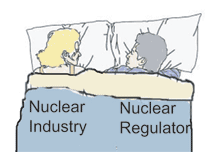
“I feel very uncomfortable with the ONR sending a letter to the government on behalf of the CEOs of the UK’s private nuclear industry.
I don’t believe that the regulator can have a shared purpose with the industry that it is regulating.“
New Civil Engineer 17 Nov, 2026 By Tom Pashby, https://www.newcivilengineer.com/latest/former-nuclear-chief-inspector-uncomfortable-with-letter-sent-to-chancellor-from-regulator-and-industry-ceos-17-11-2026/
A joint letter sent to chancellor John Healey on behalf of the newly formed UK Nuclear Industry CEO Forum, and signed by Office for Nuclear Regulation (ONR) chief executive and chief nuclear inspector Mike Finnerty, has made a former nuclear chief inspector “very uncomfortable”.
The letter, published by the Office for Nuclear Regulation (ONR) on 12 November, was sent on behalf of the Nuclear Industry CEO Forum, a new group, and marks “the first time industry and regulators have come together to respond collectively to the chancellor’s call for reform,” the ONR said.
It said existing regulation and approaches to delivery are “too slow and fragmented” to meet the “national needs” from the nuclear sector.
“The UK is entering the largest expansion and renewal of its nuclear sector in decades, but current regulatory and delivery approaches are too slow and fragmented to meet national needs,” the letter said.
“Unless pace, coordination and proportionality improve rapidly while maintaining safety, security and sustainability standards, the country risks an energy security gap, diminished defence capability, escalating costs, delayed hazard reduction and the loss of a once-in-a-generation economic opportunity.
“Urgent, system-wide reform is therefore required.”
It was signed by ONR chief executive and chief nuclear inspector Mike Finnerty and listed as being “On behalf of The UK Nuclear Industry CEO Forum”.
- AWE (the Atomic Weapons Establishment) Nuclear Security Technologies
- Babcock International Group, including Cavendish Nuclear
- BAE Systems Submarines
- Great British Energy – Nuclear
- NNB Genco (Hinkley Point C)
- Nuclear Decommissioning Authority
- Nuclear Restoration Services
- Rolls-Royce SMR (small modular reactor)
- Rolls-Royce Submarines
- Sellafield Ltd
- Sizewell C Ltd
- UK National Nuclear Laboratory
In a statement provided with the letter, Finnerty said: “A thriving nuclear sector relies on industry, government and regulators working together with trust and shared purpose, and this joint response shows that collaboration in action.
“This forum gives us a shared platform to learn from each other, build confidence in new ways of working, and hold ourselves collectively accountable for the pace and scale of change, while maintaining a safe and secure industry.”
The letter from the ONR was in response to the then chancellor Rachel Reeves’ letter titled ‘Implementing the nuclear regulatory taskforce review’ on 13 March.
“I am writing to you alongside the publication of the Government Response to the Nuclear Regulatory Taskforce led by John Fingleton,” Reeves said.
“This is a critical report in ensuring we work together to build the nuclear capacity we need at pace.
“It will require substantial change from government, from regulators and from industry at all levels of the supply chain. We will implement the measures we have outlined by December 2027.”
The letter from Reeves went on to say: “Please assess the way your organisation approaches risk management and challenge yourselves on whether those responsible for risk management are properly equipped and empowered to make proportionate judgements on acceptable risk, or if the location or mandate of those decision-makers should change.
It added: “The government has an active interest in the performance and speed of the system as a whole. Delay is not a neutral outcome; it carries its own risks.
“The government will support you in making prompt, well-reasoned, evidence-based decisions, including where those decisions involve managed risk.”
Since the letter was sent, the government changed the sponsor department of the ONR from the Department for Work and Pensions (DWP) to the Department for Energy Security and Net Zero (Desnz).
During an oral evidence session of the House of Lords Industry and Regulators Committee about the ONR on 22 July 2025, Baroness Jo Valentine asked why the DWP was the sponsor department.
She said: “DWP is your sponsoring department; I am surprised by that. Is that logical?”
ONR chair Nicola Crauford responded, saying: “One reason for that is probably partly historical. The ONR was originally part of the HSE (Health and Safety Executive), but we were split off from it; obviously, the HSE is part of the DWP.
“The other reason, I think, is to separate the policy arm from the sponsoring department and, in that way, to ensure the independence of the regulatory body.
“The DWP is not responsible for any activities in the nuclear sector, but DESNZ is and could potentially influence the regulator, hence the separation. That is what I understand; I might be wrong.”
ONR chief executive and chief nuclear inspector Mike Finnerty added: “That’s right.”
Following the July 2026 news that the sponsorship department was changing, Baroness Coffey asked the government “what safety protections are in place for the functioning independence of the Office for Nuclear Regulation after its transfer to the Department for Energy Security and Net Zero, recognising that as it is not a non-ministerial department, ministerial directions can be issued”.
Desnz parliamentary under-secretary of state Baroness Curran responded: “The Office for Nuclear Regulation was established under the Energy Act 2013 and will remain an independent public corporation. This change does not affect their statutory basis, legal powers or regulatory decisions.
“Ministers do not intervene on matters of regulatory decision-making. The extent to which Ministers can direct the ONR is set out in the Act and under Section 108 of that Act, any Ministerial direction is reported to Parliament on an annual basis.”
Reacting to the ONR’s 12 November letter, sent to the chancellor on behalf of the UK Nuclear Industry CEO Forum, former Health and Safety Executive (HSE) Nuclear Installations Inspectorate chief inspector Sam Harbison told NCE: “I feel very uncomfortable with the ONR sending a letter to the government on behalf of the CEOs of the UK’s private nuclear industry.
“I feel that it undermines the separation between promotion and regulation that is regarded internationally as the building block for ensuring safety in licensed nuclear activities.”
He added: “In Mike Finnerty’s comments, he refers to ‘industry, government and regulators working together with trust and shared purpose’. I don’t believe that the regulator can have a shared purpose with the industry that it is regulating.
“The regulator’s overriding purpose is to ensure that all the operations carried out under a nuclear licence are carried out safely and they must have the freedom to set whatever standards or conditions they deem necessary to achieve this objective.”
Responding to Harbison’s comments, an Office for Nuclear Regulation (ONR) spokesperson told NCE: “Our independence is a legal requirement, set out in the Energy Act 2013, whereas the Nuclear Industry CEO Forum letter was a response to the Chancellor’s request for the sector to address and report back on organisational culture following the Nuclear Regulatory Review.
“It does not alter ONR’s regulatory role. Each organisation within the Nuclear Industry CEO Forum has its own strategic objectives and priorities, and the common purpose is that each delivers its own priorities safely and securely.
The spokesperson continued: “ONR’s statutory purposes, legal powers and inspectors’ authority to challenge dutyholders, impose conditions and make final regulatory decisions are unchanged, and those decisions will continue to be made solely on the basis of safety, security and safeguards requirements.
“Being an independent regulator and an enabling regulator are not in conflict; ONR can help the sector work more efficiently while ensuring that the right standards of safety, security and safeguards are maintained.”
No comments yet.
1 This Month
Tell Congress: Prevent Nuclear Catastrophe in Iran

Tell Congress: Prevent Nuclear Catastrophe in Iran

Read the Public Inquiry Report, the Commissioners’ report, Surrendering Australia: The AUKUS Deception is available to download for free at aukuspublicinquiry.com. Or just watch the replay of the National Press Club Luncheon.


Shut down the radiation-damaged Heysham nuclear reactors now
To see nuclear-related stories in greater depth and intensity – go to https://nuclearinformation.wordpress.com

Say No to NASA’s Reckless Nuclear Reactor on the Moon
Say No to NASA’s Reckless Nuclear Reactor on the Moon
-
Archives
- November 2026 (202)
- October 2026 (302)
- September 2026 (339)
- August 2026 (330)
- July 2026 (355)
- June 2026 (287)
- May 2026 (306)
- April 2026 (356)
- March 2026 (251)
- February 2026 (267)
- January 2026 (308)
- December 2025 (358)
-
Categories
- 1
- 1 NUCLEAR ISSUES
- business and costs
- climate change
- culture and arts
- ENERGY
- environment
- health
- history
- indigenous issues
- Legal
- marketing of nuclear
- media
- opposition to nuclear
- PERSONAL STORIES
- politics
- politics international
- Religion and ethics
- safety
- secrets,lies and civil liberties
- spinbuster
- technology
- Uranium
- wastes
- weapons and war
- Women
- 2 WORLD
- ACTION
- AFRICA
- Atrocities
- AUSTRALIA
- Christina's notes
- Christina's themes
- culture and arts
- Events
- Fuk 2022
- Fuk 2023
- Fukushima 2017
- Fukushima 2018
- fukushima 2019
- Fukushima 2020
- Fukushima 2021
- general
- global warming
- Humour (God we need it)
- Nuclear
- RARE EARTHS
- Reference
- resources – print
- Resources -audiovicual
- Weekly Newsletter
- World
- World Nuclear
- YouTube
-
RSS
Entries RSS
Comments RSS


Leave a Reply