Canada’s budget fuels new nuclear power with billions but bypasses faster renewables
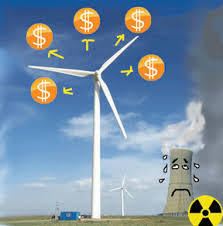
“You can build a wind farm in three-to-five years from FID [final investment decision] versus refurbishing a conventional [CANDU] power plant or building an SMR, which is unproven technology, in 15 years or more,”
Falling battery costs mean renewables paired with storage can deliver grid stability at a fraction of the cost and lead time of even five years ago, according to the International Energy Agency.
Darius Snieckus, Canada’sNational Observer, November 5th 2026
Canada’s 2026 budget commits more than $6.5 billion to nuclear power, underlining the government’s aim to make the technology the “cornerstone” of its clean electricity strategy.
Yet renewable energy could add capacity faster and more cheaply to increasingly strained provincial grids, analysts say.
The nuclear energy push, which builds on the sector strategy released in June, is part of $8 billion in capital spending on “electricity-related” projects over the next five years, according to the federal budget tabled Thursday.
Prime Minister Mark Carney’s second full budget also extends the investment tax credits (ITCs) program designed to pull in private investment into clean energy projects, at an expected cost of $38.5 billion by 2040.
The spending reflects a clear policy choice: nuclear-first, building on the federal nuclear energy strategy unveiled in June. The federal government’s wider national electricity strategy envisions $60 billion in support through 2035 across nuclear, wind, solar, storage and transmission.
But in direct, targeted capital commitments, Ottawa has placed its biggest bet on nuclear power with no standalone multi-billion-dollar allocation for wind, solar or storage.
Following the money
The list of federal and provincial nuclear projects highlighted in the budget include:
- $2.2 billion over 10 years for the Canadian Nuclear Laboratories at Chalk River, Ont., a nuclear research facility
- $970 million in Canada Infrastructure Bank financing for what would be North America’s first grid-scale small modular reactor (SMR) at Darlington, Ont.
- Up to $3 billion in equity from the Canada Growth Fund and Building Ontario Fund for construction of two new CANDU reactors in Romania.
- $74 million for a reactor being developed near Estevan, Saskatchewan by SaskPower, the provincial utility.
- $50 million for refurbishment work at Bruce Power’s Darlington nuclear complex
- $40 million for unspecified “microreactors.”
By comparison, the largest renewables budget item is $4 billion for grid expansion under the Smart Renewables and Electrification Pathways Program, on top of $4.5 billion previously committed.
There is no exclusive spending for wind, solar or battery storage, but renewables qualify for clean electricity and technology investment tax credits.
The Ontario Clean Air Alliance, a think tank, estimated the levellized cost of energy for nuclear power — the price of building and operating a plant over its lifetime divided by the revenues generated — could reach $226 per megawatt-hour (MWh) by 2030, versus $43/MWh for renewables such as wind and solar.
‘Not a strong economic case’
Hadrian Mertins-Kirkwood, a climate and energy policy analyst, argues that favouring nuclear power over wind and solar risks slowing Canada’s energy transition due to the gap in construction timelines.
“You can build a wind farm in three-to-five years from FID [final investment decision] versus refurbishing a conventional [CANDU] power plant or building an SMR, which is unproven technology, in 15 years or more,” he told Canada’s National Observer.
Mertins-Kirkwood called the economic risk in nuclear power “daunting,” citing consultancy Power Advisory’s estimate that Ontario’s high-profile expansion plans could cost more than $220 billion by 2050. “So there’s not a strong economic case,” he said.
For decades, Ottawa’s case for nuclear power rested on its ability to supply reliable “baseload” power, the minimum electricity needed to meet demand over a given period. Rapid gains in energy storage technology are poking holes in that premise.
Falling battery costs mean renewables paired with storage can deliver grid stability at a fraction of the cost and lead time of even five years ago, according to the International Energy Agency.
“Now the batteries are so cheap, I think that in 10 years, the ideal of ‘baseload’ is not going to matter because we’ll just have batteries plus renewables and that’s stable and reliable enough,” Mertins-Kirkwood said, for a decentralized energy system.
Advocates of a renewables-led energy transition also stress the industrial upside.
The Canadian Renewable Energy Association and New Economy Canada have projected around $100 billion in market opportunities for the domestic cleantech supply chain over the next decade.
The government’s own figures suggest a rapid electrification of provincial grids could add $3 trillion to the economy, create 1.6 million jobs, and yield $5 in economic benefits for every $1 invested by 2050.
That buildout of zero-emission power generation and clean manufacturing capacity would be faster than the longer timelines for complex nuclear projects.
The government’s national electricity strategy masks further contradictions in its simultaneous pursuit of conventional and clean energy generation.
Gas stays in the mix…………………………………………………………………………………………………………………………………………………………… https://www.nationalobserver.com/2026/11/05/news/canadas-budget-fuels-new-nuclear-power-billions-bypasses-faster-renewables?utm_source=Canada%27s+National+Observer&utm_campaign=7973a13254-EMAIL_CAMPAIGN_2026_11_06_09_23&utm_medium=email&utm_term=0_cacd0f141f-7973a13254-254417297
.
No comments yet.
1 This Month

Tell Congress: Prevent Nuclear Catastrophe in Iran

Tell Congress: Prevent Nuclear Catastrophe in Iran

Read the Public Inquiry Report, the Commissioners’ report, Surrendering Australia: The AUKUS Deception is available to download for free at aukuspublicinquiry.com. Or just watch the replay of the National Press Club Luncheon.

19 November – Webinar – The Reality of Reprocessing
Time: 11:00 AM Pacific Time (US & Canada) / 2:00 PM Eastern / 7:00 PM UK / 8:00 PM CET
Register for the Zoom Event Here


Shut down the radiation-damaged Heysham nuclear reactors now
To see nuclear-related stories in greater depth and intensity – go to https://nuclearinformation.wordpress.com

Say No to NASA’s Reckless Nuclear Reactor on the Moon
Say No to NASA’s Reckless Nuclear Reactor on the Moon
-
Archives
- November 2026 (147)
- October 2026 (302)
- September 2026 (339)
- August 2026 (330)
- July 2026 (355)
- June 2026 (287)
- May 2026 (306)
- April 2026 (356)
- March 2026 (251)
- February 2026 (267)
- January 2026 (308)
- December 2025 (358)
-
Categories
- 1
- 1 NUCLEAR ISSUES
- business and costs
- climate change
- culture and arts
- ENERGY
- environment
- health
- history
- indigenous issues
- Legal
- marketing of nuclear
- media
- opposition to nuclear
- PERSONAL STORIES
- politics
- politics international
- Religion and ethics
- safety
- secrets,lies and civil liberties
- spinbuster
- technology
- Uranium
- wastes
- weapons and war
- Women
- 2 WORLD
- ACTION
- AFRICA
- Atrocities
- AUSTRALIA
- Christina's notes
- Christina's themes
- culture and arts
- Events
- Fuk 2022
- Fuk 2023
- Fukushima 2017
- Fukushima 2018
- fukushima 2019
- Fukushima 2020
- Fukushima 2021
- general
- global warming
- Humour (God we need it)
- Nuclear
- RARE EARTHS
- Reference
- resources – print
- Resources -audiovicual
- Weekly Newsletter
- World
- World Nuclear
- YouTube
-
RSS
Entries RSS
Comments RSS


Leave a Reply