Zelensky wants another $175bn for 2027: Europe doesn’t have it
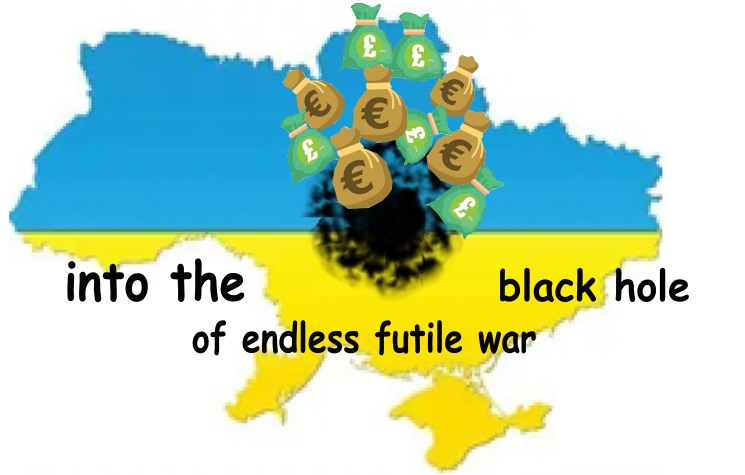
. Zelensky is now talking about a rise from roughly $100 billion to $155 billion next year. The EU is already cutting education and social programmes to fund the present level
Meanwhile Ukraine’s own economy is already in advanced collapse.
A conversation with Ben Aris of BNE Intellinews
Ian Proud, Nov 06, 2026, https://thepeacemonger.substack.com/p/zelensky-wants-another-175bn-for?utm_source=post-email-title&publication_id=3221990&post_id=223752719&utm_campaign=email-post-title&isFreemail=true&r=1ise1&triedRedirect=true&utm_medium=email
Zelensky’s latest demand for yet more money collides with two hard realities: Europe does not have it, and Russia continues to outproduce the West in the munitions that decide late-stage industrial wars. ben aris of bne IntelliNews, whose recent analysis of defence production costs cuts should provide a cold shower to those who cling to the hope that the arithmetic of war will eventually turn in Ukraine’s favour.
Nominal Russian defence spending is about $210 billion against America’s near-trillion. On purchasing-power terms the gap narrows to roughly 60 per cent. Once you price the actual outputs—$1,000 for a Russian 155 mm shell versus $4,000 for its American counterpart—the effective capacity closes further. Artillery, missiles and especially drones are where the disparity bites. Russia has scaled cheap, mass-produced systems; the West still fields small numbers of expensive platforms such as the MQ-9 Reaper at $30 million apiece. Trump’s instruction to double interceptor production has been met with timelines stretching to 2030. Ukraine cannot wait that long.
Europe’s fiscal position makes the gap unbridgeable in the short term. Zelensky is now talking about a rise from roughly $100 billion to $155 billion next year. The EU is already cutting education and social programmes to fund the present level; demonstrations in Berlin are the visible result. Debt ratios in France, Italy and the UK leave little room for further borrowing, and Germany’s relative strength won’t help it convince and increasingly anti-war public. Globalisation has hollowed out the industrial base that would be needed for a rapid wartime surge to bring the nations of Europe on a par with Russia. Turning car plants into tank factories smacks of panic production.
Meanwhile Ukraine’s own economy is already in advanced collapse. Metals production, a pre-war export mainstay, has fallen to zero. Grain shipments through Odessa are repeatedly interrupted, with stocks rotting in fields and silos. The power grid is being systematically dismantled at the substation level; Kyiv has gone dark and three remaining nuclear plants cannot feed a grid whose connections are being destroyed. Debt has crossed 100 per cent of GDP. Trade deficits with the EU have widened sharply as tariff exemptions lapsed and weapons purchases were added to the import bill. Demographics are worse still: millions of women and children have left and show little incentive to return to a ruined economy and a generation of missing men.
These facts render the usual political slogans—“Ukraine must win,” “EU membership is the destination”—impractical. Full membership of the EU for Ukraine will never happen precisely because it would expose the Common Agricultural Policy to Ukrainian volumes that, on present rules, could cost the EU budget on the order of $186 billion a year. That is far more than the yearly sums tipped into the proxy-war effort thus far. As I have said many times, that helps to explain why the Eurocrats keeping kicking the war can down the road.
Net recipients of EU budget support such as Poland and Hungary would become net contributors and would veto. On which, I wrote about this over two years ago for Responsible Statecraft…. A watered-down association agreement is the more realistic commercial outcome for Ukraine; the ability to trade with all nations including Russia, neutrality and limited armed forces remain the political terms Moscow has repeated since 2022.
Late-stage wars are settled by who can put more metal in the air and on the ground. Russia has been doing that since the first months; the West’s production response has a multi-year lag built in. Europe’s public finances and Ukraine’s residual economy cannot wait that long.
The rational course is therefore a negotiated settlement that freezes the line, limits force levels and restores trade, before the remaining productive capacity and population base of Ukraine disappear entirely. The alternative is a rump state whose reconstruction costs will still fall, in large part, on the same European treasuries that are already running out of money.
No comments yet.
1 This Month

Read the Public Inquiry Report, the Commissioners’ report, Surrendering Australia: The AUKUS Deception is available to download for free at aukuspublicinquiry.com. Or just watch the replay of the National Press Club Luncheon.


19 November – Webinar – The Reality of Reprocessing
Time: 11:00 AM Pacific Time (US & Canada) / 2:00 PM Eastern / 7:00 PM UK / 8:00 PM CET
Register for the Zoom Event Here



Shut down the radiation-damaged Heysham nuclear reactors now
To see nuclear-related stories in greater depth and intensity – go to https://nuclearinformation.wordpress.com

Say No to NASA’s Reckless Nuclear Reactor on the Moon
Say No to NASA’s Reckless Nuclear Reactor on the Moon
-
Archives
- November 2026 (94)
- October 2026 (302)
- September 2026 (339)
- August 2026 (330)
- July 2026 (355)
- June 2026 (287)
- May 2026 (306)
- April 2026 (356)
- March 2026 (251)
- February 2026 (267)
- January 2026 (308)
- December 2025 (358)
-
Categories
- 1
- 1 NUCLEAR ISSUES
- business and costs
- climate change
- culture and arts
- ENERGY
- environment
- health
- history
- indigenous issues
- Legal
- marketing of nuclear
- media
- opposition to nuclear
- PERSONAL STORIES
- politics
- politics international
- Religion and ethics
- safety
- secrets,lies and civil liberties
- spinbuster
- technology
- Uranium
- wastes
- weapons and war
- Women
- 2 WORLD
- ACTION
- AFRICA
- Atrocities
- AUSTRALIA
- Christina's notes
- Christina's themes
- culture and arts
- Events
- Fuk 2022
- Fuk 2023
- Fukushima 2017
- Fukushima 2018
- fukushima 2019
- Fukushima 2020
- Fukushima 2021
- general
- global warming
- Humour (God we need it)
- Nuclear
- RARE EARTHS
- Reference
- resources – print
- Resources -audiovicual
- Weekly Newsletter
- World
- World Nuclear
- YouTube
-
RSS
Entries RSS
Comments RSS


Leave a Reply