Zelensky wants another $175bn for 2027: Europe doesn’t have it

. Zelensky is now talking about a rise from roughly $100 billion to $155 billion next year. The EU is already cutting education and social programmes to fund the present level
Meanwhile Ukraine’s own economy is already in advanced collapse.
A conversation with Ben Aris of BNE Intellinews
Ian Proud, Nov 06, 2026, https://thepeacemonger.substack.com/p/zelensky-wants-another-175bn-for?utm_source=post-email-title&publication_id=3221990&post_id=223752719&utm_campaign=email-post-title&isFreemail=true&r=1ise1&triedRedirect=true&utm_medium=email
Zelensky’s latest demand for yet more money collides with two hard realities: Europe does not have it, and Russia continues to outproduce the West in the munitions that decide late-stage industrial wars. ben aris of bne IntelliNews, whose recent analysis of defence production costs cuts should provide a cold shower to those who cling to the hope that the arithmetic of war will eventually turn in Ukraine’s favour.
Nominal Russian defence spending is about $210 billion against America’s near-trillion. On purchasing-power terms the gap narrows to roughly 60 per cent. Once you price the actual outputs—$1,000 for a Russian 155 mm shell versus $4,000 for its American counterpart—the effective capacity closes further. Artillery, missiles and especially drones are where the disparity bites. Russia has scaled cheap, mass-produced systems; the West still fields small numbers of expensive platforms such as the MQ-9 Reaper at $30 million apiece. Trump’s instruction to double interceptor production has been met with timelines stretching to 2030. Ukraine cannot wait that long.
Europe’s fiscal position makes the gap unbridgeable in the short term. Zelensky is now talking about a rise from roughly $100 billion to $155 billion next year. The EU is already cutting education and social programmes to fund the present level; demonstrations in Berlin are the visible result. Debt ratios in France, Italy and the UK leave little room for further borrowing, and Germany’s relative strength won’t help it convince and increasingly anti-war public. Globalisation has hollowed out the industrial base that would be needed for a rapid wartime surge to bring the nations of Europe on a par with Russia. Turning car plants into tank factories smacks of panic production.
Meanwhile Ukraine’s own economy is already in advanced collapse. Metals production, a pre-war export mainstay, has fallen to zero. Grain shipments through Odessa are repeatedly interrupted, with stocks rotting in fields and silos. The power grid is being systematically dismantled at the substation level; Kyiv has gone dark and three remaining nuclear plants cannot feed a grid whose connections are being destroyed. Debt has crossed 100 per cent of GDP. Trade deficits with the EU have widened sharply as tariff exemptions lapsed and weapons purchases were added to the import bill. Demographics are worse still: millions of women and children have left and show little incentive to return to a ruined economy and a generation of missing men.
These facts render the usual political slogans—“Ukraine must win,” “EU membership is the destination”—impractical. Full membership of the EU for Ukraine will never happen precisely because it would expose the Common Agricultural Policy to Ukrainian volumes that, on present rules, could cost the EU budget on the order of $186 billion a year. That is far more than the yearly sums tipped into the proxy-war effort thus far. As I have said many times, that helps to explain why the Eurocrats keeping kicking the war can down the road.
Net recipients of EU budget support such as Poland and Hungary would become net contributors and would veto. On which, I wrote about this over two years ago for Responsible Statecraft…. A watered-down association agreement is the more realistic commercial outcome for Ukraine; the ability to trade with all nations including Russia, neutrality and limited armed forces remain the political terms Moscow has repeated since 2022.
Late-stage wars are settled by who can put more metal in the air and on the ground. Russia has been doing that since the first months; the West’s production response has a multi-year lag built in. Europe’s public finances and Ukraine’s residual economy cannot wait that long.
The rational course is therefore a negotiated settlement that freezes the line, limits force levels and restores trade, before the remaining productive capacity and population base of Ukraine disappear entirely. The alternative is a rump state whose reconstruction costs will still fall, in large part, on the same European treasuries that are already running out of money.
Media Obscure Enormity of Trump Corruption

The second Trump administration is far more corrupt than Trump’s first administration, and stands out as the most corrupt administration in history. Trump has made no qualms about the fact that he is going to exploit his position as president for self-enrichment. In fact, he has said that he was a fool in his first term for overlooking the opportunities for self-enrichment, given the president’s exemption from the conflict of interest law (18 USC 208).
Julie Hollar, November 5, 2026, https://fair.org/home/media-obscure-enormity-of-trump-corruption/
Particularly since the Citizens United ruling, US politics has been awash in corporate and billionaire money, with both parties taking gobs of cash from corporations that have direct interests in government policies. But President Donald Trump has taken corruption to new and breathtakingly bold levels.
“I have never seen such open corruption in any modern government anywhere,” said Harvard professor of government Steven Levitsky (Guardian, 6/17/25).
So, it’s probably not surprising to hear CNN (10/21/26) report that voters are increasingly “concerned about corruption,” ranking it only after the economy and the cost of living as a top concern. In a Gallup poll (9/2/26), a record-high 89% of respondents said they believe corruption is “widespread throughout the government in this country.”
But what might be surprising is that, according to a recent NBC poll (10/18/26), a majority (56%) say corruption “is equally a problem among elected officials in both parties.” (Among those who find it worse in one party or the other, 25% point to Republicans and 17% point to Democrats.)
Why would a majority of the public believe that Republicans and Democrats are equally corrupt? A FAIR study suggests that media play no small role: The US media system has given more coverage to the most prominent allegations of corruption under Biden than to those under Trump.
‘The most corrupt administration in history’
During his first term, Trump refused to divest from his business interests, raking in millions through them from foreign governments and people with interests before his administration. His solicitation of Ukrainian intervention in the 2020 presidential campaign led to his first impeachment trial.
After the GOP-controlled Senate (with Mitt Romney as the sole Republican exception) voted to acquit him—and after the Supreme Court ruling granting the president impunity for virtually anything done in office—Trump unsurprisingly entered his second term with far greater boldness. He essentially operated a pay-to-play administration that engages in regular shakedowns of major corporations and offers pardons to those with political or financial ties to him.
There have been repeated accusations of insider trading under his administration. Trump made $1.4 billion from the cryptocurrency industry in 2025 alone, including $635 million from his $TRUMP memecoin, which was gobbled up by not only true believers but also those seeking political favors. (While Trump profited from fees on trade activity, investors have lost a total of $3.8 billion because of the memecoin’s unsurprising collapse.) In perhaps the most brazen incident of corruption, Trump accepted a Boeing luxury jet worth an estimated $400 million from the Qatari government to use—after spending hundreds of millions of taxpayer dollars on security upgrades—as his presidential plane.
Craig Holman of Public Citizen told FAIR:
The second Trump administration is far more corrupt than Trump’s first administration, and stands out as the most corrupt administration in history. Trump has made no qualms about the fact that he is going to exploit his position as president for self-enrichment. In fact, he has said that he was a fool in his first term for overlooking the opportunities for self-enrichment, given the president’s exemption from the conflict of interest law (18 USC 208).
The corruption is led by Trump, but it’s been enabled by his party since their first impeachment acquittal. In Trump’s second term, the Republican-controlled Congress has refused to investigate any of the corruption scandals, implement stronger ethical standards, or include safeguards in cryptocurrency regulation to prevent Trump (and other political officials) from profiting off it.
Unequal allegations
During Joe Biden’s election campaigns and presidency, the GOP attempted to paint the former vice president as the pinnacle of corruption. When they took control in 2023, House Republicans launched an oversight committee investigation into the Biden family’s foreign business dealings during his vice presidency. They found that relatives and associates took in a total of $10 million from foreign companies during his tenure, but despite months of investigation, involving interviews and thousands of documents, the committee provided no evidence of Biden’s knowledge or influence. (It did lead to an unsuccessful impeachment inquiry.)
As perhaps the most memorable story in the right’s campaign to make the Biden family known as the “Biden Crime Family,” readers will be familiar with Hunter Biden’s famous laptop, which purportedly contained evidence of corruption on the part of his father. First published by the New York Post (10/14/20) just weeks before the 2020 election, the laptop story was pushed by the right for years and even continues to this day, despite its failure to show any actual evidence of corruption.
So on the one hand we have unsubstantiated stories of Biden family corruption, totaling $10 million in alleged graft, and on the other, we have stories of Trump corruption that total in the billions, some of which will be hard to legally prove Trump’s direct involvement (insider trading) and others in which Trump isn’t even trying to hide his self-enrichment (most of the rest, including the Qatari jet).
If the US had a media ecosystem in which those stories received attention relative to their importance, it wouldn’t even be close: Trump corruption coverage would overwhelm that of Biden.
The laptop and the ‘crime family’
In the distorted media ecosystem we are subjected to, reality is reversed. FAIR searched Media Cloud’s US–National dataset, which indexes 246 online outlets including all major corporate outlets, as well as right-wing sources like Daily Caller and left-wing sources like the Intercept, to compare attention to the two prominent Biden stories and two of the most prominent Trump stories.
When the New York Post (10/14/20) “broke” the Hunter Biden laptop story, it prompted a huge spike of attention that has never fully gone away. Coverage increased in spring of 2022, when outlets like the New York Times (3/16/22) and Washington Post (3/30/22) published pieces that helped revive it; coverage became particularly intense the next year, which saw the GOP inquiry and the Justice Department criminal investigation.
FAIR’s search found a total of 12,161 stories that mentioned “Hunter Biden” and “laptop” from the Post story’s publication through Biden’s withdrawal from the 2024 race (10/14/20-7/21/24). Right-wing outlets led the way, but MediaCloud showed even centrist outlets like the New York Times, Washington Post, USA Today and Newsweek in the top 20 outlets in terms of volume of coverage.
Coverage of the GOP investigation into Biden’s alleged “crime family,” which began in January 2023 and was led by House Oversight Committee chair James Comer (R–Ky.), drew similarly high averages and peaks of coverage, and also largely petered out after Biden’s withdrawal from the presidential race (1/1/23–7/21/24). In that year and a half, MediaCloud recorded 4,887 stories mentioning “Comer” and “Biden” and “family.”
Not all of these stories necessarily accused Biden of corruption; some centrist reports did work to debunk the false right-wing claims. But those big centrist outlets published enough prominent stories with murky headlines like “Biden Faces Conflict of Interest Questions That Are Being Promoted by Trump and Allies” (New York Times, 5/1/19), or explaining that the Hunter Biden case throws a “new wrench” in “the 2024 election” because “Democrats will have a harder time highlighting Trump’s indictments,” to muddy the narrative and legitimize the GOP accusations (see, e.g., CJR, 10/29/19; Press Watch, 8/14/23).
The Qatari jet and insider trading
Compare the quantity of these Biden corruption stories to coverage of the Qatari jet, a story that broke on May 11, 2025, and continued as Trump poured taxpayer dollars into its security upgrades. In the nearly year and a half from the story launch through the end of October 2026, the media produced 3,364 stories on the jet. That means that in approximately the same amount of time, media covered the investigation into Biden family corruption almost 1.5 times more than the Qatari jet. (Note that like the Biden stories, FAIR did not filter out jet stories that did not accuse Trump of corruption.)
Accusations of insider trading in Trump’s second term began in April 2025, when large call options were placed on the market shortly before Trump announced a 90-day pause on tariffs, sending the market soaring. They continued as more such suspicious and lucrative trades happened just before major Trump announcements on Venezuela and Iran, including within Trump’s personal holdings.
Coverage of Trump and insider trading from the first accusations (4/10/25) until the end of October 2026—a month longer than the Qatari jet coverage—has totaled 2,614 stories. The Biden family inquiry, at 4,887, got 1.9 times that amount.
Hunter Biden’s laptop, which dominated news headlines for longer, overwhelmed the Trump stories by far more. It got 4.7 times the coverage of insider trading under Trump and 3.6 times the coverage of Trump’s Qatari jet.
Even measuring them in terms of percentage of all news stories during their respective time periods, the Biden stories got far more coverage, with the family corruption story and the laptop story each averaging .10% of all content, while the Qatar jet averaged .06% and insider trading averaged .04%.
‘So vast as to be a new phenomenon’
This isn’t to say there’s no coverage of Trump’s corruption that attempts to put it into proper perspective. The New York Times editorial board () ran a lengthy editorial in January that tried to put a dollar amount to Trump’s self-enrichment just in the first year of his second term: $1,408,500,000.
The New Yorker (), looking a bit more broadly and including his first term, came up with a conservative total of $4 billion.
Times columnist Jamelle Bouie (4/22/26) wrote:
To say that President Trump is corrupt is to somehow understate the size, scope and magnitude of his corruption.
It is as if you were to describe a modern thermonuclear device as a “bomb.” That is true enough, but it is not quite the truth. It does not capture the nature of the thing in full.
So it goes for Trump’s corruption, which is so vast as to be a new phenomenon in American politics.
Yet, just as media factchecking falters under the sheer number of Trump’s lies, these isolated efforts at contextualization fall increasingly short as Trump’s corruption balloons to nearly unimaginable proportions. That’s especially true as most right-wing media outlets’ interest in corruption would appear to apply only to Democrats.
One of the most important jobs of any media outlet in a democracy is to hold those in power accountable. Democracy doesn’t work if the public doesn’t know or understand what’s happening in their government. As polling shows, people clearly care a great deal about government corruption, but if they have little sense of its mechanics, scale or worst perpetrators, they can’t easily address it. With the midterm elections suggesting a mandate for rooting it out, there’s no more critical time for journalists to step up and shine the line—brightly and consistently—on what our elected and unelected officials are doing to us.
Iranians prepare for fire, fury and nuclear fallout at Pickaxe Mountain
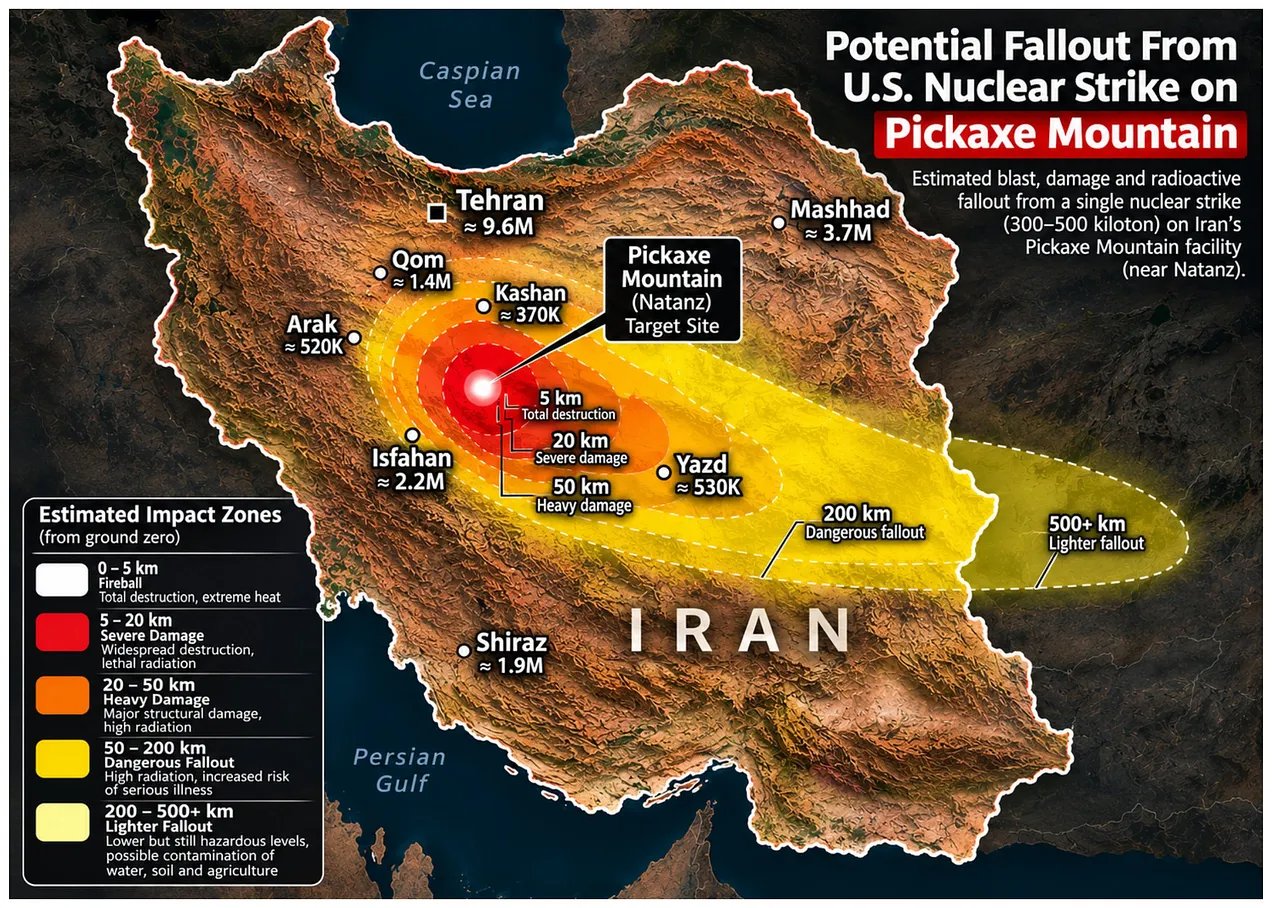
No one knows exactly what the underground facility is for but as Trump
debates renewed war, Tehran is giving out iodine tablets and survival
advice. or as long as the regime in Iran has kept the kind of secrets that
put it in the crosshairs of the regime in America,
it has buried them deep.
From Natanz to Fordow, Isfahan to Bushehr, the nuclear facilities we can
see are often matched by those that we cannot. Despite the constellation of
satellites examining every square foot of Iranian territory and the best
efforts of intelligence agencies in the US and Israel, nobody can quite say
exactly what is going on at Kuh-e Kolang Gaz La, the complex hewn from
granite known as Pickaxe Mountain.
That it exists is beyond doubt.
Satellite photos cited by President Trump prove that much. But not much
more is known, even to the vast majority of Iranians. This week, though,
that has started to change. A video being shared on Iranian social media
illustrates how the regime is increasingly concerned that Trump will order
a strike on Pickaxe, where the Ayatollah’s best nuclear scientists are
now rumoured to be working. A little over a mile south of the Natanz
uranium-enrichment complex in central Iran, the complex is believed to be
beyond the reach of conventional weapons.
Times 6th Nov 2026, https://www.thetimes.com/world/middle-east/article/iranians-prepare-us-nuclear-attack-pickaxe-mountain-9grz5mznq
The nuclear waste repository in Finland designed to outlast modern civilisation – how exactly have the engineers future-proofed their facility?

The first engineered structure built to last for 100,000 years is about to begin operations. The hope is that Onkalo, deep below ground in Finland, will offer a safe place for the country to store nuclear waste?
By George Bass and Jacklin Kwan,, New Scientist 3rd Nov 2026
There’s a timeless quality to the tunnels at Onkalo. And that’s the point. Carved into the rock more than 400 metres below ground, these passageways are part of a facility built for the long term. The extreme long term.
In fact, facilities such as Onkalo “should exist intact for at least 100,000, if not a million years”, says Allison Macfarlane at the University of British Columbia in Canada, who previously served as chair of the Nuclear Regulatory Commission in the US. “Those are geologic timescales.”
Onkalo is Finland’s answer to one of the more tricky questions posed by nuclear power: what do you do with the waste? We are going to have to get much better at answering it, given nuclear power is expanding again, driven partly by the hunt for low-carbon energy.
There’s broad consensus that burying the waste is the best option. But there is a catch. Radioactive elements can remain dangerous on timescales that make normal engineering look absurdly short-term. Egypt’s Great Pyramid of Giza is around 4500 years old. Some nuclear repositories will have to contain their contents for more than 20 times longer. Before the waste becomes harmless, civilisations may rise and fall, and ice sheets may come and go.
An earlier attempt to store waste on geological timescales failed spectacularly after just a few decades. The engineers at Onkalo, and at a handful of similar sites now being planned or built around the world, think they can do much better. So, as Onkalo prepares to accept its first waste shipments in the coming months, how exactly have the engineers future-proofed their facility?………………………………………. (Subscribers only) https://www.newscientist.com/article/2595321-the-nuclear-repository-in-finland-designed-to-outlast-modern-civilisation/
PETITION – Stop Japan’s Failed Nuclear Plant Waste Coming to Cumbria
November 2026, https://www.change.org/p/stop-japan-s-failed-nuclear-plant-wastes-coming-to-cumbria
We the undersigned demand that Cumberland Council put their constituents and neighbouring areas before the interests of the nuclear industry and halt the plan to bring volatile liquid sodium coolant to the Port of Workington from the failed Japanese Monju reactor.
Cumberland Council plans to import sodium coolant, a type of nuclear waste, thousands of miles from Japan to Cumbria, for processing at the Port of Workington, just 885m from Northside Primary School and nearby residential areas including many towns and villages. One of the best sites for birds in Cumbria, Siddick Ponds would be just 500 metres away.
Sodium coolant is extremely hazardous, and carries a high risk of violent explosion or fire if exposed to air or water.
It may also contain radioactive elements.
Further concerns include:
• Less than a mile from Northside Primary School, the proposed chemical plant is being designed to convert the hazardous coolant into caustic soda.
• Caustic soda is also a hazardous material and carries enormous risks to the environment including over decades if spilled.
• £4.5m of the Workington Town Deal government funding is being used to develop this site, despite the development planning to employ just 20 people over a period of 7 years.
• The Workington Town Deal was promoted as being for the public benefit, not for creating profit for a handful of private nuclear businesses.
• The £25m that the site construction phase is predicted to generate is meaningless compared to the certain risk our children and local environments would face as a result of the site’s operation and the £Billions that would likely be required for clean up following operation of this proposed chemical plant for Japan’s failed fast breeder nuclear reactor wastes.
Further Info
Japan’s prototype fast-breeder reactor (FBR), ‘Monju’, was a disaster from the start. It was shut down due to an accident less than 9 months after achieving criticality, and remained closed for 15 years. Reopening in 2008, a second accident closed it for good. Overall, Monju generated electricity for exactly one hour after achieving criticality in 1994 and will cost £Billions to decommission.
Fast breeder reactors use liquid metal as a coolant – usually liquid sodium, which violently explodes on contact with air and water. Dounreay, which ran the UK’s own Fast Breeder Reactors, processed the coolant onsite at both reactors. Sodium coolant at Dounreay did contain radioactive caesium.
Cumberland Council are partners in the plan to bring the Monju’s sodium coolant to the Port of Workington.
Ironically, ‘Monju’ was named to represent transcendent wisdom in Buddhist tradition. It has achieved neither wisdom nor its stated aim of electricity generation apart from one hour’s worth. Campaigners in Japan have been working to “Stop the Monju” for many years.
Despite only producing electricity for just one hour, the Monju has produced tonnes of chemical and radioactive waste some of which the operators the Japan Atomic Energy Agency now want to ship thousands of miles to Cumbria instead of dealing with in Japan. We say No!
We the undersigned demand that Cumberland Council put their constituents and neighbouring areas before the interests of the nuclear industry and halt the plan to bring volatile liquid sodium coolant to the Port of Workington from the failed Japanese Monju reactor.
For more info please see BRIEFING sent to all Cumberland Councillors
Artemis II launch tore a hole in Earth’s atmosphere, say scientists
The launch of Artemis II caused three distinct disturbances in Earth’s ionosphere
Iain Todd, : November 6, 2026, https://www.skyatnightmagazine.com/news/artemis-ii-launch-tore-a-hole-in-earth-atmosphere
NASA’s Artemis II mission caused enormous disturbances in Earth’s atmosphere that scientists say could have disrupted GPS and other communications.
The pre-print study by scientists from National Cheng Kung University in Taiwan found that disturbances created by the launch of the Artemis II rocket were stronger than those caused by any other rocket launches to date.
The team say the research could point to future problems caused by increasingly powerful rocket launches becoming more frequent.
A mission around the Moon
The Artemis II mission was arguably the biggest spaceflight story of 2026.
It launched on April 1, 2026, taking four astronauts on a 9-day journey around the Moon and back.
Artemis II travelled further beyond the Moon than any mission before it, using the Moon’s gravitational pull to slingshot around it and begin the journey back to Earth.
It was the first crewed mission to the Moon since the Apollo programme and marked a key stepping stone in NASA’s plans to establish a permanent human presence on the lunar surface.
A disturbance in Earth’s atmosphere
Yet despite the success of the Artemis II mission and its popularity, a pre-print study published in Geophysical Research Letters says that the launch of the Artemis II rocket and subsequent rocket burns caused three distinct disturbances in Earth’s ionosphere.
The ionosphere is the region of our atmosphere that reaches about 80–640 km (50–400 miles) above Earth’s surface.
It’s at the edge of space, marking the boundary between Earth’s lower atmosphere and the vacuum of the cosmos.
The first ‘disturbance’ caused by the Artemis II mission occurred during the rocket’s launch from Kennedy Space Center, generating shock-acoustic and gravity wave modulations.
But the next two upper-stage burns were much stronger than the initial liftoff.
An hour after launch, a second disturbance came via the ‘apogee raise burn’, which is an engine burn used to increase the Artemis II spacecraft’s altitude.
About 25 hours after lift-off, a third was caused by the ‘trans-lunar injection burn’, which is used to put the spacecraft on its journey towards the Moon.
That apogee raise burn “triggered shock waves and unprecedented large-scale disturbances that elongated 50° longitude across North America,” the study authors say.
“This is the first time a single space mission produced three instances of ionospheric disturbances over the same region during successive orbit manoeuvres.”
Rocket launches, GPS and self-driving cars
One of the key points made by the authors of this pre-print study is the effect that future rocket launches could have on technologies like GPS systems, drones and self-driving cars.
While they found that there was no widespread GPS disruption caused by the Artemis II lift-off itself, they did record changes in the ionosphere that could potentially cause problems during future rocket launches.
Such disturbances could disrupt communications on Earth by, for example, disturbing radio signals.
And rocket launches could affect other technologies on Earth that rely on GPS for positioning, such as self-driving cars and drones.
Read the full study at essopenarchive.org
Calogena awarded EU funding for SMR deployment – (nuclear loves socialism)

WNN, 6 November 2026
French small modular reactor developer Calogena has been awarded EUR40 million (USD44.6 million) through the European Commission’s Innovation Fund to support the potential construction of its first commercial nuclear reactor in Pierrelatte, in southern France…………………………………
The Innovation Fund is one of the world’s largest funding programmes for the deployment of innovative net-zero and low-carbon technologies. Established by Article 10a (8) of Directive 2003/87/EC to support innovation across all EU Member States, it is one of the key tools of the European Green Deal Industrial Plan. Financed by revenues from auctioning allowances from the European Union Emissions Trading System and with an estimated revenue of approximately EUR40 billion between 2020 and 2030, the Innovation Fund aims to help businesses invest in clean energy and bring technologies to market that can decarbonise European industry, while fostering its competitiveness…………………….
Calogena was selected in 2023 as part of the Innovative Nuclear Reactors call for projects under the aegis of the French government via the Secrétariat Général Pour l’Investissement, in order to support the development of nuclear technologies………………..
The Pierrelatte project could become Calogena’s first commercial reference and pave the way for deployment in other European towns and cities. The company is already involved in several projects outside France and is notably in contention to supply more than fifteen reactors in Finland.
…………………………………Calogena’s CAL30 is one of four SMR designs being evaluated by the French Nuclear Safety and Radiation Protection Authority. https://www.world-nuclear-news.org/articles/calogena-awarded-eu-funding-for-smr-deployment
Iran continues distributing anti-radiation iodine tablets in Bushehr amid regional tensions
Middle East Monitor 6th Nov 2026, https://www.middleeastmonitor.com/20261106-iran-continues-distributing-anti-radiation-iodine-tablets-in-bushehr-amid-regional-tensions/
Iranian health authorities have continued distributing iodine tablets to residents of the southern city of Bushehr, home to the country’s only operational nuclear power plant, as part of an emergency preparedness plan launched before the June 2025 war, the Young Journalists Club (YJC) news agency reported Friday.
The deputy head of Bushehr University of Medical Sciences for health affairs said the distribution initially prioritized areas surrounding the nuclear power plant before expanding to cover the entire city.
A total of 180,000 iodine tablets have been distributed under a decision by crisis management authorities, the official said.
The tablets remain available to residents at comprehensive health centers across Bushehr, according to the official.
The distribution program is limited to residents of Bushehr and is intended to protect against the absorption of radioactive iodine in the event of a nuclear or radiological incident…………………………………………………….
The announcement comes amid continued tensions between Iran and the US following the military offensive launched by Washington and Israel against Iran on Feb. 28.
US President Donald Trump warned on Nov. 1 that Washington could strike Iran’s remaining suspected nuclear facilities within 10 minutes, specifically mentioning Pickaxe Mountain, a suspected underground nuclear site.
Earlier, on Oct. 16, Trump ruled out using nuclear weapons against Iran while raising the possibility of further conventional strikes against suspected Iranian nuclear facilities.
Bushehr, located along Iran’s Gulf coast, hosts the country’s only operational nuclear power plant, making radiological emergency preparedness a particular concern for local authorities.
The iodine tablets protect the thyroid against radioactive iodine but do not provide protection against other radioactive substances or external radiation. https://www.middleeastmonitor.com/20261106-iran-continues-distributing-anti-radiation-iodine-tablets-in-bushehr-amid-regional-tensions/
U.S. Sleepwalks Into War In Space
Who regulates weapons in space? Who regulates the pollution?
Lisa Savage, Nov 07, 2026, https://went2thebridge.substack.com/p/us-sleepwalks-into-war-in-space?utm_source=post-email-title&publication_id=1580975&post_id=223756925&utm_campaign=email-post-title&isFreemail=true&r=c9zhh&triedRedirect=true&utm_medium=email
Meaningful oversight of the Pentagon and NASA’s militarization of space is non-existent. Now that they’ve admitted putting an offensive weapon into orbit, shouldn’t people be paying more attention?
Also a kindergartener could look at photos and tell you that rocket launches are very bad for the environment. Scientists can of course quantify how bad and in what specific ways: ozone depletion and a rain of toxic substances on the ground and in coastal waters. And that’s when things go as planned. Accidents, which are not at all rare, cause enormous additional emissions and debris.
That’s why we’ve maintained a presence outside the annual Maine Space Conference for the last few years.
Yesterday’s standout was discouraging. Only four of us showed up to the conference’s new location in a satellite office of Northeastern University in Portland’s Old Port.
Some conference attendees passed us on their way to lunch. Others stayed in and took delivery of pizza which I’m guessing was the private Hyde School that had sent a short bus to transport students from nearby Bath. We saw teenagers watching our protest from a balcony three stories above street level. Not sure what their school policy is on phones but I hope some observers — including an older man who was clearly filming us from the 2nd floor balcony — share their videos on social media.
The offices across the street from the Roux Institute/Northeastern also had people observing us from inside the building.
As a board member for the Global Network Against Weapons & Nuclear Power in Space I’m realizing I should publish an informational webinar about the environmental harms of space programs. Stay tuned for that! If you find it useful, maybe you will share it with others.
as for the dangers of war in space, go here to the GN website to find lots of solid information about that.
Canada Budget Commits C$518 Million To Ambitious Nuclear Energy Strategy
NUCNET, By David Dalton • 6 November 2026
Canada’s 2026 federal budget commits more than C$518.5m (€329m, $536m) to the country’s nuclear energy strategy as the government aims to make the technology the cornerstone of its clean electricity plans.
The nuclear energy push, which builds on the government’s nuclear energy strategy released in June, is part of C$8bn in capital spending on “electricity-related” projects over the next five years, according to the budget, tabled on 5 November.
Investing C$518.5m in the nuclear strategy will strengthen domestic supply chains and Canada’s position as a global energy superpower, a government statement said………………. (subscribers only) https://www.nucnet.org/news/canada-budget-commits-cusd518-million-to-ambitious-nuclear-energy-strategy-11-5-2026
“
1 This Month

Read the Public Inquiry Report, the Commissioners’ report, Surrendering Australia: The AUKUS Deception is available to download for free at aukuspublicinquiry.com. Or just watch the replay of the National Press Club Luncheon.


19 November – Webinar – The Reality of Reprocessing
Time: 11:00 AM Pacific Time (US & Canada) / 2:00 PM Eastern / 7:00 PM UK / 8:00 PM CET
Register for the Zoom Event Here



Shut down the radiation-damaged Heysham nuclear reactors now
To see nuclear-related stories in greater depth and intensity – go to https://nuclearinformation.wordpress.com

Say No to NASA’s Reckless Nuclear Reactor on the Moon
Say No to NASA’s Reckless Nuclear Reactor on the Moon
-
Archives
- November 2026 (94)
- October 2026 (302)
- September 2026 (339)
- August 2026 (330)
- July 2026 (355)
- June 2026 (287)
- May 2026 (306)
- April 2026 (356)
- March 2026 (251)
- February 2026 (267)
- January 2026 (308)
- December 2025 (358)
-
Categories
- 1
- 1 NUCLEAR ISSUES
- business and costs
- climate change
- culture and arts
- ENERGY
- environment
- health
- history
- indigenous issues
- Legal
- marketing of nuclear
- media
- opposition to nuclear
- PERSONAL STORIES
- politics
- politics international
- Religion and ethics
- safety
- secrets,lies and civil liberties
- spinbuster
- technology
- Uranium
- wastes
- weapons and war
- Women
- 2 WORLD
- ACTION
- AFRICA
- Atrocities
- AUSTRALIA
- Christina's notes
- Christina's themes
- culture and arts
- Events
- Fuk 2022
- Fuk 2023
- Fukushima 2017
- Fukushima 2018
- fukushima 2019
- Fukushima 2020
- Fukushima 2021
- general
- global warming
- Humour (God we need it)
- Nuclear
- RARE EARTHS
- Reference
- resources – print
- Resources -audiovicual
- Weekly Newsletter
- World
- World Nuclear
- YouTube
-
RSS
Entries RSS
Comments RSS

