‘UKRAINE’S DEFENCE IS OUR DEFENCE’ – NO, IT REALLY ISN’T
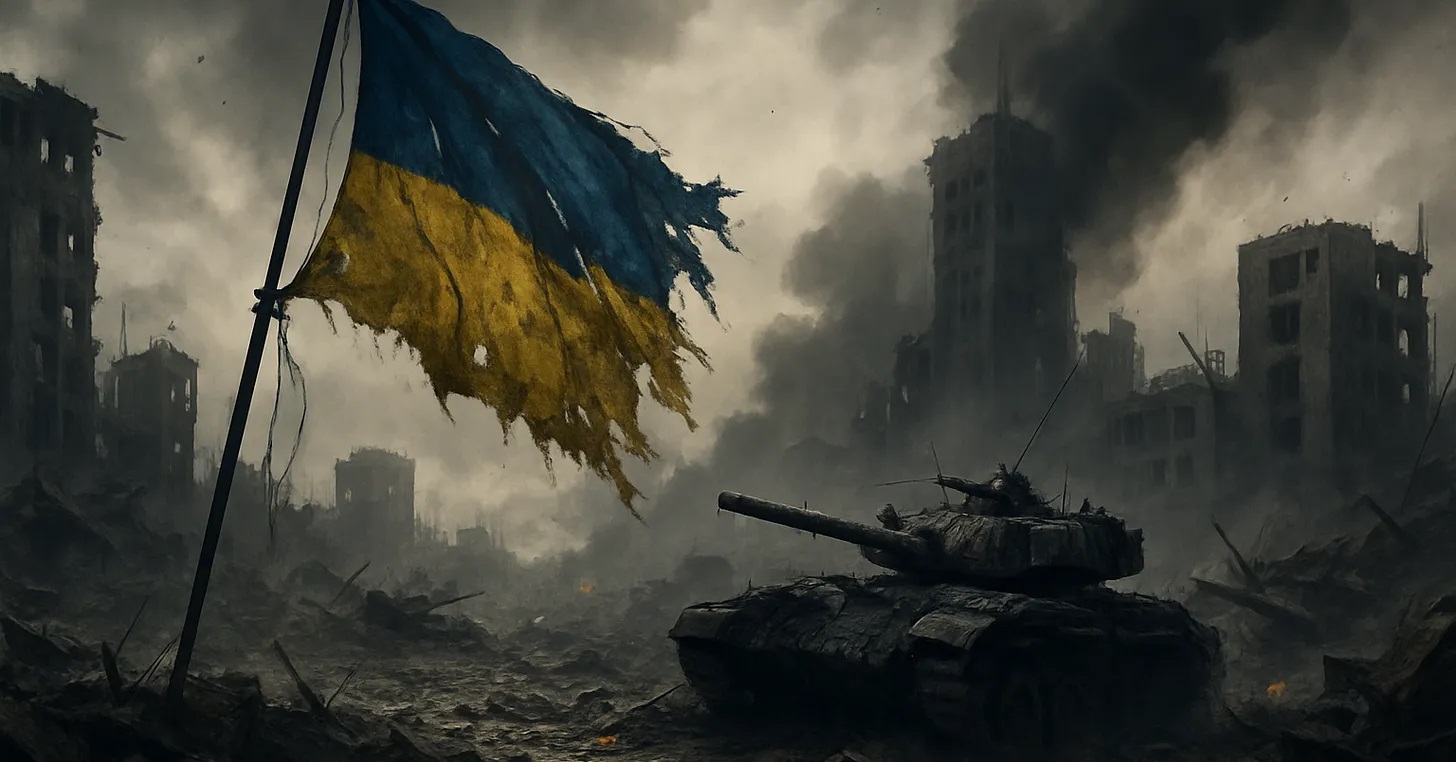
What is their evidence for saying that Russia threatens all democracies? Well, they don’t actually offer any, they simply take it is read, as a self-evident truth. But it isn’t..
any decision on an escalatory response would be ours.
Nato and/or the West, whichever you prefer, is supplying Ukrainians – geographically peripheral Europeans – with the wherewithal to fight and die for the cause of democracy in “our” Europe. This seems even to me, as a hard-bitten foreign policy realist, distasteful cynicism. How is that desirable. How is that morally right?
a devastated Ukraine will be at once a creature and a protectorate of the Europeans – at vast expense to European exchequers.
A contribution to the national and international debate we were promised, but haven’t had
Mary Dejevsky, Mary’s Substack, Oct 26, 202622
Mary’s Substack, Oct 26, 20262
If there is one line that riles me more than most in a war that has been replete with seductive soundbites, it is that “Ukraine’s defence is our defence”. Beloved by European and British politicians, this assertion rarely draws any public challenge, and my own dissent has so far been limited to a feeble ‘No it isn’t’ on social media. Recently, though, a trio of security luminaries has set out to explain why they think Ukraine’s defence is indeed our defence or, as put less pithily in their title, why they believe that “in helping Ukraine we are protecting ourselves”.
The three are Dr Greg Mills and Dr Karin von Hippel, both fellows at the London think-tank, the Royal United Services Institute, and Raimundo Robredo, described as a guest contributor. You can find their contribution – https://www.rusi.org/explore-our-research/publications/commentary/helping-ukraine-we-protect-ourselves – on the RUSI website, where, in common with all outside contributions, it carries a disclaimer to the effect that its publication here does not imply RUSI’s endorsement.
Mills et al, as I will refer to them from now on, couch their argument as a two-part answer to what they concede is a fair question being asked by Western governments and people alike: why should they keep sending billions of dollars to Ukraine; .what’s in it for us? They also invite a debate. So here is my opportunity.
Mills et al make their case in two parts. In the first, they argue that Russia poses a threat “to all democracies” and “not just to its immediate neighbours”. Hence everyone should pile in to support Ukraine and pre-empt this threat. In the second, they argue that what is also in it for us is the example that Ukraine has set, both in the military advancements it has pioneered and the strength of Ukrainians’ resilience, but also in the way they have stood up for moral values. This moral resistance cannot be allowed to fail, or we are all doomed.
Let’s look at the first argument more closely. What is their evidence for saying that Russia threatens all democracies? Well, they don’t actually offer any, they simply take it is read, as a self-evident truth. But it isn’t.
If they had tried to support it, I submit that their arguments might have included first, that Russia invaded democratic Georgia in 2008 (it didn’t; as found by an EU commissioned investigation, led by the Swiss diplomat, Heidi Tagliavini, which said Russia had responded to actions by the mercurial Georgian leader, Mikheil Saakashvili. And, second, that Russia’s 2014 annexation of Crimea and its 2022 invasion of Ukraine originated in the fear that the example of a thriving democracy next door might foment unrest in Russia. I don’t buy that argument either.
Russia lived peacefully alongside independent Ukraine through the 2004-5 Orange revolution and pursued normal relations with Ukraine after the election of a fiercely pro-Western President, Viktor Yushchenko. The difference between the Orange Revolution and Russia’s interventions in 2014 (the annexation of Crimea) and 2022 was not democracy, but Ukraine’s decision to abandon its constitutional neutrality and aim for membership of Nato. Insecurity, not democracy, was the trigger.
Then how about the specific charge that Russia threatens “all democracies”, not just its immediate neighbours…………………………………………………………………………………………………………………………………………………………………….
any decision on an escalatory response would be ours. And we could choose to stop baiting Russia, cease our own low-level, sub-kinetic, attacks, and keep out of – or withdraw from – what began in 2014 as a Ukrainian civil war, grew into a limited bilateral Ukraine-Russia conflict when Russia intervened in 2014 on behalf of the anti-Kyiv rebels, and threatened a wider war only when the US and Europeans weighed in on Ukraine’s side with ever more money, intelligence and powerful weapons.
It is not as though such an outcome was not envisaged. In 2014, then US President Barack Obama declined to supply lethal military aid to Ukraine for fear of just such an escalation. He understood that Ukraine was a “core national interest” for Russia, but not for the US, which should not go down a path that could lead to a US-Russia war.
The irony now is that, despite Ukraine not being a member of Nato, and despite its Nato aspirations having been placed on the back-burner at the 2008 Bucharest summit, thanks to the opposition of several allies, Ukraine is now the only country, ever, to be benefiting from military protection equivalent to Nato’s famed Article 5. This is a position, what is more, that Nato has meandered into without any of the consultation stipulated in the actual Article 5.
…………………………………………………………………………………….. What is happening is that, by giving Ukraine de facto Nato protection, we have not only assumed responsibility for Ukraine’s defence, but jeopardised our own by importing Ukraine’s insecurity. By supporting Ukraine militarily, we have eliminated what had been a buffer zone, and replaced it with a zone of potentially long-term instability on our eastern flank.
………………………………………In defending Ukraine, we are not protecting ourselves, far from it. We are exposing ourselves to a Russia threat that we have helped to bring into being by challenging what Obama understood was a core Russian interest.
If the first part of the case presented by Mills et al for Ukraine’s defence being our defence can at very least be contested, their second part, to me, makes even less sense, except in a world that does not, and has never, existed. Defending Ukraine is to defend ourselves because – to cut a long explanation short – Ukraine presents a superior form of warriors and war and one that we need to learn from.
At the practical level, Ukraine’s defence, they argue, is our defence, because we will benefit from the strides it has made in developing military equipment and tactics. These include its nimble approach to innovation, as well as its drones and all that.
Well, maybe. But, as a few sceptics are already noting – e.g. https://mwi.westpoint.edu/the-menace-of-misunderstanding-learning-the-wrong-lessons-from-ukraines-drone-saturated-battlefields/ – the applicability for Europeans of this Ukrainian model can be exaggerated. As in the past, our generals risk being seduced into fighting the last war. You might add that if European defence needs anything, it is less nimble entrepreneurialism than more cohesion and consolidation. Nor should it be neglected how quickly and effectively Russia has caught up both in drone technology and in satellite communications. Maybe the example we need to learn from is Russia’s?
………………………………………………………………………………………………………. Is it, to start close to home, really in the UK’s national interest to be spending so much on defending Ukraine? However much this and previous governments have tried to muddy the waters of spending on Ukraine, it cannot but eat into the resources that we might need to defend ourselves, or our actual allies, or even sustain living standards at home?
………….. the UK and the Europeans together simply do not possess either the moral or material clout that would be needed to recover Ukraine’s lost territory from Russia. In that respect, Ukraine’s defence cannot be our defence, because it is beyond our means, with or without taking account of the national interest.
Given this reality, our obligation should be to work with Ukraine to secure the best terms it can possibly get to end the war.
…………………………. Nato and/or the West, whichever you prefer, is supplying Ukrainians – geographically peripheral Europeans – with the wherewithal to fight and die for the cause of democracy in “our” Europe. This seems even to me, as a hard-bitten foreign policy realist, distasteful cynicism. How is that desirable. How is that morally right?
…………………………………………………………. a devastated Ukraine will be at once a creature and a protectorate of the Europeans – at vast expense to European exchequers.
……………………not a good return on all that we have invested in Ukraine’s defence so far, and seem intent on continuing “for as long as it takes”. https://marydejevsky.substack.com/p/ukraines-defence-is-our-defence-no2222222222222
No comments yet.
1 This Month



19 November – Webinar – The Reality of Reprocessing
Time: 11:00 AM Pacific Time (US & Canada) / 2:00 PM Eastern / 7:00 PM UK / 8:00 PM CET
Register for the Zoom Event Here



Shut down the radiation-damaged Heysham nuclear reactors now
To see nuclear-related stories in greater depth and intensity – go to https://nuclearinformation.wordpress.com

Say No to NASA’s Reckless Nuclear Reactor on the Moon
Say No to NASA’s Reckless Nuclear Reactor on the Moon
-
Archives
- November 2026 (62)
- October 2026 (302)
- September 2026 (339)
- August 2026 (330)
- July 2026 (355)
- June 2026 (287)
- May 2026 (306)
- April 2026 (356)
- March 2026 (251)
- February 2026 (267)
- January 2026 (308)
- December 2025 (358)
-
Categories
- 1
- 1 NUCLEAR ISSUES
- business and costs
- climate change
- culture and arts
- ENERGY
- environment
- health
- history
- indigenous issues
- Legal
- marketing of nuclear
- media
- opposition to nuclear
- PERSONAL STORIES
- politics
- politics international
- Religion and ethics
- safety
- secrets,lies and civil liberties
- spinbuster
- technology
- Uranium
- wastes
- weapons and war
- Women
- 2 WORLD
- ACTION
- AFRICA
- Atrocities
- AUSTRALIA
- Christina's notes
- Christina's themes
- culture and arts
- Events
- Fuk 2022
- Fuk 2023
- Fukushima 2017
- Fukushima 2018
- fukushima 2019
- Fukushima 2020
- Fukushima 2021
- general
- global warming
- Humour (God we need it)
- Nuclear
- RARE EARTHS
- Reference
- resources – print
- Resources -audiovicual
- Weekly Newsletter
- World
- World Nuclear
- YouTube
-
RSS
Entries RSS
Comments RSS


Leave a Reply