The trouble with small nuclear reactors
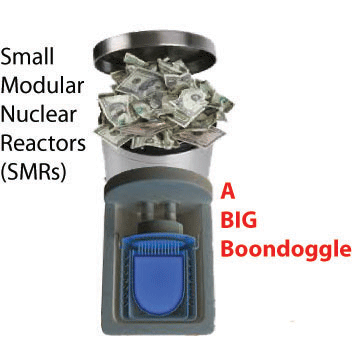
Proponents believe the technology is central to the AI data centre boom. Others think it is a waste of time and money.
In Darlington, Ontario, an expensive experiment is taking place.
Construction of the first of four small nuclear reactors, each around the
size of a football field, is under way. Connection to Canada’s grid is
planned for the end of the decade. One day, each reactor could power
300,000 homes. The project is meant to cost $15bn (C$21bn).
But critics do
not have much faith in that estimate. “This is a ‘first of its kind’
project and we don’t really know what it’s going to cost,” says Mark
Winfield, a professor in the environment faculty at Canada’s York
University. “The risks to ratepayers and taxpayers are enormous.”
The Darlington site is one of a handful of so-called small modular reactors
(SMRs) under construction that are being closely monitored by investors and
policymakers. Some believe the technology — essentially a scaled-down
version of a traditional nuclear reactor — is instrumental to the
cleantech revolution and the future of AI.
Others think SMRs are a colossal
waste of time — a distraction from cheaper, more efficient technologies.
The huge costs involved, they say, are unrealistic. And many designs rely
on fuel from hostile or rival states.
To date, billions of dollars, both
public and private, have flowed into SMRs. Last year, private capital
funding for the technology reached a record $2.9bn, according to PitchBook
data.
Proponents argue that the technology’s time has come. Unlike
renewables, nuclear produces a constant and reliable power stream that does
not need to be paired with battery storage. SMRs are also expected to be
quicker to build than conventional nuclear and take up less space.
In 2021, one SMR developer backed by Amazon, X-Energy, said that its demonstration
project would cost around $2.5bn, a figure that rose to almost $6bn in
2023. X-Energy declined to provide updated estimates but warned in June of
continued “price increases from our suppliers”.
FT 30th Oct 2026,
https://www.ft.com/content/da1af660-c1d0-4c8b-8f94-e84052344448
No comments yet.
1 This Month




Shut down the radiation-damaged Heysham nuclear reactors now
To see nuclear-related stories in greater depth and intensity – go to https://nuclearinformation.wordpress.com

Say No to NASA’s Reckless Nuclear Reactor on the Moon
Say No to NASA’s Reckless Nuclear Reactor on the Moon
-
Archives
- October 2026 (281)
- September 2026 (339)
- August 2026 (330)
- July 2026 (355)
- June 2026 (287)
- May 2026 (306)
- April 2026 (356)
- March 2026 (251)
- February 2026 (267)
- January 2026 (308)
- December 2025 (358)
- November 2025 (359)
-
Categories
- 1
- 1 NUCLEAR ISSUES
- business and costs
- climate change
- culture and arts
- ENERGY
- environment
- health
- history
- indigenous issues
- Legal
- marketing of nuclear
- media
- opposition to nuclear
- PERSONAL STORIES
- politics
- politics international
- Religion and ethics
- safety
- secrets,lies and civil liberties
- spinbuster
- technology
- Uranium
- wastes
- weapons and war
- Women
- 2 WORLD
- ACTION
- AFRICA
- Atrocities
- AUSTRALIA
- Christina's notes
- Christina's themes
- culture and arts
- Events
- Fuk 2022
- Fuk 2023
- Fukushima 2017
- Fukushima 2018
- fukushima 2019
- Fukushima 2020
- Fukushima 2021
- general
- global warming
- Humour (God we need it)
- Nuclear
- RARE EARTHS
- Reference
- resources – print
- Resources -audiovicual
- Weekly Newsletter
- World
- World Nuclear
- YouTube
-
RSS
Entries RSS
Comments RSS


Leave a Reply