Gap between renewables and nuclear widens
Renew Extra 24th Oct 2026,
Renewables outpace and overtake nuclear
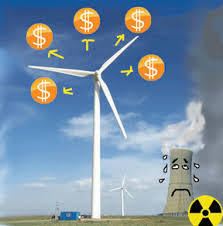
For the first time ever, in 2025 solar photovoltaics provided more electricity in the world than nuclear reactors. Adding wind turbines, these two renewable energy technologies generated more than twice as many kilowatt-hours than nuclear plants. And with solar and wind still expanding, solar in particular, and nuclear more or less static globally, the gap between nuclear and the main new renewable energy technologies is growing.
These are some of the findings of the World Nuclear Industry Status Report 2026, with Mycle Schneider, WNISR Coordinator and Publisher, saying: ‘It is remarkable to what extent public perception of the status of the nuclear sector fundamentally differs from industrial reality’. For example, he notes that China was ‘really the only country significantly expanding its nuclear program’, but it had actually added ‘120 times more solar megawatts than nuclear capacity in the past year.’ It also has a huge hydro capacity – much larger than its nuclear capacity.
While there has been a barrage of pro-nuclear propaganda of late, the WNIRS claims that ‘there have been no remarkable changes in nuclear industry trends: stagnation at best’. It notes that in 2025, ‘more reactors were closed than new ones started up; operating capacity was slightly down’; and while ‘nuclear power generation increased slightly on a global level’, it decreased outside China. Overall the nuclear share in the global electricity mix ‘has continued its decline’ ongoing since 1996. That is despite the Chinese expansion- and also Russia’s efforts to expand its nuclear technology sales globally.
Russia is certainly trying move ahead. Dmitry Gorchakov, a WNISR Contributing Author, noted that in 2025 it ‘increased enriched uranium exports to the EU, the US, and China’. But at the same time, ‘sanctions pressure on Russia has caused significant problems and delays for a number of Rosatom’s foreign projects including in Turkey and Hungary, even leading to a decline in its foreign revenue for the first time in a decade’.
So what next globally? Of late, the nuclear lobby has looked to the East to rescue nuclear from decline. However, although there are some new projects in Asia, notably in China, renewables are doing very much better there. For example, China’s solar and wind generation are now 5 times its nuclear generation. And it plans to push renewables very hard – its 2030 target is 3,500GW. Whereas its current target for nuclear is around 110GW by 2030, with WNISR saying that it ‘has fallen short of its ambitious nuclear construction targets in recent years’.
Earlier this year, the World Nuclear Association produced its own annual world nuclear outlook which saw nuclear expanding rapidly, to nearly 1 TW by 2050, mainly led by China and the USA. Well, even given that China is good at pushing technology fast these days, as noted above, that seems a bit of a stretch. The USA is a bit further ahead on nuclear, already at around 100 GW, but the prospects for very rapid expansion there seem even more limited than in China. WNISR notes that ‘it has been two years since a new reactor was connected to the grid and the US fleet continues to age, with a mid-2026 average of 44.7 years, making it amongst the oldest in the world’. It added, although there are plans, ‘there are no new reactors under construction in the US’. There is of course much talk in the US (and elsewhere) of small modular reactors, but WNISR notes that construction of one has only just started – in Canada. And even that now looks somewhat uncertain.
So, for the moment, in terms of nuclear expansion, all we are left with is the Chinese programme and a contribution from India. Although renewables are expanding faster there too – it now has two times more renewable capacity than nuclear. With the exception of Russia, which has hardly bothered with renewables, it’s the same for most places that have nuclear programmes, and especially the UK, where one new plant is under construction but renewables now supply 52% of its power, with the aim being to get to over 80% by 2030. It is always possible that there will be some new nuclear initiatives somewhere in the world. For example South Korea has surprisingly announced a major $120bn investment in large US nuclear plants. But, despite Trumps efforts to block wind projects, more backing for renewables is also possible there and elsewhere, and arguably is a better bet most places to meet power and also energy needs. And avoid climate change…………………………………………….
https://renewextraweekly.blogspot.com/2026/10/gap-between-renewables-and-nuclear.html
No comments yet.
1 This Month




Shut down the radiation-damaged Heysham nuclear reactors now
To see nuclear-related stories in greater depth and intensity – go to https://nuclearinformation.wordpress.com

Say No to NASA’s Reckless Nuclear Reactor on the Moon
Say No to NASA’s Reckless Nuclear Reactor on the Moon
-
Archives
- October 2026 (279)
- September 2026 (339)
- August 2026 (330)
- July 2026 (355)
- June 2026 (287)
- May 2026 (306)
- April 2026 (356)
- March 2026 (251)
- February 2026 (267)
- January 2026 (308)
- December 2025 (358)
- November 2025 (359)
-
Categories
- 1
- 1 NUCLEAR ISSUES
- business and costs
- climate change
- culture and arts
- ENERGY
- environment
- health
- history
- indigenous issues
- Legal
- marketing of nuclear
- media
- opposition to nuclear
- PERSONAL STORIES
- politics
- politics international
- Religion and ethics
- safety
- secrets,lies and civil liberties
- spinbuster
- technology
- Uranium
- wastes
- weapons and war
- Women
- 2 WORLD
- ACTION
- AFRICA
- Atrocities
- AUSTRALIA
- Christina's notes
- Christina's themes
- culture and arts
- Events
- Fuk 2022
- Fuk 2023
- Fukushima 2017
- Fukushima 2018
- fukushima 2019
- Fukushima 2020
- Fukushima 2021
- general
- global warming
- Humour (God we need it)
- Nuclear
- RARE EARTHS
- Reference
- resources – print
- Resources -audiovicual
- Weekly Newsletter
- World
- World Nuclear
- YouTube
-
RSS
Entries RSS
Comments RSS


Leave a Reply