The Day America Deleted a Word
A Pen, a Paper, and the End of “AI”
SinoDataCrit ( Kakajusaiyou ), Oct 04, 2026
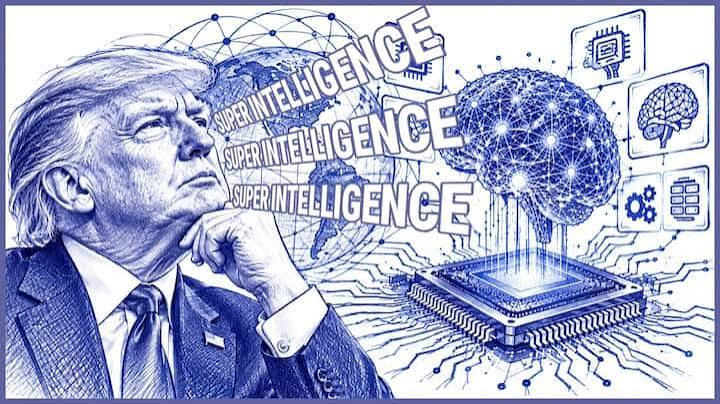
On September 29, 2026, President Trump signed an executive order requiring every federal department and agency to replace the term “Artificial Intelligence” (AI) with “Super Intelligence” (SI) in official correspondence, public communications, websites, reports, and all non-statutory documents.
The order didn’t just promote a new term. It buried the old one. The White House’s own fact sheet states that agencies should “no longer acknowledge the terms ‘Artificial Intelligence’ or ‘AI.’“ Read that again. Not “phase out.” Not “update.” No longer acknowledge.
The same day, the tech titans were summoned to the White House — Jeff Bezos, Elon Musk, Mark Zuckerberg, Jensen Huang, OpenAI president Greg Brockman, Palantir CEO Alex Karp. They signed the “White House Accord on Super Intelligence,” a voluntary safety pledge with no legal force, which Trump described as working “like a constitution.” Zuckerberg began using “Super Intelligence” in product announcements within 24 hours. The field that was born at Dartmouth College in 1956 had been renamed by executive fiat in 2026 — seventy years, almost to the season, after John McCarthy coined the term his own government now refuses to say.
The official rationale? A White House fact sheet titled “President Donald J. Trump Inaugurates The Era of Super Intelligence” argues that “artificial” implies merely “imitating or automating human intelligence,” while Super Intelligence “conveys the true capabilities” of the technology. Trump himself was blunter: the word “artificial” makes people think of fake.
There was, in fairness, a domestic political reason. A Quinnipiac poll in March 2026 found that 55% of American adults believe AI does more harm than good — up 11 percentage points in a single year. “Artificial intelligence” had become a toxic brand. Rebranding it “Super Intelligence” is, on one level, the world’s most expensive PR relaunch.
But if you think this is just marketing, you’re missing the oldest trick in the innovation empire. And it took a viral post on Chinese Q&A platform Zhihu — 4,700+ upvotes and climbing — to name the mechanism with perfect clarity. This article brings that analysis to an English audience, because it deserves one.
The Category Game: How “0-to-1” Is Manufactured
Start with a question that circulates endlessly in Western commentary: why do Chinese companies never seem to do “0-to-1” innovation?
Here’s the uncomfortable answer: “0-to-1” is not a fact. It’s a category decision — and categories can be gerrymandered.
The Zhihu analysis offers a thought experiment. Suppose a Chinese company invents the electric vehicle. A skeptic says: “That’s not 0-to-1. It’s a derivative of the car — a 1-to-100 improvement. Thank Karl Benz.” Fine — so what if the Chinese had invented the car itself? The skeptic zooms out: “That’s not 0-to-1 either. It’s a refinement of the wheel — a category humans have had for 4,000 years. Thank the ancients.”
See the mechanism? Expand the category far enough, and every invention becomes an increment. Whoever controls the category — whoever gets to decide whether “EV” is a new thing or a subset of “car” — controls whether your work counts as creation or derivation.
Now the flip side. How does anyone ever get credit for a 0-to-1? Not by building it. By naming it. A brand-new word — preferably one with a unique sound and no derivation from existing vocabulary — creates a brand-new category. And a new category has no ancestors. It pops into existence with its inventor standing at its head.
A new word doesn’t describe a new thing. It legislates a new thing into the ledger of human achievement.
Eponyms Are Property Deeds
Look at how English names its own inventions versus everyone else’s.
For its own breakthroughs, English mints eponyms — words with a founder’s name stamped on them like a trademark. Diesel, after Rudolf Diesel. Braille, after Louis Braille. The ballpoint pen that half the world calls a “biro,” after László Bíró. Every one of these is a property deed: the technology and the credit travel together, permanently, in a single syllable.
For everyone else’s breakthroughs, English does something different: it assimilates them into existing vocabulary as derivatives. Paper became “paper” — a word whose root is papyrus, the Egyptian writing reed. Gunpowder became “gunpowder” — a tidy English compound. China invented both; the English words quietly suggest both were variations on something the West already had.
The etymology does the theft silently. To an English speaker, papyrus is “an early, imperfect paper.” To a Chinese speaker, the relationship inverts: papyrus is just a reed that failed to become paper. Same history. Opposite property registry.
This is not a conspiracy. It’s a linguistic reflex — but it has the effect of a colonial land grab. The Zhihu author’s sharp observation: English borrows raw phonetics mainly from “prestige” languages it admires (French, Latin, Greek), or for “exotic, often derogatory” concepts (coolie, ramen). For ideas from civilizations it competes with, it prefers translation — because translation buries the original’s ownership inside a familiar word……………………………………………………………………………………………………..
The Modern Playbook: Metaverse, Sixth-Gen Fighters, DeepSeek
This machinery is not historical. It’s running right now, and you’ve watched it operate three times in recent years.
Metaverse. A word coined in a 1992 science fiction novel, adopted as a company name in 2021. Technologically, “the metaverse” contained nothing that virtual worlds hadn’t contained for two decades — no new architecture, no new interaction paradigm. But it had a minted word, a category nobody had to share with the past. ……………………………………………………………………………………………………………
Decoding SI: The Hedge Fund of Categories
Now the executive order makes complete sense.
The United States coined “artificial intelligence” in 1956. Its White House proudly asserts — correctly — that America is “the birthplace” of the field and has led it for “over 70 years.” That name, and that founding, is one of America’s greatest narrative assets: the entire global industry carries American words in its name.
But here’s the problem the White House faces in 2026: Chinese models have reached genuine parity — benchmark-for-benchmark, dollar-for-dollar the efficiency argument even favors China. If the race stays called “AI,” then the most likely outcome is that the “birthplace” gets out-innovated in its own category, on its own vocabulary. The founding nation would become the incumbent that lost its own field.
So instead of defending the old category, America redrew the map. Rename the category “Super Intelligence,” decree that the old name shall not be acknowledged — and instantly, every Chinese achievement in “AI” becomes progress in a field that no longer officially exists. Chinese labs will keep doing brilliant work in the old category: that’s a 1-to-100 story now, and America has already stamped itself at the “0” of the new one. Your AI is impressive; our SI is a different thing. You can never beat us at SI, because we invented the word, and the word is the race.
It’s the category game at national scale: when you can’t win the category, delete the category.
Notice the asymmetry of costs. DeepSeek’s efficiency breakthrough took years of engineering under sanctions. Huawei’s chip roadmap took seven years of siege economics. The SI rename took one pen. In narrative warfare, renaming is the cheapest weapon with the longest reach — it costs nothing and repositions everything.
And notice what the order does domestically, too. The same fact sheet announces $5 billion for a “Genesis Mission” and a “National Super Intelligence Policy Framework.” The unpopular, frightening “AI” — the one 55% of Americans distrust — quietly becomes somebody else’s legacy technology. The fear is inherited with the old word. The promise is minted with the new one.
The Counter-Move: China Is Learning to Mint Words
Here’s what makes this moment genuinely interesting, and why I’ve spent days on this question: China’s best answer isn’t to complain about the renaming. It’s to start minting categories of its own……………………………………………………………………………………………………… https://sinodatacrit.substack.com/p/the-day-america-deleted-a-word?publication_id=7110991&post_id=218751184&isFreemail=true&r=3alev&triedRedirect=true&utm_source=substack&utm_medium=email
No comments yet.
1 This Month





PLEASE OPPOSE HR 8255 AND S.3639 – bills would accelerate satellite deployment, with no environmental review or safeguards – https://ncstd5li.quorum.us/campaign/169331/
To see nuclear-related stories in greater depth and intensity – go to https://nuclearinformation.wordpress.com
-
Archives
- October 2026 (81)
- September 2026 (339)
- August 2026 (330)
- July 2026 (355)
- June 2026 (287)
- May 2026 (306)
- April 2026 (356)
- March 2026 (251)
- February 2026 (267)
- January 2026 (308)
- December 2025 (358)
- November 2025 (359)
-
Categories
- 1
- 1 NUCLEAR ISSUES
- business and costs
- climate change
- culture and arts
- ENERGY
- environment
- health
- history
- indigenous issues
- Legal
- marketing of nuclear
- media
- opposition to nuclear
- PERSONAL STORIES
- politics
- politics international
- Religion and ethics
- safety
- secrets,lies and civil liberties
- spinbuster
- technology
- Uranium
- wastes
- weapons and war
- Women
- 2 WORLD
- ACTION
- AFRICA
- Atrocities
- AUSTRALIA
- Christina's notes
- Christina's themes
- culture and arts
- Events
- Fuk 2022
- Fuk 2023
- Fukushima 2017
- Fukushima 2018
- fukushima 2019
- Fukushima 2020
- Fukushima 2021
- general
- global warming
- Humour (God we need it)
- Nuclear
- RARE EARTHS
- Reference
- resources – print
- Resources -audiovicual
- Weekly Newsletter
- World
- World Nuclear
- YouTube
-
RSS
Entries RSS
Comments RSS


Leave a comment