Russia’s nuclear plants are ageing. Who will pay to dismantle them?
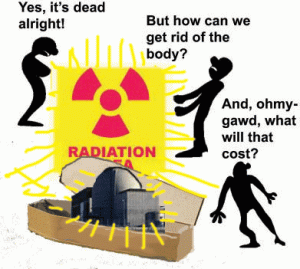
by around 2037, Rosatom’s decommissioning and remediation obligations could exceed its net profit. Moreover, the longer decommissioning is delayed, the greater the associated financial, technical and safety risks are likely to become.
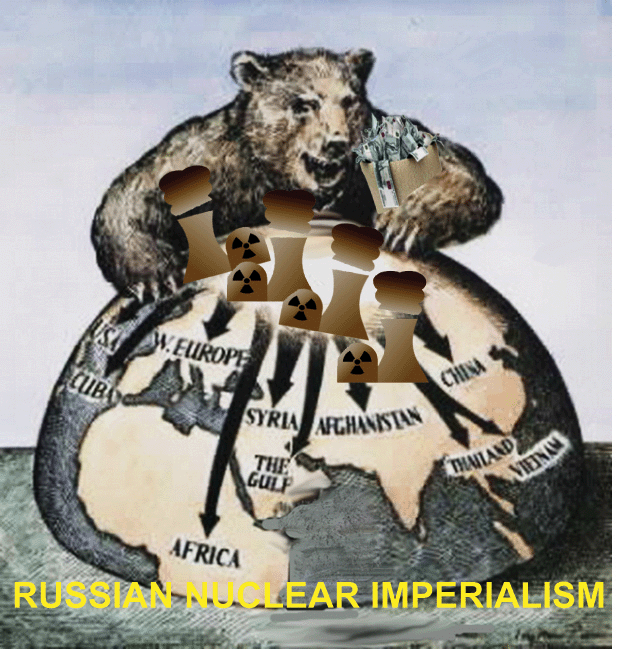
Moscow faces a huge decommissioning bill at home even as it expands its nuclear industry abroad.
By Arshak Makichyan, . 4 Oct 2026, https://www.aljazeera.com/opinions/2026/10/4/russias-nuclear-plants-are-ageing-who-will-pay-to-dismantle-them
The world often discusses the nuclear threat posed by Russia, but far less attention is paid to the nuclear risks within Russia itself, particularly those posed by ageing nuclear power plants, some of whose reactors are already more than 50 years old.
At the same time, Russia is building nuclear power plants around the world, from Turkiye to Bangladesh, while promoting nuclear energy as a “sustainable” alternative to fossil fuels. Russian President Vladimir Putin regularly meets with foreign leaders to discuss existing and potential nuclear projects. Yet one question remains largely overlooked: what happens to these nuclear facilities when they reach the end of their operational lives?
During the Soviet period, nuclear power plants were built across the USSR, including in Lithuania. As part of Lithuania’s accession to the European Union, the country was required to shut down the two Soviet-built reactors at the Ignalina Nuclear Power Plant. The first reactor was closed in 2004 and the second in 2009. The decommissioning process has proved both extraordinarily expensive and time-consuming. By 2020, the estimated cost had reached 3.3 billion euros ($3.7bn), with only 49 percent of the planned work completed. The process, initially scheduled for completion in 2038, is now expected to continue until 2049.
Russia itself does not seem to be paying much attention to this question. Rosenergoatom plans to decommission 35 reactors. Yet the company’s own estimates point to a funding shortfall of approximately 18.7 billion euros, while the total estimated cost of decommissioning is about 21 billion euros. And these are Rosenergoatom’s own estimates. Actual decommissioning costs are usually significantly higher than initially projected. For example, the cost of decommissioning the former nuclear power plant in Lubmin, Germany, was initially estimated at 1 billion euros but is now estimated at 10 billion euros.
For the time being, however, Russia appears to be postponing the most costly stages of decommissioning. Rather than fully dismantling reactors soon after shutdown, it often places them in long-term “safe” storage, transferring much of the financial and technical burden into the future. Deferred dismantling does not solve the problem, but merely postpones the costly stages of decommissioning, which is particularly concerning given Russia’s existing funding gap.
Environmental NGO Bellona Foundation reports, based on Rosatom’s own projections, that by around 2037, Rosatom’s decommissioning and remediation obligations could exceed its net profit. Moreover, the longer decommissioning is delayed, the greater the associated financial, technical and safety risks are likely to become.
Another major issue is the legacy of radioactive waste. Russia has inherited approximately 774,000 cubic metres of radioactive waste from the Soviet Union. The upcoming decommissioning of 36 reactor units at eight nuclear power plants is expected to generate an additional 800,000 cubic metres of radioactive waste.
Russia already has experience of what happens when industries leave major environmental liabilities behind. In the Kemerovo region, where around half of Russia’s coal is produced, mountains of waste from coal mining scar the landscape. Some of this waste burns, polluting nearby communities. When coal companies go bankrupt, the cost of dealing with what they leave behind can fall to the state and local communities.
But nuclear waste and decommissioned reactors cannot simply be abandoned if the money runs out. The question therefore becomes even more important as Russia’s economic situation deteriorates: what will happen to all these megaprojects if the money needed to maintain, decommission and eventually dismantle them is no longer available?
The countries where Russia is building its numerous nuclear power plants should therefore think about what happens if these projects cannot be maintained or later decommissioned as planned. They need a Plan B in case something goes wrong in Russia. And, as history has repeatedly shown, Russia’s political situation can change unpredictably.
The political consequences of nuclear mismanagement can also be significant. The Chornobyl disaster demonstrated how the Soviet authorities’ attempts to suppress information and downplay the scale of the accident fuelled public distrust and disillusionment, contributing to growing social and political unrest in the late Soviet period. Today, Russia’s continued neglect of nuclear waste and repeated postponement of nuclear plant decommissioning could similarly create conditions for both another environmental catastrophe and growing social unrest, particularly if authorities once again respond to such a crisis with silence or attempts to conceal its scale.
These risks are compounded by Russia’s deteriorating economic situation. In an effort to sustain the war economy, the Russian government has also drastically weakened environmental regulations. National defence is now by far the largest single item in Russia’s federal budget, while environmental protection accounts for only a small fraction of government spending.
Environmental disasters have repeatedly demonstrated that the Russian regime is unwilling to prioritise long-term environmental safety. Russia continues to operate an ageing shadow fleet to transport oil, and the environmental risks associated with that fleet were highlighted by the 2024 Black Sea oil spill, when two ageing Russian tankers released thousands of tonnes of fuel oil into the sea. The spill was described as the Black Sea region’s worst environmental disaster in decades. This broader pattern of environmental negligence raises questions about how the country will manage its ageing nuclear infrastructure and the growing problem of nuclear waste.
These issues should therefore be raised at every international forum where Russia promotes its nuclear industry, such as COPs, where encountering Russian nuclear lobbyists is a common experience. Russia is seeking to secure its place in the future of energy while continuing to use energy as a tool for exerting political influence and power around the world.
All of these issues are particularly concerning because Russia continues to promote its nuclear industry internationally, while independent voices capable of scrutinising its environmental impacts and safety record are increasingly silenced in Russia. As documented in a recent report by the Environmental Crisis Group, repression and the departure of environmental experts and activists have severely weakened Russia’s environmental movement.
Bellona and Greenpeace have been declared “undesirable” organisations in Russia, while EcoDefence, which organised campaigns around environmental and nuclear issues, has been designated a “foreign agent”, and its members have faced criminal prosecution.
Environmental organisations outside Russia continue to draw attention to these risks. EcoDefence in exile, alongside other German activists, campaigns against continued European cooperation with the Russian nuclear industry, which has largely escaped the sanctions imposed on other parts of Russia’s energy sector. According to Vladimir Slivyak, co-chair of EcoDefence, this continued dependence on Russian nuclear technology and services could itself create vulnerabilities that Russia could potentially exploit for sabotage or political pressure.
The result is a shrinking capacity to independently monitor and expose environmental risks inside Russia. This creates a dangerous information gap: a nuclear accident could happen, its scale could be concealed or downplayed by the authorities, and the public could learn the full extent of the disaster only years or even decades later. This is what happened after the 1957 Mayak disaster, when the Soviet authorities concealed the accident and its consequences and did not publicly acknowledge the disaster until 1989, more than three decades later, while thousands of people were left to suffer the long-term consequences of radioactive contamination.
On the Edge of the Abyss: Putin’s Nuclear Warning, Trump’s Iran Brinkmanship and Europe’s Revolt
Joe Lauria , Consortium News, October 4, 2026
This week:
1. Putin’s Warning;
2. New US Warship to Iran;
3. The Crisis of Europe: French Students Burn Their Schools
PLUS: America’s Barbaric Death Penalty.
Russian President Vladimir Putin has warned the world could face nuclear catastrophe if the West attacks the Russian enclave of Kaliningrad. Putin told the Valdai Club outside Moscow Thursday humanity has entered a “completely new and unprecedented reality.”
The historical changes underway aren’t fully understood, he said. But over the long run, the erosion of corrosive Western hegemony should create a more stable, democratic, and multipolar world order — but the transition is fraught with danger.
Putin said exceptional, narrow Western interests fuels the peril. The West forced Russia into a defensive war against Ukraine, its tool against Moscow. The war has escalated into NATO-backed attacks on Russian soil.
Putin warned that a direct attack on Kaliningrad, which is separated from mainland Russia by a land corridor, would immediately put “all the weapons” at Russia’s disposal.
“If it comes to direct attack on the Russian Federation, in this case, we mean Kaliningrad, maybe some other territories as well, of course, naturally, immediately, what will be on the agenda is the use by the Russian Federation of all weapons that are at the disposal of our country. It is unavoidable.”
Putin pointed to a Russian foreign ministry statement on Kaliningrad does not mention nuclear weapons. “It mentions, as I have just said, the use of all means and all forces at the disposal of our country and we’ll decide what it is,” Putin said.
“This escalation is based on arrogance and self conceit, and this is what pushes us to the edge of the abyss,” he said.
Putin also knows that the West will twist this warning into a threat. “What’s a different way to stand up to an aggressor? We’re not threatening anyone, but we’re just saying that we don’t have many tools of self defense.”
Iranian Quicksand
Meanwhile, Trump keeps making maniacal threats to destroy Iran, this time, if Teheran had anything to do with the attempt to hijack the Dubai-Tel Aviv jet. He talks a big game on Iran because he’s losing the big war with Iran with mid-terms a month away.
He’s in danger of also losing both Houses and of being impeached, if not convicted. He’s in danger of being humiliated before the whole world as a Big ‘L’ Loser.
So he sticks his chest out, Duce style, and proclaims: “Maybe I will, maybe I won’t. Maybe I’ll kill you all or maybe I won’t. Maybe I’ll decide to spare you.” A rank and unstable amateur coming to terms with ultimate power.
So he sends another aircraft carrier to Iran to keep up the illusion the U.S. has the upper hand in the conflict. That Trump can dictate to Iran. The Nov. 3 election will tell how many Americans are gullible enough to believe that.
Aux Barricades!
They are not so gullible in France, which has more or less kept the revolutionary spirit alive since 1789,………………………………………………………….https://consortiumnews.com/2026/10/03/watch-twtw-edge-of-the-abyss/
The Day America Deleted a Word
A Pen, a Paper, and the End of “AI”
SinoDataCrit ( Kakajusaiyou ), Oct 04, 2026
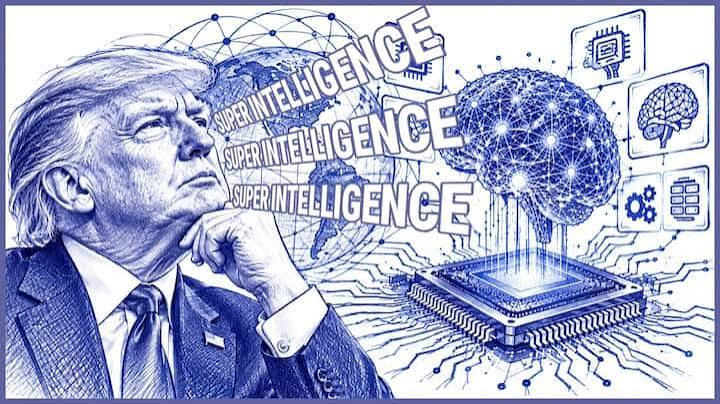
On September 29, 2026, President Trump signed an executive order requiring every federal department and agency to replace the term “Artificial Intelligence” (AI) with “Super Intelligence” (SI) in official correspondence, public communications, websites, reports, and all non-statutory documents.
The order didn’t just promote a new term. It buried the old one. The White House’s own fact sheet states that agencies should “no longer acknowledge the terms ‘Artificial Intelligence’ or ‘AI.’“ Read that again. Not “phase out.” Not “update.” No longer acknowledge.
The same day, the tech titans were summoned to the White House — Jeff Bezos, Elon Musk, Mark Zuckerberg, Jensen Huang, OpenAI president Greg Brockman, Palantir CEO Alex Karp. They signed the “White House Accord on Super Intelligence,” a voluntary safety pledge with no legal force, which Trump described as working “like a constitution.” Zuckerberg began using “Super Intelligence” in product announcements within 24 hours. The field that was born at Dartmouth College in 1956 had been renamed by executive fiat in 2026 — seventy years, almost to the season, after John McCarthy coined the term his own government now refuses to say.
The official rationale? A White House fact sheet titled “President Donald J. Trump Inaugurates The Era of Super Intelligence” argues that “artificial” implies merely “imitating or automating human intelligence,” while Super Intelligence “conveys the true capabilities” of the technology. Trump himself was blunter: the word “artificial” makes people think of fake.
There was, in fairness, a domestic political reason. A Quinnipiac poll in March 2026 found that 55% of American adults believe AI does more harm than good — up 11 percentage points in a single year. “Artificial intelligence” had become a toxic brand. Rebranding it “Super Intelligence” is, on one level, the world’s most expensive PR relaunch.
But if you think this is just marketing, you’re missing the oldest trick in the innovation empire. And it took a viral post on Chinese Q&A platform Zhihu — 4,700+ upvotes and climbing — to name the mechanism with perfect clarity. This article brings that analysis to an English audience, because it deserves one.
The Category Game: How “0-to-1” Is Manufactured
Start with a question that circulates endlessly in Western commentary: why do Chinese companies never seem to do “0-to-1” innovation?
Here’s the uncomfortable answer: “0-to-1” is not a fact. It’s a category decision — and categories can be gerrymandered.
The Zhihu analysis offers a thought experiment. Suppose a Chinese company invents the electric vehicle. A skeptic says: “That’s not 0-to-1. It’s a derivative of the car — a 1-to-100 improvement. Thank Karl Benz.” Fine — so what if the Chinese had invented the car itself? The skeptic zooms out: “That’s not 0-to-1 either. It’s a refinement of the wheel — a category humans have had for 4,000 years. Thank the ancients.”
See the mechanism? Expand the category far enough, and every invention becomes an increment. Whoever controls the category — whoever gets to decide whether “EV” is a new thing or a subset of “car” — controls whether your work counts as creation or derivation.
Now the flip side. How does anyone ever get credit for a 0-to-1? Not by building it. By naming it. A brand-new word — preferably one with a unique sound and no derivation from existing vocabulary — creates a brand-new category. And a new category has no ancestors. It pops into existence with its inventor standing at its head.
A new word doesn’t describe a new thing. It legislates a new thing into the ledger of human achievement.
Eponyms Are Property Deeds
Look at how English names its own inventions versus everyone else’s.
For its own breakthroughs, English mints eponyms — words with a founder’s name stamped on them like a trademark. Diesel, after Rudolf Diesel. Braille, after Louis Braille. The ballpoint pen that half the world calls a “biro,” after László Bíró. Every one of these is a property deed: the technology and the credit travel together, permanently, in a single syllable.
For everyone else’s breakthroughs, English does something different: it assimilates them into existing vocabulary as derivatives. Paper became “paper” — a word whose root is papyrus, the Egyptian writing reed. Gunpowder became “gunpowder” — a tidy English compound. China invented both; the English words quietly suggest both were variations on something the West already had.
The etymology does the theft silently. To an English speaker, papyrus is “an early, imperfect paper.” To a Chinese speaker, the relationship inverts: papyrus is just a reed that failed to become paper. Same history. Opposite property registry.
This is not a conspiracy. It’s a linguistic reflex — but it has the effect of a colonial land grab. The Zhihu author’s sharp observation: English borrows raw phonetics mainly from “prestige” languages it admires (French, Latin, Greek), or for “exotic, often derogatory” concepts (coolie, ramen). For ideas from civilizations it competes with, it prefers translation — because translation buries the original’s ownership inside a familiar word……………………………………………………………………………………………………..
The Modern Playbook: Metaverse, Sixth-Gen Fighters, DeepSeek
This machinery is not historical. It’s running right now, and you’ve watched it operate three times in recent years.
Metaverse. A word coined in a 1992 science fiction novel, adopted as a company name in 2021. Technologically, “the metaverse” contained nothing that virtual worlds hadn’t contained for two decades — no new architecture, no new interaction paradigm. But it had a minted word, a category nobody had to share with the past. ……………………………………………………………………………………………………………
Decoding SI: The Hedge Fund of Categories
Now the executive order makes complete sense.
The United States coined “artificial intelligence” in 1956. Its White House proudly asserts — correctly — that America is “the birthplace” of the field and has led it for “over 70 years.” That name, and that founding, is one of America’s greatest narrative assets: the entire global industry carries American words in its name.
But here’s the problem the White House faces in 2026: Chinese models have reached genuine parity — benchmark-for-benchmark, dollar-for-dollar the efficiency argument even favors China. If the race stays called “AI,” then the most likely outcome is that the “birthplace” gets out-innovated in its own category, on its own vocabulary. The founding nation would become the incumbent that lost its own field.
So instead of defending the old category, America redrew the map. Rename the category “Super Intelligence,” decree that the old name shall not be acknowledged — and instantly, every Chinese achievement in “AI” becomes progress in a field that no longer officially exists. Chinese labs will keep doing brilliant work in the old category: that’s a 1-to-100 story now, and America has already stamped itself at the “0” of the new one. Your AI is impressive; our SI is a different thing. You can never beat us at SI, because we invented the word, and the word is the race.
It’s the category game at national scale: when you can’t win the category, delete the category.
Notice the asymmetry of costs. DeepSeek’s efficiency breakthrough took years of engineering under sanctions. Huawei’s chip roadmap took seven years of siege economics. The SI rename took one pen. In narrative warfare, renaming is the cheapest weapon with the longest reach — it costs nothing and repositions everything.
And notice what the order does domestically, too. The same fact sheet announces $5 billion for a “Genesis Mission” and a “National Super Intelligence Policy Framework.” The unpopular, frightening “AI” — the one 55% of Americans distrust — quietly becomes somebody else’s legacy technology. The fear is inherited with the old word. The promise is minted with the new one.
The Counter-Move: China Is Learning to Mint Words
Here’s what makes this moment genuinely interesting, and why I’ve spent days on this question: China’s best answer isn’t to complain about the renaming. It’s to start minting categories of its own……………………………………………………………………………………………………… https://sinodatacrit.substack.com/p/the-day-america-deleted-a-word?publication_id=7110991&post_id=218751184&isFreemail=true&r=3alev&triedRedirect=true&utm_source=substack&utm_medium=email
‘NAZA’ Exposes Gaza’s Killing Machine—and the People Who Want It Hidden
October 5, 2026, Joshua Scheer, https://scheerpost.com/2026/10/05/naza-exposes-gazas-killing-machine-and-the-people-who-want-it-hidden/
Israel’s leaders have threatened the filmmakers. The documentary’s deeper challenge is to a society that treats technical expertise as an escape from moral responsibility.
A government confident in its account of a war should be able to withstand a documentary. Benjamin Netanyahu’s response to NAZA has been to threaten the citizenship of people who expose what Israeli soldiers say happened in Gaza.
According to Reuters, Netanyahu pledged to pursue legislation allowing citizenship revocation for those who defame Israeli soldiers, alongside sharply increased financial penalties. Directed by Yuval Abraham and Rachel Szor, NAZA draws on anonymous military and intelligence testimony alleging that civilian deaths were routinely incorporated into targeting decisions. Netanyahu and the military reject those allegations.
The threat raises an obvious question: If the testimony is false, why reach for the power to strip people of their citizenship?
The film’s significance extends beyond Netanyahu. In his October 2 essay for +972 Magazine, Israeli academic Sebastian Ben Daniel argues that NAZA challenges the comforting assumption that responsibility for Gaza’s destruction belongs exclusively to Israel’s openly extremist politicians and settlers.
His focus is on the prestigious institutions that make military violence possible: intelligence units, the Air Force and the professional culture connecting military service to Israel’s technology industry. The people operating that machinery can consider themselves educated, reasonable and politically opposed to the far right while participating in its devastating consequences.
That is a challenge Americans should recognize. We, too, have learned to discuss war through the reassuring vocabulary of expertise: intelligence assessments, precision weapons, operational requirements. The language sounds clean because it removes the people underneath the bombs.
NAZA confronts liberal Israel with an accusation it cannot comfortably assign to Netanyahu and the far right: The destruction of Gaza depends on prestigious institutions staffed by educated, secular professionals who consider themselves the extremists’ opposite. Political moderation does not erase responsibility, and expressions of anguish cannot redeem participation in mass killing. Ben Daniel also describes liberal media commentators attacking a film they have not watched and questioning anonymous testimony—the same kind of sourcing routinely accepted when it serves the military’s narrative. That selective skepticism protects the institutions under scrutiny while shifting attention away from the Palestinians whose lives those institutions have destroyed.
A targeting system does not bury a child. People authorize an attack, carry it out and defend its consequences. Dividing those actions among departments cannot make responsibility disappear.
For some viewers, the testimony has brought historical questions of obedience and accountability into immediate focus. Reporting for Vulture, Rachel Corbett quoted attendee Roland Lewis: “I couldn’t stop thinking about the Nuremberg trials.”
That comparison is an audience member’s reaction, not a judicial finding. Its force lies in the question it raises: How much moral shelter can anyone claim from a chain of command?
Palestinians should not have to wait for Israeli testimony to make their suffering credible. Their reporting, their photographs and their accounts of families destroyed deserve attention on their own terms.
What NAZA can do is confront another audience with testimony from inside the institutions whose assurances it has accepted. The obligation that follows belongs to viewers, journalists and governments—including Washington, whose support for Israel demands scrutiny alongside the conduct of the Israeli military.
Watching a documentary is a beginning. Accountability requires following the chain of responsibility beyond the screen.
This commentary draws on Sebastian Ben Daniel’s essay in +972 Magazine, Rachel Corbett’s reporting in Vulture and Reuters’ coverage of threats against the filmmakers. Readers can read them here Vulture, MS NOW and +972 Magazine.
Big Reactors in Saskatchewan: What could go wrong?

The implication of these experiences and proposals is that a new 1,000-MW reactor could carry a price tag of $15 to $26 billion. That would put the total cost for a two-reactor project, like Saskatchewan is proposing, in the $30-$50 billion range. Estimates of the costs of electricity needed to cover the capital costs of new nuclear plants, if they’re financed through electricity rates, range from the mid-20¢ to more than 40¢ per kilowatt-hour.
October 3, 2026, By Mark Winfield and Susan O’Donnell, https://energi.media/opinion/big-reactors-saskatchewan-what-could-go-wrong/
The Saskatchewan government’s recent announcement of its intention to build two large nuclear reactors has again raised questions of the role of large nuclear energy projects in relatively small provincial economies.
The last new full-scale nuclear reactor project in Canada, the Darlington nuclear power plant east of Toronto, was completed more than 30 years ago. The enormous cost overruns on that project contributed significantly to the effective bankruptcy of the province’s utility, Ontario Hydro, leading to its eventual break-up.
As the memories of these previous experiences with large nuclear construction projects have faded, new projects are now being proposed. These projects, and experiences with the handful of new-build nuclear projects initiated in Europe and the United States in the last two decades, give us some indication of the large reactor options, and their potential costs.
New Brunswick’s experience with its long- troubled Point Lepreau reactor, should give Saskatchewan further cause for reflection on the wisdom of such a pathway. The Lepreau plant is Canada’s lone experience with a large nuclear power plant in a relatively small provincial electricity system and economy, New Brunswick Power is still carrying a C$3.6 billion nuclear debt from the reactor’s original 1975-1983 construction, and the costs of a 2008-2012 refurbishment that was a billion dollars over budget. Since the refurbishment, the poor performance of the Lepreau reactor has been the primary reason New Brunswick Power loses money almost every year.
In Ontario and Alberta, two reactor designs, the CANDU MONARK and the Westinghouse Electric AP1000, have been considered for the expansion of the Bruce Nuclear power plant on Lake Huron, a proposed 10,000-MW Ontario Power Generation plant at Wesleyville on Lake Ontario, and the proposed 4,800-MW Peace River Nuclear Project in Alberta.
The 1,000-MW CANDU MONARK is intended as a successor to the existing CANDU reactors in Ontario and New Brunswick. Although it’s being aggressively promoted to potential international customers, the MONARK design remains incomplete. The situation has already led the Alberta project’s proponents to switch their proposal to favour the AP1000 design by Westinghouse Electric.
Cost information is available on the AP1000 reactor, as two units were completed in 2024 at the Vogtle nuclear power plant in Georgia. The total estimated cost of those two 1,100-MW reactors was US$36 billion, or about $26 billion per reactor in 2026 Canadian dollars. The plant has been described as “the most expensive power plant ever built on Earth.” When it went into service, Vogtle resulted in a nearly 24% increase in Georgia Power’s electricity rates, the largest jump in the utility’s history.
AtkinsRéalis (formerly SNC Lavalin) is currently pitching the CANDU MONARK to Poland, with a reported estimated cost of $45 to $50 billion for a three-reactor plant, or about $15 billion per unit.
The implication of these experiences and proposals is that a new 1,000-MW reactor could carry a price tag of $15 to $26 billion. That would put the total cost for a two-reactor project, like Saskatchewan is proposing, in the $30-$50 billion range. Estimates of the costs of electricity needed to cover the capital costs of new nuclear plants, if they’re financed through electricity rates, range from the mid-20¢ to more than 40¢ per kilowatt-hour.
In the case of New Brunswick, another smaller province considering a large new reactor project, it has been estimated that the project would nearly double to even triple current consumer electricity costs. Such increases would undermine energy affordability, economic competitiveness, and any plans for decarbonization through electrification.
A province could also try to finance the costs through its general tax base. That is the approach that Ontario been taking, at an estimated cost to the provincial treasury of $7 to $8.5 billion per year. Electricity subsidies now account for more than half of Ontario’s deficit, exceeding annual capital expenditures on education and health care by wide margins.
In the case of New Brunswick, the annual costs of that approach, even spread over the decade or more of construction, could exceed the province’s current, record $1.39 billion deficit, and match or exceed its entire annual capital spending plans in all other areas. Although the Saskatchewan economy is almost double the size of New Brunswick, the scale fiscal impacts of trying to finance two reactors out of general provincial tax revenues would be comparable.
Saskatchewan, for its part, has had another idea – asking the federal government to pay three-quarters of the cost of the province’s first nuclear reactor, a contribution of between $11 to $20 billion from federal taxpayers.
In addition to the financial risks a single large reactor in a relatively small electricity system would repeat and magnify a key problem associated with the original Point Lepreau project in New Brunswick —putting very higher portion of a province’s electricity supply eggs in a single, very expensive and high-risk basket.
All of this should suggest a high degree of caution among provinces considering adding large nuclear components for their electricity systems, and a need to think about other ways of decarbonizing their electricity systems while ensuring their affordability and sustainability.
Mark Winfield is a professor at the Faculty of Environmental and Urban Change at York University in Toronto, and co-chair of the faculty’s Sustainable Energy Initiative. Susan O’Donnell is adjunct research professor and lead researcher on the CEDAR project in Sustainability and Environmental Studies at St. Thomas University.
Israel to divide central West Bank with settler-only highway
The move is expected to further fragment and isolate the central metropolitan West Bank governorate, which has already been fragmented by Israeli settlements, military outposts, checkpoints and gates.
Aseel Saleh, October 2 2026, https://breakthroughnews.org/2026/10/02/israel-to-divide-central-west-bank-with-settler-only-highway/
In late September, Israeli media reported that Netanyahu’s government intends to adjust access to key routes in the central West Bank. It plans to reopen Route 463 to settler-only traffic in the governorate of Ramallah and Al-Bireh.
Yisrael Gantz, the leader of the Yesha Council (an umbrella organization representing Israeli municipal councils across Israeli settlements in the West Bank and the Jordan Valley) confirmed that plans to reopen the road received preliminary approval and funding.
Preparations are also underway by the Israeli military to complete “the security, legal, and logistical” steps required to reopen the route (also known as Wallerstein Road).
History of the road
The road was paved in 1994 under the directions of Pinchas Wallerstein, a founder of the settlement movement, to connect the illegal settlements of Beit El (north-east of Ramallah and Al-Bireh) and Dolev (north-west of Jerusalem).
However, following the outbreak of the Second Intifada in 2000, the Israeli army barred Israeli people from using the road for security reasons. They also placed a locked iron gate on its end near Ein Qiniya village, northwest of Ramallah.
Why has the reopening of the route raised concerns among Palestinians in the West Bank?
Experts argue that Israel’s move will impact not only the governorate itself, but the entire occupied West Bank because of its central location, major metropolitan status, and role as a commercial hub.
To understand the repercussions of the route reopening, BreakThrough News spoke with Jamal Jumaa, a Palestinian activist, expert on Israeli settlement and apartheid-related issues, and coordinator of the Palestinian Grassroots Anti-Apartheid Wall Campaign (Stop the Wall).
Aside from dividing the governorate’s northern and southern halves, Jumaa noted that reopening the road is dangerous because it will block the center of Ramallah and Al-Bireh from two-thirds of its villages, which are situated to the west.
The prominent Palestinian activist added that when Israel builds such roads for settler traffic, it fences them off on both sides and prohibits the use of adjacent lands. The Israeli authorities consider those lands a buffer zone, citing the security of the settlers as their reason.
“This entails setting up military towers and checkpoints. The road will cut off continuously inhabited Palestinian villages north-west and south-west of Ramallah. Therefore, we are talking about the establishment of roughly four military checkpoints along the road,” he continued.
Jumaa pointed out that the road will complicate the life of Palestinians by restricting their access to vital healthcare and education facilities, including the Istishari Arab Hospital, Birzeit University, and the Arab American University.
He also noted that the intended reopening of the road “is part of dividing and dividing more Palestinians from each other.”
On the political level, Jumaa suggested that the road “hits the heart of the West Bank, which gives a clear signal to the Palestinian Authority that it has no sovereignty over anything.”
It is worth noting that since its establishment, the Palestinian Authority has designated Ramallah and Al-Bireh as a de facto administrative capital. Yet, this has not prevented the Israeli authorities from fragmenting and isolating the governorate by establishing illegal settlements, military outposts, checkpoints, and gates.
Managed Deception and Imperial Politics: Trump’s Greenland Deal

much of the new agreement is surplusage. Arrangements are already in place permitting the establishment of defence areas by the US to “assist” Denmark in defending Greenland, station forces at them, and move personnel in the territory fairly unhindered.
Trump takes credit for an agreement signed in 1951
This merely clarified what was already an ongoing practice
6 October 2026Dr Binoy Kampmark, https://theaimn.net/managed-deception-and-imperial-politics-trumps-greenland-deal/
In his second term, US President Donald Trump has gone the way of past executive tribunes of the American imperium in seeking land and resources like a kleptomaniacal pincher. This has been bracing, not least for a foreign policy establishment inured to the hypocrisies of virtue concealed in the international order of rules and protocols. Spot the international rule and break it.
Neither ally nor adversary have been spared Trump’s scorching petulance. Thuggish language has been forthcoming for Canada just as it was for Venezuela whose leader, Nicolás Maduro, was abducted, along with his wife, on fantastic charges related to narcotics trafficking. An enduring security ally such as Denmark will be seen as amenable to giving up control of Greenland to Washington. On that score, Trump has succeeded in needlessly convincing Danish Prime Minister Mette Frederiksen and Greenland’s Prime Minister Jens-Frederik Nielsen to enter into a trilateral agreement that evokes the pseudo-colonial obsessions of old. Not that Washington had ever really relinquished strategic control over the territory, having had, during the Cold War, stationed anywhere between 10,000 and 25,000 troops based at some 17 military facilities.
The agreement does what should have already been assumed: reaffirming Danish sovereignty and recognising that Greenlanders “constitute a people pursuant to international law with the right to self-determination.” The text pointedly notes the “indispensable historical” role of the US and its “ongoing contributions to the security and defense of Greenland and the rest of the North Atlantic Treaty area.” This included “significant sacrifices and billions of dollars spent over the better part of a century, dating back to before World War II and the establishment of NATO, and the irreplaceable role the United States military plays in the defense of the territory of Greenland now and in the future.”
In terms of military matters, the US is permitted to establish “an additional Defense Area at Narsarsuaq and Mestersvig” while modernising and expanding activities in Pituffik Space Base. It remains open to Washington to establish additional defence areas in Greenland, along with strengthening “military operations or facilities.” Proposals to do so are to heed the 1991 Memorandum of Understanding and the 2004 Joint Declaration. Undersea access rights to the US in Greenlandic waters “without restriction except as mutually agreed upon by the Parties” is also assured.
For those familiar with the 1951 Agreement Pursuant to the North Atlantic Treaty between the United States and the Kingdom of Denmark Concerning the Defense of Greenland, much of the new agreement is surplusage. Arrangements are already in place permitting the establishment of defence areas by the US to “assist” Denmark in defending Greenland, station forces at them, and move personnel in the territory fairly unhindered. What makes these new arrangements somewhat different is the sine die element: unlike the 1951 agreement, which is intended to conclude in the event of NATO ceases, the current understanding is durably indefinite. “This Agreement does not have an end date and may only be amended by mutual consent in accordance with Article XIII of the 1951 Defense Agreement.” Even if Greenland were to become independent, it would still be obligated to remain part of NATO, while Denmark would still have “rights and obligations” assumed under the agreement, making the issue of self-determination purely ceremonial.
Mindful of the alleged threats posed by “adversaries to expand influence and control in Greenland,” a greater muscularity in American invigilation on who invests in the territory is offered. States or investors not members of NATO, a NATO partner, or a European Union member state will not be permitted to have control, significant influence or access to non-public information that may constitute a threat to national security or public order, notably with regards “Particularly Sensitive Sector or Activities in the territory of Greenland (including the Territorial Waters)”. “The objective shall be ensured by Greenland in close cooperation with the authorities of the Kingdom of Denmark in its application of its current or future investment screening laws” with the Danes closely consulting “relevant United States authorities and other partners.” This merely clarified what was already an ongoing practice: that the Danish authorities will prevent unwanted foreign powers access to the territory, either individually or with US assistance, when they see fit.
1 This Month





PLEASE OPPOSE HR 8255 AND S.3639 – bills would accelerate satellite deployment, with no environmental review or safeguards – https://ncstd5li.quorum.us/campaign/169331/
To see nuclear-related stories in greater depth and intensity – go to https://nuclearinformation.wordpress.com
-
Archives
- October 2026 (81)
- September 2026 (339)
- August 2026 (330)
- July 2026 (355)
- June 2026 (287)
- May 2026 (306)
- April 2026 (356)
- March 2026 (251)
- February 2026 (267)
- January 2026 (308)
- December 2025 (358)
- November 2025 (359)
-
Categories
- 1
- 1 NUCLEAR ISSUES
- business and costs
- climate change
- culture and arts
- ENERGY
- environment
- health
- history
- indigenous issues
- Legal
- marketing of nuclear
- media
- opposition to nuclear
- PERSONAL STORIES
- politics
- politics international
- Religion and ethics
- safety
- secrets,lies and civil liberties
- spinbuster
- technology
- Uranium
- wastes
- weapons and war
- Women
- 2 WORLD
- ACTION
- AFRICA
- Atrocities
- AUSTRALIA
- Christina's notes
- Christina's themes
- culture and arts
- Events
- Fuk 2022
- Fuk 2023
- Fukushima 2017
- Fukushima 2018
- fukushima 2019
- Fukushima 2020
- Fukushima 2021
- general
- global warming
- Humour (God we need it)
- Nuclear
- RARE EARTHS
- Reference
- resources – print
- Resources -audiovicual
- Weekly Newsletter
- World
- World Nuclear
- YouTube
-
RSS
Entries RSS
Comments RSS

