US Army to spend $2 bln on nuclear microreactors for bases
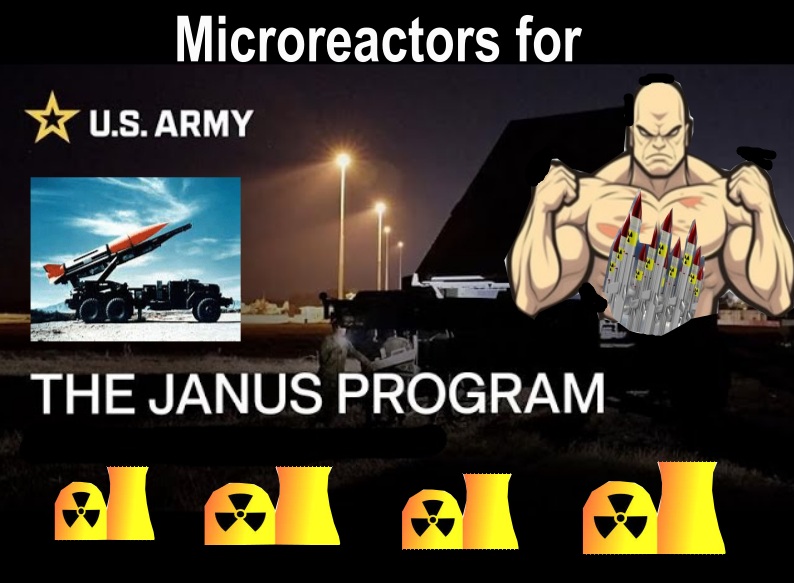
The Army program uses the military’s “deep pockets to provide a hidden subsidy” to nuclear companies that can’t find private-sector customers for their hypothetical and uneconomical reactors
DW Sean Sinico with AP, Reuters, August 27, 2026
The US Army has announced a plan to install what it calls nuclear microreactors at five of its bases across the country. The move would ensure the facilities’ energy independence from the rest of the electric grid.
The United States Army said Wednesday that it will award $2.2 billion (€1.7 billion) in contracts to five companies to build and operate small nuclear reactors on military bases. The program set a goal of deploying the first such reactor by the end of September 2028.
Called microreactors, developers say each of the nuclear plants would be easy to transport and provide up to 20 megawatts of power.
The reactors will adhere to all environmental and safety regulations that apply to commercial reactors, but an Army spokesperson said the reactors will be regulated by the Army rather than the US Nuclear Regulatory Commission, which regulates commercial reactors.
“The whole idea here is that at the back end of this we want a commercial product,” said Jeff Waksman, principal deputy assistant secretary of the Army for Installations, Energy and Environment.
Army Secretary Dan Driscoll said the awards will speed up the military’s ability “to deliver safe, reliable baseload power directly to our installations.”
“We are building the energy resilience necessary to project combat power globally, without relying on potentially vulnerable external grids,” he added………………………………………………………………………
‘Hidden subsidy’ for expensive reactors, critics say
Critics of microreactors say they will be expensive compared to conventional reactors. Safety advocates point out that nuclear technology carries significant risks that other low-carbon energy sources don’t, such as the danger of accidents or targeted attacks.
The Army program uses the military’s “deep pockets to provide a hidden subsidy” to nuclear companies that can’t find private-sector customers for their hypothetical and uneconomical reactors, Alan J. Kuperman, associate professor at the Lyndon B. Johnson School of Public Affairs at the University of Texas at Austin and coordinator of the Nuclear Proliferation Prevention Project, told the AP news agency.
The Army’s Waksman said nobody thinks that microreactors will be lower in cost than conventional plants.
“What we are trying to do here with Janus … is to flesh out how can we get those prices down,” he said.
What will happen with the radioactive waste?
Waksman said the microreactors would safely shut down in case of a failure and that the Army wouldn’t add them to installations without being certain they are safe.
He added that the Army is working on a deal with the Energy Department to remove radioactive waste, and there won’t be any long-term storage on these installations.
Last month, five states offered to accept nuclear waste in exchange for federal support in developing nuclear energy facilities.
Trump pushing nuclear power in US
Executive orders signed by US President Donald Trump in May 2025 aimed to accelerate the development of nuclear power. Trump has called for the US to quadruple its nuclear energy production — just two new large reactors have been built from scratch in the United States in nearly 50 years. Those two reactors were completed years late and at least $17 billion over budget, AP reported.
The nation’s 94 nuclear reactors supply about 19% of U.S. electricity, compared to about 60% for fossil fuels and 21% for renewables, according to the US Energy Information Administration. https://www.dw.com/en/us-army-to-spend-2-billion-on-nuclear-microreactors-for-bases/a-78518374
No comments yet.
-
Archives
- October 2026 (120)
- September 2026 (339)
- August 2026 (330)
- July 2026 (355)
- June 2026 (287)
- May 2026 (306)
- April 2026 (356)
- March 2026 (251)
- February 2026 (267)
- January 2026 (308)
- December 2025 (358)
- November 2025 (359)
-
Categories
- 1
- 1 NUCLEAR ISSUES
- business and costs
- climate change
- culture and arts
- ENERGY
- environment
- health
- history
- indigenous issues
- Legal
- marketing of nuclear
- media
- opposition to nuclear
- PERSONAL STORIES
- politics
- politics international
- Religion and ethics
- safety
- secrets,lies and civil liberties
- spinbuster
- technology
- Uranium
- wastes
- weapons and war
- Women
- 2 WORLD
- ACTION
- AFRICA
- Atrocities
- AUSTRALIA
- Christina's notes
- Christina's themes
- culture and arts
- Events
- Fuk 2022
- Fuk 2023
- Fukushima 2017
- Fukushima 2018
- fukushima 2019
- Fukushima 2020
- Fukushima 2021
- general
- global warming
- Humour (God we need it)
- Nuclear
- RARE EARTHS
- Reference
- resources – print
- Resources -audiovicual
- Weekly Newsletter
- World
- World Nuclear
- YouTube
-
RSS
Entries RSS
Comments RSS


Leave a Reply