Nuclear regulator prepares to abandon a decades-old radiation safety rule
August 27, 2026, Geoff Brumfiel, NPR
The Nuclear Regulatory Commission is preparing to change a foundational rule designed to minimize radiation exposure. The update is part of President Trump’s expansive changes to nuclear oversight, as his administration seeks to revive nuclear energy to power data centers for artificial intelligence.
Under a new proposed rule, the agency is eliminating a 50-year-old standard known as “As Low As Reasonably Achievable” (ALARA), which requires the nuclear industry to drive radiation exposure for workers and the public below the stated limits where possible. The new rule also creates a carveout for some workers to get higher exposures to radiation in special circumstances.
For some, the elimination of ALARA is overdue. “Keeping doses as low as reasonably achievable was a fair idea,” said Emily Caffrey, a radiation health physicist at the University of Alabama at Birmingham. But in practice, the standard forced companies to take increasingly stringent radiation protection measures. It also created ambiguity, Caffrey said, “because what’s ‘reasonable’ to one person isn’t reasonable to another person.”
But others warn that the change could lay the groundwork for higher radiation exposures.
For some, the elimination of ALARA is overdue. “Keeping doses as low as reasonably achievable was a fair idea,” said Emily Caffrey, a radiation health physicist at the University of Alabama at Birmingham. But in practice, the standard forced companies to take increasingly stringent radiation protection measures. It also created ambiguity, Caffrey said, “because what’s ‘reasonable’ to one person isn’t reasonable to another person.”
But others warn that the change could lay the groundwork for higher radiation exposures.
Since shortly after the dawn of the nuclear age, scientists have been aware of the risks of radiation exposure, and decades of data makes it clear.
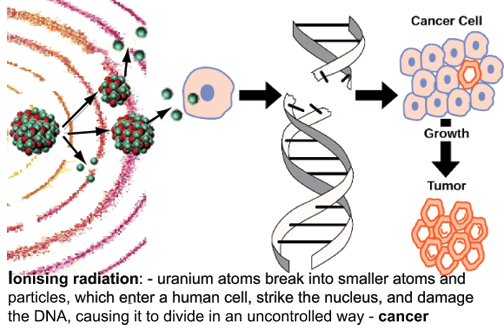
“At high radiation doses, nobody’s really arguing: radiation causes cancer,” said David Brenner, director of the Center for Radiological Research at Columbia University. High doses of radiation damage DNA and can cause mutations that lead to cancer. But when the dose is low, it’s much harder to determine risk because about 40% of the U.S. population develops cancer at some point in their lifetime.
“As you go down in dose, what you’re looking for is a very small increase in cancer risk over a very large background,” Brenner said. “That’s what makes it really, really hard.”
For the past 50 years or so, the Nuclear Regulatory Commission has dealt with this uncertainty by requiring that the nuclear industry adhere to ALARA and keep radiation exposure as low as possible.
Then last May, President Trump signed an executive order calling for a wholesale overhaul of nuclear regulations. The order specifically called out ALARA, claiming the principle was a “flawed” understanding of radiation risks.
The NRC decided not to change its scientific model of radiation risk, known as the Linear No Threshold model, but it has proposed eliminating ALARA.
Speaking this week on the Federal News Network, NRC Chairman Ho Nieh said that ALARA is no longer working…………………………………………………
“Loosey-goosey” rules
The NRC will instead use the existing current threshold of 5 rem for a worker and 0.1 rem for the public as the upper limit for radiation exposure. A whole body CT scan is about 1 rem, according to the EPA…………………………………
The proposed NRC rule doesn’t change its other regulatory limits, but it does create some carve-outs. In particular, the industry would now be able to ask for a “planned occupational dose limit extension,” which would allow workers to receive 10 rem instead of 5 in any given year, providing their overall exposure doesn’t pass 25 rem in a five-year period………………………………
But Lyman, with the Union of Concerned Scientists, thinks that ALARA should stay. He said while it may be imperfect, its net effect has been to reduce radiation exposure to very low levels. The harms of low-dose radiation exposure are difficult to see, but Lyman says NRC’s own models suggest those harms exist.
In his opinion, the revised rule ignores that risk and is designed to desensitize the public to the dangers of radiation. “It’s trying to devalue and deemphasize the harm of ionizing radiation exposure,” he warned. https://www.npr.org/2026/08/27/nx-s1-5920368/nrc-nuclear-radiation-safety-rules-alara-update
No comments yet.
1 This Month


9 September – online public forum THREE MILE ISLAND:
7-8:30 PM ET,
Legacy, resistance to reopening – https://us02web.zoom.us/webinar/register/WN_-LGJU4j6TD2Hgf0rpgAr1A#/registration
The nuclear industry and the U.S. Nuclear Regulatory Commission are threatening to restart Pennsylvania’s permanently closed and decommissioning Three Mile Island Unit 1 nuclear power station. Three expert speakers will present the resistance to this dangerous misadventure in a webinar hosted by the Clamshell Alliance, Beyond Nuclear and Massachusetts Peace Action.

No Nuclear in Cwm Llynfi! Stop the nuclear power station near Maesteg.
To see nuclear-related stories in greater depth and intensity – go to https://nuclearinformation.wordpress.com
-
Archives
- September 2026 (24)
- August 2026 (330)
- July 2026 (355)
- June 2026 (287)
- May 2026 (306)
- April 2026 (356)
- March 2026 (251)
- February 2026 (267)
- January 2026 (308)
- December 2025 (358)
- November 2025 (359)
- October 2025 (375)
-
Categories
- 1
- 1 NUCLEAR ISSUES
- business and costs
- climate change
- culture and arts
- ENERGY
- environment
- health
- history
- indigenous issues
- Legal
- marketing of nuclear
- media
- opposition to nuclear
- PERSONAL STORIES
- politics
- politics international
- Religion and ethics
- safety
- secrets,lies and civil liberties
- spinbuster
- technology
- Uranium
- wastes
- weapons and war
- Women
- 2 WORLD
- ACTION
- AFRICA
- Atrocities
- AUSTRALIA
- Christina's notes
- Christina's themes
- culture and arts
- Events
- Fuk 2022
- Fuk 2023
- Fukushima 2017
- Fukushima 2018
- fukushima 2019
- Fukushima 2020
- Fukushima 2021
- general
- global warming
- Humour (God we need it)
- Nuclear
- RARE EARTHS
- Reference
- resources – print
- Resources -audiovicual
- Weekly Newsletter
- World
- World Nuclear
- YouTube
-
RSS
Entries RSS
Comments RSS
 nuclear-news
Leave a comment