Mission impossible? Quantifying military emissions
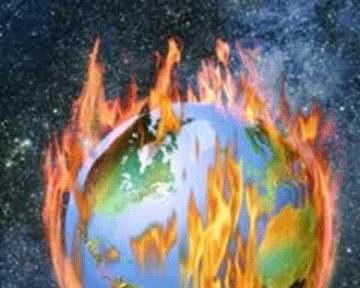
Military and wartime emissions are difficult to track—but too important to ignore.
Bulletin, By Neta C. Crawford, August 24, 2026
ow much does war, and the preparation and recovery from it, contribute to the climate crisis? Nobody knows, because there is no comprehensive accounting of global warming emissions from militaries, military industries, or war. While some military emissions are reported, those are the tip of the iceberg. The failure to quantify the emissions from this sector inhibits the ability to reduce them and keeps them largely sacrosanct.
One can make some educated guesses as to what they may be, which I’ve attempted here. This rough estimate—which is on the conservative side—shows that US and global military, military-industrial, and wartime emissions are enormous and should be factored into our understanding of global warming.
The procedures and criteria for nations to make a comprehensive report of their greenhouse emissions were first worked out as part of the 1997 Kyoto Protocol Treaty process.
A 1997 Pentagon memo—a piece of rhetorical genius—explained the stakes very clearly: The military was the US government’s single largest fossil fuel user. Ensuring the US military remained preeminent in the world required unlimited fuel use for training and operations. Reporting emissions could lead to a push for reductions, and “limitations on tactical and strategic military systems would … adversely impact operations and readiness.”
The Pentagon argued that even a 10 percent reduction in fuel use would harm military readiness and “represent a serious threat to national security.”
To forestall this, the Pentagon suggested draft language for the Kyoto treaty proposing that parties “shall exclude from its measurement of anthropogenic emissions by sources any emissions attributable to military tactical or strategic systems used for military operations in support of national or collective security, humanitarian activities, peacekeeping, peace enforcement, or United Nations, NATO, and other multinational actions.” The Pentagon also proposed excluding measurement of any “emissions attributable to military tactical or strategic systems used in training” for those operations.
The Defense Department also asserted that “to minimize fundamental conflicts between national security and global environmental protection, the Protocol itself must address military operations and readiness so that the [sic] we can pursue and enjoy the fruits of national security as well as the benefits of a healthy planet.”
The White House agreed, and the United States successfully lobbied to exempt most military emissions from countries’ annual National Inventory Reports of greenhouse gas emissions.
Even though military emissions reporting was made voluntary in 2015 at the UN’s climate conference in Paris, there is still no comprehensive accounting of direct military emissions by all countries. But even if and when those institutional numbers are reported, most accounting is still partial because it undercounts military emissions and excludes the emissions from military industry and war. Every uncounted metric ton is an obstacle to grasping the full scale of the problem and hampers the ability to reduce the worst effects of warming.
US military emissions. The US Defense Department is still the single largest energy user and institutional greenhouse gas emitter in the country. And that is before we account for all the national security related emissions that are counted as emissions in other departments. Indeed, as I show below, there are significant military related emissions that are essentially under or uncounted…………………………………………………………………….
But most significantly, Defense Department emissions have fallen because many of its functions are now essentially off-book, as the US military has increasingly outsourced its operations to contractors.
Nearly 4,000 million metric tons of carbon dioxide equivalent is a large quantity, but this is a conservative estimate since the Defense Department, which provides the data to the Energy Department, uses a lower 100-year Global Warming Potential for methane than the Intergovernmental Panel on Climate Change. My estimate also does not include the Defense Department’s biogenic emissions (from organic waste decay), which averaged .78 million metric tons of carbon dioxide equivalent from 2010 to 2024………………………………………………………………………………………………………………………………………………………………………………………………………
States will deliberately destroy the forests of their enemies. The United States used chemicals, bombardment, and plows to destroy 417,000 hectares (roughly 1,600 square miles) of tropical forests and mangroves of Southern Vietnam during the Vietnam War, releasing an estimated 183.6 – 535.6 million metric tons of carbon dioxide equivalent emissions. An additional 5.6 million hectares (or 21,600 square miles) of forests were partially destroyed. If damaged forests are not regrown, their sequestration potential is reduced or even eliminated…………………………………………………………..
More concerning perhaps are the ways that war contributes to fugitive methane emissions—from slow leaks, deliberate venting, and accidents—that are already a large source of warming. Methane has a 29.8 times higher global warming potential on a 100-year time scale than carbon dioxide. War related emissions of methane, which vary depending on the source and cause of the emissions, largely go uncounted. During the 1991 Gulf War, one location, Mansoria station in northern Kuwait, recorded a 50 percent increase in atmospheric methane due to a fire set by Iraq.
Oil infrastructure continues to be targeted now, regardless of the long-term environmental consequences. The diagram below, from the US Joint Chiefs of Staff Joint Targeting publication, illustrates all the options the United States considers available for targeting oil infrastructure…………………………………………………………………………………………..
A team of scholars led by Ben Neimark has attempted to estimate the emissions of all phases of the Israel-Gaza war from pre-conflict, conflict, and reconstruction. The immediate human toll was staggering: Tens of thousands of people killed, millions displaced, and health care infrastructure in Gaza gutted. They estimate that “emissions from the open conflict surpassed 1.3 million tons CO2 equiv by January 2025,” but that including pre-war mobilization and post-war reconstruction, emissions from this war may be as high as 33 million metric tons of carbon dioxide equivalent.
Both these wars illustrate how the effects of military emissions extend beyond borders. The Russian invasion of Ukraine has caused increased military spending and military industrialization not only in Russia and Ukraine, but also in NATO, and increased global arms manufacturing as countries rush to supply Ukraine with weapons, much of which will outlast the war once it ends. Similarly, the Israel-Gaza war, which includes Israeli attacks in Lebanon and other countries, has generated increased military mobilization in the Middle East as well as increased arms sales. It may be fair to say that, since war became industrialized—if we take greenhouse gas emissions into account—there is no longer such thing as a purely local or regional war………………………………………………………………………………………………………………………………….
Why don’t we have the military and military-industrial data, and why do the impacts of war on emissions remain largely unexamined? On one level, as harmful as wartime greenhouse gas emissions may be, they are essentially not covered under either the laws of war or international humanitarian law. The 1976 Convention on the Prohibition of Military or Any Other Hostile Use of Environmental Modification Techniques is focused on “the deliberate manipulation of natural processes—the dynamics, composition or structure of the earth, including its biota, lithosphere, hydrosphere and atmosphere, or of outer space.” The greenhouse gas emissions of war are an unintended, albeit foreseeable and now foreseen side effect of combat.
Just as political leaders often aver that wars will be short, effective, decisive, cheap, and controllable—even if war is rarely any of those things—they assume that the environmental consequences of mobilization, armaments, and war are local, even trivial externalities, without long-term consequences that can change the planet itself. Indeed, in some respects, as soon as war and military industry began to be powered by fossil fuels in the 19th century, there was no longer any such thing as a purely “local” war.
Policymakers tend to assume that national security, understood as military security, is the sine qua non of survival. As the 1997 Pentagon memo urging that most or all military emissions be exempt from reporting explained, “We must not sacrifice our national security to achieve reductions in greenhouse gas emissions. We must not see this as an issue of being able to achieve either national security or protection of the global climate.” But to a certain extent, nonreporting, and the failure to count all other military, military-industrial, and war related emissions, may have done just that—put military capability and American preeminence above survival, and thus jeopardized the latter. https://thebulletin.org/2026/08/mission-impossible-quantifying-military-emissions/?utm_source=ActiveCampaign&utm_medium=email&utm_content=How%20much%20does%20war%20contribute%20to%20the%20climate%20crisis%3F&utm_campaign=20260824%20Monday%20Newsletter
No comments yet.
1 This Month





PLEASE OPPOSE HR 8255 AND S.3639 – bills would accelerate satellite deployment, with no environmental review or safeguards – https://ncstd5li.quorum.us/campaign/169331/
To see nuclear-related stories in greater depth and intensity – go to https://nuclearinformation.wordpress.com
-
Archives
- October 2026 (67)
- September 2026 (339)
- August 2026 (330)
- July 2026 (355)
- June 2026 (287)
- May 2026 (306)
- April 2026 (356)
- March 2026 (251)
- February 2026 (267)
- January 2026 (308)
- December 2025 (358)
- November 2025 (359)
-
Categories
- 1
- 1 NUCLEAR ISSUES
- business and costs
- climate change
- culture and arts
- ENERGY
- environment
- health
- history
- indigenous issues
- Legal
- marketing of nuclear
- media
- opposition to nuclear
- PERSONAL STORIES
- politics
- politics international
- Religion and ethics
- safety
- secrets,lies and civil liberties
- spinbuster
- technology
- Uranium
- wastes
- weapons and war
- Women
- 2 WORLD
- ACTION
- AFRICA
- Atrocities
- AUSTRALIA
- Christina's notes
- Christina's themes
- culture and arts
- Events
- Fuk 2022
- Fuk 2023
- Fukushima 2017
- Fukushima 2018
- fukushima 2019
- Fukushima 2020
- Fukushima 2021
- general
- global warming
- Humour (God we need it)
- Nuclear
- RARE EARTHS
- Reference
- resources – print
- Resources -audiovicual
- Weekly Newsletter
- World
- World Nuclear
- YouTube
-
RSS
Entries RSS
Comments RSS


Leave a comment