Radioactive material exceeding voluntary standards in sea bass landed in Japan; voluntary restraint on shipments

Feb. 07, 2023
Radioactive materials exceeding the voluntary standard set by the Fukushima Prefectural Fisheries Federation were detected in sea bass landed off the coast of Iwaki City, Fukushima Prefecture on February 7, and the federation has suspended shipments of sea bass.
According to the Fukushima Prefectural Federation of Fisheries, on the morning of March 7, radioactive substances exceeding the standard voluntarily set by the federation were detected in sea bass caught 8.8 km off the coast of Iwaki City at a depth of about 75 m. After a detailed investigation by a prefectural agency, the sea bass was found to have a high level of radiation.
Subsequent detailed examination by a prefectural agency revealed that radioactive cesium-137 was detected at a concentration of 85.5 becquerels per kilogram.
This is below the national food standard of 100 becquerels per kilogram, but above the standard of 50 becquerels per kilogram voluntarily set by the prefectural fisheries federation.
Therefore, the prefectural fisheries federation has decided to recall all sea bass landed in the prefecture on July 7, and to refrain from shipping until the levels remain below the voluntary standard for a certain period of time.
This is the first time that the government has voluntarily refrained from shipping sea bass since the shipment restrictions were lifted in April 2018, almost five years ago.
In January of last year, radioactive materials exceeding the national standard were detected in black sea bass caught off the coast of Soma City, and the restrictions on shipments are still in place.
https://www3.nhk.or.jp/lnews/fukushima/20230207/6050021695.html?fbclid=IwAR0CP1j7m2tn7ApkcYR7ealeENsQigTgKXHixCh994n8rkqc9 jESkkyBuh4
Cleaning Up After the Nuclear Accident: The Changing Face of Interim Storage Facilities
February 06, 2023
The accident at TEPCO’s Fukushima Daiichi Nuclear Power Plant has spread an enormous amount of radioactive materials. Contaminated soil from the decontamination process in Fukushima Prefecture was delivered to an interim storage facility built by crushing farmland, forests, and residential areas in the towns of Futaba and Okuma. Nearly eight years have passed since operations began. The delivery, processing, and storage of the contaminated soil is now in its final stages, and the processing plants are being dismantled one after another, and hills made of the contaminated soil are appearing in various places. (Takeshi Yamakawa and Natsuko Katayama)
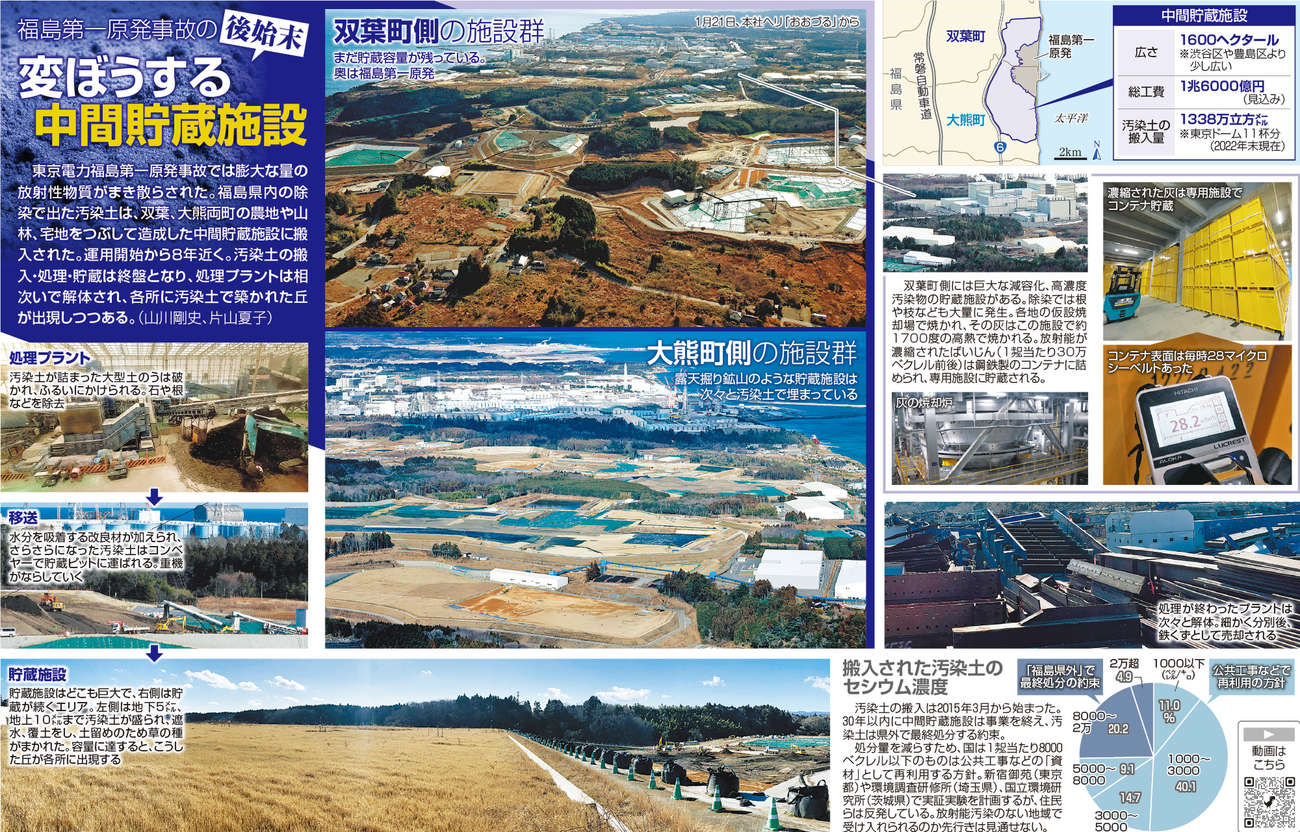
The accident at the Fukushima Daiichi Nuclear Power Plant of Tokyo Electric Power Company (TEPCO) has spread an enormous amount of radioactive materials. Contaminated soil and other materials were stripped and collected from all over Fukushima prefecture into an interim storage facility built near the plant. The 1,600 hectares of land is turning into hills of contaminated soil. See the latest situation here.

A group of facilities on the Okuma side. Storage facilities, which look like open-pit mines, are being filled with contaminated soil one after another.

Futaba Town side. This side still has storage capacity. In the back is the Fukushima Daiichi Nuclear Power Plant.

Treatment plant. Large sandbags filled with contaminated soil are broken and sifted. Stones and roots are removed.

Contaminated soil, which has been cleaned by the addition of a moisture-absorbing amendment, is transported by conveyor to a storage pit. Heavy equipment levels the soil.

The storage facilities are all huge. On the right side is the area where the storage continues. On the left side, contaminated soil has been piled up to 5 meters underground and 10 meters above the ground, and the soil has been shielded, covered, and covered with grass seeds to keep the soil in place. When the site reaches capacity, hills like this will appear in various locations.

On the Futaba Town side, there is a huge volume reduction and storage facility for highly contaminated materials. Roots and branches are also generated in large quantities during decontamination. They are burned at temporary incineration plants in various locations, and the ashes are burned at this facility at a high temperature of about 1,700 degrees Celsius. Radioactivity-enriched dust (around 300,000 becquerels per 1,000,000 tons) is packed in steel containers and stored in a dedicated facility.

Within the volume reduction facility is an incinerator that reduces the volume of ash. The ash is burned at 1,700 degrees Celsius.

Highly concentrated (about 300,000 becquerels/kg) dust separated from the burned ash is stored for a long time in this way.

Contaminated soil treatment plants that have finished processing are being dismantled, sorted into smaller pieces, and sold as scrap iron.
Fukushima: Director Makoto Shinkai of “Suzume no Togome”: “If I don’t depict the scenery of Futaba-gun, I will be telling a lie”

C)2022 “Suzume no Togome
2023/02/05
The protagonists stop their car at a coastal area in the prefecture along Route 6 and get off at a hill overlooking the beautiful sea. As they look around, they see a village with overgrown grass. Director Makoto Shinkai (49)’s latest animated film, “Suzume no Togome” (The Sparrow’s Doorstep),” depicts the Great East Japan Earthquake as one of its themes, as well as Fukushima Prefecture and other affected areas. In an exclusive online interview with Fukushima Minpo, Shinkai said, “I felt that if I did not depict the scenery of Futaba County, I would be telling a lie with ‘Suzume no Togomei’ (Suzume’s Door Closed).
■Preparedness
The film features Suzume, a 17-year-old high school student living in Kyushu. The film is an adventure story in which Suzume and her friends are trying to close the “door” that leads to disaster in abandoned buildings in various parts of the country where people no longer live.
Suzume and his friends drive down National Route 6, passing by a sign that reads “Difficult-to-return zone. While the road has been cleaned up, the houses on both sides of the road remain abandoned. The view from the top of the hill where they arrived at the site shows buildings reminiscent of TEPCO’s Fukushima Daiichi Nuclear Power Plant.
Two summers ago, Shinkai visited the area and experienced firsthand the current situation in the hard-to-return zone. It is meaningful to indirectly convey to the audience that this kind of scenery exists in Japan,” he said. He was determined not to let the disaster fade away.
There are many scenes that faithfully reproduce the scenery of various parts of Japan. However, in depicting Fukushima Prefecture, the shapes and layouts of the houses were fictitious while maintaining the atmosphere of the area. There are many people who want to return. I couldn’t just paint someone’s house without their permission.”
Trust
In Shinkai’s works, background art plays an important role in the story. Many viewers are drawn to the sparkling sea and colorful grasslands. Memories of people who once spent their lives in abandoned schools and hot spring resorts float in the air. The film is a directing collaboration between Shinkai and the director of the hit film “Kimi no na wa. The art director of this film, Takumi Tanji, who has been working with Shinkai for about 20 years, including on the hit film “Kimi no na wa. He is like a ‘Superman’ to me,” he says.
Tanji is responsible for setting up fictional locations such as hot spring resorts and amusement parks based on real landscapes. Even if I ask him to do something a little difficult, he smiles and says, “Well, we’ll figure it out. He has the full confidence of all the staff, including myself, that we can leave everything in his capable hands.
Spinning
Twelve years will soon pass since the disaster. An increasing number of people of that generation do not know what it was like at the time of the disaster. He analyzes that more than one-third of the audience is younger than the disaster victims and says, “If I could create an opportunity for people to learn about the disaster, I would like to think that it was only possible because it was an animation.
About three months have passed since the release of the film. He has given stage greetings throughout Japan and visited Fukushima Prefecture on January 28. He received many letters through the theaters and was encouraged by the warm response, smiling and saying, “I felt that it was good that this film exists.
There has been criticism of the depiction of the disaster in entertainment films, and he accepts that “there can never be a film that everyone agrees with, and I can’t easily say that it was a success. Still, he also believes that if films only avoid depicting the painful parts of the disaster, they will not move people’s hearts.
I hope that animated films can play a role in society, and not just be interesting,” he said. He believes in the power of film and intends to continue to face this challenge.
https://www.minpo.jp/news/moredetail/20230205104586?fbclid=IwAR3j81Uxq22DoAI6LEXaQSTK08ej5p7_DfpSaSvvxN0gHq5AC3i8Vdd7nx8
Lack of competition in biddings for Fukushima decontamination,auditors say
Feb. 3, 2023
Japan’s Board of Audit has found that nearly half of the tenders related to reconstruction work related to the Fukushima Daiichi nuclear accident had only one bidder.
The auditors on Friday submitted their report on government projects such as decontamination and waste disposal in the aftermath of the 2011 accident.
The Environment Ministry’s Fukushima office held 735 public tenders in the five and a half years until September 2021. Of these, 49.3 percent had one bidder.
The percentage is about 15 points higher than the average for public tenders held by the government.
The auditors also found that, on average, the prices offered by successful bidders were 94.6 percent of the prices set by the government.
This is more than 13 points higher than the average for tenders with two or more bidders.
The Board of Audit is calling on the government to ensure fair competition in public biddings.
Sophia University Professor Kusunoki Shigeki says the findings raise suspicion of a structural problem that allows only one bidder to take part.
He says that when a bidder is confident of winning, it usually sets a high price.
This week in nuclear news

A bit of good news. Good news about global warming: The public’s paying attention.
Coronavirus. Coronavirus Disease (COVID-19): Weekly Epidemiological Update
Climate.
Climate change is triggering more earthquakes. Big Oil’s interests are a factor.
Nuclear. Insanity rules? America going gaga about a balloon. Turkey pressing on with nuclear reactor build – all too handy to the earthquake zone. Australia looking forward to its war against China. Ukraine thinking it would be nice to bomb Crimea – and that’s OK with the Yanks.
Christina notes. Hooray – Australia’s cultural cringe is over! We’re gonna be important, like Ukraine! The evil of the nuclear industry – France to transfer public interest savings funds to the nuclear industry?
************************************************************
CLIMATE. Ann Darling: Nuclear power is no answer to anything our ailing planet needs. France in new row with Germany and Spain. Leak: France wins recognition for nuclear in EU’s green hydrogen rules. France wants to call nuclear-derived hydrogen “clean”. When the Great Tide returns. Twice as Much Land in Developing Nations Will be Swamped by Rising Seas than Previously Projected, New Research Shows.
CIVIL LIBERTIES. Night carnival in London calls for Julian Assange’s release. https://www.youtube.com/watch?v=YJaq08VHJk4 Ukraine purges libraries of Russian-language books – official.
ECONOMICS. Poland might have tax-payer fund its ambitious nuclear plans, and hope that investors might come in later. Marketing: Russia marketing nuclear reactors to Myanmar. Cameco Agrees to New Deal With Ukraine’s Nuclear Energy Utility.
EMPLOYMENT. Young people want to work in genuinely clean industries.
ENERGY. Renewables In China Trend Upward While Nuclear Trends Flat. US announces first transfer of seized Russian assets to Kiev. Solar’s stunning journey from lab curiosity to global juggernaut wiping out fossil fuels.
ENVIRONMENT. Campaigners claim permit change at Hinkley Point would kill billions of fish. Fear for fish: EDF plan for Hinkley project means ‘enormous tragedy’ for ecosystem. Japan Plans to Dump Fukushima Wastewater Into a Pacific With a Toxic Nuclear History.
HEALTH. Health status of the population living in the zone of influence of radioactive waste repositories . Radioactive releases from the nuclear power sector and implications for child health. ‘Downwind’: How Did America Create Its Own Nuclear Disaster?
HUMAN RIGHTS. Emerging Environmental Justice Issues in Nuclear Power and Radioactive Contamination.
LEGAL. Neo-Nazi previously implicated in plot to attack nuclear plants now arrested for planning grid sabotage around Baltimore. U.S. Court of Appeals rejects New Mexico’s challenge to Nuclear Waste License . Greenpeace will sue the European Commission over its decision to include gas and nuclear as “clean”. Outline of Greenpeace’s legal arguments against including gas and nuclear in the EU Taxonomy.
MEDIA. Media ‘Spy Balloon’ Obsession a Gift to China Hawks.
OPPOSITION to NUCLEAR. Highlands Against Nuclear Power (HANP).
POLITICS.
- Rep. Matt Gaetz introduces resolution to end military and financial aid to Ukraine, urge peace deal.
- “The devil is always in the details”: Nuclear watchdog urges public to attend Diablo Canyon meetings.
- France’s Latest Nuclear Halt Is a Reminder of Long-Lasting Nature of Problem. France considers tapping public interest savings accounts for nuclear reactor funding.
- Poland wants the European Union to push for more investment in nuclear energy.
- Spain upholds decision to reject plan for uranium mine.
- Signs of madness? —in the rarefied air of the British Parliament, Westinghouse spouts nuclear lies, without being challenged. UK’s Nuclear Free Local Authorities send seven magnificent suggestions to the new Secretary of State.
POLITICS INTERNATIONAL and DIPLOMACY. Setting the Record Straight; Stuff You Should Know About Ukraine. Ballooning paranoia: The China threat hits the skies. The United States and China Still Need to Talk About Nuclear Weapons. China’s spy balloon can help deflate US nuclear tensions with Beijing.
The US Department of Energy has made it
easier to share nuclear information with Mexico and harder to do so for Colombia and Egypt. EU’s Top Diplomat Says
Iranian Deal Is Only Way to Stop Tehran’s Nuclear Program.
PROTESTS. No to US nukes in Britain: CND is returning to Lakenheath, 20 May 2023!
SAFETY. French minister confirms plans to extend nuclear lifetimes. Continuing with Akkuyu nuclear plant in seismic Turkey would be reckless. Fears of ‘catastrophic’ nuclear horror as Turkey’s reactor rocked by horror earthquake. Japan: Cabinet adopts policy of using nuclear reactors beyond 60-year limit. Incident. That time Northern California had a near nuclear accident.
SECRETS and LIES. Illegal organ market is a lucrative business in war-torn Ukraine.
SPINBUSTER. High-altitude surveillance — even balloons — is nothing new. So why the fuss?
SPACE. EXPLORATION, WEAPONS. Another sign of madness? – thermonuclear propulsion technology to power a rocket to Mars.
WAR and CONFLICT. We’ve Never Been Closer to Nuclear Catastrophe—Who Gains by Ignoring It? Australia safest country to survive nuclear apocalypse – except for it being a military target. The US is preparing Australia to fight its war against China. Australia’s Taiwan nightmare. Aukus fallout: as US-China tensions grow, Australians reveal mixed feelings about nuclear submarine pact.
Endgame is going on in Ukraine crisis. US defense official flags ‘no objections’ to Kiev attacking Crimea.Here’s eight reasons why the US has no interest in pushing for peace in Ukraine. Did Volodymyr Zelensky call for ‘preventive nuclear strikes’ against Russia? Not exactly. US role in Kiev’s artillery warfare identified – media.
CNN video: NATO rehearses war with Russia in neighboring Estonia Dr. Helen Caldicott Says The World Is Closer To Nuclear Annihilation Than Ever Before. Would YOUR neighborhood be targeted in a nuclear attack? Official map shows the 2,000 locations across the US most at risk.
WEAPONS and WEAPONS SALES. Russia closes down the world’s largest nuclear-powered strategic submarine (they don’t say where the radioactive wastes go). U.S. Test Launches ICBM Into Pacific as Part of Nuclear ‘Deterrence Mission’ If Arms Control Collapses, US and Russian Strategic Nuclear Arsenals Could Double In Size.
New Report Unpacks Dangers of Emerging Military Tech, From AI Nukes to Killer Robots. US takes another step toward gearing up nuclear plutonium weapons core factory. Much-hyped tanks for Ukraine are in short supply. Elon Musk’s SpaceX Cuts Support for Ukrainian Military but continues work for U.S. military. North Korea shows off largest-ever number of nuclear missiles at anniversary parade. Three years without one single on-site US nuclear weapons inspection at base for Northern Fleet ballistic missile submarines.
The latest warning — Continuing with Akkuyu nuclear plant in seismic Turkey would be reckless

Devastating Turkey earthquake should end nuclear plant plans
The station is being built like all major projects in Turkey through non-transparent procedures with direct commissioning and guarantees from the government, just like the apartment buildings we saw crumble into rubble during the recent earthquake.
For those wondering why Erdogan supports unsafe, expensive and dirty nuclear power, the answer lies in his statement in 2019, at an AKP conference, that “Turkey’s intention is to acquire a nuclear arsenal”.
The latest warning — Beyond Nuclear International
Continuing with Akkuyu nuclear plant in seismic Turkey would be reckless
By Maria Arvanitis Sotiropoulou
The devastating earthquakes of February 7, with a magnitude of 7.8 in Turkey, brought to the fore the issue of the danger of the nuclear plant under construction there in Akkuyu.
The Akkuyu Nuclear Power Plant, consisting of four 1,200 MWe VVER1200 units, is being built under an intergovernmental agreement between the Turkish and Russian governments. In May 2010, Russia and Turkey signed an agreement that Rosatom would build, own and operate the 4.8 GW nuclear power plant at Akkuyu. The agreement was ratified by the Parliament of Turkey in July 2010. Construction began in 2011 and was expected to be commissioned in 2023 in celebration of the 100 years of the Turkish Republic.
The station is being built like all major projects in Turkey through non-transparent procedures with direct commissioning and guarantees from the government, just like the apartment buildings we saw crumble into rubble during the recent earthquake.
From the beginning of the construction, many technical issues were revealed: ground subsidence, serious deficiencies in the geotechnical and environmental studies, even a case of a forged design signature in 2015. Then, in January 2021, two explosions occurred at the construction site, causing interventions in the European Union where MEP George Georgiou submitted a pertinent question to the European Commission, while the Minister of Foreign Affairs Nikos Dendias also took similar actions without a response.
Unfortunately, as demonstrated by the Classification Vote (on including nuclear power in the green taxonomy) in the European Parliament, the nuclear lobby prevails in the EU today, despite the justifiable alarm among European citizens caused by the war in Ukraine, due to the presence of the Chornobyl and Zaporizhzhia nuclear plants in the war zone.
On January 10, 2021, Kemalist Republican People’s Party (CHP) MP, Mahir Basasir, tweeted that seawater was seeping through the concrete floor of the Akkuyu station. But even if the nuclear plant were structurally safe, such strong earthquakes can cause damage to the piping, so a Fukushima-style disaster is to be expected.
In Fukushima, we saw radioactive contaminated water pouring into the Pacific ocean and pollution has now been measured in the Atlantic as well. The Mediterranean is a closed basin and a similar disaster would turn it into a Dead Sea.
Additional risks arise with radioactive waste because Turkey is not a party to the IAEA (1997) treaty on the safe management of nuclear waste, and, in the Agreement with Rosatom, Russia retains the right to return the irradiated highly radioactive waste fuel to Turkey, after five to 10 years, for dry storage.
The recent earthquakes are an opportunity to stop this madness again. After all, this is not the first time that citizens have managed to reason with their leaders on this matter.
The nuclear era in Turkey began in 1969 when Demirel decided to build a 3,000MW nuclear plant. Ecevit approved a bid from the Swedish ASEA — Atom Metex — but the agreement ended due to problems within the company. Because the nuclear lobby has always been powerful, three companies, from Switzerland, France and Germany, immediately bid and in 1975 the Akkuyu site, 25 km from an active seismic area, was chosen.
In 1985, an agreement was signed with the Canadian AECL for a capacity of 7,000 MW, causing many negative reactions both in Turkey and in the Mediterranean, Europe and Canada, especially after the deadly 6.3 earthquake of June 27, 1998 in Adana, whose epicenter was 136 km east of Akkuyu .
This, along with the 1986 Chornobyl nuclear disaster, prompted a rapid mobilization of citizens, including in Greece, where a press conference was held in Athens on September 28, 1998 with the Greek-Canadian MP and scientific director of the “Nuclear Awareness Project”, David Martin, as the speaker.
Further concerns were raised after the even larger earthquake of August 17, 1999 in the Kocaeli Province of Turkey, with a catastrophic magnitude of 7.6. It caused enormous damage and led to more than 18,000 deaths.
Thanks to the reactions of citizen activists and due to the enormous financial costs, the construction of Akkuyu was canceled in 2000. However, President Erdogan, who does not hide his nuclear ambitions, decided in 2010 to revive it using Russian financing and know-how. Ground was broken for the first of the four reactors in April 2018. Groundbreaking for the fourth reactor took place in July 2022.
Although the nuclear lobby argues that it provides cheap and sustainable energy production, Akkuyu refutes this.
With an estimated cost of $20 billion, the Akkuyu nuclear power plant is one of the most expensive for an estimated lifetime of 60 years. Its construction and operation for the first 20 years is under the exclusive control of Rosatom. Although control of the power station will pass to Turkey after that, 51% of the shares will remain with Rosatom.
The claim that Akkuyu will provide cheap energy is also not true. With the Akkuyu deal, Turkey has guaranteed to buy electricity at a weighted average price of 12.35 to 15.33 US cents/kWh for at least 15 years, while Turkey’s average power purchase price is 4.4 cents/kW currently.
For those wondering why Erdogan supports unsafe, expensive and dirty nuclear power, the answer lies in his statement in 2019, at an AKP conference, that “Turkey’s intention is to acquire a nuclear arsenal”.
Although after the experience of India and Pakistan, who went from nuclear reactors to nuclear everything, the process has become more difficult, Erdogan apparently hopes that the three planned nuclear plants (Akkuyu, Sinop, Iconium, all in seismic areas of military interest) will allow Turkish scientists to be trained in the relevant fields.
As happened after the deadly earthquakes of 1998 and 1999, we hope today that the politics of peace will prevail, that the disastrous nuclear course for the Mediterranean will stop and that the nuclear plant in Akkuyu will remain on the drawing board.
This article is a translation from the Greek of Maria Arvanitis Sotiropoulou’s blog. A retired doctor, she is the President of the Greek affiliate of International Physicians for the Prevention of Nuclear War.
Headline photo of February 2023 earthquake damage in Turkey by Voice of America/Wikimedia Commons.
We’ve Never Been Closer to Nuclear Catastrophe—Who Gains by Ignoring It?
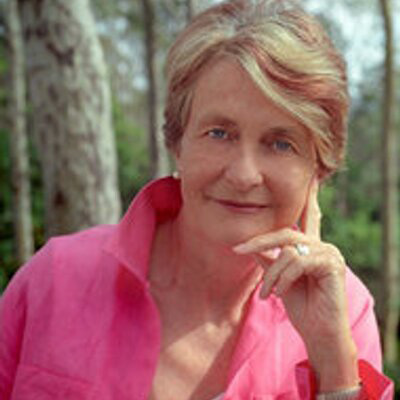
Antiwar and environmental activist Dr. Helen Caldicott warns that policymakers who understate the danger of nuclear weapons don’t have the public’s best interest at heart.
By Steve Taylor. 12.02.23 – Independent Media Institute https://www.pressenza.com/2023/02/weve-never-been-closer-to-nuclear-catastrophe-who-gains-by-ignoring-it/
Editor’s note: This interview has been edited for clarity and length. A video of the description of nuclear war from the interview can be viewed on Vimeo. Listen to the entire interview, available for streaming on Breaking Green’s website or wherever you get your podcasts. Breaking Green is produced by Global Justice Ecology Project.
This interview took place on January 25, 2023, one day after the Bulletin of the Atomic Scientists advanced the hands of the Doomsday Clock to 90 seconds before midnight—in large part due to developments in Ukraine. Dr. Helen Caldicott, an Australian peace activist and environmentalist, discussed the extreme and imminent threat of a nuclear holocaust due to a proxy war between the U.S. and Russia in Ukraine. She also addressed the announcement by the U.S. Department of Energy of a controlled nuclear reaction and outlines the relationship between the nuclear power industry and nuclear weapons.
Caldicott is the author of numerous books and is a recipient of at least 12 honorary doctorates. She was nominated for the Nobel Prize by physicist Linus Pauling and named by the Smithsonian as one of the most influential women of the 20th century. Her public talks describing the horrors of nuclear war from a medical perspective raised the consciousness of a generation.
Caldicott believes that the reality of destroying all of life on the planet has receded from public consciousness, making doomsday more likely. As the title of her recent book states, we are “sleepwalking to Armageddon.”
Steve Taylor: The Bulletin of the Atomic Scientists recently set the Doomsday Clock to 90 seconds to midnight. What is the Doomsday Clock, and why is it now set to 90 seconds to midnight?
Helen Caldicott: For the last year, it’s been at 100 seconds to midnight, which is the closest it’s ever been. Each year they reset the clock according to international problems, nuclear problems. Ninety seconds to midnight—I don’t think that is close enough; it’s closer than that. I would put it at 20 seconds to midnight. I think we’re in an extremely invidious position where nuclear war could occur tonight, by accident or by design. It’s very clear to me, actually, that the United States is going to war with Russia. And that means, almost certainly, nuclear war—and that means the end of almost all life on Earth.
ST: Do you see similarities with the 1962 Cuban missile crisis?
HC: Yes. I got to know John F. Kennedy’s Secretary of Defense, Robert McNamara, later in his life. He was in the Oval Office at the time of the Cuban missile crisis. He once told me, “Helen, we came so close to nuclear war—three minutes.” Three minutes. We’re in a similar situation now.
ST: So back then, though, famously, the world held its breath during the missile crisis.
HC: Oh, we were terrified. Terrified, absolutely terrified.
ST: That doesn’t seem to be the case today.
HC: Today, the public and policymakers are not being informed adequately about what this really means—that the consequences would be so bizarre and so horrifying. It’s very funny; New York Cityput out a video as a hypothetical PSA in July 2022 showing a woman in the street, and it says the bombs are coming, and it’s going to be a nuclear war. It says that what you do is go inside, you don’t stand by the windows, you stand in the center of the room, and you’ll be alright. I mean, it’s absolutely absurd.
ST: That is what you were fighting against back in the ’70s and ’80s—this notion that a nuclear war is survivable.
HC: Yes. There was a U.S. defense official called T.K. Jones who reportedly said, don’t worry; “if there are enough shovels to go around,” we’ll make it. And his plan was if the bombs are coming and they take half an hour to come, you get out the trusty shovel. You dig a hole. You get in the hole. Someone puts two doors on top and then piles on dirt. I mean, they had plans. But the thing about it is that evolution will be destroyed. We may be the only life in the universe. And if you’ve ever looked at the structure of a single cell, or the beauty of the birds or a rose, I mean, what responsibility do we have?
ST: During the Cuban missile crisis, the U.S. did not want missiles pointed at it from Cuba, and the Soviet Union did not want missiles pointed at it from Turkey. Do you see any similarities with the conflict in Ukraine?
HC: Oh, sure. The United States has nuclear weapons in European countries, all ready to go and land on Russia. How do you think Russia feels—a little bit paranoid? Imagine if the Warsaw Pact moved into Canada, all along the northern border of the U.S., and put missiles all along the northern border. What would the U.S. do? She’d probably blow up the planet as she nearly did with the Cuban missile crisis. I mean, it’s so extraordinarily unilateral in the thinking, not putting ourselves in the minds of the Russian people.
ST: Do you feel we’re more at risk of nuclear war now than we were during the Cold War?
HC: Yes. We’re closer to nuclear war than we’ve ever been. And that’s what the Bulletin of the Atomic Scientists indicated by moving the clock to 90 seconds to midnight.
ST: Does it seem like political leaders are more cavalier about nuclear exchange now?
HC: Yes, because they haven’t taken in what nuclear war would really mean. And the Pentagon is run by these cavalier folks who are making millions out of selling weapons. Almost the whole of the U.S. budget goes to killing and murder, rather than to health care and education and the children in Yemen, who are millions of them starving. I mean, we’ve got the money to fix everything on Earth, and also to power the world with renewable energy. The money is there. It’s going into killing and murder instead of life.
ST: You mentioned energy. The Department of Energy has announced a so-called fusion breakthrough. What do you think about the claims that fusion may be our energy future?
HC: The technology wasn’t part of an energy experiment. It was part of a nuclear weapons experiment called the Stockpile Stewardship Program. It is inappropriate; it produced an enormous amount of radioactive waste and very little energy. It will never be used to fuel global energy needs for humankind.
ST: Could you tell us a little bit about the history of Lawrence Livermore National Laboratory in California, where scientists developed this fusion technology?
HC: The Lawrence Livermore Laboratory was where the first hydrogen bombs were developed. It was set up in 1952, by Edward Teller, a wicked man.
ST: There is this promotion of nuclear energy as a green alternative. Is the nuclear energy industry tied to nuclear weapons?
HC: Of course. In the ’60s, when people were scared stiff of nuclear weapons, there was a Pentagon psychologist who said, look, if we have peaceful nuclear energy, that will alleviate the people’s fear.
ST: At the end of your 1992 book If You Love This Planet, you wrote, “Hope for the Earth lies not with leaders, but in your own heart and soul. If you decide to save the Earth, it will be saved. Each person can be as powerful as the most powerful person who ever lived—and that is you, if you love this planet.” Do you stand by that?
HC: If we acknowledge the horrifying reality that there is an extreme and imminent threat of nuclear war, it’s like being told that as a planet, we have a terminal disease. If we’re scared enough, every one of us can save the planet. But we have to be very powerful and determined.
This article was produced by Earth | Food | Life, a project of the Independent Media Institute.
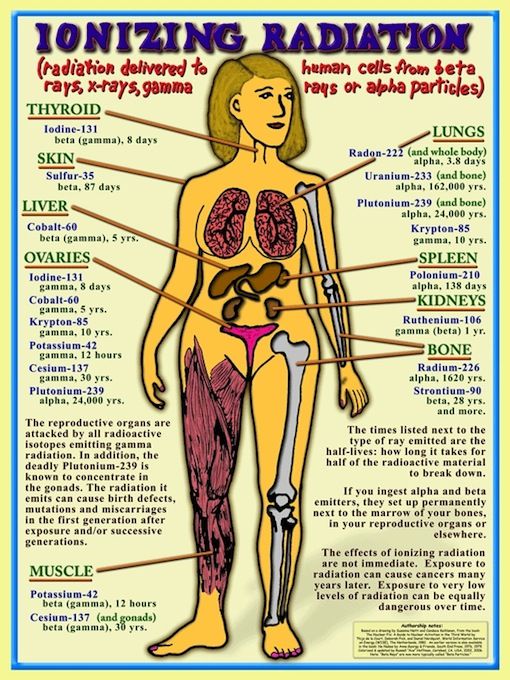
Radioactive releases from the nuclear power sector and implications for child health.
Notes here provided by:
Simon J Daigle, B.Sc., M.Sc., M.Sc(A)
Industrial / Occupational Hygienist, Climatologist,
Environmental Sciences Expert (Air Quality tropospheric Ozone),
Epidemiologist, Citizen scientist
Montreal, Quebec, Canada.
This BMJ article articulated extremely well the challenges of women’s health, pregnancy and radioactive exposures and includes nuclear power and related industries (nuclear waste). The facts below were known for decades and true to this very day and I quote:
“exposure standards in the USA remain based on a Reference Man—a model that does not fully account for sex and age differences.”
“Early in the nuclear weapons era, a ‘permissible dose’ was more aptly recognised as an ‘acceptable injury limit,’ but that language has since been sanitised. Permissible does not mean safe.”
“As noted by the EPA, this gives radiation a ‘privileged pollutant’ status”
The facts above are not only astonishing, in which the general public may either be oblivious or uninformed, but in 2023, these facts remain true and yet the nuclear industry remain “willfully blind” and disingenuous about the real radiation risks, especially to the most vulnerable groups in our population.
British Medical Journal – Paediatrics (Open Access).
A reputable journal! A recent article in the British Medical Journal – Paediatrics (Oct 2022).
Open access to all. A reputable journal!
Radioactive releases from the nuclear power sector and implications for child health (October 2022).
Link: https://bmjpaedsopen.bmj.com/content/6/1/e001326
Selected excerpts:
“Children, women and particularly pregnant women living near nuclear production facilities appear to be at disproportionately higher risk of harm from exposure to these releases. Children in poorer often Non-White and Indigenous communities with fewer resources and reduced access to healthcare are even more vulnerable—an impact compounded by discrimination, socioeconomic and cultural factors.”
“Nevertheless, pregnancy, children and women are under protected by current regulatory standards that are based on ‘allowable’ or ‘permissible’ doses for a ‘Reference Man’.”
“Early in the nuclear weapons era, a ‘permissible dose’ was more aptly recognised as an ‘acceptable injury limit,’ but that language has since been sanitised. Permissible does not mean safe. Reference Man is defined as ‘…a nuclear industry worker 20–30 years of age, [who] weighs 70kg (154 pounds), is 170cm (67 inches) tall…is a Caucasian and is a Western European or North American in habitat and custom’.”
“However, many studies are unable to link these adverse outcomes to radioactivity because the studies’ authors tend to use several faulty assumptions:
- ‘doses will be too low to create an effect’—a beginning assumption ensuring poor hypothesis formation and study design. Therefore, when an effect is found, radioactivity has been predetermined not to have an association with the effect. This exclusion often leads to an inability to find an alternate associated disease agent;
‘small negative findings matter’—In fact, what matters are positive findings or very large negative findings;- ‘statistical non-significance means a lack of association between radiation exposure and disease’ — a usage a number of scientists in various disciplines now call ‘ludicrous’;
- ‘potential bias or confounding factors are reasons to dismiss low dose studies’—In fact, when assessing low dose impacts, researchers should take care not to dismiss studies with these issues and researchers should minimise use of quality score ranking.
“Consequently, we examine and reference studies even if they contain such faulty assumptions because they still indicate increases in certain diseases, such as some leukaemias, known to be caused by radiation exposure. Additionally, few alternative explanations were offered in the conclusions of these studies, meaning radiation exposure might still have been the cause.”
“Current U.S. regulations allow a radiation dose to the public (100 mrem per year) which poses a lifetime cancer risk to the Reference Man model of 1 person in 143. This is despite the EPA’s acceptable risk range for lifetime cancer risk from toxics being 1 person in 1million to 1 person in 10000. As noted by the EPA, this gives radiation a ‘privileged pollutant’ status. Additionally, biokinetic models for radioisotopes are not sex-specific. A male model is still used for females. The models are also not fully age-dependent. Radiation damage models also fail to account for a whole host of childhood and pregnancy damage.”
Highlights (Conclusion)
- Despite the numerous observations globally, linking radiation exposures to increased risks for children, pregnant and non-pregnant women and the well-demonstrated sensitivity to other toxicants during these life stages, exposure standards in the USA remain based on a Reference Man—a model that does not fully account for sex and age differences.
- In addition, faulty research assumptions, unique exposure pathways, systemic inequities and legacy exposures to both heavy metals and radioactivity from mining wastes add to the risks for women and children, especially those in underserved communities.
- Socioeconomic factors that drive higher deprivation of services in non-homogenous low-income communities of colour also put non-White children at higher risk of negative health outcomes when exposed to radioactive releases, than their White counterparts.
- A first and essential step is to acknowledge the connection between radiation, heavy metal and chemical exposures from industries and the negative health impacts observed among children, so that early diagnosis and treatment can be provided.
- Measures should then be taken to protect communities from further exposures, including a prompt phaseout of nuclear power and its supporting industries.
Studies are also urgently needed where there are none, and the findings of independent doctors, scientists and laboratories should be given equal attention and credence as those conducted by industry or government-controlled bodies, whose vested and policy interests could compromise both their methodologies and conclusions.- Finally, in the face of uncertainty, particularly at lower and chronic radiation doses, precaution is paramount.
Notes:
Funding: The authors have not declared a specific grant for this research from any funding agency in the public, commercial or not-for-profit sectors.
Competing interests: None declared.
Patient consent for publication: Not applicable.
Ethics approval: Not applicable.
Provenance and peer review: Commissioned; externally peer reviewed
US defense official flags ‘no objections’ to Kiev attacking Crimea
any attack on Crimea would be interpreted as an attack on the country itself. Kiev must understand that such moves would be “met with inevitable retaliation using weapons of any kind.”
the administration of US President Joe Biden was warming to the prospect of helping Ukraine to target Crimea, “even if such a move increases the risk of escalation.”
https://www.rt.com/russia/571323-us-no-objections-crimea-attack/ 12 Feb 23,
Washington will not limit Ukrainian strikes on territory it claims as its own, Celeste Wallander said.
The US would have no objections to Ukrainian forces striking targets inside Crimea with American-supplied weapons, a senior defense official said on Friday.
Dr Celeste Wallander, Assistant Secretary of Defense for International Security Affairs, was asked whether Washington supports Kiev in seizing Crimea, or at least in striking Russian targets there. The peninsula overwhelmingly voted to become part of Russia in 2014 following a Western-backed coup in Kiev.
Speaking at the Center for a New American Security, Wallander reiterated that the US “supports Ukraine’s territorial integrity and sovereignty over its internationally recognized borders, and that includes Crimea.” With this in mind, the official argued that Kiev “has the right to defend every inch of its territory.”
As long as Ukraine “identifies operational value in targeting Russian forces on Ukrainian territory… we don’t have objections and do not seek to limit Ukrainian military operations to achieve their objectives.”
She also commented on remarks made by Chairman of the US Joint Chiefs of Staff General Mark Milley, who warned in January that it would be “very difficult” for Ukraine “to militarily eject the Russian forces” from all the territories they currently control.
“I am not going to contradict general Milley, and I think he was giving a hard-headed assessment of the scale of the challenge,” she said.
In January, The New York Times reported, citing sources, that the administration of US President Joe Biden was warming to the prospect of helping Ukraine to target Crimea, “even if such a move increases the risk of escalation.”
On February 3, the US announced a new $2.17 billion security package for Ukraine which included ground-launched, small-diameter bombs (GLSDB) with a range of up to 150 kilometers (93 miles). While the Pentagon said that this long-range capability would enable Ukrainians “to take back their sovereign territory,” it declined to speculate about Kiev’s future potential operations.
Last week, former Russian President Dmitry Medvedev, who now serves as Deputy Chair of the nation’s Security Council, warned that any attack on Crimea would be interpreted as an attack on the country itself. Kiev, he said, must understand that such moves would be “met with inevitable retaliation using weapons of any kind.”
Leak: France wins recognition for nuclear in EU’s green hydrogen rules

By Nikolaus J. Kurmayer | EURACTIV.com. Feb 12, 2023
The European Commission has tabled long-awaited rules defining the circumstances under which hydrogen can be labelled as coming from “renewable” energy sources. Last minute, Paris also won recognition for low-carbon hydrogen produced from nuclear electricity.
……. the European Commission has been working on a set of rules to ensure green hydrogen uses only “additional” sources of renewable electricity.
After more than a year of delay due to intense lobbying from Paris and Berlin, the EU executive finally adopted those rules on Friday evening (10 February), according to documents obtained by EURACTIV.
……….. France scored a major victory.
For months, French politicians have lobbied Brussels to hammer the point that green hydrogen should also come from low-carbon nuclear electricity, not just renewables.
………………………… “this goes in the direction of pro-nuclear countries as well as those hostile to imports,” confirms Mikaa Mered, a lecturer on hydrogen markets, diplomacy and geopolitics at Sciences Po in Paris………………………………………….
The actual texts, seen by EURACTIV, have yet to be officially published in the EU’s register of delegated acts. However, last-minute changes are not expected.
> The main document, called a “delegated act” in EU jargon, is available below and can also be downloaded here. Two other documents are also available: a “delegated regulation” (here) and an annex (here). https://www.euractiv.com/section/energy-environment/news/leak-france-wins-recognition-for-nuclear-in-eus-green-hydrogen-rules/
Rep. Matt Gaetz introduces resolution to end military and financial aid to Ukraine, urge peace deal

in October House Leader Kevin McCarthy was more cautious, saying that Republicans wouldn’t write a “blank check” for Ukraine.
Russia-Ukraine conflict has been ongoing for nearly a year
By Adam Shaw | Fox News 12 Feb 23 https://www.foxnews.com/politics/gaetz-introduces-resolution-end-military-financial-aid-ukraine-urge-peace-deal
Rep. Matt Gaetz, R-Fla., is introducing a resolution in the House on Thursday that calls on the Biden administration to end U.S. military and financial aid to Ukraine — while also urging all involved to secure a peace agreement after nearly a year of war in the region.
The resolution, the “Ukraine Fatigue Resolution” is being introduced by Gaetz and 10 co-sponsors and calls for the U.S. to “end its military and financial aid to Ukraine and urges all combatants to reach a peace agreement.”
The resolution notes that since Russia invaded Ukraine in February 2022, the U.S. has been the top contributor to the Ukrainian war effort, with more than $110 billion in financial, military, and humanitarian aid to the U.S. ally. It includes more than $27.4 billion in security assistance.
In January the U.S. announced additional security assistance, including approval by President Biden of 31 Abrams M1 tanks to Ukraine. On top of that, reports suggest another $2 billion could be in the pipeline.
The resolution lists the enormous amount of equipment that the U.S. has provided to the country since the beginning of the conflict. It also cites Pentagon officials who have said the munitions have “severely depleted United States stockpiles, weakening United States readiness in the event of conflict.”
It also claims that by providing assistance, the U.S. is inadvertently contributing to civilian casualties, and notes U.S. estimates that 40,000 civilians had died in the conflict.
Concern about the continued U.S. funding of the war has grown among a subset o f Republicans as the conflict has dragged on, with lawmakers highlighting issues at home that could use additional funding
Gaetz, a member of the House Armed Services Committee, said the U.S. has been the top contributor to what he called an “everlasting conflict.”
“America is in a state of managed decline, and it will exacerbate if we continue to hemorrhage taxpayer dollars toward a foreign war,” he said. We must suspend all foreign aid for the War in Ukraine and demand that all combatants in this conflict reach a peace agreement immediately.”
The co-sponsors on the resolution include Reps. Andy Biggs, R-Ariz., Lauren Boebert, R-Colo., Paul Gosae, R-Ariz., Marjorie Taylor Greene, R-Ga., Anna Paulina Luna, R-Fla., Thomas Massie, R-Ky., Mary Miller, R-Ill., Barry Moore, R-Ala., Ralph Norman, R-S.C. and Matt Rosendale, R-Mont.
Gaetz had taken aim at both parties for the additional funding for Ukraine earlier this week on the House floor, asking if there was a limit to the funding the U.S. was prepared to provide.
“How much more for Ukraine? Is there any limit?” he asked on the House floor. “Which billionth dollar really kicks in the door? Which redline we set will we not later cross?”
Republican leadership had broadly remained in favor of funding the war effort. Senate GOP Leader Mitch McConnell said in December said that “providing assistance for Ukrainians to defeat the Russians is the No. 1 priority for the United States right now according to most Republicans.”
However, in October House Leader Kevin McCarthy was more cautious, saying that Republicans wouldn’t write a “blank check” for Ukraine.
Another sign of madness? – thermonuclear propulsion technology to power a rocket to Mars.

Decisions on nuclear future are guided by myths.
By Linda Pentz Gunter 12 Feb 23
“…………………………………………………………. a sign of some kind of madness?
A few weeks later, that same presentiment [about the UK government] was re-evoked on reading a headline in the print edition of the Washington Post: US works on nuclear-powered rocket.
This is not an entirely new story, but an update on the plan to use thermonuclear propulsion technology to power a rocket to Mars.
There are so many things wrong with this. The premise is that not using a nuclear reactor to power the rocket will mean it will just be too tediously slow for human passengers to endure — a journey of seven months. With the reactor on board speeding the rocket on its way, the journey to Mars could be cut to what? A mere three and a half months. Not tedious at all!
Never mind that rockets have a nasty habit of sometimes exploding on the launch pad. And never mind that do we REALLY need to spend billions of dollars right now trying to get maybe three astronauts to Mars when we have a planet called Earth that desperately needs every dime and dollar available to save it?
The announcement was replete with the usual illogicalities. Sending astronauts on that seven-month journey to Mars in a traditional rocket was “dangerous” as “the radiation levels on a Mars mission could expose astronauts to radiation levels more than 100 times greater than on Earth.” Much better to send them there on a rocket powered by a nuclear reactor!
There is another agenda afoot here, of course, and it’s a military one and the sinister battle for who controls space.
If you thought shooting down the Chinese spy balloon was exciting, that was child’s play compared to what is planned for NASA’s nuclear reactors in space.
This includes being able to power satellites to become more agile in maneuvering away from “enemy” satellites. Using nuclear propulsion will achieve that, but what other consequences might result from a host of nuclear powered satellites buzzing around in space? It’s no surprise that the Space Force, created for war-fighting in space, is involved in all this.
And of course, apparently taking its cue from the mess we have already created on Earth, NASA wants to place nuclear reactors on the Moon as a power source. But for who or what exactly? Will we plant the US flag there while we are at it and claim a new military and strategic frontier? The signs are ominous.
And what about all the radioactive waste? Will we be boring deep holes in the Moon to bury it, or will we simply jettison it further into deep space? It’s bad enough that the oceans are already our dustbin. Now Space is to be our new nuclear waste frontier.
While all this was going on, evidence from yet more research poured in about how completely unnecessary it is to use nuclear power for anything, now or in the future.
Looking at every kind of power demand including energy consumption, electric vehicles, and commercial transport, then applying solar, wind, nuclear, heat pumps, storage and other technology, nuclear power was repeatedly eliminated from the mix for increasing costs without increasing reliability.
And yet, governments here and in far too many other parts of the world press on inexorably with plans to continue the use of nuclear power or develop new nuclear programs.
Despite all the evidence that this is — to understate it — a Very Bad Idea. https://beyondnuclearinternational.org/2023/02/12/signs-of-madness/
Linda Pentz Gunter is the international specialist at Beyond Nuclear and writes for and curates Beyond Nuclear International.
Signs of madness? —in the rarefied air of the British Parliament, Westinghouse spouts nuclear lies, without being challenged

Rarified (hot) air in halls of power is filled with propaganda
Fortunately, the gallery was under a mandatory code of silence, for it was hard not to emit a gasp of incredulity when the Westinghouse executive announced that his company had been “smashing production records” around the world.
Westinghouse has indeed broken some things: the law, and the bank for starters. But production records? He also mentioned that nuclear was “clean, reliable, dependable power” the very things it is not.
Signs of madness? — Beyond Nuclear International
Decisions on nuclear future are guided by myths
By Linda Pentz Gunter 12 Feb 23
Last month I rushed through the august halls of the British parliament in Westminster, on my way to a briefing on small modular reactors for Members of the Welsh Affairs Select Committee.
Running late though I was, it was tempting to slow down and take in all the historic portraits and portals as I hurried down flagstoned hallways, through heavy oak doors and finally into the richly carpeted committee room. But the albeit fleeting impression all of this left was of a world completely isolated from the reality of the daily struggles most of us endure. The rarified air was almost suffocating.
This became even more apparent as, unwillingly gagged, I listened to testimony from executives representing Westinghouse, Bechtel and Rolls Royce. One unsubstantiated sound bite after another tumbled from the mouths of these corporate executives, all serving their rich agenda of vested interests (read shareholders and profits).
But the questions they faced, at least from the Conservative nuclear cheerleaders present, were mainly mild softballs. Give us the soundbite, they urged. What do we need to tell the government to do to make all this happen?
Even Labour MP, Beth Winter, while challenging them on the obvious detriments of small modular, or any, reactors — time and cost — given, as she pointed out, climate change is very much here now, politely did not expose their utter hypocrisy. It was, after all, not a room in which arguing was on the agenda.
The Rolls Royce response was to trot out the “we need to do everything” mantra, which is what nuclear companies have to say in order for their technology to stand any chance at all. In reality, it is clear that choosing nuclear cancels out renewables. Meanwhile, Rolls Royce has pocketed — and presumably invested — £250 million (around $302 million US) with which it has done precisely nothing. But that’s the government’s fault, the company says. We just need to get in a room and get things done.
Fortunately, the gallery was under a mandatory code of silence, for it was hard not to emit a gasp of incredulity when the Westinghouse executive announced that his company had been “smashing production records” around the world.
Westinghouse has indeed broken some things: the law, and the bank for starters. But production records? He also mentioned that nuclear was “clean, reliable, dependable power” the very things it is not.
All of this was both a reminder of, and an eye-opener to, exactly the kind of false propaganda our elected officials are continuously exposed to, and swallow whole-heartedly. This is who they listen to: the corporate elite, in the United States bearing gifts as well, often in the form of generous campaign contributions. The politicians bought literally and figuratively by the major corporations, including nuclear power companies, dwell in an echo chamber filled with hot air. It’s not reality.
What was happening in that room in Westminster was also utterly pointless. Sitting there listening to 90 minutes of valuable time squandered in the stubborn pursuit of learning something more about a completely futile technology that has zero applicability to the climate or the immediate jobs crisis, it struck me that this was yet another symptom of humanity’s general malaise.
Or is it something worse than that? Being hell bent on wasting time and money talking about something entirely irrelevant no matter what the empirical evidence that should dismiss the continued use of nuclear power out of hand, must surely be a sign of some kind of madness?…………………………………….more https://beyondnuclearinternational.org/2023/02/12/signs-of-madness/
‘Downwind’: How Did America Create Its Own Nuclear Disaster?
BY PANDORA DEWAN ON 2/9/23 https://www.newsweek.com/downwind-documentary-america-create-nuclear-disaster-1780196
new documentary called Downwind shines a spotlight on the legacy of nuclear testing in the Nevada desert in the 50s and 60s and shares the stories of those whose lives were the most severely impacted.
Between 1951 and 1962, nuclear weapons were tested above ground at the Nevada Test Site, based in the Nevada desert, 65 miles north of Las Vegas. Underground testing continued until the 1990s and, in total, over 900 nuclear weapons tests were carried out at the site, according to the documentary.
Ken Smith, professor of family studies and population science at the University of Utah and executive director of the Wasatch Front Research Data Center, told Newsweek that the people who were most affected by these detonations, known as “downwinders,” were mostly based in Utah, southern Nevada and northern Arizona. “The number of people in that area at the time—[in] the mid-50s to the early 60s—is the concern,” he said.
The testing released plumes of radioactive material into the atmosphere, which was carried hundreds of miles by the wind before falling back down to the ground. This “nuclear fallout” material takes many different forms, but one of the most concerning is iodine-131, which can increase risk of thyroid cancer.
It is impossible to accurately determine the dose of radiation and the resulting risk of this exposure, but a report in 1999 by the National Cancer Institute estimated that nuclear weapons testing at the Nevada site would have yielded between 11,300 to 212,000 excess cases of thyroid cancer over this period.
Exposure to radioactive material is mainly thought to have occurred through the consumption of contaminated milk: when iodine-131 falls down to the earth it can settle on vegetation, which is eaten by cows and goats. Over time, the iodine-131 builds up in the animal’s bodies and accumulates in their milk, which is then consumed by people. Fresh produce and meat may have also contained small amounts of this radioactive material too, but it would have been less concentrated.
Overall, these concentrations are still very small, but some people would have been more vulnerable to this radiation than others. “It’s the children who were the most affected,” Smith said. “This is because they drink more milk and have smaller bodies. Your thyroid accumulates iodine-131, and they have a smaller thyroid.”
The Centers for Disease Control and Prevention (CDC) says that iodine-131 is not the only radioactive material in fallout that affects a person’s health. For example, strontium-90 can affect the bone marrow and lead to an increased risk of leukemia.
Downwind directors Douglas Brian Miller and Mark Shapiro, spoke to people from Utah and Nevada about how this testing had impacted their communities.
One of the people they heard from was Mary Dickson, a writer, playwright and downwinder who grew up in Salt Lake City during this period. She ate locally grown vegetables and drank locally produced milk, never knowing the risks of her exposure. At age 29, she was diagnosed with thyroid cancer.
Dickson survived the disease, but others she knew were less lucky.
In a post for the anti-nuclear campaign group, #stillhere, Dickson said that two of her fellow classmates had died of cancer at 8 and 4 years old, and her own sister is now battling a rare form of stomach cancer.
“Sometimes I feel like I am forever piling up losses,” she said.
On July 10, 2000, Congress established the Radiation Exposure Compensation Act (RECA) which provides monetary compensation for the people who developed cancer in light of this exposure. It was due to expire in 2022 but has been extended for another two years.
To date, RECA has awarded nearly $2.6 billion in benefits to close to 40,000 claimants, as per statistics from the U.S. Department of Justice. However, over 13,000 claims have been rejected, and downwinders can only claim compensation if they lived in Utah, Nevada or Arizona during the period of above-ground testing.
Downwind premiered at the Slamdance Film Festival in Park City, Utah, at the end of January.
That time Northern California had a near nuclear accident
by: Matthew Nobert, Feb 11, 2023 https://fox40.com/news/local-news/sutter-county/that-time-northern-california-had-a-near-nuclear-accident/
KTXL) — The Sacramento region has a rich history of United States Air Force aviation, but on a Tuesday in 1961 that history turned dark as an aircraft armed with nuclear bombs crashed in Sutter County.
Following World War II the United States Air Force was looking to add a modern bomber to its fleet and in 1955 the B-52 Stratofortress began its military service.
Between 1960 and 1968, the USAF would run Operation Chrome Dome, which would have B-52’s armed with nuclear weapons remain continuously airborne on the border of the Soviet Union.
On March 14, 1961, a B-52F-70-BW armed with two nuclear weapons departed Mather Air Force Base, now Mather Airport, when the cabin pressure in the crew compartment began to fail, according to Department of Defense records.
The crew dropped the plane to 10,000 feet but the increased fuel consumption caused “fuel exhaustion” before an air tanker could refuel the B-52.
The crew bailed out at 10,000 feet, but the commander stayed until 4,000 feet in order for the massive bomber to be steered away from a populated area.
The bomber crashed into Sutter County farmland near the intersection of Moroni Road and Drexler Road, about 17.5 miles southwest of Yuba City.
When the bomber crashed, the two nuclear weapons it was carrying were stripped away from the body of the plane, but their explosives did not detonate. No nuclear contamination was detected either.
This recounting of events by the Department of Defense was challenged years later in a 2013 book written by Retired USAF Lt Col Earl McGill, a B-47 and B-52 pilot during the Cold War.
His book “Jet Age Man: SAC B-47 and B-52 Operations in the Early Cold War” recounts the Strategic Air Commands (SAC) Operation Chrome Dome and the events of March 14, 1961.
“Whatever the cause, SAC crews were briefed on every B-52 accident….we were summoned to the alert shack briefing room where we were told that a B-52 returning from a 24-hour CHROME DOME mission ran out of fuel and dumped four Mk-28’s on Northern California,” McGill writes.
McGill’s recounting of the crash also puts into question how safe the nuclear weapons actually were when the plane went down.
“The safety devices barely worked as designed,” McGill writes. “Apparently three weapons chutes did not fully deploy, which prevented detonation. The one that hung up (in a tree), we were briefed, had ‘rung in’, a term we used to indicate ‘armed’….”
McGill’s book was Nominated as Best Military History Book 2013 by Air Power History, published by the US Air Force Historical Foundation.
Northern California was not the only area of the United States or the world that saw crash landings by B-52’s armed with nuclear bombs.
Operation Chrome Dome would come to an end in 1968 after five B-52 crashes in the United States and abroad.
1 This Month
23 April – WEBINAR – Why new nuclear reactors are the wrong tools for decarbonization Thursday, April 23 • 1 AM – 2 AM AEST
World Nuclear Power. Reactors 1951-2026, 75 Years of Nuclear Power.
Interactive Map– https://dv.worldnuclearreport.org/

Chernobyl: The Lost Tapes – A good documentary on Chernobyl on SBS available On Demand for the next 3 weeks– https://www.sbs.com.au/ondemand/tv-program/chernobyl-the-lost-tapes/2352741955560

of the week–London Campaign for Nuclear Disarmament

Tell the Ukrainian Government to Drop Prosecution of Peace Activist Yurii Sheliazhenko
To see nuclear-related stories in greater depth and intensity – go to https://nuclearinformation.wordpress.com
-
Archives
- April 2026 (231)
- March 2026 (251)
- February 2026 (268)
- January 2026 (308)
- December 2025 (358)
- November 2025 (359)
- October 2025 (376)
- September 2025 (257)
- August 2025 (319)
- July 2025 (230)
- June 2025 (348)
- May 2025 (261)
-
Categories
- 1
- 1 NUCLEAR ISSUES
- business and costs
- climate change
- culture and arts
- ENERGY
- environment
- health
- history
- indigenous issues
- Legal
- marketing of nuclear
- media
- opposition to nuclear
- PERSONAL STORIES
- politics
- politics international
- Religion and ethics
- safety
- secrets,lies and civil liberties
- spinbuster
- technology
- Uranium
- wastes
- weapons and war
- Women
- 2 WORLD
- ACTION
- AFRICA
- Atrocities
- AUSTRALIA
- Christina's notes
- Christina's themes
- culture and arts
- Events
- Fuk 2022
- Fuk 2023
- Fukushima 2017
- Fukushima 2018
- fukushima 2019
- Fukushima 2020
- Fukushima 2021
- general
- global warming
- Humour (God we need it)
- Nuclear
- RARE EARTHS
- Reference
- resources – print
- Resources -audiovicual
- Weekly Newsletter
- World
- World Nuclear
- YouTube
-
RSS
Entries RSS
Comments RSS
 nuclear-news