NRA delays easing reactor rules after one expert objects

Akira Ishiwatari, a commissioner of the Nuclear Regulation Authority, raises opposition to the government’s plan to ease safety regulations for reactors at a meeting on Feb. 8.
February 9, 2023
A Nuclear Regulation Authority panel member objected to the government’s draft policy to lift the 40-year cap on the lifespan of nuclear reactors, forcing official approval to be delayed.
Akira Ishiwatari, one of the five members of the NRA, said at a Feb. 8 meeting that dropping the restriction on reactors’ operation periods at 40 years, in principle, and a maximum 60 years from the nuclear reactor regulation law, is not a “change to make them safer.”
Ishiwatari, a former professor of geology at Tohoku University and head of the Geological Society of Japan, is tasked with studying plant operators’ measures to safeguard reactors from earthquakes and tsunami. He has been on the NRA since 2014.
Under the more stringent reactor regulations introduced in 2013 following the 2011 Fukushima nuclear disaster, the life of a reactor was limited to 40 years, in principle, to enhance the safety of nuclear facilities. But it can operate 20 more years, including the period when they were shut down for safety checks or court injunctions, if found safe to do so by the NRA.
The Kishida administration compiled a plan to ease the rules last month that would allow reactors to serve beyond the maximum 60-year limit by excluding the time when they were offline.
For example, the lifespan of a reactor that remained idle for 10 years would be extended to 70 years in total.
Ishiwatari noted that some reactors have been shut down for many years due to the NRA’s prolonged safety examinations for their restart.
But he expressed concern that excluding the shutdown period from the maximum 60-year rule would lead to the activation of more aged units.
With his objection, NRA Chairman Shinsuke Yamanaka decided to postpone the panel’s approval of the government policy for more discussion on the issue.
A majority of the public opposes the easing of the reactor restrictions.
At the NRA meeting, it was reported that most of the 2,016 opinions received from the public over the government plan were critical.
Still, the NRA initially planned to back the government policy to remove the cap and install a system that would require a reactor to undergo safety checks in under every decade once it reaches 30 years in service.
Japan Plans to Dump Fukushima Wastewater Into a Pacific With a Toxic Nuclear History

Storage tanks for contaminated water at the Fukushima Daiichi nuclear power plant in Japan, Jan. 20, 2023.
February 6, 2023
Pacific Island nations have for decades been grappling with the environmental and health consequences of Cold War-era nuclear testing in the region by the likes of the U.S. and France. Now, they worry about another kind of nuclear danger from neighbors much closer to home.
As concerns over energy security and the desire to transition away from fossil fuels pushes several Asian nations to reconsider once-scrapped nuclear power programs, there is increasing anxiety over how the waste from those facilities—depending on the methods of disposal—might impact the lives of Pacific Islanders.
Notably, in the region, Philippines President Ferdinand “Bongbong” Marcos said in his first address to Congress in mid-2022 that he was open to adding nuclear energy to the country’s energy mix, the Indonesian government said in December it plans to build a nuclear power plant by 2039, and weeks later Japan announced that it plans to ramp up the use of nuclear energy.
Nuclear plants have long been touted as a reliable source of carbon-free energy, though many plants across the world had been shuttered in past decades over worries about the safety of nuclear waste disposal. In this new era of nuclear revival, similar uncertainties abound.
In Japan, one plant that isn’t even operational has become the frontline for the fight between activists seeking safety assurances for waste disposal and operators who are running out of space in on-site tanks to store the wastewater accumulating from keeping damaged reactors cool. Currently, Japan plans to release wastewater from the Fukushima Daiichi nuclear power plant into the Pacific Ocean later this year.
“It’s just horrendous to think what it might mean,” says Henry Puna, the secretary general of the Pacific Islands Forum (PIF), a regional intergovernmental organization that has more than a dozen member countries, including, for example, the Cook Islands, Fiji, Tonga, and Vanuatu. “The people of the Pacific are people of the ocean. The ocean is very much central to our lives, to our culture, to our livelihoods. Anything that prejudices the health of the ocean is a matter of serious concern.”
When a magnitude 9.1 earthquake and tsunami hit off the coast of Japan in 2011, it caused a meltdown at the Fukushima nuclear power plant. Since then, water is being used to cool the damaged reactors and prevent further catastrophe. Now, more than 1.3 million metric tons of radionuclide-contaminated water has been collected on site, and it continues to accumulate, as rain and groundwater seep in. Tokyo Electric Power Company (TEPCO), the operator of the plant, says that the storage tanks take up too much space and hinder decommissioning the plant. Japan initially said that it would begin releasing the water into the ocean in the spring of 2023. Chief Cabinet Secretary Hirokazu Matsuno told the media in January that the release target date is now around spring or summer, which appears to be a postponement, according to the Associated Press, due to construction delays on a pipeline and the apparent need to gain greater public support.
The plan has faced widespread opposition. Japanese fishermen, international environmentalists, and other governments in the region, including China, South Korea, and Taiwan, have all expressed concern. Some of the strongest pushback has come from Pacific Island countries, including from lawmakers, former leaders, regional fisheries management groups, and other organizations. Among those voices is the PIF, which is advocating for more time to deal with questions and concerns. Earlier this year, the PIF appointed a panel of independent global nuclear experts to help inform its members in their consultations with Japan and TEPCO. The experts have stressed that more data are needed to determine the safety of the water for disposal.
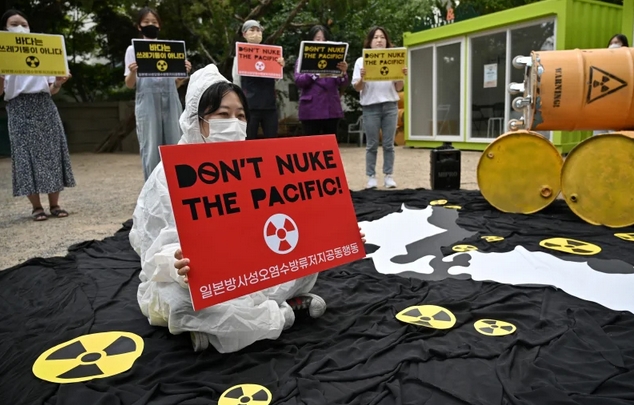
South Korean environmental activists protest in Seoul against Japan’s plan to discharge Fukushima radioactive water into the sea, as they mark World Oceans Day on June 8, 2022.
“We think that there is not enough scientific evidence to prove that the release is safe, environmentally, healthwise, and also for our economy in the Pacific,” says Puna, who is also the former Prime Minister of the Cook Islands. Until more information is shared and evaluated, he asks that Japan “please defer the discharge of the water.”
Doubts and divisions over the data
TEPCO says the water will be purified so that the concentration of radioactive substances—with the exception of a hydrogen isotope called tritium, which it says has “little impact on the human body”—falls below regulatory standards. The tritium will be diluted with a large volume of seawater. The government of Japan told TIME in an emailed statement that the measures it is taking are fully in line with international law and the safety standards of the International Atomic Energy Agency (IAEA). An IAEA task force, set up to review the safety of Japan’s plan, says that it completed a second review in Japan in January, and that it will release a report on its findings in about three months, as well as a comprehensive report before the discharge.
But there appears to be a major disconnect between TEPCO and others, including the PIF panel of experts—who say that they’re concerned with the adequacy, accuracy, and reliability of the data backing up the decision to release the water. Robert H. Richmond, a research professor and the director of the Kewalo Marine Laboratory at the University of Hawaii at Manoa, who is one of the panel experts, tells TIME that “the critical, foundational data upon which a sound decision could be made was either absent or, when we started getting more data,” he says, “extremely concerning.” He also casts doubt on if the IAEA is in the best position to assess the risks. “They’re an agency that has a mandate to promote the use of nuclear energy,” says Richmond, “and our mandate is to look after the people, the ocean, and the people who depend on the ocean. And our unanimous conclusion … is that this is a bad idea that is not defended properly at this point, and that there are alternatives that Japan should really be looking at.”
“One of the biggest surprises to me was the fact that the data was so sparse,” says Ferenc Dalnoki-Veress, scientist-in-residence and adjunct professor at the James Martin Center for Nonproliferation Studies at the Middlebury Institute of International Studies at Monterey, who is also on the PIF panel of experts. “There were prolonged gaps in data collection, which suggests that the matter may not have been given the level of attention and importance it deserved.” He adds that only a fraction of the tanks had been sampled, and only a handful of some 60 isotopes were typically measured in the samples—fewer than he would expect for this kind of assessment. (TEPCO says that the analysis done on a sample of tanks so far is just to assess the water’s condition in storage but that, after the purification process, further measurements will be taken on all the treated water before discharge to ensure that only that which meets sufficient standards of safety is released into the ocean).
Some still fear the safety of the treated water, and the far-reaching implications if it’s dumped into the ocean. Puna points out, for example, that the waters of the Western and Central Pacific Ocean produce much of the world’s tuna. If the tuna were to be impacted, it would cause major problems for Pacific nations, for which fisheries are a significant source of income, as well as for consumers globally.
In December, the U.S.-based National Association of Marine Laboratories also announced its opposition to TEPCO’s plans, publishing a position paper that says “there is a lack of adequate and accurate scientific data supporting Japan’s assertion of safety” while “there is an abundance of data demonstrating serious concerns about releasing radioactively contaminated water.”
Japan’s government told TIME in an emailed statement that it has provided detailed explanations, answered questions in a sincere manner, and that it stands ready to receive further questions. Puna says that the PIF panel of experts has been invited to Japan this year, but unless more data are offered, such a meeting would be “meaningless.” Richmond, similarly, says that requests for more data have not produced sufficient responses and that the panel of experts hasn’t been able to get the information they wanted via Zoom calls or emails, so he isn’t confident that a trip would produce enough information to make the panel of experts comfortable with the plan. “We asked ABC, and you answered with DEF,” he says.
When asked by TIME if it would indefinitely delay the discharge owing to the concerns of Pacific nations, TEPCO said in an emailed statement that it would “make every effort to foster understanding prior to the commencement of discharge.” The government of Japan also said that it “attaches great importance” to its relationship with the Pacific Island nations and that it “takes the PIF’s concerns sincerely,” but it stopped short of saying it wouldn’t go ahead with the discharge plan.
That approach may damage relations with the Pacific region. “We’ve been friends for a long time,” says Puna. “In the Pacific, we believe that if you are friends that you are always open to sharing information.”
A scarring past and a new path forward
Other nuclear plants across the globe have released treated wastewater containing tritium. Rafael Mariano Grossi, the IAEA’s director general, said in 2021 that Japan’s plan is “in line with practice globally, even though the large amount of water at the Fukushima plant makes it a unique and complex case.”
But Pacific Island nations have particular reason to be anxious. There is a noxious legacy of nuclear testing in the region, and other countries have historically treated the Pacific as a dumping ground for their waste. The U.S. conducted 67 nuclear tests in the Marshall Islands between 1946 and 1957—and disposed of atomic waste in Runit Dome, where it’s still stored. That testing led not only to forced relocations, but also to increased rates of cancers. Today there is concern that the dome is leaking and that rising sea levels might impact its structural integrity. France also conducted 193 nuclear tests from 1966 to 1996 at Moruroa and Fangataufa atolls in French Polynesia.

The BAKER explosion during Operation Crossroads, a series of two tests conducted by the U.S. to investigate the effect of nuclear weapons on naval warships, at Bikini Atoll, July 25, 1946.
“To have this on top of that creates a feeling of fear and apprehension in the hearts and minds of our leaders and our people in the Pacific,” says Puna.
In the wake of Russia’s invasion of Ukraine and the ensuing energy crisis, many countries seem to be embracing nuclear power anew. Japan, for example, wound-down the use of nuclear energy in the wake of the Fukushima disaster. But in December it announced a major reversal of that policy and said that it plans to use more nuclear energy by restarting as many reactors as possible and prolonging the operating life of older reactors. (By late 2022, 10 of 50 nuclear reactors that were shut after the disaster had been restarted, according to the Economist Intelligence Unit.)
Rather than let dumping wastewater into the ocean become the norm, at this juncture for nuclear energy, some say it’s an opportunity to explore different ways of doing things. The panel of PIF experts has proposed several alternative solutions, including treating the water and storing it in more secure tanks to allow the tritium time to decay, or using the treated water to make concrete for use in projects that won’t have high contact with humans.
“This is not the first nuclear disaster and by no means is it going to be the last,” says Richmond. “This is an opportunity for Japan,” he says, “to do the right thing and to invest time, effort, and money into determining and coming up with new ways of handling radioactive waste and setting a new trajectory.”
Cabinet approves a major change in nuclear power plant policy, including new construction and operation beyond 60 years.

Unit 3 of Kansai Electric Power Co.’s Mihama Nuclear Power Plant in Mihama Town, Fukui Prefecture, September 16, 2022; photo by Satoru Iizuka from an Asahi Broadcasting Corporation TV helicopter.
February 10, 2023
On February 10, the Kishida administration approved the “Basic Policy for Realization of GX (Green Transformation),” which includes allowing new construction and operation of nuclear power plants for more than 60 years, at a cabinet meeting. The change in nuclear power policy since the accident at TEPCO’s Fukushima Daiichi Nuclear Power Plant became an official government policy. Related bills will be submitted to the ordinary Diet session.

Prime Minister Fumio Kishida speaks at the GX Executive Conference. Second from the front is Yasutoshi Nishimura, Minister of Economy, Trade, and Industry. In the back is Akihiro Nishimura, Minister of the Environment = 2:59 p.m., December 22, 2022, Prime Minister’s Official Residence, photo by Koichi Ueda.
Public comments on the draft of the basic policy presented in December of last year included many objections to the nuclear power policy, but no major revisions were made.
The basic policy mainly lists policies that should be taken over the next 10 years toward the realization of a decarbonized society in 2050. It clearly states the “maximum use” of nuclear power plants as well as renewable energy. After the accident, the government had stated that it did not envision the construction of new nuclear power plants at this time, but it has now shifted to a policy of working toward this goal.
Specifically, the government will “work on the development and construction” of improved nuclear power plants, which it calls “next-generation innovative reactors,” and will rebuild them on the sites of nuclear power plants that have been decided to be decommissioned. The government will also “consider” building nuclear power plants in areas where there are currently no nuclear power plants.
https://www.asahi.com/articles/ASR2B0BKBR29UTFK015.html?fbclid=IwAR37nbrqQvZ8dCIO0ks8hkt6LpoP7GEh1Irdxc7LpFQf9Blvh-RB7C_qJcc
Regulatory Commissioners object to proposed new rules for nuclear power plant regulation
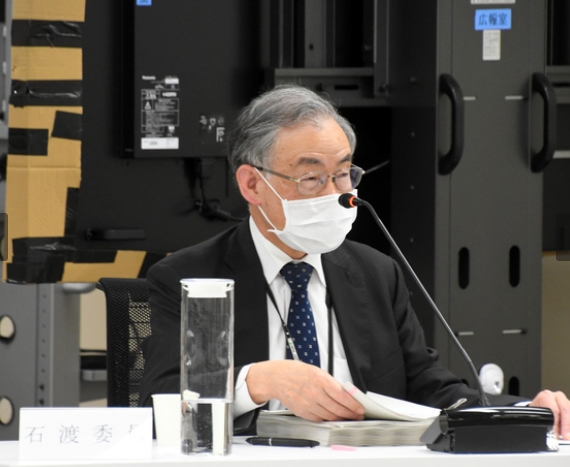
Akira Ishiwata, a member of the Nuclear Regulation Authority of Japan (NRAJ), expresses his opposition to the draft of new safety regulation rules for nuclear power plants.
February 9, 2023
At the February 8 meeting of the Nuclear Regulation Authority (NRA), committee members voiced their opposition to the draft framework for new safety regulation rules, which would require safety inspections at intervals of no more than 10 years starting from 30 years of operation. The committee members decided not to make a formal decision on that day, and will discuss the issue again next week or later.
Since the end of last year, the Regulatory Commission has been conducting “public comments” to gather opinions from the public on the draft framework. At the meeting, it was reported that 2016 comments had been received, many of which were opposed to the 40-year operation period stipulated in the Nuclear Reactor Regulation Law, but the committee decided that no revisions to the draft were necessary and decided to proceed with the decision as originally proposed.
Regulatory Commission is in the forefront of extending the operation of nuclear power plants.
In response, Akira Ishiwata, a member of the committee in charge of the earthquake and tsunami review, stated, “I am opposed to this proposal,” citing two main reasons.
The first is that the stipulation of an operating period will be removed from the Reactor Regulation Law, which is under the jurisdiction of the Regulatory Commission.
Mr. Ishiwata said, “The mission of the Nuclear Regulation Commission is to protect people and the environment based on scientific and technical findings. This change is not about changing the law based on some new findings. Dropping the operation period from the law (Reactor Regulation Law) is not an alteration to the safety side,” he said.
https://www.asahi.com/articles/ASR286GKRR28ULBH00F.html?iref=pc_photo_gallery_bottom
Proposal to operate nuclear power plants for more than 60 years “cannot be considered a change to the safe side”; Regulatory Commission postpones formal decision due to unusual opposition
February 9, 2023
At its regular meeting on February 8, the Nuclear Regulatory Commission discussed whether to make a formal decision on a new regulatory system for nuclear power plants to operate beyond 60 years, but it decided not to do so due to opposition from Akira Ishiwata, who stated that the proposal “cannot be considered an alteration to the safe side. The matter will be discussed again at the regular meeting next week. It is extremely unusual for the regulatory commission to be divided on such an important matter. (Kenta Onozawa)
◆Public comments: Most oppose the review

The new draft regulation will review the deterioration status of nuclear power plants every 10 years or less, starting 30 years after the start of operation, and if the plant complies with the regulatory standards, the extension of operation will be approved. The proposal was unanimously approved at the regular meeting held last December. On the day of the meeting, the final draft was discussed based on the results of public comments received from the public.
The majority of the 2016 comments received from the public were against the review of the system, but the secretariat of the Regulatory Commission consulted with the regular meeting on whether to make a formal decision on the draft without changing the content of the draft regulation. Of the five committee members, four, including Chairman Shinsuke Yamanaka, voted in favor of the draft, while Commissioner Ishiwata expressed his opposition. Chairman Yamanaka stated that he would not make a decision by majority vote, but would discuss the matter again together with the proposed amendment to the article of the Nuclear Reactor Regulation Law (Reactor Regulation Law) that stipulates the operation period.
At a press conference following the regular meeting, Chairman Yamanaka said, “I think there is a misunderstanding (among Commissioner Ishiwata). I don’t think it is a problem that there are opposing opinions. I would like to deepen the discussion among the committee members.
Last December, the government decided to allow nuclear power plants to operate for more than 60 years by excluding from the number of years of operation the period during which the plants were shut down for restart examinations and judicial decisions. It aims to submit a draft amendment to related laws to the current Diet session. The current provisions in the Reactor Regulation Law regarding the period of operation, which is “40 years in principle, with a maximum of 60 years,” are expected to be deleted and redefined in the Electricity Business Law under the jurisdiction of the Ministry of Economy, Trade and Industry (METI).
◆”Aging nuclear power plants will be operated in the future,” said Akira Ishiwata, a member of the committee.

I am against this proposal. Akira Ishiwatari, a member of the committee, stated his opposition in a firm tone toward the end of the meeting.
This change is not based on new scientific findings. It is not a change for the sake of safety, because the law will drop the period of operation. There is no need for us to amend the law voluntarily.
A geological expert, he has served as a professor at Tohoku University and as a member of the committee since 2014. When it was discovered that geological data had been rewritten during the review of the Tsuruga No. 2 reactor at the Japan Atomic Power Company’s Tsuruga Nuclear Power Plant in Fukui Prefecture, he proposed that the review be suspended. When the secretariat of the Regulatory Commission proposed last November that the Commission hear opinions from electric power companies on the proposed new regulations, he opposed the proposal, saying that it was too early to make a decision. Discussions were postponed.
Under the new government policy, the period of shutdown due to the review will be excluded from the number of years of operation. In most cases, the 10 units currently under review have been delayed due to inadequate explanations from the power companies. Commissioner Ishiwata, who is in charge of the examination of earthquake and tsunami countermeasures, said, “We are not unnecessarily prolonging the examination, but unfortunately it is taking a long time. The longer the review takes, the longer the operation period will be, and the older (aged) nuclear power plants will be in operation in the future.
He expressed strong concern that the more difficult the review process becomes, the more likely it is to encourage the operation of aging nuclear power plants. At the meeting, Chairman Yamanaka explained that “this is a mechanism to ensure that regulations can be implemented no matter what the operating period is like,” but Commissioner Ishiwata did not back down, saying, “My thoughts are as I have stated.
https://www.tokyo-np.co.jp/article/230093
Radioactive material exceeding voluntary standards in sea bass landed in Japan; voluntary restraint on shipments

Feb. 07, 2023
Radioactive materials exceeding the voluntary standard set by the Fukushima Prefectural Fisheries Federation were detected in sea bass landed off the coast of Iwaki City, Fukushima Prefecture on February 7, and the federation has suspended shipments of sea bass.
According to the Fukushima Prefectural Federation of Fisheries, on the morning of March 7, radioactive substances exceeding the standard voluntarily set by the federation were detected in sea bass caught 8.8 km off the coast of Iwaki City at a depth of about 75 m. After a detailed investigation by a prefectural agency, the sea bass was found to have a high level of radiation.
Subsequent detailed examination by a prefectural agency revealed that radioactive cesium-137 was detected at a concentration of 85.5 becquerels per kilogram.
This is below the national food standard of 100 becquerels per kilogram, but above the standard of 50 becquerels per kilogram voluntarily set by the prefectural fisheries federation.
Therefore, the prefectural fisheries federation has decided to recall all sea bass landed in the prefecture on July 7, and to refrain from shipping until the levels remain below the voluntary standard for a certain period of time.
This is the first time that the government has voluntarily refrained from shipping sea bass since the shipment restrictions were lifted in April 2018, almost five years ago.
In January of last year, radioactive materials exceeding the national standard were detected in black sea bass caught off the coast of Soma City, and the restrictions on shipments are still in place.
https://www3.nhk.or.jp/lnews/fukushima/20230207/6050021695.html?fbclid=IwAR0CP1j7m2tn7ApkcYR7ealeENsQigTgKXHixCh994n8rkqc9 jESkkyBuh4
Cleaning Up After the Nuclear Accident: The Changing Face of Interim Storage Facilities
February 06, 2023
The accident at TEPCO’s Fukushima Daiichi Nuclear Power Plant has spread an enormous amount of radioactive materials. Contaminated soil from the decontamination process in Fukushima Prefecture was delivered to an interim storage facility built by crushing farmland, forests, and residential areas in the towns of Futaba and Okuma. Nearly eight years have passed since operations began. The delivery, processing, and storage of the contaminated soil is now in its final stages, and the processing plants are being dismantled one after another, and hills made of the contaminated soil are appearing in various places. (Takeshi Yamakawa and Natsuko Katayama)
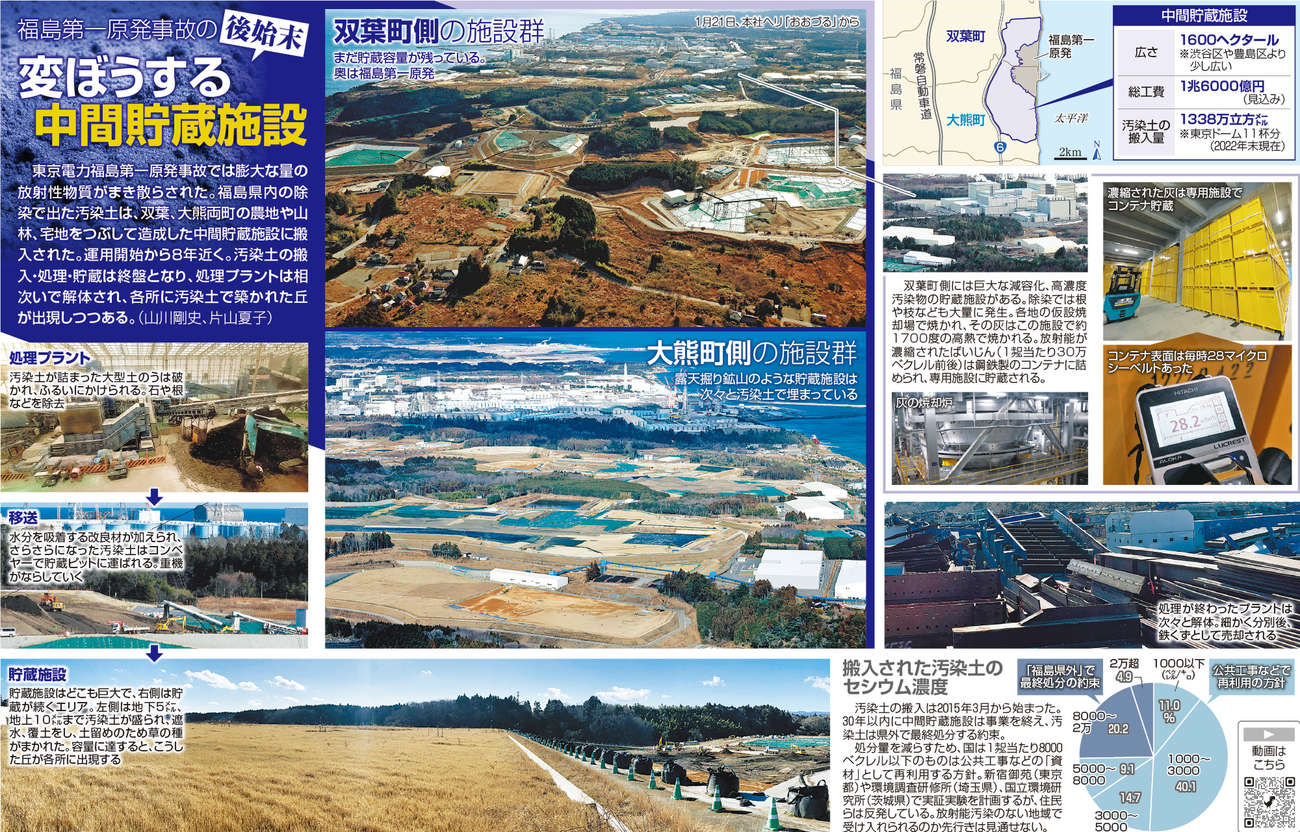
The accident at the Fukushima Daiichi Nuclear Power Plant of Tokyo Electric Power Company (TEPCO) has spread an enormous amount of radioactive materials. Contaminated soil and other materials were stripped and collected from all over Fukushima prefecture into an interim storage facility built near the plant. The 1,600 hectares of land is turning into hills of contaminated soil. See the latest situation here.

A group of facilities on the Okuma side. Storage facilities, which look like open-pit mines, are being filled with contaminated soil one after another.

Futaba Town side. This side still has storage capacity. In the back is the Fukushima Daiichi Nuclear Power Plant.

Treatment plant. Large sandbags filled with contaminated soil are broken and sifted. Stones and roots are removed.

Contaminated soil, which has been cleaned by the addition of a moisture-absorbing amendment, is transported by conveyor to a storage pit. Heavy equipment levels the soil.

The storage facilities are all huge. On the right side is the area where the storage continues. On the left side, contaminated soil has been piled up to 5 meters underground and 10 meters above the ground, and the soil has been shielded, covered, and covered with grass seeds to keep the soil in place. When the site reaches capacity, hills like this will appear in various locations.

On the Futaba Town side, there is a huge volume reduction and storage facility for highly contaminated materials. Roots and branches are also generated in large quantities during decontamination. They are burned at temporary incineration plants in various locations, and the ashes are burned at this facility at a high temperature of about 1,700 degrees Celsius. Radioactivity-enriched dust (around 300,000 becquerels per 1,000,000 tons) is packed in steel containers and stored in a dedicated facility.

Within the volume reduction facility is an incinerator that reduces the volume of ash. The ash is burned at 1,700 degrees Celsius.

Highly concentrated (about 300,000 becquerels/kg) dust separated from the burned ash is stored for a long time in this way.

Contaminated soil treatment plants that have finished processing are being dismantled, sorted into smaller pieces, and sold as scrap iron.
Fukushima: Director Makoto Shinkai of “Suzume no Togome”: “If I don’t depict the scenery of Futaba-gun, I will be telling a lie”

C)2022 “Suzume no Togome
2023/02/05
The protagonists stop their car at a coastal area in the prefecture along Route 6 and get off at a hill overlooking the beautiful sea. As they look around, they see a village with overgrown grass. Director Makoto Shinkai (49)’s latest animated film, “Suzume no Togome” (The Sparrow’s Doorstep),” depicts the Great East Japan Earthquake as one of its themes, as well as Fukushima Prefecture and other affected areas. In an exclusive online interview with Fukushima Minpo, Shinkai said, “I felt that if I did not depict the scenery of Futaba County, I would be telling a lie with ‘Suzume no Togomei’ (Suzume’s Door Closed).
■Preparedness
The film features Suzume, a 17-year-old high school student living in Kyushu. The film is an adventure story in which Suzume and her friends are trying to close the “door” that leads to disaster in abandoned buildings in various parts of the country where people no longer live.
Suzume and his friends drive down National Route 6, passing by a sign that reads “Difficult-to-return zone. While the road has been cleaned up, the houses on both sides of the road remain abandoned. The view from the top of the hill where they arrived at the site shows buildings reminiscent of TEPCO’s Fukushima Daiichi Nuclear Power Plant.
Two summers ago, Shinkai visited the area and experienced firsthand the current situation in the hard-to-return zone. It is meaningful to indirectly convey to the audience that this kind of scenery exists in Japan,” he said. He was determined not to let the disaster fade away.
There are many scenes that faithfully reproduce the scenery of various parts of Japan. However, in depicting Fukushima Prefecture, the shapes and layouts of the houses were fictitious while maintaining the atmosphere of the area. There are many people who want to return. I couldn’t just paint someone’s house without their permission.”
Trust
In Shinkai’s works, background art plays an important role in the story. Many viewers are drawn to the sparkling sea and colorful grasslands. Memories of people who once spent their lives in abandoned schools and hot spring resorts float in the air. The film is a directing collaboration between Shinkai and the director of the hit film “Kimi no na wa. The art director of this film, Takumi Tanji, who has been working with Shinkai for about 20 years, including on the hit film “Kimi no na wa. He is like a ‘Superman’ to me,” he says.
Tanji is responsible for setting up fictional locations such as hot spring resorts and amusement parks based on real landscapes. Even if I ask him to do something a little difficult, he smiles and says, “Well, we’ll figure it out. He has the full confidence of all the staff, including myself, that we can leave everything in his capable hands.
Spinning
Twelve years will soon pass since the disaster. An increasing number of people of that generation do not know what it was like at the time of the disaster. He analyzes that more than one-third of the audience is younger than the disaster victims and says, “If I could create an opportunity for people to learn about the disaster, I would like to think that it was only possible because it was an animation.
About three months have passed since the release of the film. He has given stage greetings throughout Japan and visited Fukushima Prefecture on January 28. He received many letters through the theaters and was encouraged by the warm response, smiling and saying, “I felt that it was good that this film exists.
There has been criticism of the depiction of the disaster in entertainment films, and he accepts that “there can never be a film that everyone agrees with, and I can’t easily say that it was a success. Still, he also believes that if films only avoid depicting the painful parts of the disaster, they will not move people’s hearts.
I hope that animated films can play a role in society, and not just be interesting,” he said. He believes in the power of film and intends to continue to face this challenge.
https://www.minpo.jp/news/moredetail/20230205104586?fbclid=IwAR3j81Uxq22DoAI6LEXaQSTK08ej5p7_DfpSaSvvxN0gHq5AC3i8Vdd7nx8
Lack of competition in biddings for Fukushima decontamination,auditors say
Feb. 3, 2023
Japan’s Board of Audit has found that nearly half of the tenders related to reconstruction work related to the Fukushima Daiichi nuclear accident had only one bidder.
The auditors on Friday submitted their report on government projects such as decontamination and waste disposal in the aftermath of the 2011 accident.
The Environment Ministry’s Fukushima office held 735 public tenders in the five and a half years until September 2021. Of these, 49.3 percent had one bidder.
The percentage is about 15 points higher than the average for public tenders held by the government.
The auditors also found that, on average, the prices offered by successful bidders were 94.6 percent of the prices set by the government.
This is more than 13 points higher than the average for tenders with two or more bidders.
The Board of Audit is calling on the government to ensure fair competition in public biddings.
Sophia University Professor Kusunoki Shigeki says the findings raise suspicion of a structural problem that allows only one bidder to take part.
He says that when a bidder is confident of winning, it usually sets a high price.
This week in nuclear news

A bit of good news. Good news about global warming: The public’s paying attention.
Coronavirus. Coronavirus Disease (COVID-19): Weekly Epidemiological Update
Climate.
Climate change is triggering more earthquakes. Big Oil’s interests are a factor.
Nuclear. Insanity rules? America going gaga about a balloon. Turkey pressing on with nuclear reactor build – all too handy to the earthquake zone. Australia looking forward to its war against China. Ukraine thinking it would be nice to bomb Crimea – and that’s OK with the Yanks.
Christina notes. Hooray – Australia’s cultural cringe is over! We’re gonna be important, like Ukraine! The evil of the nuclear industry – France to transfer public interest savings funds to the nuclear industry?
************************************************************
CLIMATE. Ann Darling: Nuclear power is no answer to anything our ailing planet needs. France in new row with Germany and Spain. Leak: France wins recognition for nuclear in EU’s green hydrogen rules. France wants to call nuclear-derived hydrogen “clean”. When the Great Tide returns. Twice as Much Land in Developing Nations Will be Swamped by Rising Seas than Previously Projected, New Research Shows.
CIVIL LIBERTIES. Night carnival in London calls for Julian Assange’s release. https://www.youtube.com/watch?v=YJaq08VHJk4 Ukraine purges libraries of Russian-language books – official.
ECONOMICS. Poland might have tax-payer fund its ambitious nuclear plans, and hope that investors might come in later. Marketing: Russia marketing nuclear reactors to Myanmar. Cameco Agrees to New Deal With Ukraine’s Nuclear Energy Utility.
EMPLOYMENT. Young people want to work in genuinely clean industries.
ENERGY. Renewables In China Trend Upward While Nuclear Trends Flat. US announces first transfer of seized Russian assets to Kiev. Solar’s stunning journey from lab curiosity to global juggernaut wiping out fossil fuels.
ENVIRONMENT. Campaigners claim permit change at Hinkley Point would kill billions of fish. Fear for fish: EDF plan for Hinkley project means ‘enormous tragedy’ for ecosystem. Japan Plans to Dump Fukushima Wastewater Into a Pacific With a Toxic Nuclear History.
HEALTH. Health status of the population living in the zone of influence of radioactive waste repositories . Radioactive releases from the nuclear power sector and implications for child health. ‘Downwind’: How Did America Create Its Own Nuclear Disaster?
HUMAN RIGHTS. Emerging Environmental Justice Issues in Nuclear Power and Radioactive Contamination.
LEGAL. Neo-Nazi previously implicated in plot to attack nuclear plants now arrested for planning grid sabotage around Baltimore. U.S. Court of Appeals rejects New Mexico’s challenge to Nuclear Waste License . Greenpeace will sue the European Commission over its decision to include gas and nuclear as “clean”. Outline of Greenpeace’s legal arguments against including gas and nuclear in the EU Taxonomy.
MEDIA. Media ‘Spy Balloon’ Obsession a Gift to China Hawks.
OPPOSITION to NUCLEAR. Highlands Against Nuclear Power (HANP).
POLITICS.
- Rep. Matt Gaetz introduces resolution to end military and financial aid to Ukraine, urge peace deal.
- “The devil is always in the details”: Nuclear watchdog urges public to attend Diablo Canyon meetings.
- France’s Latest Nuclear Halt Is a Reminder of Long-Lasting Nature of Problem. France considers tapping public interest savings accounts for nuclear reactor funding.
- Poland wants the European Union to push for more investment in nuclear energy.
- Spain upholds decision to reject plan for uranium mine.
- Signs of madness? —in the rarefied air of the British Parliament, Westinghouse spouts nuclear lies, without being challenged. UK’s Nuclear Free Local Authorities send seven magnificent suggestions to the new Secretary of State.
POLITICS INTERNATIONAL and DIPLOMACY. Setting the Record Straight; Stuff You Should Know About Ukraine. Ballooning paranoia: The China threat hits the skies. The United States and China Still Need to Talk About Nuclear Weapons. China’s spy balloon can help deflate US nuclear tensions with Beijing.
The US Department of Energy has made it
easier to share nuclear information with Mexico and harder to do so for Colombia and Egypt. EU’s Top Diplomat Says
Iranian Deal Is Only Way to Stop Tehran’s Nuclear Program.
PROTESTS. No to US nukes in Britain: CND is returning to Lakenheath, 20 May 2023!
SAFETY. French minister confirms plans to extend nuclear lifetimes. Continuing with Akkuyu nuclear plant in seismic Turkey would be reckless. Fears of ‘catastrophic’ nuclear horror as Turkey’s reactor rocked by horror earthquake. Japan: Cabinet adopts policy of using nuclear reactors beyond 60-year limit. Incident. That time Northern California had a near nuclear accident.
SECRETS and LIES. Illegal organ market is a lucrative business in war-torn Ukraine.
SPINBUSTER. High-altitude surveillance — even balloons — is nothing new. So why the fuss?
SPACE. EXPLORATION, WEAPONS. Another sign of madness? – thermonuclear propulsion technology to power a rocket to Mars.
WAR and CONFLICT. We’ve Never Been Closer to Nuclear Catastrophe—Who Gains by Ignoring It? Australia safest country to survive nuclear apocalypse – except for it being a military target. The US is preparing Australia to fight its war against China. Australia’s Taiwan nightmare. Aukus fallout: as US-China tensions grow, Australians reveal mixed feelings about nuclear submarine pact.
Endgame is going on in Ukraine crisis. US defense official flags ‘no objections’ to Kiev attacking Crimea.Here’s eight reasons why the US has no interest in pushing for peace in Ukraine. Did Volodymyr Zelensky call for ‘preventive nuclear strikes’ against Russia? Not exactly. US role in Kiev’s artillery warfare identified – media.
CNN video: NATO rehearses war with Russia in neighboring Estonia Dr. Helen Caldicott Says The World Is Closer To Nuclear Annihilation Than Ever Before. Would YOUR neighborhood be targeted in a nuclear attack? Official map shows the 2,000 locations across the US most at risk.
WEAPONS and WEAPONS SALES. Russia closes down the world’s largest nuclear-powered strategic submarine (they don’t say where the radioactive wastes go). U.S. Test Launches ICBM Into Pacific as Part of Nuclear ‘Deterrence Mission’ If Arms Control Collapses, US and Russian Strategic Nuclear Arsenals Could Double In Size.
New Report Unpacks Dangers of Emerging Military Tech, From AI Nukes to Killer Robots. US takes another step toward gearing up nuclear plutonium weapons core factory. Much-hyped tanks for Ukraine are in short supply. Elon Musk’s SpaceX Cuts Support for Ukrainian Military but continues work for U.S. military. North Korea shows off largest-ever number of nuclear missiles at anniversary parade. Three years without one single on-site US nuclear weapons inspection at base for Northern Fleet ballistic missile submarines.
1 This Month
10 March A LIVE WEBINAR THE REAL EFFECTS OF NUCLEAR POWER
What the Industry Isn’t Telling Us
1:00 PM Mountain, 2 pm Central, 3 pm Eastern. Live on the Keepers of the Water Facebook page



18 March Webinar @ 1 PM EST: An Assessment of SMR Projects: The Case of Canada
register for the zoom:
https://us02web.zoom.us/webinar/register/WN_o8BIIOUvQ2ONJR1nta65DQ#/registration


of the week – STOP SMALL MODULAR REACTORS IN CANADA
To see nuclear-related stories in greater depth and intensity – go to https://nuclearinformation.wordpress.com
-
Archives
- March 2026 (119)
- February 2026 (268)
- January 2026 (308)
- December 2025 (358)
- November 2025 (359)
- October 2025 (376)
- September 2025 (258)
- August 2025 (319)
- July 2025 (230)
- June 2025 (348)
- May 2025 (261)
- April 2025 (305)
-
Categories
- 1
- 1 NUCLEAR ISSUES
- business and costs
- climate change
- culture and arts
- ENERGY
- environment
- health
- history
- indigenous issues
- Legal
- marketing of nuclear
- media
- opposition to nuclear
- PERSONAL STORIES
- politics
- politics international
- Religion and ethics
- safety
- secrets,lies and civil liberties
- spinbuster
- technology
- Uranium
- wastes
- weapons and war
- Women
- 2 WORLD
- ACTION
- AFRICA
- Atrocities
- AUSTRALIA
- Christina's notes
- Christina's themes
- culture and arts
- Events
- Fuk 2022
- Fuk 2023
- Fukushima 2017
- Fukushima 2018
- fukushima 2019
- Fukushima 2020
- Fukushima 2021
- general
- global warming
- Humour (God we need it)
- Nuclear
- RARE EARTHS
- Reference
- resources – print
- Resources -audiovicual
- Weekly Newsletter
- World
- World Nuclear
- YouTube
-
RSS
Entries RSS
Comments RSS
 nuclear-news