Lithuania deal to dismantle Soviet-era nuclear reactors could be world first
Pamela Largue , January 9, 2023
https://www.powerengineeringint.com/nuclear/waste-management-decommissioning/lithuania-to-dismantle-soviet-era-nuclear-reactors/
Two contracts have been signed to plan the dismantling and waste management for the Ignalina Nuclear Power Plant in Lithuania.
The first of two four-year contracts was signed with a consortium led by Westinghouse Electric Spain, including Jacobs Slovakia, and Lithuanian Energy Institute.
The second contract was signed with another consortium led by the French company Electricite de France.
The dismantling services will be provided in two phases. The first will see contractors propose engineering solutions for dismantling the reactor.
The engineering design concept will be assessed and then further developed in consultation with stakeholders, namely the European Commission, Ministry of Energy of the Republic of Lithuania, CPVA (Central Project Management Agency) and VATESI (State Nuclear Power Safety Inspectorate).
Audrius Kamienas, director general of the Ignalina plant, said in a statement that the signing of the contracts is an important milestone, as dismantling the reactor core is the most challenging part of the decommissioning.
“There are only a few examples of graphite reactors being dismantled in the world today, but the RBMK reactor type has never been dismantled before.
“This is an extremely complex task, unprecedented in the world, for which preparatory work will continue for several more years.”
Physical dismantling of the reactor will commence in 2028 and will be funded by the EU Ignalina Programme.
Graphite-moderated reactor
Dismantling two of the most powerful RBMK reactors is believed to be a decommissioning first.
According to the World Nuclear Association, Soviet-designed RBMK (reaktor bolshoy moshchnosty kanalny, high-power channel reactor) is a water-cooled reactor with individual fuel channels and uses graphite as its moderator.
Ignalina could be the first graphite-moderated reactor plant to be dismantled, making it an important test bed for methodologies that could be used to decommission others of the same type, such as the UK’s Magnox and advanced gas-cooled reactors, which also have graphite cores.
Jacobs Energy, Security & Technology senior vice president Karen Wiemelt, commented: “Our teams based in the UK, France and Slovakia are applying decommissioning skills acquired through work on some of the world’s most complex and challenging nuclear sites including Sellafield and Fukushima.”
In 2002, the Lithuanian government decided to shut down Ignalina NPP, which supplied up to 88% of the country’s electricity.
Ukraine on ‘NATO mission’ – defense minister
https://www.rt.com/russia/569500-reznikov-ukraine-nato-mission/ 9 Jan 23
Aleksey Reznikov has argued that Kiev is shedding blood for the military bloc and expects weapons in return.
Kiev is shedding blood to carry out the mission NATO set for itself and expects the “civilized West” to provide weapons and ammunition in return, Ukrainian Defense Minister Aleksey Reznikov has said in an interview for a domestic TV channel.
Appearing on the 1+1 network’s TSN channel on Thursday evening, Reznikov pointed out that at the Madrid summit last summer, NATO declared Russia the greatest threat to the US-led bloc.
“Today, Ukraine is addressing that threat. We’re carrying out NATO’s mission today, without shedding their blood. We shed our blood, so we expect them to provide weapons,” he said.
Reznikov also claimed that his NATO colleagues have told him, both in conversations and via text messages, that Ukraine is the “shield of civilization” and “defending the entire civilized world, the entire West.”
Ukrainian officials, from President Vladimir Zelensky down, routinely make public appeals for tanks, missiles, artillery and ammunition. Russian Defense Minister Sergey Shoigu told the General Staff in December that Moscow was de facto fighting the collective West. By his estimates, the government in Kiev has received almost $100 billion worth of weapons, ammunition and other supplies in 2022 alone.
Reznikov has led that effort, boasting to the US outlet Politico in October that he had figured out the Pentagon’s political process. His goal, he said, was to keep raising the bar until Ukraine received main battle tanks.
While that particular threshold has yet to be crossed, on Friday Washington announced the delivery of 50 Bradley infantry fighting vehicles, the most modern armor sent to Kiev so far, as part of a $3 billion weapons package. Earlier this week, France pledged a number of wheeled ‘light tanks’ as well.
These shipments are intended to replace Ukraine’s battlefield losses. Last month, Kiev’s top general Valery Zaluzhny told The Economist he would need 300 more tanks, up to 700 infantry fighting vehicles, and 500 howitzers to conduct offensive operations. This is more than the number of such vehicles in British or German inventory.
Moscow insists that Western weapon deliveries only serve to prolong the conflict, and has repeatedly warned Ukraine’s backers that this could result in an all-out military confrontation between Russia and NATO.
Holtec seeks $7.4 billion government loan for expansion tied to new reactor
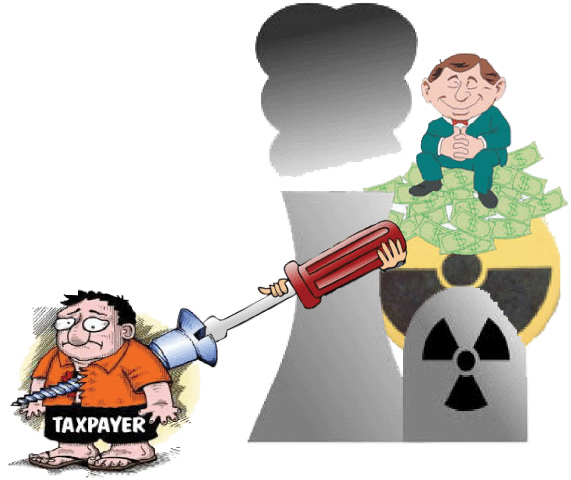
“an outrageous pickpocketing of hardworking American taxpayers to benefit a filthy rich private company.”
Jim Walsh, Cherry Hill Courier-Post, 9 Jan 23
CAMDEN – Holtec International Inc. has applied for a $7.4 billion federal loan to fund expansion expected from future sales of a company-designed nuclear reactor.
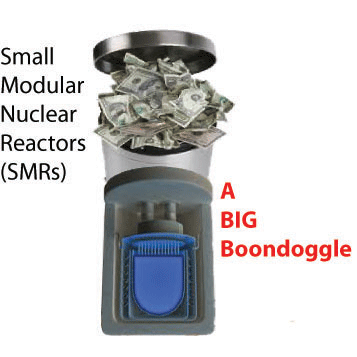
Holtec would tap the loan to boost capacity to make parts at its existing U.S. facilities, and to build and commission “at least four” SMR-160 advanced light water reactors.
It also expects to build “one or more additional manufacturing plants,” the company said.
Holtec added it’s “actively evaluating” potential sites “for the new ultra-modern manufacturing plant(s).”
The firm has three nuclear manufacturing facilities in the United States, including one at its Camden corporate campus that was designed for the eventual production of SMR-160s. It also has a fabrication plant in India.
Holtec claims its small modular reactor produces carbon-free energy more safely than a conventional nuclear power plant.
The firm has invested more than $400 million in the reactor’s development since 2010. It was approved in 2020 for $116 million in federal aid “to support the SMR-160’s commercialization readiness.”
Holtec is seeking the loan from the U.S. Department of Energy’s Loan Programs Office, which received an infusion of about $111 billion from last year’s Inflation Reduction Act.
“We anticipate that (the application process) will be ongoing for a while as DOE usually (has requests) for information or clarifying questions for an applicant,” said Holtec spokesman Patrick O’Brien………………….
Holtec also said it expects the U.S. Nuclear Regulatory Commission “early this year” will license its planned nuclear-waste storage facility in New Mexico.
The complex, in the works for seven years, could hold “the vast quantity of spent nuclear fuel presently stored at more than 70 nuclear sites in 35 states,” the company said.
But an environmental coalition plans to challenge any NRC approval in federal court, said Kevin Kamps of Beyond Nuclear, a nonprofit that’s sharply critical of Holtec’s plan.
Kamps said Holtec’s waste-storage project also faces court challenges from the states of New Mexico and Texas, as well as from businesses with mining and ranching interests near the proposed storage site.
He also described potential federal aid to Holtec as “an outrageous pickpocketing of hardworking American taxpayers to benefit a filthy rich private company.”
According to Holtec, the operation of a consolidated waste-storage site would spur nuclear power in the United States, “leading to the rise of small modular reactors.”
It also expressed the belief that modular reactors made in America would find “a large global export market.”
Holtec previously has predicted it could place 32 SMR-160s in the United Kingdom by 2050………….. https://www.courierpostonline.com/story/news/local/south-jersey/2023/01/09/holtec-federal-loan-production-advanced-nuclear-reactor-oyster-creek/69779027007/
Irish Republic monitoring nuclear risk as a consequence of fighting in Ukraine
International Atomic Energy Agency repeatedly expresses concern over shelling around Zaporizhzhia plant
Irish Times, Jennifer Bray, Mon Jan 9 2023
Europe’s exposure to a potential nuclear event in Ukraine is being monitored by a team of public health and Government officials as well as the State’s environmental watchdog.
The Zaporizhzhia plant, Europe’s largest, was captured by Russian forces in March, soon after their invasion of Ukraine. It repeatedly came under fire last year, prompting concerns about a possible nuclear disaster. The International Atomic Energy Agency (IAEA) has repeatedly expressed concerns over shelling around the site.
Health Service Executive chief risk officer Patrick Lynch told a meeting of the organisation’s audit and risk committee in October that public health officials were involved in an evaluation process around potential nuclear exposure which would require further reflection.
He advised the committee that a Government department and the Environmental Protection Agency (EPA) are “considering the potential risk of nuclear release in Ukraine and subsequent exposure across Europe”…….
A Department of the Environment spokesman confirmed that its officials and other agencies are “closely monitoring the evolving situation in Ukraine in relation to nuclear safety implications”.
He said the EPA is “in close contact” with the IAEA, the European Nuclear Safety Regulators Group and national authorities in other European countries in order “to keep a close watch on developments and to monitor any increases in exposure levels”.
The department said that the EPA has an around-the-clock radiation monitor in use………………………..
The EPA operates a radiation monitoring network for Ireland which is continuously monitoring for radioactivity in the environment and also maintains contact with radiation authorities in other countries throughout Europe.” https://www.irishtimes.com/politics/2023/01/09/republic-monitoring-nuclear-risk-as-a-consequence-of-fighting-in-ukraine/
to 9th January – nuclear news this week

A bit of good news. Quitea shortage of good news this week. I’m reduced to falling back on stories of individual goodness. Well, why not? Individuals in their millions are doing kind things every day – that just doesn’t get into the news media. The Top 10 Acts of Kindness in 2022 Warmed Our Hearts and Restored Our Faith in Strangers and Neighbors.
Coronavirus. Weekly epidemiological update on COVID-19
Climate. Climate change could cause ‘disaster’ in the world’s oceans.
Nuclear. Not much happening, except hype for small nuclear reactors. Australia’s nuclear submarines project is beginning to sound less like a goer, and more like something of a 171$billion ego-trip by former PM Scott Morrison, in a bid to look important on the world stage
Christina’s notes: They’re at it again! The nuclear industry dazzles journalists with its newest hogwash – “inflection point”. Corporate media focusses on ‘new’ nuclear solutions. Are they stupid? Or is it just what they’re paid to write?
AUSTRALIA.
- US President Joe Biden warned AUKUS nuclear submarine deal could come at cost to American fleet. Dear US Congress, thank you for saving Australia from itself.
- Australia to buy long-range HIMARS missile system from United States – at unknown cost (? 2 $billion). https://www.youtube.com/watch?v=5_M2JqeY8CA
- Military join rescue effort as floods ravage outback. Bushfire deaths and smoke-related healthcare costs predicted to rise in next few years.
*************************************
CIVIL LIBERTIES. Guilty of Journalism. Key US Allies Collaborate On Espionage Laws Considered Harmful To Whistleblowers And Journalists.
CLIMATE. Coal 2 Nuclear: From the fossil fuel frying pan into the fission fire. Under present conditions, a huge loss of the planet’s glaciers will happen in the next 30 years. Writers protest against UK’s imprisonment of climate activists.
ECONOMICS
- Green surge is circuit breaker on nuclear revival. Nuclear power saw multiple gains in 2022, but economic and other questions remain.
- Sizewell C Nuclear Project’s biggest stumbling block is its funding problem. Sizewell C: How will the £20billion plant be fully-funded? Is EDF using Britain’s “windfall tax” as an excuse to get out of uneconomic Hartlepool and Heysham nuclear reactors?
- Japan’s shortage of engineers and manufacturing capacity sets back its nuclear ambitions.
- GUSTAFSON: Russian nuclear power – unsanctioned – is prospering worldwide.
ENERGY. Analysis Shows U.S. Wind and Solar Could Outpace Coal and Nuclear Power in 2023. European Energy Crisis: France Close to Electricity Rationing Over Problems with Local Nuclear Plants. The Future Remains Uncertain For Nuclear Energy. Nuclear is not the answer to the UK’s energy requirements, and honesty about Sizewell is needed. Solar power innovation by two British local councils. Great Britain produced a record amount of wind-powered electricity in 2022.
ENVIRONMENT. Namibia orders Russian uranium exploration to stop due to environmental concerns.
HEALTH. Electromagnetic radiation – cellphones as a health hazard. Ionising radiation. Return to studying baby teeth for radioactivity from nuclear weapons and nuclear facilities.
HISTORY. It’s all about the bomb: why civilian nuclear power is merely a cover for producing more nuclear weapons. Why Did Portland General Electric Want to Build Trojan Nuclear Plant in the First Place?
LEGAL. John LaForge Set to Be First US Activist Jailed in Germany for Anti-Nuke Protests. Take Japan to court for nuclear water dumping.
MEDIA. Under Musk, Twitter Continues to Promote US Propaganda Networks. Zelensky Expands Crackdown on Ukrainian Media. Media Silent as Latest Twitter Files Expose Flagrant Misconduct in Govt. & Journalism.
NUCLEAR TECHNOLOGY.
- $Billions of tax-payer money to go to kickstarting the “new nuclear reactor” industry’s “inflection point”.
- Small Nuclear Reactor (SMR) developers submit 6 designs for UK approval. SMRs – an oversold hype?
- International nuclear fusion project may be delayed by years, its head admits. Is Nuclear Fusion Hotter Than the Sun?. Nuclear fusion may change our world but renewable energy sources will save it: experts.
PERSONAL STORIES.. Beatrice Fihn – a decade fighting to ban nuclear weapons. This man saved the world from nuclear war. His story is a heart-pumper.
POLITICS. German minister reignites coalition row with call to review nuclear exit.
POLITICS INTERNATIONAL and DIPLOMACY. US and South Korea hold talks on “nuclear sharing”. South Korea asks US for greater role in managing nuclear weapons. Nuclear weapons and the resistance to reality. U.S. President Biden contradicts South Korea’s President‘s claim that the two countries are planning joint nuclear exercises.
Pakistan supplies India with a list of its nuclear facilities. US Says ‘All Options’ On Table As Iran Nuclear Talks Remain Deadlocked.
SAFETY.
- Nuclear Ukraine? Amid concerns over alleged Russian threat, the world overlooks the real danger .
- Canada: Pressure tubes at two nuclear reactors deteriorated far too quickly .
- Letter in the Morning Star Exposes Links Between Subsea Coal Mine and Subsea Nuclear Dumping. Enforcement action revealed after Hinkley Point C worker death.
- Japan to use Self-Defense Forces to guard nuclear power plants.
- South Korea: Credible nuclear regulation needs independence transparency.
SECRETS and LIES.
- White Lives Matter More in Ukraine. Japan
- Data rewriting and erroneous statements…Sloppy handling continues at Tsuruga Nuclear Power Plant Unit No.2 of JAERI, Regulatory Commission suggests termination of review if no improvement is made. Kashiwazaki Kariwa, a Distant Recovery of Confidence TEPCO Shares Crisis Awareness to Prevent Misconduct. British-run spy tech powers Ukraine proxy war, putting civilians at risk.
- Russian computer hacking team targeted 3 USA nuclear weapons facilities.
- Can nuclear safety protocols be maintained in a poor country like Kyrgyzstan, where corruption is rampant?.
SPINBUSTER. Countering nuclear industry propaganda by telling the facts – Joshua Frank’s book “Atomic Days”. Workington under siege from new nuclear plans.
WASTES.
- Fukushima, Our ongoing accident. Japan must work with the Pacific to find a solution to the Fukushima water release issue – otherwise we face disaster.
- Feds push plan to dispose plutonium using nuclear waste repository near Carlsbad. Editorial: New Mexico right to ask for accounting of nuclear waste.
- Indigenous Taiwanese kept in the dark as a massive nuclear waste dump was imposed on their island.
- UK. Coal Boss Compiles Lastest Nuclear Dump Report for Government who have just Approved his Coal Mine.
WAR and CONFLICT. Before the Bombs Come the Platitudes. Cold War estimates of deaths in nuclear conflict. A Secret War in the Making: Americans Should Not Die to Defend Taiwan.
Number of civilians killed in Donbass revealed. Ukraine – The Big Push To End The War. CODEPINK calls on Zelensky, Biden and Congress to seize this chance for peace in Ukraine. Donetsk shelled in first minute of Christmas truce . Los Alamos National Laboratory’s record $4.6B budget will still mostly fund nuclear weapons.
WEAPONS and WEAPONS SALES. Pentagon pressures NATO allies to boost arms flow to Ukraine. Defensive and offensive operations: “tank-killers” part of new U.S. $45b arms package to Ukraine
North Korea to have “exponential increase” in its nuclear arsenal. Raytheon sells long-range missiles to Romania for war in Black Sea
Guilty of Journalism

The Political Prosecution of Julian Assange
by Kevin Gosztola https://www.sevenstories.com/books/4493-guilty-of-journalism?fbclid=IwAR2np9Ku9WHMKuJ7xTPkrrolJRvbkxdWcmyac0FnEZqKSduuhH2g2M-zPaM 7 Jan 23
From an acclaimed independent journalist, this carefully-documented analysis of the government’s case against Julian Assange and its implications for press freedom acts as a crucial, compelling guidebook to Assange’s upcoming trial.
The legal action against Julian Assange is poised to culminate in a trial in the United States in 2023, and this book will help the public understand the proceedings. The establishment media’s coverage of WikiLeaks founder Julian Assange’s extradition case has focused on his deteriorating health and what CBS News called his “secret family,” but most of this coverage failed to detail the complex issues at stake against Assange.
Guilty of Journalism outlines how WikiLeaks exposed the reality of American wars, the United States government’s unprecedented indictment against Assange as a publisher, and the media’s role in persuading the public to “shoot the messenger.” This new book by Kevin Gosztola, who has spent the last decade covering Assange, WikiLeaks, and the wider war on whistleblowers, tells the full story based on testimony from dozens of witnesses.
It examines abuses of power by the CIA and the FBI, including a spying operation that targeted Assange’s family, lawyers, and doctors. Guilty of Journalism offers a balanced and comprehensive perspective on all the events leading up to what press freedom advocates have called the trial of the century.
It’s all about the bomb: why civilian nuclear power is merely a cover for producing more nuclear weapons

Nuclear weapons are a special kind of horror opposed by most rational people around the world.
the IAEA’s bluntly stated mission is to promote nuclear technology.
Like Atoms for Peace, this repackaging of a military activity as a civilian one succeeded in making the endeavor socially acceptable and somewhat self-funding
The nuclear power-nuclear weapons link can only be broken by a ban on both
It’s all about the bomb — Beyond Nuclear International
Why civilian nuclear power is merely a cover for producing more nuclear weapons
By Alfred Meyer, 8 Jan 23,
The Zaporizhzhia Nuclear Power Station in southeastern Ukraine, Europe’s largest nuclear power plant, has the world’s attention right now, and rightly so. For the first time in history, six nuclear reactors and thirty-seven years’ worth of high-level nuclear waste are in the middle of a battlefield in an active war zone—one artillery shell, on site or off, could interrupt the control and cooling of the operational reactor, or the cooling of the waste in storage, leading to a catastrophic release of radiation that could spread throughout the Northern Hemisphere. How in the world can nuclear power reactors be considered clean and safe sources of electricity?
Russia, a nuclear-armed nation that invaded Ukraine on February 24, 2022, has said that it would use nuclear weapons if needed. And strong allies of Ukraine—the United States, the United Kingdom, and France, all NATO members—are also armed with nuclear weapons.
You likely are aware of what has happened in the weeks since this magazine went to press, and whether or not the world is in the midst of another major radioactive disaster, as happened at Fukushima in Japan in 2011, Chernobyl in northern Ukraine in 1986, and Three Mile Island in the United States in 1979. I assume that if you are reading this, nuclear weapons have not been used in the war in Ukraine. So how has the world ended up in such an existentially threatening situation? Why does the nuclear enterprise have the world’s future so tightly in its grip?
The short answer: nuclear weapons. It is all about the bomb.
In 1939, Albert Einstein wrote to President Franklin D. Roosevelt urging him to pursue nuclear research in the United States. It was crucial, Einstein wrote, to counter Germany’s efforts to harness the magic of radioactivity and develop a super weapon. A few years later, the Manhattan Project was born in secrecy in 1942. A sprawling and tightly controlled academic, military, industrial, and governmental infrastructure was built to accommodate an entirely new industry equal in size to the American automobile industry at the time. Secrecy was so thorough that when Vice President Harry Truman ascended to the presidency on April 12, 1945, upon Roosevelt’s sudden death, he was unaware that the atomic bomb program even existed, much less that it was on the verge of testing a plutonium weapon in July.
During World War II, the United States succeeded in developing atomic weapons, while Germany was defeated before it could do so. Even though Japan was essentially defeated by then, Truman, some three months after he learned that the United States did possess the super weapons, chose to use them. Although the firebombing of Tokyo in March 1945 had burned to death more than 100,000 people and left more than a million people homeless, it did not occasion the global outcry that followed the use of the uranium bomb on Hiroshima, on August 6, 1945, and the plutonium bomb on Nagasaki, three days later. Nuclear weapons are a special kind of horror opposed by most rational people around the world.
However, following the use of nuclear weapons in Japan in 1945, there has been significant ongoing public opposition to them. In the earliest days of the United Nations, there were various efforts to abolish or control nuclear weapons. It was clear that they constitute an entirely different type of military threat that includes the likelihood of ending life on earth as we know it. Abolishing nuclear weapons is the way to end this existential threat.
When World War II hero General Dwight D. Eisenhower became President in 1953, the dilemma for the military, and for Eisenhower, was how to grow the atomic bomb programs, in light of negative public opinion toward the nuclear enterprise. At the same time, the United States wanted to be recognized as the leader of the “free world” in the postwar years. In the early 1950s, the military needed to recast nuclear enterprise activities to appear to be peaceful, beneficial parts of our modern life, very distant from the wartime horrors.
In August 1953, Eisenhower was worried about the Soviet Union’s successful test of a sophisticated hydrogen bomb—which signaled to the United States that the nuclear arms race was officially on. Eisenhower considered delivering a type of “fireside chat” to the American public—or perhaps a “mushroom cloud chat”—to level with citizens about the truly horrific existential threat that nuclear weapons posed to the world.
But by December of that year, a different strategy appeared to take effect. In a now famous speech on December 8, 1953, titled “Atoms for Peace,” Eisenhower proposed to the U.N. General Assembly an international program of sharing “peaceful” nuclear materials and know-how for untold bounty, to encourage development of nuclear programs around the world.
The United States also proposed an international agency under the United Nations to promote and oversee nuclear activities, which today is the International Atomic Energy Agency, or IAEA. While acknowledging the IAEA’s important oversight role, such as inspecting the Zaporizhzhia reactors and fuel pools at this perilous time in history, one should also recognize that the IAEA’s bluntly stated mission is to promote nuclear technology. The first leaders of the IAEA were from the United States, to ensure that U.S. interests were protected.
Nuclear enterprise infrastructure is an outgrowth of World War II. These new endeavors drew international interest in creating the huge nuclear marketplace now in existence. Atoms for Peace—a plan to share nonmilitary nuclear technology with other countries to “win hearts and minds”—placed nuclear materials and reactors in more than forty countries, including Iran. This generated ongoing business for many American nuclear enterprise companies while supporting and expanding the U.S. military’s nuclear infrastructure and capacity in the United States.
Having nuclear activities under the auspices of the United Nations conferred upon them the legitimacy and respect of that international body. While Eisenhower was making his “Atoms for Peace” speech at the United Nations, he was in the middle of planning the largest hydrogen bomb test ever in the United States, the fifteen-megaton “Bravo” test, on March 1, 1954, which was more than 1,000 times bigger than the bomb dropped on Hiroshima.
The generally favorable response to Atoms for Peace was a trifecta for the nuclear enterprise. U.S. nuclear activities were repackaged as the “peaceful” atom and given the patina of social acceptance through United Nations oversight. Eisenhower was lauded as a good leader for sharing the atom with the world, and the U.S. nuclear infrastructure got new business and growth, which supported more U.S. nuclear weapons and nuclear Navy programs.
Atoms for Peace also served geopolitical ends. For instance, one reason the United States provided Iran with a research reactor in 1967 was to saddle that country with significant financial obligations, including paying for ongoing parts, services, and technical support from American companies. These financial obligations would then, theoretically, force Iran to sell more oil on the world market, regardless of OPEC actions, a kind of atoms-for-oil program—but only peaceful atoms, mind you!
As Atoms for Peace was taking shape, a major policy change was made via the Atomic Energy Act of 1954. The top-secret, tightly controlled Manhattan Project to build the atomic bomb was a governmental endeavor. Nuclear reactors produce the plutonium needed for atomic bombs. With the passage of this new bill by Congress, the operation of nuclear power reactors by privately owned corporations was allowed.
The Atomic Energy Commission was created in 1946 to promote and regulate the development of this new industry. With the commission led by Wall Street banker Lewis Strauss for five critical years, it is not surprising that the scales heavily favored promotion over regulation. Encouraging private investment in these risky reactor projects was assisted by minimizing regulatory safety and operational demands upon the private operators.
Being the biggest nuclear enterprise on earth encourages the circular, self-sustaining dynamic of the nuclear arms race.
But why was it so important for the U.S. government to develop and subsidize civilian nuclear power? Because it allowed the military, in essence, to spin off its nuclear reactor activities to private financing and corporate operations. Like Atoms for Peace, this repackaging of a military activity as a civilian one succeeded in making the endeavor socially acceptable and somewhat self-funding—although government subsidies are still perennially needed to carry on, and taxpayers are still covering the liability insurance costs of the private corporations. Most importantly, as detailed in a 2017 report by former U.S. Energy Secretary Ernest Moniz, civilian nuclear power is an “essential enabler” of our national security. The Atlantic Council calculates the value of this contribution to national security to be $42.4 billion a year. Businesses contributing to the nuclear Navy’s supply chain are in forty-four U.S. states.
The essential nature of civilian nuclear power for national security would suggest that if the United States has the largest national inventory of civilian nuclear reactors in the world, then it also has the largest nuclear enterprise infrastructure to support nuclear weapons production and a nuclear Navy.
Being the biggest nuclear enterprise on earth encourages the circular, self-sustaining dynamic of the nuclear arms race. The United States is busy modernizing its nuclear weapons infrastructure to be “strong enough” to negotiate the elimination of nuclear weapons. This is presented as official doctrine in the nonproliferation world. In reality, the United States is actually driving the growing international nuclear arms race.
Atoms for Peace and the nuclear enterprise employ particularly successful advertising campaigns, greatly influencing public opinion and shaping our cultural consciousness of the nuclear world.
Presenting civilian nuclear power as the answer to climate change, as clean and safe electrical generation, or as energy “too cheap to meter” is simply a sales pitch. What is actually delivered by a robust nuclear energy fleet is the capacity for nuclear weapons and a nuclear Navy.
Over the decades, there have been numerous expert critiques of nuclear power, authoritatively debunking these misleading and false promises, yet these critiques seem to have no effect on the trajectory of the nuclear enterprise. I suggest that these sales pitches are diversionary techniques aimed at sapping our energy. It does not matter if nuclear power can really solve climate change, it just has to be seen as an essential part of the solution to attract bright, young talent into what is made to appear as the cutting edge of technology and climate solutions, even though the civilian nuclear power industry worldwide has been in decline since 2002.
To protect ourselves from the dangers of the nuclear enterprise, we need to stop the nuclear weapons and nuclear power reactor programs—a tall order, for sure. But if we seek success in our efforts, we are well advised to understand the forces we are engaging with. It is all about nuclear weapons.
Alfred Meyer is a member of Physicians for Social Responsibility and has worked with communities affected by the Chernobyl and Fukushima nuclear catastrophes.
GUSTAFSON: Russian nuclear power – unsanctioned – is prospering worldwide
INTELLINEWS, By Professor Thane Gustafson in Washington January 8, 2023
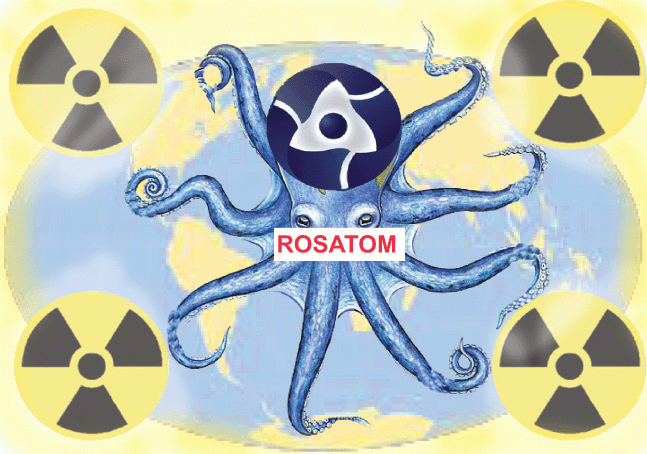
As the Western nuclear industry flounders, Russia’s Rosatom is building nuclear power plants (NPPs) on time and under budget around the world, while selling uranium to the US……………….
Russia’s nuclear industry is thriving, thanks mainly to its international business. According to Aleksey Likhachev, CEO of Rosatom, Russia’s nuclear monopoly, Russia is currently at work on 23 nuclear power units in a dozen different countries, including China, India, Belarus, Turkey, Hungary and Egypt. It sold $10bn worth of products abroad in 2022, a 15% increase on the year before, and its current foreign order book stands at over $200bn. Rosatom is actively courting new customers, mostly in the developing world; it offers a “full service” package that covers construction and operation, as well as the supply and reprocessing of nuclear fuel. The Russian government actively supports Rosatom with low-interest financing. In short, Russian nuclear power is on a roll.
But that is not all. In addition to building and operating new NPPs, Rosatom exports enriched uranium to numerous countries around the world, including the US and Europe. (In addition, Rosatom provides services to five EU counties that operate Russian-built NPPs.) Even though the revenues are not comparable (only about $1bn per year), the fuel exports are key politically. Because of this dependence, Russia’s nuclear industry is not under Western sanctions (as discussed further below), and it is not likely to be so any time soon. At this moment, Rosatom is able to operate without impediment, both at home and abroad; one of the few sectors in the Russian economy to be able to do so.
For both the US and Europe the implications are serious. First, they will continue to depend on Russian enriched uranium for several years more, potentially weakening their common front on sanctions. (Indeed, there have already been substantial disagreements among EU members over their policy toward Russian nuclear power.)
…… . Russia should continue to hold a commanding position in nuclear power for some time to come. …..

…. Putin named a politician, Sergei Kiriyenko, (above)to head the nuclear programme. Kiriyenko had had a mixed career up to that time – including a disastrous five-month stint as prime minister that coincided with Russia’s 1998 financial meltdown – but he turned out to be a talented manager. He regathered Rosatom’s wandering assets under one roof and after seeing off the oligarchs, he brought the industry’s unruly suppliers and contractors to heel. During the next eleven years he built Rosatom into a powerhouse. In 2016, Putin rewarded him with a secret medal and a top job, as Number 2 in the Kremlin’s Presidential Administration, where he is today.
The secrecy was no accident. When Rosatom was created in 2007, it inherited both the civilian NPPs and the military weapons assets. Kiriyenko made vigorous efforts to disentangle the military wing from the civilian, but the separation proved easier to achieve on paper than in reality. Today, the civilian and the military parts of Rosatom remain connected at the hip, as many parts of the nuclear supply chain, beginning with the mining of uranium, serve both military and civilian customers inside Russia.
But the military part was (and is) funded directly by the government, while the civilian part was supposed to be self-supporting. For Kiriyenko, this was a crucial difference. He had begun with ambitious plans for expanding nuclear power inside Russia, but he soon realised that there was little domestic demand for new NPPs in an electricity sector dominated by gas, and so Kiriyenko turned his sights on the foreign market. For this he needed to persuade the international community that Rosatom had become essentially a civilian business, in other words to fashion a new “commercial” image for the company. By and large he was successful, and Rosatom owes its present prosperity largely to the international business he built.
The impact of Western sanctions
Because of its important role as a supplier of uranium and nuclear fuels to NPPs around the world, including the US, Rosatom is not under Western sanctions. The US, in particular, relies on Russia for low-enrichment uranium for its own NPPs. Although efforts are under way to develop substitutes, for the present Rosatom is simply too valuable to sanction.
But even if sanctions were to be imposed, Rosatom’s operations would be largely unaffected by them. Internally, its supply chain, which as mentioned runs from uranium mining to power plant construction and operation, depends very little on the outside. ………….
Rosatom’s international business might be somewhat more vulnerable to sanctions, but so far there is little sign of it. Only one country, Finland, has pulled out of an ongoing project with Rosatom. ………………………….
Multiple challenges ahead
Yet quite apart from sanctions, Rosatom and Russian nuclear power may face multiple challenges ahead. One of them is technological progress. …………
Russia is the only country in the world to operate nuclear-powered icebreakers and floating NPPs, both of which are powered by small reactors. The Russian experience in designing and building small reactors goes back decades to the Soviet era, and there have been multiple generations of successively improved designs. Rosatom is working on deploying them not only on nuclear icebreakers and floating platforms, but also on land.
…………………….. The key to the future of SMRs, in the longer term, will likely be so-called “Generation IV” reactors, based on revolutionary designs that break entirely from the traditional light-water-reactor technology. But Generation IV is still an immature technology, and the race for leadership in G-IV is only now getting under way.
The more proximate threat to Rosatom’s leading position is Beijing. China has a vigorous nuclear programme, which is entirely independent of Russia…………………………………………
Finally, the ultimate challenges for Rosatom may be safety and reputational risk. Ever since the Chernobyl disaster in 1986, the Russian nuclear industry has had an excellent safety record. But the Russian invasion of Ukraine raises a serious new threat. There are four NPPs operating in Ukraine – ironically, all of them of Soviet manufacture. Russian [?] missiles have already landed close to one of them, the Zaporizhzhia plant, which is located close to the current battle line between Russian and Ukrainian forces. Just who is responsible for the safety of the plant is in dispute……………for Rosatom this plan is full of risks. If the plant were damaged and there were radioactive contamination, quite apart from the further suffering this would inflict on the Ukrainian people, for Rosatom the reputational damage would be extreme.
……. The challenges ahead are real, but they will come more from technological changes and rising competition from China, than from sanctions, from which Rosatom in any case remains so far exempt. https://www.intellinews.com/gustafson-russian-nuclear-power-unsanctioned-is-prospering-worldwide-266160/
Delay to small nuclear reactors as ministers battle over costs

Sunday January 08 2023, 12.01am GMT, The Sunday Times Harry Yorke
A funding deal for the first fleet of mini nuclear reactors is not expected to materialise for at least another 12 months, amid a row in government over the cost of Britain’s wider nuclear ambitions.
Last year, in order to triple domestic nuclear capacity to 24 gigawatts by 2050 — a quarter of the UK’s projected electricity demand — Boris Johnson set out plans for eight new large reactors alongside the development of small modular reactors (SMRs).
The government also announced the formation of Great British Nuclear (GBN), a body responsible for helping to deliver the next generation of reactors and SMRs by identifying potential sites, developers and investors.

At present only one plant, Hinkley Point C, is under construction, with the financing and final investment decisions on Sizewell C still pending. However, even though all but one of the UK’s existing plants are set to be shut down by the end of the decade, the government’s nuclear strategy now appears at risk of stalling amid internal disagreements.
In particular, Whitehall sources have revealed that there remains significant uncertainty over the scale of state investment in SMRs. Rolls-Royce, which has created designs for a 470 megawatt SMR and wants to
begin building factories, has called for ministers to enter funding talks and start placing orders. Rolls is understood to be seeking a commitment for four initial SMRs at a cost of about £2 billion each, which it
believes would unlock orders from interested foreign buyers.
But a senior government source said the Treasury would not sign off on any orders or significant funding until the technology had approval from the Office for Nuclear Regulation, which is not expected until 2024.
While the government has already invested £210 million in Rolls’s technology, the Department for Business, Energy and Industrial Strategy (BEIS) is also still assessing whether its competitors, including GE Hitachi, may offer “more viable” alternatives.
Insiders have signalled that the government may opt to launch yet another competition to gather further evidence before any firm deals are struck. More broadly, Treasury ministers harbour big concerns over the
costs associated with GBN, which officials have warned is billions over budget. While officials expect GBN to be announced early this year, after months of delays, the internal wrangling could lead to changes to both the body’s scope and funding.
Times 8th Jan 2023
Pentagon pressures NATO allies to boost arms flow to Ukraine

January 8, 2023, Rick Rozoff Interfax-Ukraine January 7, 2023 https://antibellum679354512.wordpress.com/2023/01/08/pentagon-pressures-nato-allies-to-boost-arms-flow-to-ukraine/
USA to seek from its allies to expand military aid to Ukraine – Pentagon
U.S. Secretary of Defense Lloyd Austin, (pictured above) in a phone conversation with his Ukrainian counterpart Oleksiy Reznikov, said the United States will convince its allies of the need to increase military assistance to Kyiv, according to the Pentagon.
Austin reaffirmed its commitment to encouraging allies and partners to provide additional air defense systems, combat vehicles and other critical capabilities to support Ukraine.
Arms flow to Ukraine
Date: January 8, 2023Author: Rick Rozoff0 Comments
Interfax-Ukraine
January 7, 2023
USA to seek from its allies to expand military aid to Ukraine – Pentagon
U.S. Secretary of Defense Lloyd Austin, in a phone conversation with his Ukrainian counterpart Oleksiy Reznikov, said the United States will convince its allies of the need to increase military assistance to Kyiv, according to the Pentagon.
Austin reaffirmed its commitment to encouraging allies and partners to provide additional air defense systems, combat vehicles and other critical capabilities to support Ukraine.
At the same time, the U.S. minister said assistance would be provided “as much as needed.”
The Pentagon also said Austin had already discussed with German Defense Minister Christine Lambrecht ways to increase assistance in the run-up to the meeting of the Ukrainian Defense Contact Group in Ramstein, Germany.
Austin appreciated Germany’s decision to provide Ukraine with a Patriot air defense battery and Marder infantry fighting vehicles.
According to Ukrainian Ambassador to the United States Oksana Markarova on her Facebook page, in addition to a new $3.075 billion U.S. military aid package for Ukraine, Washington provides “$682 million in additional foreign military funding to stimulate and compensate for the transfer of military equipment to Ukraine from allies and partners”.
Ukrainian News
January 7, 2023
Defense Minister Reznikov discusses new military aid to Ukraine with Pentagon head Austin
Defense Minister Oleksii Reznikov announced that he discussed the details of the new U.S. aid package to Ukraine with his American colleague Lloyd Austin.
We discussed the details of the new U.S. security assistance package for Ukraine and the next Ramstein-style meeting with Lloyd Austin,” Reznikov emphasized.
According to the head of the Ministry of Defense of Ukraine, this largest the United States’ aid package gives Ukraine “new opportunities to liberate our territory in the east and south.”
Return to studying baby teeth for radioactivity from nuclear weapons and nuclear facilities

St. Louis baby teeth study sparked nuclear test ban 60 years ago
Now, the baby tooth study from decades ago carries new life in the form of a Harvard study.
by: Joey Schneider, Jan 7, 2023 https://fox2now.com/news/missouri/st-louis-baby-teeth-study-sparked-nuclear-test-ban-60-years-ago/
ST. LOUIS – A famous study involving the baby teeth of St. Louis area children helped lay the foundation for a treaty to ban atmospheric nuclear testing 60 years ago.
A group of scientists, led by physician Louise Reed and St. Louis-area professor Barry Commoner, launched the study in December 1958 through the Greater St. Louis Citizen’s Committee for Nuclear Information. The mission: To determine whether radioactive fallout and nuclear energy had a negative impact on children’s health.
From 1958 to 1970, researchers collected more than 320,000 baby teeth of children from various ages, primarily from those in the St. Louis area.
The study followed a 1956 report from the U.S. Public Health Service, which hinted that St. Louis and other Midwestern cities could have alarming levels of radioactivity in water, air and milk following above-ground nuclear tests around the United States. In the decade leading up to that, officials had moved forward with nearly 100 nuclear tests, some that happened above-ground and spurred concerns of exposure, according to the Arms Control Association.
Preliminary case studies determined that children born in 1963 had levels of strontium 90, a radioactive isotope found in bomb fallout, nearly 50 times higher than children born in 1950. A limited study published by Science Magazine in 1961 presented similar findings.
“The immediate radiation danger moved public opinion, which influenced Congress to pass and President John F. Kennedy to implement the Limited Test Ban Treaty in 1963,” said the Missouri History Museum on the research. “They knew that a by-product of nuclear weapons testing is death-dealing, cancer-causing radiation. Some elemental isotopes last for thousands of years while others decay quickly, but airborne debris drifts for miles from explosions, falling onto food and water.”
Kennedy campaigned for president in strong opposition to nuclear testing, according to the John F. Kennedy Presidential Library. However, he entered his term at the height of the Cold War and faced mounting pressure after the Soviet Union conducted dozens of above-ground nuclear tests. In 1962, he reluctantly announced that the United States would resume atmospheric testing.
As Kennedy attempted to negotiate a ban on such testing, the findings of the St. Louis baby tooth study came to his attention. Negotiations to end atmospheric radioactive testing, the issue at the center of the baby tooth study, intensified midway through 1963.
By July, Kennedy had reached an agreement with the Soviet Union to exclusively conduct nuclear tests underground. By August, government officials from the Soviet Union, the United Kingdom, and the United States gathered in Moscow to sign what is officially known as the “Treaty Banning Nuclear Weapon Tests in the Atmosphere, in Outer Space and Under Water” or “Partial Test Ban Treaty.”
“Let us if we can step back from the shadows of war and seek out the way of peace. And if that journey is 1,000 miles or even more, let history record that we, in this land, at this time, took the first step,” said Kennedy on the agreement in a televised speech on July 26, 1963.
The initial baby tooth study continued through 1970. A research team acquired 85,000 of the tested teeth for a 2001 analysis that concluded 12 children who died of cancer had strontium 90 levels twice as high as others alive during the time of research. Some scientists denounce those findings to this day.
Now, the baby tooth study from decades ago carries new life in the form of a Harvard study. Researchers hope to collect tens of thousands and determine a possible connection between metals and cognitive decline at an older age. Harvard neuroscientist Marc Weisskopf launched the study in 2021, and one survey for the project remains ongoing.
According to a report from DrBicuspid.com, Japanese filmmaker Hideaki Ito is also working on a documentary about the original study and visited St. Louis last year for some groundwork.
Key US Allies Collaborate On Espionage Laws Considered Harmful To Whistleblowers And Journalists

Since the legislation was passed, Australian Federal Police have raided the homes and offices of journalists who reported on war crimes in Afghanistan and the monitoring of Australian citizens’ communications.
Groups, such as Reporters Without Borders and the National Union of Journalists, wrote to lawmakers and warned that the bill conflated journalism with spying, expanded the definition of classified information, and disproportionately increased the penalty of espionage to life imprisonment.
Many of these new elements align existing laws with the United States Espionage Act, an antiquated law that was adopted over a century ago.
Richard Spence, Jan 5, 2023 https://thedissenter.org/us-allies-collaborate-to-write-new-espionage-laws/
Ministers and security officials in Australia, Sweden, and the United Kingdom have coordinated with the United States to develop new espionage laws.
Each of the countries have faced criticism from news media and civil society organizations for proposing laws that will harm journalists and whistleblowers’ ability to report on abuse and corruption in their own and each other’s countries.
These states have close intelligence ties to each other and the United States, and they have played some role in the extradition of WikiLeaks founder Julian Assange, whose prosecution is widely recognized as a threat to global press freedom. In fact, disclosures of the kind that Assange published have been cited as what the laws aim to make illegal.
FBI Director Christopher Wray had several days of meetings with “law enforcement partners in the United Kingdom” during July 2022. After these meetings, MI5 chief Ken McCallum promoted the “National Security Bill,” the first change to UK espionage laws since 1989.
The law would purportedly address the perceived threats Wray and McCallum discussed.
McCallum and other intelligence officials’ warnings and suggestions were frequently referenced by parliament members and government ministers who supported the bill when it was debated in the UK Parliament in November 2022.
Priti Patel, when she was UK Home Secretary, said the bill “was designed in close consultation with security services.”
In Sweden, the 2022 Foreign Espionage Act, which was adopted last November, specifically criminalized disclosures that cause “substantial damage” to Sweden’s relations with other countries or organizations. That led reporters to warn that journalists revealing war crimes committed by the US government could be prosecuted.
The Australian espionage bill also defined information that “harm[s] or prejudice[s] Australia’s international relations” as illegal to disclose.
Australia Security Intelligence Organization (ASIO) Director Duncan Lewis, who advised the country’s premier on their legislation, was asked at a parliamentary committee hearing, “Is there a connection, in your view, between our diplomatic and economic relations and our national security? In other words, if someone causes harm to our diplomatic relations with a foreign country, like the United States, can that harm our national security?”
“Absolutely,” Lewis responded. “You would need [to] go no further than perhaps the case of [Edward] Snowden to think about that—the enormous damage that was done to various diplomatic relations as a result of the leaks that came out of Snowden.”
The Espionage and Foreign Interference Act of 2018 introduced a range of measures the Australia government claimed were meant to combat Chinese interference.
A collection of media outlets, including The Guardian and News Corp, opposed the law, saying that “journalists and their support staff continue to risk jail time for simply doing their jobs” due to the possibility of being prosecuted for dealing with classified information.
Since the legislation was passed, Australian Federal Police have raided the homes and offices of journalists who reported on war crimes in Afghanistan and the monitoring of Australian citizens’ communications.
The ASIO gave “extensive operational briefings” on foreign interference to Malcolm Turnbull, when he was Australia’s prime minister, and Turnbull noted their input as he introduced the legislation in Parliament.
ASIO Director Duncan Lewis explained what in part motivated the push to expand the country’s espionage law. “Our international allies and partners with whom we share threat information tell us resoundingly that Australia is not alone in confronting a new threat environment, one that’s different from what we’ve seen before. In ASIO’s view, we must now adjust to this harsh reality.”
Lewis pointed to UK Prime Minister Theresa May who had urged allied powers to do more to “clamp down on the hostile activity of foreign agents.”
During parliamentary debate in the UK, Patel referred to these discussions.
“Let me say something about the legislation we want to introduce. We are learning from other countries, such as Australia—indeed, I had a bilateral meeting just last week. This is also part of the work of Five Eyes,” Patel shared. “A lot of work is being done to look at the institutional impacts of hostile state activity, alongside issues such as foreign agent registration. We want to get this right through future legislation, and that is what we are working on.”
Groups, such as Reporters Without Borders and the National Union of Journalists, wrote to lawmakers and warned that the bill conflated journalism with spying, expanded the definition of classified information, and disproportionately increased the penalty of espionage to life imprisonment.
Many of these new elements align existing laws with the United States Espionage Act, an antiquated law that was adopted over a century ago.
During a Novembr 2021 speech for the right-wing Heritage Foundation on the US-UK alliance, Patel acknowledged this fact.
“We will modernize existing counter-espionage laws to better reflect the contemporary threat; and we will improve our ability to protect official data and strengthen the associated offenses,” Patel declared “Our strategic partnership must continue to address all this activity – which is uninhibited and growing along with all the other threats we see day in, day out.”
The UK’s proposed legislation updates the current espionage laws to now be applicable to non-UK citizens. Press organizations have complained, “The lack of geographic limits and the overly broad definition of the safety and interests of the United Kingdom can extend the reach of the bill across the globe.”
Australia’s new laws also apply outside of the country and like the UK include assisting (or benefiting in the UKs case) foreign entities, leading to criticism that officials are criminalizing those who work with foreign press outlets.
According to the Australian chair of the Five Eyes Law Enforcement Committee, the organization will arrest those who have committed espionage “no matter where those criminals are in the world.”
Swedish military and intelligence officials studied changes to espionage legislation at the behest of the Swedish government and used WikiLeaks’ release of US diplomatic cables in 2010 as an example of a kind of leak that would harm Sweden’s relationship with other countries if it happened today.
Officials also singled out the North Atlantic Treaty Organization (NATO) and the US as powers that were important to protect from damaging leaks.
In June 2022, Conservative Party parliamentary member Sir John Hayes asked Damian Hinds, who was the UK minister of state for prisons, parole, and probation, if “a WikiLeaks-type disclosure dressed up as being by a guardian of liberty or some such other nonsense” would be illegal.
“The defenses in part one of the bill provide law enforcement with several options for prosecuting disclosures, where the person is acting for or on behalf of a foreign power or where the disclosure would materially assist a foreign intelligence service,” Hinds responded. “That can include bulk disclosures.”
“To be clear, with this bill, the maximum sentence for an indiscriminate disclosure—a bulk data dump—will be higher than it is today if that act is done for a foreign power or the disclosure would materially assist a foreign intelligence service, even if not procured by that foreign intelligence service itself,” Hinds further stated.
Canada, which is a Five Eyes country like Australia and the United Kingdom, has also followed their lead. Canadian security officials briefed the press and politicians, claiming that China aims to influence Canadian democracy.
Security officials in Canada have submitted reports to their government requesting new security laws to prevent Canada from becoming a “weak link” amongst its allies.
A Secret War in the Making: Americans Should Not Die to Defend Taiwan
American Institute for Economic Research Doug Bandow January 2, 2023
The United States might be a democracy in form, but most policies are developed without even a semblance of public participation. For instance, policymakers overwhelmingly believe that the US should go to war with the People’s Republic of China if it attacks Taiwan. President Biden has five times declared that he would back Taiwan militarily. Yet Congress has not voted.
Those predicting conflict believe the hour is late, but some imagine that a tough stance would preclude war. America’s president merely needs to wave his pinky finger, or state his demands, and Chinese Communist Party officials would run screaming back to the leadership compound of Zhongnanhai, never to be heard from again. General Secretary Xi Jinping is, however, made of sterner stuff, buttressed by the People’s Liberation Army, which is rapidly expanding to prevent Washington from treating the Asia-Pacific as coastal American waters.
Even so, many Blob members assume that if Beijing were foolish enough to fight, it would (of course) be defeated. Not so. Any war over Taiwan would be won on the seas, and the PRC is much closer and can more easily reinforce its forces. Breaking a naval blockade would be difficult and would invite full-scale conflict. Beijing now possesses a larger (based on numbers, not tonnage) navy than America. And China is able to concentrate its forces in the Asia-Pacific. Reported the Congressional Research Service: “China’s navy is a formidable military force within China’s near-seas region, and it is conducting a growing number of operations in the broader waters of the Western Pacific, the Indian Ocean, and waters around Europe.”
Geography is a major problem: Taiwan is barely 100 miles off China’s shore, roughly the same distance as Cuba from America. The PRC could rely on two score mainland military bases and enjoy air superiority over the island. Beijing’s strategy would be anti-access/area denial, using submarines and missiles, especially, to keep the US Navy afar.
Washington would have to rely on allied bases, most notably Japan (Okinawa), the Philippines, and South Korea. However, none of America’s friends want to end up as targets of Chinese missiles. The Republic of Korea, confronting a dangerous North Korea, is least-likely to back the US in a war against the PRC. The Philippines is a semi-failed state; a former defense secretary once opined that his nation had “a navy that can’t go out to sea and an air force that cannot fly.”
Which leaves Japan. North Korea’s nuclear turn and China’s rise have caused Tokyo to plan a major increase in defense outlays. That government now notes its strategic interest in Taiwan, but has insisted that nothing said so far commits Japan to go to war with China over the issue. Entry into any war would turn the entire country into a potential target, and reaffirm Tokyo’s status as an enemy of the PRC.
Alas, the US usually loses wargames involving a Taiwan conflict. ………
Equally important, China cares much more about Taiwan than does the US For the Chinese, the issue is nationalism at its most raw: the island was seized by Japan as war booty more than a century ago. Regaining Taiwan would complete recovery from the so-called “century of humiliation,” during which outside imperialistic powers, including America, effectively humbled and dismantled the moribund Chinese empire.
Taiwan also has obvious military significance. No great power would accept an enemy base so close to its territory. In the event of defeat, China could expect the island to fill with US bases and forces. Washington faced such a possibility with Cuba in 1962 and almost fought a nuclear war with the Soviet Union over the issue.
No surprise, then, that the PRC is serious about forcing reunification. In his talk at the twentieth Chinese Communist Party congress in October, Xi Jinping insisted that “The complete unification of the motherland must be realized, and it will be realized.” Several Chinese diplomats strongly expressed similar views to me after House Speaker Nancy Pelosi’s ill-considered August visit to Taiwan.
In contrast, in terms of security, Taiwan doesn’t matter one whit to the US.At most, Washington would gain by denying Taiwan to China, inhibiting the latter’s naval activities in the region. But that is no justification for war. Beijing will always be willing to spend and risk more in any fight over the island.
Moreover, a conflict between the US and China might not remain conventional. Never before have two nuclear-armed powers fought a major conventional war. Escalation would be a constant danger. The US could not easily ignore military targets on the Chinese mainland. Attacking China proper, however, would force Beijing to respond by, for instance, hitting American possessions like Guam, at least. The PRC would face even-greater pressure to escalate if it was losing, since Taiwan is an existential interest………………..
The US needs to have a serious debate over Taiwan. Now.
……………… Finally, the US should seek tripartite negotiations to find a modus vivendi to keep the peace in the Taiwan Strait. We might begin with Taiwan downplaying its efforts to assert a separate international identity, the US pledging to forgo a military relationship with Taipei and minimizing efforts to highlight ties with Taiwan, and Beijing reducing military forces targeting the island and agreeing to eschew military action as long as the other parties keep their promises.
Most members of the Washington foreign policy elite have never met a war they didn’t want other Americans to fight. Policymakers managed to blunder through Afghanistan, Iraq, and Libya without wrecking the US. A war against China over Taiwan could have far more destructive consequences. It is vital for the American people to participate in the decision-making process over policy toward Taiwan. For their future, and that of their kids and grandkids, the right answer is no to war. https://www.aier.org/article/a-secret-war-in-the-making-americans-should-not-die-to-defend-taiwan/
Coal Boss Compiles Lastest Nuclear Dump Report for Government who have just Approved his Coal Mine.

Originally posted on Keep Cumbrian Coal in the Hole: High Level Cronyism and Corruption – Coal and Nuclear Waste Still not raising an eyebrow in the press or by NGOs is the fact that the coal boss Mark Kirkbride is the Government’s key advisor on the dumping of nuclear wastes in big holes. The latest…
Coal Boss Compiles Lastest Nuclear Dump Report for Government who have just Approved his Coal Mine. — RADIATION FREE LAKELAND
Australia’s contribution to AUKUS should be a next generation conventional submarine

By Kym Bergmann, 08/01/2023 https://asiapacificdefencereporter.com/australias-contribution-to-aukus-should-be-a-next-generation-conventional-submarine/
Sherlock Holmes teaches us that when all possible explanations have been eliminated, the only remaining answer – no matter how improbable – must be correct. As prospects are diminishing that Australia will be able to receive a nuclear-powered submarine before the 2050s, policy makers are faced with two choices: do nothing, or fast track something that will add significantly to the undersea warfare capabilities of the three AUKUS partners.
The latest development is that two US Senators – one serving and one just retired – Democratic Chair of the Senate Armed Services Committee Jack Reed and his Republican predecessor Senator James Inhofe, have warned that the US does not have the capacity to build submarines for Australia. Previously, Australian officials have dismissed any negative commentary about the nuclear submarine plan as “noise”, but this is getting hard to ignore.
Maybe the report by the nuclear-powered submarine task force due in March will prove the critics wrong, but unless it comes up with a concrete schedule with dates, legally enforceable commitments and so on, Australia needs to have a Plan B. A document that emphasises intentions, good will, more discussions, dialog, harmonising requirements, committees, and further investigations gets us nowhere.
Even the most vocal critics of conventional submarine technology concede that they nevertheless retain some performance advantages, such as in complex, shallow water littoral environments. They are also comparatively cheaper to build and – depending on their size and complexity – a nation can acquire at least three conventional submarines for every nuclear-powered boat.
A new generation fleet of Australian conventional submarines could see some of them permanently based in Guam – or even Japan – making an important contribution to USN-led coalition operations in areas such as the South China Sea. Some could also travel to the UK, though what contribution they could make to joint security from there is unclear, but the gesture might be politically worthwhile.
A commitment to actually doing something to help ourselves would also go over well in Washington. US figures are reportedly surprised and disappointed at the supine position of Australia, which seems to believe a solution for our defence needs will be handed to us on a platter. Why should Australia expect the US to solve our submarine problems for us? First and foremost, this a challenge to be met by the sovereign Australian government and not offshore it like some sort of strategic help line.
The quickest solution for Australia would be to forget about the Collins Life of Type Extension due to start in 2026 and fast track the local construction of the South Korean KSS-III Batch 2 design – now owned by Hanwha – which could see boats in the water from 2030. These are long-range conventional submarines that achieve a very low indiscretion rate by using lithium-ion batteries and other advanced technologies that were never part of the cancelled Attack class program. Their endurance could be further expanded by building a resupply base on Christmas Island – surrounded by deep water and easy to protect – that would give them an extra 25% time on station.
Another option would be a Next Generation Collins class – a larger version of the Swedish A26 submarine, similar to the one favoured to be chosen by the Netherlands to meet their need for a long-range oceanic submarine. A Third Generation Collins in the 2050s could be nuclear-powered, with the involvement of both the US and the UK. That’s called long term planning and is probably closer to the spirit of AUKUS because it would contribute to sovereign capability.
For all the boosters of nuclear-powered submarines, we say this: unless Australia has a highly skilled construction base, we will be condemned to forever seeking to buy them from the US or the UK – and, as we are witnessing, the chances of that ever happening are receding. As those two nations learned from the Sea Wolf and Astute programs, without a continuous submarine construction program, the loss of skills can be catastrophic.
The only sure way to guarantee that Australia will be able to build nuclear powered submarines – other than the reactors themselves – is to be able to transition from building large, advanced conventional submarines to something with a different propulsion system. Put simply: those arguing that an interim submarine is too inconvenient are condemning to death the idea of the local build of a nuclear-powered boat. We will need a skilled, experienced, existing workforce, existing program management and existing local supply chains.
The only sure way to guarantee that Australia will be able to build nuclear powered submarines – other than the reactors themselves – is to be able to transition from building large, advanced conventional submarines to something with a different propulsion system. Put simply: those arguing that an interim submarine is too inconvenient are condemning to death the idea of the local build of a nuclear-powered boat. We will need a skilled, experienced, existing workforce, existing program management and existing local supply chains.
1 This Month
23 April – WEBINAR – Why new nuclear reactors are the wrong tools for decarbonization Thursday, April 23 • 1 AM – 2 AM AEST
World Nuclear Power. Reactors 1951-2026, 75 Years of Nuclear Power.
Interactive Map– https://dv.worldnuclearreport.org/

Chernobyl: The Lost Tapes – A good documentary on Chernobyl on SBS available On Demand for the next 3 weeks– https://www.sbs.com.au/ondemand/tv-program/chernobyl-the-lost-tapes/2352741955560

of the week–London Campaign for Nuclear Disarmament

Tell the Ukrainian Government to Drop Prosecution of Peace Activist Yurii Sheliazhenko
To see nuclear-related stories in greater depth and intensity – go to https://nuclearinformation.wordpress.com
-
Archives
- April 2026 (231)
- March 2026 (251)
- February 2026 (268)
- January 2026 (308)
- December 2025 (358)
- November 2025 (359)
- October 2025 (376)
- September 2025 (257)
- August 2025 (319)
- July 2025 (230)
- June 2025 (348)
- May 2025 (261)
-
Categories
- 1
- 1 NUCLEAR ISSUES
- business and costs
- climate change
- culture and arts
- ENERGY
- environment
- health
- history
- indigenous issues
- Legal
- marketing of nuclear
- media
- opposition to nuclear
- PERSONAL STORIES
- politics
- politics international
- Religion and ethics
- safety
- secrets,lies and civil liberties
- spinbuster
- technology
- Uranium
- wastes
- weapons and war
- Women
- 2 WORLD
- ACTION
- AFRICA
- Atrocities
- AUSTRALIA
- Christina's notes
- Christina's themes
- culture and arts
- Events
- Fuk 2022
- Fuk 2023
- Fukushima 2017
- Fukushima 2018
- fukushima 2019
- Fukushima 2020
- Fukushima 2021
- general
- global warming
- Humour (God we need it)
- Nuclear
- RARE EARTHS
- Reference
- resources – print
- Resources -audiovicual
- Weekly Newsletter
- World
- World Nuclear
- YouTube
-
RSS
Entries RSS
Comments RSS
 nuclear-news