Kiev’s Worst Attack Against Donetsk In Eight Years Is A Desperate Attempt To Save Face
Andrew Korybko, https://korybko.substack.com/p/kievs-worst-attack-against-donetsk Dec 15 2022
Kiev’s latest war crime was also a psychological operation aimed at manipulating domestic, Russian, and Western perceptions of the conflict at this pivotal moment when its dynamics are once again trending in Moscow’s favor. It’s too early to predict whether this hybrid military-infowar provocation will succeed in obtaining its desired results, but there’s no doubt that more will likely follow as Kiev becomes more desperate.
Mayor of Donetsk Alexey Kulemzin wrote on Telegram Thursday morning that “Another war crime was committed this morning by Ukrainian fascists. Today, at exactly 7:00 a.m. [04:00 GMT], they subjected the center of Donetsk to the most massive strike since 2014.” Kiev’s worst attack against that newly incorporated Russian city in eight years was undertaken out of desperation in an attempt to “save face” amidst the American Ambassador to NATO admitting that the bloc can’t keep up the pace of its aid.
Julianne Smith dropped that bombshell while speaking at an event hosted by the CSIS think tank on Tuesday, but it shouldn’t have been surprising for objective observers. After all, it was already obvious by as early as last spring that NATO couldn’t indefinitely sustain the scale and scope of its military support for Kiev. That anti-Russian alliance’s stockpiles are dwindling yet its military-industrial complex can’t replace its lost supplies fast enough to reverse this trend.
This development is to the detriment of Kiev’s offensive and defense capabilities. It’ll struggle to maintain its on-the-ground momentum after reconquering the right bank of Russia’s newly reunified Kherson Region simultaneously with struggling to fend off Moscow’s reportedly planned offensive early next year. This isn’t speculation either but is proven by two recent statements from Ukrainian officials that strongly hint about those disadvantageous aforementioned consequences.
Defense Minister Reznikov’s announcement on Monday that his side will supposedly resume its “active counteroffensive actions” after the ground freezes can be interpreted as a tacit admission that the expected decline in NATO’s military aid hampered Kiev’s plans. Likewise, Foreign Minister Kuleba’s warning the day after that Russia is supposedly planning a “large offensive” by late January or early February can be seen as hinting that Kiev risks being crushed if NATO scales back its aid as expected.
Taken together, it’s clear that the military-strategic dynamics at this phase of Russia’s special operation are trending in Moscow’s favor, with the decisive variable being that NATO’s military-industrial complex exhausted its capabilities after ten months of contributing to this proxy war. Reading the writing on the wall, it’s therefore understandable why Kiev is panicking since it’s increasingly being coerced by circumstances into moderating its maximalist goals in this conflict and thus considering a ceasefire.
That’s politically unacceptable for its leadership though and they’re thus desperate to distract the public from this emerging trend, ergo why they authorized the most massive strike on Donetsk in eight years in order to “save face”. Kiev hopes to terrorize the local Russians there, boost pro-war sentiment at home, and convince NATO to sacrifice the rest of its dwindling stockpiles at the expense of its members’ minimum national security needs in order to maintain the pace of its proxy war support.
Analyzed from this angle, it can therefore be concluded that Kiev’s latest war crime was also a psychological operation aimed at manipulating domestic, Russian, and Western perceptions of the conflict at this pivotal moment when its dynamics are once again trending in Moscow’s favor. It’s too early to predict whether this hybrid military-infowar provocation will succeed in obtaining its desired results, but there’s no doubt that more will likely follow as Kiev becomes more desperate.
Ukraine Crisis Highlights Security Needs Of Civilian Nuclear Power

[[Ed – “a secure environment for the proliferation of nuclear energy.”? Pigs might fly?]
Ariel Cohen, Forbes, 16 Dec 22,
On November 27-28 a conference in Paris addressed a broad spectrum of challenges humanity is facing. Renowned thinkers, including Nuriel Roubini and Jacob Frenkel, the former Chairman of JP Morgan International, and three central bankers from Iceland, Tunisia, and Armenia, warned about inflation and the growing mountain of debt threatening the global economy. The panel at which this author addressed civilian nuclear security was organized by Dialogue of the Continents, a project of the Astana Club, the brainchild of the Nazarbayev Foundation. The panel was chaired by the veteran nuclear policy expert Ambassador Kairat Abusseitov, the former First Deputy Foreign Minister of Kazakhstan.
Today the planet shudders at the prospect of Russia’s first use of nuclear weapons and its military attacks on Ukrainian nuclear reactors. The world faced nuclear crises before. On October 27th, 1962 Vasili Arkhipov, a former Vice Admiral in the Soviet Navy, prevented a nuclear war when he countermanded the orders of two other officers and prevented a nuclear attack against the US Navy during the Cuban Missile Crisis. In September 1983 Soviet Airforce Colonel Stanislav Petrov manually overrode a missile launch system that erroneously detected an American attack. Two months later in November 1983 the NATO military exercise Able Archer almost triggered World War III when the Soviets believed it to be a real attack. In 1995 a Norwegian weather missile almost triggered a Russian massive strike on the U.S., which President Yeltsin canceled.
In every instance, nuclear war was prevented by the judgment of individuals where systems had failed. This was possible as adversarial powers recognized the “rules of the game” and created an atmosphere of cooperation to avoid nuclear confrontation amidst other profound disagreements.
That atmosphere is gone, and the next time a Russian alert system goes off we may not have a Colonel Petrov to save us. And it won’t be the ballistic missiles that may be the cause of a massive nuclear disaster.
International law explicitly provides for the immunity of nuclear power plants during war. There are even measures that specifically plan for their safety. The International Atomic Energy Agency (IAEA) for instance has promulgated 16 legally binding conventions rand protocols under the international legal framework for nuclear security to prevent, detect and respond to threats to nuclear security within one state. Nevertheless, the international community has proven unable to stymy Russian actions [and Ukrainian] around Chernobyl and the Zaporizhzhia Nuclear Power Plants that amount to nuclear blackmail and flagrantly violate these laws.
Enforcing the existing international law is easier said than done. International law presupposes an agreement between state actors, which is sorely lacking today. Calling counter-terrorism instruments into action requires UN approval, created by an ad hoc committee……………..
Being a nuclear state under the non-proliferation treaty Russia is under no obligation to place the Zaporizhzhia plant under IAEA safeguards and given the likelihood that it will not recognize that the plant comes under Ukraine’s comprehensive safeguards agreement, IAEA may find access to the plant completely denied next fall.
This is not just a Russian or Ukrainian problem; this is an emerging structural problem of the international energy security system that will reoccur if nothing is done now……………………………………. The future ubiquity of civilian nuclear power means that currently lacking international frameworks must be overhauled – or civilian nuclear power would be un-investable and too risky.
……………. A false sense of security after the Cold War has dangerously numbed many to the existential threat that nuclear weapons represent, with polls repeatedly showing an alarming lack of concern towards these tools of extinction………………………………………………. more https://www.forbes.com/sites/arielcohen/2022/12/16/ensuring-the-security-of-civilian-nuclear-power/?sh=25e66be71f24
Alliance of Pacific organisations condemns Japan’s decision to discharge nuclear wastewater into the Pacific Ocean
NZ and Pacific urged to ‘step up’ against Japan’s nuclear plan, Stuff NZ, Christine Rovoil, Dec 17 2022,
Japan’s decision to discharge nuclear wastewater into the Pacific Ocean for the next 30 years has been condemned by a Pacific alliance.
And the group of community members, academics, legal experts, NGOs and activists is calling on New Zealand and the Pacific to act to stop Japan.
Three reactors at the Fukushima Daiichi nuclear power plant had meltdowns after the earthquake and tsunami on March 11, 2011 which left more than 15,000 people dead.
The Japanese government said work to clean up the radioactive contamination would take up to 40 years.
Following the Nuclear Connections Across Oceania Conference at the University of Otago last month, a working group was formed to address the planned discharge.
Dr Karly Burch at the OU’s Centre for Sustainability said many people might be surprised to hear that the Japanese government has instructed Tokyo Electric Power Company (Tepco) to discharge more than 1.3 million tonnes of radioactive wastewater into the ocean from next year.
Burch said they had called on Tepco to halt its discharge plans, and the New Zealand Government to “step up against Japan”.

In June, Prime Minister Jacinda Ardern called for nuclear disarmament during her speech at the Nato Leaders’ Summit in Madrid.
“New Zealand is a Pacific nation and our region bears the scars of decades of nuclear testing. It was because of these lessons that New Zealand has long declared itself proudly nuclear-free,” Ardern said.
Burch said the Government must “stay true to its dedication to a nuclear-free Pacific” by taking a case to the International Tribunal for the Law of the Sea against Japan.
“This issue is complex and relates to nuclear safety rather than nuclear weapons or nuclear disarmament,” the Ministry of Foreign Affairs and Trade said in a statement on Friday.
“Japan is talking to Pacific partners in light of their concerns about the release of treated water from Fukushima and Aotearoa New Zealand supports the continuation of this dialogue.
…………….. In Onahama, 60km from the power station, fish stocks have dwindled, said Nozaki Tetsu, of the Fukushima Fisheries Co-operative Associations.
“From 25,000 tonnes per year before 2011, only 5000 tonnes of fish are now caught,” he said. “We are against the release of radioactive materials into our waters. What worries us is the negative reputation this creates.”
………………………. Burch said predictive models showed radioactive particles released would spread to the northern Pacific.
“To ensure they do not cause biological or ecological harm, these uranium-derived radionuclides need to be stored securely for the amount of time it takes for them to decay to a more stable state. For a radionuclide such as Iodine-129, this could be 160 million years.”
………… Burch said the Japanese government was aware in August 2018 that the treated wastewater contained long-lasting radionuclides such as Iodine-129 in quantities exceeding government regulations.
She has called for clarity from Tokyo, the International Atomic Energy Agency, the Pacific Islands Forum Secretariat, Pacific Oceans Commission, and a Pacific panel of independent global experts on nuclear issues on the outcome of numerous meetings they have had about the discharge.
“We want a transparent and accountable consultation process which would include Japanese civil society groups, Pacific leaders and regional organisations.
“These processes must be directed by impacted communities within Japan and throughout the Pacific to facilitate fair and open public deliberations and rigorous scientific debate,” Burch said.
The Pacific Islands Forum secretary-general, Henry Puna, has been approached for comment.
https://www.stuff.co.nz/pou-tiaki/130784783/nz-and-pacific-urged-to-step-up-against-japans-nuclear-plan
Nuclear blow for EDF, the Flamanville EPR delayed again by six months
While the previous reorganization of the schedule brought the commissioning
of the Flamanville EPR to the end of 2023, it has now been postponed to
mid-2024. At a time when the President of the Republic is relaunching the
nuclear industry in favor of the energy crisis with the start of
construction of 6 new EPRs, the first of which is expected from 2035, this
new delay is bad timing because it emphasizes the technical puzzle that the
construction of an EPR represents.
La Tribune 16th Dec 2022
Media enthuses over “sexy”high tech nuclear energy, but ignores the really effective one – energy saving.

It’s that time of year when editors seem happy to let a few dubious stories
through. Most of the media ran with this one on yet another nuclear fusion
breakthrough- this one at the Lawrence Livermore labs in California, at the
National Ignition Facility.
Well, with the climate change threat looming,
non-fossil energy is a big issue just now- and its certainly cold out! So
is help at hand? Well no, not for some time at least. And at unknown cost.
Even if this laser based system, which was designed primarily for
replicating the physics of H-bomb ignition, can be made to deliver energy
on a large scale reliably and safely, it’s going to take a while- it’s a
very long shot.
An equally familiar but arguably much more welcome
newspaper article was this one on energy saving. As seems to be said almost
every week now, saving energy saves money. And it’s available now. But no
one seems to notice.
Energy conservation is just not sexy. Not like high
tech fusion or hydrogen- which also these days regularly gets star billing.
Well hydrogen may have some applications, but in a wide ranging critique,
Michael Liebreich, BNEF founder, says not that many.
It’s not the
wonder-fuel it’s been billed as. He is not happy: ‘we are going to waste
huge amounts of money on the wrong use cases for hydrogen and the wrong
infrastructure in the wrong places’. Few seem happy either about the
proposed new coal mine in Cumbria, but support for solar farms seems to be
missing in Tory UK, although, in the EU, there seems to be support for
putting solar in space…What an odd world. With Russia still calling many
of the shots: according to a new Parliamentary Briefing Note, ‘it is
currently the only country capable of commercially providing the more
enriched fuel needed for Advanced Modular Reactors’, which some look to the
replace the current type of nuclear technology.
Renew Extra 17th Dec 2022
https://renewextraweekly.blogspot.com/2022/12/an-end-of-year-whimsy.html
Russia installs sheild over Zaporizhzhia nuclear storage site
A shield is being set up over a storage site for spent nuclear waste at the
Zaporizhzhia nuclear power plant in southern Ukraine to protect it from
shelling and drones, a Russian-installed official said on Saturday. Video
footage published by Vladimir Rogov, a Russian-appointed official in
Ukraine’s Zaporizhzhia province, showed workers mounting a screen of what
appeared to be some kind of transparent sheeting on wires above dozens of
concrete cylinders about 5 metres (16 feet) high.
Reuters 17th Dec 2022
‘Bottling the Sun’: is this a new dawn for the fusion industry? (actually – no!)
‘Bottling the Sun’: is this a new dawn for the fusion industry? There are
two good reasons to be very excited about the latest breakthrough in
nuclear fusion technology announced this week. Not only does the generation
of net positive energy in a fusion reaction represent an outstanding
scientific achievement, it also opens up the tantalising possibility of
cheap, green and abundant energy that might put the environmentally ruinous
fossil fuel industry out of business.
But there are also two good reasons
not to be overly excited by the news. Even with a favourable wind, it will
take at least 20 years of development and massive injections of capital
before fusion energy can ever become commercially viable at scale.
Unfortunately, that means it is not likely to arrive quickly enough to
solve the imminent threat of the climate emergency. If so, the question
arises: is the technology worth backing at all if alternative clean energy
sources, such as solar, wind and next-generation nuclear fission, are
already proven and available?
FT 16th Dec 2022
https://www.ft.com/content/c87965a2-f695-4645-8d6b-7af8a62b5131
U.S. troops deployed near Russian border
U.S. troops deployed near Russian border –Estonia’s defense ministry has announced the arrival of an American infantry company as part of NATO’s presence in the country | 16 Dec 2022 | A United States infantry company arrived in Estonia this week as part of NATO’s effort to bolster the military bloc’s eastern border with Russia, the Baltic country’s defense ministry has revealed.
A statement published on the ministry’s website on Friday said that U.S. service members are stationed at Taara base in the town of Voru, some 20 kilometers from the Russian border. Commenting on the U.S. service members’ arrival, Colonel Mati Tikerpuu, the commander of the 2nd Infantry Brigade of the Estonian Defense Forces, said he expects to be able to “integrate our allies on a brigade level and gain an additional maneuver unit.” Colonel Richard Ikena, U.S. 1st Infantry Division Artillery Commander, said American troops are “excited to be in Estonia” and “look forward to working shoulder-to-shoulder, alongside our Allies.”
December 18 Energy News — geoharvey

Science and Technology: ¶ “Satellite Will Measure Most Water On The Planet” • The first mission to survey nearly all of the water on Earth has launched. It is a joint effort of NASA and the French space agency Centre National d’Études Spatiales. It will survey water on more than 90% of the world’s surface, […]
December 18 Energy News — geoharvey
TODAY. The media – dishonest – or just sloppy and incompetent ?- nuclear fusion coverage as a case in point.
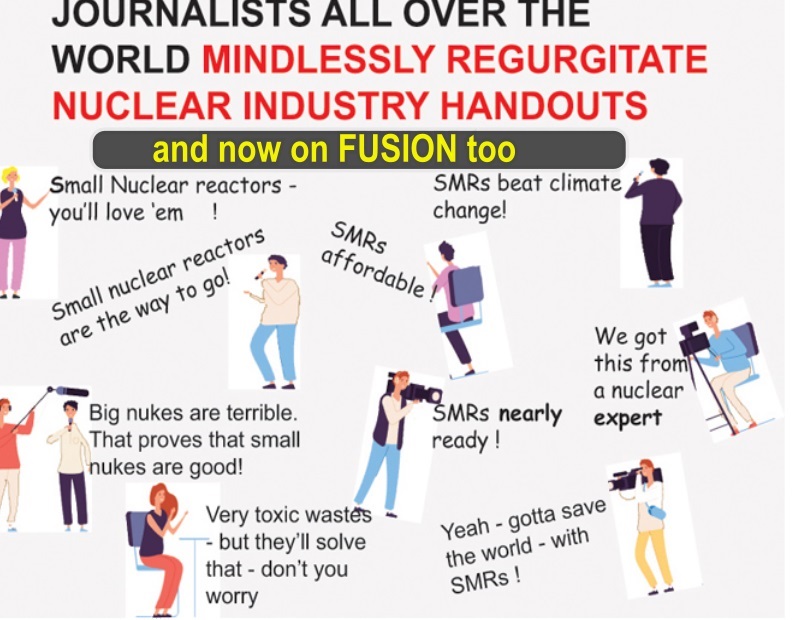
A part of me thinks that it is some sort of giant conspiracy – the media being told by military-industrial-corporate-government-complex to never criticise the nuclear priesthood.
The more sensible part of me suggests that the journalists are probably overworked people who must get the news out FAST, and are relieved to get the helpful handouts from the nuclear priesthood.
After all, journalists are not qualified nuclear physicists, and we all know that only qualified nuclear physicists can have an opinion on matters nuclear, don’t we?
Well, either way, it comes out as sloppy and incompetent reporting – never better shown that the present chorus of media joy over a nuclear fusion experiment.
Fortunately, there are a few mainstream journalists out there who do bother to do their homework. Arianna Skibell of Politico wrote a piece headed “Here’s a reality check for nuclear fusion.” Henry Fountain in his New York Times online column queried the costs and the claims about action on climate. The Washington Post and The New Statesman deplored the hype..And I’m hoping that there will be more journalists today, who bother to find out the facts on the usefulness or non-usefulness of nuclear fusion development.
Mothering a Movement: Notes from India’s Longest Anti-Nuclear Struggle

It was striking how these women activists situated their politics in motherhood and in their responsibility as the guardians for future generations. Prayers to Lourde Matha at the main church, floral tributes to Kadalamma, and protests against the nuclear plant all lie on a continuum as acts of reverence for life. While this politics around maternity might not sit well with a certain progressive outlook, these women are clear about their feminist goals.
A time will come. We will take over the village and remove the nuclear power plant.
Radiowaves Collective, Half-Life, December 2022
‘……………………………………………………………………… Both Idinthikarai and Kudankulam, the other settlement that abuts the northern boundary of the nuclear plant, lie off the beaten path for the tourists that come to Kanyakumari—a narrow strip of “Land’s End” with an old temple, newer memorials to regional and national personages, and the Indian Ocean—located a little over twenty-five kilometers away. Yet in 2011 and 2012, Kudankulam and its nearby villages had commanded significant media attention. Putting aside their caste and religious differences, the locals around Kudankulam had put up a remarkable non-violent resistance against the nuclear establishment. We want to find out what has happened to that movement a decade later.
Next morning, en route to Kudankulam, our bus lurches past the bustling town of Anjugramam and other smaller settlements, surrounded by farmlands and coconut and palmyra trees. But it is the giant windmills, mushrooming all over, that dominate the landscape and serve as a reminder that India is a country hungry for energy. All of this area, Anjugramam onwards, falls under what is called the emergency planning zone: a sixteen-kilometer radius around the nuclear plant that would need evacuation in case of a disaster. Our fellow passengers include some non-locals, who form the bulk of the workforce at the plant. When we do not get off at either the Anuvijay— “Victory of the Atom”— town, a gated community for staff and their families, or the plant some seven kilometers away, the few remaining people on the bus start eyeing us.
Once at the busy main market in Kudankulam, our local guide and a few other men quickly whisk us away to a house where we are scheduled to interview women activists who were involved in the 2012 protests. However, before we can start a conversation with them, a man in a striped blue shirt asks us to write down our names and contact details. “CID [Criminal Investigation Department],” he replies softly when we ask why. “He is a policeman. He is just doing his job,” another man chimes in, matter of factly. The sprawling nuclear plant across the road reaches far into the lives of the people here. Police surveillance is part and parcel of the architecture of the nuclear establishment.
The KKNPP is India’s largest nuclear power plant, housing two Russian VVER-1000 reactors—similar to the ones under siege now in Zaporizhzhya, Ukraine—and has four others in the pipeline. As far as one can tell, it has little to do with nuclear weapons, but the Department of Atomic Energy (DAE)—the agency which oversees all things nuclear in India—makes it easy to indulge in wild speculations. Right from its inception in 1954, the DAE has been notoriously opaque, with little independent or public scrutiny, and prone to misinformation and grandiose statements.
While the US launched its “Atoms for Peace” program in 1953, the motto of the DAE has always been “Atoms in the service of the nation.” But the nebulous nature of these slogans is often put on display. For instance, in 1974, the DAE tested nuclear weapons in the guise of a peaceful nuclear program, calling them “peaceful nuclear explosives” for the development of the nation.1 Things have been equally farcical in the case of the civilian nuclear energy program, where, in the name of national security, the DAE has refused to share details about basic public matters such as energy costs and nuclear safety. And even though the DAE is currently (and consistently) decades behind in meeting its own projections for power generation, it still proclaims a fifty-fold increase in nuclear power by 2050.2 The message is loud and clear: the future is nuclear, and only fools worry about the past—or the present.
“If we say anything against [the plant], they will file a case against us,” says a young woman who teaches science at a nearby school. “We don’t have permission to talk about this issue with the students. We can only teach things that are mentioned in the books,” she continued. While adding that the KKNPP supports some schools in its vicinity, like many others in Kudankulam, she is more concerned about the dismal state of affairs. “We do not have any facilities, we have long power cuts, we receive drinking water only once every ten days, and there are all sorts of diseases. Now, it is not possible to remove the plant, but at least our people should get better jobs. Outsiders have all the permanent positions there.” She is sympathetic to the DAE’s rhetoric of nation-building, but dismayed with the lopsidedness of it all. Why should people who live in metropolitan India receive the benefits of nuclear energy while people from Kudankulam take on the risks?
“People protested a lot, and nothing happened. Many who protested can’t get jobs there. It was a waste,” the teacher concluded. “People have accepted that they must live with the diseases. They have made up their mind to live happily until they die. They have started building bigger houses. And since people have come from other places, the land rates have increased, like in the big cities.” Indeed, right outside the nuclear plant, locals have opened new shops selling food, cellphones, and other sundry items. The area has become a real estate hotspot………………..
The region has seen sporadic protests ever since India and the erstwhile Soviet Union had signed an agreement to build these reactors in 1988, as part of post-Chernobyl nuclear diplomacy.3 With the fall of Soviet Union, the project went nowhere for a decade. In the wake of its Pokhran-II nuclear weapons tests in May 1998 and the sanctions that followed, however, India sought Russia’s help. Construction work at the Kudankulam plant finally began in 2000. However, it was the 2011 Fukushima accident in the aftermath of a tsunami that hit close to home…….
A few days after the Fukushima accident, a senior DAE official announced that “there [was] no nuclear accident or incident [in Fukushima],” instead claiming that “it was purely a chemical reaction and not a nuclear emergency.”4 Such technocratic stonewalling, typical of the DAE, did little to allay the anxieties of people living around the plant. Following a test run at the nuclear plant in July 2011, which involved generating high pressure steam to check safety mechanisms, residents started protesting non-violently. The DAE sought to further counter the heightened fear of locals with high-handedness and by flexing its scientific, economic, and legal authority.
Former Indian president A. P. J. Abdul Kalam—uniquely positioned as both a leading defense scientist and a member of the coastal fishing community in Tamil Nadu—visited KKNPP in November 2011. He declared the nuclear plant to be safe and recommended introducing four-lane highways, hospitals, jobs, and bank subsidies to the area. However, the former President refused to meet those in the village with anti-nuclear sentiments, declaring instead that “history is not made by cowards. Sheer crowd cannot bring about changes. Only those who think everything is possible can create history and bring about changes.”
Months later, tired of intransigent protestors, the state enlisted the help of India’s leading mental health hospital to counsel them. Meanwhile, the police and additional security agencies dealt with dissenting locals in their own style. By the first anniversary of the non-violent protests in August 2012, nearly 7,000 people had been accused of sedition and waging war against the state. Many in Idinthakarai still refuse to forgive the state for how they responded to the protests.
Mildred, a fifty-year-old leader of the Idinthikarai protests with dozens of legal cases against her recounted the day they had marched on the nuclear plant in September 2012. “We were frightened by the gun fire. I was in the front with other women and the hot gas fell between our legs. We couldn’t breathe. We couldn’t see for many days. They captured six other women, but I escaped by swimming into the sea,” For Mildred and other villagers from Idinthikarai, marching on the plant was a last-ditch effort to stop the loading of the nuclear fuel rods and the commissioning of the first reactor at KKNPP.
“That changed everything. We decided to protect the village by destroying the roads. We rang the church bell to warn people about the arrival of the police. We were hurt in our hearts,” Mildred continued. Throughout, the state could only see the irrationality and naïveté of this resistance, with the Prime Minister and Home Minister alleging that “foreign NGOs” were instigating the locals against the KKNPP. However, most apprehensions of the women activists we met in Kudankulam and Idinthakarai were grounded in their personal experience and knowledge…………
In Idinthakarai, this fierce sense of belonging to the soil and sea is a common refrain, even among different generations of women. A senior government official once put this down to their “primitive” mindset—calling them a “sea-tribe”—and to their inability to understand modern society. This framing is, of course, an attempt to dismiss these people as relics of a bygone era. “Mobile phones came around [the protest] time. We started googling the effects [of radiation]. Only then did we realize how dangerous this could be. We saw the fate of Chernobyl, of Fukushima,” a twenty-seven-year-old nurse, Preeka, who was shortly leaving to work at a hospital in Qatar, told us.
…………………there is little substantive dialogue around nuclear safety with the local communities. To date, let alone independent monitoring, plant authorities do not make their environment survey lab reports publicly available.
Albeit without recourse to scientific data, these women read the nuclear plant and its effects on their lives in anecdotal terms and in stories that make sense to them. The fish catch, the illnesses, the changing climate, and the sea all have become signs of things to come. Preeka observed, “the sea is my favorite. But now it is not good and it angers me. Many babies are affected with diseases, such as cancer and thyroid, these diseases are coming to our people… And since people get affected by diseases without doing anything wrong, they can’t control it. It makes me very sad.”
…………………….. these women are not far off from the scholars who see human-made radioactive nuclides as a marker of the Anthropocene.
Even though the authoritarian techniques of the nuclear establishment have prevailed, the activists in Idinthakarai have faith in their own powers………………………………………….. It was striking how these women activists situated their politics in motherhood and in their responsibility as the guardians for future generations. Prayers to Lourde Matha at the main church, floral tributes to Kadalamma, and protests against the nuclear plant all lie on a continuum as acts of reverence for life. While this politics around maternity might not sit well with a certain progressive outlook, these women are clear about their feminist goals.
A time will come. We will take over the village and remove the nuclear power plant…………………………….
A few days before we came, Idinthakarai witnessed a showdown between those who wanted to accept money from the nuclear plant to renovate the village playground and others who remain opposed to any such enticements. Even though the voices of the women activists carried the day, it isn’t clear how long this resistance will last. On our way out, we meet a young engineer, and ask him about his future plans. “I don’t blame others who might work at the plant, but I refused to work there. I have seen the people of my village struggle against it… Our people have no say. I am preparing for a government job. We need to take charge.” Perhaps the hopes of the women aren’t too far-fetched, for people’s movements too have long half-lives. https://www.e-flux.com/architecture/half-life/508409/mothering-a-movement-notes-from-india-s-longest-anti-nuclear-struggle/
Fusion. Really?
BY KARL GROSSMAN, https://www.counterpunch.org/2022/12/16/fusion-really/— 16 Dec 22
There was great hoopla—largely unquestioned by media—with the announcement this week by the U.S. Department of Energy of a “major scientific breakthrough” in the development of fusion energy.
“This is a landmark achievement,” declared Energy Secretary Jennifer Granholm. Her department’s press release said the experiment at Lawrence Livermore National Laboratory in California “produced more energy from fusion than the laser energy used to drive it” and will “provide invaluable insights into the prospects of clean fusion energy.”
“Nuclear fusion technology has been around since the creation of the hydrogen bomb,” noted a CBS News article covering the announcement. “Nuclear fusion has been considered the holy grail of energy creation.” And “now fusion’s moment appears to be finally here,” said the CBS piece
But, as Dr. Daniel Jassby, for 25 years principal research physicist at the Princeton Plasma Physics Lab working on fusion energy research and development, concluded in a 2017 article in the Bulletin of the Atomic Scientists, fusion power “is something to be shunned.”
His article was headed “Fusion reactor: Not what they’re cracked up to be.”
“Fusion reactors have long been touted as the ‘perfect’ energy source,” he wrote. And “humanity is moving much closer” to “achieving that breakthrough moment when the amount of energy coming out of a fusion reactor will sustainably exceed the amount going in, producing net energy.”
“As we move closer to our goal, however,” continued Jassby, “it is time to ask: Is fusion really a ‘perfect’ energy source?” After having worked on nuclear fusion experiments for 25 years at the Princeton Plasma Physics Lab, I began to look at the fusion enterprise more dispassionately in my retirement. I concluded that a fusion reactor would be far from perfect, and in some ways close to the opposite.”
“Unlike what happens” when fusion occurs on the sun, “which uses ordinary hydrogen at enormous density and temperature,” on Earth “fusion reactors that burn neutron-rich isotopes have byproducts that are anything but harmless,” he said.

A key radioactive substance in the fusion process on Earth would be tritium, a radioactive variant of hydrogen.
Thus there would be “four regrettable problems”—“radiation damage to structures; radioactive waste; the need for biological shielding; and the potential for the production of weapons-grade plutonium 239—thus adding to the threat of nuclear weapons proliferation, not lessening it, as fusion proponents would have it,” wrote Jassby.
“In addition, if fusion reactors are indeed feasible…they would share some of the other serious problems that plague fission reactors, including tritium release, daunting coolant demands, and high operating costs. There will also be additional drawbacks that are unique to fusion devices: the use of a fuel (tritium) that is not found in nature and must be replenished by the reactor itself; and unavoidable on-site power drains that drastically reduce the electric power available for sale.”
“The main source of tritium is fission nuclear reactors,” he went on. Tritium is produced as a waste product in conventional nuclear power plants. They are based on the splitting of atoms, fission, while fusion involves fusing of atoms.
“If adopted, deuterium-tritium based fusion would be the only source of electrical power that does not exploit a naturally occurring fuel or convert a natural energy supply such as solar radiation, wind, falling water, or geothermal. Uniquely, the tritium component of fusion fuel must be generated in the fusion reactor itself,” said Jassby.
About nuclear weapons proliferation, “The open or clandestine production of plutonium 239 is possible in a fusion reactor simply by placing natural or depleted uranium oxide at any location where neutrons of any energy are flying about. The ocean of slowing-down neutrons that results from scattering of the streaming fusion neutrons on the reaction vessel permeates every nook and cranny of the reactor interior, including appendages to the reaction vessel.”
As to “additional disadvantages shared with fission reactors,” in a fusion reactor: “Tritium will be dispersed on the surfaces of the reaction vessel, particle injectors, pumping ducts, and other appendages. Corrosion in the heat exchange system, or a breach in the reactor vacuum ducts could result in the release of radioactive tritium into the atmosphere or local water resources. Tritium exchanges with hydrogen to produce tritiated water, which is biologically hazardous.”

“In addition, there are the problems of coolant demands and poor water efficiency,” he went on. “A fusion reactor is a thermal power plant that would place immense demands on water resources for the secondary cooling loop that generates steam, as well as for removing heat from other reactor subsystems such as cryogenic refrigerators and pumps….In fact, a fusion reactor would have the lowest water efficiency of any type of thermal power plant, whether fossil or nuclear. With drought conditions intensifying in sundry regions of the world, many countries could not physically sustain large fusion reactors.”

“And all of the above means that any fusion reactor will face outsized operating costs,” he wrote.
Fusion reactor operation will require personnel whose expertise has previously been required only for work in fission plants—such as security experts for monitoring safeguard issues and specialty workers to dispose of radioactive waste. Additional skilled personnel will be required to operate a fusion reactor’s more complex subsystems including cryogenics, tritium processing, plasma heating equipment, and elaborate diagnostics. Fission reactors in the United States typically require at least 500 permanent employees over four weekly shifts, and fusion reactors will require closer to 1,000. In contrast, only a handful of people are required to operate hydroelectric plants, natural-gas burning plants, wind turbines, solar power plants, and other power sources,” he wrote.
“Multiple recurring expenses include the replacement of radiation-damaged and plasma-eroded components in magnetic confinement fusion, and the fabrication of millions of fuel capsules for each inertial confinement fusion reactor annually. And any type of nuclear plant must allocate funding for end-of-life decommissioning as well as the periodic disposal of radioactive wastes.”
“It is inconceivable that the total operating costs of a fusion reactor would be less than that of a fission reactor, and therefore the capital cost of a viable fusion reactor must be close to zero (or heavily subsidized) in places where the operating costs alone of fission reactors are not competitive with the cost of electricity produced by non-nuclear power, and have resulted in the shutdown of nuclear power plants,” said Jassby.
“To sum up, fusion reactors face some unique problems: a lack of a natural fuel supply (tritium), and large and irreducible electrical energy drains….These impediments—together with the colossal capital outlay and several additional disadvantages shared with fission reactors—will make fusion reactors more demanding to construct and operate, or reach economic practicality, than any other type of electrical energy generator.”
“The harsh realities of fusion belie the claims of its proponents of ‘unlimited, clean, safe and cheap energy.’ Terrestrial fusion energy is not the ideal energy source extolled by its boosters,” declared Jassby.
Earlier this year, raising the issue of a shortage of tritium fuel for fusion reactors, Science, a publication of the American Association for the Advancement of Science, ran an article headed: “OUT OF GAS, A shortage of tritium fuel may leave fusion energy with an empty tank.” This piece, in June, cited the high cost of “rare radioactive isotope tritium…At $30,000 per gram, it’s almost as precious as a diamond, but for fusion researchers the price is worth paying. When tritium is combined at high temperatures with its sibling deuterium, the two gases can burn like the Sun.”

Then there’s regulation of fusion reactors. An article last year in MIT Science Policy Review noted: “Fusion energy has long been touted as an energy source capable of producing large amounts of clean energy…Despite this promise, fusion energy has not come to fruition after six decades of research and development due to continuing scientific and technical challenges. Significant private investment in commercial fusion start-ups signals a renewed interest in the prospects of near-term development of fusion technology. Successfully development of fusion energy, however, will require an appropriate regulatory framework to ensure public safety and economic viability.”
“Risk-informed regulations incorporate risk information from probabilistic safety analyses to ensure that regulation are appropriate for the actual risk of an activity,” said the article. “Despite the benefits of adopting a risk-informed framework for a mature fission industry, use of risk-informed regulations for the licensing of first-generation commercial fusion technology could be detrimental to the goal of economic near-term deployment of fusion. Commercial fusion technology has an insufficient operational and regulatory experience base to support the rapid and effective use of risk-informed regulations.”
Despite the widespread cheerleading by media about last week’s fusion announcement, there were some measured comments in media. Arianna Skibell of Politico wrote a piece headed “Here’s a reality check for nuclear fusion.” She said “there are daunting scientific and engineering hurdles to developing this discovery into machinery that can affordably turn a fusion reaction into electricity for the grid. That puts fusion squarely in the category of ‘maybe one day.’”

“Here are some reasons for tempering expectations that this breakthrough will yield any quick progress in addressing the climate emergency,” said Skibell. “First and foremost, as climate scientists have warned, the world does not have decades to wait until the technology is potentially viable to zero out greenhouse gas emissions.” She quoted University of Pennsylvania climate scientist Michael Mann commenting: “I’d be more excited about an announcement that U.S. is ending fossil fuel subsidies.”
Henry Fountain in his New York Times online column “Climate Forward,” wrote how “the world needs to sharply cut [carbon] emissions soon…So even if fusion power plants become a reality, it likely would not happen in time to help stave off the near-term worsening effects of climate change. It’s far better, many climate scientists and policymakers say, to focus on currently available renewable energy technologies like solar and wind power to help reach these emissions targets.”
“So if fusion isn’t a quick climate fix, could it be a more long-term solution to the world’s energy needs?” he went on. “Perhaps, but cost may be an issue. The National Ignition Facility at Livermore, where the experiment was conducted, was built for $3.5 billion.”
The Lawrence Livermore National Laboratory has a long history with fusion. It is where, under nuclear physicist Edward Teller, who became its director, the hydrogen bomb was developed. Indeed, he has long been described as “the father of the hydrogen bomb.” The hydrogen bomb utilizes fusion while the atomic bomb, which Teller earlier worked on at Los Alamos National Laboratory, utilizes fission. The development of atomic bombs at Los Alamos led to a nuclear offshoot: nuclear power plants utilizing fission.
Karl Grossman, professor of journalism at State University of New York/College at Old Westbury, and is the author of the book, The Wrong Stuff: The Space’s Program’s Nuclear Threat to Our Planet, and the Beyond Nuclear handbook, The U.S. Space Force and the dangers of nuclear power and nuclear war in space. Grossman is an associate of the media watch group Fairness and Accuracy in Reporting (FAIR). He is a contributor to Hopeless: Barack Obama and the Politics of Illusion.
Clean energy or weapons ? What the ‘breakthrough’ in nuclear fusion really means.

National Ignition Facility (NIF), then, is a way to continue investment into modernising nuclear weapons, albeit without explosive tests, and dressing it up as a means to produce “clean” energy.
this sure-to-fail attempt to develop fusion power only amounts to diverting money and resources away from proven and safer renewable energy sources and associated technologies. Investment in research and development into fusion is bad news for the climate.
By M.V. Ramana, https://beyondnuclearinternational.org/2022/12/16/clean-energy-or-weapons/ 16 Dec 22
On December 13, the US Department of Energy (DOE) announced that the National Ignition Facility (NIF) at the Lawrence Livermore National Laboratory had reached a “milestone”: the achievement of “ignition” in nuclear fusion earlier in the month. That announcement was hailed by many as a step into a fossil fuel-free energy future. US Senate majority leader Charles Schumer, for example, claimed that we were “on the precipice of a future no longer reliant on fossil fuels but instead powered by new clean fusion energy”.
But in truth, generating electrical power from fusion commercially or at an industrial scale is likely unattainable in any realistic sense, at least within the lifetimes of most readers of this article. At the same time, this experiment will contribute far more to US efforts to further develop its terrifyingly destructive nuclear weapons arsenal.
Over the last decade or so, there have been many similar announcements featuring breathless language about breakthroughs, milestones, and advances. These statements have come with unfailing regularity from NIF (for example, in 2013) and the larger set of laboratories and commercial firms pursuing the idea of nuclear fusion. Apart from the United States, similar announcements have come from Germany, China and the United Kingdom. France is expected to take its turn once the International Thermonuclear Experimental Reactor (ITER) starts operating. The reactor is currently being built in Cadarache, France, at an estimated cost of somewhere between $25 billion to as high as $65 billion, much higher than the original estimate of $5.6 billion.
These incredibly high costs also explain why such announcements are made in the first place: without the excitement created by these hyped-up statements, it would be impossible to get funded for the decades it takes to plan and build these facilities. Conceptual design work on ITER began in 1988.
Of course, that timescale pales in comparison to the time period of the first major announcement about fusion-generated electricity. That took place in 1955 when Homi Bhabha, the architect of India’s nuclear programme, told the first International Conference on Peaceful Uses of Atomic Energy in Geneva:
“I venture to predict that a method will be found for liberating fusion energy in a controlled manner within the next two decades. When that happens the energy problems of the world will have been solved for ever.”
That would not be the last prediction about the imminence of fusion power that would be wrong.
Three challenges for nuclear fusion
The recent “breakthrough” that NIF announced pertains to what I would term “physics challenges”. One can identify three stages of physics challenges.
The first challenge is to have enough fusion reactions in the pellet that is blasted by lasers to produce more energy than is put into the target. That was what seems to have been seen at NIF: the reports say that the lasers pumped in 2.05 megajoules of energy and about 3.15 megajoules came out. All of this over a time period of a few nanoseconds (a nanosecond is one billionth of a second). The figure of 3.15 megajoules might seem like a lot but it is only 0.875 kilowatt-hours, that too of heat, which would produce perhaps 0.3 kilowatt-hours of electricity if it was used to boil water and drive a turbine. (For comparison, a rooftop solar panel that costs under Rs 30,000 in Delhi could generate around 5,000 times more electrical energy in a year.)
The second physics challenge is to produce more energy than is used by the facility as a whole. NIF is far from meeting this challenge. It admitted that just the 192 lasers consumed around 400 megajoules in the process of blasting the pellet. To this, we have to add all the energy that goes into running the other equipment and the facility as a whole.
The final physics challenge is to produce more energy than what is required to construct the facility and all the equipment. In the case of the ITER experiment, for example, it has been estimated that “the tokamak itself will weigh as much as three Eiffel towers [and the] total weight of the central ITER facility is around 400,000 tons”. As Daniel Jassby, a retired physicist from the Princeton Plasma Physics Lab, put it, all this “must appear on the negative side of the energy accounting ledger”.
If these physics challenges are not met, of course, then one has a permanent loss-making facility in energy terms. NIF is far from meeting the latter challenges.
The next stage can be called an “engineering challenge” and that revolves around the question: how do you convert this experimental set up that produces energy for a microscopic fraction of a second into a continuous source of electricity that operates 24 hours a day and 365 days per year? To do that, these fusion reactions should occur several times each second, each second of the day, each day of the year. As of now, the lasers can fire only once a day, at a single target. To move from that state to what is required will need an improvement by a factor of over 500,000 (assuming around six shots per second).
But it is not just firing the laser. Each of these explosions produces a large amount of debris, which would have to be cleared. And then a new pellet has to be placed with utmost precision at the very spot where the lasers can focus their beams.
If all of this is not trouble enough, there is fuel procurement. NIF uses a “gold cylinder with a frozen pellet of the hydrogen isotopes deuterium and tritium”. Deuterium and tritium are isotopes of hydrogen. Deuterium is quite common but tritium is very scarce, because it decays radioactively with a half-life of only around 12 years. Fusion proponents often talk about generating tritium in situ, but this is an exceedingly difficult task, as Jasby has explained.
Even if one were to adopt the approach of watching superhero movies and willingly suspend disbelief to assume that all these engineering challenges are solved, then there is an even more difficult challenge: to make this incredibly complicated process into an economically competitive way of generating electricity. If one goes by history, the last could be a killer as has been the case with nuclear fission power, which is a far easier process in comparison to fusion.
Thus, these advances can better be described as “micron-stones”, to coin a term, rather than milestones, and that too on a path that might never lead to economical electricity generation. In the meanwhile, this recent experiment is far more likely to be useful to nuclear weapons designers.
NIF and nuclear weapons
NIF’s chief purpose is not generating electricity or even finding a way to do so. NIF was set up as part of the Science Based Stockpile Stewardship Program, which was the ransom paid to the US nuclear weapons laboratories for forgoing the right to test after the United States signed the Comprehensive Test Ban Treaty. This is a purpose NIF can start fulfilling without ever generating any electricity.
The main utility that NIF offers nuclear weapons designers and planners is by providing a greater understanding of the underlying science. As the Lawrence Livermore National Laboratory’s webpage proudly proclaims:
“NIF’s high energy density and inertial confinement fusion experiments, coupled with the increasingly sophisticated simulations available from some of the world’s most powerful supercomputers, increase our understanding of weapon physics, including the properties and survivability of weapons-relevant materials”.
Another 1995 document explains that NIF would provide lots of “neutrons with the very short pulse widths characteristic of low-yield nuclear intercepts, that can be used to establish lethal criteria for chemical/biological agents and nuclear warhead targets”. In other words, NIF could help with modelling the use of nuclear weapons to destroy chemical, biological and nuclear weapons.
NIF might even help with developing new kinds of nuclear weapons. Back in 1998, Arjun Makhijani, who has a PhD in nuclear fusion, and Hisham Zeriffi suggested that NIF could help with the development of pure fusion weapons, i.e., thermonuclear weapons that do not need a nuclear fission primary. If that were to happen – and that is a big if, as is the case with most fusion activities – that would obviate the need for highly enriched uranium or plutonium, which are currently the main obstacles to making nuclear weapons.
NIF, then, is a way to continue investment into modernising nuclear weapons, albeit without explosive tests, and dressing it up as a means to produce “clean” energy. The managers of NIF and the larger laboratory in which it is housed are careful to highlight different promises based on the circumstance they are speaking at. When anthropologist Hugh Gusterson asked a senior official about the purpose of the laser programme, the official replied, “It depends who I’m talking to…One moment it’s an energy program, the next it’s a weapons programme. It just depends on the audience”.
Dangerous distraction
The tremendous media attention paid to NIF and ignition amounts to a distraction – and a dangerous one at that.
As the history of nuclear fusion since the 1950s shows, this complicated technology is not going to produce cheap and reliable electricity to light bulbs or power computers anytime in the foreseeable future.
But nuclear fusion falls even shorter when we consider climate change, and the need to cut carbon emissions drastically and rapidly. The Intergovernmental Panel on Climate Change has warned that to stop irreversible damage from climate change, the world will have to achieve zero net emissions by 2050. Given this relatively short timeline to turn around our economies and ways of living, spending billions of dollars on this sure-to-fail attempt to develop fusion power only amounts to diverting money and resources away from proven and safer renewable energy sources and associated technologies. Investment in research and development into fusion is bad news for the climate.
Meanwhile, nuclear fusion experiments like those at NIF will further the risk posed by the nuclear arsenal of the US, and, indirectly, the arsenals of the eight other countries known to possess nuclear weapons. The world has been lucky so far to avoid nuclear war. But this luck will not hold up forever. We need nuclear weapons abolition, but programmes like NIF offer nuclear weapons modernisation, which is just a means to assure destruction forever.
“FUSION NET GAIN” is manufactured ignorance.
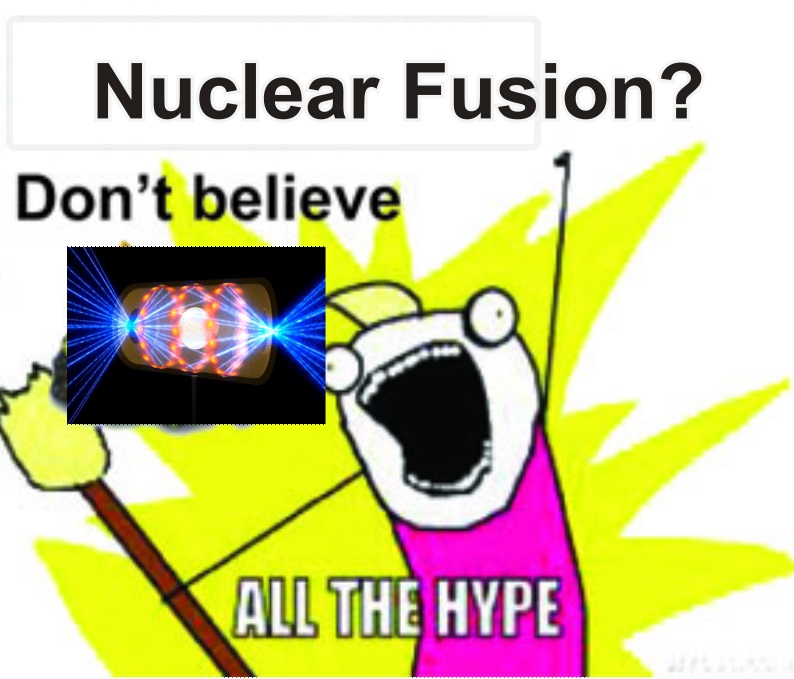
The only thing limitless and free about fusion power is the hype it generates
ARENA ONLINE, DARRIN DURANT, 16 DEC 2022 On 5 December 2022, fusion power researchers at California’s Lawrence Livermore National Laboratory (LLNL) achieved two technical milestones which by 12 December had encouraged a media-fuelled, gigantically unfounded and exaggerated projection about impending cheap, carbon-free, infinite electricity supply. Yes, ‘ignition’—a sustained, lab-controlled fusion reaction—was achieved. So too was ‘gain’, [?really] as the energy released by the fusion reaction was greater than that required by the lasers used to heat and compress a deuterium-tritium fuel pellet.
But we are light years away, at minimum, from fusion power contributing electricity into a grid and in any way helping to resolve the climate crisis. What is going on in all the pretending otherwise?
Almost every word written about ‘net energy gain’ from a fusion reaction is a species of manufactured ignorance generated by managing uncomfortable knowledge, which is complicated by a tension between the desire to trust fusion experts but the knowledge that those experts operate under powerful incentives to engage in hype.
INERTIAL CONFINEMENT
We have been at the doorstep of fusion hype before. In fact, ever since the 1950s fusion power has been just over the horizon. The fusion illusion has become its own cottage industry, with competing fusion research teams over-calling each other in a series of breakthroughs and decisive advances that generate hype, but no electricity.
For instance, on 9 February 2022 the Joint European Torus (JET) fusion reactor in the UK announced that it had produced 59 Megajoules of energy and that this indicated ‘powerplant potential’. Yet JET consumed significantly more power than it produced. Hence I suggested that the claim of a net power gain was a form of hyped science communication in which future promise colonises present limitations.
Researchers at LLNL’s National Ignition Facility (NIF) are the most recent hype-mongers. In fusion research, there are two main approaches: doughnuts and lasers. The ITER tokamak reactor in France is a doughnut-shaped machine that uses high-temperature magnetic confinement to create a stable and continuous plasma in which fusion can occur. By contrast, in the inertial confinement approach, discrete fusion reactions produce bursts of energy. In NIF experiments, a weak laser pulse is created, split, amplified, converted from infrared to ultraviolet energy, and then, in the form of 192 beams, focused onto a capsule containing deuterium and tritium, heating and compressing (fusing) the nuclear fuel to create alpha particles and release neutrons.
In their 13 December announcement of NIF’s experimental result, the US Department of Energy (DOE) advertised the result as a ‘game changer’ and quoted a host of US politicians directly linking the result to commercial fusion power and the goal of a ‘net-zero carbon economy’. Media outlets which really should adopt stricter editorial standards gushed about the result implying ‘limitless, zero-carbon power’ or stating that it ‘changes everything’ and heralds a decisive step towards ‘carbon-free energy’ for ‘everyone’ for ‘millions of years’.
The only thing limitless and free about fusion power is the hype it generates.
Back in reality, the DOE specified that ‘LLNL’s experiment surpassed the fusion threshold by delivering 2.05 megajoules (MJ) of energy to the target, resulting in 3.15 MJ of fusion energy output’. The DOE suggested ‘there is momentum to drive rapid progress towards fusion commercialization’, but what does that 1.10 MJ ‘gain’ in fact mean?
Even science magazines regurgitated the hype, suggesting the fusion reaction released ‘roughly 54% more than the energy that went into the reaction’. Yet when any of these media sources came up for air, typically late into the triumphant narrative, there were somewhat grudging estimates of total energy input, always attributed to some scientists who otherwise had gushed about technological promise. These scientists estimated that the total energy consumed by NIF’s 192 lasers was between 300 megajoules and 500 megajoules. Multiple credulous sources split the difference at 400 megajoules. As one sceptical physicist noted, ‘consuming 400 MJ and producing 3.15 MJ is a net energy loss greater than 99%’, akin to you giving me $400 and me returning to you $3.15, then trying to pump your tyres about how wealthy you just became.
UNCOMFORTABLE KNOWLEDGE
I am not a particle or theoretical physicist, and am admittedly biased by finding nuclear fission as a commercial electricity option to be a kind of technological creationism, and certainly a white elephant for Australia. Moreover, my field of Science and Technology Studies is known more for deconstructing facts than building them up. But as a sociologist of knowledge interested in theorising the positive, ‘partnership’ role experts can play in democratic decision-making, I ask, could experts with specialist knowledge relevant to fusion engineering be doing a better job of reining in the unwarranted hype about fusion net gain?
Specialist commentators on fusion power could do worse than get more comfortable with uncomfortable knowledge. Uncomfortable knowledge is information or understanding that is available but unevenly distributed or acknowledged, inadvertently or strategically obscured or left undone, and actually or potentially disruptive for the goals and interests of select organisations and institutions.
In fusion research, the fact that net energy gain is not the goal of either magnetic confinement or laser inertial confinement is the most salient piece of uncomfortable knowledge. ITER recently withdrew its claim of net energy gain—of 500 MW of fusion power from 50 MW of input power (a Q value of 10)—and now says that ITER is ‘the investigation and demonstration of burning plasmas’, in which the energy of helium nuclei produced by fusion reactions is enough to maintain plasma temperature.
The LLNL team admitted as much as well, describing the NIF result as a ‘proof of concept [not designed] to plug the NIF into the grid’, with other physicists adding that NIF was designed to be a big laser that could ‘give us the data we need for the [nuclear] stockpile research programme’.
Given the hype about limitless clean energy just over the horizon, another type of uncomfortable knowledge involves the judgements about the feasibility of commercial electrical power from fusion. Put differently, rather than being regaled by hyped milestones and heroic assumptions about future developments, why not cold, hard assessments of uncertainties and obstacles?
While it seemed easy to find a dozen experts willing to gush on record about how remarkable it was to spend $3.5 billion to produce an energy output that might boil a few kettles, frank assessments of future prospects are confined to scattered observations by disconnected critics.
But the list of uncertainties includes: how to increase the fusion reaction frequency from 1 per day to maybe 10 per second; how to reduce the cost of the capsule ‘target’ from tens of thousands of dollars to a few cents, especially as production ramps up from one capsule per week to up to one million per week; how to ensure the laser can reliably fire ten times per second, not once per day; whether energy out can increase versus energy in from 1.54x to 30x; how the heat produced by the fusion will be extracted; whether the efficiency of the yield can be increased by least two orders of magnitude; and whether it is possible to breed enough of the tritium fuel for a commercial industry.
Where such uncomfortable knowledge about feasibility is tackled in depth, it is only by critics. One physicist thus suggested commercial feasibility would demand an increase in fusion output of 100,000 per cent, a mastery of exceedingly strict conditions vis a vis temperature, shape of target capsule and vacuum chamber, a solution to the problem that the machine breaks when it works and requires hours to recover, and an overcoming of the low supply of tritium fuel and its prohibitive cost.
A final form of uncomfortable knowledge includes drawbacks, which are typically managed through practices that include denial (avoiding acknowledging information even if others bring it to collective attention), dismissal (manufacturing justifications for rejecting a counter-claim), diversion (distracting via a decoy issue) and displacement (swapping problems).
Two examples will suffice. One is the deuterium-tritium fuel needed for any future fusion reactor. It scarcely exists in nature (a fact met with denial) and must be produced either in heavy water reactors or by breeding it from enriched lithium-6, which is in short supply (met with dismissal), and, no, it is not solved by speculations about extracting the fuel from sea water (a diversion).
A second drawback is that nuclear fusion may be not the perfect energy source for a climate crisis but, as a former fusion physicist put it, is ‘in some ways close to the opposite’. Put succinctly, the fact that neutron streams comprise 80 per cent of fusion energy output in deuterium-tritium reactions makes it an odd electrical energy source. The neutron streams damage the structure of the machine, produce relatively bulky radioactive waste, require biological shielding, and constitute a proliferation risk (Pu-239). The fusion reactor itself has a high parasitic power consumption, a scarce fuel supply, and likely high operating costs due to continual radiation damage…………………………………… more https://arena.org.au/fusion-net-gain-is-manufactured-ignorance/
German states oppose construction of Poland’s first nuclear power plant
Alicja Ptak, Notes From Poland, DEC 16, 2022
Four eastern German states – Mecklenburg–Western Pomerania, Brandenburg and Saxony, which border Poland, as well as Berlin – have formally expressed opposition to the Polish government’s plans to develop the country’s first nuclear power station.
“Together, the federal states speak out against the construction and operation of the first nuclear power plant in Poland and [are] in favour of abandoning the project,” reads a statement by Brandenburg’s consumer protection ministry published earlier this week.
“In view of the devastating nuclear accidents in Chernobyl and Fukushima, plans for the further use of nuclear energy should be abandoned in the interest of the population and environment of all Baltic Sea countries,” it adds.
The statement notes that the environment ministry of Mecklenburg–Western Pomerania has forwarded their objections and concerns to Poland’s general director for environmental protection in Warsaw.
Poland intends to build the power plant in Lubiatowo-Kopalino, near the Baltic Sea and around 250 kilometres from the German border. The project is subject to mandatory consultation, and any opinions or objections could be submitted by Tuesday this week.
In October, Poland picked the United States as its international partner in developing the plant, which is scheduled to open in 2033. Soon after, South Korea was chosen as the partner in a project by a group of private and state-owned firms to develop a second nuclear power station.
By contrast, Germany has over the last decade been withdrawing from nuclear power in the wake of the Fukushima disaster in Japan. During a visit to Warsaw in February this year, Germany’s environment minister, Steffi Lemke of the Greens, expressed concern about Poland’s plans.
Nuclear is “neither good nor safe” in Berlin’s view, she said. “If reactors are to be built in Poland, we will work with the appropriate legal instruments…at the European level.”…… https://notesfrompoland.com/2022/12/16/german-states-oppose-construction-of-polands-first-nuclear-power-plant/
1 This Month
26 April – Chernobyl: Inside the Meltdown airs on National Geographic on Sunday 26th April from 4pm

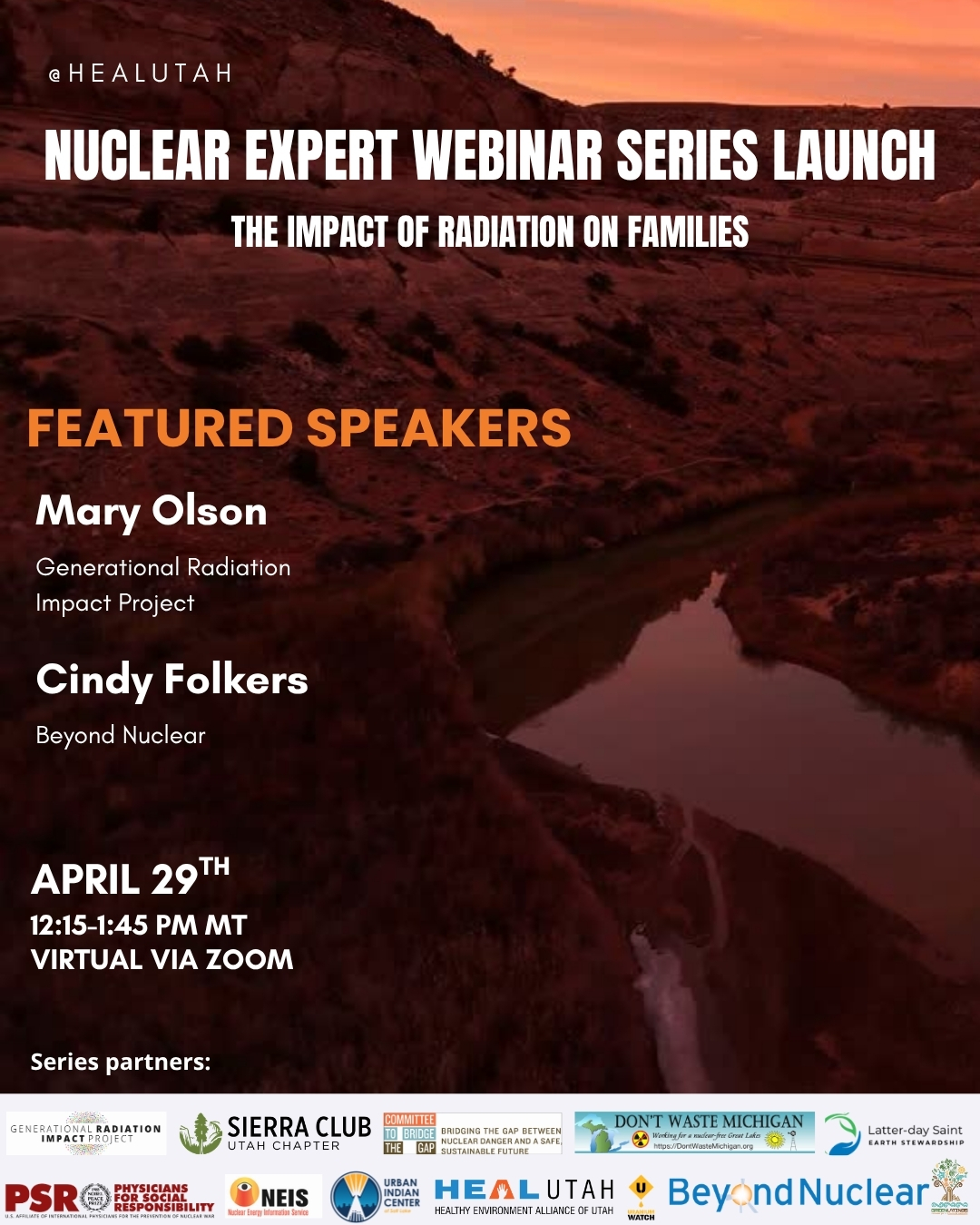
29 April – Nuclear Expert Webinar #1 – Radiation Impacts on Families with Mary Olson and Cindy Folkers
- 12:15 PM MT – 1:45 PM MT
- Location: Virtual – REGISTER TODAY

4 May -West Suburban Peace Coalition to discuss Iran war at May Educational Forum
Monday, May 4, 7:00 – 8:00 PM Central Standard Time
Title: : How Trump’s Narrative Tries to Shape the Reality of the War on Iran.
Contact Walt Zlotow, zlotow@hotmail.com 630 442 3045 for further information
14 May – online event From Bombs to Data Centres: the Face of Nuclear Colonialism

Pine Ridge Uranium is the real threat, not Tehran- Tell Burgum: Stop the Extraction.
Chernobyl: The Lost Tapes – A good documentary on Chernobyl on SBS available On Demand for the next 3 weeks– https://www.sbs.com.au/ondemand/tv-program/chernobyl-the-lost-tapes/2352741955560
To see nuclear-related stories in greater depth and intensity – go to https://nuclearinformation.wordpress.com
-
Archives
- April 2026 (317)
- March 2026 (251)
- February 2026 (268)
- January 2026 (308)
- December 2025 (358)
- November 2025 (359)
- October 2025 (376)
- September 2025 (257)
- August 2025 (319)
- July 2025 (230)
- June 2025 (348)
- May 2025 (261)
-
Categories
- 1
- 1 NUCLEAR ISSUES
- business and costs
- climate change
- culture and arts
- ENERGY
- environment
- health
- history
- indigenous issues
- Legal
- marketing of nuclear
- media
- opposition to nuclear
- PERSONAL STORIES
- politics
- politics international
- Religion and ethics
- safety
- secrets,lies and civil liberties
- spinbuster
- technology
- Uranium
- wastes
- weapons and war
- Women
- 2 WORLD
- ACTION
- AFRICA
- Atrocities
- AUSTRALIA
- Christina's notes
- Christina's themes
- culture and arts
- Events
- Fuk 2022
- Fuk 2023
- Fukushima 2017
- Fukushima 2018
- fukushima 2019
- Fukushima 2020
- Fukushima 2021
- general
- global warming
- Humour (God we need it)
- Nuclear
- RARE EARTHS
- Reference
- resources – print
- Resources -audiovicual
- Weekly Newsletter
- World
- World Nuclear
- YouTube
-
RSS
Entries RSS
Comments RSS
 nuclear-news