What’s all the fuss about fusion? – a breakthrough, and if so, for whom?
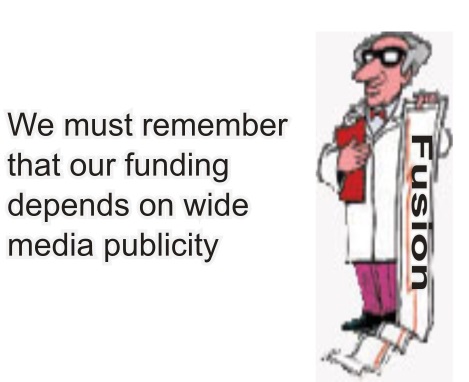
“obviously, if you are the director of a project that has been the recipient of billions of dollars of taxpayer funding over decades, you have to make optimistic noises and get as much mileage as you can out of any signs of progress.”
By Linda Pentz Gunter, 16 Dec 22,
It was heralded as a major breakthrough. The tantalizing challenge of fusion had been cracked! Yes, the elusive moment when the fusing of atoms would release more energy than had been put in, had finally happened. The National Ignition Facility at Lawrence Livermore Laboratory in California had won the fusion race against hot competition both in the US and overseas.
This “landmark achievement,” as U.S. energy secretary, Jennifer Granholm, described it, now means that what had been forever decades away — the delivery of electricity powered by fusion — was now……still decades away.
The Washington Post aptly summed up all the hype in a single sentence: “This was a science experiment more than a demonstration of a practical technology.” The New Statesman echoed the hype angle.
And how big a breakthrough really was it? While the experiment delivered 3.15 megajoules of energy output to the 2.05 megajoules it put in, the 192 lasers that produced it required 300 megajoules of energy.
We have been here before, as described in Stephane Lhomme’s accompanying article (in English and French.) For example, back in 1991, the collaborative Joint European Torus (JET) project in the UK achieved a temperature of about 200 million degrees Celsius (about 10 times the temperature in the centre of the sun) for a period of two seconds. Thermonuclear energy from a deuterium-tritium plasma (86% deuterium and 14% tritium) was released during this time at the rate of 2 million watts.
This, too, was heralded as “a significant milestone”, by JET’s director at the time, Dr Paul-Henri Rebut. Since then, there have been a series of other so-called breakthroughs, none of which have brought us any closer to the practical application of fusion as a provider of commercial electricity.
Fusion does not have now, never had, and never will have, any practicable applicability to electricity generation. As my father, Mike Pentz, who began his physics career working on controlled fusion in the late 1940s, wrote in the mid-1990s:
“By the time, if ever, a practicable commercial fusion power station was actually built and became operational, likely some time well into the 21st century, thermonuclear power will be irrelevant to the world’s energy needs, because by then about 90% of the world’s energy will be needed by the people living in the countries now somewhat euphemistically called ‘developing’, and extremely advanced, high-technology and high cost energy sources like controlled fusion will be entirely inappropriate for meeting their needs.”
At such a time, he predicted, almost 30 years ago, our focus would need to be elsewhere, and especially on solar energy. He wrote:“we are also going to have to move away from very large, centralized sources of energy, like most of today’s electrical power stations, whether they use coal, oil, gas or uranium, towards much smaller, decentralized sources, and that will make controlled fusion reactors as impracticable and inappropriate as nuclear reactors based upon fission.”
How ironic, then, that we continue to ignore the most obvious opportunity presented by fusion — to harvest the power of the sun itself. Even as renewable energy is soaring in application while dropping in price, absurd amounts of money continue to be squandered on the elusive pursuit of fusion.
And yet, utility-scale solar PV [photovoltaics] is already “the least costly option for new electricity generation in a significant majority of countries worldwide”, according to a 2022 study published by the International Energy Agency (IEA).
The IEA further reports that “Solar PV’s installed power capacity is poised to surpass that of coal by 2027, becoming the largest in the world.”
With the August 2022 passage of President Biden’s Inflation Reduction Act, the US now has in place an unprecedented long-term policy for federal tax credits supporting the expansion of solar PV projects out to 2032.
Fusion, on the other hand, is not about electricity production at all. The crowing about harnassing fusion as a safe, clean form of nuclear energy — already misleading as Daniel Jassby pointed out on these pages — is just a conveniently benign-sounding cover story.
The real agenda — which shouldn’t be hard to guess given the fusion “breakthrough” was achieved at Lawrence Livermore — is nuclear weapons.
…………………………………………….. Jennifer Granholm, however, returned to the cover story playbook when she said, tellingly: “This is our planet’s first step towards the ultimate clean energy, and THIS is why investing in America’s National Labs matters.”
The first part of her sentence is irrelevant nonsense of course, but the second part is the giveaway. It’s all about the money, and who gets it (again, see the Lhomme article.) Why is that funding needed? To turn our lights on? Absolutely not.
As my father noted in his memoirs, in rather more colorful language, so gentle edits have been made, “obviously, if you are the director of a project that has been the recipient of billions of dollars of taxpayer funding over decades, you have to make optimistic noises and get as much mileage as you can out of any signs of progress.”
That’s pretty much what we heard from NIF and the US government this week: noise. Joyful noise for the white coats, white noise for the rest of us, who instead urge the rapid implementation of real and affordable energy solutions that will serve us now, not wildly expensive ones that remain perpetually decades away. https://beyondnuclearinternational.org/2022/12/15/whats-all-the-fuss-about-fusion/
Exposed: The Most Polluted Place in the United States

A new book investigates the toxic legacy of Hanford, the Washington state facility that produced plutonium for nuclear weapons.
The Revelator The Ask, December 14, 2022 – by Tara Lohan, The most polluted place in the United States — perhaps the world — is one most people don’t even know. Hanford Nuclear Site sits in the flat lands of eastern Washington. The facility — one of three sites that made up the government’s covert Manhattan Project — produced plutonium for Fat Man, the atomic bomb dropped on Nagasaki during World War II. And it continued producing plutonium for weapons for decades after the war, helping to fuel the Cold War nuclear arms race.
Today Hanford — home to 56 million gallons of nuclear waste, leaking storage tanks, and contaminated soil — is an environmental disaster and a catastrophe-in-waiting.
It’s the costliest environmental remediation project the world has ever seen and, arguably, the most contaminated place on the entire planet,” writes journalist Joshua Frank in the new book, Atomic Days: The Untold Story of the Most Toxic Place in America.
It’s also shrouded in secrecy.
Frank has worked to change that, beginning with a series of blockbuster investigations published in Seattle Weekly a decade ago. Atomic Days offers an even fuller picture of the ecological threats posed by Hanford and its failed remediation.
The Revelator spoke with him about the environmental consequences, the botched cleanup operation, and what comes next.
Why is the most polluted place in the country so little known?
We have to understand what it was born out of, which was the Manhattan Project. There were three locations picked — Los Alamos [N.M.], Oak Ridge [Tenn.] and Hanford — to build the nuclear program.
Hanford was picked to produce plutonium and it ran for four decades, from World War II through the Cold War in the late 80s. For decades people that lived in and around Hanford didn’t know what was really going on there. It was run as a covert military operation. Even now, it’s still very much run like a covert operation because of the dangers that exist with the potential for an attack on one of the nuclear waste tanks……………….
What are the known environmental dangers?
There are 177 underground tanks that hold 56 million gallons of nuclear waste. We know that 67 of those tanks have leaked in the past into the groundwater that feeds the Columbia River.
We know that during its operation in the 50s and 60s the government was monitoring the water in the Columbia River, and even at the mouth of the Columbia they were finding radioactive fish. So we know that there have been leaks that made it to the river.
Right now, we know that there are two tanks currently leaking. The Washington Department of Ecology and the U.S. Department of Energy know about these leaks, but they can’t do anything about them because there’s no other place to safely put the waste…………………………
What has the cleanup process been like?
The big thing right now is trying to get all this waste vitrified, which is turning it into glass so it can be stored safely and permanently. The government thought that could be done in four years, but that was 30 years ago now……………………………………….
Bechtel is a privately owned corporation and we’re spending billions of dollars paying this company to not get the job done. It’s a big mess……………………………………………….. more https://therevelator.org/hanford-nuclear-book/
New Delay, Cost Overrun For France’s Next-gen Nuclear Plant

https://www.barrons.com/news/new-delay-cost-overrun-for-france-s-next-gen-nuclear-plant-01671212709 By AFP – Agence France Presse, December 16, 2022
Welding problems will require a further six-month delay for France’s next-generation nuclear reactor at Flamanville, the latest setback for the flagship technology the country hopes to sell worldwide, state-owned electricity group EDF said Friday.
The delay will also add 500 million euros to a project whose total cost is now estimated at around 13 billion euros ($13.8 billion), blowing past the initial projection of 3.3 billion euros when construction began in 2007.
It comes as EDF is already struggling to restart dozens of nuclear reactors taken down for maintenance or safety work that has proved more challenging than originally thought.
EDF also said Friday that one of the two conventional reactors at Flamanville would not be brought back online until February 19 instead of next week as planned, while one at Penly in northwest Farnce would be restarted on March 20 instead of in January.
The French government has warned of potential power shortages this winter because of the shutdowns at around two-dozen of the 56 reactors across the country that normally generate around 70 percent of its electricity needs.
EDF said the latest problems at Flamanville, on the English Channel in Normandy, emerged last summer when engineers discovered that welds in cooling pipes for the new pressurised water reactor, called EPR, were not tolerating extreme heat as expected.
As a result, the new reactor will be start generating power only in mid-2024.
The French-developed European Pressurised Reactor was designed to relaunch nuclear power in Europe after the 1986 Chernobyl catastrophe in Russia, and is touted as offering more efficient power output and better safety.
But similar projects at Olkiluoto in Finland, Hinkley Point in Britain and the Taishan plant in China have also suffered production setbacks and delays, raising doubts about the viability of the new technology.
French President Emmanuel Macron said in February that he wants a nuclear “renaissance” that would see up to 14 new reactors in France as the country seeks to reduce use of fossil fuels.
Bill Gates-backed nuclear demonstration project in Wyoming delayed because Russia was the only fuel source
Catherine Clifford, 16 Dec 22
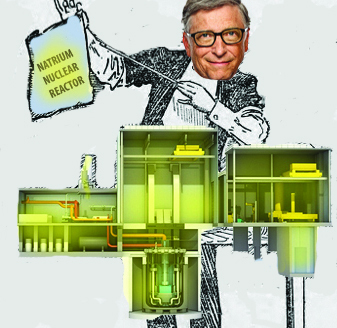
- Bill Gates nuclear innovation company TerraPower says the operation of its demonstration advanced power reactor will be pushed back at least two years because the only source of fuel for the reactor was Russia.
- The advanced reactor design uses high-assay low-enriched uranium, or HALEU, and was slated to be done in 2028.
- Stakeholders are now calling on the U.S. to secure other sources, or produce it domestically.
……………………………………………. Terrapower’s advanced nuclear plant design, known as Natrium, will be smaller than conventional nuclear reactors, and is slated to cost $4 billion, with half of that money coming from the U.S. Department of Energy. It will offer baseload power of 345 megawatts, with the potential to expand its capacity to 500 megawatts
………………. TerraPower has raised over $830 million in private funding in 2022 and the Congress has appropriated $1.6 billion for the construction of the plant, said Chris Levesque, the CEO of TerraPower. https://www.cnbc.com/2022/12/16/bill-gates-backed-nuclear-demonstration-delayed-by-at-least-2-years.html
UN committee adopts Russian draft resolution on prevention of arms race in space
https://tass.com/world/1531171 16 Dec 22
The resolution drew support from 124 delegations, while 48 voted against it and 9 abstained
UNITED NATIONS, November 1. /TASS/. The UN General Assembly First Committee on Tuesday adopted Russia’s draft resolution on Further Practical Measures for the Prevention of an Arms Race in Outer Space.
The resolution drew support from 124 delegations, while 48 voted against it and 9 abstained. The resolution is now expected to be considered by a full General Assembly in December. The document underscores the importance of taking urgent measures in order to forever prevent the deployment of weapons in the outer space, use of force or threat of force in the outer space, from space against Earth and from Earth against objects in space. The document calls on all states to achieve via negotiations corresponding legally binding multilateral agreements.
The UN General Assembly First Committee approved the Russian draft resolution “No first placement of weapons in outer space.” The document was supported by 123 delegations, with 50 voting against and 4 abstaining. The draft document is now expected to be reviewed by the General Assembly’s full membership in December.
The document was co-authored by 18 other states. It calls to promptly begin a substantial work based on the updated version of the 2008 draft agreement on prevention of deployment of weapons in space, use of force or threat of force against space objects, introduced by Russia and China. It reaffirms the need for examination and adoption of practical measures during development of agreements for prevention of an arms race in the outer space.
The committee approved without a vote the Russian draft resolution on Transparency and Confidence-Building Measures in Outer Space Activities.
The committee also adopted the Russian draft resolution “Transparency and confidence-building measures in outer space activities” without a vote. The document states that the UN Secretary General must inquire about opinions and proposals of member states on practical implementation of transparency measures, contained in the 2013 report of Group of government experts on transparency and trust-building measures in space.
For true reporting on nuclear fusion, non-magical science is needed
We want to know about the uncertainties attending fusion research, but are the people best placed to discuss those uncertainties because they are at the coalface of technical innovation, mired in commercial, and sometimes military, incentives to underplay risk and overplay potential?
FUSION NET GAIN IS MANUFACTURED IGNORANCE, ARENA ONLINE, DARRIN DURANT, 16 DEC 2022
“…………………….. ………………. Net gain in fusion research today exploits holes in our broader culture about what we do not know we know. It is unevenly known that more power is consumed than is produced by fusion experiments. The process of manufacturing ignorance about that unevenly known fact turns on excluding uncomfortable knowledge because of the way that knowledge might threaten fusion-related institutional goals and interests.
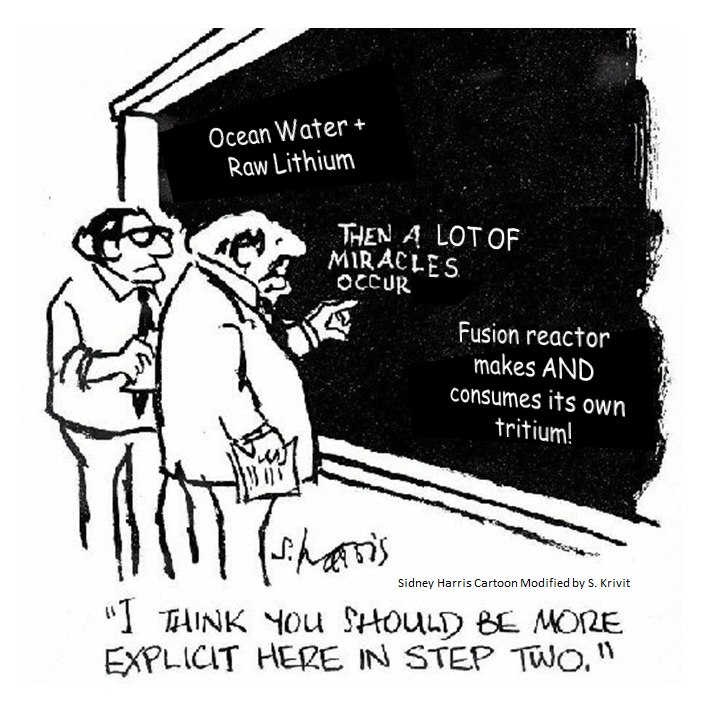
We are not ignorant of fusion gaslighting because of some natural but temporary state of maldistribution of knowledge, nor because we just happen to have not done the relevant work of knowing. Instead, fusion hype actively makes and sustains broader ignorance. Manufacturing ignorance is an achievement which in the case of fusion relies on fuzzy measures today being masked by heroic projections about tomorrow, aided by eliding the uncertainties attending fusion technology.
THE TRUTH OF THE MATTER?
If the managing of uncomfortable knowledge is leading to the manufacturing of ignorance about fusion research, is the solution to embrace frank assessment? Unfortunately, a tension exists whereby we reasonably suspect both that experts are best placed to know of uncertainties, and that those same experts might have incentives to underplay them. Social and political analysts of techno-science represent this as the conflict between the certainty trough and the commercialisation of science.
The certainty trough is the finding that those alienated from institutions committed to a non-preferred technology are uncertain due to distrust, but that insiders or producers of knowledge are uncertain (even if only in private) due to close experience with the relevant techno-science. If the question can be established as technical, not political, then by the principle of the locus of legitimate interpretation, in science the producers of knowledge ought to be the arbiters of meaning (unlike in the Arts, where we accept that consumers can play the role of interpreters of meaning).
Yet the commercialisation of science often incentivises an instrumental function of hype in which scientists sell opportunity and underplay risk, producing warranted distrust in the delegating of meaning-making to experts. The hermeneutics of suspicion can be either crude (financial investments are said to directly undermine norms of objectivity), subtle (a medialisation process is shifting the norms of science towards the norms of marketing, entertainment, media and attention cycles), or deep (a restricted agenda of tractable uncertainties, resolvable by existing frameworks, makes invisible the limiting commitments and assumptions of any given techno-scientific project).
The NIF experiment is especially burdened by the tension between trusting and being suspicious of experts because it is a weapons project. The DOE announcement slipped in that the ‘breakthrough will ensure the safety and reliability of our nuclear stockpile’. The director for weapons physics and design at LLNL (California’s Lawrence Livermore National Laboratory) did not hide this, clarifying that fusion ignition is important because it ‘has direct application to maintaining the weapons stockpile—NIF’s (National Ignition Facility) primary mission)
The DOE’s National Nuclear Security Administration warranted the NIF ignition test as part of the Stockpile Stewardship Program, in which thermonuclear weapons are assessed and certified without the need for explosive testing. In reply, critics linked the test to concerns about proliferation and continued weapons development, and clean energy was branded a ‘convenient reason to keep the dollars flowing to dual-use weapons R&D’.
Is this tension a catch-22? Is there no escape from the mutually dependent but conflicting conditions? We want to know about the uncertainties attending fusion research, but are the people best placed to discuss those uncertainties because they are at the coalface of technical innovation mired in commercial, and sometimes military, incentives to underplay risk and overplay potential?
NON-MAGICAL SCIENCE
Maybe there is a sliver of hope. The director for weapons physics at LLNL lamented that ‘he would have preferred [the results] be released through a scientific journal. But the results were sure to leak out’. The unedifying hype accompanying fusion research trades on the image of science as magically pulling rabbits (clean, infinite power for all, tomorrow) out of hats. Distrust follows when exaggerated projections are revealed to be emperors with no clothes.
But here is a scientist, enmeshed in all the complexities of military and commercial work, still holding on to a key value of science: organised scepticism. The more scientists opt for the less sexy route of assessing results and uncertainties, checking before unveiling and opening research to scientific scrutiny before turning meaning-making over to the norms of sensationalism, the more the rest of us might have access to their distributed judgements about uncertainties.
Note there is an historical precedent: the LIGO result announcing the detection of gravity waves. LIGO detected the ripple in September 2015 but waited until February 2016 to announce it, using the time to double-check everything. The story is told by the sociologist of science Harry Collins in Gravity’s Kiss (2017), where he suggests that the result was withheld because LIGO was still hostage to the ‘science is revelatory’ image. There remained a commitment to flawless and glorious truth, and a reluctance to let science be a bit uncertain and maybe even wrong. There is historical precedent here too: some nuclear waste disposal programs have let their institutional selves be vulnerable, which is a key condition for building trust, by making their choices amenable to checking and changing by broader audiences. I am just, I guess, fusing some ideas together. https://arena.org.au/fusion-net-gain-is-manufactured-ignorance/
‘We are all downwinders’: New film discusses Nevada’s nuclear fallout
https://www.reviewjournal.com/entertainment/movies/we-are-all-downwinders-new-film-discusses-nevadas-nuclear-fallout-2695496/ By Taylor Lane Las Vegas Review-Journal, December 16, 2022
“At the end of the day, we are all downwinders.”
That’s the message directors Mark Shapiro and Douglas Brian Miller hope viewers take away from their upcoming film “Downwind,” a documentary on the health consequences of nuclear testing at the Nevada Test Site (now called the Nevada National Security Site).
The test site saw over 900 nuclear detonations between 1951 and 1992, including 100 atmospheric tests that could be seen from as far as Las Vegas, 65 miles south of the test site, and St. George, Utah, which has above-average rates of radioactivity compared to the U.S. average.
The film centers around the areas closest to the blasts in Utah and western Nevada, where communities officials once deemed a “low-use segment of the population” bore the brunt of the fallout — mainly Mormon communities, Native Americans and other rural residents, Shapiro said.
Because of its Utah focus, the filmmakers wanted to debut it in the Beehive State at the Slamdance Film Festival in Park City.PauseUnmute
The film premieres Jan. 23 and will be preceded by a panel featuring Miller and Shapiro, along with downwinder advocates Claudia Peterson and Mary Dickson, Nevada Shoshone Nation Principal Man and spokesperson Ian Zabarte and Scott Williams, a nuclear policy consultant from Heal Utah.
Shapiro and Miller said they became interested in researching nuclear fallout after reflecting on their families’ history of cancer, which is found in higher rates in communities in proximity to the test site.
The two descended down a rabbit hole of research on the widespread impacts of radiation from nuclear testing, and found out radiation is not exclusive to the Southwest.
“Even if you don’t live in St. George, the radiation impacts us globally,” Shapiro said.
Miller said he was awestruck by a map from researcher Richard Miller (no relation) that shows how far the winds blew the radiation across the U.S.
“It blasted the entire country, minus Los Angeles because of the way the wind was blowing. … It just changes your whole mindset of ‘Is this real?’ And then you continue to dig,” Miller said.
Talking with Nevadans
Miller and Shapiro spoke with many Nevadans about their experiences with nuclear fallout, including members of the Western Bands of the Shoshone Nation of Indians such as Zabarte. The test site is on the traditional homelands of the Western Shoshone.
“We wanted to make sure that we had the perspective of Ian and others from the community to talk about the significance of testing on land that they still consider theirs and theirs by treaty,” Shapiro said.
The duo found support from late Review-Journal reporter Keith Rogers, whose career at the newspaper focused on the test site, military issues and the environment. Rogers died in October.
“We looked at him as a significant contributor to this film,” Shapiro said. “(For) both Doug and I, he was like a father figure to us. He really helped guide a lot of the story.”
Rogers is featured in the film, and behind the scenes helped Miller and Shapiro connect with people who work at Atomic Testing Museum and to past test site employees.
The greatest resource Rogers gave the team, Shapiro said, was a U.S. nuclear test booklet from the Department of Energy, which detailed every test ever done at the test site.
“Each one of them has a name, it has a date, it has a location, it has the yield range — some of these bombs were several times larger than the bombs dropped in Hiroshima and Nagasaki,” Shapiro said. “This booklet that he gave me, you see notes from the government saying ‘accidental release of radiation detected off site.’ It almost gives you shivers — it’s the rabbit hole effect.”
The film also stars actor Martin Sheen, who serves as the film’s narrator and has spoken out against nuclear testing, and comedian Lewis Black, who adds humor to a dark story about America’s past and has joked about duck-and-cover drills in his stand-up routines.
“(Black) is a political commentator, and his comedy is a reflection of the time we live in,” Shapiro said.
Holding accountability
Miller hopes the film shows that residents whose lives have been changed by testing should be compensated and that Americans can find ways to prevent testing from happening again, he said.
“We have to make sure that we’re holding our government accountable for what’s happening,” Shapiro said. “While we recognize how much we love living here (in the U.S.), still, there’s accountability.”
For more information on the film, visit backlotdocs.com.
Contact Taylor Lane at tlane@reviewjournal.com. Follow @tmflane on Twitter.

Twice as many people support onshore wind compared to nuclear power, according to UK Government survey.
Renewable energy of all sorts is at
least twice as popular with the British public compared to nuclear power
according to the newly released ‘BEIS Public Opinion Tracker Autumn
2022‘. Solar power was supported or strongly supported by 89% of
respondents, offshore wind by 85% and onshore wind by 79%. This was
compared to only 37% for nuclear power, 25% for fracking and 44% for carbon
capture and storage. The survey recorded that just 29% of people believe
that nuclear energy ‘provides a safe source of energy in the UK’.
100% Renewables 15th Dec 2022
For the Western leaders, Minsk Agreements were designed to buy time for Ukrainians to get ready for conflict with Russia
Former German chancellor Angela Merkel’s astonishing admission vis-a-vis Minsk II, made during an interview with German newspaper Die Zeit recently merely confirms that Putin was played for a fool when he entered negotiations for Minsk II with Germany, France and Ukraine in 2015. Russia entered said negotiations in good faith while the other parties involved did not. Thousands of lives lost and counting seven years on is the result.
Again and again, Ukraine’s future prosperity, security and stability upon becoming independent in 1991 was always dependent on it being a bridge between Russia and the West not the battlefield it became.
Merkel admits Minsk Agreements were designed to buy time for Ukrainians to get ready for conflict with Russia, yet Putin? Medium, John Wight, 13 Dec 22.
Sooner or later people in the West are going to have to wake up to the hard truth that their enemy is not at the gates but within the gates — this in the shape of ruling elites that have driven our world to the brink of destruction economically, ecologically, environmentally, and militarily with their lust for power, hegemony, domination and riches.
Before we go on, though, let us take a moment to deal with the usual ordure that gets shovelled in the direction of those in writing in the West who dare not type the name Putin in a sentence without also including words such as ‘tyrant’, ‘dictator’, ‘monster’ either before or after it — and preferably both. Here it is just as Eduardo Galeano said: “The marketplace of fear requires a steady supply of monsters.”
Russian President Vladimir Putin is a brutal man leading his country through a brutal period in human affairs. But he is not the architect of this brutal period; on the contrary, the Russia he has led since 2000 has been among the most grievous victims of it.
Canadian author and journalist Naomi Klein, in her remarkable work Shock Doctrine, describes how Russia was used as a laboratory by US free market think tanks, gurus and economists, who descended on the country while still reeling from the shock of the implosion of the Soviet system in the early 1990s. Their objective was the establishment of a pure market economy shorn of state intervention, wherein the market would decide who worked and who did not, who could heat themselves and who could not, who ate and who could not — and ultimately who would live and who would not………………………
The primary aim of the free market economic ‘hitmen’ who arrived in Russia in early 1990s was the decimation of every vestige of state involvement in the nation’s economy or economic life. Rather than the arbiter of social justice and guarantor of economic stability, the government was now to be reduced to the role of facilitator and guardian of the interests of international investors, shareholders, speculators, and global corporations.
This process entailed the deregulation of the banking system, the removal of social protections and safety nets, the lifting of price controls and the privatisation of all state owned sectors of the economy, sold off to speculators at a fraction of their true value. The aforementioned reforms were laid down as conditions of post-Soviet Russia’s membership of the IMF, when it applied to join under its first post-Soviet president, Boris Yeltsin, in 1992.
Moscow at this point was on the verge of bankruptcy, burdened with an external debt of $66 billion in the wake of the Soviet’s Union’s dissolution. The creditor nations of the G7 made it a condition of their cooperation in rescheduling the country’s debt that the IMF play a central role as policy advisor, lender and coordinator of assistance. Russia’s sovereignty, in other words, was to be suborned to the diktats of the IMF in Washington…………………………………………
the impact of this economic medicine on Russian society was nothing short of devastating. Most Russians consumed 40 percent less in 1992 after a year of shock therapy than they consumed in 1991, while a third of the population fell below the poverty line……………………
That the country managed to recover from this horrific decade was in large part down to the stewardship of Vladimir Putin. He it was who restored national pride, faced down the oligarchs who’d taken control of the nation’s economy, and reasserted the primacy of the state over that of blind economic forces.
Benefiting from its domination of the European energy market and an extended period of high oil and gas prices, Russia’s economic growth from 1999 — when Putin first became prime minister — to 2008 was exponential……………………..
The Putin so demonised in the West today is the same Putin that broached the possibility of Russia becoming a member of NATO with US President Bill Clinton in 2000. The Putin so demonised in the West today is the same Putin who was the first leader to call US President George W. Bush to express his condolences after 9/11 and offered the use of Russian airbases in Central Asia for US airstrikes against Al Qaeda and the Taliban in Afghanistan, staged in response.
That Putin is now to all intents engaged in conflict against the West in Ukraine marks an abject failure not of Russian but Western foreign policy in the wake of the demise of the Soviet Union.
Former German chancellor Angela Merkel’s astonishing admission vis-a-vis Minsk II, made during an interview with German newspaper Die Zeit recently merely confirms that Putin was played for a fool when he entered negotiations for Minsk II with Germany, France and Ukraine in 2015. Russia entered said negotiations in good faith while the other parties involved did not. Thousands of lives lost and counting seven years on is the result.
Again and again, Ukraine’s future prosperity, security and stability upon becoming independent in 1991 was always dependent on it being a bridge between Russia and the West not the battlefield it became.
In the words of Professor John J. Mearsheimer:
U.S. and European leaders blundered in attempting to turn Ukraine into a Western stronghold on Russia’s border. Now that the consequences have been laid bare, it would be an even greater mistake to continue this misbegotten policy. https://johnwight1.medium.com/merkel-admits-minsk-ii-was-designed-to-buy-time-for-the-ukrainians-to-get-ready-for-conflict-with-504191f7872d
The military connection to the fusion experiment.
Frank N. von Hippel
December 15, 2022 at 10:20:50 AM EST
Below is the letter I sent to the NYTimes:
“The achievement of fusion in a tiny pellet of heavy hydrogen at the National Ignition Facility represents a scientific and engineering but not an energy achievement.
“After an expenditure of about $10 billion over three decades, it converted 80 kilowatt-hours of electric energy into less than one kilowatt-hour of fusion heat. The investment was justified as necessary to check the computer codes used by nuclear-weapon designers in the absence of nuclear weapon test explosions, which the US ended in 1992.
“Extrapolating this achievement to a competitive source of electric power “a few decades” hence, however, is a huge reach. As a source of power, laser fusion is in the same league as lunar power. One could construct a huge mirror and focus moonlight to generate power, but not at a cost comparable to solar power. This achievement should not be used as a pretext to divert precious energy research and development funds to subsidize nuclear-weapon R&D.”
Coal Mine Boss Should be Sacked from Position as Government’s Nuclear Dump Advisor — RADIATION FREE LAKELAND

Originally posted on Keep Cumbrian Coal in the Hole: Many will have heard by now the awful news that the coal mine in Cumbria has been approved by Government. What the public have not been made aware of despite the banner headlines is the fact that the coal mine CEO Mark Kirkbride is advising Government…
Coal Mine Boss Should be Sacked from Position as Government’s Nuclear Dump Advisor — RADIATION FREE LAKELAND
TODAY: Toad’s new fad- nuclear fusion.

Sadly, in this age of omnipresent Disney characters, it is rare to see the whimsical children’s favoutites of last century. Mr Toad, of the Wind in the Willows, was a great favourite. Lovable, but foolish, he entertained with his enthusiastic obsessions for new technology, inevitably ending himself in trouble. Luckily those surrounding him saw through his follies, and helped him scrape out.
Not so lovable, today’s technical experts come up with new nuclear gimmicks, and the media fawn over them.
Today I find news item after news item, whether it be in print, radio TV or social media – extolling the wonder of the latest nuclear fusion breakthrough.
Wow! It will be boundless, super-clean, cheap electricity for all of us! We can hardly wait – to spend $squillions of tax-payer funding to produce this planet-saving marvel!
I tell you – you gotta scour through a heap of information to find these little scraps of thoughtful knowledge:
- The lasers creating the nuclear fusion emitted 2.05 megajoules, but they took about 500 megajoules of energy to power,
- the actual experiment made a tiny net gain of 1.1 megajoules of energy. (Expert Gordon Edwards estimates that a typical household averages 273 megajoules per day).
- it will take at least 20-30 years to have a prototype fusion reactor in operation, even if things go quite well, and more decades will be required to scale it up to a commercial level.
- fusion reactors will not produce high-level nuclear waste, but will release an enormous amount of tritium (radioactive hydrogen) to the environment.
- the structural materials in a fusion reactor will become very radioactive. The decommissioning wastes will remain dangerously radioactive for hundreds of thousands of years
- And of course – there’s a military connection, (as with all nuclear stuff)
Fusion “breakthrough” is largely irrelevant to the climate crisis
Gordon Edwards 15 Dec 22
Just a short commentary on the “fusion breakthrough” this week.
The experiment took place at the Lawrence Radiation Lab, a pre-eminent weapons Laboratory in California once directed by Edward Teller.
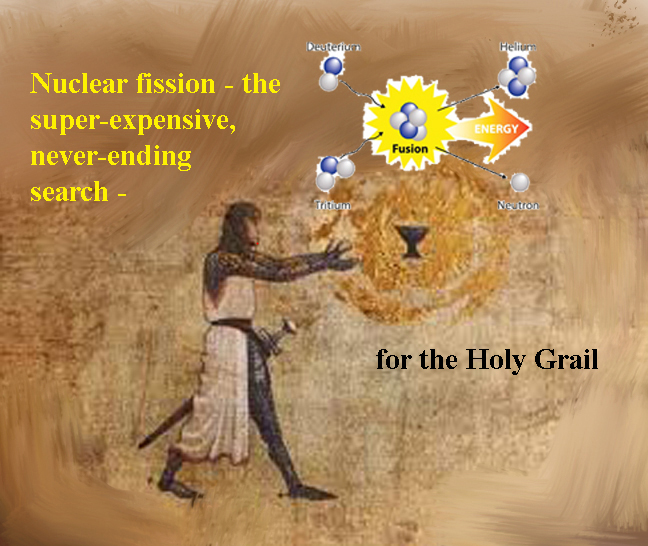
Jubilation is felt because, for the first time in over 60 years of effort costing many billions of dollars, a greater amount of energy came out of an extremely short-lived fusion reaction than the amount of energy needed to trigger it in the first place. The net energy gain was about 50 percent.
It all happened very quickly. “The energy production took less time than it takes light to travel one inch,” said Dr Marvin Adams, at the NNSA. (NNSA = National Nuclear Security Administration)
Here are a few details –
1) In an earlier email (www.ccnr.org/fission_fusion_and_efficiency_2022.pdf )I described the “magnetic confinement” concept, whereby an electromagnetic force field holds a very hot plasma of hydrogen gases inside a doughnut-shaped torus (typical of the Tokamak and its close relatives). In this case, “very hot”. Means about 150 million degrees C.
But the breakthrough that is being bally-hooed now, since Tuesday December 13, is a different kind of process altogether, using a concept called “inertial confinement”.
The experiment involved a small pellet about the size of a peppercorn. This pellet contained, in its interior, a mixture of deuterium and tritium gases, two rare hydrogen isotopes. In the experiment, the pellet’s exterior was blasted by x-rays triggered by a battery of 192 very powerful lasers, all targeted on the inner walls of a cylinder made of gold. The lasers generated x-rays on contact with the goldatoms, and those x-rays were focussed by the curving cylinder walls on the little peppercorn-sized pellet in the middle of the gold cylinder.
The x-rays heated the outer shell of the pellet to more than three million degrees, making the exterior of the pellet explode outwards, and (by Newtons “action-reaction” principle) causing the inner gases to be compressed to a very high density at an extremely high temperature, presumably to over 100 million degrees. It is a high-energy kind of implosion, causing fusion to occur in the very centre. The peppercorn “pops”.
2) The experimenters input 2.05 megajoules of energy to the target, and the result was 3.15 megajoules of fusion energy output – that is over 50% more energy than was put in (for a net gain of 1.1 megajoules). This suggests that the fusion reaction inside the pellet may have triggered other fusion reactions.
How much energy is that? Well, a typical household uses about 100,000 megajoules of energy per year, or an average of 273 megajoules per day. So 1.1 megajoules is not much. But it is greater than the input energy.
The Tokamak project now under construction in France for the ITER project, using magnetic confinement, is hoping to have a net energy gain factorof 10 or more (i.e. 10 times as much energy output as energy input).
Earlier this year, in February 2022, the UK JET laboratory announced thatthey had managed to have a fusion reaction last for five seconds. Thereaction produced 59 megajoules of energy, but without a net gain in energy.
3) Most of the news stories about this event state, erroneously, that fusionreactors will not produce any radioactive wastes. This is untrue.
It is true that fusion reactors will not produce high-level; nuclear waste(irradated nuclear fuel), but It is expected that fusion reactors will release an enormous amount of tritium (radioactive hydrogen) to the environment— far more than is currently released by CANDU reactors, which in turn release 30 to 100 times more tritium than light water fission reactors.
Moreover, because of neutron irradiation, the structural materials in a fusion reactor will beome very radioactive. The decommissioning wastes will remain dangerously radioactive for hundreds of thousands of years.
4) Many experts believe it will take at least 20-30 years to have a prototype fusion reactor in operation, even if things go quite well, and more decades will be required to scale it up to a commercial level. Thus fusion energy will be largely irrelevant to the climate emergency we are now facing as all of the critical decision points will have passed before fusion is available.
And, of course, there are no guarantees even then. As one commentator sardonically remarked, fusion energy is 20 years away,it always has been, and perhaps it always will be.
Dismantling Sellafield: the epic task of shutting down a nuclear site

Nothing is produced at Sellafield anymore. But making safe what is left behind is an almost unimaginably expensive and complex task that requires us to think not on a human timescale, but a planetary one
Guardian, by Samanth Subramanian 15 Dec 22,
“……………………………………………………………………….. Laid out over six square kilometres, Sellafield is like a small town, with nearly a thousand buildings, its own roads and even a rail siding – all owned by the government, and requiring security clearance to visit………. having driven through a high-security gate, you’re surrounded by towering chimneys, pipework, chugging cooling plants, everything dressed in steampunk. The sun bounces off metal everywhere. In some spots, the air shakes with the noise of machinery. It feels like the most manmade place in the world.
Since it began operating in 1950, Sellafield has had different duties. First it manufactured plutonium for nuclear weapons. Then it generated electricity for the National Grid, until 2003. It also carried out years of fuel reprocessing: extracting uranium and plutonium from nuclear fuel rods after they’d ended their life cycles. The very day before I visited Sellafield, in mid-July, the reprocessing came to an end as well. It was a historic occasion. From an operational nuclear facility, Sellafield turned into a full-time storage depot – but an uncanny, precarious one, filled with toxic nuclear waste that has to be kept contained at any cost.
Nothing is produced at Sellafield any more. Which was just as well, because I’d gone to Sellafield not to observe how it lived but to understand how it is preparing for its end. Sellafield’s waste – spent fuel rods, scraps of metal, radioactive liquids, a miscellany of other debris – is parked in concrete silos, artificial ponds and sealed buildings. Some of these structures are growing, in the industry’s parlance, “intolerable”, atrophied by the sea air, radiation and time itself. If they degrade too much, waste will seep out of them, poisoning the Cumbrian soil and water.
To prevent that disaster, the waste must be hauled out, the silos destroyed and the ponds filled in with soil and paved over. The salvaged waste will then be transferred to more secure buildings that will be erected on site. But even that will be only a provisional arrangement, lasting a few decades. Nuclear waste has no respect for human timespans. The best way to neutralise its threat is to move it into a subterranean vault, of the kind the UK plans to build later this century.
Once interred, the waste will be left alone for tens of thousands of years, while its radioactivity cools. Dealing with all the radioactive waste left on site is a slow-motion race against time, which will last so long that even the grandchildren of those working on site will not see its end. The process will cost at least £121bn.
Compared to the longevity of nuclear waste, Sellafield has only been around for roughly the span of a single lunch break within a human life. Still, it has lasted almost the entirety of the atomic age, witnessing both its earliest follies and its continuing confusions. In 1954, Lewis Strauss, the chair of the US Atomic Energy Commission, predicted that nuclear energy would make electricity “too cheap to meter”. That forecast has aged poorly. The main reason power companies and governments aren’t keener on nuclear power is not that activists are holding them back or that uranium is difficult to find, but that producing it safely is just proving too expensive.
… The short-termism of policymaking neglected any plans that had to be made for the abominably lengthy, costly life of radioactive waste. I kept being told, at Sellafield, that science is still trying to rectify the decisions made in undue haste three-quarters of a century ago. Many of the earliest structures here, said Dan Bowman, the head of operations at one of Sellafield’s two waste storage ponds, “weren’t even built with decommissioning in mind”.
As a result, Bowman admitted, Sellafield’s scientists are having to invent, mid-marathon, the process of winding the site down – and they’re finding that they still don’t know enough about it. They don’t know exactly what they’ll find in the silos and ponds. They don’t know how much time they’ll need to mop up all the waste, or how long they’ll have to store it, or what Sellafield will look like afterwards. The decommissioning programme is laden “with assumptions and best guesses”, Bowman told me. It will be finished a century or so from now. Until then, Bowman and others will bend their ingenuity to a seemingly self-contradictory exercise: dismantling Sellafield while keeping it from falling apart along the way.
To take apart an ageing nuclear facility, you have to put a lot of other things together first. New technologies, for instance, and new buildings to replace the intolerable ones, and new reserves of money. (That £121bn price tag may swell further.) All of Sellafield is in a holding pattern, trying to keep waste safe until it can be consigned to the ultimate strongroom: the geological disposal facility (GDF), bored hundreds of metres into the Earth’s rock, a project that could cost another £53bn. Even if a GDF receives its first deposit in the 2040s, the waste has to be delivered and put away with such exacting caution that it can be filled and closed only by the middle of the 22nd century.
Anywhere else, this state of temporariness might induce a mood of lax detachment, like a transit lounge to a frequent flyer. But at Sellafield, with all its caches of radioactivity, the thought of catastrophe is so ever-present that you feel your surroundings with a heightened keenness. At one point, when we were walking through the site, a member of the Sellafield team pointed out three different waste storage facilities within a 500-metre radius. The spot where we stood on the road, he said, “is probably the most hazardous place in Europe”.
Sellafield’s waste comes in different forms and potencies. Spent fuel rods and radioactive pieces of metal rest in skips, which in turn are submerged in open, rectangular ponds, where water cools them and absorbs their radiation. The skips have held radioactive material for so long that they themselves count as waste. The pond beds are layered with nuclear sludge: degraded metal wisps, radioactive dust and debris. Discarded cladding, peeled off fuel rods like banana-skins, fills a cluster of 16-metre-deep concrete silos partially sunk into the earth.
More dangerous still are the 20 tonnes of melted fuel inside a reactor that caught fire in 1957 and has been sealed off and left alone ever since. Somewhere on the premises, Sellafield has also stored the 140 tonnes of plutonium it has purified over the decades. It’s the largest such hoard of plutonium in the world, but it, too, is a kind of waste, simply because nobody wants it for weapons any more, or knows what else to do with it.
…………………………………
………………………………… I only ever saw a dummy of a spent fuel rod; the real thing would have been a metre long, weighed 10-12kg, and, when it emerged from a reactor, run to temperatures of 2,800C, half as hot as the surface of the sun. In a reactor, hundreds of rods of fresh uranium fuel slide into a pile of graphite blocks. Then a stream of neutrons, usually emitted by an even more radioactive metal such as californium, is directed into the pile. Those neutrons generate more neutrons out of uranium atoms, which generate still more neutrons out of other uranium atoms, and so on, the whole process begetting vast quantities of heat that can turn water into steam and drive turbines.
During this process, some of the uranium atoms, randomly but very usefully, absorb darting neutrons, yielding heavier atoms of plutonium: the stuff of nuclear weapons. The UK’s earliest reactors – a type called Magnox – were set up to harvest plutonium for bombs; the electricity was a happy byproduct. The government built 26 such reactors across the country. They’re all being decommissioned now, or awaiting demolition. It turned out that if you weren’t looking to make plutonium nukes to blow up cities, Magnox was a pretty inefficient way to light up homes and power factories.
For most of the latter half of the 20th century, one of Sellafield’s chief tasks was reprocessing. Once uranium and plutonium were extracted from used fuel rods, it was thought, they could be stored safely – and perhaps eventually resold, to make money on the side. Beginning in 1956, spent rods came to Cumbria from plants across the UK, but also by sea from customers in Italy and Japan. Sellafield has taken in nearly 60,000 tonnes of spent fuel, more than half of all such fuel reprocessed anywhere in the world. The rods arrived at Sellafield by train, stored in cuboid “flasks” with corrugated sides, each weighing about 50 tonnes and standing 1.5 metres tall.
………….. at last, the reprocessing plant will be placed on “fire watch”, visited periodically to ensure nothing in the building is going up in flames, but otherwise left alone for decades for its radioactivity to dwindle, particle by particle.
ike malign glitter, radioactivity gets everywhere, turning much of what it touches into nuclear waste. The humblest items – a paper towel or a shoe cover used for just a second in a nuclear environment – can absorb radioactivity, but this stuff is graded as low-level waste; it can be encased in a block of cement and left outdoors. (Cement is an excellent shield against radiation. A popular phrase in the nuclear waste industry goes: “When in doubt, grout.”) Even the paper towel needs a couple of hundred years to shed its radioactivity and become safe, though. A moment of use, centuries of quarantine: radiation tends to twist time all out of proportion.
On the other hand, high-level waste – the byproduct of reprocessing – is so radioactive that its containers will give off heat for thousands of years. …………………………….
Waste can travel incognito, to fatal effect: radioactive atoms carried by the wind or water, entering living bodies, riddling them with cancer, ruining them inside out. During the 1957 reactor fire at Sellafield, a radioactive plume of particles poured from the top of a 400-foot chimney. A few days later, some of these particles were detected as far away as Germany and Norway. Near Sellafield, radioactive iodine found its way into the grass of the meadows where dairy cows grazed, so that samples of milk taken in the weeks after the fire showed 10 times the permissible level. The government had to buy up milk from farmers living in 500 sq km around Sellafield and dump it in the Irish Sea.
From the outset, authorities hedged and fibbed. For three days, no one living in the area was told about the gravity of the accident, or even advised to stay indoors and shut their windows. Workers at Sellafield, reporting their alarming radiation exposure to their managers, were persuaded that they’d “walk [it] off on the way home”, the Daily Mirror reported at the time. A government inquiry was then held, but its report was not released in full until 1988. For nearly 30 years, few people knew that the fire dispersed not just radioactive iodine but also polonium, far more deadly. The estimated toll of cancer deaths has been revised upwards continuously, from 33 to 200 to 240. Sellafield took its present name only in 1981, in part to erase the old name, Windscale, and the associated memories of the fire.
The invisibility of radiation and the opacity of governments make for a bad combination. Sellafield hasn’t suffered an accident of equivalent scale since the 1957 fire, but the niggling fear that some radioactivity is leaking out of the facility in some fashion has never entirely vanished. In 1983, a Sellafield pipeline discharged half a tonne of radioactive solvent into the sea. British Nuclear Fuels Limited, the government firm then running Sellafield, was fined £10,000. Around the same time, a documentary crew found higher incidences than expected of leukaemia among children in some surrounding areas. A government study concluded that radiation from Sellafield wasn’t to blame. Perhaps, the study suggested, the leukaemia had an undetected, infectious cause.
It was no secret that Sellafield kept on site huge stashes of spent fuel rods, waiting to be reprocessed. This was lucrative work. An older reprocessing plant on site earned £9bn over its lifetime, half of it from customers overseas. But the pursuit of commercial reprocessing turned Sellafield and a similar French site into “de facto waste dumps”, the journalist Stephanie Cooke found in her book In Mortal Hands. Sellafield now requires £2bn a year to maintain. What looked like a smart line of business back in the 1950s has now turned out to be anything but. With every passing year, maintaining the world’s costliest rubbish dump becomes more and more commercially calamitous.
The expenditure rises because structures age, growing more rickety, more prone to mishap. In 2005, in an older reprocessing plant at Sellafield, 83,000 litres of radioactive acid – enough to fill a few hundred bathtubs – dripped out of a ruptured pipe. The plant had to be shut down for two years; the cleanup cost at least £300m. …………………………………………………………………………….
Waste disposal is a completely solved problem,” Edward Teller, the father of the hydrogen bomb, declared in 1979. He was right, but only in theory. The nuclear industry certainly knew about the utility of water, steel and concrete as shields against radioactivity, and by the 1970s, the US government had begun considering burying reactor waste in a GDF. But Teller was glossing over the details, namely: the expense of keeping waste safe, the duration over which it has to be maintained, the accidents that could befall it, the fallout of those accidents. Four decades on, not a single GDF has begun to operate anywhere in the world. Teller’s complete solution is still a hypothesis.
Instead, there have been only interim solutions, although to a layperson, even these seem to have been conceived in some scientist’s intricate delirium. High-level waste, like the syrupy liquor formed during reprocessing, has to be cooled first, in giant tanks. Then it is vitrified: mixed with three parts glass beads and a little sugar, until it turns into a hot block of dirty-brown glass. (The sugar reduces the waste’s volatility. “We like to get ours from Tate & Lyle,” Eva Watson-Graham, a Sellafield information officer, said.) Since 1991, stainless steel containers full of vitrified waste, each as tall as a human, have been stacked 10-high in a warehouse. If you stand on the floor above them, Watson-Graham said, you can still sense a murmuring warmth on the soles of your shoes.
Even this elaborate vitrification is insufficient in the long, long, long run. Fire or flood could destroy Sellafield’s infrastructure. Terrorists could try to get at the nuclear material. Governments change, companies fold, money runs out. Nations dissolve. Glass degrades. The ground sinks and rises, so that land becomes sea and sea becomes land. The contingency planning that scientists do today – the kind that wasn’t done when the industry was in its infancy – contends with yawning stretches of time. Hence the GDF: a terrestrial cavity to hold waste until its dangers have dried up and it becomes as benign as the surrounding rock.
A glimpse of such an endeavour is available already, beneath Finland. From Helsinki, if you drive 250km west, then head another half-km down, you will come to a warren of tunnels called Onkalo…………. If Onkalo begins operating on schedule, in 2025, it will be the world’s first GDF for spent fuel and high-level reactor waste – 6,500 tonnes of the stuff, all from Finnish nuclear stations. It will cost €5.5bn and is designed to be safe for a million years. The species that is building it, Homo sapiens, has only been around for a third of that time.
………. In the 2120s, once it has been filled, Onkalo will be sealed and turned over to the state. Other countries also plan to banish their nuclear waste into GDFs…. more https://www.theguardian.com/environment/2022/dec/15/dismantling-sellafield-epic-task-shutting-down-decomissioned-nuclear-site
Can France rely on its nuclear fleet for a low-carbon 2050?
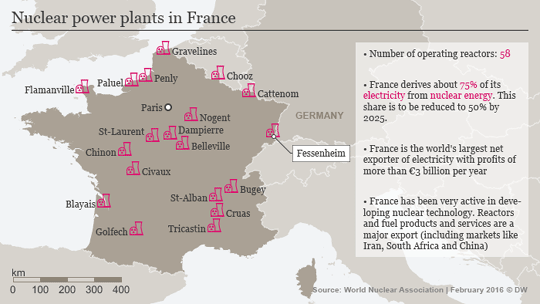
Map above refers to 2016 – many of the nuclear plants above are not currently in operation
Nuclear Engineering International, 14 Dec 22,
EDF has not shown its 900 MW units can be operated that far ahead, says ASN’s annual assessment of nuclear safety in France. Decisions have to be taken soon if nuclear is to play a big part in 2050 – and a ‘Marshall Plan’ is needed to rebuild the industry’s capability
France may have to go back to the drawing board with regard to options for decarbonising its economy, because assumptions it has made on the lifetime of the 900 MW reactors in its nuclear fleet may be unwarranted.
That was the warning in French nuclear safety authority ASN’s annual report on safety in the country’s nuclear industries.
The annual “ASN report on the state of nuclear safety and radiation protection in France in 2021”, published earlier this year, warned of “new energy policy prospects which must address safety concerns at once”. And it reminded operators that “quality and rigour in the design, manufacture and oversight of nuclear facilities, which were not up to the required level in the latest major nuclear projects conducted in France, constitute the first level of Defence in Depth in terms of safety.”
ASN noted that five of the six scenarios presented in a report by French system operator Re´seau de Transport d’Electricite´ (RTE) report on “Energies of the future”, which aims to achieve a decarbonised economy by 2050, are based on continued operation of the existing nuclear fleet. But with regard to the 900 MW fleet, ASN says, it cannot say that those plants can be operated beyond 50 years, based on information it received during the generic examination of the fourth periodic safety review of that reactor series. It added, “Due to the specific features of some reactors, it might not be possible, with the current methods, to demonstrate their ability to operate up to 60 years”.
EDF has 32 operating 900 MWe reactors commissioned between 1978 and 1987 and they are reaching their fourth periodic safety review. This safety review has “particular challenges”, ASN says. In particular:
Some items of equipment are reaching their design-basis lifetime……………………
Too optimistic on new-build?
The safety authority also noted that one RTE scenario had almost 50% nuclear in its electricity mix in 2050. It said, consultation with industry revealed that the rate of construction of new nuclear reactors in order to achieve such a level would be hard to sustain……………………………………
Broad concerns
More broadly, ASN said whatever France’s energy policy, it will “imply a considerable industrial effort, in order to tackle the industrial and safety challenges.
If nuclear power is needed for 2050, the nuclear sector will have to implement a ‘Marshall Plan’ to make it industrially sustainable and have the skills it needs.
It warned that “Quality and rigour in the design, manufacture and oversight of nuclear facilities… were not up to the required level in the latest major nuclear projects conducted in France”.
It also warned that more work was also needed in fuel chain facilities. It said a series of events “is currently weakening the entire fuel cycle chain and is a major strategic concern for ASN requiring particularly close attention”. Most urgent is a build-up of radioactive materials and delays in construction of a centralised spent fuel storage pool planned by EDF to address the risk of saturation of the existing pools by 2030. The need for the pool was identified back in 2010, but work has not begun.
ASN said the combination of shortcomings between fuel cycle and nuclear plants meant the electricity system “faces an unprecedented two-fold vulnerability in availability”. New vulnerabilities like the discovery of stress corrosion cracking mostly “stem from the lack of margins and inadequate anticipation,” ASN said, and “must serve as lessons for the entire nuclear sector and the public authorities.”……………….
An energy policy comprising a long-term nuclear component “must be accompanied by an exemplary policy for the management of waste and legacy nuclear facilities,” ASN said………………………………….. more https://www.neimagazine.com/features/featurecan-france-rely-on-its-nuclear-fleet-for-a-low-carbon-2050-10436984/
1 This Month
26 April – Chernobyl: Inside the Meltdown airs on National Geographic on Sunday 26th April from 4pm

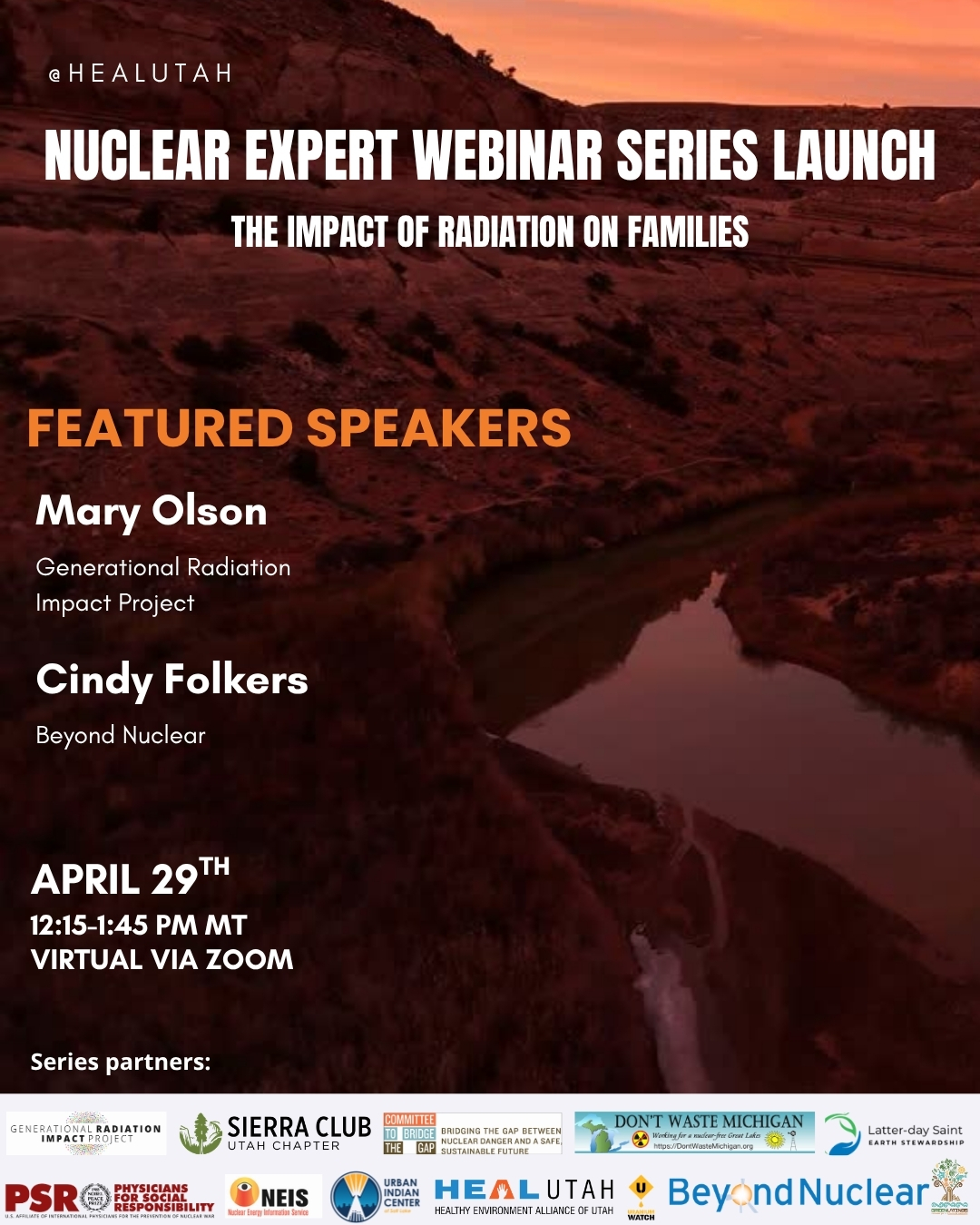
29 April – Nuclear Expert Webinar #1 – Radiation Impacts on Families with Mary Olson and Cindy Folkers
- 12:15 PM MT – 1:45 PM MT
- Location: Virtual – REGISTER TODAY

4 May -West Suburban Peace Coalition to discuss Iran war at May Educational Forum
Monday, May 4, 7:00 – 8:00 PM Central Standard Time
Title: : How Trump’s Narrative Tries to Shape the Reality of the War on Iran.
Contact Walt Zlotow, zlotow@hotmail.com 630 442 3045 for further information
14 May – online event From Bombs to Data Centres: the Face of Nuclear Colonialism

Pine Ridge Uranium is the real threat, not Tehran- Tell Burgum: Stop the Extraction.
Chernobyl: The Lost Tapes – A good documentary on Chernobyl on SBS available On Demand for the next 3 weeks– https://www.sbs.com.au/ondemand/tv-program/chernobyl-the-lost-tapes/2352741955560
To see nuclear-related stories in greater depth and intensity – go to https://nuclearinformation.wordpress.com
-
Archives
- April 2026 (317)
- March 2026 (251)
- February 2026 (268)
- January 2026 (308)
- December 2025 (358)
- November 2025 (359)
- October 2025 (376)
- September 2025 (257)
- August 2025 (319)
- July 2025 (230)
- June 2025 (348)
- May 2025 (261)
-
Categories
- 1
- 1 NUCLEAR ISSUES
- business and costs
- climate change
- culture and arts
- ENERGY
- environment
- health
- history
- indigenous issues
- Legal
- marketing of nuclear
- media
- opposition to nuclear
- PERSONAL STORIES
- politics
- politics international
- Religion and ethics
- safety
- secrets,lies and civil liberties
- spinbuster
- technology
- Uranium
- wastes
- weapons and war
- Women
- 2 WORLD
- ACTION
- AFRICA
- Atrocities
- AUSTRALIA
- Christina's notes
- Christina's themes
- culture and arts
- Events
- Fuk 2022
- Fuk 2023
- Fukushima 2017
- Fukushima 2018
- fukushima 2019
- Fukushima 2020
- Fukushima 2021
- general
- global warming
- Humour (God we need it)
- Nuclear
- RARE EARTHS
- Reference
- resources – print
- Resources -audiovicual
- Weekly Newsletter
- World
- World Nuclear
- YouTube
-
RSS
Entries RSS
Comments RSS
 nuclear-news