Environmentalists devoted to reveal nuclear contamination in Fukushima
A team of elderly Japanese environmentalists has been devoted to revealing the real environmental conditions of Fukushima after the nuclear incident in 2011. The team, with all members over 60 years old, volunteered to have a routine check for nuclear radiation in Fukushima. Masami Aoki, 77 and a former media worker, is one of the persons in charge of the team founded in 2012. Over the past 10 years, Aoki has worked with his team to examine nuclear radiation levels near the Fukushima Daiichi Nuclear Power Plant, including Futaba Machi and Minamisoma.
A group of journalists from HT investigates the impact of Fukushima’s controversial plan to dump water into the ocean

24 Nov, 2022
MADRID, Nov. 25, 2022 /PRNewswire/ — While the Japanese Primer Minister has described the measure as “totally safe and unavoidable”, member countries of the Indian Ocean Rim Association (ORA), official institutions, non-governmental organizations, environmental associations such as Greenpece, experts and professors in atomic energy, as well as doctors and researchers specialized in diseases related to uncontrolled exposure to atomic substances, denounce this measure as irresponsible, and do not understand the silence of the IAEA (International Atomic Energy Agency) in this situation.
A group of international journalists led by Global Think Agency investigates and analyzes the impact of the controversial plan to discharge water from Fukushima into the sea. The Key findings are:
- The decision announced by the Japanese government in April 2021, announcing it as a “safe” project, the measure does not convince the scientific community, nor the experts in atomic energy, for all is “the cheapest option“.
- It is currently unknown how the long-lived radioactive isotopes contained in the contaminated water will interact with marine biology, this situation is “unprecedented”.
- An independent analysis of the report published by Japan’s Ministry of Economy, Trade and Industry (METI) Subcommittee shows that the company responsible for the Fukushima plant understood that additional storage of contaminated water beyond 2022 was possible, but it was ruled out because it would require “a substantial amount of coordination, time and financial resources.“
- Last October 30, and in view of the IAEA’s silence, a group of experts and professors in atomic energy, as well as doctors and researchers specialized in diseases related to uncontrolled exposure to atomic substances, submitted a letter to the Director General Mr. Rafael Mariano Grossi, requesting him to urge the Japanese authorities to halt this measure, without receiving any reply to date.
Shaun Burnie, senior nuclear specialist with Greenpeace, confirms “the lack of clarity and scientific inconsistencies” in the Fukushima nuclear power plant decommissioning project, considering it “fantasy” and that the discharge of contaminated and treated water into the ocean “does not solve the crisis and will generate an unpredictable environmental situation”.
Eleven years after the earthquake and tsunami that led to one of the worst nuclear accidents in history, Greenpeace is issuing a new wake-up call after reviewing multiple documents from different government agencies and industry.
Satoshi Sato, leader of the nuclear fusion and quantum energy neutron source design group in Rokkasho (Japan), says “decommissioning is not possible in 40 years”. There are many shadows and doubts and the Japanese government should clarify the progress that has been made so far.
It will have to “live with treated water for decades while a safe solution is found”, said the expert in relation to the discharge of treated water into the Pacific Ocean, a plan foreseen for 2023 and which the International Atomic Energy Agency (IAEA) recently evaluated during a mission to the country.
Shaun Burine and Satoshi Sato, agreed, telling us that the IAEA’s position in supporting the plans of the Japanese government and TEPCO (Tokyo Electric Power Company Holdings, Inc.) “does not make sense”. They went on to say that “the mission of this organization is to develop safety standards and maintain high levels of safety for the protection of human health and the environment against ionizing radiation. As well as to verify that States comply with their commitments.”
“TEPCO has no intention of decommissioning the Fukushima nuclear power plant in the next 20 to 30 years. It is a fantasy and a much longer process than we have been told“, said Burnie, who stressed the need to inform affected communities and the public in detail.
“The long-term consequences cannot be dismissed, because this transcends generations and this fact should be crucial in addressing the problem, not the official agenda of the actors involved“, Burnie criticized the roadmap approved by the Japanese government.
Tokyo Electric Power Co. is the world’s fourth-largest utility and the bastion of the nation’s nuclear power, from which Japan draws 30% of its electricity. Tepco serves a third of the population. The company that operates the nuclear power plant has contributed to the disaster with its management before and after the accident It falsified reviews, concealed information and delayed urgent measures
The company is contributing to the scandal, acknowledging that it has falsified safety reports, elevating fleeting inspections to exhaustive examinations. Tepco is also accused of irresponsibly delaying the cooling of the reactors with salt water because it was going to ruin them beyond repair.
The legacy of scandals in the sector in half a century has punished its credibility.
The Greenpeace organization recalls that the company’s negligence brought the former IAEA management to task on numerous occasions, its spokesman Hidehiko Nishiyama denounced on numerous occasions as “extremely regrettable” the errors in the measurements of radioactive water, apparently due to failures in the software used to carry out the measurements. “Tepco is facing a very serious situation and is failing to meet people’s expectations“, Nishiyama insisted, in the harshest criticism the company has ever received.
About HT
HT is a global agency specializing in developing documentary, research and entertainment content. The company boasts a team of experts from different fields such as production, creativity, and journalism, some have over 25 years of experience in major production companies in Spain.
Fukushima Daiichi Nuclear Power Plant Accident Survivors Urge Diet Members to Provide Adequate Relief in Light of Policy to Revise Compensation Standards

Plaintiffs appealed their plight as evacuees at a meeting held at the House of Councillors building in Nagata-cho, Tokyo, on March 24.
November 24, 2022
On November 24, the National Liaison Group of Plaintiffs in Lawsuits Against Nuclear Power Plants, consisting of victims of the TEPCO’s Fukushima Daiichi Nuclear Power Plant accident, held a meeting at the Diet to demand that the interim compensation standards established by the government’s Nuclear Damage Dispute Review Board be revised to provide adequate relief to the victims of the accident.
The plaintiffs, who are engaged in class-action lawsuits against the national government and TEPCO in various parts of Japan, submitted their requests to the offices of members of the Diet at both the House of Representatives and the House of Councillors.
The CALI decided to review the guidelines on the 10th of this month in response to a series of court decisions ordering TEPCO to pay more compensation than the interim guidelines. In addition to the review of the guidelines to match the actual damage, the request also called for the government to consider building new nuclear power plants and extending their operating periods, and to oppose the discharge into the ocean of water treated to purify contaminated water generated at the Fukushima Daiichi Nuclear Power Plant.
At the rally following the request, lawyer Guntaro Managi, who serves as the secretary general of the legal team for the Fukushima lawsuit, criticized the government’s response, saying, “The review of the guidelines is too little too late. Hiroshi Murata, 79, an evacuee from Minamisoma City, Fukushima Prefecture, who has been living in Yokohama, said, “The guidelines were created immediately after the accident, and it was not assumed that the evacuation would last this long. The guidelines were created immediately after the accident and were not based on the assumption that evacuees would have to live for such a long time. They should be revised in their entirety, not just partially. (Kenta Onozawa)
https://www.tokyo-np.co.jp/article/215953?fbclid=IwAR3Ur_jQqDli869rwXoAJspCvxE1W7BFpeTaI_VE4RRqMiOqcN-ZCZFAq60
Safety first must be priority for Fukushima water: China Daily editorial

2022-11-23
Since the Japanese government announced its highly controversial plan to release massive amounts of radioactive water from the wrecked Fukushima nuclear plant into the Pacific Ocean in April last year, it has met with opposition and condemnation, not only from Japan’s neighbors, China and the Republic of Korea, but also from Japanese society, residents in Fukushima and the country’s fishery industry in particular.
Although the Japanese government says that apart from tritium, which cannot be removed from the water, all other radionuclides will have been reduced to safe amounts after treatment, it is not known what the environmental consequences will be after it is discharged into the sea.
Marine experts have raised concerns over traces of ruthenium, cobalt, strontium and plutonium isotopes in the wastewater.
The Pacific Ocean does not belong to Japan. It is an ocean shared by dozens of countries and regions. By discharging the water into the ocean, the Japanese government shows little regard for the health and well-being of its own people and those in neighboring countries. As such, the International Atomic Energy Agency, as the world’s nuclear watchdog, should put public health first and do its utmost to see to it that Japan fully complies with all the relevant nuclear safety standards.
The IAEA set up a task force last year to review the safety of Japan’s discharge plan, comprising a group of IAEA specialists and external experts from 11 countries. The task force conducted a field trip to the Fukushima Daiichi Nuclear Power Station last week, and reviewed the updated technical plans for the water discharge by Tokyo Electric Power Company and the equipment and facilities to be used for the discharge. The IAEA said a report of the mission will be made available within three months, and a comprehensive assessment on the safety of the discharge will be issued prior to the planned release in 2023.
Both China and the ROK have urged the agency to strictly adhere to all safety standards in its assessment of the plan.
Chinese Foreign Ministry spokeswoman Mao Ning said on Monday that China hopes the task force will ensure the “absolute safety” of the treatment.
And the Foreign Ministry of the ROK also struck the same tune on Tuesday, stressing that the discharge of the contaminated water should meet objective scientific standards.
Needless to say, Japan should coordinate closely and transparently with the task force so as to ensure the IAEA clearly grasps the whole picture.
China’s support of the IAEA task force’s work should not be interpreted as an approval of Japan’s decision to discharge the contaminated water. It needs to be pointed out that the task force has not evaluated the alternatives to ocean discharge, leaving the IAEA unable to conduct a comprehensive evaluation and find the best way to dispose of nuclear-contaminated water. China still maintains that instead of pushing forward with its discharge plan, Japan should find a safer way to treat the contaminated water.
https://www.chinadaily.com.cn/a/202211/23/WS637e2ecaa31049175432b7ec.html
China supports IAEA review of Fukushima treatment
“Just because China supports the task force’s work does not mean it approves of Japan’s decision to discharge the contaminated water, Mao also said, urging Japan to find an appropriate way to treat the contaminated water, instead of pushing forward with its discharge plan.”

2022-11-21
China supports the International Atomic Energy Agency and its task force in reviewing Japan’s treatment of nuclear contaminated water, and hopes the task force will strictly implement the IAEA’s nuclear safety standards and ensure the “absolute safety” of the treatment, Foreign Ministry spokeswoman Mao Ning said.
Mao made the remarks at a daily news conference on Monday after the task force carried out a new mission last week to review Japan’s plan to discharge treated nuclear-contaminated water from the Fukushima Daiichi Nuclear Power Station.
The IAEA said a report of the mission will be made available within three months.
In response, Mao said a time limit should be avoided to ensure the quality and credibility of the report, and Japan should coordinate closely with the task force.
The IAEA didn’t review other plans of treating contaminated water than discharging it to sea, thus failing to make a full assessment and find the best treatment plan, Mao pointed out.
Just because China supports the task force’s work does not mean it approves of Japan’s decision to discharge the contaminated water, Mao also said, urging Japan to find an appropriate way to treat the contaminated water, instead of pushing forward with its discharge plan.
https://global.chinadaily.com.cn/a/202211/21/WS637b7603a31049175432b07c.html
JNFL’s application for examination of a nuclear fuel reprocessing plant was criticized by the Regulatory Commission for “lacking a sense of urgency”

JNFL Senior Managing Executive Officer Rei Sudo (left) and others explain at the Nuclear Regulation Authority’s review meeting in Minato-ku, Tokyo.
November 22, 2022
JNFL found multiple errors in the seismic calculation results of the application it submitted to the Nuclear Regulation Authority during the examination required for the operation of its reprocessing plant for spent nuclear fuel from nuclear power plants in Rokkasho Village, Aomori Prefecture. The errors were discovered when the Nuclear Regulation Commission pointed them out to JNFL. Even two years after the application was submitted, NNFL continues to reveal its inadequacies, and there is no prospect that the review will be completed.
The errors were in the results of seismic calculations for the cooling tower fire detectors, which NNFL submitted on November 8 in the form of an amendment to its application. According to NNFL, when the results of the seismic calculations were transcribed into the application, incorrect values were entered in several places. Although the documents were checked before submission, the mistake was not noticed. The cause of the error has not been disclosed, saying that it is under investigation. The correction will be corrected and resubmitted in the future.
According to the secretariat of the regulatory commission, the error in the calculation results was so simple that a person with expert knowledge would be able to recognize it at a glance.
At the review meeting held on March 15, the person in charge at the secretariat of the regulatory commission commented, “In the review of facility design, making a mistake in numerical values is a definite and serious problem,” and “It is the most rudimentary of rudiments. Why don’t they notice it? Why don’t they realize this? They have no sense of crisis at all. Rei Sudo, executive vice president of Nenryo, who is in charge of handling the review, simply stated, “This is something that really shouldn’t happen. We take this very seriously.
The reprocessing plant, a core facility under the government’s nuclear fuel cycle policy, met the new regulatory standards for basic accident countermeasures in July 2020, and in December of the same year, JNFL applied for a review of detailed facility designs and construction plans. However, there has been no significant progress since the application stage due to inadequate explanations from NNFL.
In September of this year, NNFL announced for the 26th time that it was postponing the completion of the plant due to the difficulties encountered in the review process. The company plans to announce the next target date for completion by the end of this year, but the examination process will inevitably become even more difficult due to the discovery of numerical errors. (Kenta Onozawa)
https://www.tokyo-np.co.jp/article/215291?fbclid=IwAR3axQXraZ9FR1wgBWFW97VsXYaz7LEtnmRwhAa8f6fSsxczwS8WNBpIdY4
Iitate will be 1st to lift evacuation order without decontamination

Akihiko Morota, deputy director-general of the government’s Nuclear Emergency Response Headquarters, explains the status of the difficult-to-return zone to Iitate village residents at a briefing in Fukushima city on Nov. 20.
November 21, 2022
FUKUSHIMA–Iitate village near the Fukushima No. 1 nuclear power plant plans to lift an evacuation order next spring for a small portion of the “difficult-to-return zone” so it can reclaim space for a park.
This marks the first time an evacuation order will be lifted without first carrying out decontamination work since the government made it easier to lift evacuation orders in 2020.
The order was originally issued due to high levels of radiation detected following the triple meltdown at the plant triggered by the 2011 earthquake and tsunami.
Iitate Mayor Makoto Sugioka and the central government’s Nuclear Emergency Response Headquarters made the announcement at a news conference following a briefing for residents in Fukushima city on Nov. 20.
Residents of Iitate in eastern Fukushima Prefecture had initially opposed lifting the evacuation order without first decontaminating the area, but the mayor said they were persuaded.
“We were able to obtain their consent at the briefing,” Sugioka said.
The area where the order will be lifted without any decontamination work is small. It spans just 0.64 hectares and includes only one household.
Workers will set up shields on the ground there to prevent exposure to radiation.
But the government has confirmed that even without the shielding, the radiation level is below the standard for issuing an evacuation order, at 20 millisieverts per year. The village plans to use this area as a park.
The government designated areas with readings of more than 50 millisieverts a year as difficult-to-return zones.
Iitate has a difficult-to-return zone measuring 1,080 hectares in total, according to the village and the central government.
Within this area, officials have designated a 186-hectare special zone for reconstruction and revitalization, which covers 63 households. That land will be decontaminated by removing topsoil contaminated with radioactive materials.
But there is no prospect for lifting the order for the remaining land outside the special zone, which covers 10 households.
In December 2020, the government created new criteria for lifting an evacuation order for land outside the special zone, where radiation levels are below the standard due to natural attenuation. Those conditions include a request from the local government and confirmation that no one will live there.
Among eight municipalities that have such special zones, this will be the first time that an evacuation order will be lifted outside the zone. No municipalities other than Iitate are seeking a lifting of the evacuation order under the new criteria.
Fukushima Iitate Village Lifting of Evacuation Order for “Out of Base Area” First indication of timing

November 20, 2022
The national government and Iitate Village in Fukushima Prefecture have announced that they will lift the evacuation order for a part of the Nagadori area, which has been designated as a “difficult-to-return zone” due to the accident at the TEPCO’s Fukushima Daiichi Nuclear Power Plant, around the major holidays in spring next year under the so-called “lifting of evacuation order without decontamination.
This is the first time that a specific date for lifting the evacuation order for areas outside of the “base area” has been announced.
In the Nagadori area of Iitate Village, which is a hard-to-return zone where entry is severely restricted, 17% of the area has been designated as a “specific restoration and rehabilitation base zone” where decontamination and other measures will be carried out first, with the aim of lifting the evacuation order in the spring of next year.
On April 20, the central government and Iitate Village held a press conference after holding a briefing session for local residents in Fukushima City to discuss the possibility of lifting the evacuation order in the spring of next year under the framework of “lifting the evacuation order without decontamination,” which allows the lifting of the evacuation order even if the government has not decontaminated the land, provided that the local government has strong intentions to use the land and the radiation level is lowered and the residents do not return. The government has announced that it plans to lift the evacuation order for a part of the area outside the “base area” around the major holidays in the spring of next year.
The area to be removed is a 6,400-square-meter plot of land where a government demonstration experiment to block radiation by pouring concrete on the ground was being conducted, and it represents 0.07% of the area outside the “base area” in the village.
Since it has been confirmed that radiation levels have been sufficiently reduced, the government will allow people to freely enter the area to see the results of this demonstration project.
This is the first time that a specific date for the lifting of the evacuation order for “outside the base area” has been announced.
In conjunction with this, the policy of lifting all evacuation orders for the base area in the village was also announced.
Iitate Village Mayor Makoto Sugioka said, “We would like to consider using the site as a place where we can confirm the effects of the radiation dose reduction demonstration project and a place where we can pass on to future generations what has been done in the difficult-to-return zone and Nagadori area.
https://www3.nhk.or.jp/news/html/20221120/k10013897961000.html?fbclid=IwAR3mZj8YTUnBARRCJV-KqrxSGzF9OP-jVrRRRv2GY1kcSpDWnrIF0boiiNg
TODAY. Plummeting hopes for Small Nuclear Reactors – and that realisation is a blow to the nuclear weapons industry.

The new problem is – that they can no longer hide the escalating costs of “commercial” small nuclear reactors.
But small nuclear reactors have nothing to do with war – do they?
They sure do!
For one thing – they power the deadly submarines that have their nuclear missiles ready to target and incinerate whole cities, (dunno where those nuclear wastes go – ?into the ocean)
But more importantly – “small” nuclear reactors – (and by the way, they’re not small any more now) – are intended as a pretty cloak, or mask, over the nuclear weapons industry.
How so? Well, scientists, governments, and nuclear corporation bosses all know that
(a) small nuclear reactors are now, and always will be . irrelevant to global heating – especially as many thousands of them would be needed in a very short time if they were to have the supposed effect against climate change.
(b) absurdly expensive, smrs are not a credible investment – so, only governments will pay for them.
So – the beauty of small nuclear reactors is that they are a marvellous “con”. The goal is to “con” the public.
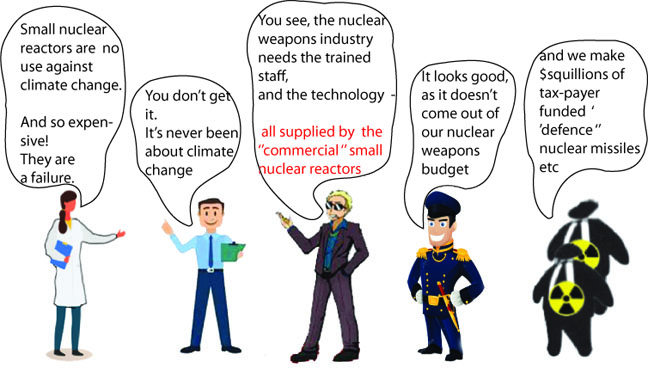
“Solving climate change” is the pretty cloak over SMRs that makes them appeal to the public.
“Solving energy problems” looks good, too.
Very importantly, young men and women can be attracted into this “peaceful” nuclear industry.
And it all looks so “modern” and :feminist-friendly” – attractive to “progressively” minded people.
Wake up, world – those are all lies.
Small Modular Nuclear Reactor cost overruns: the same old problems haunt new nuclear in Utah
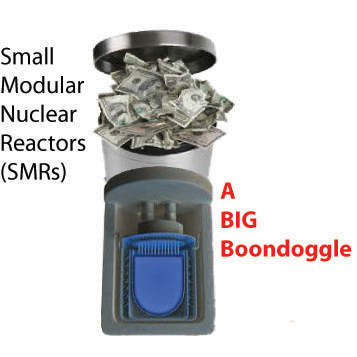
Much hope is being placed on Small Modular Reactors (SMR) making new
nuclear plants competitive. But David Schlissel at IEEFA summarises their
research into the publications, updates and statements coming from the
stakeholders involved with the SMR by UAMPS (Utah Associated Municipal
Power Systems) and NuScale Power Corporation that shows that costs are
going out of control, a persistent problem in the nuclear industry.
The original target power price of $55/MWh has risen to $100 (with subsidies)
and is likely to rise further by the time it’s switched on in 2030, says
Schlissel. Construction costs and delays are the main causes (as usual). So
concerned are potential customers that, since February 2022, only 101MW of
the plant’s total 462MW have been subscribed to.
It will be difficult to
secure financing for the plant without a fully subscribed project.
Meanwhile, IEEFA figures say renewable resources and battery storage will
provide reliable electricity at lower cost than the UAMPS plant, even if
the price for the power from the project is just $58 per MWh. And
renewables and battery costs are still declining.
Energy Post 25th Nov 2022 more https://energypost.eu/small-modular-reactor-cost-overruns-the-same-old-problems-haunt-new-nuclear-in-utah/
Could the Minsk II agreement Have Prevented the War in Ukraine?
a significant minority of Ukrainians want to remain close to Russia, and for them fully integrating with the West represents a loss.
The fundamental problem for Ukraine was that a majority of citizens sought closer ties with the West, but a significant minority sought closer ties with Russia, and these two aspirations were mutually incompatible.
Daily Sceptic, BY NOAH CARL., 23 NOVEMBER 2022,
Since Russia’s invasion of Ukraine began, Western commentators have spent a huge amount of time expressing moral outrage at Russia’s actions, but comparatively little time thinking about how the war could have been prevented.
This is puzzling. Even if Ukraine manages to win, this victory will have come at an enormous price – tens of thousands of lives, millions of refugees (many of whom may never return), and untold damage to the country’s infrastructure. No matter what the outcome, the war will have been disastrous for ordinary Ukrainians.
It therefore seems essential to ask whether it could have been prevented.
One possible way it could have been prevented is through deterrence. NATO members could have announced in advance, ‘We commit to defending Ukraine if it is ever attacked by Russia’. Alternatively, the U.S. and its allies could have armed Ukraine to the teeth by transferring huge quantities of offensive weapons.
The disadvantages of this approach are obvious. It might have caused Russia to invade even sooner to forestall the arrival of NATO troops or weapons. And if Russia did call the West’s bluff, it might have sparked World War III, as NATO would have pre-committed to entering the war on Ukraine’s side.
As late as February 2014, the percentage of Ukrainians who wanted to join the EU was only 5 points higher than the percentage who wanted to join the Eurasian Customs Union. The balance of opinion then shifted after the ‘Revolution of Dignity’.
There’s another possible way the war could have been prevented: through the implementation of Minsk II. This was an agreement signed in 2015 by representatives from Russia, Ukraine and the two separatist republics, which aimed to bring an end to the fighting in Donbas. It was based on a plan drawn-up by the leaders of France and Germany.
Although Minsk II ultimately failed, since neither side honoured the terms, it was unanimously endorsed
by the UN Security Council.
Critics of Minsk II say it was too favourable to the Russian/separatist side. This is because the agreement would have granted significant autonomy to the two Donbas regions, allowing them to veto Ukraine’s future membership of NATO and possibly its membership of the EU as well. (Minsk II is roughly equivalent to the plan John Mearsheimer put forward in 2014, which emphasised Ukrainian neutrality.)
For Ukrainians who aspire to fully integrate with the West, not being able to join NATO or the EU represents a major loss. Yet a significant minority of Ukrainians want to remain close to Russia, and for them fully integrating with the West represents a loss.
Likewise, almost half of Ukrainians opposed the Maidan protest movement, including a plurality who “[did] not support it all”. For this reason alone, calling the subsequent change of government a ‘Revolution of Dignity’ is highly dubious.
The fundamental problem for Ukraine was that a majority of citizens sought closer ties with the West, but a significant minority sought closer ties with Russia, and these two aspirations were mutually incompatible.
You might say that in a democracy, the majority gets to decide the future path of the country, so Minsk II was fundamentally unfair. Yet it’s widely understood that in ethnically divided countries, the majority often has to make concessions to the minority for the sake of overall stability. Half the parliamentary seats in Lebanon are reserved for Christians and half for Muslims, regardless of the ethnic make-up of the country (which no one quite knows), to prevent one group from dominating the other.
In any case, the European interest – as judged by the leaders of France and Germany – was preserving stability in Ukraine, rather than ensuring the country’s pro-Western majority got its way.
According to the New York Times, the plan for Minsk II emerged “in response to reports that lethal assistance was now on the table in Washington”. In other words, the U.S. wanted to start supplying Ukraine with offensive weapons, so France and Germany stepped in to broker a peace deal before that happened.
Why did Minsk II fail? As I’ve already stated, neither side upheld its end of the bargain. Yet historian Anatol Lieven argues it could have worked but for “the refusal of Ukrainian governments to implement the solution and the refusal of the United States to put pressure on them to do so”…………………………
why, as the country’s main backer, did the U.S. not pressure Ukraine to implement the agreement? After all, the U.S. endorsed the agreement in its capacity as a member of the UN Security Council, and the U.S. pressures its allies to do things all the time.
The obvious reason is that U.S. interests were not served by the implementation of Minsk II.
From a Western perspective, preventing the war in Ukraine would have required the French and Germans to act more decisively, or the Americans to look beyond their own interests. Unfortunately, neither of these eventualities came to pass…………………………… https://dailysceptic.org/2022/11/23/could-minsk-ii-have-prevented-the-war-in-ukraine/
It’s high time to defuse the military carbon bomb
We cannot tackle climate change, and save our collective future, while increasing military spending.
the richest countries spent $9.45 trillion on their militaries between 2013 and 2021 compared with an estimated $234bn on climate finance – in other words, they have spent 30 times as much on the military as climate finance.
- https://www.aljazeera.com/opinions/2022/11/25/military-carbon-bomb Nick Buxton, Researcher at the Transnational Institute, 25 Nov 202225 Nov 2022,
The annual United Nations climate talks, known as the Conference of Parties (COP), have traditionally promised much but delivered little. This year’s COP27 was no different, with most observers noting that it even backtracked on commitments made at COP26 in Glasgow.
What was less observed was that the summit faced a major additional obstacle in 2022. This year, the climate crisis was overshadowed by the war in Ukraine which has been the foreign policy priority of the United States and the European Union since the beginning of Russia’s invasion in February.
The difference between the way the world’s richest countries responded to the Ukraine war and the carbon war on our whole planet is undoubtedly stark.
Since the beginning of Russia’s invasion, the US and its NATO allies provided Ukraine with military assistance worth more than $25bn, welcomed nearly seven million refugees, and willingly absorbed severe economic shocks caused by energy price increases triggered by the war.
Despite a global recession looming on the horizon, these countries did not hesitate to increase their military expenditure. Germany allocated 100 billion euros ($104bn) of its 2022 budget for the armed forces, for example, and the US House of Representatives approved a record $840bn military spending.
Yet at COP27, these same wealthiest nations were not even able to deliver the $100bn in climate finance that had been promised as far back as 2009 to the world’s most climate-vulnerable countries. A recent report co-published by the organisation I work for, the Transnational Institute, found that the richest countries spent $9.45 trillion on their militaries between 2013 and 2021 compared with an estimated $234bn on climate finance – in other words, they have spent 30 times as much on the military as climate finance.
After many years of pressure, at COP27, nations finally agreed to create a loss and damage mechanism to provide funds to impoverished countries suffering severe climate impacts, but it is so far just an empty pot. The accelerated arms race that has emerged since the Russian invasion and rising US-China tensions signal that filling that pot will not be a priority for most wealthy nations in the near future.
These spending choices matter not just because they are diverting resources from urgently needed climate action, but also because every dollar spent on the military is worsening the climate crisis. Most militaries consume significant amounts of fossil fuels. One estimate calculates that military emissions may make up 5.5 percent of global emissions. If the global military were a country, it would be the fourth biggest emitter in the world, ahead of Russia.
Furthermore, most of the world’s military spending goes towards the purchase of equipment and vehicles that are among the worst offenders when it comes to carbon emissions. In 2022 alone, for example, 475 new F-35 fighter jets, which use a whopping 5,600 litres (1,480 gallons) of oil per hour of flight, have been ordered. These fuel-guzzling planes could be flying for the next 30 years.
The emissions increase even further when war breaks out. The Ukrainian government at COP27 presented research showing that the first eight months of war had already led to 33 million tonnes of greenhouse gas emissions, equivalent to adding 16 million cars to the United Kingdom’s roads for two years.
US and UK military chiefs argue that they are committed to reducing military emissions, but their plans so far remain undetailed, opaque and unconvincing. Adding solar panels to a military base is easy to do, but does nothing to tackle the main challenge, which is fossil fuel consumption by military jets, ships and tanks. For now, there is no alternative, green fuel that can be produced at the scale needed and without triggering unacceptable social and environmental consequences, such as increased deforestation and the dispossession of Indigenous peoples.
The uncomfortable truth is that there is no way of ensuring that our planet remains habitable in the long term while continuing to increase military spending. In the midst of an intense and brutal war in Ukraine, this fact is too easily lost as governments are able to justify any increases in military spending to deal with the new immediate “threats”.
Moreover, the military spending of many rich countries is already way out of proportion to any real or perceived threat. NATO member states, for example, already spend 17 times as much on the military as Russia. The US spends more on its military than the next nine countries combined.
Meanwhile, the world has an ever smaller window to tackle climate change – the most pressing threat to our collective future. The Intergovernmental Panel on Climate Change says the world must cut emissions by 45 percent by 2030 to have any chance at keeping global average temperature increases below 1.5 degrees Celsius (2.7 degrees Fahrenheit). When every month counts, embarking on an accelerated arms race is the worst path the world’s most powerful nations can take. It diverts money and attention from urgent climate action, it increases emissions and it fuels conflicts at a time of increased climate instability.
Climate change can teach us a critical lesson about security. Carbon emissions do not recognise borders. It is not possible for any nation to shield itself from the effects of climate change using tanks or fighter jets. The only way to tackle the climate emergency is through global cooperation. Demilitarisation and peace are the best and perhaps the only ways to ensure that humanity has the capacity and resilience to respond to this crisis.
Only if the world’s leaders recognise that uniting to confront the threat of global heating is more important than any imperialist strategy or narrow economic interest, may we have a chance to avoid climate catastrophe. A secure nation in the end depends on a secure planet.
US Arms Dealing Is Out of Control
What will it take to rein in Washington’s arms-sales addiction?

The Nation, By William D. Hartung. NOVEMBER 23, 2022,
There’s a seldom commented upon reality of this century and this moment: The United States remains the number-one arms-exporting nation on the planet. Between 2017 and 2021, it grabbed 39 percent of the total global weapons market, and there’s nothing new about that. It has, in fact, been the top arms dealer in every year but one for the past three decades. And it’s a remarkably lucrative business, earning American weapons makers tens of billions of dollars annually.
It would be one thing if it were simply a matter of money raked in by the industrial half of the military-industrial complex. Unfortunately, in these years, US-supplied weaponry has also fueled conflicts, enabled human-rights violations, helped destabilize not just individual countries but whole regions, and made it significantly easier for repressive regimes to commit war crimes.
At first glance, it appeared that Joe Biden, on entering the White House, might take a different approach to arms sales. On the campaign trail in 2020, he had, for instance, labeled Saudi Arabia a “pariah” state and implied that the unbridled flow of US weaponry to that kingdom would be reduced, if not terminated. He also bluntly assured voters that this country wouldn’t “check its values at the door to sell arms.”
Initially, Biden paused arms deals to that country and even suspended one bomb sale. Unfortunately, within eight months of his taking office, sales to the Saudi regime had resumed. In addition, the Biden team has offered arms to a number of other repressive regimes from Egypt and Nigeria to the Philippines. Such sales contrast strikingly with the president’s mantra of supporting “democracies over autocracies,” as well as his reasonable impulse to supply weapons to Ukraine to defend itself against Russia’s brutal invasion.
The last president who attempted to bring runaway US weapons trafficking under some sort of control was Jimmy Carter. In 1976, he campaigned for the presidency on a platform based, in part, on promoting human rights globally and curbing the arms trade. And for a period as president, he did indeed suspend sales to repressive regimes, while, in that Cold War era, engaging in direct talks with the Soviet Union on reducing global arms sales. He also spoke out eloquently about the need to rein in the trade in death and destruction.
However, Zbigniew Brzezinski, his hard-line national security advisor, waged a campaign inside his administration against the president’s efforts, arguing that arms sales were too valuable as a tool of Cold War influence to be sacrificed at the altar of human rights. And once that longtime ally, the shah of Iran, was overthrown in 1978 and the Soviet Union invaded Afghanistan in 1979, all talk of controlling the arms trade went out the window.
THE BIDEN RECORD: WHY NOT RESTRAINT?
What accounts for Joe Biden’s transformation from a president intent on controlling arms sales to a business-as-usual promoter of such weaponry globally? The root cause can be found in his administration’s adherence to a series of misguided notions about the value of arms sales. In a recent report I wrote for the Quincy Institute for Responsible Statecraft on the US approach to such exports, I lay out those notions fully, including lending a hand in stabilizing key regions, deterring Washington’s adversaries from engaging in aggression, building meaningful military-to-military relationships with current or potential partner nations, increasing this country’s political and diplomatic influence globally, and creating jobs here in the United States. In the Saudi case, Biden’s shift was tied to the dangerous notion that we needed to bolster the Kingdom’s supposedly crucial role in “containing Iran”—a policy that only increases the risk of war in the region—and the false promise that, in return, the Saudis would expand their oil output to help curb soaring gas prices here at home.
Such explanations are part of an all-encompassing belief in Washington that giving away or selling weaponry of every sort to foreign clients is a risk-free way of garnering yet more economic, political, and strategic influence globally. The positive spin advocates of the arms trade give to the government’s role as the world’s largest arms broker ignores the fact that, in too many cases, the risks—from fueling conflict and increasing domestic repression elsewhere to drawing the United States into unnecessary wars—far outweigh any possible benefits.
AN ARMS CLIENTS HALL OF SHAME
There are numerous examples, both historically and in the present moment, of how this country’s arms sales have done more harm than good, but for now let’s just highlight four of them—Saudi Arabia, Egypt, Nigeria, and the Philippines.
SAUDI ARABIA……………
EGYPT…………………….
NIGERIA………………….
THE PHILIPPINES……….
COMPANIES CASH IN
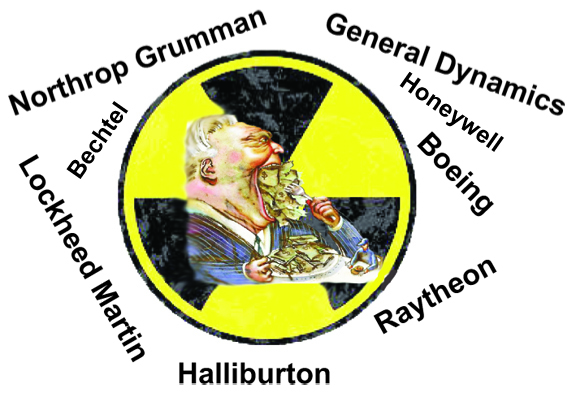
While the humanitarian consequences of US arms sales may be devastating, if you happen to be a major weapons maker like Lockheed Martin, Boeing, Raytheon, or General Dynamics, the economic benefits are enormous. Weapons systems built by those four companies alone have figured in more than half of the $100 billion-plus in major arms offers made since President Biden took office.
While those firms prefer to pose as passive beneficiaries of carefully considered government policies, they continue to work overtime to loosen restrictions on weapons exports and expand the number of countries eligible for such equipment and training. To that end, those four giant firms alone routinely donate millions of dollars to key members of Congress, while employing 300 lobbyists, many of them drawn from the ranks of the Pentagon, Congress, and the National Security Council. Once on board, those retired generals, admirals, and other officials use their government contacts and inside knowledge of the arm-sales process to influence government policies and practices.
A particularly egregious and visible example of this was Raytheon’s effort to pressure Congress and the Trump administration to approve a sale of precision-guided munitions to the Saudis. A former Raytheon lobbyist, Charles Faulkner, worked inside the State Department to keep the Saudi arms pipeline open despite that country’s bombing of civilian targets in Yemen, and then Raytheon’s former CEO, Thomas Kennedy, even went so far as to directly lobby Senate Foreign Relations chairman Senator Robert Menendez over Saudi arms sales. (He was rebuffed.) But the most spectacular lobbyist for the Saudis was, of course, President Trump, who justified continuing arms sales to Riyadh after the regime’s 2018 murder of US resident, Saudi journalist, and Washington Post columnist Jamal Khashoggi this way:
$110 billion will be spent on the purchase of military equipment from Boeing, Lockheed Martin, Raytheon, and many other great U.S. defense contractors. If we foolishly cancel these contracts, Russia and China would be the enormous beneficiaries—and very happy to acquire all this newfound business. It would be a wonderful gift to them directly from the United States!
In fact, neither Russia nor China would be able to replace the US as Saudi Arabia’s primary arms supplier any time soon. The kingdom is so reliant on American equipment that it might take a decade or more for it to rebuild its military around weapons supplied by another nation.
In reality, expansive as American arms sales to the Saudis are, that $110 billion figure was a typical case of Trumpian exaggeration. Actual sales during his term were less than one-third of that, and jobs tied to those sales in the US were similarly far less than President Trump claimed. The figure he liked to throw around— 500,000—was at least 12 times the actual one. Still, the damage done by the weaponry his administration rammed through Congress for the Saudis has been incalculable and can’t be measured by the dollar value of any particular sale.
The Raytheon lobbying campaign was extraordinary primarily because its details became public knowledge. But count on one thing: Similar efforts by other military-industrial corporations surely take place behind closed doors on a regular basis. One precondition for reducing dangerous arms deals would have to be reducing the political power of the major weapons-producing companies.
PUSHING BACK AGAINST AMERICA’S ARMS SALES ADDICTION
In 2019, spurred by Saudi actions ranging from the war in Yemen to the Khashoggi murder, both houses of Congress voted down a specific deal for the first time—$1.5 billion in precision-guided bombs for Saudi Arabia and other Middle Eastern clients—only to have their actions vetoed by President Trump. Successful votes to end military support or Saudi Arabia under the War Powers Resolution met a similar fate……………………………
Success in reining in Washington’s arms-sales addiction will, at the very least, require a major campaign of public education. Too few Americans even know about their nation’s role as the world’s largest weapons trader, much less the devastating impact of the arms it transfers. But when asked, a majority of Americans are against arming repressive regimes like Saudi Arabia and consider arms sales to be “a hazard to US security.”
Still, until there is greater public understanding of the humanitarian and security consequences of what the government is doing in our name, coupled with concerted pressure on the Biden administration, the national security state, and the weapons makers, the arms trade is likely to continue full speed ahead. If so, those companies will remain in weapons heaven, while so many people on this planet will find themselves in a hell on Earth https://www.thenation.com/article/world/arms-dealing-us-weapons-market/?utm_source=Sailthru&utm_medium=email&utm_campaign=Daily%2011.23.2022&utm_term=daily
The projected cost of new nuclear power has risen by fourfold since 2008 – and it is still rising

The projected cost of new nuclear power has risen by almost fourfold since
the UK Government made estimates in 2008, and the cost is still rising.
Nuclear analysts warn that the cost to consumers of funding Sizewell C
through the so-called ‘Regulatory Asset Base’ (RAB) model will be much
higher than has been projected by the Government.
In 2008 as the Government argued for more nuclear power stations to be built, the Government, in a
White Paper on nuclear costs, said that each 1.6 GWe EPR reactor would cost
around 2.8 billion. But the most recently released (by EDF) cost of the
Hinkley C EPR double reactor is £25.5 billion (in 2015 prices) and assumes
the plant will be completed by 2027.
This equates to £12.75 billion per
each 1.6 GWe reactor, as reported by World Nuclear News. This is nearly
four times the estimate made by the UK Government in 2008 after inflation
is taken into account.
100% Renewables 25th Nov 2022
Estonian public concerned about radioactive waste from planned nuclear power plant.
The handling of radioactive nuclear waste is one of the public’s biggest
concerns in discussions about potentially building a nuclear power plant in
Estonia, pollsters have found. In 2024, the government will make a decision
on whether or not to build a nuclear power plant in Estonia.
This will be based on a report currently being put together by the Ministry of
Environment. Surveys show nuclear energy is seen as an alternative to using
shale oil to create energy. But the public’s attitudes can be broadly split
into three groups: supporters, opponents and skeptics.
ERR 24th Nov 2022
-
Archives
- February 2026 (221)
- January 2026 (308)
- December 2025 (358)
- November 2025 (359)
- October 2025 (376)
- September 2025 (258)
- August 2025 (319)
- July 2025 (230)
- June 2025 (348)
- May 2025 (261)
- April 2025 (305)
- March 2025 (319)
-
Categories
- 1
- 1 NUCLEAR ISSUES
- business and costs
- climate change
- culture and arts
- ENERGY
- environment
- health
- history
- indigenous issues
- Legal
- marketing of nuclear
- media
- opposition to nuclear
- PERSONAL STORIES
- politics
- politics international
- Religion and ethics
- safety
- secrets,lies and civil liberties
- spinbuster
- technology
- Uranium
- wastes
- weapons and war
- Women
- 2 WORLD
- ACTION
- AFRICA
- Atrocities
- AUSTRALIA
- Christina's notes
- Christina's themes
- culture and arts
- Events
- Fuk 2022
- Fuk 2023
- Fukushima 2017
- Fukushima 2018
- fukushima 2019
- Fukushima 2020
- Fukushima 2021
- general
- global warming
- Humour (God we need it)
- Nuclear
- RARE EARTHS
- Reference
- resources – print
- Resources -audiovicual
- Weekly Newsletter
- World
- World Nuclear
- YouTube
-
RSS
Entries RSS
Comments RSS
 nuclear-news