Germany to extend last 2 nuclear power plant lifespans by a few weeks
DW 5 SEpt 22, The economics ministry has issued a recommendation to keep two of Germany’s last atomic energy stations online through the winter as Berlin scrambles to come up with alternatives to Russian gas.
Germany announced on Monday that it would likely be extending the life of two of its remaining nuclear power plants.
Deputy Chancellor Robert Habeck, whose ministerial brief incorporates energy policy, said that the plants were to be put on standby until mid-April 2023, instead of being shut down as planned at the end of the year.
Bavaria’s Isar 2 station as well as Neckarwestheim 2, which is north of Stuttgart, will act as reserve power sources through the winter.
The third remaining plant will not be needed, according to a report by the economics ministry that stress tested the three stations.
“That there are many-hour crisis situations in our power grid over the winter of 2022/2023 is very unlikely,” Habeck said on whether Germany could face blackouts as the result of a looming energy crunch.
At the same press conference, Habeck expressed his extreme confidence in the country’s energy supply following a “stress test” carried out earlier in the day.
“We have a high level of supply security,” the deputy chancellor said. “We have great grid stability.”
The move is a major about-face in German energy policy, where the government has been committed to a complete nuclear phaseout since 2011.
For two of the three parties currently in coalition, the SPD and the Greens in particular, exiting nuclear power was also a decades-long campaign platform. The SPD and Greens together ushered in Germany’s first nuclear phaseout, only for it to be overturned for just 18 months or so by former Chancellor Angela Merkel, who eventually reverted to a shutdown soon after the Fukushima meltdown in Japan…………………………..
Scientists: Too late to completely rollback phaseout of these reactors
Scientists have warned, though, that a long-term extension to the nuclear plants’ lifespan would present much more of a problem because of the extent to which the plants have already begun the decommissioning process. https://www.dw.com/en/germany-to-extend-last-2-nuclear-power-plant-lifespans-by-a-few-weeks/a-63023953
Kiev spreading ‘propaganda by fear’ – French ex-presidential candidate
 |
https://www.rt.com/russia/562148-kiev-spreading-propaganda-fear/1 4 Sept 22, Segolene Royal has faced backlash after questioning Ukrainian accounts of events in Bucha and Mariupol.
A former French presidential candidate has accused Ukrainian leader Vladimir Zelensky of using ‘war propaganda’ as a tool to obstruct the peace process. Veteran politician Segolene Royal also called on the UN and media associations to fight against such tactics.
Royal’s suggestion, that some of the “war crimes” Kiev blames on Russian troops were part of ‘propaganda,’ has made her a target for widespread criticism.
Speaking to BFMTV earlier this week, Royal said that “everyone knows that there is war propaganda by fear.”
As an example, she cited the alleged shelling of a maternity hospital in Mariupol – the story which made headlines in Western media in early March. Zelensky blamed Russia for the incident that, as local authorities claimed, killed three people, including a child. The Russian military denied targeting the medical facility and insisted the whole thing was a “completely staged provocation” by the Ukrainian side.
“You can imagine that if there had been any victim, any baby with blood, in the age of cell phones we would have seen [their photos],” Royal stressed.
The authenticity of the photos presented by Kiev as proof of the claimed Russian attack were questioned by many online. Marianna Vyshemirskaya, one of the pregnant women featured in the images that appeared on the front pages of many major outlets, later claimed that there had been no Russian airstrike on the hospital. She insisted that she told AP journalists about this, but they decided not to mention it in their reportage.
Royal, who used to be a long-term partner of France’s former president Francois Hollande, also commented on the events of April in the town of Bucha near Kiev, after which Zelensky claimed that negotiations with Russia became impossible. Ukrainian authorities accused the Russian forces of multiple atrocities against civilians in the town, including the rape of children. Moscow firmly denied the allegations of war crimes, insisting it was “yet another provocation” by Kiev.
“The stories of child rape for seven hours under the eyes of the parents: but it’s monstrous to go and spread things like that only to interrupt the peace process,” the veteran French politician stated, without elaborating.
She also claimed that Zelensky used accounts of alleged torture of Ukrainian soldiers by Russian troops – which Moscow also vehemently denies – not only to impede any peace process but also to “remobilize” troops. She argued that as “there’s been enough horror of war and casualties” and that “Ukrainian propaganda” should be stopped “under the aegis of the UN and media organizations.”
After BFMTV tweeted a fragment of her interview with a caption “Segolene Royal questions certain war crimes in Ukraine,” the politician responded that this was “false,” as she’d “never denied war crimes.”
On Saturday, Royal published the final part of her remarks which, as she said, was cut by the television network. In this fragment she says that “there is a form of one-upmanship in the description of the horror, to encourage arms deliveries and to refrain from setting up negotiation and peace processes.”
“To plead for peace is to act for the end of the suffering of the Ukrainian people and of Russian aggression,” she wrote in a caption to the video.
Royal’s interview was condemned by some politicians as well as by many social media users. The Stand With Ukraine group representing the victims and the families of victims of “Russian aggression” even announced that it was considering filing a complaint against Royal in order to defend “the honor of disappeared.”
Meanwhile, the president of the party The Patriots, Florian Philippot, criticized “the aggressive and crazy reactions” to Royal’s remarks and said that she “has every right, and an intellectual duty” to question war propaganda.
Revival of the Iran nuclear deal is not likely any time soon
Tehran has submitted its latest response in the ongoing negotiations to
restore the Iran nuclear deal — and the United States is slamming it as a
“not at all encouraging” step “backwards.” The negative reaction
from the Biden administration — as well as European sources — suggests
that a revival of the 2015 nuclear agreement is not imminent as some
supporters of the deal had hoped, despite roughly a year and a half of
talks.
Politico 1st Sept 2022
https://www.politico.com/news/2022/09/01/nuclear-talks-u-s-iran-00054603
Researchers agree: The world can reach a 100% renewable energy system by or before 2050
Oxford Brookes University , 09 August 2022
New analysis of energy research by 23 scientists around the
world has concluded that the world can reach a 100% renewable energy system
by or before 2050.
The findings, explained in a recent paper On the History
and Future of 100% Renewable Energy Systems Research published by the IEEE
(Institute of Electrical and Electronics Engineers) are that such systems
can power all energy in all regions of the world at low cost. As such,
society will not need to rely on fossil fuels in the future.
In the early
2020s, there is growing scientific consensus that renewable energy
generated by solar panels and wind turbines and the associated
infrastructure will dominate the future energy system, and new research
increasingly shows that 100% renewable energy systems are not only feasible
but also cost effective. This provides the key to a sustainable
civilization and the long-lasting prosperity of humankind.
Oxford Brookes University 9th Aug 2022
Safety a ‘top priority’ for anti-nuclear groups seeking answers on nuclear rail transport
The Nuclear Free Local Authorities have joined with the Close Capenhurst Campaign, Highlands against Nuclear Transport (HANT) and Radiation Free Lakeland to highlight the issue of safety in nuclear rail transport in the UK.
For many years, Close Capenhurst, HANT, and Radiation Free Lakeland have raised issues of concern relating to the rail transportation of nuclear fuel and nuclear waste, particularly in relation to train movements in the North-West of England and from the former Dounreay plant on the North Scottish coast. The NFLA published its own analysis of the rail, sea and road transport of nuclear materials in June 2021[i], with member authorities expressing concerns about such movements through their own areas.
Although nuclear rail transport has a good record, the hazardous nature of the cargoes carried, and the consequences of any accident, means that all four organisations have resolved to work together to raise questions about safety standards and accident preparedness in the industry. They have today sent a joint question set to the head of Direct Rail Services (DRS), Chris Connolly, asking for answers on a range of safety issues, and it is hoped this will also open a dialogue with industry leaders.
Direct Rail Services (DRS) was established in 1995 as ‘lead supplier of rail transport and associated services to the nuclear industry’[ii]. In 2021, DRS was brought under the umbrella of Nuclear Transport Services (NTS), a new division of the restructured Nuclear Decommissioning Authority (NDA) responsible for the transportation of nuclear materials by rail, road, sea and air. The NDA is the publicly funded body responsible for decommissioning Britain’s old nuclear power stations and moving and managing spent fuel, radioactive waste and other materials from operational or redundant nuclear plants to storage at Sellafield or Drigg, both on the West Cumbrian coast. New nuclear fuel rods and materials are also transported from operating plants from manufacturing facilities at Capenhurst, near Chester, and Springfields, near Preston.
Commenting on the latest initiative, the Chair of the NFLA Steering Committee, Councillor David Blackburn, said: “All of our organisations are opposed to civil nuclear power generation, and so nuclear waste, but we are pragmatic; we cannot simply magic ‘nuclear away’. Although the case for renewables rather than nuclear – on the grounds of cost, time, practicality and safety – becomes stronger every day, the present government remains intent on building new nuclear power plants and keeping existing plants online for several years yet, and the decommissioning of closed stations will take many decades to complete. Consequently, there shall continue to be nuclear fuel rods and nuclear waste in transit for many years to come.
“We intend our questions to provoke debate and to open a dialogue between ourselves as campaigners opposed to nuclear power and those in the industry who are responsible for nuclear rail transportation. For when it comes to safety, it is best to talk. The absolute priority for all concerned about nuclear transport – whether for or against nuclear power – must be to ensure the best possible safety standards are maintained in the industry, for the well-being of the public, for NTS staff, and for our natural environment, for so long as the transport of these materials continues, whilst, for our part, we continue to work for the eventual elimination of nuclear power.”
The NFLA intends to publish a full Briefing of the responses and the dialogue in due course.
UK government grants £3.3M funding for Advanced Modular Development and Demonstration Nuclear Reactors
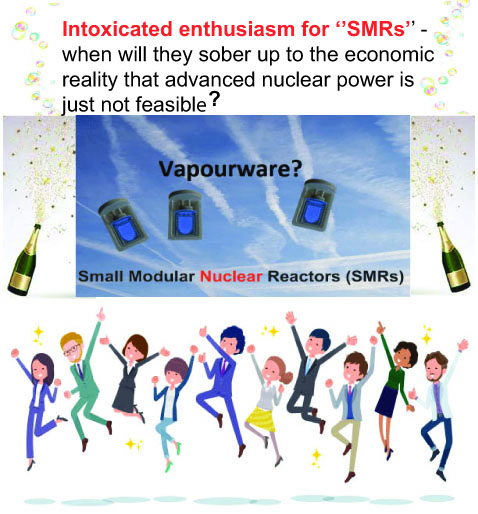
Six ground-breaking nuclear technology projects across the UK have
received government backing to help develop the next generation of nuclear
reactors. The £3.3M funding will support the early-stage innovation for
the winning projects, ………….. Through the Advanced Modular
Reactor Research, Development and Demonstration (AMR RD&D) programme, the
funding support the development of technology such as high temperature gas
reactors (HTGRs), helping revolutionise the way the UK gets its energy. The
innovative projects being backed by the government include National Nuclear
Laboratory in Cheshire, which is coordinating a UK-Japan team to design an
innovative HTGR and U-Battery Developments in Slough, for a study to
determine the optimum size, type, cost, and delivery method for a U-Battery
AMR suitable for demonstration in the UK.
New Civil Engineer 5th Sept 2022
https://www.newcivilengineer.com/latest/6-nuclear-innovations-win-government-funding-05-09-2022/
A big week in nuclear news
Unfortunately, right now when alternative news on nuclear issues is needed more than ever, our international website, nuclear-news.net is not available. This is due to a domain name problem, which I hope will soon be fixed. Nuclear-news.net has, for over 12 years, been gathering together those few news items that show the ‘other side’ of nuclear news – in a media landscape dominated by glossy spin from the nuclear lobby – regurgitated by the corporate media.
Indeed – right now – it borders on the hilariously funny – as corporate media pushes nuclear power as safe and clean, while Ukraine, Belarus, even Europe anxiously fear catastrophe at Zaporizhia.

A bit of good news – Humanity’s Moment: A Climate Scientist’s Case for Hope by Joëlle GergisReviewed by Kara Nicholson
AUSTRALIA.
Our Air Force is already ‘operating against China’. Anti-AUKUS campaign ramps up over U.S.-China war talk.
US admiral issues blunt warning on building Australian submarines in overstretched shipyards. Australian submariners to train onboard British nuclear-powered submarines under AUKUS deal. Britain supports Australia’s nuclear submarines – (UK and USA vying for the sale to Oz?)
AI Group Unveiled: a propaganda service for Defence, big business and the Coalition.
INTERNATIONAL.
Russia and the U.S. are entering ‘dangerous and uncharted’ nuclear territory.
Podcast – How the Western Press has become a propaganda tool of the war industry and the Ukrainian government.
Infographic: The impact of nuclear tests around the world. Can the testing on anti-satellite weapons be banned?.
No energy solution without a radical rethink — World leaders suck in the fossil-nuclear mindset.
$Multibillion costs in the struggle to deal with nuclear wastes across the globe.
Global fossil fuel subsidies rocket to almost $US700 billion in 2021
UKRAINE.
Zaporizhia. Collective madness — Zaporizhzhia is the poster child for abandoning the use of nuclear power. Very real risks of nuclear catastrophe at Zaporizhia nuclear station, with the memory of Chernobyl ever present. A1 IAEA at Zaporizhia nuclear station: Dr Paul Dorfman assesses the risks. https://www.youtube.com/watch?v=C7jdMlL3Ohc Ukraine’s nuclear plant partly goes offline amid fighting. Fighting goes on near Ukraine nuclear plant; IAEA on site. Nikopol under attack: Residents flee fighting near Zaporizhzhia nuclear power plant.
UN thanks Russia for keeping nuclear team safe. Fighting at Ukraine nuclear plant brings chances of a meltdown to a ‘coin toss’, expert says. U.S. Calls For ‘Controlled Shutdown’ Of Zaporizhzhya Plant As IAEA Inspectors Seek Access. New artillery attack as IAEA heads to Ukraine nuclear plant. https://www.youtube.com/watch?v=6ooAMfR7PrQ
Pentagon admits ‘likelihood’ of Ukrainian shelling near nuclear plant. Ukraine accused of targeting possible route of nuclear inspectors. Russia accuses Ukraine of fresh shelling of nuclear plant. Satellite images show damage to buildings right next to Zaporizhzhia nuclear reactors. Russia blames Ukrainian forces for potential disaster.
European Union providing Ukraine with over 5 million doses of potassium iodide tablets. Zelensky aide says UN nuclear watchdog should be mistrusted ‘by default’. If people take part in referendums in Donbass region, Ukraine government will prosecute them as criminal offenders. Ukrainian government wants to sell nuclear energy to Germany .
Moscow says – US Afraid Inhumane Acts Committed by Azov Terrorists Will Be Made Public. International Atomic Energy Agency inspection team on its way to Zaporizhzhia nuclear power plant.
JAPAN. Fukushima town lifts evacuation order, but few former residents want to come back. Fukushima Plants Showing ‘Unusual Growing Patterns’.
PACIFIC ISLANDS. As Japan builds nuclear dumping facilities, Pacific groups say ‘stop‘.
RUSSIA. Gorbachev Ended Cold War, Eased Nuclear Tensions But Trusted US Too Much – Experts.
UK. New nuclear bases and nuclear submarines in Scotland deemed “unachievable” by a UK Government watchdog. Navy officer opposed to nuclear weapons sues UK Ministry of Defence .
You can’t trust Liz Truss (oil and gas devotee) on energy policy for Britain Nuclear power: the accumulating problems. Boris Johnson unveils £1.45billion nuclear submarine. Boris Johnson’s parting gift – a £30 billion nuclear debt. Boris Johnson locking the next Prime Minister into unsustainable nuclear debt. High Court legal challenge to UK government against decision to build Sizewell C nuclear station.
Caroline Lucas, Green Party MP for Brighton Pavilion condemns decision for massively costly Sizewell C nuclear station. Boris Johnson’s legacy of the nuclear fantasy. Compulsory purchase orders of land for Sizewell C nuclear project . Stop Sizewell C urges Boris Johnson’s successor to totally review this costly nuclear project. £3.3 million tax-payer boost for untried non-existent technology . Nuclear power for Britain – a “financial basket case “. UK’s Nuclear Gambit Faces Long Odds Even With Sizewell Approval.
GDF Community Partnership promotes “feel good” books to children., making nuclear waste dump ‘cute and safe’. A concerted push now for renewable energy would save Britons billions of pounds.
USA. Mothers For Peace disappointed that California Governor supports ”lifeline” for Diablo Canyon nuclear power station. USA’s Inflation Reduction Act a tidy little bonanza for the nuclear industry . City of Aiken will receive more than $168M in plutonium storage settlement. Radioactive Waste ‘Everywhere’ at Ohio Oilfield Facility, Says Former Worker.
CANADA. Walk in Ignace protests nuclear waste storage site.
EUROPE. Gas prices and nuclear outages put European grid at breaking point.
SWITZERLAND. Future threat to Europe’s water supplies as Switzerland’s glaciers are rapidly thawing . https://www.youtube.com/watch?v=4-18HL-dpWw
FRANCE. France braces for uncertain winter as nuclear power shortage looms.
PAKISTAN. The ‘horrors of climate change‘ hit Pakistan . https://www.youtube.com/watch?v=UGvggMbBfWY
SOUTH ASIA. South Asian countries facing devastating extreme weather events – seek reparation from rich countries.
IRAN. Iran does not seek to develop nuclear weapons, says President Ebrahim Raisi. Iran seeks stronger U.S. guarantees for revival of 2015 nuclear deal.
Collective madness — Zaporizhzhia is the poster child for abandoning the use of nuclear power.

The IAEA team that went to Zaporizhizhia aren’t superheroes and can’t fix what’s broken
Collective madness — Beyond Nuclear International By Linda Pentz Gunter
The deadly peril posed by nuclear power plants embroiled in a war zone — something we have been warning about since before the Russian invasion of Ukraine — just came into even sharper focus.
The continued military activity around the Zaporizhzhia nuclear power plant, home to six of Ukraine’s 15 reactors, has raised worldwide concern about the terrible consequences should a missile strike a reactor, or worse, the unprotected irradiated fuel pools or radioactive waste storage casks.
Let’s remember that the 1986 Chornobyl nuclear disaster — the result of the explosion of a single, relatively new unit — has rendered a 1,000 square mile region (the Exlusion Zone) uninhabitable still today and for the foreseeable future. Any one of the Zaporizhzhia reactors contains a far larger radioactive inventory and a more densely packed fuel pool than was the case at Chornobyl. A major breach of any one of the six would release long-lasting radioactive contamination into the environment, forcing permanent evacuations and sickening countless people.
Several obvious conclusions emerge from all this.
- Nuclear reactors cannot be in a war zone.
- The consequences of an attack on a nuclear plant could be catastrophic, long-lasting and far-reaching.
- It is impossible to predict where a war might happen (Lindsey Graham’s recent reckless statements remind us that yes, there could even be (civil) war again here in the US).
- The odds of a catastrophic failure at a nuclear plant must be zero given the unacceptable consequences; an impossibility.
- Nuclear power plants are not only ill-suited to the climate of war, but also to both the present and impending extremes of climate change (major sea-level rise; floods; fires; violent weather events etc).
Therefore, it is senseless and irresponsible to continue using nuclear power as an energy source.
Instead, as a 14-person delegation from the International Atomic Energy Agency (IAEA) made its way to the Zaporizhzhia plant, its General Secretary, Rafael Grossi, stated that theirs was a mission “that seeks to prevent a nuclear accident and to preserve this important — the largest, the biggest — nuclear power plant in Europe”.
Preserve? Well, as Henry Sokolski just reminded us in his August 31 article — The Zaporizhzhia Nuclear Plant Is Kindling for World War III — “The IAEA was founded seventy years ago to promote nuclear power.” It is set up to “conduct occasional nuclear audits, not to physically protect plants against military attacks or to demilitarize zones around them,” he wrote. “The IAEA can’t provide the Zaporizhzhia plant with any defenses, nor will it risk keeping IAEA staff on-site to serve as defensive tripwires.”
James Acton, co-director of the nuclear policy program at the Carnegie Endowment for International Peace, issued similar warnings about the limitations of the IAEA delegation when he was interviewed about the worsening situation at Zaporizhzhia and the IAEA visit on the August 29th edition of The Rachel Maddow Show.
“We should be realistic about what they can achieve,” he said. “It’s their job to report what’s going on in the plant, to assess the safety and security features on the plant and to report back. They don’t have a magic way of defending the plant or repairing broken equipment.”
The White House has called for the Zaporizhzhia reactors to be shut down. It should be calling for all reactors to be shut down. Instead, it is blindly persisting with nuclear power as a present and future energy program.
The White House is not alone, of course. The illogical — and arguably insane — response to the war in Ukraine by a number of governments has been to insist on the continued or even expanded use of nuclear energy. Given what is at stake in so doing — and given the obvious safer, faster and cheaper alternatives of energy efficiency and renewable energy— this appears to be a symptom of some kind of collective madness.
Let’s face it, if Zaporizhzhia was a 6-acre wind farm instead of a 6-reactor nuclear power plant, we wouldn’t even be talking about it, let alone worrying about how to pronounce it.
Linda Pentz Gunter is the international specialist at Beyond Nuclear and writes for and curates Beyond Nuclear International.
Nuclear power for Britain – a “financial basket case “
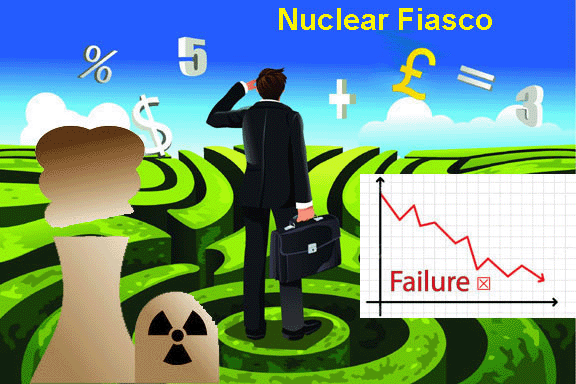
Recent days have seen Government ministers blaming opposition parties for
the failure to deploy nuclear power in the UK. But the problem is not
politicians, not the Conservatives, Labour or anyone else; it is the
extreme difficulty of delivering nuclear power itself.
Financially, it is a basket case, and any other technology with similar problems simply wouldn’t
get past the lobbyists’ meetings with politicians. On August 7th Kwasi
Kwarteng produced a tweet blaming Nick Clegg and Labour for delays in
building nuclear power, saying: ‘Thanks to Labour’s 13-year moratorium
and Lib Dem blockers in the Coalition, we made no progress on nuclear.
Supply chains disappeared. Since 2015, we got Hinkley approved and Sizewell
C received planning consent last month. ‘
However, this explanation does
not stand up to serious analysis. In their 2005 manifesto the Conservatives
did not even mention nuclear power, referring instead to renewables and
energy efficiency as a means of protecting energy security. By the 2010
election both Labour and Conservatives were backing the idea of building
more nuclear power plant, but Conservatives ruled out giving nuclear
subsidies. Their manifesto said they would be ‘clearing the way for new
nuclear power stations – provided they receive no public subsidy’ .Of
course the Liberal Democrats were very much opposed to new nuclear power
before they joined the Coalition in 2010.
But then it was the Liberal
Democrat Energy Secretary of State Chris Huhne who proposed a new
electricity market reform consultation paper at the end of 2010. This
allowed, in effect, nuclear power to receive public subsidies under the
cover that this same subsidy would be available to other low carbon
sources. This laid the basis for the current contracts for difference (CfD)
regime which is funding Hinkley C.
But in practice the offer of a generous
CfD for Hinkley C proved not to satisfy the prospective nuclear generators.
This included EDF which was/is backed by the French state who wanted to
promote France’s new European Pressurised Reactor (EPR) design. The most
fundamental problem was that no major British political party was then
willing to underwrite cost overruns – this was seen as giving nuclear
constructors a blank cheque, which it is. Nevertheless this underwriting
has now, latterly, been given EDF for Sizewell C under the so-called
‘RAB’ arrangements.
100% Renewables 3rd Sept 2022
No energy solution without a radical rethink — World leaders suck in the fossil-nuclear mindset

Global leaders bear responsibility for ever worsening energy problems
No solution without a radical rethink — Beyond Nuclear International The danger of antiquated fossil-nuclear mindsets on energy policy
By Hans-Josef Fell 4 Sept 22,
EU President von der Leyen, German Chancellor Scholz, French President Macron, Taiwan’s President Tsai Ing Wen, as well as most other global leaders – they are all characterized by the fact that in their important high-ranking functions they have almost always viewed energy security solely from a fossil-nuclear perspective. To the present day they have prioritised the business interests of the big energy companies, whose focus is fossil-nuclear.
These global leaders subordinated the resulting geopolitical tensions and climate protection in their policy of procuring crude oil, natural gas, coal and uranium, although the consequences have been foreseeable for decades. They have not effectively promoted domestic renewable energies as the only real solution for energy security. For that reason, they are largely responsible for the fact that the EU and other regions are now highly dependent on energy supplies from autocratic countries and they bear a large share of the blame for the current, ever worsening energy problems, geopolitical tensions and global warming. …………
German Chancellor Olaf Scholz
For example, German Chancellor Scholz has still not been to Bavaria, the state that has been the biggest blocker of the energy transition for years and is hence now facing particularly massive energy problems in the coming winter. ……………………..
French President Emmanuel Macron
Another example for persisting fossil nuclear patterns of thought is the French President Emmanuel Macron. He aims to build 14 new nuclear power plants and to continue operation of the existing ones with 50-year longevity extensions to enable French energy security in the years ahead. This strategy seems particularly absurd in light of France’s recent experiences with new nuclear construction and operation. For example, the only new nuclear power plant built in France, the EPR reactor in Flamanville, is still not in operation since construction started in 2007 and planned commissioning in 2012. Construction costs have skyrocketed by at least three times. With this in mind, the plans for the construction of 14 new reactors will certainly not be feasible before 2050 and hence will by no means be part of a solution to the the current energy crisis.
On the contrary, France’s 56 nuclear power plants contribute significantly to the European energy crisis. Up to 50% of the French nuclear power plants had to be shut down recently, partly because significant safety risks had been discovered due to cracks in the cooling pipes. Additionally, many other nuclear plants had to be shut down this hot summer due to warm river temperatures and low water levels that could no longer guarantee the plants’ cooling.If the drought persists, there is a threat of further shutdowns in the coming weeks, incidentally also at coal-fired power plants as they also rely on river cooling water.
So far, a French blackout has only been prevented with green electricity supplies from Germany………………….
EU Commission President Ursula von der Leyen ………………………….. Ursula von der Leyen is responsible for the inclusion of the highly climate-damaging natural gas and the highly dangerous nuclear energy as “green” energies in the EU taxonomy. There is no more obvious way to document the compliant support of the fossil and nuclear economy. Against this backdrop, Ursula von der Leyens recent political activities completely failed in terms of the expansion of renewable energies.
Ukrainian President Wolodimir Selenski
The Ukrainian President Wolodomir Selenski plans to export electricity to Europe to generate revenue. However, more than 50% of the electricity in Ukraine comes from nuclear power plants. These are at high risk in Putin’s war right now. Misdicrected rockets as well as targeted attacks during wars can cause a nuclear “super-disaster”. In that case, regions all over Europe would be affected by radioactive contamination……….
at least in wars, nuclear power plants must be shut down. President Selenski, however, is still sticking to nuclear power production, building up on his announcement to construct new nuclear power plants. Moreover, Ukraine itself buys fuel elements from Russia and thus paradoxically finances Russia’s war of aggression against its own country.
Selenski’s adherence to the fossil-nuclear energy system is thus also a great danger to the existence of all Europeans. The only way out of this highly dangerous situation is the switch to 100% renewable energies. But so far, Selenski has hardly promoted this transformation.
Taiwanese President Tsai Ing Wen
Similarily, the industrial region of Taiwan, another current trouble spot, is almost completely dependent on fossil and nuclear energy supplies from abroad…………………………………..
Conclusion
Scholz, Macron, von der Leyen, Selenski, Tsai Ing Wen – as different as the challenges that the respective countries are currently facing may be – what unites them all is that they seem to have learned nothing from the current crises. Even though the multidimensional crises of our time – energy price crisis, climate crisis, health crisis, wars – show us more painfully than ever where our nuclear fossil dependency has led us, they are still clinging to the fossil and nuclear energy system instead of clearly focusing all efforts on the expansion of renewable energies. Only with these will we be able to embark on the path to a sustainable and peaceful future. Read our global study to learn how such a 100% clean energy supply can be implemented worldwide in a technically and economically viable way.
Hans-Josef Fell is the founder and president of The Energy Watch Group and was a member of the German Parliamentary Group Alliance 90/ the Greens from 1998 to 2013.
Zaporizhzhia nuclear plant loses power line – IAEA
ZURICH, Sept 3 (Reuters) – Ukraine’s Zaporizhzhia nuclear plant again lost connection to the last remaining main external power line, but continues to supply electricity to the grid through a reserve line, the International Atomic Energy Agency (IAEA) said on Saturday.
The agency also said, in a statement posted on its website, that only one of the station’s six reactors remained in operation…………..
The U.N. nuclear watchdog’s experts now stationed at the plant were told by Ukrainian staff that the site’s fourth operational 750 kilovolt power line was down after three others were lost earlier, the IAEA said.
But IAEA experts also learned that a reserve line linking the facility to a nearby thermal power plant was delivering electricity to the external grid. This reserve line can also provide backup power to the ZNPP if needed, it said.
“One reactor is still operating and producing electricity both for cooling and other essential safety functions at the site and for households, factories and others through the grid,” the IAEA said……… https://www.reuters.com/world/europe/zaporizhzhia-nuclear-plant-loses-power-line-iaea-2022-09-03/
A series of defective products at a French MOX fuel plant Abnormal nuclear reaction at a nuclear power plant

September 3, 2022
A series of defective products have been found at the Mellox plant in southeastern France, which manufactures fuel for plutonium thermal power generation, in which plutonium is burned in nuclear power plants. In addition, an abnormal increase in nuclear reactions has also been observed at some nuclear power plants that are conducting plu-thermal power generation. What in the world is going on?
The plant also manufactures fuel for the Japanese market. No problems have been found so far with the fuel for the Japanese market, but production has been delayed, and future product deliveries are now unpredictable.
Plutonium is extracted from spent nuclear fuel from nuclear power plants through chemical processing (reprocessing). Plutonium is mixed with uranium in the case of pressurized-water nuclear power plants that conduct plutonium thermal power generation, and baked into pellets, cylindrical grains about 8 mm in diameter. This is called mixed uranium-plutonium oxide fuel (MOX fuel). In the case of a pressurized-water nuclear power plant that conducts plutonium thermal power generation, approximately 320 pellets are stacked inside fuel rods, and another 260 fuel rods are bundled together to form a fuel assembly (approximately 4.1 meters in height).
Highly Difficult Homogenization
It is difficult to uniformly mix plutonium and uranium. According to ASN data and other sources, “plutonium spots,” dense clumps of plutonium, were found in the fuel pellets produced at the MELOX plant. Plutonium spots were found in the fuel pellets manufactured at the MELOX plant.
On the other hand, a phenomenon in which the amount of neutrons, which indicate a nuclear reaction, increases more than expected near the upper and lower ends of MOX fuel rods was confirmed at a French nuclear power plant conducting a plutonium thermal operation.
According to ASN, the combination of this plutonium mass problem and the two anomalies of partially elevated nuclear reactions was predicted to “raise questions about the integrity of the fuel, depending on the circumstances of the accident.
According to Chihiro Uesawa, 56, an engineering specialist at the NPO Nuclear Information and Data Center (Nakano Ward, Tokyo), concerns are that the fuel could melt or the tubes covering the fuel could break. When plutonium is used as fuel, it has been pointed out that there is a possibility of a localized increase in nuclear reactions. This has become apparent,” Uesawa said.
UK’s Nuclear Gambit Faces Long Odds Even With Sizewell Approval
The 24 gigawatt-target is “not viable if each project happens by negotiation that takes five to 10 years,” said Luba Kotzeva de Diaz, managing director European energy & renewables at Lazard Ltd.
- EDF’s Hinkley Point C is over budget and behind schedule
- Government’s 24-gigawatt nuclear target seen as unrealistic
Bloomberg. By Rachel Morison, September 4, 2022 , The UK’s audacious push to triple nuclear power capacity inched forward with the promise of government funding for the Sizewell C station, but doubts remain about the government’s ability to greenlight enough projects by 2030 to meet that goal.
Considering it took about 10 years for Electricite de France SA’s plant to get this far, the government’s “go big” gambit on nuclear energy — to help wean the nation off Russian fossil fuels and reduce emissions — is seen as a long shot. And those odds may get worse for the successor to Prime Minister Boris Johnson.
……….. The government wants to deliver eight new nuclear reactors this decade — needing approval at a pace equivalent to one a year. A construction program of this scale hasn’t been achieved on the continent since the French in the 1970s, prompting calls on leaders to find alternative paths for achieving energy independence and legally binding emissions cuts.
“It will be extremely difficult for the government,” said Asgeir Heimisson, senior associate at Aurora Energy Research Ltd. “Investment would need to occur approximately every three years from 2022, requiring a total of about £180 billion of capital expenditure.”
That’s a challenge for the new prime minister, who will take over in coming days amid a recession spurred by record energy prices and an inflation rate set to hit 14% this winter.
By 2050, a 24 gigawatt-strong fleet of new reactors is supposed to provide stable backup for offshore wind, the most-advanced renewable technology in Britain. The near-term ambition here is massive, too: reaching 50 gigawatts this decade………………………………..
The Sizewell project still needs significant backing from private investors before a final investment decision is made. It would follow on from Hinkley Point C, the UK’s first nuclear plant in three decades. Progress at Hinkley is costing more and taking longer to build than planned, stoking concerns about whether the government is right to rely so heavily on the technology.
Financing is the biggest hurdle for new stations, with the price tag for Sizewell being £20 billion ($23 billion) at the start of this year, but materials costs have surged since. An overhaul of the financing mechanism is meant to attract more funds. The regulated asset base, or RAB, model is supposed to encourage private investors and dilute the construction risk shouldered by the developer and taxpayers.
The government’s £700 million investment is expected to form a 20% stake in the project, with EDF taking another 20%. Greencoat Capital LLC, one of the UK’s biggest managers of renewable-energy funds, is considering investing, founder Richard Nourse said in July.
Sizewell represents a “glimmer of hope” for the nuclear industry, said Vince Zabielski, partner at Pillsbury Winthrop Shaw Pittman LLC. “The investment shows promise, but the decision is about 10 years late.”
…………The 24 gigawatt-target is “not viable if each project happens by negotiation that takes five to 10 years,” said Luba Kotzeva de Diaz, managing director European energy & renewables at Lazard Ltd. — With assistance by Ellen Milligan https://www.bloomberg.com/news/articles/2022-09-04/uk-s-nuclear-gambit-faces-long-odds-even-with-sizewell-approval
Youth- led 7 day anti-nuclear march against UK government’s plan for small nuclear reactors
Members of the youth cohort of CND Cymru will be embarking on a 7-day march
from Trawsfynydd Nuclear Power Station in Gwynedd to Wylfa Nuclear Power
Station on Ynys Môn in September, in protest against the Westminster
government’s decision to locate Small Modular Nuclear Reactors (SMRs) on
the decommissioned sites.
This decision came hand in hand with the growing
frustration felt by young people following the government’s
‘greenwashing’ of nuclear energy; selling it as a form of clean, safe and
homegrown energy in the backdrop of the climate crisis.
We are equally concerned about the disastrous effects of uranium mining on the lands of
indigenous people in Australia as well as in areas of the Global South –
not to mention the links between nuclear power, the military and nuclear
weapons.
The young people who have decided to march against the
construction of SMRs in Trawsfynydd and Wylfa want their voices heard in
the debates that will depict the future landscape in which they will have
to live in. They demand to see preparations for a genuinely green future
and the creation of jobs that will not come at the expense of the health of
workers and their communities, or the environment.
Climate justice cannot
be achieved by nuclear energy. We will be walking with the support of the
Public and Commercial Services Union (PCS), Nuclear Free Local Authorities
(NFLA), CADNO, PAWB, Cymdeithas yr Iaith, XR Cymru, Youth Fusion and Mabon
ap Gwynfor (MS). Although the march will be youth-led, anyone wishing to
join will be most welcome.
CND Cymru 4th Sept 2022
1 This Month
23 April – WEBINAR – Why new nuclear reactors are the wrong tools for decarbonization Thursday, April 23 • 1 AM – 2 AM AEST


Pine Ridge Uranium is the real threat, not Tehran- Tell Burgum: Stop the Extraction.
Chernobyl: The Lost Tapes – A good documentary on Chernobyl on SBS available On Demand for the next 3 weeks– https://www.sbs.com.au/ondemand/tv-program/chernobyl-the-lost-tapes/2352741955560
To see nuclear-related stories in greater depth and intensity – go to https://nuclearinformation.wordpress.com
-
Archives
- April 2026 (275)
- March 2026 (251)
- February 2026 (268)
- January 2026 (308)
- December 2025 (358)
- November 2025 (359)
- October 2025 (376)
- September 2025 (257)
- August 2025 (319)
- July 2025 (230)
- June 2025 (348)
- May 2025 (261)
-
Categories
- 1
- 1 NUCLEAR ISSUES
- business and costs
- climate change
- culture and arts
- ENERGY
- environment
- health
- history
- indigenous issues
- Legal
- marketing of nuclear
- media
- opposition to nuclear
- PERSONAL STORIES
- politics
- politics international
- Religion and ethics
- safety
- secrets,lies and civil liberties
- spinbuster
- technology
- Uranium
- wastes
- weapons and war
- Women
- 2 WORLD
- ACTION
- AFRICA
- Atrocities
- AUSTRALIA
- Christina's notes
- Christina's themes
- culture and arts
- Events
- Fuk 2022
- Fuk 2023
- Fukushima 2017
- Fukushima 2018
- fukushima 2019
- Fukushima 2020
- Fukushima 2021
- general
- global warming
- Humour (God we need it)
- Nuclear
- RARE EARTHS
- Reference
- resources – print
- Resources -audiovicual
- Weekly Newsletter
- World
- World Nuclear
- YouTube
-
RSS
Entries RSS
Comments RSS
 nuclear-news