The Royal Society for the Protection of Birds (RSPB) condemns ludicrous Sizewell C planning approval.

The Royal Society for the Protection of Birds (RSPB) has expressed its
disappointment that “ludicrous” plans for a nuclear power plant near the
internationally-important RSPB Minsmere reserve have been approved. RSPB
chief executive Beccy Speight said: “The RSPB is extremely disappointed to
learn that the government has approved plans for Sizewell C, the proposed
new nuclear power station that will affect our nature reserve at Minsmere
in Suffolk.
East Anglian Daily Times 20th July 2022
https://www.eadt.co.uk/news/business/rspb-condemns-ludicrous-sizewell-c-planning-approval-9157422
Baseload nuclear power not needed in an all-renewable future – Claverton Energy Research Group
Sizewell C is much more expensive and slower to build than proven and
reliable alternative low carbon solutions say elite Energy Think Tank
Latest Research – Baseload generators such as nuclear power plants are
not needed in an all-renewable future and their use will almost certainly
increase overall costs to consumers says elite Claverton Energy Group of
experts.
Professor Mark Barrett, from UCL, who has modeled the comparative
costs of nuclear and renewable power, using hour-by-hour wind and solar
data with 35 years of weather data , said: “Nuclear power is more
expensive and slower to build than renewables, particularly offshore wind.
7 GW of wind will generate about 40% more electricity than Hinkley at about
30-50% of the cost per kWh and will be built in half the time. Neither wind
nor nuclear plant operates all the time, so both will need backup. Modeling
shows the total cost of a renewable generation to be less than nuclear and
to be just as able to provide continuous power even with wind and solar
droughts.”
Claverton Energy Group 20th July 2022
ISRAEL AND THE NUCLEAR NORM
How does existential fear interact with nuclear policy?
INKSTICK Doreen Horschig 22 July 22, Globally, if you ask people “do you support the use of a nuclear weapon?” most people will say “no.” Public opinion polls consistently reflect such anti-nuclear stances and norms. Citizens of EU states that host US nuclear weapons are in favor of a global nuclear weapons ban. Chinese citizens strongly oppose the use of nuclear weapons under any circumstances and a majority of Americans think that the very invention of nuclear weapons was bad. Even under the shadow of the Russia-Ukraine War, 85% of Central and Eastern Europeans reported in March 2022 that there are no situations in which using nuclear weapons would be morally justified.
However, this public aversion toward nuclear weapons can erode.
In a recent experimental study that I conducted in Israel, I found that when faced with a threat to their security, respondents showed high support for nuclear use. In light of this, I explored why it is that people might deviate from anti-nuclear norms and become willing to endorse a nuclear strike against a foreign country.
. I found that when respondents are reminded of their own mortality, they are more likely to support a nuclear strike.
In other words, psychological mechanisms explain why people may violate the nuclear norm. Individuals move away from their existing moral principles and resort to an aggressive defense mechanism that they perceive as effective in destroying the root cause of an existential threat.
ISRAELI SUPPORT FOR A NUCLEAR STRIKE
Israeli support for a retaliatory nuclear strike in a real-life scenario is likely to be even higher than in the theoretical study. First, because the main finding for the support of the use of nuclear weapons in the study is based on a first strike by Israel. If an adversary uses nuclear weapons first, support for a retaliatory strike in response tends to be higher than a nuclear first strike.
……… the results of the same study surveying Americans showed similar support for nuclear use in the case of an existential threat……………….
WHY PUBLIC OPINION MATTERS
Why should we be concerned about public support for nuclear weapons when elites hold the power in nuclear policy? After all, the current debate on gun legislation in the United States shows that public opinion has little to no impact on federal policy. Even though the majority of Americans support stronger gun control policies, few changes have been made. But public attitudes on nuclear weapons do matter for two main reasons, which are intensified by the rise of populism along with nationalist and authoritarian leaders.
First, leaders and war advocates can use the public’s existential fear to their advantage by inflating threats. ……………………
Second, leaders might be more inclined to use a nuclear weapon if they believe they have their public’s support……………………………..Recent research findings also suggest that the public is unlikely to act as a strong restraint on leaders seeking nuclear weapons. Hence, not only can a supportive public embolden leaders to use a nuclear weapon in nuclear-armed states, but also to proliferate in non-nuclear weapons states.
It is essential to educate the public on the realities of nuclear use. People support the use of nuclear weapons because they believe them to have a distinctive military utility. Yet, often conventional weapons are just as effective in destroying an adversarial target (unless, for example, it is a deeply buried weapons storage).
Beyond that, people need to understand the costs and consequences of such a strike. If aversion toward nuclear weapons can easily erode, public knowledge on nuclear weapons needs to be more robust to begin with. https://inkstickmedia.com/israel-and-the-nuclear-norm/
 | |||
|
New failure on the Flamanville EPR, the reactor control system’s malfunction
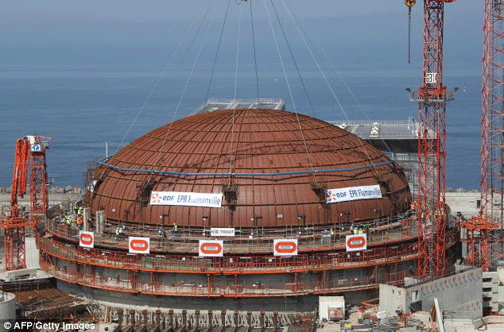
After problems with concrete, steel or welds, the reactor under
construction experienced a new malfunction.
Part of the installation’s control systems is out of order. The structural failure, known since 2019,
is now recognized by EDF. Flamanville and its EPR reactor, umpteenth
episode.
We thought we knew everything about the setbacks of the calamitous
EDF project which has been dragging on for fifteen years now on the nuclear
power plant in the Manche department and whose bill has gone in seventeen
years from 3.3 billion to 12.7 billion euros ( and even 19 billion with
interest and launch costs according to the Court of Auditors ).
Well no !
After the concrete problems during the construction of the reactor
building, the poorly forged steel of the bottom and the cover of the
nuclear vessel or the poorly made welds on the reactor piping, EDF has a
new problem on its hands.
And a big one: two essential systems which make
it possible to control the reactor are victims of a problem problem for the
start of the EPR. A tile known for several years by the operator and the
Nuclear Safety Authority (ASN), but which has not been the subject of any
publicity and has still not been resolved, according to information from
Liberation . We already knew that this powerful 1,650 MWe nuclear reactor
would not enter service before the end of 2023, more than ten years behind
the date initially planned.
Liberation 19th July 2022
Japan’s nuclear regulator formally approves release of Fukushima wastewater to the Pacific

Japan’s nuclear regulator on Friday formally approved a plan to release
more than a million tonnes of treated water from the crippled Fukushima
nuclear power plant into the ocean.
The plan has already been adopted by
the government and endorsed by the International Atomic Energy Agency
(IAEA), but plant operator TEPCO must still win over local communities
before going ahead. The country’s Nuclear Regulation Authority approved
TEPCO’s plan, according to a foreign ministry statement, which said the
government would ensure the safety of the treated water as well as the
“reliability and transparency of its handling”.
Daily Mail 22nd July 2022
Nuclear regulators have found “clear breaches” of safety rules while investigating a chemical leak at the Dounreay plant
Dounreay chemical leak probe finds breach of nuclear safety regulations.
Nuclear regulators have found “clear breaches” of safety rules while
investigating a chemical leak at the Dounreay plant in the Highlands.
The site operators have been ordered to carry out improvements to prevent a
repeat of the incident in April. Emergency crews were called to the
prototype fast reactor at the former nuclear facility in Caithness
following the leak at the sodium storage tanks in the building. Dounreay
Site Restoration Ltd (DSRL), which is in charge of the decommissioning of
the complex, said at the time that a planned reaction of material inside a
tank resulted in an “excursion” which caused the release of a “small
amount of caustic liquor”.
Press & Journal 21st July 2022
Dounreay chemical leak probe finds breach of nuclear safety regulations
Japan approves nuclear-contaminated water discharge plan, may turn Japanese people into ‘sick men of Asia,’ seafood consumption and export nosedive
By Zhang Hui and Xing Xiaojing Jul 22, 2022 , Japan’s nuclear regulator on Friday approved the discharge plan of Fukushima nuclear-contaminated water, with Chinese observers voicing concerns that the release of the contaminated water into the ocean may start earlier than the previous schedule of next spring and warning that Japan will bear the brunt of damage, with people’s lives under serious threat and seafood consumption and export nosediving.
………………… Although the Foreign Ministry statement said this does not mean that TEPCO can immediately start the discharge of the contaminated water into the sea as there are remaining processes, such as the Japanese regulator’s inspections to check and confirm the installation status of the discharge facilities, Chinese observers believed that Japan may accelerate its scheduled plan, making the release start earlier than April 2023.
Chang Yen-chiang, director of the Yellow Sea and Bohai Sea Research Institute of Dalian Maritime University, who has been closely following the Japanese government’s decision on discharging Fukushima wastewater, told the Global Times on Friday that the administrative process for releasing the contaminated water was done in a really fast manner, as it only took Japan five days from announcing completion of construction for undersea tunnel outlet to approving the plan.
The TEPCO has basically completed the construction of an undersea tunnel outlet to dump the nuclear-contaminated water, the Kyodo News agency reported on Sunday.
Japan’s latest move apparently aroused lots of concern and opposition from neighboring countries.
Chinese Foreign Ministry spokesperson Wang Wenbin said at Friday’s media briefing that it is extremely irresponsible for Japan to attempt to create a fait accompli, regardless of various parties’ concerns and China firmly opposes it.
China once again urges Japan to earnestly fulfill its due international obligations, dispose of the nuclear-contaminated water in a scientific, open, transparent and safe manner, and stop pushing through the ocean discharge plan, Wang said.
……………. Meanwhile, Japan’s seafood exports will be greatly hindered, which would hurt the economy and local fishery groups, observers said.
Many countries, including the US and UK, banned imports of food products manufactured in and around Fukushima Prefecture following the 2011 nuclear disaster, and some countries and regions have not lifted the ban even now.
Fishery groups in Japan have repeatedly said they were firmly opposed to the plan due to concerns over a negative impact on the industry. ……………..
China and other stakeholders could through the UN request an advisory opinion from the International Court of Justice, to prove the release is illegal, Chang said.
Yu also advised countries to conduct maritime environment investigation, which could be evidence in seeking compensation from Japan in cases of biological resources damages and other damage.
https://www.globaltimes.cn/page/202207/1271183.shtml
Extreme heat warnings in effect in 28 states across US
Extreme heat warnings in effect in 28 states across US
100 million Americans are enduring searing temperatures as Biden declines to announce a climate emergency
Calling Putin ‘Hitler’ to Smear Diplomacy as ‘Appeasement’
FAIR, JOSHUA CHO, 21 July 22 ‘‘………………………………. To say Ukraine is “filled” with Nazis is an obvious exaggeration, although even a relatively small number of Nazis has wielded disproportionate influence in the Ukrainian government (Kyiv Post, 3/26/19; Euronews, 8/4/21). Nevertheless, FAIR (3/7/14, 1/15/22, 1/28/22, 2/23/22) has covered the Western media’s denial of the far-right’s role in the Ukrainian 2014 coup, as well as their complicity in amplifying Ukrainian neo-Nazi publicity stunts during the war.
But if it’s true that falsely associating a government with Nazism is a manipulation worthy of condemnation, how then should one judge Western media efforts to tie Russian President Vladimir Putin to Nazi dictator Adolf Hitler?
FAIR (3/30/22) has previously noted how evidence-free caricatures in Western media of Putin as irrational (and perhaps psychotic) make diplomatic efforts to end the Ukraine crisis seem pointless. Tracing a connection between Putin and Hitler is an even more insidious attempt to make the idea of a negotiated end to the war seem like a moral outrage……………………………………………..
Russia’s brutal invasion of Ukraine is a violation of international law, condemned by 141 out of 193 countries in a UN General Assembly vote. But claims that Russia is committing genocide—a charge that carries automatic repercussions under international law—have to reckon with the comparison between the Ukraine invasion and the largest US military operation of the 21st century, the Iraq War. The UN’s count of civilian deaths in the first four months of Russia’s war was 4,677; the tally in the first four months of Iraq, according to Iraq Body Count, a project that monitored press accounts of civilian casualties, was 8,576.
Both numbers are horrific, and each surely underestimates the true civilian toll of these wars. But if Russia is committing genocide in Ukraine, what was the US doing in Iraq?
“I know it’s hard…to swallow that the carnage and destruction could be much worse than it is,” a US Defense Intelligence Agency analyst told Newsweek (3/22/22). “But that’s what the facts show. This suggests to me, at least, that Putin is not intentionally attacking civilians.”
If one genuinely wants to compare Putin’s brutality to Hitler’s, one has to look at the actual civilian toll of World War II. In the European theater alone, tens of millions of civilians were killed; some 14 million of these deaths were inflicted in the Soviet Union, which comprised both Russia and Ukraine. When you assert that the enemy of the day is as bad as Hitler, you’re also asserting that Hitler is no worse than the enemy of the day……………………………………
Diplomacy = ‘appeasement’
One inevitable feature of these Hitler comparisons is frequent reference to “appeasement” when reporting on the US’s dealings with foreign leaders. This presents any attempt at diplomatic negotiations with foreign leaders opposed by the US as a misguided or unprincipled effort to placate an irrational or evil dictator bent on expansionist conquest. ……………………………….
This is a false dichotomy. Although establishment Western pundits and officials like to claim that the Russian invasion was “unprovoked,” FAIR (1/28/22, 3/4/22) has pointed out that this self-serving narrative omits a record of conscious provocations against Russia via NATO expansion towards Russian borders, in violation of promises made to Soviet reformer Mikhail Gorbachev. …………………
Accusations of “appeasing” Russia or Putin have been raised towards influential Western officials who have either engaged in diplomacy or advocated de-escalation through negotiations. Zelenskyy has made contradictory remarks throughout the conflict, arguing that diplomacy is the only way to end the war, while also advocating for escalation through more NATO military support and setting up a “no-fly-zone.”…………………………………………..
The cost of ‘appeasement’ charges
The hyperbolic comparisons between Russia and Vladimir Putin to Nazi Germany and Adolf Hitler, as well as constant accusations that anyone who attempts to negotiate with Russia for a peaceful end to the war is engaged in “appeasement,” have cost the world opportunities to de-escalate. The Biden administration has not encouraged the Ukrainian government to engage in serious negotiations with Russia (Jacobin, 5/30/22)………………..
The extreme caricatures of Putin as equal to or worse than Hitler are setting up Ukraine and the world for a grim fate. A BBC report (6/20/22) last month featured NATO Secretary-General Jens Stoltenberg urging the West to “prepare to continue supporting Ukraine in a war lasting for years,” while the head of the British Army, Gen. Patrick Sanders, asserted that the “UK and allies needed to be capable of winning a ground war with Russia.” The frequent Nazi comparisons and Munich references made by Western media paint those who would prefer a negotiated settlement to years of bloodshed, the risk of World War III and nuclear war as “appeasers” of a Hitlerian dictator with genocidal ambitions. https://fair.org/slider/calling-putin-hitler-to-smear-diplomacy-as-appeasement/
Government gives go-ahead to ‘monumental modern folly’ Sizewell-C
Government gives go-ahead to ‘monumental modern folly’ Sizewell-C. The
Nuclear Free Local Authorities were saddened and disappointed, but
unsurprised, to hear yesterday’s announcement that the interim British
Government has decided to grant a Development Consent Order to the Sizewell
C nuclear power station in Suffolk; for Ministers have been signalling for
months that they would give this ‘monumental modern folly’ the
go-ahead.
NFLA 21st July 2022
UN Scientific Committee’s Dialogue Meeting Rocks – “No Change in Conclusion” when Error Pointed Out
2022/07/22
The United Nations Science Commission on Radiation Effects from the Fukushima Daiichi Nuclear Power Plant Accident (UNSCEAR), which compiled a report on the effects of radiation exposure from last year to this year, held an interactive meeting in Iwaki City, Fukushima Prefecture, on March 21 to explain the contents of the report to the public. The meeting was held in Iwaki City, Fukushima Prefecture. The former UNSCEAR chair Gillian Haas and others explained that the radiation doses were low and that cancer and other health problems did not occur, but domestic researchers raised questions one after another, saying that the report contained errors and underestimated radiation doses.
From July 19 to 22, UNSCEAR has been conducting “outreach activities” in Japan to disseminate the report. On this day, a meeting for the public was held for the first time, attended by about 30 people, including domestic researchers and media representatives. The meeting began with an hour-long presentation on the report, which cited 500 papers selected from more than 1,000 peer-reviewed articles and other materials published by the end of 2019. He emphasized that the report was scientific and objective, citing 500 papers selected from more than 1,000 peer-reviewed papers published by the end of 2019, and pointed out that the radiation dose from the accident was extremely low. He pointed out that the radiation doses from the accident were extremely low. The report concluded that the large number of pediatric thyroid cancers found in Fukushima Prefecture were not the result of the accident, but rather “the result of ultra-sensitive screening tests.
Dr. Hiyako Sakiyama, a medical doctor and president of the NPO 3.11 Thyroid Cancer Children’s Fund, raised the issue of the radiation dose of radioactive iodine being estimated in half based on the dietary habits of the Japanese people. Looking at the amount of iodine in urine, which is publicized as a result of the secondary thyroid examination conducted by Fukushima Prefecture, she pointed out that “the amount of iodine that Japanese people are consuming from food is the same as the world average. He refuted the report, saying that the exposure in the report was “clearly underestimated.
Shinichi Kurokawa, professor emeritus at the High Energy Accelerator Research Organization (KEK), criticized the existence of impossible data in the report. He pointed out that the deposition rate of radioactive cesium, which is used as a model for simulations to estimate absorbed doses in the thyroid gland, is at a “physically impossible” rate. He harshly criticized the report.
He also sharply criticized the previous day’s press conference, in which Kurokawa and his group of researchers had responded that the error was a mere typo and that they had not received any suggestions that would change their conclusions. He expressed his anger, saying, “Why did they say that?”
In addition, a number of people from the audience raised questions about the data used and its contents, including a former fishery cooperative official who complained that the doses of fish he had measured had been revised downward. Haas and others, however, reiterated that while they would verify the areas pointed out, their conclusions would not change.
The term “scientific” means “picked up from published papers.”
In an interview with Synodos, former Japanese representative Mamon Akashi emphasized that the report was scientific. When asked about the fierce criticism that was leveled at him in his dialogue with the public, he responded. The report is based on a review of published papers, with the exception of personal dosimeter data from Minamisoma and Naraha, but most of the data has been reviewed. I only said that I picked up the data from the published papers, and I described it as scientific, not that I arbitrarily excluded any papers or tried to exclude any papers. I didn’t say that I arbitrarily excluded or tried to exclude any papers,” he responded.
He also emphasized that he had no idea about the report’s suggestion that errors had occurred in its own analysis, since it was outside his area of expertise.
NRA approval for Fukushima Daiichi radioactive pollution of the Pacific Ocean – no justification, no scientific basis and illegal – Greenpeace condemns decision
Greenpeace Japan
2022-07-22
Tokyo, Japan – The final approval by Japan’s Nuclear Regulation Authority (NRA) of Tokyo Electric Power Company Holding (TEPCO) plans to discharge radioactive waste water into the Pacific Ocean has no justification, is based on incomplete and limited data and flawed analysis and violates international law, according to Greenpeace East Asia.

Shaun Burnie, a senior nuclear specialist from Greenpeace East Asia, said:
“The decision by Japan’s regulator to deliberately pollute the Pacific Ocean with radioactive waste water is as bad as it sounds. The NRA approval of the TEPCO contaminated water discharge plan is scientifically and technically flawed. It is a decision intended to support the false narrative that decommissioning the destroyed reactors at Fukushima Daiichi is making real progress. In reality the contaminated water plan is a symptom of the wider crisis that the current decommissioning plan is doomed. The discharges into the Pacific will not solve any problems but create many more. The NRA knows that a fundamental reassessment of the decommissioning plan is inevitable, and that will also mean choosing the least environmentally damaging option which is long term storage and processing.”
“The NRA has failed to assess many important issues that are fundamental to any environmental assessment. Further, it disregards the human rights of those most impacted by the 2011 disaster – the citizens of Fukushima prefecture, including fishing communities, as well as neighboring prefectures. It ignores the wider environmental marine impact and the rights of the peoples of the Asia Pacific region who are opposed to the deliberate pollution of the Pacific with radioactive waste,” said Burnie.
Japan is legally required under the UN Convention for the Law of the Sea to conduct a comprehensive Environmental Impact Assessment (EIA). No such assessment has been made or is planned either by Japan’s regulator or the International Atomic Energy Agency (IAEA). There are many legal issues that the NRA has just completely failed to consider.
The opposition to radioactive discharges continues to grow, including the efforts by the 18 nations of the Pacific Island Forum (PIF) to challenge the false scientific rationale for the radioactive pollution plans.
Greenpeace analysis on the Fukushima water crisis includes submissions to the NRA, IAEA, as well as two reports on the technical issues and problems with the management of contaminated water at the site and discharge plans.
ENDS
Notes:
See “TEPCO WATER CRISIS”, Greenpeace Germany, January 2019
And, “Stemming the tide 2020: The reality of the Fukushima radioactive water crisis”, Greenpeace East Asia, October 2020
Statement: Protest the Nuclear Regulatory Commission’s Approval of TEPCO’s Plan for the Oceanic Discharge of Contaminated Water from the Fukushima Daiichi Nuclear Power Plant

July 22, 2022
International Environmental NGO FoE Japan
Today, the Nuclear Regulation Authority (NRA) approved an application for modification of the implementation plan for the installation of an offshore discharge facility for treated contaminated water from the TEPCO-Fukushima Daiichi Nuclear Power Plant. We believe that the following points should be taken into consideration: 1) radioactive materials should be centrally controlled and should not be released into the environment, 2) effective alternatives such as mortar solidification have been proposed, 3) there are strong objections from fishermen and citizens, and 4) there are many problems in the consensus building process as no public hearing or explanation meetings have been held since the decision on the ocean discharge policy. The company has long opposed the discharge of treated contaminated water into the ocean for a number of reasons.
The approval is problematic mainly in the following respects. The Nuclear Regulatory Commission is not fulfilling its role as a regulatory agency.
1. It is unclear what and how much will be released
Currently, approximately 1.26 million m3 (as of March 2022) of treated contaminated water is stored in tanks. In addition to tritium, strontium-90 and iodine-129 remain in this water, and nearly 70% of this water exceeds the sum of the notified concentration ratio of 1 (exceeding the standard). The total amount of these radioactive materials is not indicated. TEPCO has measured 64 radioactive materials (62 nuclides targeted for ALPS removal, tritium, and carbon-14) only for three tank groups, but not for many other tank groups at this stage. TEPCO has stated that the water exceeding the standards will be treated sequentially and measured before being discharged. However, the total amount will not be known until the discharge is completed, which is expected to take more than 30 years.
Also, tritium has been shown to be present in the tanks at 780 trillion becquerels (as of May 2021), but there is still a large amount of tritium in the debris and in the buildings. The total amount of tritium released is unknown because the amount of contaminated water will continue to increase as long as the inflow of groundwater is not stopped.
The review was conducted without providing crucial data on what and how much will be discharged.
2. Verification of radioactive materials other than the 64 nuclides and selection of nuclides to be measured before release were postponed.
TEPCO had identified 64 nuclides (62 nuclides to be removed from the ALPS, tritium, and carbon-14) as those to be monitored, but the Nuclear Regulation Authority had requested an explanation of the basis for the absence of residuals of other nuclides. In the end, however, TEPCO’s explanation remained the same and no new verification was conducted. TEPCO has explained that it will verify this point in the future and, based on this verification, will also indicate the radioactive materials to be measured prior to the release. In other words, the Regulatory Commission has approved the plan before TEPCO has even begun to specify the “verification” that it will conduct and the radioactive materials that will be measured prior to the release of radioactive materials.
The measurements of radionuclides and their concentrations in the three tank groups that TEPCO now indicates as source terms in its radiation impact assessment were not measured after the tanks were agitated. In other words, it should be noted that there is a possibility that they may have failed to capture materials that have settled at the bottom of the tanks.
3. No indication that ocean discharge is “for risk reduction and optimization”
As a result of the review, the Regulatory Commission stated that “future risk reduction and optimization of the specific nuclear facilities as a whole are being pursued.
However, risk reduction and optimization should not be achieved only within the Fukushima Daiichi Nuclear Power Plant site, but should be evaluated including the marine environment.
In addition, other alternatives must be considered in order to demonstrate that “ocean discharge is the way to reduce and optimize the overall risk.
TEPCO has not adequately considered the storage in large, robust tanks and the mortar solidification disposal proposal proposed by the Citizens Commission on Atomic Energy and other groups.
Although TEPCO cites the risk of leakage in the large tank proposal, large tanks have a long track record in oil storage, and sufficient countermeasures have already been established technically, including the installation of dikes to prevent leakage. Rather, the current storage in tanks is vulnerable, and the risk of leakage is high considering the planned offshore release period of more than 30 years. Regarding the mortar solidification disposal proposal, the proposer points out that water evaporates due to the heat of hydration, which can also be addressed.
It is inappropriate to conduct a review based solely on TEPCO’s views without obtaining the opinions of the proponents of these alternative proposals.
4. Priority should be given to drastic water sealing measures
The major source of contaminated water is the inflow of groundwater into the buildings. The frozen soil wall, which was constructed at great expense, has not been able to sufficiently stop the inflow of groundwater and is only a temporary facility. It has also been pointed out that it has not reached the bottom of the geological stratum, which allows water to pass through easily. Geological experts have proposed the construction of a wide-area impervious wall using existing technology, and TEPCO and the government should seriously consider these proposals and give priority to drastic measures to stop the inflow of water.
https://foejapan.org/issue/20220722/8675/?fbclid=IwAR2czi0QX4uA89blKdKWxdQgSJqHQEDNQsRniPBazKVunyR_ECEiEKigzng
TEPCO Approves Plan to Discharge Treated Water into Ocean, Focuses on Local Consent to Begin Construction

July 22, 2022
The Nuclear Regulation Authority (NRA) held an extraordinary meeting on July 22 and approved a plan for the offshore discharge of treated water from TEPCO’s Fukushima Daiichi Nuclear Power Plant (Okuma and Futaba, Fukushima Prefecture), finding no safety issues. TEPCO plans to begin full-scale construction of the discharge facilities after obtaining the consent of local authorities. TEPCO aims to begin discharging the water in the spring of next year.

TEPCO applied for the review in December 2021. According to the plan, the concentration of tritium, a radioactive substance, in the treated water will be diluted with a large amount of seawater so that it is less than 1/40th of the national standard, and discharged about 1 km offshore through a newly constructed undersea tunnel.

There is strong opposition to the discharge of treated water into the ocean, mainly from the fishing industry, which is concerned about harmful rumors.
https://www.tokyo-np.co.jp/article/191227?rct=national&fbclid=IwAR0s4gKwWiMVmlLjToo0VuL0vGPtINMOVFCmrO8hYvCHwUpQc6lQly8kgQc
TEPCO ex-chairman and others ordered to pay over $95 billion in compensation, shareholders request seizure of property

July 22, 2022
Following the ruling on the 13th of this month ordering TEPCO to compensate its former chairman and four others with over 13.3 trillion yen, shareholders have asked TEPCO to promptly seize the assets of the former chairman and others. TEPCO was ordered by the court to compensate the former chairman and four others with over 13.3 trillion yen.
TEPCO shareholders demanded that the former management of TEPCO compensate the company for 22 trillion yen, claiming that the company suffered massive damages due to the nuclear power plant accident, including decommissioning work and compensation for evacuees. In response, the shareholders’ lawyers filed a lawsuit against the company, claiming compensation of 22 trillion yen.
In response to this decision, lawyers for the shareholders held a press conference on March 22 and announced that they had requested TEPCO to take steps for “provisional execution” to seize the assets of the former chairman and others.
The court decision allows for provisional execution, which means that if the procedure is followed, it is possible to seize the deposits and real estate of the former chairman and others without waiting for the court decision to become final and binding in order to promptly compensate them for their losses.
Lawyer Hiroyuki Kawai said, “The fact that the court declared provisional execution on the judgment shows the court’s anger and sense of justice. If TEPCO is truly remorseful, it should not be defending the former management team, but should be executing the provisional execution,” he said.
TEPCO “will consider the matter and take appropriate action as a company”
TEPCO commented, “We will consider the contents of the written request and take appropriate action as a company.
https://www3.nhk.or.jp/news/html/20220722/k10013730811000.html?fbclid=IwAR19wE7q5OOEfZWwMGi-aulOevpWAcTBw4dbB9P2-TpsVuwdFA3nakWswqU
1 This Month

of the week – Shut Down Drone Warfare!


Tell the Ukrainian Government to Drop Prosecution of Peace Activist Yurii Sheliazhenko

Petition to revoke the licensing of the Near Surface Nuclear Disposal Facility (NSDF) at Chalk River. https://www.ourcommons.ca/petitions/en/Petition/Details?Petition=e-7247
To see nuclear-related stories in greater depth and intensity – go to https://nuclearinformation.wordpress.com
-
Archives
- April 2026 (19)
- March 2026 (251)
- February 2026 (268)
- January 2026 (308)
- December 2025 (358)
- November 2025 (359)
- October 2025 (376)
- September 2025 (257)
- August 2025 (319)
- July 2025 (230)
- June 2025 (348)
- May 2025 (261)
-
Categories
- 1
- 1 NUCLEAR ISSUES
- business and costs
- climate change
- culture and arts
- ENERGY
- environment
- health
- history
- indigenous issues
- Legal
- marketing of nuclear
- media
- opposition to nuclear
- PERSONAL STORIES
- politics
- politics international
- Religion and ethics
- safety
- secrets,lies and civil liberties
- spinbuster
- technology
- Uranium
- wastes
- weapons and war
- Women
- 2 WORLD
- ACTION
- AFRICA
- Atrocities
- AUSTRALIA
- Christina's notes
- Christina's themes
- culture and arts
- Events
- Fuk 2022
- Fuk 2023
- Fukushima 2017
- Fukushima 2018
- fukushima 2019
- Fukushima 2020
- Fukushima 2021
- general
- global warming
- Humour (God we need it)
- Nuclear
- RARE EARTHS
- Reference
- resources – print
- Resources -audiovicual
- Weekly Newsletter
- World
- World Nuclear
- YouTube
-
RSS
Entries RSS
Comments RSS
 nuclear-news