South Ossetia: NATO nations gave Ukraine go-ahead for assault on Donbass — Anti-bellum
State News Agency of South OssetiaFebruary 19, 2022 South Ossetia is ready to receive a group of orphans from the DNR and LNR, – Anatoly Bibilov President of the Republic of South Ossetia Anatoly Bibilov had a telephone conversation with the head of the Donetsk People’s Republic Denis Pushilin, the press service of the head […]
South Ossetia: NATO nations gave Ukraine go-ahead for assault on Donbass — Anti-bellum
Video: Near Ukraine border, U.S. and Russian troops could clash for first time ever — Anti-bellum

Radoslaw Sikorski’s background.
Video: Near Ukraine border, U.S. and Russian troops could clash for first time ever — Anti-bellum
11 years after the accident at the Fukushima Daiichi Nuclear Power Plant, residents angered by the retreat from decontamination of the entire area: “It is only natural to clean up the mess and return it.
February 19, 2022
It will soon be 11 years since the accident at TEPCO’s Fukushima No. 1 nuclear power plant. Many people who have left their homes in areas where it is difficult to return are still uncertain about their future. Last year, the government announced a new policy to decontaminate only the areas around the homes of those who wish to return to their homes in areas where the lifting of evacuation orders was not foreseeable. This is a step backward from the previous policy of decontaminating the entire area, and the residents are angry, saying, “They won’t decontaminate unless we decide to return? (Natsuko Katayama)

In August 2021, the government decided to partially lift the evacuation order for the remaining difficult-to-return areas in seven cities, towns, and villages in Fukushima Prefecture by decontaminating homes and roads by 2029 in response to requests from people who want to return to their homes and live there. The government plans to begin decontamination in fiscal 2024, but has yet to decide what to do with the homes and land of those who do not wish to return. The “designated recovery and revitalization zone,” where decontamination was prioritized within the zone, accounts for only about 8% of the area that is difficult to return to.

The trees around our house and in the fields have grown so thick that we can’t do anything about them… Every time Kazuo Kubota, 70, and his wife Taiko, 66, who have been living as evacuees in Fukushima City, return to their home in the difficult-to-return area of Namie Town in Fukushima Prefecture, they sigh.
Their house is located in the Hatsuki district of Tsushima, Namie Town, about 30 kilometers northwest of the nuclear power plant. The fields are overgrown with trees that can grow up to three meters high. We can’t even cut the kaya with a sickle anymore,” said Kazuo. The plastic greenhouse for leaf tobacco is now just a skeleton, with thick branches sticking up from below. His house was also ransacked by wild boars and other animals, and he gave up clearing it.

Still, Taiko feels relieved when she returns to Hatsuke. Surrounded by nature, she feels the four seasons. Horseradish grows in the stream beside my house, and salamanders live there. I want to return here as soon as possible.
He hopes to have the area around his house decontaminated and the house demolished, the land cleared, and the house rebuilt so that he and Kazuo’s mother, Tsuya (95), can return to the area together.
If we could have lived in Hatsuke, our family would have been much closer,” said Taiko. Before the nuclear accident, the family used to go everywhere together, but after the evacuation, they were separated.

Tsuya, who used to work in the fields early in the morning and take care of her favorite flowers, began to stay at home more and more often and developed dementia. The family became increasingly strained and quarrelsome. With no one to talk to about her care, Taiko developed alopecia areata and continued to go to the hospital.
In the same town of Tsushima, there is a “Specific Reconstruction and Regeneration Center Area (Reconstruction Center)” where decontamination is being carried out ahead of time, covering 1.6% of the total area of Tsushima. On the other hand, Hatsuke, located to the west of the Reconstruction Center, has relatively low levels of radiation, but has not been decontaminated except along the main road.
When Taiko sees places in Namie that have been decontaminated over and over again, she feels her guts boil over.
If the area had been decontaminated even once, I would have been motivated to do my best,” she said. Why is it that all other areas are decontaminated before being sent home, but the hard-to-return area, which has the highest radiation dose, is not decontaminated until the residents decide to return?

His eldest son is said to be saying, “I want to start a farm in Hatsuke after I finish raising my child. However, there is a strong concern that decontamination limited to the living areas of those who wish to return to the area will result in “unevenness” and many contaminated areas will remain.
That is why Kazuo is so angry. “I still want to go back here. My parents cultivated this land and passed it down to me. I want to leave it to the next generation. If we pollute the land, it is only natural to clean it up and return it.”
”Eleven years have passed. I want to go home. I want to go home. I’ll do whatever I can to return to Hatsuke and die,” Tsuya said, but then he said, “I’ve given up. I’ve given up.”
Taiko said as if she were praying. “I don’t know how long we will be able to move. I want the decontamination work to be done as soon as possible.”
Non-disclosure of official documents related to treated water from nuclear power plants: Fukushima Prefecture releases history

February 16, 2022
The Fukushima prefectural government has announced the series of events that led to the non-disclosure of official documents related to the treated water at the Fukushima Daiichi Nuclear Power Plant, saying that there was insufficient confirmation.
In this issue, 24 official documents from briefings and government meetings held for fishermen since April last year were uniformly not disclosed.
On April 15, the prefectural government reversed its decision of nondisclosure and indicated that it would disclose some of the official documents.
On the 16th, the prefecture announced the series of events and explained that the reason for the non-disclosure was “because the decision was made uniformly without sufficient confirmation of whether the documents should be open or closed.
The prefectural government also confirmed that there were other documents that should have been disclosed, and said it would disclose them additionally.
Fukushima Disaster’s Impact on Health Will Be Challenged in Court

By Thisanka Siripala
February 17, 2022
A link between radiation from the Fukushima nuclear disaster and cancer will be the focal point of the civil court case against operator TEPCO.
Almost 11 years have passed since the Fukushima Daiichi nuclear power plant catastrophe. But even as Fukushima prefecture gets ready to launch a new revitalization slogan – “Making Fukushima’s reconstruction a reality one step at a time” – it is still struggling to overcome the lingering aftereffects of the accident. Earlier this month, a group of six men and women diagnosed with thyroid cancer as children filed a class action case against Tokyo Electric Power Company (TEPCO), seeking $5.4 million in compensation.
Eastern Japan was hit by a massive magnitude 9.1 earthquake and 15-meter tsunami on March 11, 2011. The disaster shut off power and cooling to three reactors at the Fukushima Daiichi nuclear power plant, triggering the release of radiation for up to six days.
The plaintiffs, who are aged between 17 and 27, are seeking to hold TEPCO responsible for the thyroid cancer they developed. Two have had one side of their thyroid removed and four others have had a complete thyroidectomy and are planning or undergoing radiation therapy. The treatment has forced them to drop out of school or college and give up on their dreams. The plaintiffs argue that their thyroid cancer has created barriers to their education and employment as well as marriage and starting a family.
The Fukushima Daiichi meltdown was the worst nuclear accident since Chernobyl in 1986, which was followed by a spike in cancer cases in the region. In Japan a health survey conducted by the Fukushima prefecture found 266 cases of cancer among the 380,000 people aged under 18 at the time of the accident. The lawyers representing the plaintiffs argue that pediatric thyroid cancer is extremely rare, with an annual incident rate of two cases in one million people.
The plaintiffs added that in the past decade they have been forced to stay silent due to social pressure and the risk of public outrage over speaking out about the connection between the Fukushima nuclear accident and their thyroid cancer.
The Federation of Promotion of Zero-Nuclear Power and Renewable Energy, a civic group that includes five former Japanese prime ministers, sent a letter to the EU urging the elimination of nuclear power. In the letter, they stated that many children are suffering from thyroid cancer as a result of the Fukushima nuclear power plant accident.
However, the Japanese government believes there is no causal link between exposure to radiation from the accident and the children developing thyroid cancer. Prime Minister Kishida Fumio said at a House of Representatives Budget Committee meeting that “it is not appropriate to spread false information that children from Fukushima are suffering from health problems.”
At a press conference Takaichi Sanae, chairperson of the ruling LDP’s Policy Research Council refuted the letter sent by the federation. She stressed the government’s position that the cases of childhood thyroid cancer have been assessed by experts who have determined the accident is unlikely to have caused cancer.
Fukushima prefecture’s expert panel say there could be the possibility of “over-diagnosis” due to increased vigilance after the disaster, suggesting that some patients diagnosed with cancer did not need treatment. They say they are continuing to investigate the nature of each diagnosis. The Ministry of Environment also said they will continue to disseminate knowledge based on scientific findings to dispel rumors about the health effects of radiation.
Last week, the Fukushima reconstruction and revitalization council met to discuss the “diverse needs of the prefecture” and a long term response to support evacuees. Governor of Fukushima Uchibori Masao acknowledged that the prefecture is “facing many difficulties including the reconstruction and rehabilitation of evacuated areas and rebuilding the lives of evacuees and victims of the disaster.” There are also plans to establish a new national research and education organization in Fukushima that will devise measures to prevent and dispel rumors fueling discrimination toward evacuees and Fukushima food.
Taiwan recently lifted its blanket food import ban on Fukushima produce introduced in the wake of the disaster but there are 14 countries and regions that still maintain import restrictions. Additionally, Japan’s decision to discharge more than one million tonnes of low-level radioactive water from the crippled Fukushima nuclear power plant into the sea is another issue attracting negative publicity abroad.
https://thediplomat.com/2022/02/fukushima-disasters-impact-on-health-will-be-challenged-in-court/
UN to review Japan’s plan to release Fukushima water into Pacific
Transparency coming from Tepco is an oxymoron…

Taskforce will ‘listen to local people’s concerns’, as government plans to release more than 1m tonnes
February 18, 2022
A UN nuclear taskforce has promised to prioritise safety as it launches a review of controversial plans by Japan to release more than 1m tonnes of contaminated water into the ocean from the wrecked Fukushima Daiichi nuclear plant.
Japan’s government announced last April that it had decided to release the water over several decades into the Pacific Ocean, despite strong opposition from local fishers and neighbouring China and South Korea.
Lydie Evrard, the deputy director general of the International Atomic Energy Agency [IAEA], speaking after a team of experts visited the plant to collect water samples, said on Friday: “We listen very carefully to local people’s concerns and the inspection is designed to provide answers about safety in a transparent manner.” .
The controversy comes almost 11 years after a magnitude 9.0 earthquake triggered a huge tsunami that killed more than 18,000 people along Japan’s north-east coast.
Tsunami waves crashed into Fukushima Daiichi, knocking out its backup electricity supply, triggering meltdowns in three of its reactors and sending large quantities of radiation into the atmosphere. More than 150,000 people were forced to flee their homes, and evacuation orders in communities closest to the plant have only recently been partially lifted.
The Tokyo Electric Power company (Tepco) says its treatment technology can remove all radioactive materials from water except tritium, which is harmless in small amounts. It said the gradual release of the water, diluted with seawater, would not pose a threat to human health or the marine environment. In 2020, however, Greenpeace said the water still contained contaminants beside tritium and would have to be treated again.
The wastewater is being stored in about 1,000 tanks that officials say need to be removed so the plant can be decommissioned, an operation expected to take several decades. The tanks are expected to reach their capacity of 1.37m tonnes this summer.
The liquid includes water used to cool the damaged reactors, as well as rain and groundwater that seeps into the area.
Shaun Burnie, a senior nuclear specialist for Greenpeace East Asia, said he did not believe the IAEA would fully investigate and address safety and environmental concerns in its report.
Noting that the agency had welcomed the discharge option when it was announced last year, Burnie said: “The IAEA is not an independent agency in nuclear affairs – under statute its mission is to promote nuclear power. It has sought to justify radioactive marine pollution as having no impact and safe. But the IAEA is incapable of protecting the environment, human health or human rights from radiation risks – that’s not its job.
“The IAEA taskforce should be investigating the root cause of the contaminated water crisis and exploring the option of long-term storage and the best available processing technology as an alternative to the deliberate contamination of the Pacific.”
The IAEA team, which includes experts from South Korea and China, will report its findings at the end of April.
South Korea, which has yet to lift an import ban on Fukushima seafood introduced in 2013, has said that discharging the water would pose a “grave threat” to the marine environment. Pacific peoples have challenged Japan to prove the water is safe by dumping it in Tokyo.
Local fishers also oppose the water’s release, saying it would undo a decade’s work to rebuild their industry and reassure nervous consumers their seafood is safe.
Junichi Matsumoto, a Tepco official overseeing management of the treated water, said the utility was prioritising safety and the effect on the Fukushima region’s reputation. “Ensuring transparency and objectivity is crucial to the project,” he said this week. “We hope to further improve the objectivity and transparency of the process based on the review.”
Latest look inside Fukushima’s ruins shows mounds of melted nuclear fuel

February 16, 2022
A remote-controlled robot has captured images of melted nuclear fuel inside Japan’s wrecked Fukushima nuclear plant.
A massive earthquake and tsunami in 2011 damaged cooling systems at the power plant, causing the meltdown of three reactor cores.
Most of their highly radioactive fuel fell to the bottom of their containment vessels, making its removal extremely difficult.
A previous attempt to send a small robot with cameras into the Unit 1 reactor failed, but images captured this week by a ROV-A robot show broken structures, pipes and mounds of what appears to be melted fuel.
Other debris was also submerged in cooling water, according to Tokyo Electric Power Company Holdings (TEPCO), the plant operator.
About 900 tonnes of melted nuclear fuel remain inside the plant’s three damaged reactors, including about 280 tons in Unit 1.
Its removal is a daunting task that officials say will take 30-40 years. Critics say that’s overly optimistic.
The robot, carrying several tiny cameras, obtained the internal images of the reactor’s primary containment vessel while on a mission to establish a path for subsequent probes, TEPCO said.
TEPCO spokesperson Kenichi Takahara said the piles of debris rose from the bottom of the container, including some inside the pedestal — a structure directly beneath the core — suggesting the mounds were melted fuel that fell in the area.
Takahara said further probes will be needed to confirm the objects in the images.
At one location, the robot measured a radiation level of 2 sievert, which is fatal for humans, Takahara said. The annual exposure limit for plant workers is set at 50 millisievert.

The robot probe of the Unit 1 reactor began on Tuesday and was the first since 2017 when an earlier robot failed to obtain any images of melted fuel because of the extremely high radiation and interior structural damage.
The fuel at Unit 1 is submerged in highly radioactive water as deep as 2 meters (6.5 feet).
TEPCO said it will conduct additional probes after analyzing the data and images collected by the first robot.
The investigation at Unit 1 aims to measure the melted fuel mounds, map them in three dimensions, analyze isotopes and their radioactivity, and collect samples, TEPCO officials said.
Those are key to developing equipment and a strategy for the safe and efficient removal of the melted fuel, allowing the reactor’s eventual decommissioning.
Details of how the highly radioactive material can be safely removed, stored and disposed of at the end of the cleanup have not been decided.
TEPCO hopes to use a robotic arm later this year to remove an initial scoop of melted fuel from Unit 2, where internal robotic probes have made the most progress.
A lonely evening at home for Fukushima man retracing past

December 11, 2021
OKUMA, Fukushima Prefecture–Settling in for the night, Mitsuhide Ikeda poured sake into a glass and raised a toast to framed photos of his deceased parents: “I finally made it back home. Let’s drink together.”
The last time the 60-year-old cattle farmer spent a night at home was 10 years and nine months ago.
Large parts of this town that co-hosts the Fukushima No. 1 nuclear power plant were declared “difficult-to-return” zones after the triple meltdown triggered by the 2011 earthquake and tsunami disaster.
Ikeda’s parents died after the nuclear accident.
The Shimonogami district where the Ikeda’s home is located lies about five kilometers southwest of the Fukushima nuclear facility.
As part of efforts to rebuild the areas around the plant, the government recently began letting residents return home for an overnight stay as a means of preparing for the day when they can do so permanently.
Unsurprisingly, concerns about radiation levels are still on the minds of many former residents. His wife, Mikiko, 64, refused to accompany him for that reason. Ikeda was the only individual in his neighborhood who took up the offer to return home.
Dangerously high radiation levels registered immediately after the disaster that made it impossible for anybody to live in the area have gradually fallen. The government spent vast sums on the time-consuming process of decontaminating topsoil as a way of reducing radiation levels.
It intends to lift the evacuation order for some parts of Okuma in spring. That would be the first step for setting the stage for residents to return home.
The temporary overnight stay program began in Katsurao on Nov. 30 and is gradually being expanded to five other municipalities, including Okuma.
A check for radiation in November on the Ikeda plot found one spot with a reading of 3.8 microsieverts per hour, above the level deemed safe enough for the government to lift the evacuation order.
Even though the Environment Ministry is planning additional decontamination work, Mikiko was unsettled by the reading and concluded it would be impossible to pick up the threads of their past life in Okuma.
Other changes in the close to 11 years since the nuclear disaster make a return to Okuma unrealistic.
While a large supermarket, hospital and bank branch remain standing in the town, there is no indication when those facilities might resume operations.
In the interim, the Ikedas plan to commute to Okuma from the community they moved to as evacuees.
The overnight stay program is restricted to an area close to what was once the bustling center of the town. About 7,600 residents lived there before the nuclear disaster.
The town government envisions that as many as 2,600 people will reside in the town within five years of the evacuation order being finally lifted if plans proceed to rebuild social infrastructure.
But the writing is on the wall for many people.
According to the Environment Ministry, about 1,150 homes in the district had been torn down as of the end of September.
And as of Dec. 8, only 31 residents in 15 households applied for the overnight stays.
Even Ikeda admits that Okuma will likely never return to the community he knew before 2011.
“Too much time has passed,” he said.
Fresh pressure on Japan to reverse Fukushima discharge plan

February 17, 2022
Japan’s proposal to release contaminated water from the crippled Fukushima Daiichi nuclear power plant into the ocean was condemned again as a team from the International Atomic Energy Agency arrived in the country to review the plan.
The Northern Mariana Islands, a US territory that is located some 2,500 kilometers southeast of Japan, said Japan’s plan, officially announced last year, is unacceptable.
“The expectation is that the discharge will not happen until 2023. There is time to overturn this decision,” said Sheila Babauta, a member of the Northern Mariana Islands’ House of Representatives. In December, its government adopted a joint resolution opposing any nation’s decision to dispose of nuclear waste in the Pacific Ocean.
“The effort that went into the creation of the joint resolution exposed research and reports from Greenpeace East Asia highlighting alternatives for the storage of Japan’s nuclear waste, including the only acceptable option, long-term storage and processing using the best technology available,” Babauta added.
Under Japan’s proposal, the Japanese government will gradually dump the still-contaminated water in spring 2023. The water has been used to cool highly radioactive damaged reactor cores as the massive earthquake and tsunami in 2011 destroyed the Fukushima plant’s cooling systems, triggering the meltdown of three reactors and the release of large amounts of radiation.
The plan has provoked concerns since its first day by local fishers, coastal communities, neighboring countries and Pacific Island countries. Foreign ministries of China and South Korea had vocally expressed opposition and the Pacific Islands Forum, the intergovernmental organization for the region, said that “Japan has not taken sufficient steps to address the potential harm to the Pacific”.
Haruo Ono, a 69-year-old fisherman in Fukushima, told China Daily in December that the discharge will completely ruin the reputation of fishing industry of Fukushima.
“The (Japanese) government and Tokyo Electric Power Company (the plant’s operator) have been hiding information since the 2011 accident,” Ono said, adding that he and his fellow fishermen “can’t trust them for a second”.
On Monday, a team from the IAEA including experts from Argentina, China, France, South Korea, Russia, the United States, Vietnam, and the United Kingdom arrived in Tokyo to review Japan’s plan. They will hold a news conference on Friday after their five-day mission of visiting the site and observing the handling of the contaminated water.
Gustavo Caruso, director-coordinator of the IAEA’s nuclear safety and security department that heads the team, said the review would be carried out in an “objective, credible and science-based manner and help send a message of transparency and confidence to the people in Japan and beyond”.
Chinese Foreign Ministry spokesperson Wang Wenbin said on Tuesday: “Japan should face up to the international community’s concerns, revoke the erroneous decision on ocean discharge, and stop advancing relevant preparatory work. Unless consensus is reached with stakeholders including neighboring countries and relevant international organizations through full consultation, the Japanese side mustn’t wantonly start the ocean discharge.”
http://global.chinadaily.com.cn/a/202202/17/WS620daf49a310cdd39bc872b7.html
Last Fukushima town to reopen welcomes back its first residents
Three people have moved back to Futaba, which aims to attract about 2,000 over the next five years

February 16, 2022
Late last month, Yoichi Yatsuda slept in his own home for the first time in more than a decade.
As a resident of Futaba, a town in the shadow of the wrecked Fukushima Daiichi nuclear power plant, there was a time when simply spending the night in his family home had seemed an impossible dream.
The 70-year-old was one of tens of thousands of people who were forced to flee and start a life in nuclear limbo when the plant had a triple meltdown in March 2011.
As Japan reeled after the earthquake and tsunami that killed more than 18,000 people and triggered the world’s worst nuclear disaster since Chernobyl, Yatsuda and his wife, Analisa, and an estimated 160,000 other residents of Fukushima prefecture packed a few belongings and left, believing they would be back within weeks.
“If you had told me at the beginning that I would have to wait this long to come home, I would have given up straight away,” said Yatsuda, a retired professional keirin cyclist who has lived in more than 10 places since the disaster.
Today, the couple are attempting to rebuild their lives in Futaba, the last of dozens of towns and villages to have ended their status as no-go zones after radiation levels were deemed low enough for people to return.

They made periodic visits to repair and refurbish their house, which was once overrun by wild boar, and have been allowed to stay overnight on a trial basis since late January. Local authorities hope more people will follow when the evacuation order is officially lifted in parts of the town later this year.
Yatsuda’s homecoming has been bittersweet. Before the disaster, Futaba was home to about 7,000 people. Just 15 residents applied to take part in the trial, and to date only three, including Yasuda and his wife, have moved back permanently.
Many of his former neighbours have found jobs and built new lives in other parts of the region and across Japan. In a poll by the reconstruction agency, just 10% of Futaba’s former residents said they would like to return, while 60% had no plans to go back.
Those with young children are the most reluctant to contemplate returning to a town that has no schools, shops, restaurants, hospitals or public services. Those with homes that survived the tsunami – which killed 50 people in Futaba – have had them demolished, leaving the town dotted with empty plots of land.
Yatsuda’s only neighbour – although he lives a short drive away – is Yasushi Hosozawa, who lives in a tiny room above a parking space and a shed filled with his beloved fishing rods.
“I was born here, and I always felt that if I was ever given the chance to return, then I would take it,” said Hosozawa, whose wife and son run a restaurant in another Fukushima town farther inland. “I love fishing and have my own boat moored here … that was a big factor in deciding to come back.”

The 78-year-old, a former plumber and cafeteria owner, returned late last month to find that his water supply had yet to be reconnected, meaning he had to drive to the railway station to use the toilet. “There used to be lots of people here,” he said, pointing at patches of grass where his neighbours’ homes once stood. “But look at it now … it’s a wasteland.”
Like many Fukushima residents, Yatsuda has little positive to say about Tokyo Electric Power (Tepco), the company that operates the nuclear plant, where decommissioning work is expected to last decades. “I believed Tepco when they said that something like the 2011 disaster could never happen,” he said. “It’s all about trust. When I returned to Fukushima 40 years ago, I was assured that this was a safe place to live.”
While no one expects life in Futaba to ever return to its pre-disaster normality, local officials believe more people will resettle. The town has set a target of attracting about 2,000 people, including new residents, over the next five years, and new public housing for 25 households will open in October.

“Very few people want to come back, so can you really say that the town has recovered?” said Yatsuda, who will plant flowers in his garden this spring and, he hopes, reopen the gym behind his home where he trained aspiring keirin racers before the disaster.
“The problem is people can’t see physical signs of recovery with their own eyes. Unless the authorities do more to create jobs and attract new residents, I can’t see things improving much in the next 10 years.”
The stress of life as an evacuee has taken a toll on his mental and physical health, but he has no regrets about returning to a town that, its three current residents aside, still resembles a nuclear ghost town. “This is our house. This is where we played with our children when they were little,” he said.
While the couple have no concerns about radiation, they have accepted that, for now, they must travel outside the town to spend time with their eight grandchildren.
“We used to enjoy seeing friends and playing with our grandchildren here,” said Analisa. “It would be great if younger families moved here … I desperately want to see and hear children again.”
UKRAINE Special – the madness continues

It is almost unbelievable that the entire Western media and just about all governments are mindlessly jumping on the war bandwagon again. All that Russia wants is for the West to keep to the 2014 Minsk agreement , and not to be surrounded by hostile NATO and its weaponry.
But no – Biden’s USA is intransigent, and all the lackey nations just fall into line, (including my own, Australia). ”National Security” – my foot! Russia is not threatening any of them.
Haven’t they learned?
There was Vietnam, Iraq, Afghanistan, Libya – all unmitigated disasters, all unnecessary – and now the sheep are going in for fleecing again!
And fleecing it is. Ukraine and everybody else is buying not only the story, but more importantly the weaponry from multinational weapons corporations led of course by the USA. (Probably Russia and China’s equivalent macho men love weaponry, too)
When do we all wake up? The USA government is in the grip of the military-industrial-complex. Remember – the Pentagon brass, the weapons executives and big shareholders are NRB (Not Real Bright), and don’t quite grasp that even they themselves are not immune from the effects of war.
Media forecasting on Russian invasion is just like religious cult leaders predicting the apocalypse

Caitlin Johnstone: Russian Invasion Seers are Like Cult Leaders Predicting the Apocalypse https://consortiumnews.com/2022/02/17/caitlin-johnstone-russian-invasion-seers-are-like-cult-leaders-predicting-the-apocalypse/ The Ukraine invasion that never arrives is showing us once again that when it comes to Russia you really can just completely ignore all the so-called experts in the mainstream media.
By Caitlin Johnstone, CaitlinJohnstone.com Back in November The Military Times published a Ukrainian intelligence claim, which was picked up and repeated by numerous other mainstream publications, alleging that Russia was going to invade Ukraine by the end of January.
Then in late January when the calendar debunked The Military Times incendiary headline “Russia preparing to attack Ukraine by late January,” that same outlet ran a much less viral story with the headline “Russia not yet ready for full-scale attack says Ukraine.“
This past Friday the deputy director of the Atlantic Council’s Eurasia Center, Melinda Haring, tweeted the following:
“Putin has big weekend plans in Ukraine: 1) he’s going to cut power and heat, knock out Ukrainian navy and air force, kill general staff and hit them with cyber attack; 2) then install pro-Russian president and 3) resort to full-scale military invasion if Ukraine doesn’t give in.”
And, of course, none of these things happened. The weekend came and went, Haring issued a sheepish admission that she got it wrong, then immediately turned around and proclaimed that “Putin may strike on Weds,” then later pivoted to “We’ve been so focused on Russian troops and tanks that we missed Moscow’s strategy: strangle Ukraine’s economy and sap the resolve of its people.”
On Jan. 14th we were told by NBC that we could expect a Russian invasion of Ukraine “within a month’s time.” On Feb. 14th the prediction was as unfulfilled as the wishes of a Jordan Peterson fan on Valentine’s Day.
Then British outlets The Daily Mirror and The Sun told us that the Russian invasion of Ukraine was to come at precisely 1am GMT on Wednesday, citing “American intelligence agencies.” This prediction, whose frightening “DAWN RAID” presentation likely gave sales a bit of a boost, was again debunked by the hands of the clock.
“The 3am time (1am GMT) when US intelligence sources suspected a Russian attack came and went without incident last night as Putin continued to keep The West guessing,” The Sun’s updated online article now reads.
”Dawn raid. Russia set to invade Ukraine at 1am tomorrow with massive missile blitz and 200,000 troops, US intelligence claims.”
Last week the U.S. president told U.S. allies that Russian President Vladimir Putin may invade on Feb.16, a prediction Ukraine’s President Zelensky made fun of in a widely misinterpreted joke. This claim also has been discredited by the clock.
And now we’re being told that nobody seriously believed Russia was going to invade on the 16th, and that Feb. 20 is the real invasion date.
“The prospect of a Russian invasion of Ukraine on Feb. 16 was always overhyped,” Politico tells us. “The time frame to really keep an eye on is what happens shortly after Feb. 20.”
Radio evangelist Harold Camping famously predicted that the Apocalypse would occur on Sept. 6, 1994, then again on Sept. 29 of the same year, and then again on Oct.2. In 2005 he revised his claim and said the real Rapture was coming on May 21, 2011, and then when that failed to pan out he said it was happening on Oct. 21 of that year. Whenever he got a prediction wrong he’d just do some more magic Bible math and move the date into the future.
Camping was one of many exploitative Christian cult leaders who’ve falsely predicted the Second Coming over the years amassing thousands of followers with an early form of tabloid clickbait. The difference between the Harold Campings of history and the Ukraine invasion prognosticators of today is that Harold Camping died disgraced and disdained instead of being elevated to lucrative positions in the most influential news media outlets on the planet.
Today’s Harold Campings will invent all kinds of justifications for their shameless participation in a transparent government psyop designed to advanced the unipolarist geostrategic agendas of the U.S. hegemon once their war forecasts fail to bear fruit.
The most common justification will be to claim that the Biden administration’s hawkish posturing and strategic information warfare is what deterred the forcible annexation of Ukraine into the Russian Federation. As we discussed previously, this claim is logically fallacious, explained here by Lisa Simpson: https://www.youtube.com/watch?v=xSVqLHghLpw
“If Vladimir Putin opts to back away from invading Ukraine, even temporarily, it’s because Joe Biden — that guy whose right-wing critics suggest is so deep in dementia he wouldn’t know Kyiv from Kansas or AARP from NATO — has matched every Putin chess move with an effective counter of his own,” writes Friedman.
Putin could just as easily have launched a virulent propaganda campaign claiming the U.S. is about to invade Mexico any minute now and threatening severe repercussions if it does, and then taking credit when the invasion fails to occur for his bold stance against the Biden regime. It would have been the easiest thing in the world; just copy the Western script replacing each instance of “Ukraine” with “Mexico” and each instance of “Crimea” with “Texas.”
We’re also seeing a new narrative in the oven with claims of a Russian cyberattack against Ukraine, which as an invisible attack whose evidence is classified would serve the imperial face-saving effort, with the added bonus of justifying further economic warfare on Moscow.
“This is such a transparent scam,” journalist Aaron Maté recently tweeted of the hacking claims. “The warmongers crafting new US sanctions on Russia have repeatedly said that Russian cyberattacks could trigger them. With no invasion happening, this is Plan B.”
The Ukraine invasion that never arrives is showing us once again that when it comes to Russia you really can just completely ignore all the so-called experts in the mainstream media. Just dismiss 100 percent of everything they say, because any random schmoe’s best guess would be better than theirs.
Looking to the mainstream media for truth is like looking to a prostitute for love. That’s not what they’re there for. That’s not their job. If you believed these predictions, the correct thing to do as they fail to come true is not to engage in a bunch of mental gymnastics justifying it, but to drastically revise your worldview and your media consumption habits which caused you to believe this crap in the first place.
From eight years ago — Anti-bellum
Someone reminded me of this. As the talk was going on an organized attack by anti-Russian Ukrainians was occurring, with a few dozen people attempting to break into the building. (They can be heard in the background pounding on the glass doors in the front of the building.) The police eventually dispersed them.
From eight years ago — Anti-bellum
Headlines that cause wars
And are designed to do just that. Rick Rozoff, 19 Feb 22, https://wordpress.com/read/feeds/113283937/posts/3838427830
Recent stories picked up and circulated by Yahoo News. The first is only missing the adjectives Young and Innocent before the word Kids.
Daily Beast
Pro-Russian Forces Shell Ukrainian Kindergarten Full of Kids
The Hill
Russia likely to launch ‘limited’ attack against Ukraine, Estonia foreign intelligence agents say
Axios
U.S. warns of Russia-sponsored hackers targeting defense contractors
‘Serious problems’ with NuScale’s proposed small nuclear reactors
Report claims ‘serious problems’ with proposed NuScale SMR, Power Engineering, By Kevin Clark -2.18.2022. Too late, too expensive, too risky and too uncertain” is how a new report by the Institute for Energy Economics and Financial Analysis (IEEFA) described NuScale’s proposed small modular reactor (SMR) project.
The analysis, released by the institute February 17, primarily focuses on the SMR project the Oregon-based company is building for Utah Associated Municipal Power Systems (UAMPS) at a U.S. Department of Energy (DOE) site in Idaho. However, the institute noted it was outlining cost risks, construction timelines, and competitive alternatives for all buyers in the SMR market.
In 2020, NuScale received U.S. Nuclear Regulatory Commission (NRC) approval on its SMR design, the first design approval for a small commercial nuclear reactor. SMRs have a smaller footprint, capacity and anticipated cost than traditional high-capacity nuclear power plants.
NuScale is among several companies developing SMRs, with the intent of reigniting the country’s nuclear power sector. The company touts its reactors as “smarter, cleaner, safer and cost competitive.”
The SMRs are light-water reactors, which represent most of the reactors now in operation. But modular reactors are designed to use less water than traditional ones and have a passive safety system enabling them to shut down automatically, should something go wrong.
The federal government has invested in the development of SMRs, and the NuScale site is no exception. In October 2020, UAMPS received a nearly $1.4 billion, 10-year award from the DOE to help fund the project.
However, in its report, IEEFA said there are “uncertain implications for the units’ cost, performance and reliability,” and that NuScale makes overly optimistic claims in each of these categories.
NuScale said its plant has a construction period of “less than 36 months from the first safety concrete through mechanical completion,” according to reports on the company’s website. But the institute said based on recent nuclear industry experience, plants with new reactor designs have taken more than twice as long to build as the owners projected at construction start, resulting in “delays of four years or longer before the start of commercial operations.”
IEEFA also noted NuScale’s project design has changed repeatedly throughout the development process. In July 2021 UAMPS said it would be downsizing the project from 12 to six modules, with 462 MW of power. NuScale recently projected the project’s first module, once expected to deliver in 2016, would come online in 2029, with all six modules online by 2030.
The institute also doubted NuScale’s ability to keep construction costs in check, thereby meeting a target power price of less than $60/MWh, set in mid-2021.
The nonprofit noted costs for all recent nuclear projects have vastly exceeded original estimates. It cited cost overruns at the embattled Plant Vogtle in Georgia, the project “most like NuScale in terms of modular development” where costs “now are 140% higher than the original forecast.”
“This first-of-a-kind reactor poses serious financial risks for members of [UAMPS], currently the lead buyer, and other municipalities and utilities that sign up for a share of the project’s power,” IEEFA researchers wrote.
The report also cited the new wind, solar and energy storage that have been added to the grid in the last decade, along with significant additional renewable capacity and storage expected to come online by 2030. IEEFA added new techniques for operating these renewable and storage resources, along with energy efficiency, load management and broad efforts to better integrate the western grid would undermine NuScale’s affordability and reliability claims.
“This new capacity is going to put significant downward pressure on prices, undercutting the need for expensive round-the-clock power,” the institute said……..
VOYGR is the official name of NuScale’s small modular reactor………..
In December 2021 the company and Spring Valley Acquisition Corp., a publicly traded special purpose acquisition company, reached a merger agreement with an estimated enterprise value of $1.9 billion.
Upon completion of the transaction, Fluor projects to control around 60% of the combined company, based on the PIPE investment commitments and the current equity and in-the-money equity equivalents of NuScale Power and Spring Valley.
Existing NuScale shareholders, including majority owner Fluor, will retain their equity in NuScale and roll it into the combined company. Fluor will also continue to provide NuScale with engineering services, project management, administrative and supply chain support. Additional investors in NuScale include Doosan Heavy Industries and Construction, Samsung C&T Corp., JGC Holdings Corp., IHI Corp., Enercon Services, Inc., GS Energy, Sarens and Sargent & Lundy.
In April 2021, Japanese project firm JGC Holdings Corp. announced it was investing $40 million in NuScale Power. https://www.power-eng.com/nuclear/report-claims-serious-problems-with-proposed-nuscale-smr/
1 This Month
26 April – Chernobyl: Inside the Meltdown airs on National Geographic on Sunday 26th April from 4pm

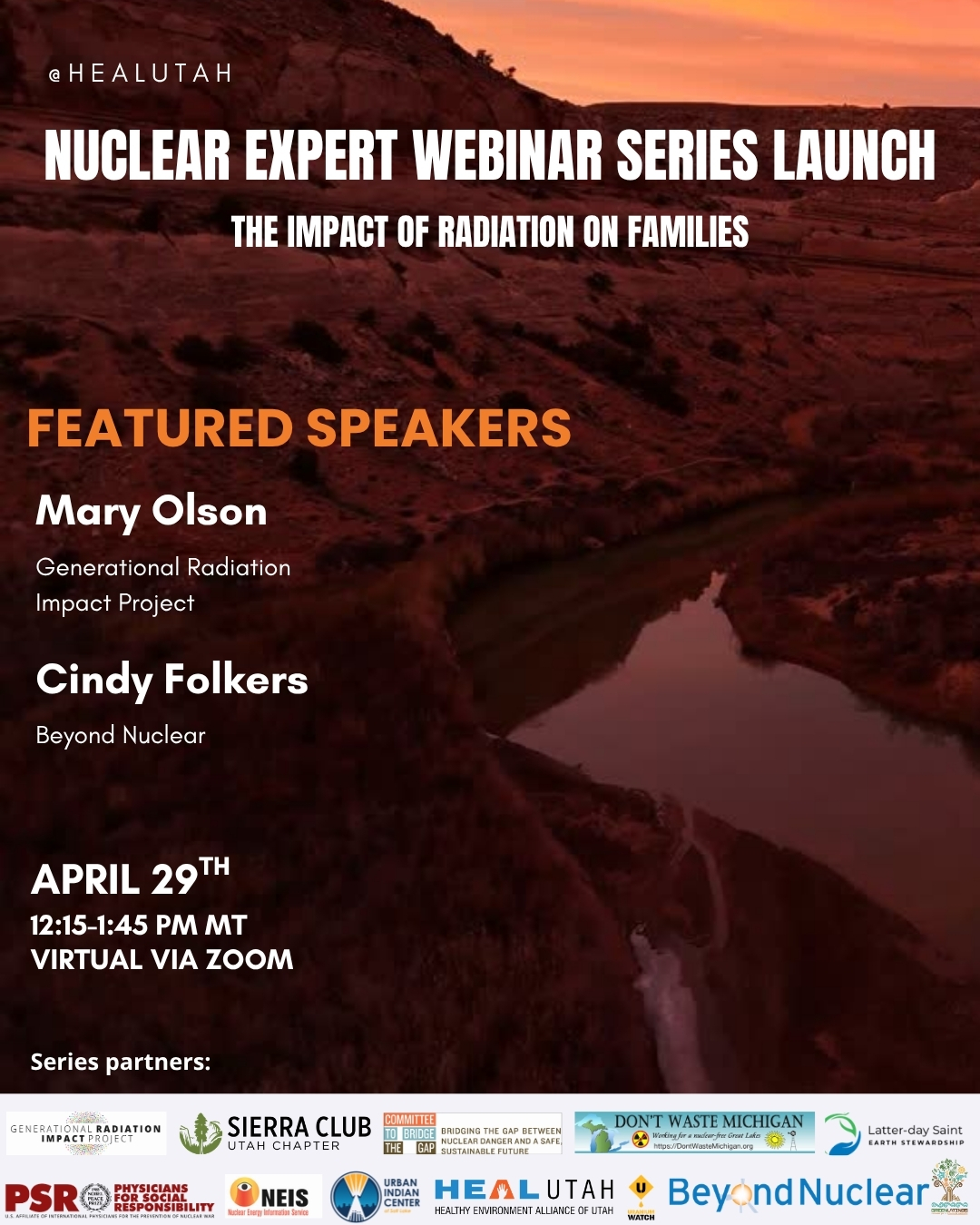
29 April – Nuclear Expert Webinar #1 – Radiation Impacts on Families with Mary Olson and Cindy Folkers
- 12:15 PM MT – 1:45 PM MT
- Location: Virtual – REGISTER TODAY

4 May -West Suburban Peace Coalition to discuss Iran war at May Educational Forum
Monday, May 4, 7:00 – 8:00 PM Central Standard Time
Title: : How Trump’s Narrative Tries to Shape the Reality of the War on Iran.
Contact Walt Zlotow, zlotow@hotmail.com 630 442 3045 for further information
14 May – online event From Bombs to Data Centres: the Face of Nuclear Colonialism

Pine Ridge Uranium is the real threat, not Tehran- Tell Burgum: Stop the Extraction.
Chernobyl: The Lost Tapes – A good documentary on Chernobyl on SBS available On Demand for the next 3 weeks– https://www.sbs.com.au/ondemand/tv-program/chernobyl-the-lost-tapes/2352741955560
To see nuclear-related stories in greater depth and intensity – go to https://nuclearinformation.wordpress.com
-
Archives
- April 2026 (288)
- March 2026 (251)
- February 2026 (268)
- January 2026 (308)
- December 2025 (358)
- November 2025 (359)
- October 2025 (376)
- September 2025 (257)
- August 2025 (319)
- July 2025 (230)
- June 2025 (348)
- May 2025 (261)
-
Categories
- 1
- 1 NUCLEAR ISSUES
- business and costs
- climate change
- culture and arts
- ENERGY
- environment
- health
- history
- indigenous issues
- Legal
- marketing of nuclear
- media
- opposition to nuclear
- PERSONAL STORIES
- politics
- politics international
- Religion and ethics
- safety
- secrets,lies and civil liberties
- spinbuster
- technology
- Uranium
- wastes
- weapons and war
- Women
- 2 WORLD
- ACTION
- AFRICA
- Atrocities
- AUSTRALIA
- Christina's notes
- Christina's themes
- culture and arts
- Events
- Fuk 2022
- Fuk 2023
- Fukushima 2017
- Fukushima 2018
- fukushima 2019
- Fukushima 2020
- Fukushima 2021
- general
- global warming
- Humour (God we need it)
- Nuclear
- RARE EARTHS
- Reference
- resources – print
- Resources -audiovicual
- Weekly Newsletter
- World
- World Nuclear
- YouTube
-
RSS
Entries RSS
Comments RSS
 nuclear-news