French Environment Minister asks EDF to conduct audit on nuclear power availability, following safety shutdowns
French Environment Minister Barbara Pompili asked power utility EDF
(EDF.PA) on Friday to conduct an audit on the availability of its nuclear
power stations after the company shut down some of its reactors due to
technical problems. EDF, whose reactors provide up to 70% of the country’s
electricity needs, said on Wednesday it found faults at a nuclear power
station and shut down another plant using the same kind of reactors.
Reuters 17th Dec 2021
German experts argue that high costs, delays and toxic wastes mean that money for nuclear power would be better spent elsewhere
From CNN 19 Dec 21, ……..German politicians and experts argue that high costs and the time it takes to build new plants — no fewer than five years, and often much longer — mean money would be better spent elsewhere.
German politicians and experts argue that high costs and the time it takes to build new plants — no fewer than five years, and often much longer — mean money would be better spent elsewhere.
German officials also argue that the lack of a global plan for storing toxic waste should disqualify nuclear as a “sustainable” energy source.Christoph Hamann, an official at Germany’s federal office for nuclear waste management, emphasized that government efforts to construct sites below ground where waste can be stored indefinitely remain a work-in-progress.”We’re talking about a very toxic, high radioactive waste, which is producing problems for the next tens of thousands, or even hundreds of thousands of years. And we’re directing this problem, when using nuclear power, to future generations,” Hamann said………..
USA govt moves towards getting an interim storage for nuclear wastes
The feds have collected more than $44 billion for a permanent nuclear waste dump — here’s why we still don’t have one, CNBC, DEC 18 2021 KEY POINTS
- The federal government has more than $44 billion collected from energy customers since the 1980s specifically to be spent on a permanent nuclear waste disposal in the United States.
- Currently, nuclear waste is mostly stored in dry casks on the locations of current and former nuclear power plants around the country.
- On Nov. 30, the Office of Nuclear Energy at the U.S. Department of Energy took a preliminary step towards establishing an interim repository for nuclear waste. Some see this as a reason for optimism, others as kicking the can down the road.
The federal government has a fund of $44.3 billion earmarked for spending on a permanent nuclear waste disposal facility in the United States.
It began collecting money from energy customers for the fund in the 1980s, and the money is now earning about $1.4 billion in interest each year.
But plans to build a site in Yucca Mountain, Nevada, were scuttled by state and federal politics, and there’s been a lack of political will to find other solutions. The result is that the U.S. does not have the infrastructure to dispose of radioactive nuclear waste in a deep geologic repository, where it can slowly lose its radioactivity over the course of thousands of years without causing harm………………………………………….
After 2014, the federal government was forced to stop collecting money for the Nuclear Waste Fund because of a legal ruling. Owners and operators of nuclear power plants had challenged Department of Energy’s collection of fees, arguing that ratepayers should not be paying into a fund when the United States had no viable options for where the used fuel permanent disposal should go.
Amid all the stops and starts, the money in the Nuclear Waste Fund has been put back into the general fund and is being used for other purposes, Frank Rusco of the Government Accountability Office says. To use the funds for their original purpose would require new authorization and appropriation by Congress, he said.
“This will potentially cause a difficulty in getting a repository built,” Rusco said.
Since the federal government has not established a permanent repository for its radioactive nuclear waste, it’s had to pay utility companies to store it themselves. Currently, nuclear waste is mostly stored in dry casks on the locations of current and former nuclear power plants around the country. So far, the system is working, and in 2014, the Nuclear Regulatory Commission (NRC), the lead oversight body for the industry, has said that current storage technology would be sufficient for 100 years……………………
As of Sept. 30, the government has paid $9 billion to utility companies for their interim storage costs and the Department of Energy’s Agency Finance Report estimates it will cost another $30.9 billion until a permanent waste disposal option is completed in the United States.
hat estimate could prove to be low, Rusco said.
However, the tide may be turning back toward finding longer-term solutions.
On Nov. 30, the Office of Nuclear Energy at the U.S. Department of Energy put out a formal “request for information” for a temporary, but consolidated, nuclear waste storage in the U.S.
Unlike a permanent storage facility, which involves digging deep into the ground, a temporary facility would simply keep all the dry casks together in one place, as opposed to distributed around the country. In some cases, the local nuclear plants have been completely disassembled — but the waste is still stored on site. Consolidating it would at least save on costs.
Nuclear power is never safe or economical
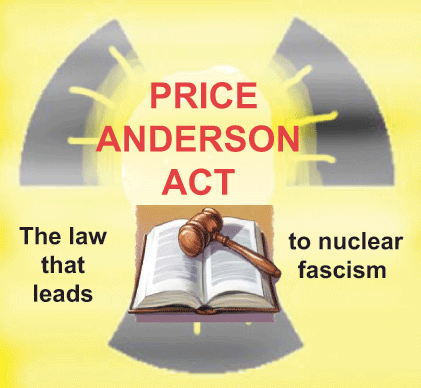
Nuclear power is never safe or economical
I hope Sen. Durbin changes his mind about promoting nuclear energy. The real carbon-free sources of electricity are wind and solar. Chicago Sun Times George Milkowski, West Ridge Nov 27, 2021 ”’
……….. When nuclear power plants were first touted in the 1950s as a new and safe method for producing electricity, it was said the electricity would be “too cheap to meter.” This is pure nonsense! If it was so safe, why weren’t any power plants built and put on line until passage of the Price-Anderson Act? The law has been amended a number of times and greatly limits the liability of operators of nuclear power plants.
Anything paid out beyond the limits set in Price-Anderson would take years of lawsuits.
Sen. Durbin wrote “It is past time for Congress to step up and develop a comprehensive, consent-based plan to store nuclear waste.” That’s an understatement. Nuclear waste is stored within a half-mile of Lake Michigan at the now-closed Zion nuclear power plant. Why is it close to the source of our drinking water? Because there is nowhere to ship it! Plans to ship such waste to a depository in Yucca Mountain in the southwest fell through when some improperly stored barrels burst into flames, releasing large amounts of high-level radioactive material.
Who does the senator think will agree to a “consent-based plan” when there is no known method of safely storing these dangerous materials for thousands of years, the time it takes for radioactive decay to make it safe for the environment?
Sen. Durbin argued that “we must ensure the nuclear fleet remains safe and economical,” but nuclear power has never been economical. As far as I know, the last time a permit was approved for a new nuclear plant was during the Obama administration. That plant in Georgia is only about half complete, although it was to be finished by now and the cost is already double the initial estimate.
The current “fleet,” as Sen. Durbin called them, of nuclear power plants were designed and engineered to last about 30 to 40 years. Most of our country’s plants are near that age. Their internal systems are constantly bombarded by radioactive particles, making the metal in the systems more brittle and prone to failure every year. Subsidizing them is a waste of taxpayer money and a dangerous gamble with our lives.
I hope Sen. Durbin changes his mind. The real carbon-free sources of electricity are renewables: wind and solar.
The climate change impact of Manchin’s “no” on Biden plan
The climate change impact of Manchin’s “no” on Biden plan
Senator Joe Manchin’s (D-W.Va.) decision Sunday to oppose President Biden’s signature climate and social policy legislation imperils the administration’s climate goals.
Humanity should not test whether Antarctica’s ice will hold out
Humanity should not test whether Antarctica’s ice will hold out
Washington Post editorial
Humanity should not test whether unrestrained warming will catastrophically reshape the world’s coastlines. As is the case with so many other potential climate consequences, allowing this gamble to play out is not worth the risk.
PFAS ‘forever chemicals’ constantly cycle through ground, air and water, study finds
PFAS ‘forever chemicals’ constantly cycle through ground, air and water, study finds
The Stockholm University study highlights the chemicals’ mobility, which has been found in penguin eggs and polar bears
Understanding cobalt’s human cost
Understanding cobalt’s human cost
After studying the impacts of mining cobalt — a common ingredient in lithium-ion batteries — on communities in Africa’s Democratic Republic of the Congo (DRC), an interdisciplinary team of researchers led by Northwestern University is calling for more data into how emerging technologies affect human health and livelihoods.
Heysham 2 nuclear power station to close earlier than planned
Heysham 2 nuclear power station will continue generating electricity
safely until 2028, however, “closing” two years earlier than originally
planned. In 2016, the sites’ operational lives were extended by seven
years to 2030. Operational dates are under constant review and since then
inspection, modelling and operational experience from other sites, have
given EDF a clearer picture of lifetime expectations for the AGR fleet as
the stations age. Heysham 1 will operate until 2024,
Lancaster Guardian 17th Dec 2021
Energy economics – getting the fuel -oil and nuclear -for continued expansion of capitalism – is costing more all the time
Dave Elliott: n an interesting article in the Ecologist, Gareth Dale
argues that the rising cost of plundering nature presents major problems
for the continued expansion of capitalism.
For example, he says the ‘energy return on energy invested’ (EROI) for fossil-fuel extraction is
plummeting: ‘In plain English, ever more energy is consumed in squeezing
each drop of oil from the bowels of the earth’. He notes that a recent
study has found that, at present, over 15% of the oil extracted was being
use to extract more oil and that this will rise as easily accessed reserves
deplete.
It’s the same for nuclear – as high grade ore reserves
deplete, the energy cost of mining/processing uranium rise, with EROI
ratios falling from 15:1 as now, to maybe 5:1 or less over time. Meantime
the EROIs for renewables are mostly higher and improving- e.g. solar was
poor in the early days, but is now at around 25:1, wind is around 50:1 on
good sites, and may get to 80:1 offshore, hydro is at around 200:1.
Renew Extra 18th Dec 2021
https://renewextraweekly.blogspot.com/2021/12/energy-resource-limits.html
French President says discussions continue with Germany about nuclear power as ”green”
French President Emmanuel Macron said on Thursday France and Germany would
continue discussions in the coming days to find a compromise on whether the
European Union should label nuclear and gas as green investments. France
wants to be able to attract green finance to fund the construction of new
nuclear power plants in France, while Germany is phasing out nuclear and
keen on switching to gas — a fossil fuel. Macron said in a joint news
conference with his German counterpart Olaf Scholz that a decision on the
subject, the so-called green taxonomy, would soon be issued by the European
Commission.
Reuters 17th Dec 2021
Japan’s Fukushima water set to be dumped as critics attack ‘flawed’ Tepco report
. Fukushima Dai-ichi nuclear plant’s operator says its move to dispose some 1.23 million tons of treated radioactive water will have ‘minimal’ impact on public health
. But Greenpeace says Tepco’s scientific analysis is lacking in multiple areas, including an assessment of how the water will affect the wider Asia-Pacific region

16 Dec, 2021
The operator of the crippled Fukushima Dai-ichi nuclear power plant has this week commenced test drilling for pipes to release more than 1.23 million tons of treated radioactive water into the Pacific Ocean, the work coinciding with a study by an environmental group accusing Tokyo Electric Power Co (Tepco) of using “flawed” scientific analysis to justify the release.
Tepco on Tuesday started a boring survey at the nuclear plant, which was destroyed in the March 2011 earthquake and the massive tsunami it triggered, causing the meltdown of three of the six reactors at the site and the second-worst nuclear disaster in history.
With the backing of the government, Tepco intends to lay a pipeline to a location about 700 metres offshore and start to release treated water into the ocean from the spring of 2023.

The company claims that virtually all trace of the 64 radionuclides will be eliminated before the release of the water, which is used to keep the damaged reactors cool, but critics point out that no independent organisations had been permitted to test radiation levels in the water in the more than 10 years since the disaster.
Tepco on November 17 released a study that concluded the effects of the release of the water “on the public and the environment is minimal as calculated doses were significantly less than the dose limits, dose targets and the values specified by international organisations”.
On Thursday, Greenpeace released a study that took issue with the findings in Tepco’s report, saying its own radiological impact assessment “found many flaws in the approach and with their conclusions”.
The firm “does not apply the basic principles of radiation protection, which requires even low-level increases in radiation risks to be justified and demonstrate net benefits to society”, Greenpeace’s report said, while Tepco had also failed to take into account the existing radiation exposure of the local population as a result of the original disaster in its conclusions.
Tepco also ignored cumulative effects of exposure to elevated levels of radiation, as well as the long-term effects on marine ecology, species and food chains, the Greenpeace study found.
The Tepco report also failed to take into account future hazards at the plant due to “its fundamentally flawed decommissioning plan”, while the assessment of the impact of the radiation was “extremely limited” and failed to include the impact on the wider east coast of Japan or further afield in the Pacific.
The plan to discharge the water violates the United Nations Convention on the Law of the Sea, Greenpeace said, adding that Tepco continued to ignore alternative solutions to the problem of contaminated water at the site, including long-term storage.
“The Tepco document is flawed in its scientific analysis and disregard for basic international norms of radiation protection,” said Shaun Burnie, senior nuclear specialist with Greenpeace East Asia.
“It is wholly inadequate, legally takes no account of wider impacts, including to the Asia-Pacific region, and in no way provides justification to deliberately discharge radioactivity into the Pacific Ocean over at least 30 years,” he said. “Opposition, including by small Pacific island nations, continues. Tepco’s discharge plans can be stopped.”
In a statement, a Tepco official declined to comment directly on the Greenpeace report, but said the company would continue to seek the approval of the Nuclear Regulation Authority for the planned release of the water.
Tepco says an additional 210 tons of water builds up at the site every day and argues it is running out of space close to the reactors, and that another natural disaster could rupture the hundreds of tanks containing the contaminated water, causing a new environmental crisis.
The plant operator is pushing ahead with the plan in spite of criticism from home and abroad.
Fishermen and farmers in eastern Japan have expressed their anger, claiming it will further damage the reputation of their industries and ruin their livelihoods, while people living in coastal areas are similarly concerned at the possible impact on their health.
The work is taking place at the same time the Japanese government is calling on countries around the world to lift restrictions on imports of foodstuffs from northeast Japan as there is no evidence they pose any danger to the health of consumers.
A number of governments in the region, including Hong Kong, South Korea and China, have also expressed deep reservations about the proposal to dump the contaminated water into the Pacific. South Korea has already indicated it is planning to take legal action against the move and the case may be joined by other nations.
Why Nuclear Power Is Bad for Your Wallet and the Climate
Fashionably rebranded “Small Modular” or “Advanced” reactors can’t change the outcome. Their smaller units cost less but output falls even more, so SMRs save money only in the sense in which a smaller helping of foie gras helps you lose weight.
They’ll initially at least double existing reactors’ cost per kWh; that cost is ~3–13x renewables’ (let alone efficiency’s); and renewables’ costs will halve again before SMRs can scale. Do the math: 2 x (3 to 13) x 2 = 12–52-fold. Mass production can’t bridge that huge cost gap—nor could SMRs scale before renewables have decarbonized the US grid.
Even free reactors couldn’t compete: their non-nuclear parts cost too much. Small Modular Renewables are decades ahead in exploiting mass-production economies; nuclear can never catch up. It’s not just too little, too late: nuclear hogs market space, jams grid capacity, and diverts investments that more-climate-effective carbon-free competitors then can’t contest.
Why Nuclear Power Is Bad for Your Wallet and the Climate, https://news.bloomberglaw.com/environment-and-energy/why-nuclear-power-is-bad-for-your-wallet-and-the-climate, 17 Dec 21, Amory B. Lovins, Stanford University
As Congress and the Department of Energy pile new subsidies on nuclear power and the Nuclear Regulatory Commission seeks to gut its regulation, its marginal output additions have shrunk below 0.5% of the world market, says physicist Amory B. Lovins, adjunct professor of civil and environmental engineering at Stanford University. He explains why nuclear energy is not the answer to climate change, but actually worsens it due to climate opportunity cost.
Does climate protection need more nuclear power? No—just the opposite. Saving the most carbon per dollar and per year requires not just generators that burn no fossil fuel, but also those deployable with the least cost and time. Those aren’t nuclear.
Making 10% of world and 20% of U.S. commercial electricity, nuclear power is historically significant but now stagnant. In 2020, its global capacity additions minus retirements totaled only 0.4 GW (billion watts). Renewables in contrast added 278.3 GW—782x more capacity—able to produce about 232x more annual electricity (based on U.S. 2020 performance by technology). Renewables swelled supply and displaced carbon as much every 38 hours as nuclear did all year. As of early December, 2021’s score looks like nuclear –3 GW, renewables +290 GW. Game over.
The world already invests annually $0.3 trillion each, mostly voluntary private capital, in energy efficiency and renewables, but about $0.015–0.03 trillion, or 20–40x less, in nuclear—mostly conscripted, because investors got burned. Of 259 US power reactors ordered (1955–2016), only 112 got built and 93 remain operable; by mid-2017, just 28 stayed competitive and suffered no year-plus outage. In the oil business, that’s called an 89% dry-hole risk.
Renewables provided all global electricity growth in 2020. Nuclear power struggles to sustain its miniscule marginal share as its vendors, culture, and prospects shrivel. World reactors average 31 years old, in the U.S., 41. Within a few years, old and uneconomic reactors’ retirements will consistently eclipse additions, tipping output into permanent decline. World nuclear capacity already fell in five of the past 12 years for a 2% net drop. Performance has become erratic: the average French reactor in 2020 produced nothing one-third of the time.
China accounts for most current and projected nuclear growth. Yet China’s 2020 renewable investments about matched its cumulative 2008–20 nuclear investments. Together, in 2020 in China, sun and wind generated twice nuclear’s output, adding 60x more capacity and 6x more output at 2–3 times lower forward cost per kWh. Sun and wind are now the cheapest bulk power source for over 91% of world electricity
Nuclear Power Has No Business Case
Nuclear power has bleak prospects because it has no business case. New plants cost 3–8x or 5–13x more per kWh than unsubsidized new solar or windpower, so new nuclear power produces 3–13x fewer kWh per dollar and therefore displaces 3–13x less carbon per dollar than new renewables. Thus buying nuclear makes climate change worse. End-use efficiency is even cheaper than renewables, hence even more climate-effective. Arithmetic is not an opinion.
Unsubsidized efficiency or renewables even beat most existing reactors’ operating cost, so a dozen have closed over the past decade. Congress is trying to rescue the others with a $6 billion lifeline and durable, generous new operating subsidies to replace or augment state largesse—adding to existing federal subsidies that rival or exceed nuclear construction costs.
But no business case means no climate case. Propping up obsolete assets so they don’t exit the market blocks more climate-effective replacements—efficiency and renewables that save even more carbon per dollar. Supporters of new subsidies for the sake of the climate just got played.
Continue readingEuropean Union’s rift over nuclear power

EU faces nuclear rift in decision on energy funds, future, Ravalli Republic, By SAMUEL PETREQUIN and RAF CASERT – Associated Press By SAMUEL PETREQUIN and RAF CASERT -17 Dec 21,
BRUSSELS (AP) — The leaders of the European Union’s two most important nations faced reporters together during a joint news conference early Friday, a show of unity at the end of the EU’s final summit of the year.
Then two words – “nuclear energy” – intervened.
Heading into the Christmas week, atomic power is a topic on which France and Germany broadly differ, and one that has become a big thorn in the side of the EU as the 27-nation bloc decides whether to include nuclear-generated energy among the economic activities that qualify for sustainable investment.
German Chancellor Olaf Scholz, who took office last week, and French President Emmanuel Macron agreed on most of the issues tackled during Thursday’s summit, including Ukraine-Russia tensions and an immigration dispute with Belarus.
On the the sustainable investment rules, however, the two leaders have yet to reach a compromise. The rift over nuclear energy was enough to scuttle any agreement on energy prices during the summit.
A big rise in energy prices has reignited the debate about whether the EU should promote nuclear power projects as a way of becoming greener and more energy independent.
France has asked for nuclear power to be included in the so-called “taxonomy” by the end of the year, leading the charge with several other EU countries that operate nuclear power plants.
The group initially faced strong opposition from Germany and other members that wanted nuclear power to be ineligible for green financing, but Scholz adopted a peacebuilding tone in the summit’s final hours early Friday.
“We are talking about countries with different business models. It’s important that each EU country can pursue its own approach without Europe becoming disunited,” Scholz said. “At the end of the day, we will have to come together despite the different priorities we may have set.”
Germany’s remaining nuclear power plants are due to go offline next year. France derives about 70% of its electricity from nuclear energy……………..
making future nuclear power projects eligible for billions in euros available as part of the European Green Deal while avoiding “greenwashing” remains a controversial issue.
…….. “The lack of agreement shows how lively this is, not only in our country, but throughout Europe,” Belgian Prime Minister Alexander De Croo, who faces a domestic crisis over how to phase out nuclear plants and still maintain energy security to his citizens.
De Croo suggested that amid the energy price crunch, nuclear energy and gas could be temporarily eligible for funds……..
The ball is now with the EU’s chief, European Commission President Ursula von der Leyen. She is expected to present before the end of the year the list of activities eligible for the green investment funds and must decide whether nuclear energy and natural gas make the cut.
Von der Leyen has been under pressure from environmental groups and Green European lawmakers to resist the inclusion of both.
“Fossil gas and nuclear power have no place in the EU taxonomy” for sustainable activities, said Sven Giegold, a Green lawmaker in the European Parliament……. https://ravallirepublic.com/lifestyles/technology/eu-faces-nuclear-rift-in-decision-on-energy-funds-future/article_9d325652-1272-5667-8c6b-1654e065aa61.html
1 This Month
26 April – Chernobyl: Inside the Meltdown airs on National Geographic on Sunday 26th April from 4pm

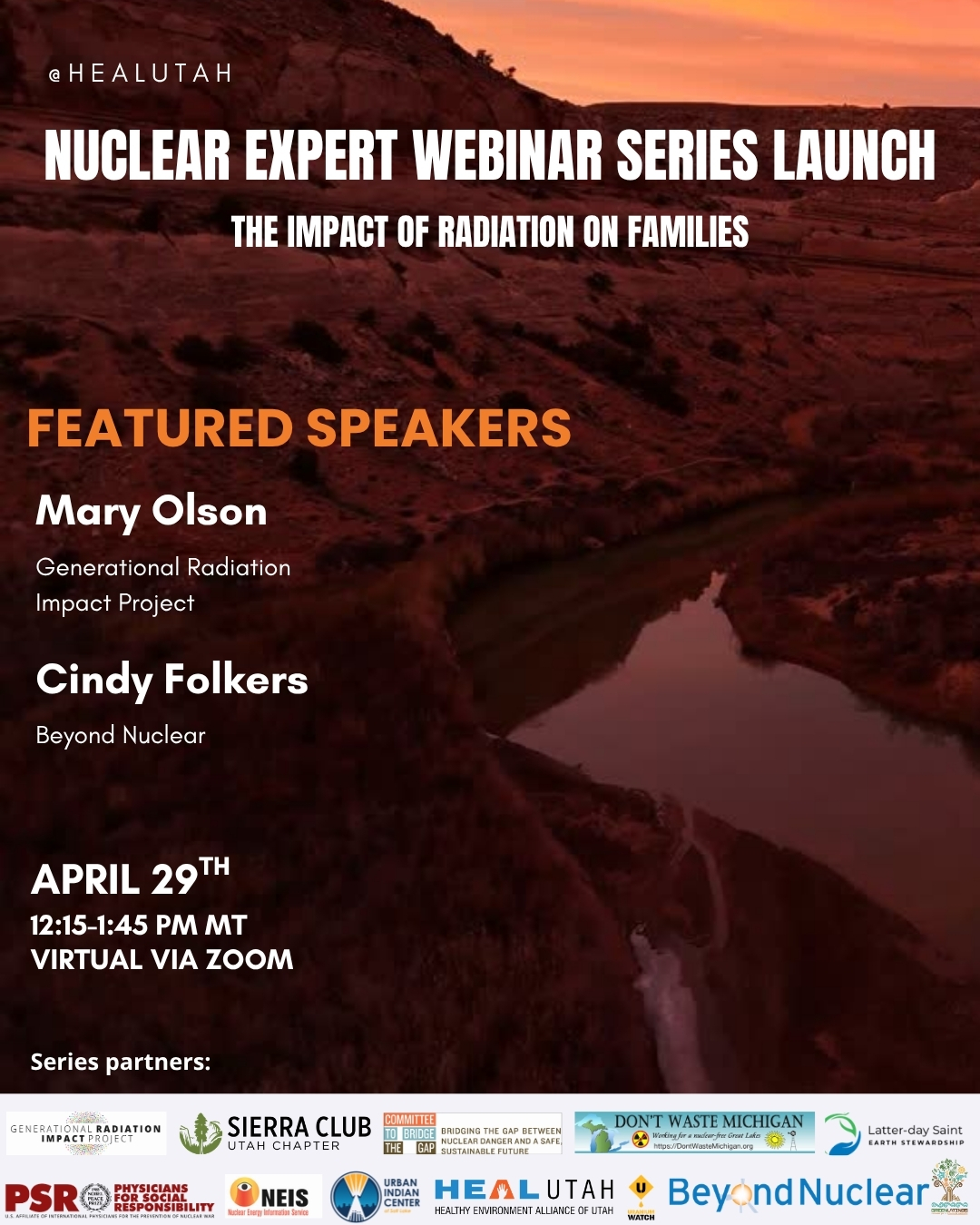
29 April – Nuclear Expert Webinar #1 – Radiation Impacts on Families with Mary Olson and Cindy Folkers
- 12:15 PM MT – 1:45 PM MT
- Location: Virtual – REGISTER TODAY

4 May -West Suburban Peace Coalition to discuss Iran war at May Educational Forum
Monday, May 4, 7:00 – 8:00 PM Central Standard Time
Title: : How Trump’s Narrative Tries to Shape the Reality of the War on Iran.
Contact Walt Zlotow, zlotow@hotmail.com 630 442 3045 for further information
14 May – online event From Bombs to Data Centres: the Face of Nuclear Colonialism

Pine Ridge Uranium is the real threat, not Tehran- Tell Burgum: Stop the Extraction.
Chernobyl: The Lost Tapes – A good documentary on Chernobyl on SBS available On Demand for the next 3 weeks– https://www.sbs.com.au/ondemand/tv-program/chernobyl-the-lost-tapes/2352741955560
To see nuclear-related stories in greater depth and intensity – go to https://nuclearinformation.wordpress.com
-
Archives
- April 2026 (288)
- March 2026 (251)
- February 2026 (268)
- January 2026 (308)
- December 2025 (358)
- November 2025 (359)
- October 2025 (376)
- September 2025 (257)
- August 2025 (319)
- July 2025 (230)
- June 2025 (348)
- May 2025 (261)
-
Categories
- 1
- 1 NUCLEAR ISSUES
- business and costs
- climate change
- culture and arts
- ENERGY
- environment
- health
- history
- indigenous issues
- Legal
- marketing of nuclear
- media
- opposition to nuclear
- PERSONAL STORIES
- politics
- politics international
- Religion and ethics
- safety
- secrets,lies and civil liberties
- spinbuster
- technology
- Uranium
- wastes
- weapons and war
- Women
- 2 WORLD
- ACTION
- AFRICA
- Atrocities
- AUSTRALIA
- Christina's notes
- Christina's themes
- culture and arts
- Events
- Fuk 2022
- Fuk 2023
- Fukushima 2017
- Fukushima 2018
- fukushima 2019
- Fukushima 2020
- Fukushima 2021
- general
- global warming
- Humour (God we need it)
- Nuclear
- RARE EARTHS
- Reference
- resources – print
- Resources -audiovicual
- Weekly Newsletter
- World
- World Nuclear
- YouTube
-
RSS
Entries RSS
Comments RSS
 nuclear-news